


Saint Sofia Palace, Mdina
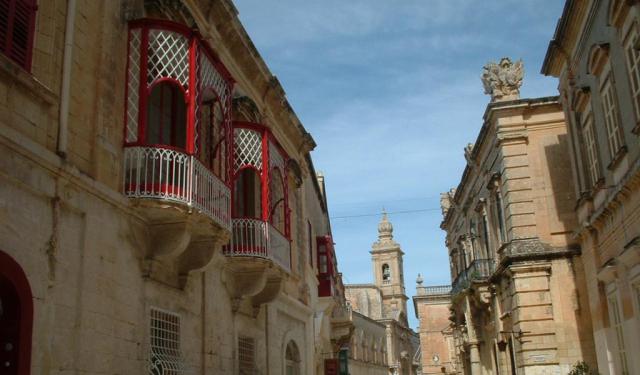
Saint Sofia Palace is one of Mdina’s most historically and architecturally significant residences. The palace’s ground floor dates from 1233, a date proudly inscribed on the moulding of one of its windows. The upper floor, by contrast, is a much more recent addition, built in the 20th century sometime after 1938. Over the centuries, the palace has served various purposes and was, for a time, rented and used as a school by Roman Catholic nuns.
Today, Saint Sofia Palace is privately owned and is not generally open to the public. However, the property can occasionally be hired for private functions, including dinners, cocktail parties, lectures and other special events.
The original palace consisted of a single-storey structure arranged around a central courtyard. Its main entrance was through an arched passageway known as a siqifah, which led into the courtyard. Over time, this passageway developed into the narrow Saint Sofia Street. The ground-floor façade is relatively simple, with two doorways flanking the former passageway. Look for the distinctive two-tiered palline losanghe cornice, which marks the division between the medieval ground floor and the later upper storey.
The upper floor features four ornate mullioned windows, adding considerably more decoration to the otherwise restrained façade. At roof level, another palline losanghe cornice provides an additional decorative flourish. Several coats of arms can also be seen across the façade, reflecting the palace’s long history and associations with prominent families.
Although its interior is usually inaccessible, Saint Sofia Palace is well worth admiring from the street, particularly for the striking contrast between its medieval ground floor and much later upper storey.
Today, Saint Sofia Palace is privately owned and is not generally open to the public. However, the property can occasionally be hired for private functions, including dinners, cocktail parties, lectures and other special events.
The original palace consisted of a single-storey structure arranged around a central courtyard. Its main entrance was through an arched passageway known as a siqifah, which led into the courtyard. Over time, this passageway developed into the narrow Saint Sofia Street. The ground-floor façade is relatively simple, with two doorways flanking the former passageway. Look for the distinctive two-tiered palline losanghe cornice, which marks the division between the medieval ground floor and the later upper storey.
The upper floor features four ornate mullioned windows, adding considerably more decoration to the otherwise restrained façade. At roof level, another palline losanghe cornice provides an additional decorative flourish. Several coats of arms can also be seen across the façade, reflecting the palace’s long history and associations with prominent families.
Although its interior is usually inaccessible, Saint Sofia Palace is well worth admiring from the street, particularly for the striking contrast between its medieval ground floor and much later upper storey.
Want to visit this sight? Check out these Self-Guided Walking Tours in Mdina. Alternatively, you can download the mobile app "GPSmyCity: Walks in 1K+ Cities" from Apple App Store or Google Play Store. The app turns your mobile device to a personal tour guide and it works offline, so no data plan is needed when traveling abroad.
Download The GPSmyCity App



Saint Sofia Palace on Map
Sight Name: Saint Sofia Palace
Sight Location: Mdina, Malta (See walking tours in Mdina)
Sight Type: Attraction/Landmark
Guide(s) Containing This Sight:
Sight Location: Mdina, Malta (See walking tours in Mdina)
Sight Type: Attraction/Landmark
Guide(s) Containing This Sight:
Nearby Sights





Walking Tours in Mdina, Malta

Create Your Own Walk in Mdina
Creating your own self-guided walk in Mdina is easy and fun. Choose the city attractions that you want to see and a walk route map will be created just for you. You can even set your hotel as the start point of the walk.
Mdina Introduction Walking Tour
A picturesque walled city in the heart of Malta, Mdina is a true gem of the Mediterranean, perched atop a hill overlooking much of the country.
Mdina’s history spans almost 3,000 years, making it one of Europe’s oldest continuously inhabited cities. Originally settled by the Phoenicians around the 8th century BC, it has been inhabited by various civilisations, including the Romans,... view more
Tour Duration: 2 Hours
Travel Distance: 0.8 Km or 0.5 Miles
Mdina’s history spans almost 3,000 years, making it one of Europe’s oldest continuously inhabited cities. Originally settled by the Phoenicians around the 8th century BC, it has been inhabited by various civilisations, including the Romans,... view more
Tour Duration: 2 Hours
Travel Distance: 0.8 Km or 0.5 Miles
Rabat Walking Tour
In ancient times, the city of Melite, the precursor of present-day Mdina and Rabat, was considerably larger than Mdina is today. During the period of Arab rule in Malta, the settlement was reduced in size and divided into two distinct areas: the fortified city of Mdina and the suburb that developed outside its walls.
Rabat’s name derives directly from the Arabic word for “suburb” or... view more
Tour Duration: 1 Hour
Travel Distance: 0.6 Km or 0.4 Miles
Rabat’s name derives directly from the Arabic word for “suburb” or... view more
Tour Duration: 1 Hour
Travel Distance: 0.6 Km or 0.4 Miles