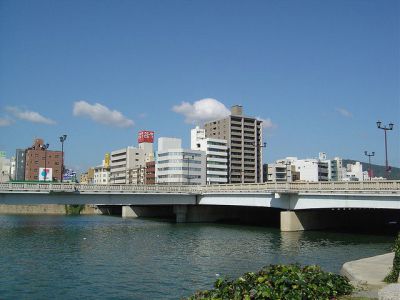


The "Aioi" T-Bridge, Hiroshima
The Aioi Bridge in Hiroshima is a noteworthy T-shaped three-way bridge that spans the Honkawa and Motoyasu rivers. Constructed in 1932, originally to accommodate street cars, the bridge's unique configuration and its central location made it a critical landmark in the city's urban layout. Its distinct shape provided a clear target from the air during World War II, which led to its selection as the aiming point for the atomic bomb dropped by the Enola Gay in 1945.
Although intended to be the bomb's direct target, the Aioi Bridge was missed by approximately 800 feet; however, it still suffered significant damage from the near miss. Eyewitness accounts from survivors describe the bridge being momentarily lifted several meters into the air by the blast before settling back onto its foundations. Remarkably, the bridge remained standing and continued to be in use.
The bridge served the city for nearly four decades after the war until it was eventually deemed necessary to replace it. In 1983, a new bridge was constructed as a replica of the original. This was done not only to preserve the functional integrity of the structure but also as a tribute to its historical significance. Parts of the original bridge, including a floor girder, were preserved and donated to the Hiroshima Peace Memorial Museum as a reminder of its resilience and the historical events tied to it.
Today, the Aioi Bridge plays an integral role in Hiroshima's landscape, linking the main city area to the Nakajima-cho district on the northern side of the Ōta River. It also serves as the northern gateway to the Hiroshima Peace Memorial Park, marking a point of convergence for history, memory, and the daily life of Hiroshima's residents. The bridge remains a poignant symbol of the past and a resilient beacon of peace.
Although intended to be the bomb's direct target, the Aioi Bridge was missed by approximately 800 feet; however, it still suffered significant damage from the near miss. Eyewitness accounts from survivors describe the bridge being momentarily lifted several meters into the air by the blast before settling back onto its foundations. Remarkably, the bridge remained standing and continued to be in use.
The bridge served the city for nearly four decades after the war until it was eventually deemed necessary to replace it. In 1983, a new bridge was constructed as a replica of the original. This was done not only to preserve the functional integrity of the structure but also as a tribute to its historical significance. Parts of the original bridge, including a floor girder, were preserved and donated to the Hiroshima Peace Memorial Museum as a reminder of its resilience and the historical events tied to it.
Today, the Aioi Bridge plays an integral role in Hiroshima's landscape, linking the main city area to the Nakajima-cho district on the northern side of the Ōta River. It also serves as the northern gateway to the Hiroshima Peace Memorial Park, marking a point of convergence for history, memory, and the daily life of Hiroshima's residents. The bridge remains a poignant symbol of the past and a resilient beacon of peace.
Want to visit this sight? Check out these Self-Guided Walking Tours in Hiroshima. Alternatively, you can download the mobile app "GPSmyCity: Walks in 1K+ Cities" from Apple App Store or Google Play Store. The app turns your mobile device to a personal tour guide and it works offline, so no data plan is needed when traveling abroad.
Download The GPSmyCity App



The "Aioi" T-Bridge on Map
Sight Name: The "Aioi" T-Bridge
Sight Location: Hiroshima, Japan (See walking tours in Hiroshima)
Sight Type: Attraction/Landmark
Sight Location: Hiroshima, Japan (See walking tours in Hiroshima)
Sight Type: Attraction/Landmark
Nearby Sights
Walking Tours in Hiroshima, Japan

Create Your Own Walk in Hiroshima
Creating your own self-guided walk in Hiroshima is easy and fun. Choose the city attractions that you want to see and a walk route map will be created just for you. You can even set your hotel as the start point of the walk.
Hiroshima Peace Memorial Tour
Hiroshima Peace Memorial Park stands as a solemn testament to one of the darkest chapters in human history. It is a haunting reminder of the catastrophic consequences of nuclear warfare during the Second World War. Its grounds, marked by deeply moving memorials, bear witness to the immense suffering and loss caused by the atomic bombing of Hiroshima on August 6, 1945.
Among the most significant... view more
Tour Duration: 1 Hour
Travel Distance: 1.2 Km or 0.7 Miles
Among the most significant... view more
Tour Duration: 1 Hour
Travel Distance: 1.2 Km or 0.7 Miles
A Walk Through Hiroshima Downtown
Hiroshima is a major city in southwestern Japan, situated on the broad delta formed by the Ōta River. Its name combines the kanji hiro, meaning “wide” or “broad,” and shima, meaning “island.”
Hiroshima's history began in 1589, when the powerful feudal lord Mōri Terumoto established it as a castle town. At its center rose Hiroshima Castle, whose elegant reconstruction now... view more
Tour Duration: 2 Hours
Travel Distance: 3.8 Km or 2.4 Miles
Hiroshima's history began in 1589, when the powerful feudal lord Mōri Terumoto established it as a castle town. At its center rose Hiroshima Castle, whose elegant reconstruction now... view more
Tour Duration: 2 Hours
Travel Distance: 3.8 Km or 2.4 Miles
City Walks Overview
