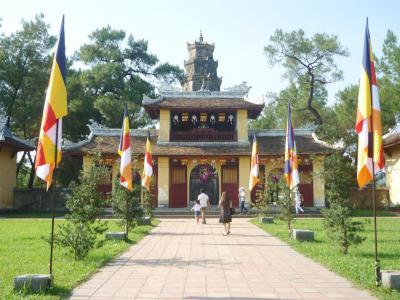


Thien Mu Pagoda, Hue (must see)
Thien Mu Pagoda, also known as the Pagoda of the Celestial Lady, is one of Hue’s most iconic and historic landmarks. Perched on Ha Khe Hill overlooking the Perfume River, it dates back to 1601 when Nguyen Hoang, the first Nguyen Lord of southern Vietnam, ordered its construction after local legends foretold the arrival of a “celestial lady” who would inspire the building of a spiritual site. The pagoda has since become a powerful symbol of Hue’s religious and cultural identity, standing as the oldest officially recognized Buddhist pagoda in the city.
The most striking feature of the complex is the seven-story Phuoc Duyen Tower, built in 1844 under Emperor Thieu Tri. Each level of the octagonal tower is dedicated to a different Buddha, and it serves as both a religious structure and a symbol of Hue itself. Nearby, visitors can find a large bell cast in 1710 and a stone stele mounted on a marble turtle-both bearing inscriptions that reflect the site’s historic significance. The surrounding gardens, shrines, and bonsai trees contribute to the serene atmosphere that makes the pagoda a popular spot for quiet reflection.
Beyond its architecture, Thien Mu has played a role in modern history. In the 1960s, it became a center of Buddhist activism during political unrest in South Vietnam. One of the most poignant artifacts is the blue Austin car used by monk Thich Quang Duc before his self-immolation in Saigon-a powerful reminder of the pagoda’s enduring influence. Today, Thien Mu remains an active monastery and a revered destination for pilgrims and tourists alike.
The most striking feature of the complex is the seven-story Phuoc Duyen Tower, built in 1844 under Emperor Thieu Tri. Each level of the octagonal tower is dedicated to a different Buddha, and it serves as both a religious structure and a symbol of Hue itself. Nearby, visitors can find a large bell cast in 1710 and a stone stele mounted on a marble turtle-both bearing inscriptions that reflect the site’s historic significance. The surrounding gardens, shrines, and bonsai trees contribute to the serene atmosphere that makes the pagoda a popular spot for quiet reflection.
Beyond its architecture, Thien Mu has played a role in modern history. In the 1960s, it became a center of Buddhist activism during political unrest in South Vietnam. One of the most poignant artifacts is the blue Austin car used by monk Thich Quang Duc before his self-immolation in Saigon-a powerful reminder of the pagoda’s enduring influence. Today, Thien Mu remains an active monastery and a revered destination for pilgrims and tourists alike.
Want to visit this sight? Check out these Self-Guided Walking Tours in Hue. Alternatively, you can download the mobile app "GPSmyCity: Walks in 1K+ Cities" from Apple App Store or Google Play Store. The app turns your mobile device to a personal tour guide and it works offline, so no data plan is needed when traveling abroad.
Download The GPSmyCity App



Thien Mu Pagoda on Map
Sight Name: Thien Mu Pagoda
Sight Location: Hue, Vietnam (See walking tours in Hue)
Sight Type: Religious
Sight Location: Hue, Vietnam (See walking tours in Hue)
Sight Type: Religious
Nearby Sights
Walking Tours in Hue, Vietnam

Create Your Own Walk in Hue
Creating your own self-guided walk in Hue is easy and fun. Choose the city attractions that you want to see and a walk route map will be created just for you. You can even set your hotel as the start point of the walk.
Imperial City Walking Tour
The Kings of the Nguyen Dynasty built their feudal capital along the fertile banks of the Perfume River, whose steady flow, centuries on, still sets up a languid pace that the rest of the city is happy to follow.
Situated within the walls of the Royal Citadel, The Imperial City in Hue is one of, if not the most prominent landmark in Vietnam, renowned for its wonderful collection of oriental... view more
Tour Duration: 2 Hours
Travel Distance: 2.9 Km or 1.8 Miles
Situated within the walls of the Royal Citadel, The Imperial City in Hue is one of, if not the most prominent landmark in Vietnam, renowned for its wonderful collection of oriental... view more
Tour Duration: 2 Hours
Travel Distance: 2.9 Km or 1.8 Miles
Hue Introduction Walking Tour
Once the seat of the imperial dynasty in the heart of Vietnam, Hue is chock-full of stories. During feudal times, for nearly 150 years - from 1802 to 1945, the city served as the national capital. The royal lifestyle and customs have had a strong impact on the lifestyle of locals, and this impact can still be felt today.
First cited about 200 BCE as the seat of the Chinese military authority in... view more
Tour Duration: 2 Hours
Travel Distance: 3.5 Km or 2.2 Miles
First cited about 200 BCE as the seat of the Chinese military authority in... view more
Tour Duration: 2 Hours
Travel Distance: 3.5 Km or 2.2 Miles
City Walks Overview
