Custom Walk in Strasbourg, France by pmness58_9e624 created on 2023-05-15
Guide Location: France » Strasbourg
Guide Type: Custom Walk
# of Sights: 6
Tour Duration: 1 Hour(s)
Travel Distance: 1.7 Km or 1.1 Miles
Share Key: PUY22
Guide Type: Custom Walk
# of Sights: 6
Tour Duration: 1 Hour(s)
Travel Distance: 1.7 Km or 1.1 Miles
Share Key: PUY22
How It Works
Please retrieve this walk in the GPSmyCity app. Once done, the app will guide you from one tour stop to the next as if you had a personal tour guide. If you created the walk on this website or come to the page via a link, please follow the instructions below to retrieve the walk in the app.
Retrieve This Walk in App
Step 1. Download the app "GPSmyCity: Walks in 1K+ Cities" on Apple App Store or Google Play Store.



Step 2. In the GPSmyCity app, download(or launch) the guide "Strasbourg Map and Walking Tours".
Step 3. Tap the menu button located at upper right corner of the "Walks" screen and select "Retrieve custom walk". Enter the share key: PUY22
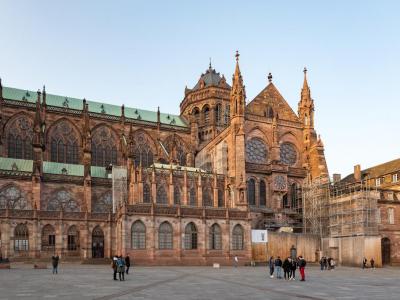
1) Cathédrale Notre-Dame de Strasbourg (Strasbourg Cathedral) (must see)
Until 1874 the Strasbourg Cathedral was the world's tallest building; today it is the 6th tallest church and its tower dominates the Strasbourg skyline.
Described by Victor Hugo as a "gigantic and delicate marvel", and by Goethe as a "sublimely towering, wide-spreading tree of God", the cathedral is visible far across the plains of Alsace and can be seen from as far off as the Vosges Mountains or the Black Forest on the other side of the Rhine. Sandstone from Vosges, used in construction, gives the cathedral its characteristic pink hue.
The building took many centuries to finish and has three distinctive styles. Its crypt, dating back to 1015, has been expanded over the centuries. The North Tower, built in 1439, stands 142 meters high and on a clear day you can see for over 30 kilometers from its observation deck. The Lawrence Portal in the North Transept was finished in 1505 in a markedly post-Gothic, early-Renaissance style.
Most of the statues in the cathedral are copies of the originals kept at the Oeuvre Notre-Dame Museum. The stunning Astronomical Clock, built in 1843 to replace an earlier clock, is 18 meters high and is one of the largest in the world.
The clock show, including a 30-minute movie presentation with English subtitles, is at 12:30 pm in the summer, but you must be there at around 11:30 am to book your entry at the back door of the Cathedral, since the places are limited. Climbing up the tower is not difficult, as long as you can manage 330 steps - and it's worth the effort!
Described by Victor Hugo as a "gigantic and delicate marvel", and by Goethe as a "sublimely towering, wide-spreading tree of God", the cathedral is visible far across the plains of Alsace and can be seen from as far off as the Vosges Mountains or the Black Forest on the other side of the Rhine. Sandstone from Vosges, used in construction, gives the cathedral its characteristic pink hue.
The building took many centuries to finish and has three distinctive styles. Its crypt, dating back to 1015, has been expanded over the centuries. The North Tower, built in 1439, stands 142 meters high and on a clear day you can see for over 30 kilometers from its observation deck. The Lawrence Portal in the North Transept was finished in 1505 in a markedly post-Gothic, early-Renaissance style.
Most of the statues in the cathedral are copies of the originals kept at the Oeuvre Notre-Dame Museum. The stunning Astronomical Clock, built in 1843 to replace an earlier clock, is 18 meters high and is one of the largest in the world.
The clock show, including a 30-minute movie presentation with English subtitles, is at 12:30 pm in the summer, but you must be there at around 11:30 am to book your entry at the back door of the Cathedral, since the places are limited. Climbing up the tower is not difficult, as long as you can manage 330 steps - and it's worth the effort!
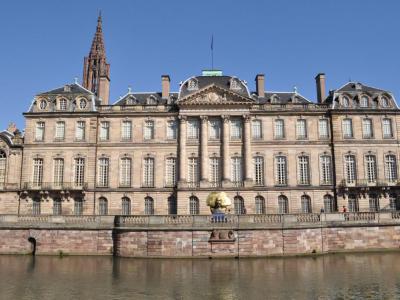
2) Palais Rohan (Rohan Palace) (must see)
Built right next to the towering Strasbourg Cathedral, Rohan Palace was used to house the prince-bishops and cardinals of the House of Rohan. Rohan was a French noble family from Brittany.
It has been considered a masterpiece of French Baroque architecture since it was finished in 1742. Many monarchs have visited the premises, including Louis XV, Marie Antoinette, Napoleon and Joséphine, and Charles X. It is one of the most important architectural and historic buildings in the city.
These days, the Palace is home to three incredible museums--the Archaeological Museum in the basement, the Museum of Decorative Arts on the ground floor, and the Museum of the Fine Arts on the second and third floors. There is also a municipal art gallery in one wing.
The Palace is still used for major diplomatic events. In 1985, American President Ronald Reagan dined in the Palace while visiting European Parliament. In 2009, US President Barack Obama met with French President Nicolas Sarkozy.
The city's Archaeological Museum is located in the basement. Many artifacts from the original collection were destroyed in the 1870 Siege of Strasbourg. The new collection has been recreated and put together since then. There is a particular focus on Argentoratum, the Roman settlement that eventually became Strasbourg.
The Museum of Decorative Arts lies above on the ground floor. The collection was established in 1887 from the collections of Kunstgewerbe-Museum Hohenlohe. Here you'll see original furnishings from the cardinal's apartments. Of special interest are locally produced porcelains and clockmaking. Parts of the original 1354 astronomical clock from the Strasbourg Cathedral are housed here and on display.
The two floors above are home to the Museum of Fine Arts. The original collection was established in 1803 but destroyed in 1870. Today you'll see a fine collection of European art spanning from the 13th to 19th centuries. Italian, Flemish, and Dutch painters are highly featured. Some highlights include Botticelli, Jacob Jordaens, and Hans Memling.
Why You Should Visit:
The Palais de Rohan is a highlight of Baroque architecture in the city. Visiting the Palace is its own history lesson, with a glimpse at how the city's aristocrats lived in luxury.
Beyond the Palace itself, visiting the three museums is worth your time. The museums span such various themes and periods that they have a little something for everyone.
Tips:
All museums share one common entrance, but once in, you can choose your destination. When you buy a ticket to one museum, you receive a discount on the subsequent admission. This setup means that you can spend less and only visit the museum or museums that interest you the most.
It has been considered a masterpiece of French Baroque architecture since it was finished in 1742. Many monarchs have visited the premises, including Louis XV, Marie Antoinette, Napoleon and Joséphine, and Charles X. It is one of the most important architectural and historic buildings in the city.
These days, the Palace is home to three incredible museums--the Archaeological Museum in the basement, the Museum of Decorative Arts on the ground floor, and the Museum of the Fine Arts on the second and third floors. There is also a municipal art gallery in one wing.
The Palace is still used for major diplomatic events. In 1985, American President Ronald Reagan dined in the Palace while visiting European Parliament. In 2009, US President Barack Obama met with French President Nicolas Sarkozy.
The city's Archaeological Museum is located in the basement. Many artifacts from the original collection were destroyed in the 1870 Siege of Strasbourg. The new collection has been recreated and put together since then. There is a particular focus on Argentoratum, the Roman settlement that eventually became Strasbourg.
The Museum of Decorative Arts lies above on the ground floor. The collection was established in 1887 from the collections of Kunstgewerbe-Museum Hohenlohe. Here you'll see original furnishings from the cardinal's apartments. Of special interest are locally produced porcelains and clockmaking. Parts of the original 1354 astronomical clock from the Strasbourg Cathedral are housed here and on display.
The two floors above are home to the Museum of Fine Arts. The original collection was established in 1803 but destroyed in 1870. Today you'll see a fine collection of European art spanning from the 13th to 19th centuries. Italian, Flemish, and Dutch painters are highly featured. Some highlights include Botticelli, Jacob Jordaens, and Hans Memling.
Why You Should Visit:
The Palais de Rohan is a highlight of Baroque architecture in the city. Visiting the Palace is its own history lesson, with a glimpse at how the city's aristocrats lived in luxury.
Beyond the Palace itself, visiting the three museums is worth your time. The museums span such various themes and periods that they have a little something for everyone.
Tips:
All museums share one common entrance, but once in, you can choose your destination. When you buy a ticket to one museum, you receive a discount on the subsequent admission. This setup means that you can spend less and only visit the museum or museums that interest you the most.
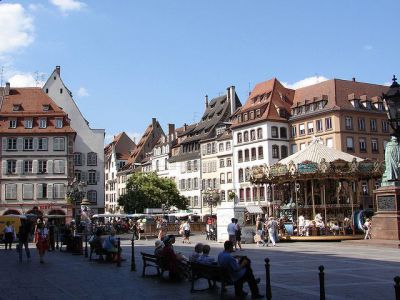
3) Place Gutenberg (Gutenberg Square) (must see)
One destination that should be on your “must-see” list is the Place Gutenberg which lies in the center of medieval Strasbourg, not far from the Cathedral.
This large square is a favorite for locals and tourists alike as it has a lot of excellent cafes and restaurants. The Chamber of Commerce building occupies one side of the square and is easily recognizable with its Renaissance style, but with the sloping roof that is typical of Alsace, where winter snow is a way of life.
There is a 16th-century hotel on the square where Arthur Young was staying when revolutionists destroyed the city’s magistrates records and where today art exhibitions are held on the ground floor. Another attraction is the flea markets that often set up around the statue in the center of the square.
The statue is, quite obviously, dedicated to Johannes Gutenberg; it was sculpted by David d’Angers in 1840 and features the famous printer holding a piece of parchment on which is inscribed the words “Et la lumière fut” (And behold, there was light) from the Book of Genesis. Around the base of the statue, bas reliefs depict notable scenes from Gutenberg’s life.
Not many people know that apart from being the inventor of the first mechanical, movable printing press in Europe in 1439 and the publisher of the Gutenberg Bible in 1455, Gutenberg lived in Strasbourg between 1434-44, where he was an apprentice goldsmith, set to follow in his father’s footsteps.
This large square is a favorite for locals and tourists alike as it has a lot of excellent cafes and restaurants. The Chamber of Commerce building occupies one side of the square and is easily recognizable with its Renaissance style, but with the sloping roof that is typical of Alsace, where winter snow is a way of life.
There is a 16th-century hotel on the square where Arthur Young was staying when revolutionists destroyed the city’s magistrates records and where today art exhibitions are held on the ground floor. Another attraction is the flea markets that often set up around the statue in the center of the square.
The statue is, quite obviously, dedicated to Johannes Gutenberg; it was sculpted by David d’Angers in 1840 and features the famous printer holding a piece of parchment on which is inscribed the words “Et la lumière fut” (And behold, there was light) from the Book of Genesis. Around the base of the statue, bas reliefs depict notable scenes from Gutenberg’s life.
Not many people know that apart from being the inventor of the first mechanical, movable printing press in Europe in 1439 and the publisher of the Gutenberg Bible in 1455, Gutenberg lived in Strasbourg between 1434-44, where he was an apprentice goldsmith, set to follow in his father’s footsteps.
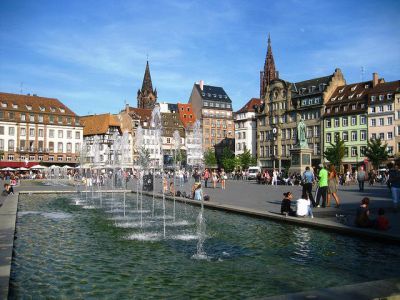
4) Place Kléber (Kleber Square) (must see)
It is well worth taking time to visit the Place Kleber which is the biggest square in the heart of the city’s commercial district. The square has been a central meeting place since it was laid out in the 14th century and it took its name in 1840 after the General Jean Baptiste Kleber, whose statue stands in the center of the square. The general served in Napoleon’s army during the campaign in Egypt in 1798 and 1799. The statue was erected in 1838 by Philippe Grass.
When Napoleon returned to Paris, he named the Kleber Commander of the French Forces. Kleber was assassinated in 1800 in Cairo. His body was repatriated and kept in the Chateau d’If off the Marseille coast until being interred in his native Strasbourg thirty years later. The general’s remains are in a vault under the statue.
An interesting building along the north side of the square is the Aubette building, built in 1772 by Jacque-François Blondel. Once a military post, it was given its name in the 19th century, from the dawn (aube) changing of the guard. In 1928 three avant-garde artists Jean Arp, Theo van Doesburg and Sophie Taeuber-Arp decorated the interior of the building. This work of art is often called the "Sistine Chapel of Abstract Art" for its artistic beauty. Nowadays, the Aubette building is an artistic and historical landmark with on Place Kléber and is enjoyed by locals and tourists alike. Admission to the building is free.
When Napoleon returned to Paris, he named the Kleber Commander of the French Forces. Kleber was assassinated in 1800 in Cairo. His body was repatriated and kept in the Chateau d’If off the Marseille coast until being interred in his native Strasbourg thirty years later. The general’s remains are in a vault under the statue.
An interesting building along the north side of the square is the Aubette building, built in 1772 by Jacque-François Blondel. Once a military post, it was given its name in the 19th century, from the dawn (aube) changing of the guard. In 1928 three avant-garde artists Jean Arp, Theo van Doesburg and Sophie Taeuber-Arp decorated the interior of the building. This work of art is often called the "Sistine Chapel of Abstract Art" for its artistic beauty. Nowadays, the Aubette building is an artistic and historical landmark with on Place Kléber and is enjoyed by locals and tourists alike. Admission to the building is free.
5) Petite France (Little France) (must see)
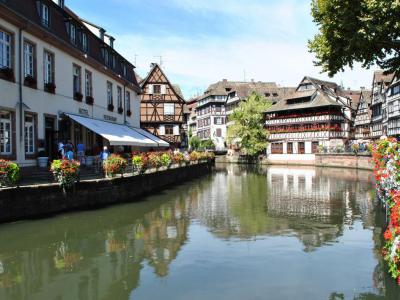
Petite France is an area in Strasbourg that is often called the Venice of the North because of its narrow streets and canals. It is a delightful area to visit as it takes you back to Medieval Strasbourg.
In the Middle Ages the beautiful half-timbered houses were the homes of fishermen, millers and tanners, and indeed many of the streets bear the names of the crafts carried out: Millers Street, Tanners Ditch and Lace Street, for example. The houses have the traditional tiered sloping roofs and hides were once hung up to dry on the topmost rafters.
In the late 15th century a hospice was built on the island for small-pox victims and later for French soldiers suffering from syphilis – which the Germans called it “French Disease” to stop the local girls from sleeping with the soldiers! The area became known as “Little France”, more out of derision than patriotism. The name stuck and today it is one of the most expensive quarters in the city.
Just to the west of Petite France, you can visit the Barrage Vauban – a weir that crosses the River Ill. It was built in 1686 from the plan by Marquis Vauban. The weir has two stories with wonderful sculptures on the main level, as well as a roof terrace where you can take superb photos of Petite France.
Why You Should Visit:
The most romantic neighborhood in Strasburg by far, especially at nightfall. There are also plenty of shops and places to try authentic French dishes. Places are open late and buildings are lit up after dark.
Tip:
Walk around here early in the morning if you wish to get photos without thousands of tourists in your shots. If you have issues walking on cobblestones, you can also take the boat or a little touristic train that goes around the Petit France.
In the Middle Ages the beautiful half-timbered houses were the homes of fishermen, millers and tanners, and indeed many of the streets bear the names of the crafts carried out: Millers Street, Tanners Ditch and Lace Street, for example. The houses have the traditional tiered sloping roofs and hides were once hung up to dry on the topmost rafters.
In the late 15th century a hospice was built on the island for small-pox victims and later for French soldiers suffering from syphilis – which the Germans called it “French Disease” to stop the local girls from sleeping with the soldiers! The area became known as “Little France”, more out of derision than patriotism. The name stuck and today it is one of the most expensive quarters in the city.
Just to the west of Petite France, you can visit the Barrage Vauban – a weir that crosses the River Ill. It was built in 1686 from the plan by Marquis Vauban. The weir has two stories with wonderful sculptures on the main level, as well as a roof terrace where you can take superb photos of Petite France.
Why You Should Visit:
The most romantic neighborhood in Strasburg by far, especially at nightfall. There are also plenty of shops and places to try authentic French dishes. Places are open late and buildings are lit up after dark.
Tip:
Walk around here early in the morning if you wish to get photos without thousands of tourists in your shots. If you have issues walking on cobblestones, you can also take the boat or a little touristic train that goes around the Petit France.
6) Pont Couverts (Covered Bridges) (must see)
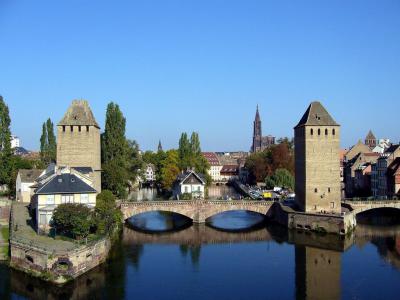
To protect the ancient city of Strasbourg, the Covered Bridges were constructed in the 1200s. There are three bridges crossing the River Ill. Additionally, there are four defensive towers set up between them.
In the late 1600s, the bridges were covered with wooden roofs. These were intended to cover soldiers and defenders who were stationed on the bridges during times of war. The covers were removed in 1784, but the name "Covered Bridges" has stuck.
While the bridges and towers remain, their task of defending the city was taken by the nearby the Vauban Dam. The Vauban Dam is the combination bridge and weir just west of the Covered Bridges.
If you want some postcard-perfect photos, stop by the Covered Bridges just after dark. The bridges and city are lit spectacularly. The best place to view and photograph the Covered Bridges is from near or on the Vauban Damn.
In the late 1600s, the bridges were covered with wooden roofs. These were intended to cover soldiers and defenders who were stationed on the bridges during times of war. The covers were removed in 1784, but the name "Covered Bridges" has stuck.
While the bridges and towers remain, their task of defending the city was taken by the nearby the Vauban Dam. The Vauban Dam is the combination bridge and weir just west of the Covered Bridges.
If you want some postcard-perfect photos, stop by the Covered Bridges just after dark. The bridges and city are lit spectacularly. The best place to view and photograph the Covered Bridges is from near or on the Vauban Damn.
