Custom Walk in Cambridge, England by joanna_stansfield_4e9d9 created on 2023-12-08
Guide Location: England » Cambridge
Guide Type: Custom Walk
# of Sights: 11
Tour Duration: 2 Hour(s)
Travel Distance: 3.3 Km or 2.1 Miles
Share Key: HVL5L
Guide Type: Custom Walk
# of Sights: 11
Tour Duration: 2 Hour(s)
Travel Distance: 3.3 Km or 2.1 Miles
Share Key: HVL5L
How It Works
Please retrieve this walk in the GPSmyCity app. Once done, the app will guide you from one tour stop to the next as if you had a personal tour guide. If you created the walk on this website or come to the page via a link, please follow the instructions below to retrieve the walk in the app.
Retrieve This Walk in App
Step 1. Download the app "GPSmyCity: Walks in 1K+ Cities" on Apple App Store or Google Play Store.



Step 2. In the GPSmyCity app, download(or launch) the guide "Cambridge Map and Walking Tours".
Step 3. Tap the menu button located at upper right corner of the "Walks" screen and select "Retrieve custom walk". Enter the share key: HVL5L
1) Jesus College
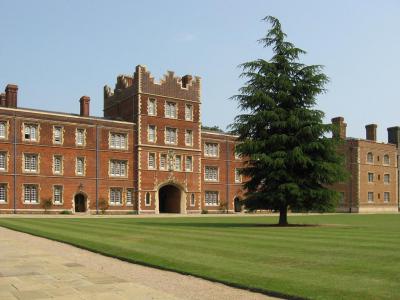
Jesus College, a prestigious constituent of the University of Cambridge, is formally known as The College of the Blessed Virgin Mary, Saint John the Evangelist, and the glorious Virgin Saint Radegund, near Cambridge. The colloquial name, "Jesus College," derives from its chapel, Jesus Chapel, which is a central feature on the campus.
The college traces its roots to between 1496 and 1516, when it was founded by John Alcock, the then Bishop of Ely, on the site of a twelfth-century Benedictine nunnery of Saint Mary and Saint Radegund. The symbol of the college is a cockerel, which is a nod to the surname of its founder. With assets amounting to approximately £344 million, Jesus College is the fourth wealthiest in Cambridge. It is renowned for its extensive and beautifully maintained grounds, which not only house sporting fields but also lie near the college's boathouse, enhancing its appeal to students and visitors alike.
Academically, Jesus College boasts a distinguished record of achievement. It has produced three Nobel Prize laureates, two fellows who have been appointed to the International Court of Justice, and a host of notable alumni across various fields. Among these are Thomas Cranmer, Samuel Taylor Coleridge, Thomas Robert Malthus, and contemporary figures such as Lord Reid, Lord Toulson, Sir Rupert Jackson, Sir David Hare, Sir Roger Scruton, Nick Hornby, and members of the band Clean Bandit.
In 2019, Sonita Alleyne was elected as the master of Jesus College, marking a historic milestone as she became the first woman and the first black leader to hold this position in an Oxbridge college. This was a significant event, coming 40 years after the college began admitting women as students. This leadership underlines the college's progressive values and its commitment to diversity and inclusion.
The college traces its roots to between 1496 and 1516, when it was founded by John Alcock, the then Bishop of Ely, on the site of a twelfth-century Benedictine nunnery of Saint Mary and Saint Radegund. The symbol of the college is a cockerel, which is a nod to the surname of its founder. With assets amounting to approximately £344 million, Jesus College is the fourth wealthiest in Cambridge. It is renowned for its extensive and beautifully maintained grounds, which not only house sporting fields but also lie near the college's boathouse, enhancing its appeal to students and visitors alike.
Academically, Jesus College boasts a distinguished record of achievement. It has produced three Nobel Prize laureates, two fellows who have been appointed to the International Court of Justice, and a host of notable alumni across various fields. Among these are Thomas Cranmer, Samuel Taylor Coleridge, Thomas Robert Malthus, and contemporary figures such as Lord Reid, Lord Toulson, Sir Rupert Jackson, Sir David Hare, Sir Roger Scruton, Nick Hornby, and members of the band Clean Bandit.
In 2019, Sonita Alleyne was elected as the master of Jesus College, marking a historic milestone as she became the first woman and the first black leader to hold this position in an Oxbridge college. This was a significant event, coming 40 years after the college began admitting women as students. This leadership underlines the college's progressive values and its commitment to diversity and inclusion.
2) Trinity College (must see)
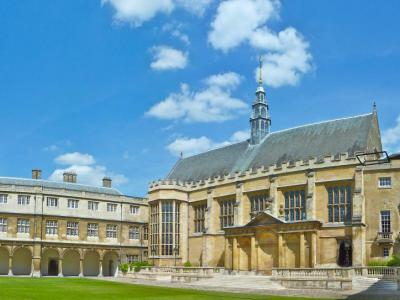
Trinity College, a prestigious constituent of the University of Cambridge in England, is notable not only for its academic excellence but also for its rich history and significant contributions to various fields. Established in 1564 by King Henry VIII through the amalgamation of Michaelhouse and King's Hall, Trinity stands out as the largest and wealthiest college in both Cambridge and Oxford, and it even owns the O2 Arena.
Trinity College has a notable roster of alumni including two members of the British royal family, six British prime ministers, and numerous other distinguished individuals. Among these are 32 Nobel laureates, representing a significant portion of the 90 Nobel prizes awarded to Cambridge affiliates. Some of its most famous alumni include Sir Isaac Newton, King Charles III, and philosopher Ludwig Wittgenstein.
Architecturally, Trinity is renowned for its Wren Library, the largest in Cambridge, housing around 300,000 books and open to the public. The library, along with other historic buildings such as the King's Hostel, the Great Gate, and Neville's Court, illustrates the college's commitment to preserving its heritage while providing modern educational facilities.
The Great Gate, an iconic entrance facing Trinity Street, is usually the first glimpse visitors get of the college. Above its doorway, a statue of Henry VIII, holding a wooden chair leg instead of a scepter due to a historical student prank, greets visitors. This gate leads to the Great Court, reputed to be the largest enclosed quad in Europe, and the central courtyard features a prominent fountain.
Adjacent to the Great Court is Neville’s Court, named after Thomas Neville who was master of the college when he commissioned its construction. It is characterized by its cloisters that provide sheltered walkways linking the Great Hall, the college libraries, and other facilities. The construction of the Wren Library at the end of the 17th century enclosed the court, adding to the grandeur of the college.
Trinity College thus remains a symbol of historical significance, academic achievement, and architectural beauty, continuing to inspire and nurture some of the brightest minds in the world.
Trinity College has a notable roster of alumni including two members of the British royal family, six British prime ministers, and numerous other distinguished individuals. Among these are 32 Nobel laureates, representing a significant portion of the 90 Nobel prizes awarded to Cambridge affiliates. Some of its most famous alumni include Sir Isaac Newton, King Charles III, and philosopher Ludwig Wittgenstein.
Architecturally, Trinity is renowned for its Wren Library, the largest in Cambridge, housing around 300,000 books and open to the public. The library, along with other historic buildings such as the King's Hostel, the Great Gate, and Neville's Court, illustrates the college's commitment to preserving its heritage while providing modern educational facilities.
The Great Gate, an iconic entrance facing Trinity Street, is usually the first glimpse visitors get of the college. Above its doorway, a statue of Henry VIII, holding a wooden chair leg instead of a scepter due to a historical student prank, greets visitors. This gate leads to the Great Court, reputed to be the largest enclosed quad in Europe, and the central courtyard features a prominent fountain.
Adjacent to the Great Court is Neville’s Court, named after Thomas Neville who was master of the college when he commissioned its construction. It is characterized by its cloisters that provide sheltered walkways linking the Great Hall, the college libraries, and other facilities. The construction of the Wren Library at the end of the 17th century enclosed the court, adding to the grandeur of the college.
Trinity College thus remains a symbol of historical significance, academic achievement, and architectural beauty, continuing to inspire and nurture some of the brightest minds in the world.
3) Great St. Mary's Church (must see)
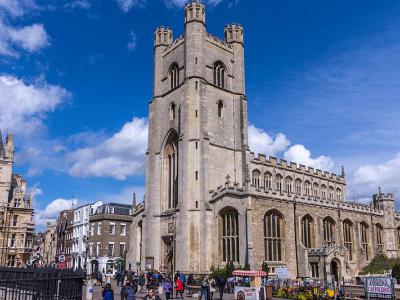
Great Saint Mary's is a Church of England parish and university church situated at the north end of King's Parade in central Cambridge. Designated as a Grade I listed building by Historic England, it holds significant historical and architectural value.
As the university church for the University of Cambridge, Great Saint Mary's plays an integral role in the university's legislative framework. This includes residency requirements for university officers and undergraduates relative to the church's location. The church is instrumental in university life, hosting University Sermons, and housing both the University Organ and the iconic University Clock, which chimes the "Cambridge Quarters" that inspired the Big Ben chimes.
The historical records of Great Saint Mary's date back to 1205 when King John presented Thomas de Chimeleye to the rectory. The church's foundations likely date to 1010, though it underwent reconstruction following a destructive fire on July 9, 1290. Initially known as The Church of Saint Mary the Virgin until 1352, it has since been referred to by its current name. The crown initially held the church's patronage, which was transferred to King's Hall in 1342.
Architecturally, the church is styled in the Late Perpendicular motif, with stained glass work completed by Hardman between 1867 and 1869. To manage large audiences during compulsory University Sermons, galleries were added in 1735. The church boasts several unique features, including one of the few moveable pulpits in England, a font from 1632, and a significant sculpture of Christ in Majesty by Alan Durst completed in 1960.
The church's bell history is notable as well, with the bells initially housed in a wooden structure before being moved to the tower in 1515. The Society of Cambridge Youths, formed in 1724 to oversee the ringing, is recognized as one of the oldest bellringing societies.
Great Saint Mary's also contains two distinct pipe organs-the Parish Organ in the Chancel and the University Organ in the West Gallery, the latter owned by the university. The University Organ, built originally in 1698 by Bernard Smith and significantly enhanced over the centuries, serves as a focal point for university services.
Today, Great Saint Mary's continues to serve both its parish and the academic community, aligning with the Liberal Catholic tradition of the Church of England and embracing inclusive practices as a member of the Inclusive Church network.
Why You Should Visit:
As well as viewing the beautiful nave, you can climb the bell tower (admission fee) to the viewing platform for a spectacular panorama of the city.
Tip:
The acoustics here are excellent for concerts (watch for a schedule) and be sure to check out the first edition King James Bible, on the left-hand side, as you enter the church.
If you climb the tower, try to be the first in your group and go up quickly (very narrow stairs), so you have one minute alone on the top.
As the university church for the University of Cambridge, Great Saint Mary's plays an integral role in the university's legislative framework. This includes residency requirements for university officers and undergraduates relative to the church's location. The church is instrumental in university life, hosting University Sermons, and housing both the University Organ and the iconic University Clock, which chimes the "Cambridge Quarters" that inspired the Big Ben chimes.
The historical records of Great Saint Mary's date back to 1205 when King John presented Thomas de Chimeleye to the rectory. The church's foundations likely date to 1010, though it underwent reconstruction following a destructive fire on July 9, 1290. Initially known as The Church of Saint Mary the Virgin until 1352, it has since been referred to by its current name. The crown initially held the church's patronage, which was transferred to King's Hall in 1342.
Architecturally, the church is styled in the Late Perpendicular motif, with stained glass work completed by Hardman between 1867 and 1869. To manage large audiences during compulsory University Sermons, galleries were added in 1735. The church boasts several unique features, including one of the few moveable pulpits in England, a font from 1632, and a significant sculpture of Christ in Majesty by Alan Durst completed in 1960.
The church's bell history is notable as well, with the bells initially housed in a wooden structure before being moved to the tower in 1515. The Society of Cambridge Youths, formed in 1724 to oversee the ringing, is recognized as one of the oldest bellringing societies.
Great Saint Mary's also contains two distinct pipe organs-the Parish Organ in the Chancel and the University Organ in the West Gallery, the latter owned by the university. The University Organ, built originally in 1698 by Bernard Smith and significantly enhanced over the centuries, serves as a focal point for university services.
Today, Great Saint Mary's continues to serve both its parish and the academic community, aligning with the Liberal Catholic tradition of the Church of England and embracing inclusive practices as a member of the Inclusive Church network.
Why You Should Visit:
As well as viewing the beautiful nave, you can climb the bell tower (admission fee) to the viewing platform for a spectacular panorama of the city.
Tip:
The acoustics here are excellent for concerts (watch for a schedule) and be sure to check out the first edition King James Bible, on the left-hand side, as you enter the church.
If you climb the tower, try to be the first in your group and go up quickly (very narrow stairs), so you have one minute alone on the top.
4) King's College (must see)
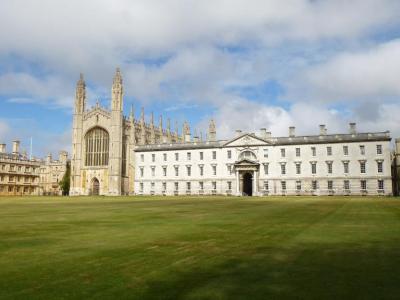
King’s College is located on the western side of Cambridge University campus, close to the River Cam and the surrounding Backs area of countryside. The college gatehouse stands adjacent to King’s College Chapel, one of the city’s most iconic buildings. The history of King’s College is one of many paradoxes. Completed in the Tudor era, the college was at one time only accessible to students of Eton, a renowned private school for children of the English upper classes. Nowadays, it has one of the highest intake rates of students from state schools of any Cambridge college.
True to its name, the college was founded by Henry VI and saw heavy investment under his reign, including the creation of the adjoining chapel. Other colleges viewed King’s College as a status symbol for the Tudor monarchy – to this day, many of the buildings, including the striking Gothic gatehouse, feature the Tudor rose emblem repeatedly. Despite its royalist beginnings, King’s College has become known for left wing and republican sentiment among its student base. Famous alumni of the college include authors Salman Rushdie and E.M. Forster.
True to its name, the college was founded by Henry VI and saw heavy investment under his reign, including the creation of the adjoining chapel. Other colleges viewed King’s College as a status symbol for the Tudor monarchy – to this day, many of the buildings, including the striking Gothic gatehouse, feature the Tudor rose emblem repeatedly. Despite its royalist beginnings, King’s College has become known for left wing and republican sentiment among its student base. Famous alumni of the college include authors Salman Rushdie and E.M. Forster.
5) King's College Chapel (must see)
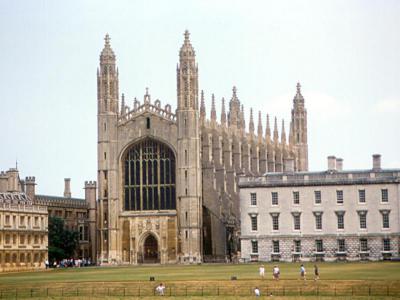
King’s College Chapel has stood in Cambridge since 1515 when Henry VIII was King of England. As its name suggests, the chapel was built to provide a place of worship for residents of nearby King’s College, at the western end of the city’s sprawling university campus. The chapel is considered to be one of the city’s finest examples of late Gothic English architecture. The interior of the chapel building is notable for its ornate fan vault ceiling, as well as elements of Renaissance-era design. Nikolaus Pevsner, a leading expert on ecclesiastical architecture, stated that King’s College Chapel contains the UK’s finest surviving examples of Italian decoration. The chapel is one of Cambridge’s most distinctive buildings and is featured on the city council logo.
The chapel is known for its exquisite original stained glass windows, which date from the 16th century. Still an active place of worship, King’s College Chapel is also used for college events and concerts, including the college music society’s May Week Concert, where the audience is treated to free champagne and strawberries on the church lawn. The chapel has a rich musical history, on account of its exceptional acoustics, and has a world-famous men’s choir.
Why You Should Visit:
This chapel is like a cathedral in scale and grandeur with high stained glass windows and a wonderful ornate ceiling which is worth seeing on its own.
The grounds offer a superb view of the chapel exterior and other buildings, as well as the river.
Tip:
Try going to Evensong at 5:30pm (you need to get there around 5pm) which is not chargeable, but has a retiring collection; the service is lovely and you can sit within the chapel and soak up the atmosphere of this ancient building.
The chapel is known for its exquisite original stained glass windows, which date from the 16th century. Still an active place of worship, King’s College Chapel is also used for college events and concerts, including the college music society’s May Week Concert, where the audience is treated to free champagne and strawberries on the church lawn. The chapel has a rich musical history, on account of its exceptional acoustics, and has a world-famous men’s choir.
Why You Should Visit:
This chapel is like a cathedral in scale and grandeur with high stained glass windows and a wonderful ornate ceiling which is worth seeing on its own.
The grounds offer a superb view of the chapel exterior and other buildings, as well as the river.
Tip:
Try going to Evensong at 5:30pm (you need to get there around 5pm) which is not chargeable, but has a retiring collection; the service is lovely and you can sit within the chapel and soak up the atmosphere of this ancient building.
6) Corpus Clock (must see)
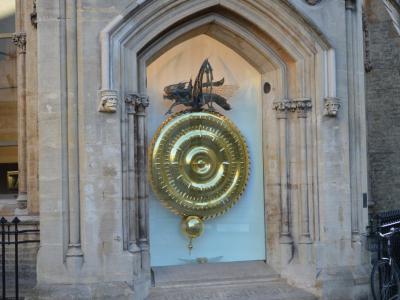
The Corpus Clock can be found in the Library Court at Corpus Christi College. The newest of three at the college, the court incorporates a former library building, redeveloped and extended to provide accommodation for students. The clock is Library Court’s centrepiece and was unveiled to the public in 2008 by Professor Stephen Hawking, himself a Cambridge University graduate.
The clock is a unique device, a fitting addition to the university campus renowned for invention throughout its history. Fitted with a rippled, 24-carat gold face, the clock displays time through three rings of LEDs, which depict hours, minutes and seconds. The face is topped by a large metal object, which resembles a grasshopper. This is an enlarged clock escarpment, which links the pendulum to the cogs inside the clock. It has been set on top of the clock face to resemble an insect that ‘eats’ time as the clock face rotates. It is even fitted with eyes that blink occasionally.
Perhaps the most remarkable feature of the Corpus Clock is the fact that it is only accurate once every five minutes. It has been set to randomly slow and accelerate, to give the appearance that the metal insect is indeed eating up time at will. The clock, one of Time Magazine’s greatest inventions of the 21st century, can be viewed within Corpus Christi’s grounds. Ask at the porter’s lodge for admission times and costs.
Tip:
Try to time your visit after dark and see the clock from across the road, when there's no traffic or significant pedestrian noise, as it is then at its best.
In the daytime, there are generally a number of tourists standing in the road taking photos, gathering particularly on the hour, so take care not to get run over.
The clock is a unique device, a fitting addition to the university campus renowned for invention throughout its history. Fitted with a rippled, 24-carat gold face, the clock displays time through three rings of LEDs, which depict hours, minutes and seconds. The face is topped by a large metal object, which resembles a grasshopper. This is an enlarged clock escarpment, which links the pendulum to the cogs inside the clock. It has been set on top of the clock face to resemble an insect that ‘eats’ time as the clock face rotates. It is even fitted with eyes that blink occasionally.
Perhaps the most remarkable feature of the Corpus Clock is the fact that it is only accurate once every five minutes. It has been set to randomly slow and accelerate, to give the appearance that the metal insect is indeed eating up time at will. The clock, one of Time Magazine’s greatest inventions of the 21st century, can be viewed within Corpus Christi’s grounds. Ask at the porter’s lodge for admission times and costs.
Tip:
Try to time your visit after dark and see the clock from across the road, when there's no traffic or significant pedestrian noise, as it is then at its best.
In the daytime, there are generally a number of tourists standing in the road taking photos, gathering particularly on the hour, so take care not to get run over.
7) The Eagle
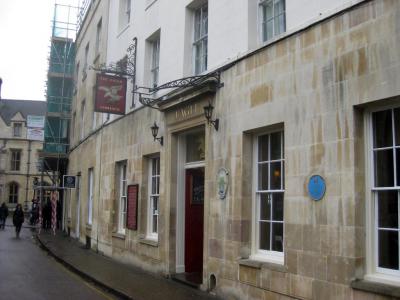
The Eagle in Cambridge is a historic pub and a popular social spot, closely tied to the academic culture of the city. Known as one of Cambridge's most famous pubs, The Eagle has a history spanning around 400 years. Originally a coaching inn, it still retains its old-world charm and a distinctly British feel, attracting both locals and tourists.
The pub is notably linked to a significant scientific event. In 1953, scientists James Watson and Francis Crick chose The Eagle to announce their discovery of the DNA molecule. This highlights the pub's role as a favorite meeting place for the academic circles in Cambridge, especially those from the nearby Cavendish Laboratory.
Today, The Eagle is a relaxed and lively venue for students, professors, and residents. It offers a casual atmosphere where people gather to watch sports, chat about scholarly topics, or just hang out with friends. The interior reflects a typical Cambridge student hangout, cozy and infused with a sense of history and intellectual discussion.
The Eagle has a varied drink menu, featuring everything from classic cocktails like the Lazy Margarita to a special selection of gins and around ten New World wines. Beer lovers can appreciate the Greene King IPA and other popular lagers and bitters. The pub's commitment to a diverse drink selection ensures there's something for everyone.
On the food side, The Eagle serves robust, meat-centric dishes along with all the traditional pub favorites. Notable dishes include the Dirty Burger and a meat tray that offers a variety of flavors, from barbecue burnt ends to buttermilk fried chicken with spicy pickled slaw and rosemary-salted fries.
Booking a visit to The Eagle allows guests to immerse themselves in a piece of British history, enjoy irresistible food and drinks, and experience the warm, inclusive atmosphere that makes this pub a beloved landmark in Cambridge.
The pub is notably linked to a significant scientific event. In 1953, scientists James Watson and Francis Crick chose The Eagle to announce their discovery of the DNA molecule. This highlights the pub's role as a favorite meeting place for the academic circles in Cambridge, especially those from the nearby Cavendish Laboratory.
Today, The Eagle is a relaxed and lively venue for students, professors, and residents. It offers a casual atmosphere where people gather to watch sports, chat about scholarly topics, or just hang out with friends. The interior reflects a typical Cambridge student hangout, cozy and infused with a sense of history and intellectual discussion.
The Eagle has a varied drink menu, featuring everything from classic cocktails like the Lazy Margarita to a special selection of gins and around ten New World wines. Beer lovers can appreciate the Greene King IPA and other popular lagers and bitters. The pub's commitment to a diverse drink selection ensures there's something for everyone.
On the food side, The Eagle serves robust, meat-centric dishes along with all the traditional pub favorites. Notable dishes include the Dirty Burger and a meat tray that offers a variety of flavors, from barbecue burnt ends to buttermilk fried chicken with spicy pickled slaw and rosemary-salted fries.
Booking a visit to The Eagle allows guests to immerse themselves in a piece of British history, enjoy irresistible food and drinks, and experience the warm, inclusive atmosphere that makes this pub a beloved landmark in Cambridge.
8) University Museum of Zoology
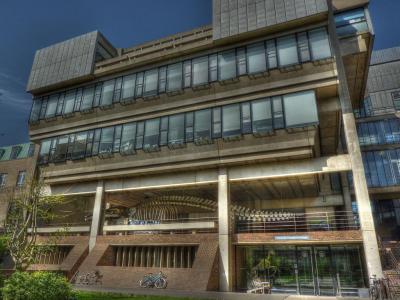
The University Museum of Zoology in Cambridge is a prominent institution affiliated with the University of Cambridge and functions under the Department of Zoology. It is renowned for its extensive and scientifically significant zoological collections. Recognized for their outstanding historical and international value, these collections were officially designated as such in 1998 by the Museums, Libraries, and Archives Council, now managed by Arts Council England.
The museum's collections primarily grew during the 19th century, a pivotal era for the evolution of modern biology. A substantial portion of its materials was collected between 1865 and 1915, sourced through private collections and various expeditions. This period marked Cambridge as a crucial hub for biological research, with several museum affiliates playing central roles in significant scientific discussions of the time.
In a significant effort to modernize and enhance its facilities and offerings, the museum underwent a major redevelopment, reopening on June 23, 2018. The redevelopment included the creation of new storage facilities to maintain the museum’s valuable collections to the highest standards, the redesign of displays to better engage the public with the diversity of animal life, and the expansion of its educational programs. This also involved extending its outreach to broader audiences and bolstering its online resources.
The University Museum of Zoology is part of the University of Cambridge Museums consortium, a group of eight museums that collaborate on various projects and public engagement activities. This consortium approach enables the museum to share resources and knowledge, enhancing the visitor experience and educational impact.
The museum's collections primarily grew during the 19th century, a pivotal era for the evolution of modern biology. A substantial portion of its materials was collected between 1865 and 1915, sourced through private collections and various expeditions. This period marked Cambridge as a crucial hub for biological research, with several museum affiliates playing central roles in significant scientific discussions of the time.
In a significant effort to modernize and enhance its facilities and offerings, the museum underwent a major redevelopment, reopening on June 23, 2018. The redevelopment included the creation of new storage facilities to maintain the museum’s valuable collections to the highest standards, the redesign of displays to better engage the public with the diversity of animal life, and the expansion of its educational programs. This also involved extending its outreach to broader audiences and bolstering its online resources.
The University Museum of Zoology is part of the University of Cambridge Museums consortium, a group of eight museums that collaborate on various projects and public engagement activities. This consortium approach enables the museum to share resources and knowledge, enhancing the visitor experience and educational impact.
9) Queens' College
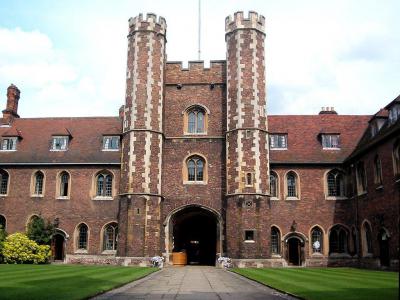
Queens’ College is the southernmost in the chain of prestigious colleges which line the east bank of the river Cam. It is one of only two colleges in this chain (the other being Saint John’s College to the north) to have buildings on either side of the river. The two sides of the campus – known as the ‘light’ and ‘dark’ sides by students – are connected by the college’s famous wooden Mathematical Bridge, one of Cambridge’s most famous structures. Sitting adjacent to Silver Street, the college’s medieval buildings are perhaps the most accessible in the city. The oldest building on the river Cam belongs to Queens’ – the President’s Lodge, a Tudor-style structure completed in 1460.
Queens’ College is so named as it was founded by the respective queens of Henry VI and Edward IV. The college was first founded in 1448 and then re-founded by Elizabeth Woodville, wife of Edward, in 1465. It is one of the oldest and largest colleges within Cambridge University, and one of the most academically successful. The large Queens’ campus encompasses modern and medieval buildings which can be viewed along the length of Silver Street. Queens’ College is a progressive, social institution that has produced a variety of famous alumni, including the renowned philosopher Erasmus, Oliver Cromwell and, more recently, actor and author Stephen Fry.
Why You Should Visit:
For just a few £s you can enter and walk all around the courtyard, Tudor Gatehouse, the Old Hall and many of the courts, including the Old Court - which apparently is much the same as it was in the 15th century.
Tip:
Do cross the Mathematical Bridge and become photography subject(s) for the tourists :)
Queens’ College is so named as it was founded by the respective queens of Henry VI and Edward IV. The college was first founded in 1448 and then re-founded by Elizabeth Woodville, wife of Edward, in 1465. It is one of the oldest and largest colleges within Cambridge University, and one of the most academically successful. The large Queens’ campus encompasses modern and medieval buildings which can be viewed along the length of Silver Street. Queens’ College is a progressive, social institution that has produced a variety of famous alumni, including the renowned philosopher Erasmus, Oliver Cromwell and, more recently, actor and author Stephen Fry.
Why You Should Visit:
For just a few £s you can enter and walk all around the courtyard, Tudor Gatehouse, the Old Hall and many of the courts, including the Old Court - which apparently is much the same as it was in the 15th century.
Tip:
Do cross the Mathematical Bridge and become photography subject(s) for the tourists :)
10) Mathematical Bridge
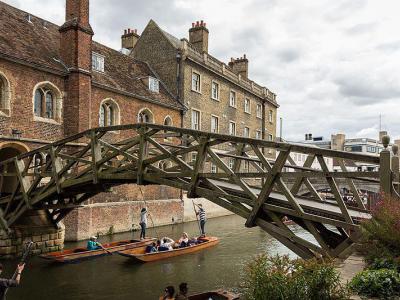
The Mathematical Bridge is the local nickname for the Wooden Bridge, a footbridge that crosses the River Cam, connecting the buildings of Queens’ College that lie on either side of the river. Part of the university grounds, it can be viewed from the road bridge on Silver Street, a few metres to the south. The bridge has earned its nickname due to the unusual design – formed of long, straight timber beams arranged radially, so as to create an arcing structure. Designed by William Etheridge and completed in 1749, the bridge was rebuilt twice, in 1866 and 1905, retaining the original design on each occasion.
Because of the design, the bridge appears to be held above the water almost unnaturally, leading to many myths – one of the most famous being that the bridge is constructed without the use of any bolts, and is held together by design alone. Sadly, this is not true, although the original design did use embedded nails which gave the impression that this was the case. The bridge is still widely believed to be the work of Sir Isaac Newton, who discovered the law of gravity. The mathematical design of the bridge contains hallmarks of Newton’s theories – but they can only be in tribute, as Newton died 20 years before the bridge was constructed.
Tip:
You can see the bridge for free from a distance away or you can pay to see it up close and walk across it on a tour of Queens' College. However, you can also travel under it on a punting tour, which is what many choose to do.
Because of the design, the bridge appears to be held above the water almost unnaturally, leading to many myths – one of the most famous being that the bridge is constructed without the use of any bolts, and is held together by design alone. Sadly, this is not true, although the original design did use embedded nails which gave the impression that this was the case. The bridge is still widely believed to be the work of Sir Isaac Newton, who discovered the law of gravity. The mathematical design of the bridge contains hallmarks of Newton’s theories – but they can only be in tribute, as Newton died 20 years before the bridge was constructed.
Tip:
You can see the bridge for free from a distance away or you can pay to see it up close and walk across it on a tour of Queens' College. However, you can also travel under it on a punting tour, which is what many choose to do.
11) Bridge of Sighs (must see)
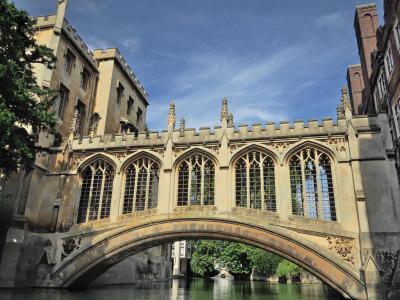
The Bridge of Sighs in Cambridge is a significant architectural feature of Saint John's College at the University of Cambridge. Named after the famed Venetian bridge, Cambridge's Bridge of Sighs was constructed in 1831 under the design of architect Henry Hutchinson. Despite its name, the bridge bears little resemblance to its Venetian counterpart aside from being covered.
Positioned over the River Cam, the bridge links the college's Third Court with the New Court, a region on the west side of the river known as the Backs. This area was developed as part of the expansion of Saint John's College, which was the first among Cambridge colleges to extend its facilities to the west bank of the Cam. The architectural style of the bridge is Gothic Revival, reflecting the fashionable trend of the era.
The Bridge of Sighs is not only a Grade I listed building but also a prominent tourist attraction in Cambridge, highly admired by historical figures including Queen Victoria, who reportedly favored it above all other places in the city. Its charm and historical significance have made it a beloved spot for many, including former Singaporean Prime Minister Lee Kuan Yew, who was photographed there as a student and during subsequent visits in 1974 and 2000.
The bridge has also been a backdrop for pranks; notably, in 1963 and again in 1968, students daringly dangled cars from the bridge as part of student pranks, though without causing any damage to the structure. Additionally, it has served as a picturesque filming location, appearing in movies such as "Elizabeth: The Golden Age" (2007) and "The Theory of Everything" (2014), further cementing its role as an iconic symbol of Cambridge's heritage.
Positioned over the River Cam, the bridge links the college's Third Court with the New Court, a region on the west side of the river known as the Backs. This area was developed as part of the expansion of Saint John's College, which was the first among Cambridge colleges to extend its facilities to the west bank of the Cam. The architectural style of the bridge is Gothic Revival, reflecting the fashionable trend of the era.
The Bridge of Sighs is not only a Grade I listed building but also a prominent tourist attraction in Cambridge, highly admired by historical figures including Queen Victoria, who reportedly favored it above all other places in the city. Its charm and historical significance have made it a beloved spot for many, including former Singaporean Prime Minister Lee Kuan Yew, who was photographed there as a student and during subsequent visits in 1974 and 2000.
The bridge has also been a backdrop for pranks; notably, in 1963 and again in 1968, students daringly dangled cars from the bridge as part of student pranks, though without causing any damage to the structure. Additionally, it has served as a picturesque filming location, appearing in movies such as "Elizabeth: The Golden Age" (2007) and "The Theory of Everything" (2014), further cementing its role as an iconic symbol of Cambridge's heritage.
