Custom Walk in Casablanca, Morocco by ptommey_54b7d created on 2025-03-31
Guide Location: Morocco » Casablanca
Guide Type: Custom Walk
# of Sights: 12
Tour Duration: 4 Hour(s)
Travel Distance: 9.8 Km or 6.1 Miles
Share Key: 8QQ43
Guide Type: Custom Walk
# of Sights: 12
Tour Duration: 4 Hour(s)
Travel Distance: 9.8 Km or 6.1 Miles
Share Key: 8QQ43
How It Works
Please retrieve this walk in the GPSmyCity app. Once done, the app will guide you from one tour stop to the next as if you had a personal tour guide. If you created the walk on this website or come to the page via a link, please follow the instructions below to retrieve the walk in the app.
Retrieve This Walk in App
Step 1. Download the app "GPSmyCity: Walks in 1K+ Cities" on Apple App Store or Google Play Store.



Step 2. In the GPSmyCity app, download(or launch) the guide "Casablanca Map and Walking Tours".
Step 3. Tap the menu button located at upper right corner of the "Walks" screen and select "Retrieve custom walk". Enter the share key: 8QQ43
1) Abderrahman Slaoui Museum
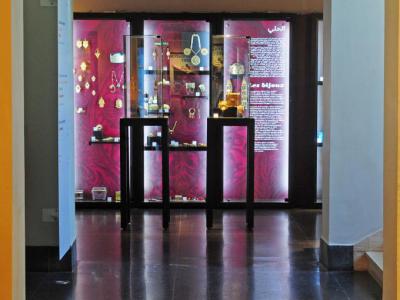
The Abderrahman Slaoui Museum, situated in Casablanca, stands as a tribute to the late Abderrahman Slaoui, a Moroccan businessman and esteemed art collector who passed away in 2001. Officially opened in May 2012, the museum is operated by the Abderrahman Slaoui Foundation and showcases a rich array of exhibits that reflect Slaoui’s diverse interests and passion for art.
The museum boasts a notable collection of old posters, Moroccan jewelry, and artworks, including figurative paintings by Muhammad Ben Ali Rabati and landscapes by Jacques Majorelle. It holds Morocco's largest collection of Orientalist posters, depicting Morocco, Algeria, and Tunisia. These late 19th-century posters, created by artists like Majorelle, Charles Halo, and Joseph de la Néziere, were originally designed to attract tourists to North Africa's 'exotic' destinations.
A standout feature of the museum is its extensive collection of 18th- and 19th-century Moroccan gold jewelry. This collection has been preserved largely due to Slaoui's foresight and the expertise of his father-in-law, a prominent jeweler from Fes. The collection showcases traditional wedding jewelry, including earrings, tiaras, frontal piece brooches, and substantial necklaces, typically shared or rented within communities for special occasions.
In contrast, the museum also explores the silver and embellished jewelry of Amazigh women, worn in daily life and rich in symbolic meaning, signifying purity and cultural identity. These artifacts underscore the important role Amazigh women play as custodians of culture, language, and traditional crafts.
Further enriching the museum’s offerings are the works of Muhammad Ben Ali Rabati, an early modern Moroccan painter whose art vividly captures scenes from Tangier. Rabati's career flourished under the patronage of Sir John Lavery, a distinguished artist from the royal court of England, who exposed Rabati's works to broader audiences.
The museum is not only a repository of historical artifacts but also a vibrant cultural center. It hosts temporary exhibitions every quarter, featuring contemporary Moroccan artists across various media including photography, sculpture, and mixed media. These exhibitions often engage with Moroccan culture and create dialogues with the museum's existing collections.
The museum boasts a notable collection of old posters, Moroccan jewelry, and artworks, including figurative paintings by Muhammad Ben Ali Rabati and landscapes by Jacques Majorelle. It holds Morocco's largest collection of Orientalist posters, depicting Morocco, Algeria, and Tunisia. These late 19th-century posters, created by artists like Majorelle, Charles Halo, and Joseph de la Néziere, were originally designed to attract tourists to North Africa's 'exotic' destinations.
A standout feature of the museum is its extensive collection of 18th- and 19th-century Moroccan gold jewelry. This collection has been preserved largely due to Slaoui's foresight and the expertise of his father-in-law, a prominent jeweler from Fes. The collection showcases traditional wedding jewelry, including earrings, tiaras, frontal piece brooches, and substantial necklaces, typically shared or rented within communities for special occasions.
In contrast, the museum also explores the silver and embellished jewelry of Amazigh women, worn in daily life and rich in symbolic meaning, signifying purity and cultural identity. These artifacts underscore the important role Amazigh women play as custodians of culture, language, and traditional crafts.
Further enriching the museum’s offerings are the works of Muhammad Ben Ali Rabati, an early modern Moroccan painter whose art vividly captures scenes from Tangier. Rabati's career flourished under the patronage of Sir John Lavery, a distinguished artist from the royal court of England, who exposed Rabati's works to broader audiences.
The museum is not only a repository of historical artifacts but also a vibrant cultural center. It hosts temporary exhibitions every quarter, featuring contemporary Moroccan artists across various media including photography, sculpture, and mixed media. These exhibitions often engage with Moroccan culture and create dialogues with the museum's existing collections.
2) Casablanca Cathedral (must see)
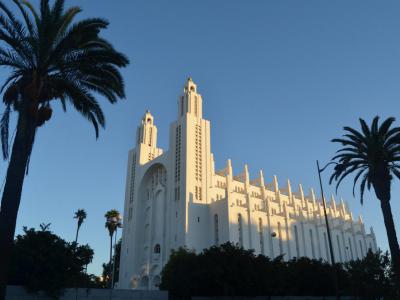
As long as the French ran the show in Morocco, a grand Catholic church in Casablanca was not inconceivable. The building commonly called a cathedral was never technically one, as the city has never been the seat of a bishop. Yet its scale and prominence earned it that popular name. Officially, it was the Church of the Sacred Heart, conceived to serve the city’s sizeable Catholic community during the French Protectorate.
After Morocco gained independence in 1956 and the European Catholic presence rapidly declined, the church ceased to function as a place of worship. In subsequent decades the building was deconsecrated and repurposed, at times housing a school and later becoming a cultural venue and exhibition space. Today it attracts visitors for its beautiful architecture and occasional art and cultural events.
Located beside the green expanse of the Arab League Park, the Church of the Sacred Heart was designed by French architect Paul Tournon and built beginning in 1930, with completion in the early 1950s. Its style combines Art Deco with neo-Gothic influences and subtle Moorish references, especially evident in the facade’s twin towers, which have square silhouettes reminiscent of minarets.
The interior features a long nave lined with stained-glass windows. Visitors are sometimes allowed to climb the towers for panoramic views over Casablanca. Though the Church of the Sacred Heart no longer serves a religious function, its scale, white exterior, and architectural fusion make it one of the city’s most memorable colonial-era landmarks.
After Morocco gained independence in 1956 and the European Catholic presence rapidly declined, the church ceased to function as a place of worship. In subsequent decades the building was deconsecrated and repurposed, at times housing a school and later becoming a cultural venue and exhibition space. Today it attracts visitors for its beautiful architecture and occasional art and cultural events.
Located beside the green expanse of the Arab League Park, the Church of the Sacred Heart was designed by French architect Paul Tournon and built beginning in 1930, with completion in the early 1950s. Its style combines Art Deco with neo-Gothic influences and subtle Moorish references, especially evident in the facade’s twin towers, which have square silhouettes reminiscent of minarets.
The interior features a long nave lined with stained-glass windows. Visitors are sometimes allowed to climb the towers for panoramic views over Casablanca. Though the Church of the Sacred Heart no longer serves a religious function, its scale, white exterior, and architectural fusion make it one of the city’s most memorable colonial-era landmarks.
3) Villa des Arts (Villa of Arts)
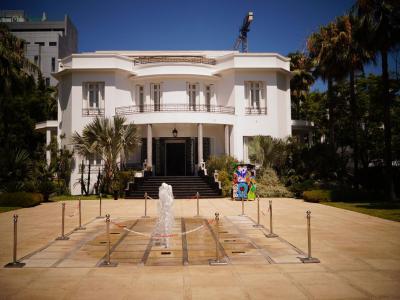
The Villa of Arts (Villa des Arts) in Casablanca is a cornerstone of contemporary art and cultural preservation within the region. Managed by the Fondation ONA, this prestigious cultural institution, established in the 1930s, plays a critical role in promoting both established and emerging Moroccan and international artists. The villa itself, an architectural treasure built in 1934, is an exemplar of the Art Deco style that was prevalent in Casablanca during the French Protectorate. It integrates traditional Moroccan elements with modernist aesthetics, featuring ornate facades, elegant curves, and expansive terraces overlooking verdant gardens.
As a cultural center, the Villa of Arts is vital to Casablanca’s artistic scene, not just for its stunning architecture but also for its significant contributions to the arts. It hosts a considerable permanent collection that includes paintings, sculptures, installations, and graphic arts, showcasing the rich diversity and evolution of contemporary art in Morocco and Africa. These pieces reflect a wide range of styles and mediums, capturing the vibrant artistic expression in the region.
Beyond its permanent collection, the Villa des Arts organizes numerous temporary exhibitions that address contemporary issues such as urbanization, identity, and globalization. These exhibitions provide a platform for artists to engage with current social, political, and environmental themes, fostering artistic innovation and encouraging critical dialogue among visitors.
The institution also emphasizes educational outreach, offering workshops, lectures, and seminars to diverse audiences, including schoolchildren and art professionals. These programs aim to enhance public appreciation of the arts and promote cultural exchange. Additionally, the Villa of Arts enriches its cultural offerings with regular film screenings and live performances held in its auditorium and lush gardens. These events span various genres and styles, enhancing the cultural experience provided by the visual arts exhibitions.
As a cultural center, the Villa of Arts is vital to Casablanca’s artistic scene, not just for its stunning architecture but also for its significant contributions to the arts. It hosts a considerable permanent collection that includes paintings, sculptures, installations, and graphic arts, showcasing the rich diversity and evolution of contemporary art in Morocco and Africa. These pieces reflect a wide range of styles and mediums, capturing the vibrant artistic expression in the region.
Beyond its permanent collection, the Villa des Arts organizes numerous temporary exhibitions that address contemporary issues such as urbanization, identity, and globalization. These exhibitions provide a platform for artists to engage with current social, political, and environmental themes, fostering artistic innovation and encouraging critical dialogue among visitors.
The institution also emphasizes educational outreach, offering workshops, lectures, and seminars to diverse audiences, including schoolchildren and art professionals. These programs aim to enhance public appreciation of the arts and promote cultural exchange. Additionally, the Villa of Arts enriches its cultural offerings with regular film screenings and live performances held in its auditorium and lush gardens. These events span various genres and styles, enhancing the cultural experience provided by the visual arts exhibitions.
4) Notre Dame de Lourdes Cathedral (Our Lady of Lourdes Cathedral)
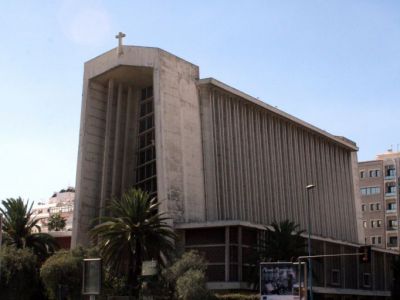
Rising like a massive slab of sculpted concrete, the Church of Our Lady of Lourdes is one of Casablanca’s most unconventional religious buildings. Its stark modernist form, often compared to a monumental industrial radiator, leaves little doubt that this is not a traditional church. A small crucifix perched high above the structure is the only immediate clue to its function. Designed in a style close to modernism with brutalist tendencies, it remains unlike any other church in Morocco.
Step inside, however, and the atmosphere changes completely. The interior is dominated by towering stained-glass walls created by French artist Gabriel Loire, covering more than 8,000 square feet and composed of deep blues and reds arranged with geometric precision. Rather than narrative scenes, the windows present a symbolic visual language inspired by the life of the Virgin Mary, transforming light itself into the building’s primary decorative element.
In the church courtyard, a replica of the Grotto of Lourdes recalls the Marian apparitions experienced by Bernadette Soubirous in France. The church is no longer regularly used for Catholic worship, but remains accessible to visitors. It is valued primarily as a landmark of postwar modern religious architecture.
Step inside, however, and the atmosphere changes completely. The interior is dominated by towering stained-glass walls created by French artist Gabriel Loire, covering more than 8,000 square feet and composed of deep blues and reds arranged with geometric precision. Rather than narrative scenes, the windows present a symbolic visual language inspired by the life of the Virgin Mary, transforming light itself into the building’s primary decorative element.
In the church courtyard, a replica of the Grotto of Lourdes recalls the Marian apparitions experienced by Bernadette Soubirous in France. The church is no longer regularly used for Catholic worship, but remains accessible to visitors. It is valued primarily as a landmark of postwar modern religious architecture.
5) Habous Souq (New Town Market)
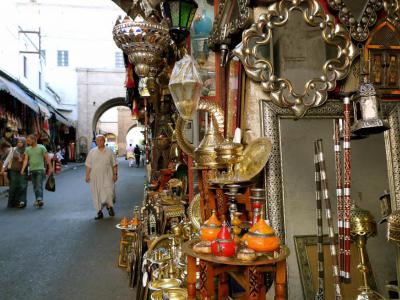
The Habous Souk, often referred to as the New Town Market, was designed to resemble a traditional Moroccan medina, combining orderly urban planning with historical architectural forms. It was conceived as a cleaner, more structured alternative to the old medina, without abandoning local building traditions.
Unlike the dense and sometimes chaotic feel of the old medina, the Habous Souk is laid out along wide, navigable streets and shaded arcades. The market offers a wide range of traditional goods. Visitors will find shops selling carpets, leather slippers, clothing, brassware, ceramics, and handcrafted jewelry, alongside bookshops, including well-known sellers of religious texts and Arabic literature. Small cafes, bakeries, and traditional pastry shops are woven into the fabric of the souk.
The atmosphere here is noticeably more relaxed than in the old medina. Shopkeepers tend to be less insistent, browsing is unhurried, and conversations often drift toward tea rather than transactions. While bargaining still exists, it is generally low-key. The Habous Souk is open daily during normal daytime and evening hours, though individual shop schedules vary, and many close for prayer times or early in the evening.
Unlike the dense and sometimes chaotic feel of the old medina, the Habous Souk is laid out along wide, navigable streets and shaded arcades. The market offers a wide range of traditional goods. Visitors will find shops selling carpets, leather slippers, clothing, brassware, ceramics, and handcrafted jewelry, alongside bookshops, including well-known sellers of religious texts and Arabic literature. Small cafes, bakeries, and traditional pastry shops are woven into the fabric of the souk.
The atmosphere here is noticeably more relaxed than in the old medina. Shopkeepers tend to be less insistent, browsing is unhurried, and conversations often drift toward tea rather than transactions. While bargaining still exists, it is generally low-key. The Habous Souk is open daily during normal daytime and evening hours, though individual shop schedules vary, and many close for prayer times or early in the evening.
6) Mahkamat al-Pasha Building (Pasha's Courthouse) (must see)
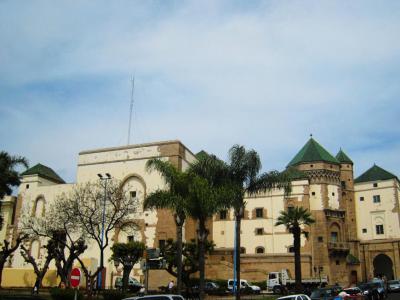
The Pasha’s Courthouse is one of the most grandiose historic buildings in Casablanca, located in the Habous Quarter, an area conceived during the French Protectorate as a “New Medina”. Designed to combine traditional Moroccan urban forms with modern planning principles, Habous was intended as a center for religious, cultural, and civic life, and the courthouse was conceived as one of its key institutional landmarks.
The project was commissioned in January 1930 by At-Tayyib al-Moqri, the Pasha of Casablanca, a high-ranking administrative official and governor, son of the influential Grand Vizier, Mohammed al-Moqri. Plans called for a multifunctional complex that would bring together civil courtrooms, administrative offices, and an official residence for the Pasha. Although the concept dates to the early 1930s, construction took place later, between 1941 and 1943, during World War II.
The building was designed by Auguste Cadet, a prominent French architect active in Casablanca during the Protectorate period. Executed in a Moorish-Andalusian revival style, the courthouse deliberately evokes the appearance of a historic palace rather than a modern government facility. Wartime shortages of industrial materials contributed to this choice, leading to extensive use of traditional Moroccan construction techniques and craftsmanship. Architectural highlights include elaborate zellij tilework, carved cedarwood ceilings and doors, finely chiseled stucco decoration, slender arches, and green-tiled roofs.
Today, the Pasha’s Courthouse remains an active government building, and public access to the interior is restricted to official visits or special arrangements. Even so, its richly decorated exterior and harmonious proportions make it one of the architectural highlights of the Habous Quarter.
The project was commissioned in January 1930 by At-Tayyib al-Moqri, the Pasha of Casablanca, a high-ranking administrative official and governor, son of the influential Grand Vizier, Mohammed al-Moqri. Plans called for a multifunctional complex that would bring together civil courtrooms, administrative offices, and an official residence for the Pasha. Although the concept dates to the early 1930s, construction took place later, between 1941 and 1943, during World War II.
The building was designed by Auguste Cadet, a prominent French architect active in Casablanca during the Protectorate period. Executed in a Moorish-Andalusian revival style, the courthouse deliberately evokes the appearance of a historic palace rather than a modern government facility. Wartime shortages of industrial materials contributed to this choice, leading to extensive use of traditional Moroccan construction techniques and craftsmanship. Architectural highlights include elaborate zellij tilework, carved cedarwood ceilings and doors, finely chiseled stucco decoration, slender arches, and green-tiled roofs.
Today, the Pasha’s Courthouse remains an active government building, and public access to the interior is restricted to official visits or special arrangements. Even so, its richly decorated exterior and harmonious proportions make it one of the architectural highlights of the Habous Quarter.
7) Royal Palace
The Royal Palace of Casablanca is one of Morocco’s official royal residences and forms part of a wider network of palaces used by the Moroccan monarchy across the country. Established during the period of the French Protectorate, the palace reflects the continued importance of Casablanca as Morocco’s economic capital, even though it has never been the primary seat of royal power.
Architecturally, the palace follows traditional Moroccan royal design. High walls enclose a complex organized around courtyards and gardens, with decorative tilework, carved plaster, and water features forming the core of the design. Although comparisons are sometimes made to Andalusian palaces such as the Alhambra, the Casablanca palace is firmly rooted in Moroccan court architecture, where privacy, enclosure, and controlled access are essential elements.
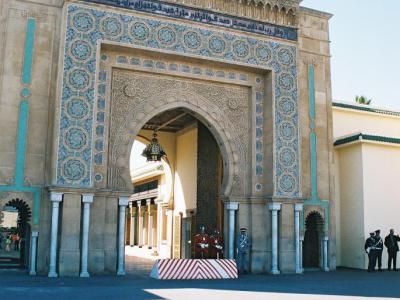
What visitors encounter is the palace exterior and its ceremonial setting. In front of the palace lies a broad open esplanade, often referred to as the Mechouar, lined with palm trees and fountains. This space offers clear views of the monumental entrance gates, decorated with geometric tilework and carved details.
The palace is guarded at all times by uniformed royal guards, and access beyond the gates is restricted. There are no public visits to the interior, as the complex functions as a working royal residence used during official stays in the city. For visitors, the experience lies in observing the architecture, the ceremonial space, and the atmosphere of royal authority from outside.
Architecturally, the palace follows traditional Moroccan royal design. High walls enclose a complex organized around courtyards and gardens, with decorative tilework, carved plaster, and water features forming the core of the design. Although comparisons are sometimes made to Andalusian palaces such as the Alhambra, the Casablanca palace is firmly rooted in Moroccan court architecture, where privacy, enclosure, and controlled access are essential elements.
What visitors encounter is the palace exterior and its ceremonial setting. In front of the palace lies a broad open esplanade, often referred to as the Mechouar, lined with palm trees and fountains. This space offers clear views of the monumental entrance gates, decorated with geometric tilework and carved details.
The palace is guarded at all times by uniformed royal guards, and access beyond the gates is restricted. There are no public visits to the interior, as the complex functions as a working royal residence used during official stays in the city. For visitors, the experience lies in observing the architecture, the ceremonial space, and the atmosphere of royal authority from outside.
8) United Nations Square
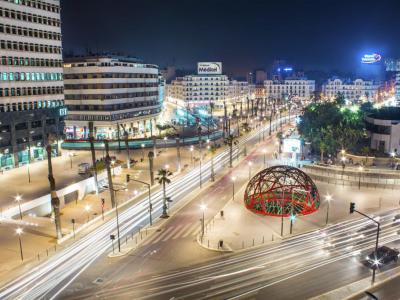
Central to the history of modern Casablanca is United Nations Square. Before French colonization, this area was known as Grand Market. In 1908, after the French bombardment and occupation of Casablanca, the French commander Charles Martial Joseph Dessigny ordered the construction of a clock tower here, marking the start of significant colonial intervention.
The space was soon named “Square of the Clock”. A planning team led by General Hubert Lyautey and architect Henri Prost then reconfigured the square and much of the town according to new urban designs. The original clock tower was demolished in 1948 amid mid-century urban changes, primarily to open the way for the Royal Armed Forces Avenue, laid out under planner Michel Écochard. A new clock tower, modeled after the original, was constructed at the south of the square in 1993.
Another visual marker within the evolving square is the “Globe” sculpture, designed in 1975 by architect Jean-François Zevaco. It is located within the open central area of the square, closer to the tram lines. Along the northern edge, the square opens toward Avenue of the Royal Armed Forces, which runs along the boundary of the old medina.
The space was soon named “Square of the Clock”. A planning team led by General Hubert Lyautey and architect Henri Prost then reconfigured the square and much of the town according to new urban designs. The original clock tower was demolished in 1948 amid mid-century urban changes, primarily to open the way for the Royal Armed Forces Avenue, laid out under planner Michel Écochard. A new clock tower, modeled after the original, was constructed at the south of the square in 1993.
Another visual marker within the evolving square is the “Globe” sculpture, designed in 1975 by architect Jean-François Zevaco. It is located within the open central area of the square, closer to the tram lines. Along the northern edge, the square opens toward Avenue of the Royal Armed Forces, which runs along the boundary of the old medina.
9) Clock Tower and Medina Gate
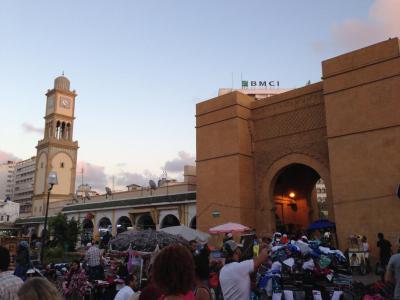
After serving in Algeria, where he supervised the construction of a clock tower, the French officer and engineer Charles Martial Joseph Dessigny was assigned to Casablanca following the French military occupation of the city in 1907. One of his earliest and most symbolic projects in Casablanca was the construction of a clock tower at the edge of the old town. Built quickly and completed in 1909, the tower was intended to mark the entrance to the historic quarter while asserting a new administrative order.
The original Clock Tower deliberately echoed the form of a minaret. Square in plan and vertically emphatic, it rose above its surroundings with four clock faces marked in Roman numerals. This visual resemblance was not accidental. Positioned at the threshold between the European quarters and the medina, the tower signaled the arrival of French authority.
Over time, structural instability became an issue. By the mid-20th century, the tower was considered unsafe and was demolished in 1948. For decades, only photographs and memory preserved its image. In 1993, a replica of Dessigny’s tower was erected nearby, restoring the landmark to the urban landscape, though without its original political charge. Today, the replica Clock Tower stands at the northeastern edge of United Nations Square, beside the Old Medina Gate.
The nearby gate predates the colonial period and historically controlled access to the walled town, regulating the movement of people and goods between the port, the market streets, and the residential quarters inside. During the early French period, the gate was reshaped and visually emphasized. Today, small shops and informal stalls continue this long tradition of exchange.
The original Clock Tower deliberately echoed the form of a minaret. Square in plan and vertically emphatic, it rose above its surroundings with four clock faces marked in Roman numerals. This visual resemblance was not accidental. Positioned at the threshold between the European quarters and the medina, the tower signaled the arrival of French authority.
Over time, structural instability became an issue. By the mid-20th century, the tower was considered unsafe and was demolished in 1948. For decades, only photographs and memory preserved its image. In 1993, a replica of Dessigny’s tower was erected nearby, restoring the landmark to the urban landscape, though without its original political charge. Today, the replica Clock Tower stands at the northeastern edge of United Nations Square, beside the Old Medina Gate.
The nearby gate predates the colonial period and historically controlled access to the walled town, regulating the movement of people and goods between the port, the market streets, and the residential quarters inside. During the early French period, the gate was reshaped and visually emphasized. Today, small shops and informal stalls continue this long tradition of exchange.
10) Church of San Buenaventura
Saint Bonaventure, born as Giovanni di Fidanza in 1217, was one of the great theologians of the Franciscan Order. According to tradition, Saint Francis of Assisi cured him as a child and, witnessing his recovery, exclaimed “O buona ventura!”. The expression, meaning “good fortune”, was later adopted as Giovanni’s name, Bonaventure.
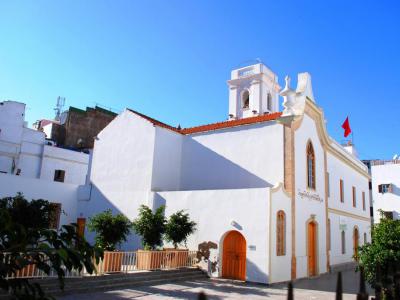
In the late 19th century, as Casablanca’s port expanded and its foreign communities grew, Spanish Franciscan missionaries established a church in the Old Town dedicated to Saint Bonaventure. Founded around 1890, the church became a key place of worship for the Spanish Catholic community. However, following Moroccan independence and the gradual departure of many European residents, the church ceased regular religious services in 1968.
Architecturally modest and functional, Saint Bonaventure reflects late 19th-century missionary church design, with simple forms adapted to the dense fabric of the Old Town rather than overt stylistic display.
Today, the site operates as a youth house and neighborhood resource hub, hosting sports activities, artisanal workshops, and cultural programs aimed at residents of the Old Town. While its religious role has ended, the building remains a significant landmark, illustrating Casablanca’s layered history and the city’s contemporary approach to preserving heritage.
In the late 19th century, as Casablanca’s port expanded and its foreign communities grew, Spanish Franciscan missionaries established a church in the Old Town dedicated to Saint Bonaventure. Founded around 1890, the church became a key place of worship for the Spanish Catholic community. However, following Moroccan independence and the gradual departure of many European residents, the church ceased regular religious services in 1968.
Architecturally modest and functional, Saint Bonaventure reflects late 19th-century missionary church design, with simple forms adapted to the dense fabric of the Old Town rather than overt stylistic display.
Today, the site operates as a youth house and neighborhood resource hub, hosting sports activities, artisanal workshops, and cultural programs aimed at residents of the Old Town. While its religious role has ended, the building remains a significant landmark, illustrating Casablanca’s layered history and the city’s contemporary approach to preserving heritage.
11) Ettedgui Synagogue
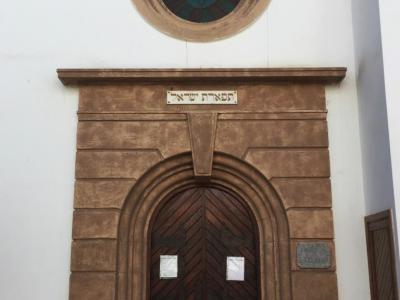
The Ettedgui Synagogue stands as one of the most important witnesses to Casablanca’s Jewish past. It was built in 1920 by the Ettedgui family, a prominent Jewish family active in the city’s commercial life, at a time when Casablanca supported one of the largest Jewish communities in North Africa.
During World War II, the building was damaged in 1942, when Casablanca was affected by Allied bombardments linked to Operation Torch. As the city’s Jewish population declined in the following decades, the synagogue fell into disuse and gradually deteriorated. Restoration efforts began in the late 20th century and gained momentum under King Mohammed VI, as part of a national program dedicated to preserving Morocco’s Jewish heritage.
Architecturally, the synagogue reflects a blend of traditional Moroccan craftsmanship and early 20th-century urban design. The exterior is discreet, in keeping with the dense fabric of the Old Town, while the interior is more expressive, featuring horseshoe arches, carved plasterwork, decorative tile panels, and a central bimah arranged according to Sephardic tradition.
Today, the Ettedgui Synagogue functions both as a place of worship on special occasions and as a heritage and exhibition space. Its displays of photographs, documents, and cultural objects trace the social, religious, and economic history of Casablanca’s Jewish community, allowing the building to serve as both a sacred site and a living archive of the city’s multicultural past.
During World War II, the building was damaged in 1942, when Casablanca was affected by Allied bombardments linked to Operation Torch. As the city’s Jewish population declined in the following decades, the synagogue fell into disuse and gradually deteriorated. Restoration efforts began in the late 20th century and gained momentum under King Mohammed VI, as part of a national program dedicated to preserving Morocco’s Jewish heritage.
Architecturally, the synagogue reflects a blend of traditional Moroccan craftsmanship and early 20th-century urban design. The exterior is discreet, in keeping with the dense fabric of the Old Town, while the interior is more expressive, featuring horseshoe arches, carved plasterwork, decorative tile panels, and a central bimah arranged according to Sephardic tradition.
Today, the Ettedgui Synagogue functions both as a place of worship on special occasions and as a heritage and exhibition space. Its displays of photographs, documents, and cultural objects trace the social, religious, and economic history of Casablanca’s Jewish community, allowing the building to serve as both a sacred site and a living archive of the city’s multicultural past.

12) Temple Beth-El
Temple Beth-El, located in Casablanca, is a prominent symbol of the city's rich Jewish heritage. Known for being one of the largest synagogues in the Kingdom of Morocco, it is not only a place of worship but also serves as a social and religious hub for Casablanca’s Jewish community. The city, which houses the largest Jewish population in the Arab world, boasts more than 30 synagogues, with Beth-El often regarded as the centerpiece.
Architecturally, Temple Beth-El is renowned for its splendid design elements, including luxurious chandeliers and stained glass windows that cast colorful light across the white and gilded plaster interiors. These features attract many tourists, highlighting the synagogue's role in promoting Jewish culture and heritage. A significant refurbishment in 1997 helped preserve these artistic elements and the building's overall grandeur.
Beth-El's historical and cultural significance extends beyond its architecture. The synagogue encapsulates the once vibrant Jewish community of Casablanca, which has dwindled to about 2,000 members today. Despite this decrease, the majority of the Jewish population continues to gather here for prayer and celebration, underscoring its importance in their religious life.
Moreover, Temple Beth-El symbolizes the harmonious coexistence between Muslims and Jews in Morocco-a country with a Jewish history dating back to 70 CE. At times, the Islamic call to prayer melds with Jewish prayers within the temple walls, painting a vivid picture of mutual respect and integration. The synagogue's Muslim gatekeeper, who kneels for prayer at the entrance, further exemplifies this peaceful interfaith relationship.
Architecturally, Temple Beth-El is renowned for its splendid design elements, including luxurious chandeliers and stained glass windows that cast colorful light across the white and gilded plaster interiors. These features attract many tourists, highlighting the synagogue's role in promoting Jewish culture and heritage. A significant refurbishment in 1997 helped preserve these artistic elements and the building's overall grandeur.
Beth-El's historical and cultural significance extends beyond its architecture. The synagogue encapsulates the once vibrant Jewish community of Casablanca, which has dwindled to about 2,000 members today. Despite this decrease, the majority of the Jewish population continues to gather here for prayer and celebration, underscoring its importance in their religious life.
Moreover, Temple Beth-El symbolizes the harmonious coexistence between Muslims and Jews in Morocco-a country with a Jewish history dating back to 70 CE. At times, the Islamic call to prayer melds with Jewish prayers within the temple walls, painting a vivid picture of mutual respect and integration. The synagogue's Muslim gatekeeper, who kneels for prayer at the entrance, further exemplifies this peaceful interfaith relationship.
