Custom Walk in Catania, Italy by mitropoulos_7f83d created on 2025-04-21
Guide Location: Italy » Catania
Guide Type: Custom Walk
# of Sights: 14
Tour Duration: 3 Hour(s)
Travel Distance: 6.3 Km or 3.9 Miles
Share Key: 2SFK6
Guide Type: Custom Walk
# of Sights: 14
Tour Duration: 3 Hour(s)
Travel Distance: 6.3 Km or 3.9 Miles
Share Key: 2SFK6
How It Works
Please retrieve this walk in the GPSmyCity app. Once done, the app will guide you from one tour stop to the next as if you had a personal tour guide. If you created the walk on this website or come to the page via a link, please follow the instructions below to retrieve the walk in the app.
Retrieve This Walk in App
Step 1. Download the app "GPSmyCity: Walks in 1K+ Cities" on Apple App Store or Google Play Store.



Step 2. In the GPSmyCity app, download(or launch) the guide "Catania Map and Walking Tours".
Step 3. Tap the menu button located at upper right corner of the "Walks" screen and select "Retrieve custom walk". Enter the share key: 2SFK6
1) At 'Piscaria (Catania Fish Market) (must see)
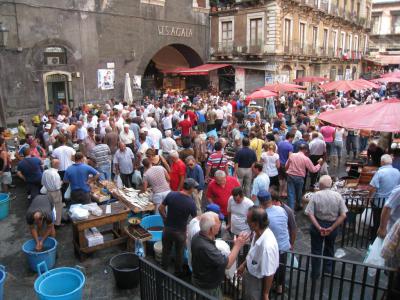
Catania Fish Market has operated continuously since the early 19th century and remains inseparable from the rhythms of the sea. Part of the market unfolds beneath the Tunnel of Charles V, a 16th-century stone passage dug under the Palace of the Seminary of the Clerics and the former defensive walls built during the reign of Emperor Charles V. The vaulted tunnel amplifies sound and smell alike: vendors’ shouted prices echo against lava-stone walls, while the scent of saltwater and fresh fish lingers in the air.
From early morning, stalls spill into surrounding streets, piled high with seafood from the Ionian Sea: swordfish, tuna, sea bass, shrimp, anchovies, clams, mussels, and sea urchins, some of it still moving as it is cleaned and cut on the spot. Vendors compete for attention with loud shouted calls in a lively contest for attention, while water is constantly thrown across the pavement to keep the fish fresh.
In recent years, the Fish Market has also become a place where visitors can actively take part in Catania’s food culture. Travelers often wander through the stalls to watch fishmongers skillfully clean swordfish or open sea urchins, sometimes offering a quick taste of the bright orange roe. Small counters nearby prepare seafood on the spot, frying anchovies, calamari, or shrimp and serving them in paper cones for an easy snack while walking through the market. Some vendors also shuck oysters or slice raw fish for simple tastings. Arriving early in the morning gives visitors the best chance to see the market at full energy, when the stalls are busiest and the day’s catch is still being sorted and sold.
From early morning, stalls spill into surrounding streets, piled high with seafood from the Ionian Sea: swordfish, tuna, sea bass, shrimp, anchovies, clams, mussels, and sea urchins, some of it still moving as it is cleaned and cut on the spot. Vendors compete for attention with loud shouted calls in a lively contest for attention, while water is constantly thrown across the pavement to keep the fish fresh.
In recent years, the Fish Market has also become a place where visitors can actively take part in Catania’s food culture. Travelers often wander through the stalls to watch fishmongers skillfully clean swordfish or open sea urchins, sometimes offering a quick taste of the bright orange roe. Small counters nearby prepare seafood on the spot, frying anchovies, calamari, or shrimp and serving them in paper cones for an easy snack while walking through the market. Some vendors also shuck oysters or slice raw fish for simple tastings. Arriving early in the morning gives visitors the best chance to see the market at full energy, when the stalls are busiest and the day’s catch is still being sorted and sold.
2) Elephant Fountain
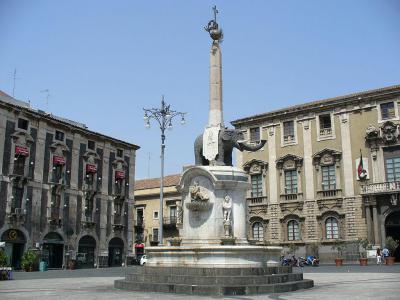
The Elephant Fountain (Fontana dell'Elefante) is a striking landmark in the heart of Cathedral Square (Piazza del Duomo) in Catania. Designed by architect Giovanni Battista Vaccarini between 1735 and 1737, this monument has become the emblem of Catania, showcasing the city’s resilience and cultural richness following the devastating earthquake of 1693.
The fountain's centerpiece is a black basalt statue of an elephant, affectionately called U Liotru, a symbol of the city. The origins of Vaccarini's inspiration are debated, with some attributing it to Gian Lorenzo Bernini’s Elephant and Obelisk in Rome, while others see a link to the Hypnerotomachia Poliphili, a Renaissance text.
The fountain’s base, made of white marble, features sculptures representing the Simeto and Amenano rivers, the key to Catania’s identity. The elephant statue itself faces the Cathedral of Saint Agatha, the city's patron saint, with an Egyptian-style obelisk mounted on its back. This granite obelisk, likely from ancient Syene, bears decorative motifs but no decipherable hieroglyphs. Atop the obelisk are symbolic elements: a globe, palm leaves for martyrdom, lilies for purity, and a metal tablet inscribed with a dedication to Saint Agatha, crowned by a cross.
Since its creation, the fountain has undergone multiple renovations, reflecting its central role in Catania’s history. Initially completed in 1737, a marble basin was added in 1757. In 1826, an iron fence and garden were installed, though these were later removed in 1998 to create a more accessible public space. Notably, the fountain narrowly escaped relocation to Piazza Palestro in 1862, thanks to a popular uprising led by Bonaventura Gravina.
Today, the Elephant Fountain stands as a symbol of Catania's spirit, blending history, artistry, and devotion in one iconic monument.
The fountain's centerpiece is a black basalt statue of an elephant, affectionately called U Liotru, a symbol of the city. The origins of Vaccarini's inspiration are debated, with some attributing it to Gian Lorenzo Bernini’s Elephant and Obelisk in Rome, while others see a link to the Hypnerotomachia Poliphili, a Renaissance text.
The fountain’s base, made of white marble, features sculptures representing the Simeto and Amenano rivers, the key to Catania’s identity. The elephant statue itself faces the Cathedral of Saint Agatha, the city's patron saint, with an Egyptian-style obelisk mounted on its back. This granite obelisk, likely from ancient Syene, bears decorative motifs but no decipherable hieroglyphs. Atop the obelisk are symbolic elements: a globe, palm leaves for martyrdom, lilies for purity, and a metal tablet inscribed with a dedication to Saint Agatha, crowned by a cross.
Since its creation, the fountain has undergone multiple renovations, reflecting its central role in Catania’s history. Initially completed in 1737, a marble basin was added in 1757. In 1826, an iron fence and garden were installed, though these were later removed in 1998 to create a more accessible public space. Notably, the fountain narrowly escaped relocation to Piazza Palestro in 1862, thanks to a popular uprising led by Bonaventura Gravina.
Today, the Elephant Fountain stands as a symbol of Catania's spirit, blending history, artistry, and devotion in one iconic monument.
3) Roman Theater of Catania (must see)
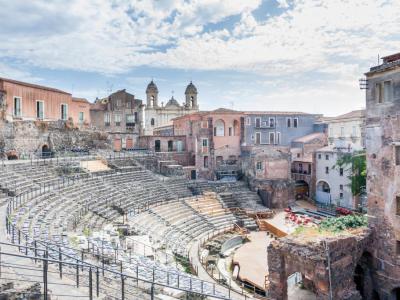
Although the visible structure dates mainly to the 2nd century AD, the Roman Theater was built directly over an earlier Greek theater. Together with the adjacent Odeon, the complex formed the city’s principal venue for performance and public gatherings. Constructed primarily from lava stone and limestone, the seating rises northward, uphill, while spectators would have looked south toward the stage, orchestra, and the sea beyond.
The elliptical structure measured roughly 330 feet in diameter and could accommodate around 7,000 spectators across twenty-one seating rows, accessed through corridors built beneath the cavea. The smaller Odeon, with a capacity of about 1,500, was reserved for music and poetry competitions and is among the best-preserved examples of its kind in Sicily.
One of the theater’s most impressive features is the Amenano River flowing directly underneath the structure. Buried by the 1669 eruption of Mount Etna, the river still runs below the orchestra, which is why parts of the lower theater are often partially flooded with clear freshwater. After the 5th century AD, the complex fell out of use, and much of its marble seating and columns were stripped during the Middle Ages. Reused in major buildings such as Catania Cathedral, recycled theater columns can still be seen in the apse.
Excavations began in the 18th century under Ignazio Paternò Castello, Prince of Biscari, and continued into the 19th century, but it was only in 1959 that modern houses encroaching on the site were removed, fully exposing the theater and Odeon. Two of those former residences on the north side of the theater, Pandolfo House and Liberti House, remain integrated into the complex today, serving as entrance spaces and small museums displaying statues, marble fragments, and architectural elements found on site.
The elliptical structure measured roughly 330 feet in diameter and could accommodate around 7,000 spectators across twenty-one seating rows, accessed through corridors built beneath the cavea. The smaller Odeon, with a capacity of about 1,500, was reserved for music and poetry competitions and is among the best-preserved examples of its kind in Sicily.
One of the theater’s most impressive features is the Amenano River flowing directly underneath the structure. Buried by the 1669 eruption of Mount Etna, the river still runs below the orchestra, which is why parts of the lower theater are often partially flooded with clear freshwater. After the 5th century AD, the complex fell out of use, and much of its marble seating and columns were stripped during the Middle Ages. Reused in major buildings such as Catania Cathedral, recycled theater columns can still be seen in the apse.
Excavations began in the 18th century under Ignazio Paternò Castello, Prince of Biscari, and continued into the 19th century, but it was only in 1959 that modern houses encroaching on the site were removed, fully exposing the theater and Odeon. Two of those former residences on the north side of the theater, Pandolfo House and Liberti House, remain integrated into the complex today, serving as entrance spaces and small museums displaying statues, marble fragments, and architectural elements found on site.
4) Piazza dell'Universita (University Square)
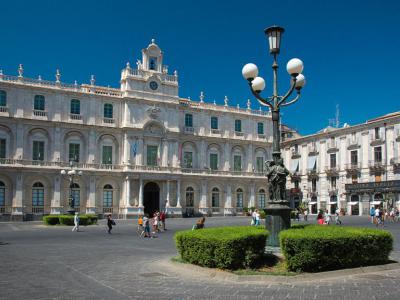
University Square is one of the city's symbols of Baroque design. Laid out after the devastating earthquake of 1693, it formed part of the city’s 18th-century reconstruction. Compared with the busier squares nearby, University Square has a calmer, more composed atmosphere.
The square takes its name from the University of Catania. Late Baroque palaces associated with the university line the square. For this reason, the square is also sometimes referred to as Student Square. Facing the west side of the square, the University Palace serves as the institution’s main seat. To the right corner of the north side, stands Gioeni Palace, while San Giuliano Palace completes the frame on the east side.
At the center of University Square stand four elaborate bronze lampposts designed by Vincenzo Corsaro, arranged together like a monumental candelabrum. Each lamppost is richly sculpted and illustrates a story drawn from Sicilian legend or history, celebrating virtues traditionally admired on the island: chastity, represented by Gammazita; patriotism, embodied by Paladin; filial devotion, shown by the Brothers Pii; and cleverness, symbolized by Colapesce.
Gammazita is located at the north-east corner, near San Giuliano Palace, depicting a woman who dives into a well to escape a soldier. Paladin stands at the south-east corner, showing a knight overcoming a Saracen. The Brothers Pii, at the north-west corner, near the University Palace, portray siblings saving their parents from a river of lava. Finally, Colapesce, at the south-west corner, represents the legendary youth who dives beneath the sea to support the island and is never seen again.
The square takes its name from the University of Catania. Late Baroque palaces associated with the university line the square. For this reason, the square is also sometimes referred to as Student Square. Facing the west side of the square, the University Palace serves as the institution’s main seat. To the right corner of the north side, stands Gioeni Palace, while San Giuliano Palace completes the frame on the east side.
At the center of University Square stand four elaborate bronze lampposts designed by Vincenzo Corsaro, arranged together like a monumental candelabrum. Each lamppost is richly sculpted and illustrates a story drawn from Sicilian legend or history, celebrating virtues traditionally admired on the island: chastity, represented by Gammazita; patriotism, embodied by Paladin; filial devotion, shown by the Brothers Pii; and cleverness, symbolized by Colapesce.
Gammazita is located at the north-east corner, near San Giuliano Palace, depicting a woman who dives into a well to escape a soldier. Paladin stands at the south-east corner, showing a knight overcoming a Saracen. The Brothers Pii, at the north-west corner, near the University Palace, portray siblings saving their parents from a river of lava. Finally, Colapesce, at the south-west corner, represents the legendary youth who dives beneath the sea to support the island and is never seen again.
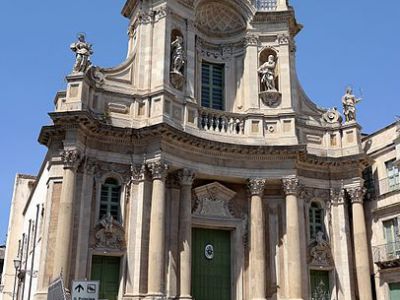
5) Basilica della Collegiata
The Ancient Royal and Eminent Basilica Collegiate of Our Lady of the Alms, more commonly referred to as the Basilica della Collegiata, stands as a remarkable example of Sicilian Baroque architecture in the heart of Catania, Sicily. Completed in 1794, the church is a testament to the city’s resilience, having been rebuilt in the early 18th century following the devastating earthquake of 1693 that destroyed much of Catania. Originally constructed in the Middle Ages, it was elevated to a collegiate church by Pope Eugenius IV.
The Basilica's redesign by Angelo Italia reoriented it towards the newly planned Via Uzeda (now Etnea Street) as part of post-earthquake urban renewal. Stefano Ittar, a Polish architect, crafted the stunning late Baroque façade with a two-tiered design: six stone columns on the lower level, statues flanking a central window on the upper level, and a bell structure above. A grand staircase with a wrought iron parapet leads to the church.
The Basilica's interior follows a traditional plan with a nave, two aisles, and three apses. The central apse, housing the rectory, is the focal point. The right aisle features a baptistery, three saintly altars, and the Altar of the Virgin of the Immaculate Conception, adorned with a marble balustrade and statue. Above the high altar in the nave’s apse is an icon of the Virgin with Child, a copy of a Byzantine original. An 18th-century wooden organ and choir enhance the sacred atmosphere. The left aisle leads to the Holy Sacrament Chapel with a polychrome marble altar and includes Olivio Sozzi's altarpiece of Sant’Apollonia. The 1896 frescoes by Giuseppe Sciuti depict the Life of Mary, Angels, and Saints.
The Basilica della Collegiata is not only a jewel of Sicilian Baroque but also a testament to the enduring faith and artistic legacy of Catania.
The Basilica's redesign by Angelo Italia reoriented it towards the newly planned Via Uzeda (now Etnea Street) as part of post-earthquake urban renewal. Stefano Ittar, a Polish architect, crafted the stunning late Baroque façade with a two-tiered design: six stone columns on the lower level, statues flanking a central window on the upper level, and a bell structure above. A grand staircase with a wrought iron parapet leads to the church.
The Basilica's interior follows a traditional plan with a nave, two aisles, and three apses. The central apse, housing the rectory, is the focal point. The right aisle features a baptistery, three saintly altars, and the Altar of the Virgin of the Immaculate Conception, adorned with a marble balustrade and statue. Above the high altar in the nave’s apse is an icon of the Virgin with Child, a copy of a Byzantine original. An 18th-century wooden organ and choir enhance the sacred atmosphere. The left aisle leads to the Holy Sacrament Chapel with a polychrome marble altar and includes Olivio Sozzi's altarpiece of Sant’Apollonia. The 1896 frescoes by Giuseppe Sciuti depict the Life of Mary, Angels, and Saints.
The Basilica della Collegiata is not only a jewel of Sicilian Baroque but also a testament to the enduring faith and artistic legacy of Catania.
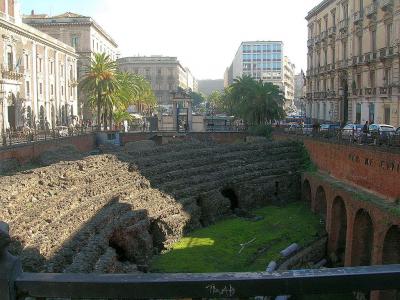
6) Roman Amphitheater
The Roman Amphitheater reveals the immense scale of ancient Catania below today’s streets. Built around 200 AD during the Roman Imperial period, it ranked among the largest amphitheaters in Italy. Positioned on the northern side of the ancient city, at the base of Montevergine Hill, it once hosted public spectacles for an audience of around 15,000, with additional standing room likely added for major events.
The amphitheater was constructed using lava stone and brick. Elliptical in plan, it featured radial walls and vaulted structures to support tiered seating, with an external gallery encircling the arena. Its dimensions were considerable, with an arena measuring roughly 268 by 164 feet, and an outer circumference of more than 1,000 feet. Evidence suggests the structure was sophisticated enough to stage naumachiae, or mock sea battles, using water supplied by the city’s aqueduct.
Over time, natural disasters and urban growth gradually erased the amphitheater from view. Although legend claims it was spared by lava during Mount Etna’s eruption in 251, the catastrophic earthquake of 1693 buried most of the structure. Stone from the ruins was reused in nearby buildings, including parts of the Church of San Biagio, and the site was covered and turned into garden ground.
The amphitheater re-emerged only during excavations in the 18th century, when its true scale became clear once again. Today, only about one-tenth of the amphitheater is visible, accessed through an iron gate flanked by Ionic columns. Now part of the Greek–Roman Archaeological Park of Catania, the exposed corridors and walls create a wonderful contrast with the surrounding streets, cafés, and shops.
The amphitheater was constructed using lava stone and brick. Elliptical in plan, it featured radial walls and vaulted structures to support tiered seating, with an external gallery encircling the arena. Its dimensions were considerable, with an arena measuring roughly 268 by 164 feet, and an outer circumference of more than 1,000 feet. Evidence suggests the structure was sophisticated enough to stage naumachiae, or mock sea battles, using water supplied by the city’s aqueduct.
Over time, natural disasters and urban growth gradually erased the amphitheater from view. Although legend claims it was spared by lava during Mount Etna’s eruption in 251, the catastrophic earthquake of 1693 buried most of the structure. Stone from the ruins was reused in nearby buildings, including parts of the Church of San Biagio, and the site was covered and turned into garden ground.
The amphitheater re-emerged only during excavations in the 18th century, when its true scale became clear once again. Today, only about one-tenth of the amphitheater is visible, accessed through an iron gate flanked by Ionic columns. Now part of the Greek–Roman Archaeological Park of Catania, the exposed corridors and walls create a wonderful contrast with the surrounding streets, cafés, and shops.
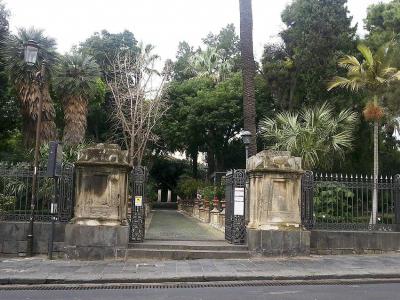
7) Orto Botanico (Botanical Garden)
The Botanical Garden of the University of Catania (Orto Botanico dell'Università di Catania) is a prominent botanical garden covering an area of 16,000 square meters. It is managed by the University of Catania's botany department and holds membership in the Botanic Gardens Conservation International (BGCI).
The garden’s origins trace back to 1847 when an initial attempt to establish it was disrupted by the revolutions of 1848. It was successfully founded in 1858 by Francis Roccaforte Tornabene, a Benedictine monk and botanist. The first plantings, in 1862, featured specimens sourced from botanical gardens in Sweden, France, Naples, and Palermo. In 1865, thanks to a generous donation from Mario Coltraro, the garden expanded to include an area dedicated to indigenous Sicilian flora. In the early 1900s, the garden was further enriched by the creation of the Giardino Botanico "Nuova Gussonea" on Mount Etna, focusing on native mountain plants.
The Botanical Garden, revitalized after World War II damage and the 1958 loss of its Tepidario greenhouse, now spans two sections. The 13,000 square meters Hortus Generalis hosts exotic plants in limestone-bordered squares, with greenhouses for succulents, tropical species, and aquatic tanks. The 3,000 square meters Hortus Siculus focuses on Sicilian species, featuring lava-stone-bordered beds arranged by the botanical family.
The garden also boasts a striking neoclassical departmental building, adding architectural charm to this scientific and cultural landmark. The Orto Botanico stands as a testament to botanical heritage and research, offering visitors a unique glimpse into both exotic and native Sicilian plant species.
The garden’s origins trace back to 1847 when an initial attempt to establish it was disrupted by the revolutions of 1848. It was successfully founded in 1858 by Francis Roccaforte Tornabene, a Benedictine monk and botanist. The first plantings, in 1862, featured specimens sourced from botanical gardens in Sweden, France, Naples, and Palermo. In 1865, thanks to a generous donation from Mario Coltraro, the garden expanded to include an area dedicated to indigenous Sicilian flora. In the early 1900s, the garden was further enriched by the creation of the Giardino Botanico "Nuova Gussonea" on Mount Etna, focusing on native mountain plants.
The Botanical Garden, revitalized after World War II damage and the 1958 loss of its Tepidario greenhouse, now spans two sections. The 13,000 square meters Hortus Generalis hosts exotic plants in limestone-bordered squares, with greenhouses for succulents, tropical species, and aquatic tanks. The 3,000 square meters Hortus Siculus focuses on Sicilian species, featuring lava-stone-bordered beds arranged by the botanical family.
The garden also boasts a striking neoclassical departmental building, adding architectural charm to this scientific and cultural landmark. The Orto Botanico stands as a testament to botanical heritage and research, offering visitors a unique glimpse into both exotic and native Sicilian plant species.
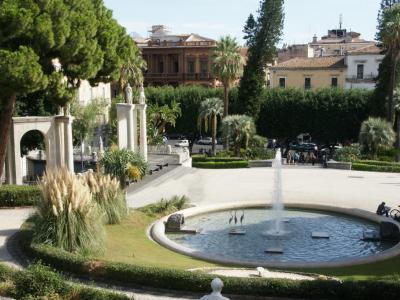
8) Giardino Bellini (Bellini Garden) (must see)
Bellini Garden is the most popular garden in which to go for a walk among locals. It is dedicated to the famous Italian composer born in Catania, V. Bellini.
Before the construction of a public garden, the area was occupied by the garden maze or labyrinth owned by the Ignazio Paternò Castello, prince of Biscari. In 1854, the Municipality of Catania bought the area of the maze, and in 1864 started to adapt the area into a public garden.
Starting from 1875, the municipality acquired several further areas surrounding the maze, and two years later the work to unify these areas was undertaken. The Bellini Garden was inaugurated in 1883.
Inside, the villa is equipped with numerous architectural features such as ponds, fountains, statues and busts of many distinguished people from Catania.
Before the construction of a public garden, the area was occupied by the garden maze or labyrinth owned by the Ignazio Paternò Castello, prince of Biscari. In 1854, the Municipality of Catania bought the area of the maze, and in 1864 started to adapt the area into a public garden.
Starting from 1875, the municipality acquired several further areas surrounding the maze, and two years later the work to unify these areas was undertaken. The Bellini Garden was inaugurated in 1883.
Inside, the villa is equipped with numerous architectural features such as ponds, fountains, statues and busts of many distinguished people from Catania.
9) Monument to Vincenzo Bellini
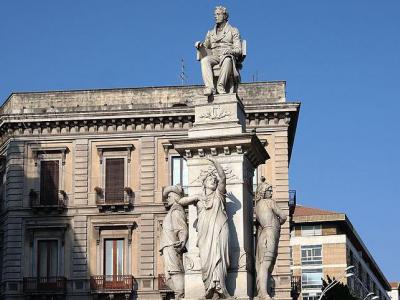
The Monument to Vincenzo Bellini marks Catania’s tribute to its most celebrated composer and a defining figure of Italian opera. Unveiled in 1882, the monument honors Bellini, born in Catania in 1801, whose operas, “Norma”, “The Sleepwalker”, “The Puritans”, and “The Pirate”, secured his international reputation despite his short life.
Designed and sculpted by Giulio Monteverde, the monument takes the form of a stepped, pyramid-like base crowned by a column. Bellini is depicted seated at the top, in a calm, reflective pose in a moment of inspiration, holding a pen and musical scores. The composition has been playfully read as a musical ascent: do, re, mi, fa, so, la, ti, seven steps leading up to the composer himself.
Around the base, four statues represent characters from Bellini’s operas mentioned above, translating music into allegorical form. An elegant iron Art Nouveau fence encloses the monument, reinforcing its 19th-century character. Though debates once suggested placing the monument in Bellini Square or even Cathedral Square, its location here has endured, making it both a cultural landmark and a natural meeting point.
Designed and sculpted by Giulio Monteverde, the monument takes the form of a stepped, pyramid-like base crowned by a column. Bellini is depicted seated at the top, in a calm, reflective pose in a moment of inspiration, holding a pen and musical scores. The composition has been playfully read as a musical ascent: do, re, mi, fa, so, la, ti, seven steps leading up to the composer himself.
Around the base, four statues represent characters from Bellini’s operas mentioned above, translating music into allegorical form. An elegant iron Art Nouveau fence encloses the monument, reinforcing its 19th-century character. Though debates once suggested placing the monument in Bellini Square or even Cathedral Square, its location here has endured, making it both a cultural landmark and a natural meeting point.
10) Piazza Bellini (Bellini Square)
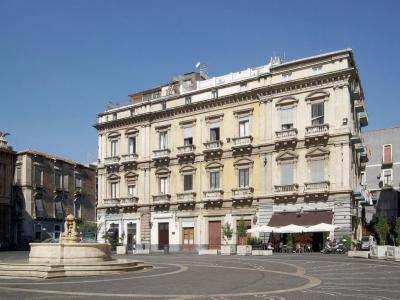
Bellini Square, sometimes informally called Massimo Bellini Theater Square, is a compact and lively space closely tied to Catania’s musical identity. Named after Vincenzo Bellini, the city’s most celebrated composer, the square developed around the opera house and functions as a cultural crossroads. The west side of the square is dominated by the Massimo Bellini Theater, Catania’s principal opera house and one of its finest 19th-century landmarks. Designed by Andrea Scala and Carlo Sala, the theater was completed in 1890 and inaugurated with the world premiere of Bellini’s Norma.
Bellini Square also reflects the city’s layered urban history. On the north side, the façade of the House of the Disabled Veterans recalls 20th-century civic architecture associated with war remembrance and social institutions. Along the east side stands the Tax Court of First Instance of Catania, a functional public building that continues the square’s role as a working part of the modern city rather than a purely ceremonial space.
At the center of the square is a landscaped area, planted with trees that include jacarandas, whose purple blossoms add color in spring and early summer. By day, cafés and shaded benches create a relaxed atmosphere. By night, the square becomes livelier, animated by theater audiences and evening crowds.
Bellini Square also reflects the city’s layered urban history. On the north side, the façade of the House of the Disabled Veterans recalls 20th-century civic architecture associated with war remembrance and social institutions. Along the east side stands the Tax Court of First Instance of Catania, a functional public building that continues the square’s role as a working part of the modern city rather than a purely ceremonial space.
At the center of the square is a landscaped area, planted with trees that include jacarandas, whose purple blossoms add color in spring and early summer. By day, cafés and shaded benches create a relaxed atmosphere. By night, the square becomes livelier, animated by theater audiences and evening crowds.
11) Badia di Sant'Agata (Church of the Abbey of Saint Agata)
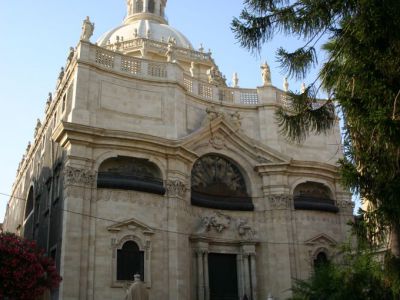
The Church of the Abbey of Saint Agatha (Badia di Sant'Agata), a masterpiece of 18th-century Baroque architecture, stands prominently in Catania, Italy, across the street from the left transept of the city’s cathedral. This Roman Catholic church, part of a female Benedictine convent, is dedicated to Saint Agatha, the patron saint of Catania, and embodies a rich history intertwined with resilience and devotion.
The nunnery was originally founded in 1620 under the Benedictine rule. However, the devastating 1693 earthquake destroyed the convent, claiming the lives of 15 of its 28 nuns. Reconstruction efforts began modestly with cloisters and a perimeter fence, but the ambitious rebuilding of the church itself only commenced in 1736 under the architect Giovanni Battista Vaccarini. His design incorporated a surviving 17th-century portal by Giovanni Maria Amato, preserving a tangible link to the pre-earthquake structure.
The church’s façade, completed by 1742, exudes Baroque elegance, while the octagonal dome, finished in 1768, offers panoramic views of Catania and the imposing Mount Etna. The elongated octagonal interior features a harmonious blend of white marble flooring and yellow Castronovo marble, handpicked by the architect Nicolò Daniele. A metal grill behind the main altar enables the cloistered nuns to observe mass discreetly, while a glass chandelier hangs beneath the dome, adding a touch of grandeur.
The side altars house stucco statues crafted in 1782 by Giovanni Battista Marino, Mario Biondo, and Giovanni Battista Amato, depicting Saint Benedict, the Immaculate Conception, Saint Joseph, and Saint Euplio. The centerpiece of the main altar is a striking statue of Saint Agatha, a fitting tribute to the saint to whom the church is dedicated.
The church was consecrated in 1796, marking its completion as a spiritual and architectural triumph. Over the centuries, the structure endured additional challenges, including earthquake damage in 1990. A comprehensive restoration completed in 2012 ensured its preservation for future generations.
The nunnery was originally founded in 1620 under the Benedictine rule. However, the devastating 1693 earthquake destroyed the convent, claiming the lives of 15 of its 28 nuns. Reconstruction efforts began modestly with cloisters and a perimeter fence, but the ambitious rebuilding of the church itself only commenced in 1736 under the architect Giovanni Battista Vaccarini. His design incorporated a surviving 17th-century portal by Giovanni Maria Amato, preserving a tangible link to the pre-earthquake structure.
The church’s façade, completed by 1742, exudes Baroque elegance, while the octagonal dome, finished in 1768, offers panoramic views of Catania and the imposing Mount Etna. The elongated octagonal interior features a harmonious blend of white marble flooring and yellow Castronovo marble, handpicked by the architect Nicolò Daniele. A metal grill behind the main altar enables the cloistered nuns to observe mass discreetly, while a glass chandelier hangs beneath the dome, adding a touch of grandeur.
The side altars house stucco statues crafted in 1782 by Giovanni Battista Marino, Mario Biondo, and Giovanni Battista Amato, depicting Saint Benedict, the Immaculate Conception, Saint Joseph, and Saint Euplio. The centerpiece of the main altar is a striking statue of Saint Agatha, a fitting tribute to the saint to whom the church is dedicated.
The church was consecrated in 1796, marking its completion as a spiritual and architectural triumph. Over the centuries, the structure endured additional challenges, including earthquake damage in 1990. A comprehensive restoration completed in 2012 ensured its preservation for future generations.
12) Cathedral of Catania (must see)
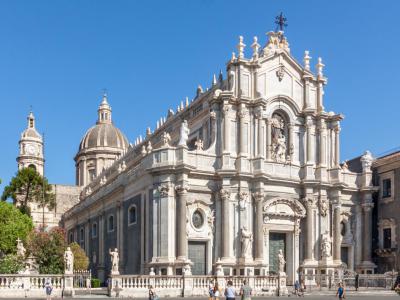
Catania Cathedral, officially the Cathedral of Saint Agatha, stands as both the city’s main religious landmark and a witness to centuries of upheaval. The site has been sacred since the Norman period, when the first cathedral was completed in the 11th century. Repeated earthquakes and eruptions from Mount Etna caused extensive damage, most dramatically in 1169 and in the catastrophic earthquake of 1693. Rather than erasing its past, each reconstruction added another layer.
The present building is a refined example of Sicilian Baroque, shaped largely in the early 18th century. The façade, designed by Giovanni Battista Vaccarini after 1693, rises in three tiers articulated by columns and niches, with pale limestone set against darker volcanic stone. The broad parvis is edged by a white stone balustrade and lined with Carrara marble statues of saints. The central wooden door is carved with panels illustrating episodes from the life of Saint Agatha. The dome was completed in the early 19th century and the bell tower rebuilt following earlier collapses.
Inside, the cathedral follows a Latin cross plan with three naves. The austere rhythm of columns leads toward an apse that dates back to the 12th century, preserving traces of the medieval structure. Several chapels punctuate the interior, including the Chapel of the Holy Crucifix in the north transept. The cathedral also houses, close to the right transept, the tomb of Vincenzo Bellini, Catania’s most celebrated composer, as well as the burial places of King Frederick III of Sicily, John of Randazzo, and Constance of Aragon.
Saint Agatha herself remains central to the cathedral’s meaning. According to tradition, she was a young noblewoman who refused the advances of the Roman prefect Quintianus and was martyred in the 3rd century. Local belief holds that she continues to protect Catania from enemies, injustice, and even Mount Etna. This faith is captured in the letters carved into the façade: N.O.P.A.Q.V.I.E., an acronym of a Latin phrase affirming that Agatha avenges wrongs committed against her land.
The present building is a refined example of Sicilian Baroque, shaped largely in the early 18th century. The façade, designed by Giovanni Battista Vaccarini after 1693, rises in three tiers articulated by columns and niches, with pale limestone set against darker volcanic stone. The broad parvis is edged by a white stone balustrade and lined with Carrara marble statues of saints. The central wooden door is carved with panels illustrating episodes from the life of Saint Agatha. The dome was completed in the early 19th century and the bell tower rebuilt following earlier collapses.
Inside, the cathedral follows a Latin cross plan with three naves. The austere rhythm of columns leads toward an apse that dates back to the 12th century, preserving traces of the medieval structure. Several chapels punctuate the interior, including the Chapel of the Holy Crucifix in the north transept. The cathedral also houses, close to the right transept, the tomb of Vincenzo Bellini, Catania’s most celebrated composer, as well as the burial places of King Frederick III of Sicily, John of Randazzo, and Constance of Aragon.
Saint Agatha herself remains central to the cathedral’s meaning. According to tradition, she was a young noblewoman who refused the advances of the Roman prefect Quintianus and was martyred in the 3rd century. Local belief holds that she continues to protect Catania from enemies, injustice, and even Mount Etna. This faith is captured in the letters carved into the façade: N.O.P.A.Q.V.I.E., an acronym of a Latin phrase affirming that Agatha avenges wrongs committed against her land.
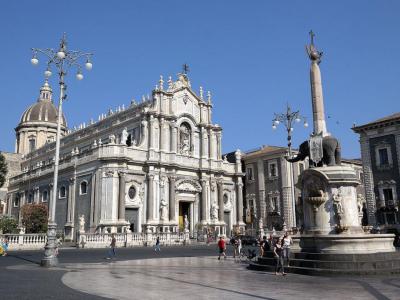
13) Piazza Duomo (Cathedral Square) (must see)
Cathedral Square is a civic and symbolic space where the city’s past and everyday rhythm come together in a single open setting. Rebuilt after the devastating earthquake of 1693, the square is a showcase of Sicilian Baroque, shaped largely in the 18th century as part of Catania’s comprehensive rebuilding plan. Its layout is defined by symmetry, broad sightlines, and a strong sense of order, framed by elegant façades and paved in pale stone that reflects the Mediterranean light.
At the center of the square stands the Elephant Fountain, Catania’s most recognizable symbol. Carved from dark lava stone in the 18th century, the elephant, known locally as Liotru, supports an ancient Egyptian obelisk whose hieroglyphs predate the city itself and echoes the city’s long relationship with Mount Etna.
On the north side of Cathedral Square rises the Elephants’ Palace, which serves as Catania’s City Hall. Built in the 18th century after the earthquake, the palace takes its name from the Elephant Fountain and continues to function as the seat of municipal government, reinforcing the square’s civic role. On the south side, stands the Palace of the Clerics, originally built to house members of the cathedral clergy and today forming part of the architectural frame of the square.
Together with the nearby Cathedral of Saint Agatha, these buildings form a cohesive architectural ensemble that reinforces both the civic and religious importance of this place. Cathedral Square is also a place of constant movement. Cafés line the edges of the square, while the nearby Fish Market fills the surrounding streets with sound, color, and activity.
At the center of the square stands the Elephant Fountain, Catania’s most recognizable symbol. Carved from dark lava stone in the 18th century, the elephant, known locally as Liotru, supports an ancient Egyptian obelisk whose hieroglyphs predate the city itself and echoes the city’s long relationship with Mount Etna.
On the north side of Cathedral Square rises the Elephants’ Palace, which serves as Catania’s City Hall. Built in the 18th century after the earthquake, the palace takes its name from the Elephant Fountain and continues to function as the seat of municipal government, reinforcing the square’s civic role. On the south side, stands the Palace of the Clerics, originally built to house members of the cathedral clergy and today forming part of the architectural frame of the square.
Together with the nearby Cathedral of Saint Agatha, these buildings form a cohesive architectural ensemble that reinforces both the civic and religious importance of this place. Cathedral Square is also a place of constant movement. Cafés line the edges of the square, while the nearby Fish Market fills the surrounding streets with sound, color, and activity.
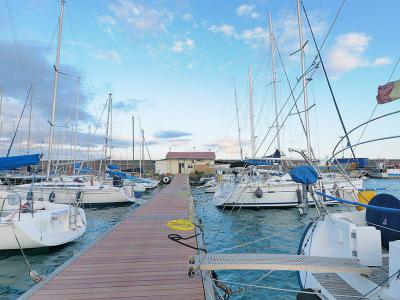
14) Port of Catania
The Port of Catania is a dynamic gateway on the Mediterranean Sea, offering a blend of historical significance and modern functionality. Situated at the foot of Mount Etna, the port boasts a picturesque setting and state-of-the-art facilities, making it one of Sicily's most important maritime hubs.
Originally constructed in 1438, the port has endured and evolved through centuries of rebuilding, including significant restoration after a devastating 17th-century earthquake. Today, it consists of two distinct sections: the historic western port and the modern eastern area. Its total surface area of 615,000 square meters accommodates a wide range of activities, from cargo storage to passenger services.
Catania Cruise Terminal, managed by Catania Cruise Port since 2011 and part of the Global Ports Holding network since 2016, serves as a key hub for cruise operations. Located on the Sporgente Centrale Pier, it supports transit, inter-porting, and homeporting with three docks accommodating up to five modern cruise ships.
In addition to cruise operations, the port supports diverse maritime activities, including cargo transport, yacht docking, and ferry services with national and international connections. Restoration efforts at the Old Customs House have transformed this historic building into a vibrant venue for business and cultural activities, further integrating the port into the city’s waterfront development.
Catania’s mild climate and strategic location in the heart of the Mediterranean make it an ideal year-round cruise destination. Visitors can enjoy a variety of excursions and activities, from exploring Mount Etna to discovering Catania’s cultural landmarks, with convenient pre-and post-cruise options supported by nearby hotels and efficient transportation networks.
With its deep-water quays, modern infrastructure, and proximity to major cruise itineraries, the Port of Catania combines tradition and innovation, standing as a proud emblem of Sicily's maritime heritage.
Originally constructed in 1438, the port has endured and evolved through centuries of rebuilding, including significant restoration after a devastating 17th-century earthquake. Today, it consists of two distinct sections: the historic western port and the modern eastern area. Its total surface area of 615,000 square meters accommodates a wide range of activities, from cargo storage to passenger services.
Catania Cruise Terminal, managed by Catania Cruise Port since 2011 and part of the Global Ports Holding network since 2016, serves as a key hub for cruise operations. Located on the Sporgente Centrale Pier, it supports transit, inter-porting, and homeporting with three docks accommodating up to five modern cruise ships.
In addition to cruise operations, the port supports diverse maritime activities, including cargo transport, yacht docking, and ferry services with national and international connections. Restoration efforts at the Old Customs House have transformed this historic building into a vibrant venue for business and cultural activities, further integrating the port into the city’s waterfront development.
Catania’s mild climate and strategic location in the heart of the Mediterranean make it an ideal year-round cruise destination. Visitors can enjoy a variety of excursions and activities, from exploring Mount Etna to discovering Catania’s cultural landmarks, with convenient pre-and post-cruise options supported by nearby hotels and efficient transportation networks.
With its deep-water quays, modern infrastructure, and proximity to major cruise itineraries, the Port of Catania combines tradition and innovation, standing as a proud emblem of Sicily's maritime heritage.
