Custom Walk in Stockholm, Sweden by sharonhipp67_f4ebb created on 2025-05-13
Guide Location: Sweden » Stockholm
Guide Type: Custom Walk
# of Sights: 10
Tour Duration: 1 Hour(s)
Travel Distance: 1.7 Km or 1.1 Miles
Share Key: K4K76
Guide Type: Custom Walk
# of Sights: 10
Tour Duration: 1 Hour(s)
Travel Distance: 1.7 Km or 1.1 Miles
Share Key: K4K76
How It Works
Please retrieve this walk in the GPSmyCity app. Once done, the app will guide you from one tour stop to the next as if you had a personal tour guide. If you created the walk on this website or come to the page via a link, please follow the instructions below to retrieve the walk in the app.
Retrieve This Walk in App
Step 1. Download the app "GPSmyCity: Walks in 1K+ Cities" on Apple App Store or Google Play Store.



Step 2. In the GPSmyCity app, download(or launch) the guide "Stockholm Map and Walking Tours".
Step 3. Tap the menu button located at upper right corner of the "Walks" screen and select "Retrieve custom walk". Enter the share key: K4K76
1) Marten Trotzigs Grand (Marten Trotzig's Alley)
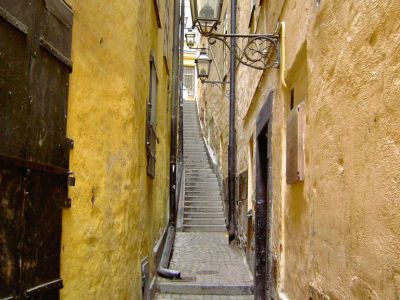
Marten Trotzig's Alley is a unique and historical street located in the heart of Stockholm's Old Town, Gamla Stan. This area is renowned for its charming, centuries-old buildings and labyrinthine streets that have stood the test of time. Mårten Trotzigs Alley is particularly notable for being the narrowest street in Stockholm, a characteristic that has made it a popular attraction for both locals and tourists.
The alleyway is so narrow that at its tightest point, it measures only 35 inches (about 90 centimeters) wide, barely allowing enough space for a person to pass through without brushing against the walls. This cramped passage is not just a walkway; it also includes a steep staircase that connects two of the main roads in Gamla Stan. The street is adorned with a few modest lamps hanging from the walls, adding to its quaint and historical atmosphere.
The name of the alley pays homage to Mårten Trotzig, a wealthy German merchant who settled in Stockholm during the 16th century. Trotzig amassed his fortune by trading in iron and copper, becoming one of the city's wealthiest citizens. He eventually purchased the land surrounding the alleyway and set up a shop there. Although the alley did not originally have a name, it quickly became associated with Trotzig, and thus it has carried his name ever since.
Mårten Trotzigs Alley remains a fascinating piece of Stockholm's history, offering a glimpse into the city's past and the daily life of its earlier inhabitants. Despite its narrowness, or perhaps because of it, the alley continues to captivate visitors who come to experience this small but significant piece of Gamla Stan.
The alleyway is so narrow that at its tightest point, it measures only 35 inches (about 90 centimeters) wide, barely allowing enough space for a person to pass through without brushing against the walls. This cramped passage is not just a walkway; it also includes a steep staircase that connects two of the main roads in Gamla Stan. The street is adorned with a few modest lamps hanging from the walls, adding to its quaint and historical atmosphere.
The name of the alley pays homage to Mårten Trotzig, a wealthy German merchant who settled in Stockholm during the 16th century. Trotzig amassed his fortune by trading in iron and copper, becoming one of the city's wealthiest citizens. He eventually purchased the land surrounding the alleyway and set up a shop there. Although the alley did not originally have a name, it quickly became associated with Trotzig, and thus it has carried his name ever since.
Mårten Trotzigs Alley remains a fascinating piece of Stockholm's history, offering a glimpse into the city's past and the daily life of its earlier inhabitants. Despite its narrowness, or perhaps because of it, the alley continues to captivate visitors who come to experience this small but significant piece of Gamla Stan.
2) Gamla Stans Polkagriskokeri AB
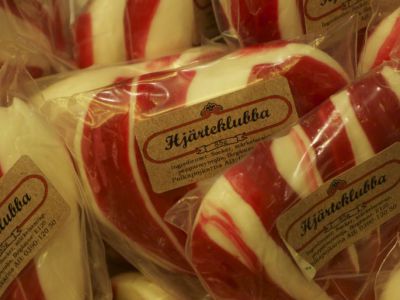
What to buy here: Home made candy canes- mint white and red stripes.
The small town of Graenna (Gränna) is famous for the locally produced candy canes, known in dialect as 'Polka pigs' ('Polkagrisar'). The cosy and rustic small town is also known for growing and harvesting tons of fruit, mostly apples. The distinct smell of caramel and mint fills the air in the summer when hundreds of pounds of sweets are mixed, stirred and boiled to be shaped, by hand, into canes and caramels.
The famous twisted red and white candy cane is made locally, and only in the small town of Graenna (Gränna). It is boiled and shaped by hand into canes, caramels, decorations or lollypops. The flavor is the original white peppermint and strawberry caramel, but other flavors are approved and added to the family of candy canes, such as licorice, raspberry and violet. You can buy the candy as round bars, the traditional shape, as canes, caramels in a jar or lollypops in all sizes. The normal price for a standard size cane (80 grams) is 3 EUR and 20 EUR for 15 smaller canes (50 grams/each).
The small town of Graenna (Gränna) is famous for the locally produced candy canes, known in dialect as 'Polka pigs' ('Polkagrisar'). The cosy and rustic small town is also known for growing and harvesting tons of fruit, mostly apples. The distinct smell of caramel and mint fills the air in the summer when hundreds of pounds of sweets are mixed, stirred and boiled to be shaped, by hand, into canes and caramels.
The famous twisted red and white candy cane is made locally, and only in the small town of Graenna (Gränna). It is boiled and shaped by hand into canes, caramels, decorations or lollypops. The flavor is the original white peppermint and strawberry caramel, but other flavors are approved and added to the family of candy canes, such as licorice, raspberry and violet. You can buy the candy as round bars, the traditional shape, as canes, caramels in a jar or lollypops in all sizes. The normal price for a standard size cane (80 grams) is 3 EUR and 20 EUR for 15 smaller canes (50 grams/each).
Image Courtesy of Miranda Holmqvist.
3) German Church
The German Church (Tyska kyrkan), also known as Saint Gertrude's Church (Sankta Gertruds Kyrka), is a significant historic and cultural landmark in Stockholm. Established in the 1580s, it has served as the primary place of worship for the German-speaking community in Stockholm for over four centuries. Initially, the church was shared with Finnish parishioners, but it became exclusively a German ecclesiastical site in 1607. Since then, the church's carillon has filled the air of the Old Town with psalms each day, a tradition that continues to this day.
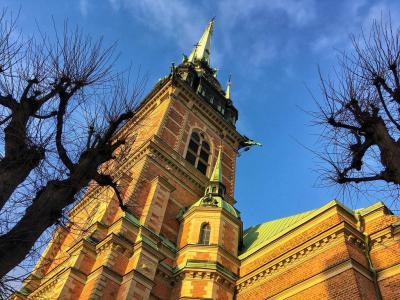
The church is particularly noted for its striking architecture. Its 96-meter steeple, completed in 1878, features a distinctive brick and copper design, crowned by Neo-Gothic gargoyles-an unusual but now iconic element in Swedish architecture. The southern portal is adorned with sandstone statues of Jesus and Moses, representing the New and Old Testaments, flanked by figures symbolizing Love, Hope, and Faith, crafted in the 1640s.
Inside, the church boasts a richly Baroque style. Large windows flood the white-vaulted interior with light, highlighting the angelic motifs adorning the ceiling. The marble flooring conceals the remnants of the original guild building's wine cellars, linking the church to its historical roots. A standout feature is the ten-meter Baroque altar, which commands attention within the sanctuary. The atrium’s stained-glass window, depicting Saint Gertrude holding a chalice and a church model, is another prominent feature, adding to the church's sacred atmosphere.
One of the church's most historically significant features is the "King's Gallery." This gallery, which includes a sacristy and overlooks painted windows from the early 20th century, is decorated with the monogram of King Charles XI and features a magnificent staircase and a painted ceiling, reflecting the church's deep connections to German history.
Beyond its architectural and historical significance, the German Church continues to serve as a cultural hub for Stockholm's German-speaking community, hosting regular services and preserving the traditions of its congregation. Its long-standing musical contributions further underscore its role as a cultural cornerstone in Stockholm.
Tip:
Check the schedule – you may be able to catch a musical performance.
Visitors can hear the carillon every day, at 8 am and 4 pm.
If timing allows, you may see the inside with good lighting and be treated to the spectacular stained glass scenes.
The church is particularly noted for its striking architecture. Its 96-meter steeple, completed in 1878, features a distinctive brick and copper design, crowned by Neo-Gothic gargoyles-an unusual but now iconic element in Swedish architecture. The southern portal is adorned with sandstone statues of Jesus and Moses, representing the New and Old Testaments, flanked by figures symbolizing Love, Hope, and Faith, crafted in the 1640s.
Inside, the church boasts a richly Baroque style. Large windows flood the white-vaulted interior with light, highlighting the angelic motifs adorning the ceiling. The marble flooring conceals the remnants of the original guild building's wine cellars, linking the church to its historical roots. A standout feature is the ten-meter Baroque altar, which commands attention within the sanctuary. The atrium’s stained-glass window, depicting Saint Gertrude holding a chalice and a church model, is another prominent feature, adding to the church's sacred atmosphere.
One of the church's most historically significant features is the "King's Gallery." This gallery, which includes a sacristy and overlooks painted windows from the early 20th century, is decorated with the monogram of King Charles XI and features a magnificent staircase and a painted ceiling, reflecting the church's deep connections to German history.
Beyond its architectural and historical significance, the German Church continues to serve as a cultural hub for Stockholm's German-speaking community, hosting regular services and preserving the traditions of its congregation. Its long-standing musical contributions further underscore its role as a cultural cornerstone in Stockholm.
Tip:
Check the schedule – you may be able to catch a musical performance.
Visitors can hear the carillon every day, at 8 am and 4 pm.
If timing allows, you may see the inside with good lighting and be treated to the spectacular stained glass scenes.
4) Stortorget (Grand Square) (must see)
Contrary to its name, Stockholm's "Grand Square" (Stortorget) was never a stylish showpiece unlike the ones in many other European cities during the Middle Ages. It was created gradually, with the surrounding buildings added haphazardly throughout the years.
Nowadays, this is the city's oldest square and an artistic and shopping hub, particularly renowned for its annual Christmas market with fun shows, traditional handicrafts, and sumptuous culinary delights.
It is also the location of the Stock Exchange Building (Börshuset) – home to the Swedish Academy, the Nobel Museum, and the Nobel Library – built in 1773 through 1776. The nearby well dried up in 1856 due to land elevation. It was then relocated to another square (Brunkebergstorg) but eventually moved back to its original location in the 1950s, and has been connected to the city water conduit ever since.
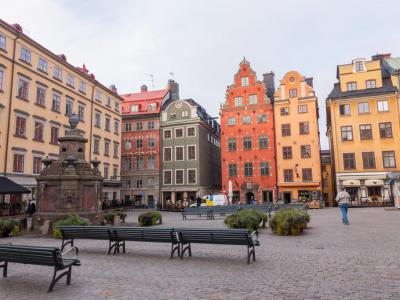
Grand Square sits at the highest point in Stockholm and presents a carefully restored rendition of the historical buildings. Among them is house No. 3 constructed in the 1640s, commonly known as Grill House (Grillska Huset), named after its owner, Antoni Grill. The nearby building No. 5 was also Grill's property. The buildings at numbers 18 and 20 were merged into one in the 17th century and named for Johan Eberhard Schantz, the secretary of King Charles X Gustavus. House No. 22, on the left side of the square, once occupied by one of the closest friends of King Charles XI, was built in 1758 and is easily identified by its green color.
The square had a violent history, ill-famed as the location of the Stockholm Bloodbath, which took place in 1520 and resulted in the beheadings of over 80 noblemen. Their bodies were left there to bleed out, leaving pools of blood running throughout the town. Eww...(((
Indeed, the antique cobblestones of Grand Square make you feel like stepping back into the times of Old Sweden, with the pastel buildings mimicking the colors commonplace in those days.
Why You Should Visit:
The Old Town is by far the most picturesque area in Stockholm, and while this square seems unpretentious at first sight, it has a unique ambiance.
Tip:
Make sure to stand in the middle and look all around you.
Nowadays, this is the city's oldest square and an artistic and shopping hub, particularly renowned for its annual Christmas market with fun shows, traditional handicrafts, and sumptuous culinary delights.
It is also the location of the Stock Exchange Building (Börshuset) – home to the Swedish Academy, the Nobel Museum, and the Nobel Library – built in 1773 through 1776. The nearby well dried up in 1856 due to land elevation. It was then relocated to another square (Brunkebergstorg) but eventually moved back to its original location in the 1950s, and has been connected to the city water conduit ever since.
Grand Square sits at the highest point in Stockholm and presents a carefully restored rendition of the historical buildings. Among them is house No. 3 constructed in the 1640s, commonly known as Grill House (Grillska Huset), named after its owner, Antoni Grill. The nearby building No. 5 was also Grill's property. The buildings at numbers 18 and 20 were merged into one in the 17th century and named for Johan Eberhard Schantz, the secretary of King Charles X Gustavus. House No. 22, on the left side of the square, once occupied by one of the closest friends of King Charles XI, was built in 1758 and is easily identified by its green color.
The square had a violent history, ill-famed as the location of the Stockholm Bloodbath, which took place in 1520 and resulted in the beheadings of over 80 noblemen. Their bodies were left there to bleed out, leaving pools of blood running throughout the town. Eww...(((
Indeed, the antique cobblestones of Grand Square make you feel like stepping back into the times of Old Sweden, with the pastel buildings mimicking the colors commonplace in those days.
Why You Should Visit:
The Old Town is by far the most picturesque area in Stockholm, and while this square seems unpretentious at first sight, it has a unique ambiance.
Tip:
Make sure to stand in the middle and look all around you.
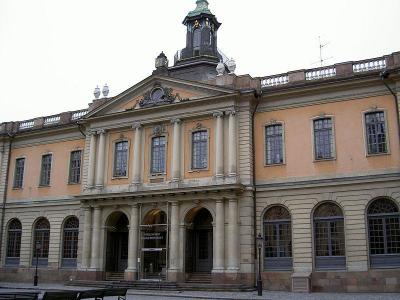
5) Nobel Prize Museum (must see)
The Nobel Prize Museum in Stockholm is a must-visit destination for anyone interested in the legacy of Alfred Nobel, the Nobel Prize, and its distinguished laureates. Opened in 2001 to commemorate the centenary of the Nobel Prize, the museum offers an immersive experience into the world of this prestigious award.
The museum’s permanent exhibition showcases a fascinating collection of artifacts, personal stories, and historical accounts from Nobel Prize winners dating back to 1901. Visitors can learn about the lives and contributions of iconic figures such as Marie Curie, Nelson Mandela, and Winston Churchill.
One of the museum's highlights is the "Cultures of Creativity Exhibit," which guides visitors through the intricate process of selecting a Nobel Prize winner, culminating in the grandeur of the Nobel Banquet. An integral part of this experience is the Nobel ice cream, a treat traditionally served at the annual awards ceremony, which visitors can sample during their visit.
The museum offers daily multilingual tours, including in English, and hosts a variety of public events, conferences, and workshops. These activities are designed to engage and educate visitors, making the museum a dynamic hub of learning and inspiration.
For those wishing to take home a unique souvenir, the museum's shop offers a range of exclusive items, such as dark fair-trade chocolate versions of Alfred Nobel's gold medal and Swedish “dynamite” candy flavored with jalapeño pepper. The shop also features educational toys, books by and about Nobel laureates, and other distinctive keepsakes.
Visitors can also enjoy a meal at Bistro Nobel, which serves a selection of Swedish cakes, Nobel chocolate, and the famous Nobel ice cream and tea-both of which are featured at the Nobel Banquet. The bistro provides a perfect spot to relax and reflect on the museum's inspiring exhibits while enjoying traditional Swedish cuisine.
Tip:
Join the English tour to get the most out of your visit.
The museum’s permanent exhibition showcases a fascinating collection of artifacts, personal stories, and historical accounts from Nobel Prize winners dating back to 1901. Visitors can learn about the lives and contributions of iconic figures such as Marie Curie, Nelson Mandela, and Winston Churchill.
One of the museum's highlights is the "Cultures of Creativity Exhibit," which guides visitors through the intricate process of selecting a Nobel Prize winner, culminating in the grandeur of the Nobel Banquet. An integral part of this experience is the Nobel ice cream, a treat traditionally served at the annual awards ceremony, which visitors can sample during their visit.
The museum offers daily multilingual tours, including in English, and hosts a variety of public events, conferences, and workshops. These activities are designed to engage and educate visitors, making the museum a dynamic hub of learning and inspiration.
For those wishing to take home a unique souvenir, the museum's shop offers a range of exclusive items, such as dark fair-trade chocolate versions of Alfred Nobel's gold medal and Swedish “dynamite” candy flavored with jalapeño pepper. The shop also features educational toys, books by and about Nobel laureates, and other distinctive keepsakes.
Visitors can also enjoy a meal at Bistro Nobel, which serves a selection of Swedish cakes, Nobel chocolate, and the famous Nobel ice cream and tea-both of which are featured at the Nobel Banquet. The bistro provides a perfect spot to relax and reflect on the museum's inspiring exhibits while enjoying traditional Swedish cuisine.
Tip:
Join the English tour to get the most out of your visit.
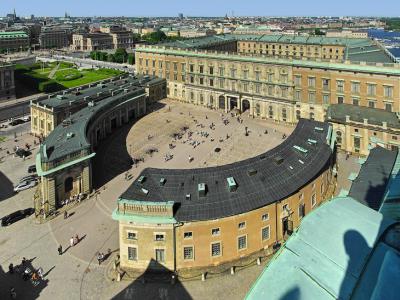
6) Royal Palace (must see)
The Royal Palace in Stockholm, also known as Stockholm Palace, is the official residence of the Swedish monarch, although King Carl XVI Gustaf and Queen Silvia primarily reside at Drottningholm Palace. Situated in the Old Town of Stockholm (Gamla Stan), adjacent to the Parliament building, the Royal Palace is a significant ceremonial venue for the King in his role as head of state.
This historic site has served as a royal residence since the mid-13th century, originally home to the Three Crowns (Tre Kronor) Castle. Following a devastating fire in 1697, the current palace was constructed, with its completion delayed until 1754 due to the Great Northern War. The palace is one of the largest in the world, boasting over 1,400 rooms, including state and guest apartments, the Hall of State, the Royal Chapel, and several museums.
Visitors are welcomed by the Swedish Royal Guard, a tradition rooted in medieval Sweden, adding to the palace's majestic atmosphere. The palace’s interior is notable for its exquisite copper roof and houses significant cultural artifacts, including the Bernadotte Library, the Royal Armoury, and the Three Crowns Museum.
One of the most distinguished features is Gustav III's Museum of Antiquities, one of Europe’s oldest museums, which displays over 200 sculptures acquired by King Gustav III during his travels in Italy. The palace also offers a unique shopping experience at the Royal Gift Shop, where visitors can purchase exclusive items linked to the Royal Collections. The shop is open daily with free entry, making it a popular destination for both history enthusiasts and those seeking distinctive souvenirs.
Tip:
While the rooms are well-marked in English, it's always good to go on a guided tour for a more personalized experience.
The Treasury room, with all the regalia, would justify taking the tour as you get to learn more about what you're looking at.
This historic site has served as a royal residence since the mid-13th century, originally home to the Three Crowns (Tre Kronor) Castle. Following a devastating fire in 1697, the current palace was constructed, with its completion delayed until 1754 due to the Great Northern War. The palace is one of the largest in the world, boasting over 1,400 rooms, including state and guest apartments, the Hall of State, the Royal Chapel, and several museums.
Visitors are welcomed by the Swedish Royal Guard, a tradition rooted in medieval Sweden, adding to the palace's majestic atmosphere. The palace’s interior is notable for its exquisite copper roof and houses significant cultural artifacts, including the Bernadotte Library, the Royal Armoury, and the Three Crowns Museum.
One of the most distinguished features is Gustav III's Museum of Antiquities, one of Europe’s oldest museums, which displays over 200 sculptures acquired by King Gustav III during his travels in Italy. The palace also offers a unique shopping experience at the Royal Gift Shop, where visitors can purchase exclusive items linked to the Royal Collections. The shop is open daily with free entry, making it a popular destination for both history enthusiasts and those seeking distinctive souvenirs.
Tip:
While the rooms are well-marked in English, it's always good to go on a guided tour for a more personalized experience.
The Treasury room, with all the regalia, would justify taking the tour as you get to learn more about what you're looking at.
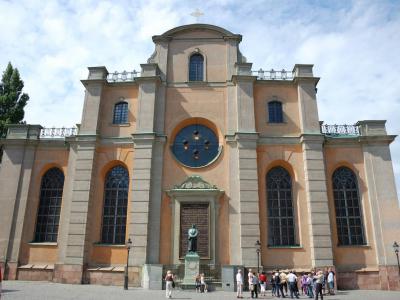
7) Stockholm Cathedral (must see)
Stockholm Cathedral, also known as the Church of Saint Nicholas (Sankt Nikolai Kyrka), is the oldest and one of the most historically significant temples in Stockholm. Centrally located at the highest point of Old Town (Gamla Stan), it is flanked by the Stock Exchange Building and Stockholm Palace, forming an integral part of the city's Baroque architectural landscape.
The cathedral was consecrated in 1306, with its origins dating back to the 13th century. It features a late medieval hall interior, while the exterior showcases Baroque modifications added in the 18th century. As a crucial site during the Reformation, Stockholm Cathedral hosted the first Mass in the Swedish language. Since 1942, it has served as the seat of the Bishop of Stockholm, highlighting its ongoing religious importance.
The cathedral has a deep historical connection with the Swedish royal family, having served as the city's sole parish church for many centuries. It has been the venue for royal coronations and other significant ceremonies, including the wedding of Crown Princess Victoria in 2010. The cathedral continues to play a vital role in national events and memorials, such as the funeral of renowned Swedish author Astrid Lindgren.
Inside, the cathedral houses several significant artworks, including a medieval sculpture of Saint George and the Dragon and the Vädersolstavlan painting, one of the earliest depictions of Stockholm. The surrounding area of the cathedral is rich with historical courtyards and statues, including representations of Reason, Divine Love, Caution, and Hope. Additionally, a statue of Olaus Petri, a key figure in the Swedish Reformation, stands near the church's east facade, where the pavement also marks the former extent of a church choir demolished during the reign of King Gustav Vasa in the 16th century.
Why You Should Visit:
Architecturally interesting, culturally enriching, and very peaceful.
Tip:
Check for free organ recitals (usually at noon) and other events.
Make sure to pick up a brochure as it is very helpful in explaining several main focuses within the cathedral.
The cathedral was consecrated in 1306, with its origins dating back to the 13th century. It features a late medieval hall interior, while the exterior showcases Baroque modifications added in the 18th century. As a crucial site during the Reformation, Stockholm Cathedral hosted the first Mass in the Swedish language. Since 1942, it has served as the seat of the Bishop of Stockholm, highlighting its ongoing religious importance.
The cathedral has a deep historical connection with the Swedish royal family, having served as the city's sole parish church for many centuries. It has been the venue for royal coronations and other significant ceremonies, including the wedding of Crown Princess Victoria in 2010. The cathedral continues to play a vital role in national events and memorials, such as the funeral of renowned Swedish author Astrid Lindgren.
Inside, the cathedral houses several significant artworks, including a medieval sculpture of Saint George and the Dragon and the Vädersolstavlan painting, one of the earliest depictions of Stockholm. The surrounding area of the cathedral is rich with historical courtyards and statues, including representations of Reason, Divine Love, Caution, and Hope. Additionally, a statue of Olaus Petri, a key figure in the Swedish Reformation, stands near the church's east facade, where the pavement also marks the former extent of a church choir demolished during the reign of King Gustav Vasa in the 16th century.
Why You Should Visit:
Architecturally interesting, culturally enriching, and very peaceful.
Tip:
Check for free organ recitals (usually at noon) and other events.
Make sure to pick up a brochure as it is very helpful in explaining several main focuses within the cathedral.
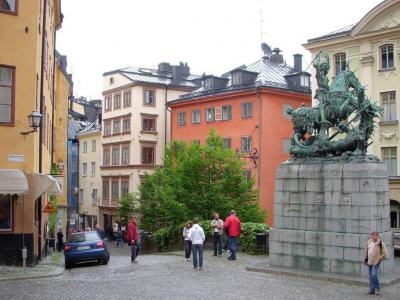
8) Köpmanbrinken (Merchant's Slope)
Merchant's Slope (Köpmanbrinken) is a historic street located in Stockholm's Old Town (Gamla Stan). This street is unique as it consists of two distinct slopes that were unified under the current name in 1885, following the creation of Merchant's Square (Köpmantorget) which separates them.
The northern slope of Merchant's Slope has a rich history, once known as Fishing Shore Slope (Fiskestrandsbrinken), due to its proximity to the city's primary fish market during the Middle Ages, from 1413 to 1520. This market, located to the east of the slope, played a crucial role in the city's daily life, highlighting the area's importance as a bustling center of commerce.
As you walk along Merchant's Slope, one of the most striking features is the statue of Saint George and the Dragon. This bronze replica, cast in 1912, is a copy of the original medieval sculpture housed in Stockholm Cathedral. The statue depicts a young Saint George, dressed in full battle armor, valiantly fighting a dragon. While the replica stays true to the spirit of the original from 1489, it introduces several alterations, such as modifications to the knight's helmet and the dragon's position. The statue is mounted on a plinth adorned with reliefs depicting the martyrdom of Saint George, adding to its historical and artistic significance.
Number 17 Köpmanbrinken stands out for its early 20th-century design, completed in 1902. The building accommodates a mix of ground-floor shops, office spaces, and residences. It also houses the restaurant "Pontus in the Green House," which adds a modern touch with its distinctive color scheme. Flanking this building are two alleys with historical significance: Nygränd (New Alley) and Brunnsgränd (Well's Alley). Although Brunnsgränd suggests the presence of a well, none exists, adding a bit of historical curiosity to the area.
The northern slope of Merchant's Slope has a rich history, once known as Fishing Shore Slope (Fiskestrandsbrinken), due to its proximity to the city's primary fish market during the Middle Ages, from 1413 to 1520. This market, located to the east of the slope, played a crucial role in the city's daily life, highlighting the area's importance as a bustling center of commerce.
As you walk along Merchant's Slope, one of the most striking features is the statue of Saint George and the Dragon. This bronze replica, cast in 1912, is a copy of the original medieval sculpture housed in Stockholm Cathedral. The statue depicts a young Saint George, dressed in full battle armor, valiantly fighting a dragon. While the replica stays true to the spirit of the original from 1489, it introduces several alterations, such as modifications to the knight's helmet and the dragon's position. The statue is mounted on a plinth adorned with reliefs depicting the martyrdom of Saint George, adding to its historical and artistic significance.
Number 17 Köpmanbrinken stands out for its early 20th-century design, completed in 1902. The building accommodates a mix of ground-floor shops, office spaces, and residences. It also houses the restaurant "Pontus in the Green House," which adds a modern touch with its distinctive color scheme. Flanking this building are two alleys with historical significance: Nygränd (New Alley) and Brunnsgränd (Well's Alley). Although Brunnsgränd suggests the presence of a well, none exists, adding a bit of historical curiosity to the area.
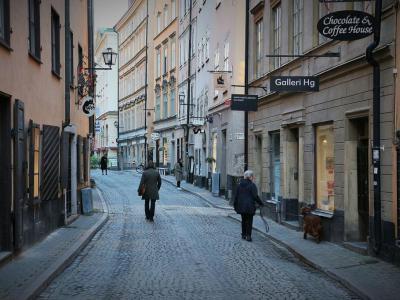
9) Österlånggatan (Eastern Long Street)
Eastern Long Street (Österlånggatan) is a historic thoroughfare located in the Old Town (Gamla Stan) of Stockholm. Its origins trace back to the 13th century when it served as a pathway along the eastern shoreline just outside the city's original walls. Over the centuries, significant changes transformed this street from a coastal road into a central artery of urban life, as land reclamation projects pushed the shoreline further eastward. This evolution turned Eastern Long Street into a bustling area lined with workshops, stores, and residences.
During the 17th century, the street became famous for its numerous taverns, which were particularly popular among the business crowd of the time. Of these taverns, only "The Golden Peace" (Den Gyldene Freden) at Number 51 remains today. Established in 1722, it holds a place in the Guinness Book of Records as one of the oldest restaurants with its interior largely unchanged since its founding. Despite its now peaceful and charming ambiance, Den Gyldene Freden's history is steeped in the rough and tumultuous life of the area, which was once notorious for its filth, stench, and frequent brawls.
As the centuries progressed, the street's connection to the shipping trade dwindled, and by the early 20th century, nearly all maritime-related activities had vanished. Today, Eastern Long Street is much quieter than in its bustling past, yet it still retains a significant amount of its historical charm.
Notable landmarks along the street include the Royal Coin Cabinet, which houses a collection of coins dating back to the 16th century, the Stockholm Concert Hall, and the Stockholm School of Economics. Additionally, Skipper Karl Alley (Skeppar Karls Gränd), named after a 16th-century skipper, serves as a reminder of the street's maritime heritage. Despite the passage of time and the changes that have occurred, Eastern Long Street remains a fascinating blend of history and modernity, offering a unique glimpse into Stockholm's rich past.
During the 17th century, the street became famous for its numerous taverns, which were particularly popular among the business crowd of the time. Of these taverns, only "The Golden Peace" (Den Gyldene Freden) at Number 51 remains today. Established in 1722, it holds a place in the Guinness Book of Records as one of the oldest restaurants with its interior largely unchanged since its founding. Despite its now peaceful and charming ambiance, Den Gyldene Freden's history is steeped in the rough and tumultuous life of the area, which was once notorious for its filth, stench, and frequent brawls.
As the centuries progressed, the street's connection to the shipping trade dwindled, and by the early 20th century, nearly all maritime-related activities had vanished. Today, Eastern Long Street is much quieter than in its bustling past, yet it still retains a significant amount of its historical charm.
Notable landmarks along the street include the Royal Coin Cabinet, which houses a collection of coins dating back to the 16th century, the Stockholm Concert Hall, and the Stockholm School of Economics. Additionally, Skipper Karl Alley (Skeppar Karls Gränd), named after a 16th-century skipper, serves as a reminder of the street's maritime heritage. Despite the passage of time and the changes that have occurred, Eastern Long Street remains a fascinating blend of history and modernity, offering a unique glimpse into Stockholm's rich past.
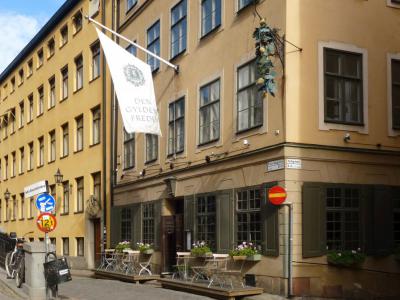
10) Den Gyldene Freden (The Golden Peace) Restaurant
The Golden Peace (Den Gyldene Freden), often affectionately referred to as "The Peace" by locals, is a renowned restaurant in Stockholm. Its name commemorates the Treaty of Nystad, which ended the Great Northern War between Russia and Sweden in 1721. This treaty resulted in Russia acquiring significant Swedish territories in the Baltics, but Sweden retained the larger territory of Finland, thus the "Golden" part of the name symbolizing this significant retention.
Established in 1722, Den Gyldene Freden holds the distinction of being the second oldest restaurant in the world to have preserved its original interior, making it a rare and authentic example of an 18th-century tavern. This historical significance has earned it a place in the Guinness Book of Records.
Over the centuries, Den Gyldene Freden has been a central hub for Sweden's cultural and literary figures, serving as a gathering spot for many renowned authors, painters, and songwriters. The restaurant initially gained fame through the songs of Carl Michael Bellman, an 18th-century national poet, and later through the works of 20th-century singer-songwriter Cornelis Vreeswijk.
Since 1901, the restaurant has been closely associated with the Nobel Prize in Literature. Each October, the Swedish Academy convenes at Golden Peace to announce the Nobel laureate in literature, further cementing the restaurant's place in Sweden's cultural and literary history.
Established in 1722, Den Gyldene Freden holds the distinction of being the second oldest restaurant in the world to have preserved its original interior, making it a rare and authentic example of an 18th-century tavern. This historical significance has earned it a place in the Guinness Book of Records.
Over the centuries, Den Gyldene Freden has been a central hub for Sweden's cultural and literary figures, serving as a gathering spot for many renowned authors, painters, and songwriters. The restaurant initially gained fame through the songs of Carl Michael Bellman, an 18th-century national poet, and later through the works of 20th-century singer-songwriter Cornelis Vreeswijk.
Since 1901, the restaurant has been closely associated with the Nobel Prize in Literature. Each October, the Swedish Academy convenes at Golden Peace to announce the Nobel laureate in literature, further cementing the restaurant's place in Sweden's cultural and literary history.
