Custom Walk in Rimini, Italy by ville_hakala_4dda6 created on 2025-05-29
Guide Location: Italy » Rimini
Guide Type: Custom Walk
# of Sights: 15
Tour Duration: 2 Hour(s)
Travel Distance: 3.1 Km or 1.9 Miles
Share Key: BCFVS
Guide Type: Custom Walk
# of Sights: 15
Tour Duration: 2 Hour(s)
Travel Distance: 3.1 Km or 1.9 Miles
Share Key: BCFVS
How It Works
Please retrieve this walk in the GPSmyCity app. Once done, the app will guide you from one tour stop to the next as if you had a personal tour guide. If you created the walk on this website or come to the page via a link, please follow the instructions below to retrieve the walk in the app.
Retrieve This Walk in App
Step 1. Download the app "GPSmyCity: Walks in 1K+ Cities" on Apple App Store or Google Play Store.



Step 2. In the GPSmyCity app, download(or launch) the guide "Rimini Map and Walking Tours".
Step 3. Tap the menu button located at upper right corner of the "Walks" screen and select "Retrieve custom walk". Enter the share key: BCFVS
1) Arco di Augusto (Arch of Augustus) (must see)
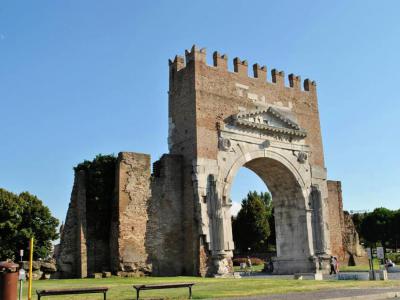
When Octavian became Augustus Caesar, he put an end (for a while) to civil wars. He also was the first Roman emperor who had in mind many civil improvements, such as roads, bridges, and gates. The Arch of Augustus of 27 BC marked the end of the Flaminian Way, an ancient Roman road that connected Rome to the cities of the Romagna historical region.
The Arch of Augustus spans Augustus Street, the ancient east-west road (decumanus maximus), connected to Emilia Street, leading to the city of Piacenza. The arch was created by order of the Roman Senate to honor the emperor. Octavian worked for the restoration of Rimini and the Flaminian Way, built by Consul Flaminius in 220 BC.
The arch is 30 feet wide and built using blocks of Istrian stone. Most arches of the time were gates, narrow enough to hold doors. It may be that as Octavian ended civil strife, doors were not needed. The opening is unusually large, as a result, easing the flow of traffic. The style of the gateway is plain.
The monument is flanked by two fluted columns having Corinthian capitals. Four shields, evenly placed next to the letters, depict the Roman gods. Jupiter and Apollo face the Roman side, while Neptune and Roma face Rimini. The top of the arch initially sported a bronze statue of Octavian driving a quadriga, a four-horse chariot.
Alas, the legendary bronze is gone. In its place are battlements called merlons, dating from the 10th century AD. Over the arch is an inscription honoring Octavian, "son of the divine Julius, Augustus." He is lauded for restoring the Flaminian Way and other important roads.
In the 1930s, during the Fascist era, the remaining walls attached to the arched gateway were demolished. Today the great arch stands incongruously alone, reminding travelers of the ancient glory of Rimini.
The Arch of Augustus spans Augustus Street, the ancient east-west road (decumanus maximus), connected to Emilia Street, leading to the city of Piacenza. The arch was created by order of the Roman Senate to honor the emperor. Octavian worked for the restoration of Rimini and the Flaminian Way, built by Consul Flaminius in 220 BC.
The arch is 30 feet wide and built using blocks of Istrian stone. Most arches of the time were gates, narrow enough to hold doors. It may be that as Octavian ended civil strife, doors were not needed. The opening is unusually large, as a result, easing the flow of traffic. The style of the gateway is plain.
The monument is flanked by two fluted columns having Corinthian capitals. Four shields, evenly placed next to the letters, depict the Roman gods. Jupiter and Apollo face the Roman side, while Neptune and Roma face Rimini. The top of the arch initially sported a bronze statue of Octavian driving a quadriga, a four-horse chariot.
Alas, the legendary bronze is gone. In its place are battlements called merlons, dating from the 10th century AD. Over the arch is an inscription honoring Octavian, "son of the divine Julius, Augustus." He is lauded for restoring the Flaminian Way and other important roads.
In the 1930s, during the Fascist era, the remaining walls attached to the arched gateway were demolished. Today the great arch stands incongruously alone, reminding travelers of the ancient glory of Rimini.
2) Palazzo Brioli (Brioli Palace)
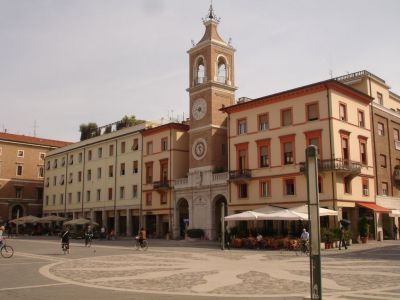
The Brioli Palace, a remarkable landmark in Rimini, graces the eastern side of the historic Three Martyrs Square (Piazza Tre Martiri). Originally constructed in 1547, the palace forms a dramatic backdrop for the iconic Clock Tower (Torre dell’Orologio), an architectural feature that has stood as a symbol of the square since its inception. The tower’s astrological clock, showcasing days, months, and zodiac signs was designed in 1750 by Domenico Carini and remains a captivating highlight.
In 1753, the palace underwent significant renovations by architect Francesco Buonamici, further enhancing its grandeur. During the mid-18th century, the palace also housed a scientific observatory, reflecting its role as a center of intellectual and cultural activity. Over the centuries, it welcomed many notable figures, including Giuseppe Verdi, Prince Umberto of Savoy, Cardinal Bonaparte, and Amedeo, Duke of Aosta, establishing itself as a hub for aristocrats and celebrities.
The building's history is intertwined with prominent families, initially belonging to the Carampi lineage before passing to the Baldini family in the 19th century. Alessandro and Ruggero Baldini, significant promoters of Rimini’s seaside culture, played a key role in reconstructing the palace and maintaining its legacy.
Today, Brioli Palace remains an integral part of Three Martyrs Square, where echoes of Julius Caesar’s legendary speech resonate. Alongside a few remnants of the ancient Roman forum, the palace stands as a testament to Rimini’s vibrant historical and cultural tapestry.
In 1753, the palace underwent significant renovations by architect Francesco Buonamici, further enhancing its grandeur. During the mid-18th century, the palace also housed a scientific observatory, reflecting its role as a center of intellectual and cultural activity. Over the centuries, it welcomed many notable figures, including Giuseppe Verdi, Prince Umberto of Savoy, Cardinal Bonaparte, and Amedeo, Duke of Aosta, establishing itself as a hub for aristocrats and celebrities.
The building's history is intertwined with prominent families, initially belonging to the Carampi lineage before passing to the Baldini family in the 19th century. Alessandro and Ruggero Baldini, significant promoters of Rimini’s seaside culture, played a key role in reconstructing the palace and maintaining its legacy.
Today, Brioli Palace remains an integral part of Three Martyrs Square, where echoes of Julius Caesar’s legendary speech resonate. Alongside a few remnants of the ancient Roman forum, the palace stands as a testament to Rimini’s vibrant historical and cultural tapestry.
3) Piazza Tre Martiri (Three Martyrs Square) (must see)
On August 16, 1944, Mario Cappelli, Luigi Nicolo, and Adelio Pagliarani were taken to the square where Julius Caesar once addressed his troops. The three were partizans of the Italian resistance against German occupation. They were hung together in the square. They were the "Three Martyrs."
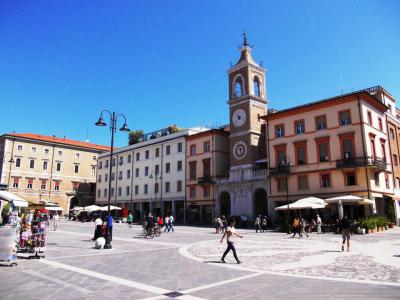
As early as 268 BC, the square has been a forum. In the Middle Ages, known as the Herbs Square (Piazza Delle Erbe), it was the site of the market and knightly tournaments. The square is the center of the Old City, the intersection of the east-west road (decumanus maximus) and the north-south road (cardo maximus), surrounded by several historic sites.
Brioli Palace is a historic 17th-century building adorned with a high clock tower of the 16th century. The clock tower is made of bricks and decorated with iron elements. The astrological clock is the main symbol of the square. The 16th-century baroque octagonal chapel of Saint Antonio forms an ensemble with the Church of San Francesco, harmoniously fitting into the picture of Three Martyrs Square.
On the north side stands a bronze figure of general Julius in full-dress armor. The column of Julius Caesar, erected in 1555, memorializes his speech to the soldiers of his formidable XIII Legion. In the center of the square, near the column, there are several excavation sites, revealing the presence of the ancient Roman forum and the churches.
Today, the square remains a center for social, commercial, and political life since its beginning when Rimini was Ariminum.
As early as 268 BC, the square has been a forum. In the Middle Ages, known as the Herbs Square (Piazza Delle Erbe), it was the site of the market and knightly tournaments. The square is the center of the Old City, the intersection of the east-west road (decumanus maximus) and the north-south road (cardo maximus), surrounded by several historic sites.
Brioli Palace is a historic 17th-century building adorned with a high clock tower of the 16th century. The clock tower is made of bricks and decorated with iron elements. The astrological clock is the main symbol of the square. The 16th-century baroque octagonal chapel of Saint Antonio forms an ensemble with the Church of San Francesco, harmoniously fitting into the picture of Three Martyrs Square.
On the north side stands a bronze figure of general Julius in full-dress armor. The column of Julius Caesar, erected in 1555, memorializes his speech to the soldiers of his formidable XIII Legion. In the center of the square, near the column, there are several excavation sites, revealing the presence of the ancient Roman forum and the churches.
Today, the square remains a center for social, commercial, and political life since its beginning when Rimini was Ariminum.
4) Tempio Malatestiano (Malatestiano Temple) (must see)
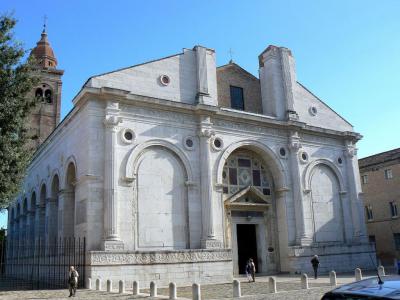
The Malatestiano Temple is the unfinished cathedral of Rimini built in the 13th century. The Gothic-style church belonged to the Franciscans, featuring a single nave and three apses but no side chapels. Frescoes by painter Giotto di Bondone adorned the central chapel. He also created the crucifix housed now in the right chapel.
Sigismondo Pandolfo Malatesta, a captain, nobleman, and poet known as the "Wolf of Rimini" for his military prowess, acquired the edifice and commissioned its reconstruction in 1450. He intended to develop the church as a mausoleum for himself and his wife, Lady Isotta degli Atti, who governed Rimini as a regent between 1460-1462 and 1468–1469.
Renaissance architect Leon Battista Alberti was approved to design the Temple. Alberti drew on ancient Roman structures for his inspiration. He used the concept of the triumphal arch, including the Arch of Augustus in Rimini. Large arcades on the sides recall the Roman aqueducts. The triangular pediment above the door has a decorated tympanum.
There are seven chapels with the remains of prominent Riminese citizens. The church was considered by Pope Pius II an exaltation of "pagan gods and profane things." Malatesta was excommunicated in 1460 as his fortunes declined. He died in 1468.
Sigismondo Pandolfo Malatesta, a captain, nobleman, and poet known as the "Wolf of Rimini" for his military prowess, acquired the edifice and commissioned its reconstruction in 1450. He intended to develop the church as a mausoleum for himself and his wife, Lady Isotta degli Atti, who governed Rimini as a regent between 1460-1462 and 1468–1469.
Renaissance architect Leon Battista Alberti was approved to design the Temple. Alberti drew on ancient Roman structures for his inspiration. He used the concept of the triumphal arch, including the Arch of Augustus in Rimini. Large arcades on the sides recall the Roman aqueducts. The triangular pediment above the door has a decorated tympanum.
There are seven chapels with the remains of prominent Riminese citizens. The church was considered by Pope Pius II an exaltation of "pagan gods and profane things." Malatesta was excommunicated in 1460 as his fortunes declined. He died in 1468.
5) Palazzo Lettimi (Lettimi Palace)
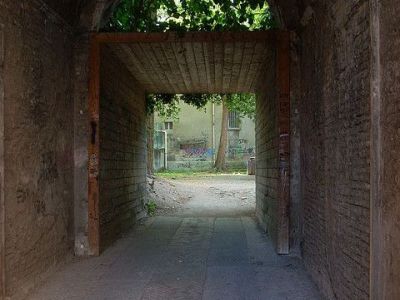
The Lettimi Palace (Palazzo Lettimi) in Rimini stands as a poignant reminder of the city’s Renaissance grandeur and its resilience in the face of destruction. Built in the early 16th century by the nobleman Carlo Maschi, the palace was one of the most prestigious buildings in Rimini, renowned for its refined Renaissance architecture and cultural significance.
Initially commissioned by Carlo Maschi, the palace showcased elaborate decorations, including a series of ceiling paintings by Marco Marchetti from Faenza. These artworks, completed in 1570, depicted the exploits of Scipio Africanus during the Second Punic War. Though much of the palace was lost during World War II bombings, some of these masterpieces were preserved and are now housed in Rimini’s City Museum (Museo del Città).
The palace passed through several noble families, including the Marcheselli and Lettimi families, and underwent significant renovations in 1770 when Andrea Lettimi added an extra floor and connected it to an adjacent residence. Giovanni Lettimi later bequeathed the building to the Municipality of Rimini in 1902, stipulating its use as a musical high school-a role it fulfilled until its destruction.
The December 1943 air raids devastated Rimini, leaving Lettimi Palace in ruins. Its upper floors were demolished in 1968 for safety, but the portal with ashlar tiles and the scarp wall remain, showcasing its Renaissance origins. These surviving elements, adorned with heraldic symbols, along with preserved artworks, highlight the palace's historical and cultural significance.
Though only fragments of the original structure remain, Lettimi Palace still resonates with historical charm. Visitors can explore its ruins and envision its former splendor while nearby museums, such as the City Museum, provide insight into its artistic heritage. The palace’s story, marked by resilience and cultural preservation, offers a unique glimpse into Rimini’s storied past.
Initially commissioned by Carlo Maschi, the palace showcased elaborate decorations, including a series of ceiling paintings by Marco Marchetti from Faenza. These artworks, completed in 1570, depicted the exploits of Scipio Africanus during the Second Punic War. Though much of the palace was lost during World War II bombings, some of these masterpieces were preserved and are now housed in Rimini’s City Museum (Museo del Città).
The palace passed through several noble families, including the Marcheselli and Lettimi families, and underwent significant renovations in 1770 when Andrea Lettimi added an extra floor and connected it to an adjacent residence. Giovanni Lettimi later bequeathed the building to the Municipality of Rimini in 1902, stipulating its use as a musical high school-a role it fulfilled until its destruction.
The December 1943 air raids devastated Rimini, leaving Lettimi Palace in ruins. Its upper floors were demolished in 1968 for safety, but the portal with ashlar tiles and the scarp wall remain, showcasing its Renaissance origins. These surviving elements, adorned with heraldic symbols, along with preserved artworks, highlight the palace's historical and cultural significance.
Though only fragments of the original structure remain, Lettimi Palace still resonates with historical charm. Visitors can explore its ruins and envision its former splendor while nearby museums, such as the City Museum, provide insight into its artistic heritage. The palace’s story, marked by resilience and cultural preservation, offers a unique glimpse into Rimini’s storied past.
6) Domus del Chirurgo (House of the Surgeon)
Civil unrest racked the Roman Empire in the 3rd century AD. Emperors were scrambling for the throne in dazzling succession. It was becoming hard to maintain border security. Hostile tribes penetrated as far down the peninsula as Ariminum (Rimini). In the battles of 258-260 AD, they burned the northern side of the city.
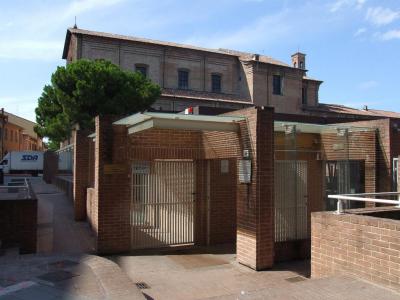
Fast forward to 1989. While replacing paving in Ferrari Square, construction workers were uprooting a bothersome tree. The tree came up, dripping soil. Under the dangling roots of the tree was a 3rd-century Roman house, the House of the Surgeon. The archaeologists of Rimini, led by Jacopo Ortalli, professor of the University of Ferrara and director in charge of the excavations, have brought to light the historical patrimony.
They spent 18 years excavating an area of 700 square meters. During their delving, Ortali and his team discovered a cache of surgical instruments overlooked by the rampaging barbarian arsonists 1,700 years before. The doctor operated a two-room clinic in his home.
Also recovered were measuring devices, mortars and pestles, coins, and a bronze hand of Jupiter Dolichenus, a popular cult in the military. The doctor's name was Eutyches. The excavation site is covered with transparent crystal for protection and easy viewing. Some of the surgeon's artifacts are kept at the City Museum nearby.
Fast forward to 1989. While replacing paving in Ferrari Square, construction workers were uprooting a bothersome tree. The tree came up, dripping soil. Under the dangling roots of the tree was a 3rd-century Roman house, the House of the Surgeon. The archaeologists of Rimini, led by Jacopo Ortalli, professor of the University of Ferrara and director in charge of the excavations, have brought to light the historical patrimony.
They spent 18 years excavating an area of 700 square meters. During their delving, Ortali and his team discovered a cache of surgical instruments overlooked by the rampaging barbarian arsonists 1,700 years before. The doctor operated a two-room clinic in his home.
Also recovered were measuring devices, mortars and pestles, coins, and a bronze hand of Jupiter Dolichenus, a popular cult in the military. The doctor's name was Eutyches. The excavation site is covered with transparent crystal for protection and easy viewing. Some of the surgeon's artifacts are kept at the City Museum nearby.
7) Ponte di Tiberio (Tiberius Bridge) (must see)
In 1995, archeologist Vittorio Galliazzo edited a list of the surviving Roman bridges in Italy and all provinces of the Roman Empire. The number came to 900. Those were only the ones still standing. The number of bridges built must be significantly greater. Roman bridge builders were seeking connections to the gods.
Rimini has a harmonious combination of function and spirituality: the Bridge of Augustus and Tiberius spanning the Marecchia River. Construction started in 14 AD, in the last years of the reign of Augustus. The Emperor, Pontifex Maximus, was the one entrusted with bridges. Construction finished in 21 AD.
Rimini was a central nexus in the all-important road system of Roman Italy. The Tiberius Bridge, built at the beginning of Emilia street, led to the Piacenza commune. It was also the beginning of Popilia street, leading to the city of Ravenna, and the famed Flaminia street, leading to Rome.
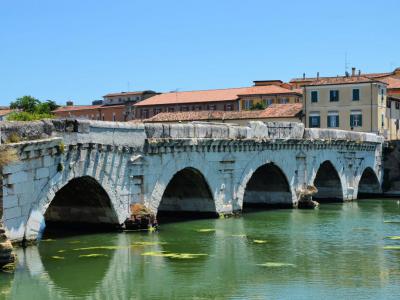
The Tiberius Bridge, made entirely of Istrian stone, is done in the Doric style with five arches. It is 243 feet long and paved with the usual trachybasalt cobbles. The span is curved slightly, forming a "donkey back" shape. Above the arches are niches framed with pilasters carrying tablets and pediments.
The cornices, covered with a coping on top, are supported by modillions and dentils. An inscription near the coping claims "given by both Emperors." The arches, supported by heavy, massive pillars, stand in water using a system of poles and breakwater buttresses set against the axis.
The Bridge of Tiberius survived earthquakes in 1672 and 1786, the Greek-Gothic War of 552, and the arson attempts of Pandolfo Malatesta in 1528. The retreating German army destroyed almost every bridge on the Marecchia River in World War II. Only the Bridge of Tiberius remained behind in their swath of devastation.
Tiberius Bridge is open to pedestrian traffic and light vehicles. It is a beautiful sight from the Sull'Aqua Square, overlooking the reservoir.
Rimini has a harmonious combination of function and spirituality: the Bridge of Augustus and Tiberius spanning the Marecchia River. Construction started in 14 AD, in the last years of the reign of Augustus. The Emperor, Pontifex Maximus, was the one entrusted with bridges. Construction finished in 21 AD.
Rimini was a central nexus in the all-important road system of Roman Italy. The Tiberius Bridge, built at the beginning of Emilia street, led to the Piacenza commune. It was also the beginning of Popilia street, leading to the city of Ravenna, and the famed Flaminia street, leading to Rome.
The Tiberius Bridge, made entirely of Istrian stone, is done in the Doric style with five arches. It is 243 feet long and paved with the usual trachybasalt cobbles. The span is curved slightly, forming a "donkey back" shape. Above the arches are niches framed with pilasters carrying tablets and pediments.
The cornices, covered with a coping on top, are supported by modillions and dentils. An inscription near the coping claims "given by both Emperors." The arches, supported by heavy, massive pillars, stand in water using a system of poles and breakwater buttresses set against the axis.
The Bridge of Tiberius survived earthquakes in 1672 and 1786, the Greek-Gothic War of 552, and the arson attempts of Pandolfo Malatesta in 1528. The retreating German army destroyed almost every bridge on the Marecchia River in World War II. Only the Bridge of Tiberius remained behind in their swath of devastation.
Tiberius Bridge is open to pedestrian traffic and light vehicles. It is a beautiful sight from the Sull'Aqua Square, overlooking the reservoir.
8) Palazzo dell'Arengo (Arengo Palace)
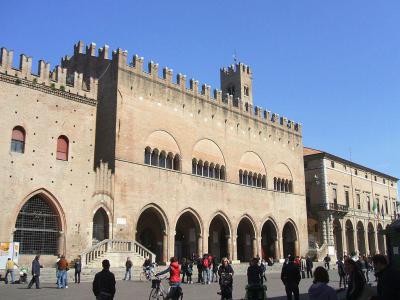
The Arengo Palace (Palazzo dell’Arengo) stands as a majestic example of Romanesque-Gothic architecture in Cavour Square (Piazza Cavour), Rimini. Built in 1204 by the will of the city’s mayor, Modio de’ Carbonesi, the palace served as a hub of political and civic life during the Middle Ages. Its defining features include Ghibelline-style battlements, a grand loggia supported by powerful colonnades and pointed arches, and a large hall on the upper floor adorned with multi-lancet windows.
The Arengo Palace symbolized Rimini's freedom and authority, hosting the General Council in the Middle Ages. Its loggia was a hub for justice, where insolvent debtors faced the lapis magnum ritual. The upper hall preserves 14th-century frescoes, reflecting Rimini’s artistic legacy, while its bell tower once served as a prison, highlighting its civic role.
The palace underwent significant renovations in 1562, 1672, and 1919–1923, with each phase altering its original structure. Despite these changes, key medieval elements, such as the capitals on the loggia’s pillars and the trussed ceiling of the upper hall, have been preserved. Its grand Salone dell’Arengo, accessible via an external staircase, is celebrated for its harmonious proportions and elegant window lines, ranking among the most beautiful halls in Italy.
Today, the Arengo Palace, along with the adjacent Podesta Palace (Palazzo del Podestà), houses the Palazzi dell'Arte Rimini (PART), a contemporary art museum featuring works from the San Patrignano Foundation Collection. This adaptive reuse highlights Rimini’s commitment to blending historical preservation with modern cultural initiatives.
Whether as a medieval seat of power or a contemporary art venue, the Arengo Palace remains a symbol of Rimini's enduring civic and artistic legacy.
The Arengo Palace symbolized Rimini's freedom and authority, hosting the General Council in the Middle Ages. Its loggia was a hub for justice, where insolvent debtors faced the lapis magnum ritual. The upper hall preserves 14th-century frescoes, reflecting Rimini’s artistic legacy, while its bell tower once served as a prison, highlighting its civic role.
The palace underwent significant renovations in 1562, 1672, and 1919–1923, with each phase altering its original structure. Despite these changes, key medieval elements, such as the capitals on the loggia’s pillars and the trussed ceiling of the upper hall, have been preserved. Its grand Salone dell’Arengo, accessible via an external staircase, is celebrated for its harmonious proportions and elegant window lines, ranking among the most beautiful halls in Italy.
Today, the Arengo Palace, along with the adjacent Podesta Palace (Palazzo del Podestà), houses the Palazzi dell'Arte Rimini (PART), a contemporary art museum featuring works from the San Patrignano Foundation Collection. This adaptive reuse highlights Rimini’s commitment to blending historical preservation with modern cultural initiatives.
Whether as a medieval seat of power or a contemporary art venue, the Arengo Palace remains a symbol of Rimini's enduring civic and artistic legacy.
9) Palazzo del Podestá (Podestá Palace)
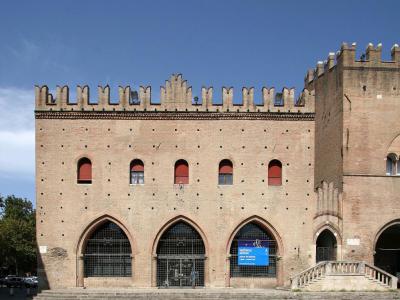
The Podestá Palace (Palazzo del Podestà) is a striking medieval monument located in the heart of Rimini's Cavour Square (Piazza Cavour). Erected in 1334, the palace once served as the residence of the Podestá, the chief administrator of the city. This Gothic architectural gem is characterized by its austere façade, which features three imposing arches on the ground floor. Historically, the central arch bore a rope used for public executions, a grim reminder of medieval justice. Above, a crenelated upper floor adds to the building's commanding presence, with smaller windows that accentuate its Gothic style.
Though originally built in the Gothic style, the Podestá Palace has undergone numerous restorations and reconstructions. The most significant changes occurred after a devastating earthquake in 1916, which destroyed much of Rimini, including the palace. The rebuilding effort, led by architect Gaspare Rastrelli, restored the palace to its original Gothic splendor, based on historical documents and illustrations. The current façade, featuring the iconic three arches, is a faithful recreation of the original design.
Today, the Podestá Palace is a vibrant cultural space. The ground floor hosts an art gallery with rotating exhibitions, making it a hub for local and international art enthusiasts. Its well-preserved Gothic architecture and central location ensure it remains a must-visit site for anyone exploring Rimini.
The Podestá Palace, the smallest of the three prominent buildings dominating Cavour Square (Piazza Cavour), is a testament to Rimini’s rich history and enduring legacy. It stands as both a relic of medieval governance and a dynamic venue for contemporary culture.
Though originally built in the Gothic style, the Podestá Palace has undergone numerous restorations and reconstructions. The most significant changes occurred after a devastating earthquake in 1916, which destroyed much of Rimini, including the palace. The rebuilding effort, led by architect Gaspare Rastrelli, restored the palace to its original Gothic splendor, based on historical documents and illustrations. The current façade, featuring the iconic three arches, is a faithful recreation of the original design.
Today, the Podestá Palace is a vibrant cultural space. The ground floor hosts an art gallery with rotating exhibitions, making it a hub for local and international art enthusiasts. Its well-preserved Gothic architecture and central location ensure it remains a must-visit site for anyone exploring Rimini.
The Podestá Palace, the smallest of the three prominent buildings dominating Cavour Square (Piazza Cavour), is a testament to Rimini’s rich history and enduring legacy. It stands as both a relic of medieval governance and a dynamic venue for contemporary culture.
10) Teatro Amintore Galli (Amintore Galli Theatre)
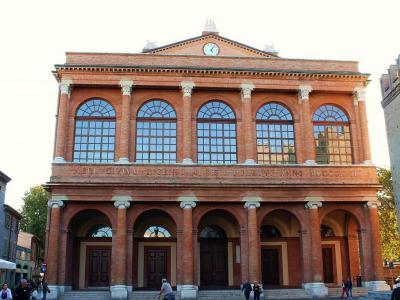
The Amintore Galli Theatre, originally named Teatro Vittorio Emanuele II until 1947, stands as the cultural centerpiece of Rimini. Inaugurated in 1857, the theater was designed in neoclassical style by Luigi Poletti, one of Italy’s renowned architects. The project, intended to replace the aging Buonarroti Theatre and an even older wooden theater from 1681, was envisioned as a monumental backdrop to Cavour Square (Piazza Cavour), overlooking Castel Sismondo at the rear.
The theater boasts an Ionic-columned portico leading to a foyer with three spacious rooms and a loggia overlooking Piazza Cavour. The main hall originally featured 71 ornate boxes seating up to 1,400 and showcased Poletti's innovative design, including varied box sizes and an impressive second tier without a royal box. While the exterior is simple, the interiors were richly adorned, with a stage curtain by Francesco Coghetti depicting Caesar’s crossing of the Rubicon and stage designs by Michele Agli.
The theater suffered significant damage over the years. The 1916 earthquake forced restoration efforts, and the building reopened in 1923. However, Allied bombing in December 1943 during World War II devastated 90% of the structure, leaving only the façade and parts of the foyer intact. Post-war looting and demolition further degraded the site, reducing it to a warehouse and later a gym.
Restoration efforts began in the 1950s but faced delays and controversy, with modernist redesigns later rejected in favor of restoring Poletti’s original vision. A project by Pier Luigi Cervellati gained funding in 2004, and reconstruction started in 2014. During the rebuild, archaeological finds like Roman domus and medieval remains led to the creation of a museum beneath the theater, including a multimedia tribute to Giuseppe Verdi.
The theater reopened on October 28, 2018, with a semi-staged performance of Rossini’s La Cenerentola, featuring Cecilia Bartoli and Les Musiciens du Prince. Today, it stands as both a cultural venue and a symbol of resilience, blending historic charm with modern innovation, and continues to captivate audiences with its rich heritage and artistic spirit.
The theater boasts an Ionic-columned portico leading to a foyer with three spacious rooms and a loggia overlooking Piazza Cavour. The main hall originally featured 71 ornate boxes seating up to 1,400 and showcased Poletti's innovative design, including varied box sizes and an impressive second tier without a royal box. While the exterior is simple, the interiors were richly adorned, with a stage curtain by Francesco Coghetti depicting Caesar’s crossing of the Rubicon and stage designs by Michele Agli.
The theater suffered significant damage over the years. The 1916 earthquake forced restoration efforts, and the building reopened in 1923. However, Allied bombing in December 1943 during World War II devastated 90% of the structure, leaving only the façade and parts of the foyer intact. Post-war looting and demolition further degraded the site, reducing it to a warehouse and later a gym.
Restoration efforts began in the 1950s but faced delays and controversy, with modernist redesigns later rejected in favor of restoring Poletti’s original vision. A project by Pier Luigi Cervellati gained funding in 2004, and reconstruction started in 2014. During the rebuild, archaeological finds like Roman domus and medieval remains led to the creation of a museum beneath the theater, including a multimedia tribute to Giuseppe Verdi.
The theater reopened on October 28, 2018, with a semi-staged performance of Rossini’s La Cenerentola, featuring Cecilia Bartoli and Les Musiciens du Prince. Today, it stands as both a cultural venue and a symbol of resilience, blending historic charm with modern innovation, and continues to captivate audiences with its rich heritage and artistic spirit.
11) Fontana della Pigna (Pinecone Fountain)
The Pinecone Fountain (Fontana della Pigna) stands as a testament to Rimini's layered history, gracing the historic Cavour Square (Piazza Cavour), where the city’s municipal buildings are located. Originating in Roman times, this fountain initially drew water from a well nearly 900 meters away. Its stone conduit was eventually replaced with cast iron and later upgraded to an underground system in 1835, routed through Castel Sismondo.
For centuries, the fountain provided Rimini's drinking water until the public aqueduct opened in 1912. Restored in 1543 by Giovanni da Carrara after fireworks damage, the renovation-funded by Pope Paul III-blended Roman stone fragments with Renaissance artistry, preserving the central drum's original bas-reliefs.
Initially crowned with a statue of Saint Paul in 1545, the fountain saw significant alterations during the Napoleonic era when French troops damaged its enclosure and stole bronze spouts. A restoration in 1807 replaced the statue with the pine cone sculpture (Pigna), which remains its defining feature today.
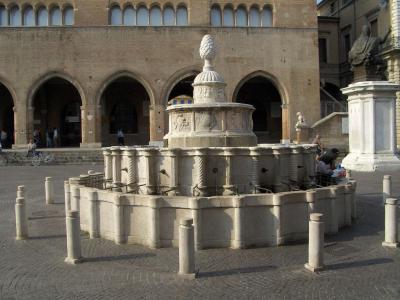
Architecturally, the Pinecone Fountain exemplifies Renaissance elegance. Its polygonal design includes two concentric basins from the fifteenth century, with the central drum-a relic from Roman times-adorned with intricate bas-reliefs. Fifteen spouts encircle the second tank, while panels framed by pillars and columns enhance its aesthetic appeal. The entire structure, made of white marble, was meticulously restored in 2002, ensuring its continued grandeur.
Adding to its historical allure is a famous visit by Leonardo da Vinci in 1502. Inspired by the fountain’s harmonious design, he left an enduring tribute: "Make a harmony with the different falls of water, as you saw at the fountain in Rimini, as you saw on the 5th of August 1502," engraved on one of the panels.
Today, the Pinecone Fountain is not only a symbol of Rimini’s past but also a celebration of its artistic and architectural legacy. Visitors can admire the commemorative plaques and inscriptions that tell the story of a city’s resilience and its fountain’s timeless charm.
For centuries, the fountain provided Rimini's drinking water until the public aqueduct opened in 1912. Restored in 1543 by Giovanni da Carrara after fireworks damage, the renovation-funded by Pope Paul III-blended Roman stone fragments with Renaissance artistry, preserving the central drum's original bas-reliefs.
Initially crowned with a statue of Saint Paul in 1545, the fountain saw significant alterations during the Napoleonic era when French troops damaged its enclosure and stole bronze spouts. A restoration in 1807 replaced the statue with the pine cone sculpture (Pigna), which remains its defining feature today.
Architecturally, the Pinecone Fountain exemplifies Renaissance elegance. Its polygonal design includes two concentric basins from the fifteenth century, with the central drum-a relic from Roman times-adorned with intricate bas-reliefs. Fifteen spouts encircle the second tank, while panels framed by pillars and columns enhance its aesthetic appeal. The entire structure, made of white marble, was meticulously restored in 2002, ensuring its continued grandeur.
Adding to its historical allure is a famous visit by Leonardo da Vinci in 1502. Inspired by the fountain’s harmonious design, he left an enduring tribute: "Make a harmony with the different falls of water, as you saw at the fountain in Rimini, as you saw on the 5th of August 1502," engraved on one of the panels.
Today, the Pinecone Fountain is not only a symbol of Rimini’s past but also a celebration of its artistic and architectural legacy. Visitors can admire the commemorative plaques and inscriptions that tell the story of a city’s resilience and its fountain’s timeless charm.
12) Vecchia Pescheria (Old Fish Market)
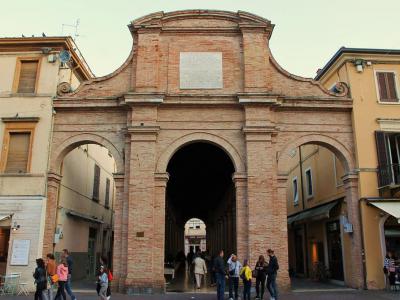
Rimini is a coastal town. Since its beginnings, fishing has been an essential activity. The Old Fish Market, built by Rimini architect Giovanni Francesco Buonamici in 1747, demonstrates the economic importance of the fishing industry in Rimini. Its appearance hasn't changed much as it was built to last. The market structure features a loggia with two aisles reached through three large stone arches. Everything is Istrian stone.
In the four corners of the market are statues of dolphins with water jets used to clean fish. Two rows of Istrian stone counters line the inner arcade. Here women used to sell fish and clams, the so-called "poveracce." The area has become a hub of restaurants, wine bars, cafes, and a hangout for the night people.
Every evening crowds of young people meet for drinks and snacks, maybe a concert or event. History and new trends come together. Outside tables, candlelight, and pubs enliven the old market. It is a great place to meet new people and make friends. The finger food is good too.
In the four corners of the market are statues of dolphins with water jets used to clean fish. Two rows of Istrian stone counters line the inner arcade. Here women used to sell fish and clams, the so-called "poveracce." The area has become a hub of restaurants, wine bars, cafes, and a hangout for the night people.
Every evening crowds of young people meet for drinks and snacks, maybe a concert or event. History and new trends come together. Outside tables, candlelight, and pubs enliven the old market. It is a great place to meet new people and make friends. The finger food is good too.
13) Piazza Cavour (Cavour Square) (must see)
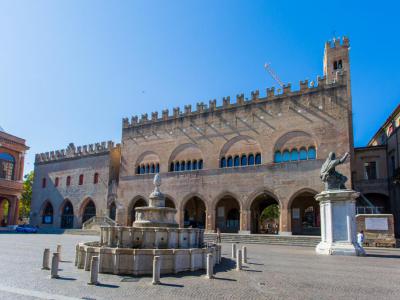
Cavour Square is one of the main historical squares of Rimini, which reflects the history of the city and the spirit of past centuries. As the center of city life since the middle ages, the square is bordered by buildings of interest. Podesta building and its battlements and Gothic arches date from 1334. The neighboring Palace dell' Arengo was built in 1204. Malatestiano Temple and City Museum are on the square as well.
Although Cavour Square is not as big as Three Martyrs' Square, it is more popular with the locals. One side of the square is lined with coffee shops. Malatesta Square and Cavour Square are the venues for the largest weekly open-air market in the Emilia Romagna region.
A statue of Pope Paul V, by sculptor Sebastiano Sebastiani, has stood in the center of the square since the 17th century. Near the sculpture is the Pine Cone Fountain (Fontana della Pigna), built in Roman times. It was the only source of drinking water for Rimini until 1912.
On the Fountain can be seen numerous commemorative plaques. The most famous testimony is the one left by Leonardo da Vinci during his visit to Rimini: "Make a harmony with the different falls of water, as you saw at the source of Rimini, as you saw on August 5, 1502".
Federico Fellini often spoke about the square. He reproduced the square as a set at the film studio Cinecitta in Rome.
Although Cavour Square is not as big as Three Martyrs' Square, it is more popular with the locals. One side of the square is lined with coffee shops. Malatesta Square and Cavour Square are the venues for the largest weekly open-air market in the Emilia Romagna region.
A statue of Pope Paul V, by sculptor Sebastiano Sebastiani, has stood in the center of the square since the 17th century. Near the sculpture is the Pine Cone Fountain (Fontana della Pigna), built in Roman times. It was the only source of drinking water for Rimini until 1912.
On the Fountain can be seen numerous commemorative plaques. The most famous testimony is the one left by Leonardo da Vinci during his visit to Rimini: "Make a harmony with the different falls of water, as you saw at the source of Rimini, as you saw on August 5, 1502".
Federico Fellini often spoke about the square. He reproduced the square as a set at the film studio Cinecitta in Rome.
14) Castel Sismondo (Sismondo Castle)
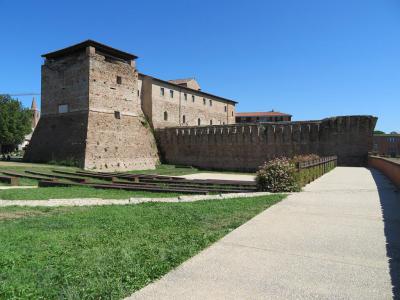
The Castle Sismondo is named after its creator, the feudal lord Sigismondo Pandolfo Malatesta. He was lord of Rimini and the coastal town of Fano until he died in 1468. The castle is located in Malatesta Square and is one of the city's most important monuments. Today's remains were once a majestic fortified palace, a manifestation of Malatesta's power and prestige.
Construction began in 1437 and lasted almost 15 years. It is known that Malatesta designed the castle, although several architects worked on the building, including the architect Filippo Brunelleschi, who had also designed the dome of Florence Cathedral.
Enormous towers and dense, slanted walls shaped the castle. The main entrance was guarded by a double ravelin (fortified island) and a drawbridge. The tops of the walls are crenelated with merlons (notched battlements).
The castle covers 3,300 square meters. It has the three-floor Isotta wing for Sigismondo's wife, a central courtyard, and a massive keep. In 1821 the building served as barracks for the local Carabinieri. The walls were partially demolished, and the towers disappeared. Outer walls, the surrounding trench, and what remained of the structure became a prison until 1967.
After a period of decline, the edifice is used for cultural exhibitions. Since 2020, the complex has become a vast museum dedicated to filmmaker Federico Fellini.
Construction began in 1437 and lasted almost 15 years. It is known that Malatesta designed the castle, although several architects worked on the building, including the architect Filippo Brunelleschi, who had also designed the dome of Florence Cathedral.
Enormous towers and dense, slanted walls shaped the castle. The main entrance was guarded by a double ravelin (fortified island) and a drawbridge. The tops of the walls are crenelated with merlons (notched battlements).
The castle covers 3,300 square meters. It has the three-floor Isotta wing for Sigismondo's wife, a central courtyard, and a massive keep. In 1821 the building served as barracks for the local Carabinieri. The walls were partially demolished, and the towers disappeared. Outer walls, the surrounding trench, and what remained of the structure became a prison until 1967.
After a period of decline, the edifice is used for cultural exhibitions. Since 2020, the complex has become a vast museum dedicated to filmmaker Federico Fellini.
15) Porta Montanara (Montanara Gate)
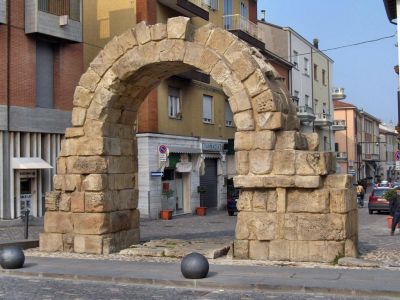
Montanara Gate (Porta Montanara), historically known as Porta Sant'Andrea, is an ancient Roman city gate located in Rimini. Built in the 1st century BC following Sulla's civil war, it originally consisted of two arches, serving as a southern gateway to the Roman colonia of Ariminum. Positioned at the southern end of Rimini’s cardo maximus (now Via Giuseppe Garibaldi), it connected the city to the Marecchia Valley and onward to Arretium (modern Arezzo).
The sandstone Montanara Gate, 12.5 meters wide with two 5.9-meter-high arches, fortified Ariminum after Sulla's forces sacked the city in 82 BC. Over time, the northern arch was sealed, and the southern arch was raised due to street-level changes. By the medieval period, it was part of Borgo Sant'Andrea, integrated into structures like Palazzo Turchi, and witnessed the 1528 Papal takeover ending Malatesta rule.
The gate survived heavy Allied bombing during World War II, which uncovered the long-hidden northern arch in 1944. However, the southern arch was destroyed by Allied forces to facilitate tank movement. Following the war, efforts were made to preserve the remaining northern arch. Despite these efforts, the arch was dismantled in 1949 and relocated to the courtyard of the Tempio Malatestiano, where it was reconstructed using modern cement and non-original stones.
In 2004, the arch was restored near its original location on Via Garibaldi, thanks to efforts funded by local organizations. The inauguration was marked by a commemorative medal featuring the original two-arch design and Rimini’s Roman grid plan. The arch now serves as a testament to the city’s rich Roman history and its resilience through centuries of change.
The surviving arch of Montanara Gate, built with double-row voussoirs, reflects Roman engineering, using sandstone from Covignano Hill or Pietracuta. Flint cubes on Via Garibaldi mark the site of the demolished southern arch. Today, it symbolizes Rimini's rich history, from Roman times to modern restoration.
The sandstone Montanara Gate, 12.5 meters wide with two 5.9-meter-high arches, fortified Ariminum after Sulla's forces sacked the city in 82 BC. Over time, the northern arch was sealed, and the southern arch was raised due to street-level changes. By the medieval period, it was part of Borgo Sant'Andrea, integrated into structures like Palazzo Turchi, and witnessed the 1528 Papal takeover ending Malatesta rule.
The gate survived heavy Allied bombing during World War II, which uncovered the long-hidden northern arch in 1944. However, the southern arch was destroyed by Allied forces to facilitate tank movement. Following the war, efforts were made to preserve the remaining northern arch. Despite these efforts, the arch was dismantled in 1949 and relocated to the courtyard of the Tempio Malatestiano, where it was reconstructed using modern cement and non-original stones.
In 2004, the arch was restored near its original location on Via Garibaldi, thanks to efforts funded by local organizations. The inauguration was marked by a commemorative medal featuring the original two-arch design and Rimini’s Roman grid plan. The arch now serves as a testament to the city’s rich Roman history and its resilience through centuries of change.
The surviving arch of Montanara Gate, built with double-row voussoirs, reflects Roman engineering, using sandstone from Covignano Hill or Pietracuta. Flint cubes on Via Garibaldi mark the site of the demolished southern arch. Today, it symbolizes Rimini's rich history, from Roman times to modern restoration.
