Custom Walk in Salzburg, Austria by gmilienou_4c4f2 created on 2025-06-03
Guide Location: Austria » Salzburg
Guide Type: Custom Walk
# of Sights: 14
Tour Duration: 3 Hour(s)
Travel Distance: 3.8 Km or 2.4 Miles
Share Key: DDKF6
Guide Type: Custom Walk
# of Sights: 14
Tour Duration: 3 Hour(s)
Travel Distance: 3.8 Km or 2.4 Miles
Share Key: DDKF6
How It Works
Please retrieve this walk in the GPSmyCity app. Once done, the app will guide you from one tour stop to the next as if you had a personal tour guide. If you created the walk on this website or come to the page via a link, please follow the instructions below to retrieve the walk in the app.
Retrieve This Walk in App
Step 1. Download the app "GPSmyCity: Walks in 1K+ Cities" on Apple App Store or Google Play Store.



Step 2. In the GPSmyCity app, download(or launch) the guide "Salzburg Map and Walking Tours".
Step 3. Tap the menu button located at upper right corner of the "Walks" screen and select "Retrieve custom walk". Enter the share key: DDKF6
1) Mozart Residence (Mozart Wohnhaus) (must see)
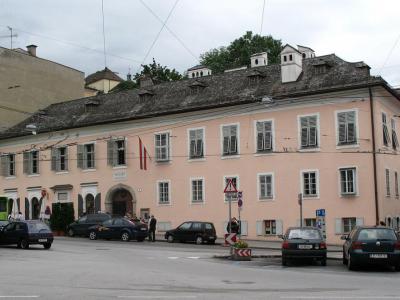
The Dance Master's House (Tanzmeisterhaus), more popularly known as the Mozart Residence (Mozart-Wohnhaus), was once the home of Leopold Mozart and his family, from 1773 to 1787. Here, Wolfgang Amadeus Mozart lived from ages 17 to 25. Located at Makart Square (Makartplatz) Number 8, this building, first documented in 1617, is now a museum.
Originally used by the court dancing master, this house was a venue for dance lessons for nobles. It came to be known as the Dance Master's House by 1713. After several ownership changes, it became the residence of the Mozart family in 1773, who moved here as their place in Grain Lane was no longer adequate for their needs. It was here, in the spacious apartment on the first floor, that the Mozart family would host social gatherings appropriately and where Wolfgang himself stayed until he moved to Vienna in 1781. Leopold Mozart continued to live here until his death in 1787.
The building was partially destroyed by bombs in 1944, but the consequent restoration in the 1950s preserved its late 18th-century stucco decoration. The on-site museum, opened in 1996, showcases musical instruments, documents, and the relocated Magic Flute House (Zauberflötenhäuschen), where Mozart reportedly composed his "The Magic Flute" opera.
A large painting of the family shows the prodigy with his father on the violin and his sister at the piano, while the mother – who had sadly died two years earlier in Paris – is portrayed separately above the threesome. Elsewhere, you'll see three circular targets high on the wall and the air rifle that the Mozarts used to shoot at them in the glass case nearby. These are just some of the marvelous artifacts displayed in the rooms.
Highlights include a screen presentation of Mozart's extensive travels throughout Europe initiated by his father, who was convinced they were essential to enlighten and humanize his prodigy son. In another room, you might be interested in the audio guide's explanation of how Leopold helped to immerse Wolfgang in playing music and later promoted his talented son. The last room has extensive information about how the "Mozart" name has been used for profit, and the one before it shows fraudulent portraits of Mozart throughout the years.
The museum is open daily: from 9 am to 5:30 pm (September through June); and from 8:30 am to 7 pm (July through August). The last admission is 30 minutes before closing.
Originally used by the court dancing master, this house was a venue for dance lessons for nobles. It came to be known as the Dance Master's House by 1713. After several ownership changes, it became the residence of the Mozart family in 1773, who moved here as their place in Grain Lane was no longer adequate for their needs. It was here, in the spacious apartment on the first floor, that the Mozart family would host social gatherings appropriately and where Wolfgang himself stayed until he moved to Vienna in 1781. Leopold Mozart continued to live here until his death in 1787.
The building was partially destroyed by bombs in 1944, but the consequent restoration in the 1950s preserved its late 18th-century stucco decoration. The on-site museum, opened in 1996, showcases musical instruments, documents, and the relocated Magic Flute House (Zauberflötenhäuschen), where Mozart reportedly composed his "The Magic Flute" opera.
A large painting of the family shows the prodigy with his father on the violin and his sister at the piano, while the mother – who had sadly died two years earlier in Paris – is portrayed separately above the threesome. Elsewhere, you'll see three circular targets high on the wall and the air rifle that the Mozarts used to shoot at them in the glass case nearby. These are just some of the marvelous artifacts displayed in the rooms.
Highlights include a screen presentation of Mozart's extensive travels throughout Europe initiated by his father, who was convinced they were essential to enlighten and humanize his prodigy son. In another room, you might be interested in the audio guide's explanation of how Leopold helped to immerse Wolfgang in playing music and later promoted his talented son. The last room has extensive information about how the "Mozart" name has been used for profit, and the one before it shows fraudulent portraits of Mozart throughout the years.
The museum is open daily: from 9 am to 5:30 pm (September through June); and from 8:30 am to 7 pm (July through August). The last admission is 30 minutes before closing.
2) Linzer Gasse
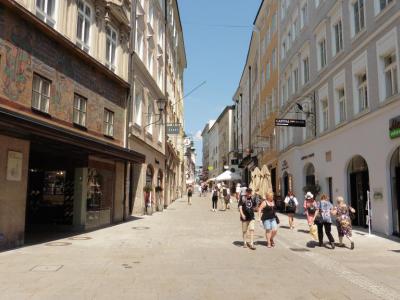
Linzergasse is a busy street in Salzburg flanked by medieval buildings. It is called Linzergasse because it was once the main road from Salzburg to Linz in Austria.
Linzergasse was an important road in Juvavum, the Roman city that later became Salzburg. In the Middle Ages, travelers and tradesman going to Linz passed through the Linzertor Gate that stood at the end of the street until 1894. The houses that flank Linzergasse date back to the 14th or 15th centuries and were always occupied by small craftsmen and their families.
There are many important buildings in Linzergasse. At No:1 is the St. Andrews Church that was built in 1898. No: 3 was the home of the scientist Paracelsus who lived here from 1540 to 1541. He was buried in the cemetery of the nearby St. Sebastian’s Church. House No: 7 was an old pharmacy where the poet George Trakl worked in 1887. House No: 9 is an old brewery and a scion of the family who owned it, Richard Mayr became a famous opera singer. One can climb the steps to the Kapuziner Abbey for breathtaking views. House No: 43 was a medieval bath house. The street ends with the St. Sebastian Church. The cemetery of the church also contains the graves of Mozart’s father Leopold and his wife Constanze.
Linzergasse was an important road in Juvavum, the Roman city that later became Salzburg. In the Middle Ages, travelers and tradesman going to Linz passed through the Linzertor Gate that stood at the end of the street until 1894. The houses that flank Linzergasse date back to the 14th or 15th centuries and were always occupied by small craftsmen and their families.
There are many important buildings in Linzergasse. At No:1 is the St. Andrews Church that was built in 1898. No: 3 was the home of the scientist Paracelsus who lived here from 1540 to 1541. He was buried in the cemetery of the nearby St. Sebastian’s Church. House No: 7 was an old pharmacy where the poet George Trakl worked in 1887. House No: 9 is an old brewery and a scion of the family who owned it, Richard Mayr became a famous opera singer. One can climb the steps to the Kapuziner Abbey for breathtaking views. House No: 43 was a medieval bath house. The street ends with the St. Sebastian Church. The cemetery of the church also contains the graves of Mozart’s father Leopold and his wife Constanze.
3) Steingasse
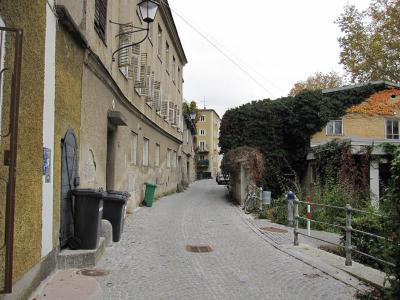
One of the oldest roads in Salzburg, the Steingasse is a small alley that lies between Kapuzinerberg and the Salzach River. It is flanked by medieval houses and has retained its medieval atmosphere until today.
Steingasse dates back to the time when Salzburg was the Roman city of Juvavum. In the middle ages, it became an important trade route and was the main entry point for salt consignments from the Hallein Township. Travelers passed the Steingasse on their way to Italy in the medieval era. The narrow Steintor Gate built in 1280 was the point of entry for travelers and traders.
Residents of Steingasse included potters, dyers and tanners who required water for their work because of its proximity to the Salzach River. No:9 Steingasse was the house where Josef Mohr, the composer of the Christmas Carol, ‘Silent Night’ was born. There is a small private museum in the building dedicated to the composer. Another notable building is the St. Johann am Imberg Church that was Mozart’s favorite place of worship. At one end of Steingasse is a small marble fountain called the Engelwirtsbrunnen which was installed in 1660 in front of the Engelwirt Inn was placed in its present location in 1890. Today, there are many bars, quaint shops, bookstores and galleries in the well preserved medieval buildings that line the street.
Why You Should Visit:
If you look for silence and some nice little bars & restaurants, this is the place.
Steingasse dates back to the time when Salzburg was the Roman city of Juvavum. In the middle ages, it became an important trade route and was the main entry point for salt consignments from the Hallein Township. Travelers passed the Steingasse on their way to Italy in the medieval era. The narrow Steintor Gate built in 1280 was the point of entry for travelers and traders.
Residents of Steingasse included potters, dyers and tanners who required water for their work because of its proximity to the Salzach River. No:9 Steingasse was the house where Josef Mohr, the composer of the Christmas Carol, ‘Silent Night’ was born. There is a small private museum in the building dedicated to the composer. Another notable building is the St. Johann am Imberg Church that was Mozart’s favorite place of worship. At one end of Steingasse is a small marble fountain called the Engelwirtsbrunnen which was installed in 1660 in front of the Engelwirt Inn was placed in its present location in 1890. Today, there are many bars, quaint shops, bookstores and galleries in the well preserved medieval buildings that line the street.
Why You Should Visit:
If you look for silence and some nice little bars & restaurants, this is the place.
4) Mozartsteg (Mozart Bridge)
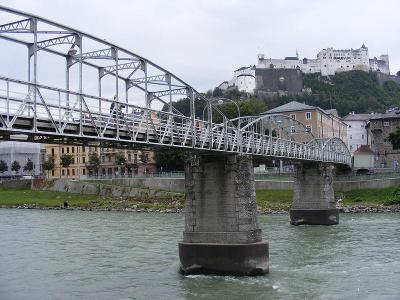
If you’ve ever dreamed of a quiet stroll through Salzburg with a pinch of history and just the right amount of cinematic flair, step onto the Mozart Bridge-a delicate little Art Nouveau footbridge stretching its iron limbs across the Salzach River like a catwalk model in steel...
Built in 1903 as a private toll bridge (yes, even bridges had side hustles back then), this beauty owes its existence to a café owner who simply wanted more foot traffic for his enterprise. Literally. The plan was simple yet clever: build a shortcut, lure the thirsty masses, get profit. And it worked (because nothing says "boost my latte sales" like constructing your own pedestrian bridge).
Crafted entirely of steel but with the grace of a ballerina, the bridge still oozes charm with its elegant curves and delicate latticework. Think of it as the architectural equivalent of Mozart in bridge form-refined, a little showy, and impossible to ignore.
Adding depth to its charm is the river gushing below- the Salzach. Once a superhighway for salt barges, it now carries only fresh water in that signature Alpine green. For nearly 2,000 years, vessels laden with “white gold” mined nearby floated downstream, fueling the city's prosperity, turning salt into gold-or at least into ornate fountains and lavish palaces...
In 1921, the city took over the property, waved goodbye to tolls, and gave the Mozart Bridge to the people. Since then, it’s become an Insta-famous, photogenic darling for tourists and a star of the Sound of Music pilgrimage trail. Yes, this is the very spot where Maria and the Von Trapp kids frolic riverside, high on life, and show tunes during the tail end of “My Favorite Things.”
These days, it’s a peaceful and less-crowded shortcut for pedestrians exploring Salzburg, perfect for those dodging crowds or chasing sunsets. It links the Old Town to the leafy slopes of Capuchin Mountain and the quieter stretches of the Salzach, where you can pause mid-bridge and soak up the Baroque skyline, with the High Salzburg Fortress brooding handsomely in the background.
So, whether you're chasing film trivia, a photogenic moment, or just an escape route with style, the Mozart Bridge is your elegant accomplice. It doesn’t just get you from A to B-it gives you a scene worth remembering. Just don’t forget to hum a few bars of "Raindrops on roses..." while crossing. It’s tradition.
Built in 1903 as a private toll bridge (yes, even bridges had side hustles back then), this beauty owes its existence to a café owner who simply wanted more foot traffic for his enterprise. Literally. The plan was simple yet clever: build a shortcut, lure the thirsty masses, get profit. And it worked (because nothing says "boost my latte sales" like constructing your own pedestrian bridge).
Crafted entirely of steel but with the grace of a ballerina, the bridge still oozes charm with its elegant curves and delicate latticework. Think of it as the architectural equivalent of Mozart in bridge form-refined, a little showy, and impossible to ignore.
Adding depth to its charm is the river gushing below- the Salzach. Once a superhighway for salt barges, it now carries only fresh water in that signature Alpine green. For nearly 2,000 years, vessels laden with “white gold” mined nearby floated downstream, fueling the city's prosperity, turning salt into gold-or at least into ornate fountains and lavish palaces...
In 1921, the city took over the property, waved goodbye to tolls, and gave the Mozart Bridge to the people. Since then, it’s become an Insta-famous, photogenic darling for tourists and a star of the Sound of Music pilgrimage trail. Yes, this is the very spot where Maria and the Von Trapp kids frolic riverside, high on life, and show tunes during the tail end of “My Favorite Things.”
These days, it’s a peaceful and less-crowded shortcut for pedestrians exploring Salzburg, perfect for those dodging crowds or chasing sunsets. It links the Old Town to the leafy slopes of Capuchin Mountain and the quieter stretches of the Salzach, where you can pause mid-bridge and soak up the Baroque skyline, with the High Salzburg Fortress brooding handsomely in the background.
So, whether you're chasing film trivia, a photogenic moment, or just an escape route with style, the Mozart Bridge is your elegant accomplice. It doesn’t just get you from A to B-it gives you a scene worth remembering. Just don’t forget to hum a few bars of "Raindrops on roses..." while crossing. It’s tradition.
5) Mozartplatz (Mozart Square) (must see)
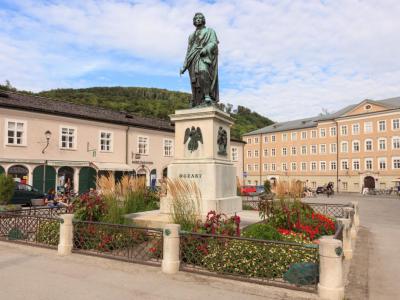
Mozart Square (Mozartplatz), in the historic Old Town of Salzburg, is named after the famous composer Wolfgang Amadeus Mozart, who was born in the city (just a few blocks away from this place, in fact) and spent most of his first 25 years here (from 1756 to 1781).
This area was redeveloped in the early 17th century by Prince-Archbishop Wolf Dietrich von Raitenau and was originally known as Michael's Square (Michaelsplatz), featuring a baroque fountain with a statue of Saint Michael. The latter was eventually replaced by the Mozart Monument (Mozartdenkmal) in 1842 to mark the 50th anniversary of the composer's death.
The monument was unveiled in the presence of Mozart's two surviving sons. The Roman mosaic found on the site during the construction is seen at the base of the statue, bearing an inscription about happiness and protection from evil. The marble pedestal of the statue was a gift from King Ludwig I of Bavaria. This monument was the first sign of public recognition the great composer had received from his hometown since his untimely passing. The music festival held that year sowed the seed for what would later become the world-renowned annual Salzburg Festival.
The square is bordered by several notable buildings. On the north side (adjacent to part of the old city wall dating back to the first half of the 1600s) is the Imhofstöckl edifice housing the city's tourist information office. The New Residence (Neue Residenz) at Number 1, which hosts the Salzburg Museum, together with several 17th-century houses with uniform facades, line the other sides of the square. Notably, one of these houses was the residence of Mozart's widow, Constanze Mozart-Nissen. The square also features the Salzburg Christmas Museum and Café Glockenspiel, sharing space at Number 2.
The on-site Resistance Memorial commemorates the transnational resistance against Bavaria's Wackersdorf reprocessing plant in the late 1980s. Inaugurated in 2000, it features a section of the original fence and a green radiation sign and honors over 420,000 objectors who influenced Austria's anti-nuclear policy.
Tip:
Those looking to buy tacky souvenirs should check out the Zum Mozart shop located at one of the corners of the square.
This area was redeveloped in the early 17th century by Prince-Archbishop Wolf Dietrich von Raitenau and was originally known as Michael's Square (Michaelsplatz), featuring a baroque fountain with a statue of Saint Michael. The latter was eventually replaced by the Mozart Monument (Mozartdenkmal) in 1842 to mark the 50th anniversary of the composer's death.
The monument was unveiled in the presence of Mozart's two surviving sons. The Roman mosaic found on the site during the construction is seen at the base of the statue, bearing an inscription about happiness and protection from evil. The marble pedestal of the statue was a gift from King Ludwig I of Bavaria. This monument was the first sign of public recognition the great composer had received from his hometown since his untimely passing. The music festival held that year sowed the seed for what would later become the world-renowned annual Salzburg Festival.
The square is bordered by several notable buildings. On the north side (adjacent to part of the old city wall dating back to the first half of the 1600s) is the Imhofstöckl edifice housing the city's tourist information office. The New Residence (Neue Residenz) at Number 1, which hosts the Salzburg Museum, together with several 17th-century houses with uniform facades, line the other sides of the square. Notably, one of these houses was the residence of Mozart's widow, Constanze Mozart-Nissen. The square also features the Salzburg Christmas Museum and Café Glockenspiel, sharing space at Number 2.
The on-site Resistance Memorial commemorates the transnational resistance against Bavaria's Wackersdorf reprocessing plant in the late 1980s. Inaugurated in 2000, it features a section of the original fence and a green radiation sign and honors over 420,000 objectors who influenced Austria's anti-nuclear policy.
Tip:
Those looking to buy tacky souvenirs should check out the Zum Mozart shop located at one of the corners of the square.
6) Residenzplatz (Residence Square) (must see)
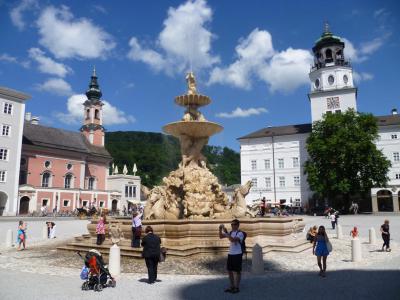
As Salzburg's center of government, the historic Residence Square (Residenzplatz) has long been at the heart of the city, set on the site of a former Roman Forum. Originally known as Main Square (Hauptplatz), it was renamed after the Old Residence (Alte Residenz) Palace, the former dwelling of the city's rulers – prince-archbishops – located to the west.
Flanking the square on the sides are several important buildings, such as the Salzburg Cathedral (to the south), and the New Residence (Neue Residenz) to the east, with its bell tower now housing the Salzburg Museum (to the west).
The square's construction began in 1587, as part of the grand project by Prince-Archbishop Wolf Dietrich von Raitenau to make Salzburg the new "Rome of the North." For that purpose, some of the surrounding medieval homes, as well as the cemetery (above the ancient Roman Forum) had to be leveled.
The square's focal point is the massive central 45-foot-tall Residence Fountain (Residenzbrunnen). Completed between 1656 and 1661 by Tommaso di Garona, it is as Italian as it can be (reportedly the largest and most beautiful Baroque fountain outside of Italy). Made from Untersberg limestone, its design features a Triton statue that propels water upwards – an over-the-top version of Bernini's famous Triton Fountain in Rome.
Notably, in the movie “The Sound Of Music”, the lead character Maria sings "I Have Confidence in Me" while crossing the square by bus on her way to the Trapp villa. She's also seen playfully splashing the fountain's spouting horses.
In the more recent past, Residence Square served as a venue for major rock concerts by the likes of Joe Cocker and Tina Turner. Presently, apart from being a historical site, it is also a vibrant cultural venue hosting various events, including an open-air cinema during summer, a fair in September, and a Christmas market during Advent.
In the 2010s, the square underwent a refurbishment which included the erection of a monument to mark the 80th anniversary of the Nazi book burning that took place here in 1938.
Tip:
Grab some lunch from the nearby bakeries or shops and sit on one of the benches near the fountain, enjoying the view.
Flanking the square on the sides are several important buildings, such as the Salzburg Cathedral (to the south), and the New Residence (Neue Residenz) to the east, with its bell tower now housing the Salzburg Museum (to the west).
The square's construction began in 1587, as part of the grand project by Prince-Archbishop Wolf Dietrich von Raitenau to make Salzburg the new "Rome of the North." For that purpose, some of the surrounding medieval homes, as well as the cemetery (above the ancient Roman Forum) had to be leveled.
The square's focal point is the massive central 45-foot-tall Residence Fountain (Residenzbrunnen). Completed between 1656 and 1661 by Tommaso di Garona, it is as Italian as it can be (reportedly the largest and most beautiful Baroque fountain outside of Italy). Made from Untersberg limestone, its design features a Triton statue that propels water upwards – an over-the-top version of Bernini's famous Triton Fountain in Rome.
Notably, in the movie “The Sound Of Music”, the lead character Maria sings "I Have Confidence in Me" while crossing the square by bus on her way to the Trapp villa. She's also seen playfully splashing the fountain's spouting horses.
In the more recent past, Residence Square served as a venue for major rock concerts by the likes of Joe Cocker and Tina Turner. Presently, apart from being a historical site, it is also a vibrant cultural venue hosting various events, including an open-air cinema during summer, a fair in September, and a Christmas market during Advent.
In the 2010s, the square underwent a refurbishment which included the erection of a monument to mark the 80th anniversary of the Nazi book burning that took place here in 1938.
Tip:
Grab some lunch from the nearby bakeries or shops and sit on one of the benches near the fountain, enjoying the view.
7) Hohensalzburg (High Salzburg Fortress) (must see)
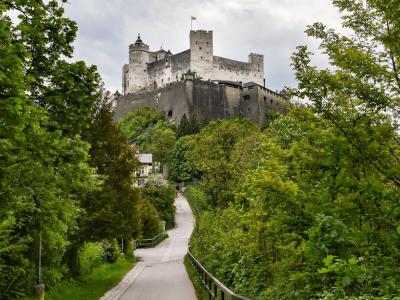
Sitting atop the Fortress Mountain (Festungsberg) at an altitude of 506 meters, the mighty High Salzburg Fortress (Hohensalzburg) dominates the skyline of Salzburg.
Archaeological findings revealed a Roman fort once present at this site. The current construction was started in 1077 by one of the city's prince-archbishops and was more a show of the Catholic Church's power and determination than anything else. Let's say that the archbishops were more businessmen and politicians than churchmen... but that sums up the Middle Ages in many places.
What started as a small castle eventually grew into a grand, whitewashed fortress – 250 meters (820 feet) long and 150 meters (490 feet) wide – making it one of the largest medieval castles in Europe, so foreboding in fact, that no army ever tried attacking it for over eight centuries.
Still, during the course of history, the fortress did see action – during the German Peasants' War in 1525 – and underwent further modifications in the Thirty Years' War (which lasted from 1618 to 1648). By the 19th century, after a stint as a military barracks and a storage depot, the fortress was decommissioned, in 1861, and opened to the public by Habsburg Emperor Franz Josef.
Being one of Europe's best-preserved castles, it has undergone significant transformations since its refurbishment in the late 19th century, including the addition of the Fortress Railway (Festungsbahn) funicular in 1892.
Inside, the fortress boasts luxurious state apartments, the Golden Hall, and the Golden Chamber, exemplifying its role as both a residence and a refuge. It features the "Salzburg Bull," a large mechanical organ, dating from 1502, that plays daily between Palm Sunday and October 31, at 7, 11, and 18 o'clock. The fortress is adorned with marble pillars, a coffered ceiling with gold stars, and a chapel with a star-vaulted ceiling. The bedchamber combines historic splendor with modern updates, showcasing precious textiles, gilded wainscoting, and a once state-of-the-art toilet...)))
On top of that, the High Salzburg Fortress offers unique panoramic views of the city, mountains, and surrounding plains, as well as cafés and a handful of museums. It’s a pleasant place to grab an ice cream cone and wander the whitewashed maze of buildings while soaking up the medieval ambiance.
Tip:
It's worth going to for the views alone, but the short guided tour is also fascinating. They do a great job telling the story of this fortress and its growth over the centuries.
Don't miss visiting the few rooms with the marionettes on display, and try to leak into the old church as well.
Although most visitors opt for the one-minute trip on the funicular, consider walking up if you are in good shape and the weather allows, as it makes the experience more enjoyable and there are some nice things to see on the way.
To save money and avoid the crowds, take advantage of online booking using the 'early bird' pricing (you'll then scan tickets from your device to get access to the site). If time allows, take advantage of dinner and the concerts which feature local musicians playing wonderful classical music from the region.
Archaeological findings revealed a Roman fort once present at this site. The current construction was started in 1077 by one of the city's prince-archbishops and was more a show of the Catholic Church's power and determination than anything else. Let's say that the archbishops were more businessmen and politicians than churchmen... but that sums up the Middle Ages in many places.
What started as a small castle eventually grew into a grand, whitewashed fortress – 250 meters (820 feet) long and 150 meters (490 feet) wide – making it one of the largest medieval castles in Europe, so foreboding in fact, that no army ever tried attacking it for over eight centuries.
Still, during the course of history, the fortress did see action – during the German Peasants' War in 1525 – and underwent further modifications in the Thirty Years' War (which lasted from 1618 to 1648). By the 19th century, after a stint as a military barracks and a storage depot, the fortress was decommissioned, in 1861, and opened to the public by Habsburg Emperor Franz Josef.
Being one of Europe's best-preserved castles, it has undergone significant transformations since its refurbishment in the late 19th century, including the addition of the Fortress Railway (Festungsbahn) funicular in 1892.
Inside, the fortress boasts luxurious state apartments, the Golden Hall, and the Golden Chamber, exemplifying its role as both a residence and a refuge. It features the "Salzburg Bull," a large mechanical organ, dating from 1502, that plays daily between Palm Sunday and October 31, at 7, 11, and 18 o'clock. The fortress is adorned with marble pillars, a coffered ceiling with gold stars, and a chapel with a star-vaulted ceiling. The bedchamber combines historic splendor with modern updates, showcasing precious textiles, gilded wainscoting, and a once state-of-the-art toilet...)))
On top of that, the High Salzburg Fortress offers unique panoramic views of the city, mountains, and surrounding plains, as well as cafés and a handful of museums. It’s a pleasant place to grab an ice cream cone and wander the whitewashed maze of buildings while soaking up the medieval ambiance.
Tip:
It's worth going to for the views alone, but the short guided tour is also fascinating. They do a great job telling the story of this fortress and its growth over the centuries.
Don't miss visiting the few rooms with the marionettes on display, and try to leak into the old church as well.
Although most visitors opt for the one-minute trip on the funicular, consider walking up if you are in good shape and the weather allows, as it makes the experience more enjoyable and there are some nice things to see on the way.
To save money and avoid the crowds, take advantage of online booking using the 'early bird' pricing (you'll then scan tickets from your device to get access to the site). If time allows, take advantage of dinner and the concerts which feature local musicians playing wonderful classical music from the region.
8) St. Peter's Abbey and Cemetery (must see)
Saint Peter's Abbey (Stift Sankt Peter) is a Benedictine monastery and former cathedral. Considered one of the oldest monasteries in the German-speaking world, the abbey was founded in 696 by Saint Rupert. Despite challenges during the Nazi regime in 1938, the abbey maintained operation and remains active to this very day.
A marvelous steeple crowned with an onion dome gives an admirable facade to the Abbey Church. Since its dedication in 1147, this Romanesque church underwent multiple renovations, acquiring its Rococo style in 1782. The church houses significant graves, including that of Martin Luther's superior.
Saint Peter's Abbey is home to Austria's oldest library, comprising nearly 100,000 volumes. The Rococo-style library is particularly noted for its extensive collection of manuscripts, incunabula, and local history volumes, along with special collections of graphics and maps. It also contains a notable collection of music manuscripts from composers like Mozart and Haydn. Additionally, the abbey houses diverse collections of paintings and other artifacts, although some are not accessible to the public. Access to the library requires a special permit.
During his early years in Salzburg, Wolfgang Amadeus Mozart composed the Dominikus Mass for Saint Peter's Abbot Dominikus Hagenauer, in 1769. Hagenauer wrote in his diary: "Music for the Mass composed by Wolfgang Mozart, 14 years of age, was in every one's opinion most elegant. Wolfgang Mozart played on the great organ for half an hour to the astonishment of all." The composer returned to Saint Peter's in 1783 to conduct his "Mass in C minor," which is now performed at the Salzburg Festival each summer.
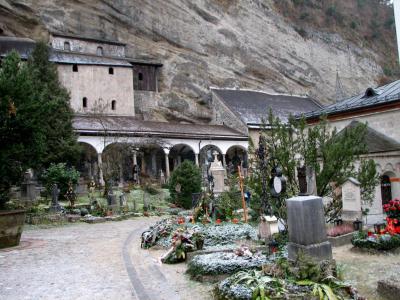
The abbey complex also contains a very old (established circa 700 AD) cemetery. The oldest graves in Saint Peter's Cemetery (Petersfriedhof) date back to the late 13th century. Distinguished individuals including Mozart's sister Nannerl (an accomplished musician in her own right), Joseph Haydn's brother Michael, and sculptor Josef Thorak are buried here.
The cemetery grounds are also known for the catacombs carved into rocks, which served as early Christian assembly places and hermitages. Wonderful to visit, they are filled with early altars, faded murals, and inscriptions.
In "The Sound of Music" movie, the Von Trapp family goes into hiding from the Nazis at a local cemetery. The actual scene was filmed on a Hollywood set meticulously recreating the setting inspired by Saint Peter's cemetery.
Why You Should Visit:
Everything here is free to visit except for the catacombs which cost a modest fee.
A marvelous steeple crowned with an onion dome gives an admirable facade to the Abbey Church. Since its dedication in 1147, this Romanesque church underwent multiple renovations, acquiring its Rococo style in 1782. The church houses significant graves, including that of Martin Luther's superior.
Saint Peter's Abbey is home to Austria's oldest library, comprising nearly 100,000 volumes. The Rococo-style library is particularly noted for its extensive collection of manuscripts, incunabula, and local history volumes, along with special collections of graphics and maps. It also contains a notable collection of music manuscripts from composers like Mozart and Haydn. Additionally, the abbey houses diverse collections of paintings and other artifacts, although some are not accessible to the public. Access to the library requires a special permit.
During his early years in Salzburg, Wolfgang Amadeus Mozart composed the Dominikus Mass for Saint Peter's Abbot Dominikus Hagenauer, in 1769. Hagenauer wrote in his diary: "Music for the Mass composed by Wolfgang Mozart, 14 years of age, was in every one's opinion most elegant. Wolfgang Mozart played on the great organ for half an hour to the astonishment of all." The composer returned to Saint Peter's in 1783 to conduct his "Mass in C minor," which is now performed at the Salzburg Festival each summer.
The abbey complex also contains a very old (established circa 700 AD) cemetery. The oldest graves in Saint Peter's Cemetery (Petersfriedhof) date back to the late 13th century. Distinguished individuals including Mozart's sister Nannerl (an accomplished musician in her own right), Joseph Haydn's brother Michael, and sculptor Josef Thorak are buried here.
The cemetery grounds are also known for the catacombs carved into rocks, which served as early Christian assembly places and hermitages. Wonderful to visit, they are filled with early altars, faded murals, and inscriptions.
In "The Sound of Music" movie, the Von Trapp family goes into hiding from the Nazis at a local cemetery. The actual scene was filmed on a Hollywood set meticulously recreating the setting inspired by Saint Peter's cemetery.
Why You Should Visit:
Everything here is free to visit except for the catacombs which cost a modest fee.
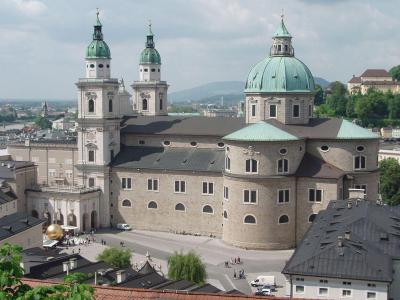
9) Salzburger Dom (Salzburg Cathedral) (must see)
Absolutely massive, incredibly ornate, and very welcoming towards visitors of all stripes, Salzburg Cathedral (Salzburger Dom) is the 17th-century Baroque church of the Roman Catholic denomination. It is dedicated to Saint Rupert and Saint Vergilius. The former founded the church in 774 on the remnants of a Roman town, and in 1181 the cathedral was rebuilt after a fire. In the 17th century, it was completely remodeled in the Baroque style under Prince-Bishop Wolf Dietrich von Raitenau to its present appearance.
In 1756, Wolfgang Amadeus Mozart was baptized here; the cathedral still contains the 14th-century Gothic baptismal font in which the composer was baptized (just see to the left upon entering). Famously, the grand bronze baptismal font was also used for the baptism of yet another artistic celebrity, Joseph Mohr, the Austrian writer, who wrote the words to the Christmas carol "Silent Night."
During World War II, the cathedral was damaged when a single bomb crashed through its central dome but was completely restored by 1959.
Salzburg Cathedral is framed by three arches linking it to the Residence Palace and Saint Peter's Abbey, creating an enclosed square. The cathedral's façade, made from dark grey stone with bright Untersberg marble, includes three portals leading to bronze doors, surrounded by statues of saints and topped with figures of the four evangelists and a scene of the Transfiguration of Jesus. The cathedral also houses historic bronze gates inside these portals, representing Faith, Hope, and Love, created by renowned sculptors in the mid-20th century.
The oldest bells in the cathedral are the Marien and the Virgil, both cast in 1628. The Salvator bell of the cathedral is the second largest bell in Austria, after the Pummerin bell in Vienna Cathedral.
Once inside, a number of organs are to be admired: one on each side of the high altar and a magnificent one in the rear traditional placing. Make sure to take a minute to sit in a pew and absorb everything around – you won't be disappointed. Cameras are allowed and there are some excellent photo opportunities to be had.
Tip:
Take a downward trip to the crypt – there is as much underground as above.
It is also worth attending a Sunday mass at 10 am, as you get a full orchestra and chorus.
In 1756, Wolfgang Amadeus Mozart was baptized here; the cathedral still contains the 14th-century Gothic baptismal font in which the composer was baptized (just see to the left upon entering). Famously, the grand bronze baptismal font was also used for the baptism of yet another artistic celebrity, Joseph Mohr, the Austrian writer, who wrote the words to the Christmas carol "Silent Night."
During World War II, the cathedral was damaged when a single bomb crashed through its central dome but was completely restored by 1959.
Salzburg Cathedral is framed by three arches linking it to the Residence Palace and Saint Peter's Abbey, creating an enclosed square. The cathedral's façade, made from dark grey stone with bright Untersberg marble, includes three portals leading to bronze doors, surrounded by statues of saints and topped with figures of the four evangelists and a scene of the Transfiguration of Jesus. The cathedral also houses historic bronze gates inside these portals, representing Faith, Hope, and Love, created by renowned sculptors in the mid-20th century.
The oldest bells in the cathedral are the Marien and the Virgil, both cast in 1628. The Salvator bell of the cathedral is the second largest bell in Austria, after the Pummerin bell in Vienna Cathedral.
Once inside, a number of organs are to be admired: one on each side of the high altar and a magnificent one in the rear traditional placing. Make sure to take a minute to sit in a pew and absorb everything around – you won't be disappointed. Cameras are allowed and there are some excellent photo opportunities to be had.
Tip:
Take a downward trip to the crypt – there is as much underground as above.
It is also worth attending a Sunday mass at 10 am, as you get a full orchestra and chorus.
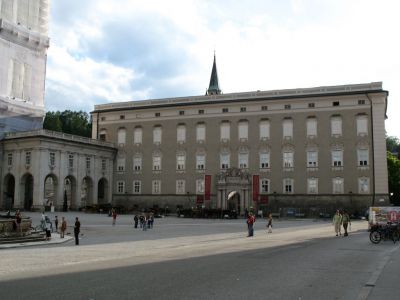
10) Residenz (Residence Palace) (must see)
At the very heart of Salzburg's baroque historic district, the Residence Palace, also known as the Old Residence (Alte Residenz), overlooks Cathedral Square (Domplatz) and the spacious Residence Square (Residenzplatz) with its famous marble fountain. First mentioned in 1120, for centuries this place accommodated prince-archbishops of Salzburg who used it as a symbol of their political status.
The palace, in its present form, emerged at the turn of the 17th century as the home of Wolf Dietrich von Raitenau, the most powerful among the city's prince-archbishops. The Wallistrakt wing of the palace, added in 1604, was the accommodation extension purpose-built for him. Throughout the 18th century, additional Baroque elements and artworks enhanced the palace's grandeur. Following the secularization of Salzburg in 1803, the property served the Austrian imperial family.
The Residence Galery (Residenzgalerie), added in 1923, houses an art collection that was gathered to replace the one lost during the Napoleonic wars. The gallery's sumptuous chambers and halls showcase a magnificent cross-section of European painters from the 16th to the 19th centuries (featuring the likes of Rembrandt, Rubens, and Brueghel).
Since the 1950s, the palace courtyard has provided a lovely setting for the Salzburg opera festival and is a good place to discover Mozart's lesser-known treasures.
It was in the state rooms of this palace that Mozart first performed for Salzburg's Archbishop. At the age of 14, he became the first violinist of the court orchestra, while at the age of 19, his violin concert (KV 219 in A major) was performed for the first time in the Conference Hall.
Tip:
Admission to the Residence Palace is included in the Salzburg Card if you buy it online before visiting. The tour can take two to three hours if you listen to the complete overview.
You can get an audio guide and visit many rooms within the palace (audience rooms, ballrooms, private rooms, etc.) while enjoying a superb aerial view of the square below.
The palace, in its present form, emerged at the turn of the 17th century as the home of Wolf Dietrich von Raitenau, the most powerful among the city's prince-archbishops. The Wallistrakt wing of the palace, added in 1604, was the accommodation extension purpose-built for him. Throughout the 18th century, additional Baroque elements and artworks enhanced the palace's grandeur. Following the secularization of Salzburg in 1803, the property served the Austrian imperial family.
The Residence Galery (Residenzgalerie), added in 1923, houses an art collection that was gathered to replace the one lost during the Napoleonic wars. The gallery's sumptuous chambers and halls showcase a magnificent cross-section of European painters from the 16th to the 19th centuries (featuring the likes of Rembrandt, Rubens, and Brueghel).
Since the 1950s, the palace courtyard has provided a lovely setting for the Salzburg opera festival and is a good place to discover Mozart's lesser-known treasures.
It was in the state rooms of this palace that Mozart first performed for Salzburg's Archbishop. At the age of 14, he became the first violinist of the court orchestra, while at the age of 19, his violin concert (KV 219 in A major) was performed for the first time in the Conference Hall.
Tip:
Admission to the Residence Palace is included in the Salzburg Card if you buy it online before visiting. The tour can take two to three hours if you listen to the complete overview.
You can get an audio guide and visit many rooms within the palace (audience rooms, ballrooms, private rooms, etc.) while enjoying a superb aerial view of the square below.
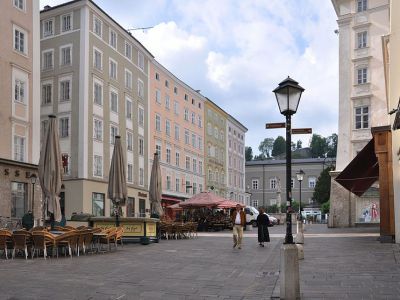
11) Alter Markt (Old Market Square) (must see)
Sometimes street and square names immediately reveal what once took place within them and became defining. So is the case with Salzburg's small and cozy Old Market (Alter Markt) square. The city’s third market square, it dates back to the 13th century. Historically, it hosted weekly markets (selling dairy, vegetables, and poultry), as well as annual Lent and Autumn markets until the late 19th century. It also hosted vibrant folk events such as the Whitsun dance and the Saint John’s bonfire.
Today, the place is encircled by baroque buildings and features the ornate Floriani fountain (Florianibrunnen) at its center. The fountain's oldest component, a delicate, ornamental metal fence was made in 1583, featuring iron figures, including horseback riders and unicorns. Replacing the original medieval draw-well, this sophisticated Baroque fountain was built in several stages.
By 1687, it had acquired a new central pillar and an octagonal marble basin adorned with rosettes and acanthus leaves. The statue of Saint Florian, added in 1734, crowns the fountain and is supposed to protect buildings from fire. Historically, this fountain was central to the annual butcher's jump ritual, marking the passage of apprentices into journeymen on Ash Wednesday (the first day of Lent before Easter).
The Old Market in Salzburg is characterized by its medieval core and is flanked by a row of Baroque burgher houses, with influences from the early modern period evident in its architecture. Notably, Old Market No. 3, currently a bank, sits atop Roman foundations and features a late Baroque marble portal from a former pawnshop. Old Market No. 6 and 7 have housed the Old Court Pharmacy since the 16th century, with the latter still operating today. The pharmacy's original Rococo design and late Baroque window frames are preserved, alongside historical furnishings from the 18th century. Meanwhile, House No. 7, originally late Gothic, now sports a classicist façade and a memorial plaque for Carl Petter, a notable local pharmacist. Additionally, Café Tomaselli, at Numbers 9 and 10, is the oldest continuously operating café in Central Europe. Adjacent to it stands Salzburg's smallest house, a mere 1.42 meters wide, built between 1830 and 1860.
Tip:
Have something from the many local vendors! You can try delicious local as well as other types of (inexpensive) food here.
Today, the place is encircled by baroque buildings and features the ornate Floriani fountain (Florianibrunnen) at its center. The fountain's oldest component, a delicate, ornamental metal fence was made in 1583, featuring iron figures, including horseback riders and unicorns. Replacing the original medieval draw-well, this sophisticated Baroque fountain was built in several stages.
By 1687, it had acquired a new central pillar and an octagonal marble basin adorned with rosettes and acanthus leaves. The statue of Saint Florian, added in 1734, crowns the fountain and is supposed to protect buildings from fire. Historically, this fountain was central to the annual butcher's jump ritual, marking the passage of apprentices into journeymen on Ash Wednesday (the first day of Lent before Easter).
The Old Market in Salzburg is characterized by its medieval core and is flanked by a row of Baroque burgher houses, with influences from the early modern period evident in its architecture. Notably, Old Market No. 3, currently a bank, sits atop Roman foundations and features a late Baroque marble portal from a former pawnshop. Old Market No. 6 and 7 have housed the Old Court Pharmacy since the 16th century, with the latter still operating today. The pharmacy's original Rococo design and late Baroque window frames are preserved, alongside historical furnishings from the 18th century. Meanwhile, House No. 7, originally late Gothic, now sports a classicist façade and a memorial plaque for Carl Petter, a notable local pharmacist. Additionally, Café Tomaselli, at Numbers 9 and 10, is the oldest continuously operating café in Central Europe. Adjacent to it stands Salzburg's smallest house, a mere 1.42 meters wide, built between 1830 and 1860.
Tip:
Have something from the many local vendors! You can try delicious local as well as other types of (inexpensive) food here.
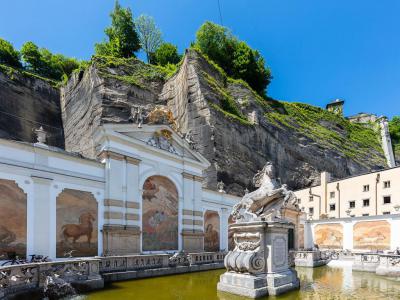
12) Horse Bath (Pferdeschwemme)
Tucked at the foot of Salzburg’s Monk’s Hill, in the city’s so-dramatic Festival District, stands what may be the world’s most flamboyant horsewash, the Horse Bath. Think of it as a 17th-century car wash, but for stallions, and with Baroque flair dialed up to eleven...
Commissioned in 1693 by Prince-Archbishop Johann Ernst von Thun - who clearly thought “washing horses” deserved the same pomp as a coronation - this stone spectacle wasn’t just for rinsing hooves. Oh no. It was a declaration: Salzburg could out-fabulous your water trough any day of the week.
Water flowed in via underground Roman-era canals, modernized in medieval times - because even plumbing, in Salzburg, has a legacy. And while there were other horse baths in the city, this one was the “Versailles” of horse tubs.
Front and center is a muscular rearing steed, held in check by its handler - a powerful marble moment sculpted by Michael Bernhard Mandl. Behind them - a technicolor riot of equine frescoes by Johann Michael Rottmayr, depicting horses in such over-the-top poses you'd think they were auditioning for an opera.
Today, the Horse Bath is a quiet gem, a stone’s throw from the Large Festival House (once the royal stables), offering a breather from Mozart-themed everything.
Film fans will also find it familiar, as the site made a brief cameo appearance in The Sound of Music. During the instrumental ending of “My Favorite Things,” Maria and the Von Trapp children pass by and splash around the fountain. Although some additional scenes filmed here didn’t make the final cut, the Horse Bath still holds a place in the movie’s visual memory.
In the end, it is both an architectural oddity and a historical gem, fully emblematic of Salzburg’s unique way of merging the everyday with the operatic. It's one part outdoor sculpture gallery, one part equine spa, and absolutely no part boring. A place where even sweaty horses got their moment in the spotlight...
Commissioned in 1693 by Prince-Archbishop Johann Ernst von Thun - who clearly thought “washing horses” deserved the same pomp as a coronation - this stone spectacle wasn’t just for rinsing hooves. Oh no. It was a declaration: Salzburg could out-fabulous your water trough any day of the week.
Water flowed in via underground Roman-era canals, modernized in medieval times - because even plumbing, in Salzburg, has a legacy. And while there were other horse baths in the city, this one was the “Versailles” of horse tubs.
Front and center is a muscular rearing steed, held in check by its handler - a powerful marble moment sculpted by Michael Bernhard Mandl. Behind them - a technicolor riot of equine frescoes by Johann Michael Rottmayr, depicting horses in such over-the-top poses you'd think they were auditioning for an opera.
Today, the Horse Bath is a quiet gem, a stone’s throw from the Large Festival House (once the royal stables), offering a breather from Mozart-themed everything.
Film fans will also find it familiar, as the site made a brief cameo appearance in The Sound of Music. During the instrumental ending of “My Favorite Things,” Maria and the Von Trapp children pass by and splash around the fountain. Although some additional scenes filmed here didn’t make the final cut, the Horse Bath still holds a place in the movie’s visual memory.
In the end, it is both an architectural oddity and a historical gem, fully emblematic of Salzburg’s unique way of merging the everyday with the operatic. It's one part outdoor sculpture gallery, one part equine spa, and absolutely no part boring. A place where even sweaty horses got their moment in the spotlight...
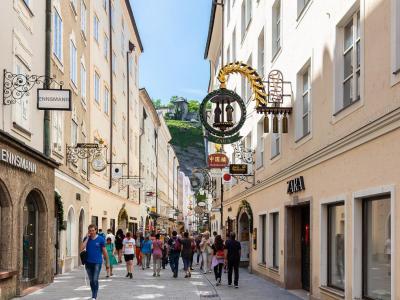
13) Getreidegasse (Grain Lane) (must see)
Old Salzburg's colorful main drag, Grain Lane (Getreidegasse) has been a center of trade since Roman times. Now a UNESCO World Heritage Site since 1996, this historic street is famous for being the birthplace of Wolfgang Amadeus Mozart, at No. 9, where he lived until the age of 17. The narrow lane is lined with high townhouses and is distinguished by its traditional wrought-iron guild signs advertising what is (or used to be) sold inside.
The street, originally named Trot Lane (Trabegasse), traces its beginnings to around 1150 when it served as a pathway from Salzburg's trade center to the suburb of Mülln. Over the centuries, its name evolved several times, reflecting its changing role in the city's economy. By the 14th century, the prince-archbishops granted the citizens staple rights, transforming the area into a vibrant trading zone and attracting Salzburg's patricians and officials who established their residences here.
Dating mainly from the 15th century, the buildings are tall and narrow because this was prime real estate, and there was nowhere to build but up. Space was always tight, as the town was squeezed between the river and the mountain, with lots of land set aside for the church. The architecture still looks much as it did in Mozart's day, though many of the buildings themselves are now inhabited by Austrian clothiers and international chain outlets. At Number 37 you will find the glamorous Goldener Hirsch hotel, a hotspot for stylish gatherings – so, if you're appropriately attired, you may wish to view the lobby and enjoy an aperitif in its gorgeous bar, the watering hole of chic Salzburg.
What was once the Salzburg quarter of prosperous medieval burghers (merchants) now bustles with the tourist trade. Today, Grain Lane forms part of a pedestrian zone and continues to be one of Salzburg's prime tourist attractions. Efforts have been made to preserve its authentic character amidst the conversion of historic residential houses into commercial premises.
Tip:
If planning some shopping for gifts, take a look in a couple of stores because they often carry similar products for different prices. Small alleys lead off the main street – do wander down these as lots of smaller shops and nice cafés can be found there.
The street, originally named Trot Lane (Trabegasse), traces its beginnings to around 1150 when it served as a pathway from Salzburg's trade center to the suburb of Mülln. Over the centuries, its name evolved several times, reflecting its changing role in the city's economy. By the 14th century, the prince-archbishops granted the citizens staple rights, transforming the area into a vibrant trading zone and attracting Salzburg's patricians and officials who established their residences here.
Dating mainly from the 15th century, the buildings are tall and narrow because this was prime real estate, and there was nowhere to build but up. Space was always tight, as the town was squeezed between the river and the mountain, with lots of land set aside for the church. The architecture still looks much as it did in Mozart's day, though many of the buildings themselves are now inhabited by Austrian clothiers and international chain outlets. At Number 37 you will find the glamorous Goldener Hirsch hotel, a hotspot for stylish gatherings – so, if you're appropriately attired, you may wish to view the lobby and enjoy an aperitif in its gorgeous bar, the watering hole of chic Salzburg.
What was once the Salzburg quarter of prosperous medieval burghers (merchants) now bustles with the tourist trade. Today, Grain Lane forms part of a pedestrian zone and continues to be one of Salzburg's prime tourist attractions. Efforts have been made to preserve its authentic character amidst the conversion of historic residential houses into commercial premises.
Tip:
If planning some shopping for gifts, take a look in a couple of stores because they often carry similar products for different prices. Small alleys lead off the main street – do wander down these as lots of smaller shops and nice cafés can be found there.
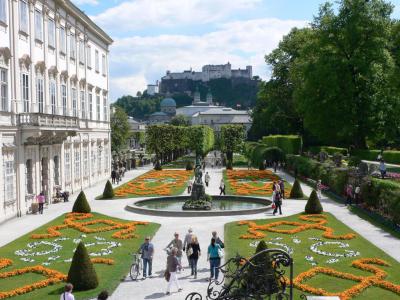
14) Mirabell Palace and Gardens (must see)
Mirabell Palace: part love story, part symphony, part surreal garden party. Here, Baroque drama meets soap opera realness and UNESCO-approved elegance. Originally constructed in 1606 by Prince-Archbishop Wolf Dietrich von Raitenau - who wasn’t just building a palace, but also a very fancy love nest for himself and his mistress - this place has always known how to turn heads.
After Wolf got the boot in 1612 (through palace intrigue), his successor renamed it Mirabell - meaning “wonderful” in Italian, which, come to think of it, is a bit more subtle than “Archbishop’s Love Shack.” The whole palace got a glitzy Baroque makeover between 1721 and 1727, and later a Neoclassical facelift - because palaces, of all properties, do need to keep up appearances...
Step inside and brace yourself for the grand staircase - or the 'staircase of thunder' if you like: with sweeping curves, angelic sculptures, and a shine so dramatic it practically sings. At the top of it is the Marble Hall. Mozart played here. You won’t. But you could get married here - if you book a few years ahead and maybe win a small lottery...
Fun fact: Hitler’s sister-in-law tied the knot here in 1944, with some disturbingly famous guests in attendance. But don’t let that kill the vibe - today, it’s more Mozart concerts and Instagram moments than fascist footnotes.
Venture further and you'll find a chapel dressed in Baroque finery, with statues so saintly they might just bless your photo.
Outside, the gardens are a mythological fever dream. Statues of Hercules, Aeneas, and Pluto look on, while the flower beds explode in geometric perfection - a riot of color that makes your eyeballs do pirouettes. At the center of it is the Pegasus Fountain, a scene-stealer from The Sound of Music’s “Do Re Mi.” Yes, that very one...
Climb the steps like a Von Trapp child chasing high notes, peek into the vine tunnel and hedge maze, and finish at Dwarf Park - where a regiment of lumpy marble gnomes stares you down with all the charm of a slightly haunted chess set.
And beyond it all, the High Salzburg Fortress, sitting smugly on its hilltop, watches centuries go by.
After Wolf got the boot in 1612 (through palace intrigue), his successor renamed it Mirabell - meaning “wonderful” in Italian, which, come to think of it, is a bit more subtle than “Archbishop’s Love Shack.” The whole palace got a glitzy Baroque makeover between 1721 and 1727, and later a Neoclassical facelift - because palaces, of all properties, do need to keep up appearances...
Step inside and brace yourself for the grand staircase - or the 'staircase of thunder' if you like: with sweeping curves, angelic sculptures, and a shine so dramatic it practically sings. At the top of it is the Marble Hall. Mozart played here. You won’t. But you could get married here - if you book a few years ahead and maybe win a small lottery...
Fun fact: Hitler’s sister-in-law tied the knot here in 1944, with some disturbingly famous guests in attendance. But don’t let that kill the vibe - today, it’s more Mozart concerts and Instagram moments than fascist footnotes.
Venture further and you'll find a chapel dressed in Baroque finery, with statues so saintly they might just bless your photo.
Outside, the gardens are a mythological fever dream. Statues of Hercules, Aeneas, and Pluto look on, while the flower beds explode in geometric perfection - a riot of color that makes your eyeballs do pirouettes. At the center of it is the Pegasus Fountain, a scene-stealer from The Sound of Music’s “Do Re Mi.” Yes, that very one...
Climb the steps like a Von Trapp child chasing high notes, peek into the vine tunnel and hedge maze, and finish at Dwarf Park - where a regiment of lumpy marble gnomes stares you down with all the charm of a slightly haunted chess set.
And beyond it all, the High Salzburg Fortress, sitting smugly on its hilltop, watches centuries go by.
