Custom Walk in Montreal, Canada by trindademkt_885a6 created on 2025-06-11
Guide Location: Canada » Montreal
Guide Type: Custom Walk
# of Sights: 10
Tour Duration: 3 Hour(s)
Travel Distance: 4.9 Km or 3 Miles
Share Key: S9QJ5
Guide Type: Custom Walk
# of Sights: 10
Tour Duration: 3 Hour(s)
Travel Distance: 4.9 Km or 3 Miles
Share Key: S9QJ5
How It Works
Please retrieve this walk in the GPSmyCity app. Once done, the app will guide you from one tour stop to the next as if you had a personal tour guide. If you created the walk on this website or come to the page via a link, please follow the instructions below to retrieve the walk in the app.
Retrieve This Walk in App
Step 1. Download the app "GPSmyCity: Walks in 1K+ Cities" on Apple App Store or Google Play Store.



Step 2. In the GPSmyCity app, download(or launch) the guide "Montreal Map and Walking Tours".
Step 3. Tap the menu button located at upper right corner of the "Walks" screen and select "Retrieve custom walk". Enter the share key: S9QJ5
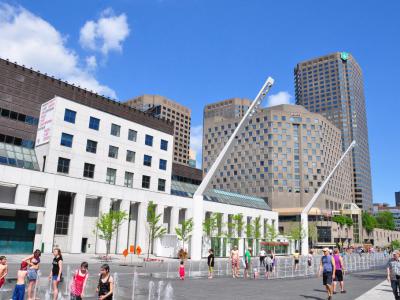
1) Place des Arts
Place des Arts was an initiative of Mayor Jean Drapeau, a noted lover of opera, as part of a project to expand the downtown core eastward from the concentration of business and financial activity. The first part of the complex was inaugurated in 1963, at the height of the city's construction and architectural boom. The other theaters were added progressively, along with Musée d'Art Contemporain that can be found next door.
Taking up an entire block of the downtown core, the multi-venue arts center is now a home of four of the city's largest production companies – the Montreal Symphony Orchestra, the Opéra de Montréal, Les Grands Ballets Canadiens, and the Jean-Duceppe theater company. The site has undergone major reconstruction in order to include a 6th concert hall dedicated to performances by the Montréal Symphony, and to remodel the Grand Foyer, which greets visitors to the complex.
In the summer the Esplanade and adjacent street comprise one of the important outdoor sites of the Festival International de Jazz de Montréal, as well as of other cultural happenings and festival events such as the Montréal World Film Festival. The Esplanade's stairs are a choice spot for a meeting point or to simply sit and people-watch; in addition, there are jumping jet fountains and shallow pools nearby, surrounded by visitors cooling off, their feet dangling in the basin.
Why You Should Visit:
The place to be in Montreal from June to August! Great fun for young and old and there is something for everyone. The area is relaxed, yet full of restaurants and also good shopping; easily accessible as there's a metro stop nearby.
Taking up an entire block of the downtown core, the multi-venue arts center is now a home of four of the city's largest production companies – the Montreal Symphony Orchestra, the Opéra de Montréal, Les Grands Ballets Canadiens, and the Jean-Duceppe theater company. The site has undergone major reconstruction in order to include a 6th concert hall dedicated to performances by the Montréal Symphony, and to remodel the Grand Foyer, which greets visitors to the complex.
In the summer the Esplanade and adjacent street comprise one of the important outdoor sites of the Festival International de Jazz de Montréal, as well as of other cultural happenings and festival events such as the Montréal World Film Festival. The Esplanade's stairs are a choice spot for a meeting point or to simply sit and people-watch; in addition, there are jumping jet fountains and shallow pools nearby, surrounded by visitors cooling off, their feet dangling in the basin.
Why You Should Visit:
The place to be in Montreal from June to August! Great fun for young and old and there is something for everyone. The area is relaxed, yet full of restaurants and also good shopping; easily accessible as there's a metro stop nearby.
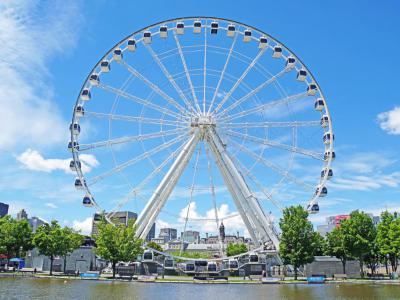
2) The Big Wheel of Montreal (La Grande Roue de Montréal)
Open to the public in September 2017, to mark the 375th anniversary of the city, The Big Wheel of Montreal (La Grande Roue de Montréal) is the tallest Ferris wheel in Canada, standing at 60 metres (200 feet). It is also the fourth of its type installed worldwide following those in Hong Kong (2014), Baku (2014), and Chicago (2016).
Situated directly on the river, on Bonsecours Basin Island in the Old Port of Montreal, the wheel provides a 360° view of the city, including Old Montreal, its historic buildings, Jacques-Cartier Square (Place Jacques-Cartier), and the architecture of Downtown Montreal with Royal Mountain (Mont-Royal) as the backdrop. To the south, unfolds the Saint Lawrence River and its seaway, while in the middle of the river, you can see Saint Helen's Island and Notre Dame Island – the former sites for Expo 67. In the evening, the dominant view is the illuminated Mount Royal Cross accompanying the changing lighting on Jacques-Cartier Bridge.
The wheel has 42 passenger units, each capable of carrying up to 8 persons, for a total capacity of 336 passengers. The climate-controlled cabins are suitable for use all year round, day and night, in temperatures down to −40 °C (−40 °F) and winds of up to 240 kilometres per hour.
A small park by the wheel contains modern and clean facilities including a restaurant, a cafe with an ice cream parlor, a gift shop, and restrooms.
Package deals are available for families, and those wanting VIP rides, yearly passes, and more. You do not have to book or reserve a time in advance – just show up and pay. Certainly not a bad addition to an Old Montreal itinerary!
Situated directly on the river, on Bonsecours Basin Island in the Old Port of Montreal, the wheel provides a 360° view of the city, including Old Montreal, its historic buildings, Jacques-Cartier Square (Place Jacques-Cartier), and the architecture of Downtown Montreal with Royal Mountain (Mont-Royal) as the backdrop. To the south, unfolds the Saint Lawrence River and its seaway, while in the middle of the river, you can see Saint Helen's Island and Notre Dame Island – the former sites for Expo 67. In the evening, the dominant view is the illuminated Mount Royal Cross accompanying the changing lighting on Jacques-Cartier Bridge.
The wheel has 42 passenger units, each capable of carrying up to 8 persons, for a total capacity of 336 passengers. The climate-controlled cabins are suitable for use all year round, day and night, in temperatures down to −40 °C (−40 °F) and winds of up to 240 kilometres per hour.
A small park by the wheel contains modern and clean facilities including a restaurant, a cafe with an ice cream parlor, a gift shop, and restrooms.
Package deals are available for families, and those wanting VIP rides, yearly passes, and more. You do not have to book or reserve a time in advance – just show up and pay. Certainly not a bad addition to an Old Montreal itinerary!
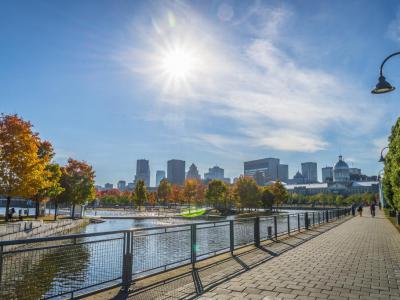
3) Old Port (Vieux-Port) (must see)
Located on the north bank of the Saint Lawrence River, the historic Old Port of Montreal (Vieux-Port de Montréal) stretches for over two kilometers (1.2 miles) south of Old Montreal, in a natural harbor that was once frequented by Amerindian canoes and then by barges and ships of French fur traders and others.
In service from as early as 1611, the port bore witness to the economic and cultural development of Montreal and remained in use until 1976, when the present Port of Montreal was launched further east. In the early 1990s, the territory was redeveloped and in 2005 changed its name to The Quays of the Old Port of Montreal. Today, it serves as a recreational and historical area, attracting annually over six million visitors.
A place for all seasons, there's always something happening here! Summer is great for all sorts of riverfront activities such as rollerblading, cycling, quadricycling, and pleasure boating. Taking a boat cruise on the Saint Lawrence river, or renting a pedal boat for a trip around Bonsecours Basin is also available. A thin park, running the entire length of the Old Port Promenade, offers tourists and locals an ideal spot to relax and catch a cool breeze off the water.
Winter is ideal for skating on the outdoor rink or just playing in the snow. At all times of the year, the Saint Lawrence river is awe-inspiring and powerful.
The on-site attractions include a "labyrinth" in Shed 16 (which is a maze of alleys and obstacles built inside an old waterfront warehouse), the Montreal Science Centre (complete with an IMAX Theatre) on King Edward Pier, and the Montreal Clock Tower.
One of the Port's gems is the Montreal-based Cirque du Soleil which approximately every two years, in spring, launches a new show from the Jacques Cartier Quay by setting up its signature blue-and-yellow-striped tents. In June 2012, an urban beach, called the Clock Tower Beach (Plage de l'Horloge), was opened adjacent to the Clock Tower.
Cultural events in the area include the Montreal High Lights Festival (Festival Montréal en lumière), Igloofest, and the Matsuri Japon festival.
If you have a couple of hours to kill in Montreal, wandering around the Old Port is worth considering.
In service from as early as 1611, the port bore witness to the economic and cultural development of Montreal and remained in use until 1976, when the present Port of Montreal was launched further east. In the early 1990s, the territory was redeveloped and in 2005 changed its name to The Quays of the Old Port of Montreal. Today, it serves as a recreational and historical area, attracting annually over six million visitors.
A place for all seasons, there's always something happening here! Summer is great for all sorts of riverfront activities such as rollerblading, cycling, quadricycling, and pleasure boating. Taking a boat cruise on the Saint Lawrence river, or renting a pedal boat for a trip around Bonsecours Basin is also available. A thin park, running the entire length of the Old Port Promenade, offers tourists and locals an ideal spot to relax and catch a cool breeze off the water.
Winter is ideal for skating on the outdoor rink or just playing in the snow. At all times of the year, the Saint Lawrence river is awe-inspiring and powerful.
The on-site attractions include a "labyrinth" in Shed 16 (which is a maze of alleys and obstacles built inside an old waterfront warehouse), the Montreal Science Centre (complete with an IMAX Theatre) on King Edward Pier, and the Montreal Clock Tower.
One of the Port's gems is the Montreal-based Cirque du Soleil which approximately every two years, in spring, launches a new show from the Jacques Cartier Quay by setting up its signature blue-and-yellow-striped tents. In June 2012, an urban beach, called the Clock Tower Beach (Plage de l'Horloge), was opened adjacent to the Clock Tower.
Cultural events in the area include the Montreal High Lights Festival (Festival Montréal en lumière), Igloofest, and the Matsuri Japon festival.
If you have a couple of hours to kill in Montreal, wandering around the Old Port is worth considering.
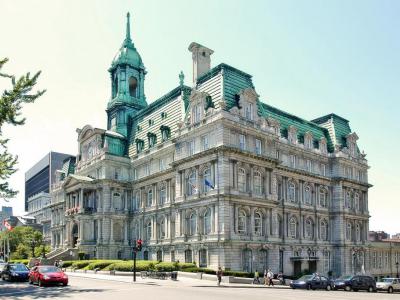
4) City Hall (Hotel de Ville)
The Montreal City Hall (Hôtel de Ville de Montréal) is the very first seat of municipal administration purposely constructed in Canada. Presently, it houses the offices of the Mayor and the City Council, as well as several other administrative departments.
The five-story edifice was originally built between 1872 and 1878 to a design by architects Henri-Maurice Perrault and Alexander Cowper Hutchison and is considered one of the best examples of the Second Empire style of architecture in the country.
The building's facade is made of gray limestone and its front and sides are beautifully decorated with turrets, balconies, and mansard roofs. The grand clock tower, rising 45 meters above the ground, is topped by a statue of the city's founder, Paul Chomedey de Maisonneuve.
Sadly, the original building was gutted by fire in March 1922, leaving only the outer wall and destroying many of the city's historical records. The replacement building, featuring a self-supporting steel structure (inside the shell of the ruins), was modelled after the city hall of the French city of Tours. It opened in February 1926.
The building's interior is equally impressive. Inside, the Hall of Honour is an open space full of marble and gold embellishments that houses Art Deco lamps from Paris and a bronze-and-glass chandelier, also from France, weighing a metric ton. In the council room, the five stained-glass windows, installed in the 1920s, depict the fundamental aspects of the city, such as Religion, Agriculture, Sea Port, Commerce, and Finance. In 1984, the building was designated a National Historic Site of Canada.
Unlike many government sites with restricted public entry, the Montreal City Hall permits visitors to take a quick guided tour – in both, English and French – free of charge. The tour schedules are displayed at the entrance.
Behind the building is a pocket of green, known as the Field of Mars (Champ-de-Mars), which used to serve as a military parade ground and a parking lot before being converted into a park in the 1980s. During the conversion, workers unearthed the remains of the city's old fortifications; parts of the restored city walls were later incorporated into the site.
The five-story edifice was originally built between 1872 and 1878 to a design by architects Henri-Maurice Perrault and Alexander Cowper Hutchison and is considered one of the best examples of the Second Empire style of architecture in the country.
The building's facade is made of gray limestone and its front and sides are beautifully decorated with turrets, balconies, and mansard roofs. The grand clock tower, rising 45 meters above the ground, is topped by a statue of the city's founder, Paul Chomedey de Maisonneuve.
Sadly, the original building was gutted by fire in March 1922, leaving only the outer wall and destroying many of the city's historical records. The replacement building, featuring a self-supporting steel structure (inside the shell of the ruins), was modelled after the city hall of the French city of Tours. It opened in February 1926.
The building's interior is equally impressive. Inside, the Hall of Honour is an open space full of marble and gold embellishments that houses Art Deco lamps from Paris and a bronze-and-glass chandelier, also from France, weighing a metric ton. In the council room, the five stained-glass windows, installed in the 1920s, depict the fundamental aspects of the city, such as Religion, Agriculture, Sea Port, Commerce, and Finance. In 1984, the building was designated a National Historic Site of Canada.
Unlike many government sites with restricted public entry, the Montreal City Hall permits visitors to take a quick guided tour – in both, English and French – free of charge. The tour schedules are displayed at the entrance.
Behind the building is a pocket of green, known as the Field of Mars (Champ-de-Mars), which used to serve as a military parade ground and a parking lot before being converted into a park in the 1980s. During the conversion, workers unearthed the remains of the city's old fortifications; parts of the restored city walls were later incorporated into the site.
5) Place Jacques-Cartier
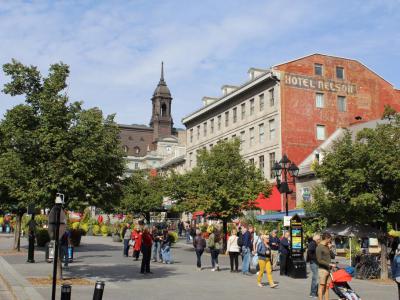
Jacques Cartier Square (Place Jacques-Cartier) serves as the gateway to Montreal's Old Port. Nestled in the heart of Old Montreal, this lively square is framed by the waterfront and the iconic City Hall. Cobblestone-paved and brimming with life, the square offers a delightful ambiance with its outdoor terraces, charming bistros, and seasonal fruit stalls. It buzzes with the presence of skilled artisans, musicians, and an array of creative individuals. Painters, photographers, and jewelers can be found in abundance along the narrow, picturesque alleyways that branch off from Saint-Paul Street, which extends from the square.
In close proximity to Jacques Cartier Square, on Commune Street (Rue de la Commune), visitors can catch a glimpse of an original section of the fortified city wall within the basement restaurant of the Old Port Inn (Auberge du Vieux-Port). A notable landmark within the square, Nelson's Column, Montreal's oldest public monument, was erected in 1809. Although the original statue was removed in 1997 for preservation, it was replaced with a replica. The square itself underwent a renaming in 1847 to honor Jacques Cartier, the renowned explorer who claimed Canada for France in 1535.
During the spring and especially the summer season, when the vibrant blooms flourish and vehicles are restricted, Jardin Nelson offers a garden restaurant experience on Jacques Cartier Square. Additionally, other charming courtyard restaurants, adorned with ivy, provide patrons with a taste of classical Parisian-style "terraces" where they can savor a refreshing drink or dine al fresco. Indulging in a glass of sangria at an outdoor table, while observing the stylish locals and bustling tourists passing by, is an unmatched experience.
In close proximity to Jacques Cartier Square, on Commune Street (Rue de la Commune), visitors can catch a glimpse of an original section of the fortified city wall within the basement restaurant of the Old Port Inn (Auberge du Vieux-Port). A notable landmark within the square, Nelson's Column, Montreal's oldest public monument, was erected in 1809. Although the original statue was removed in 1997 for preservation, it was replaced with a replica. The square itself underwent a renaming in 1847 to honor Jacques Cartier, the renowned explorer who claimed Canada for France in 1535.
During the spring and especially the summer season, when the vibrant blooms flourish and vehicles are restricted, Jardin Nelson offers a garden restaurant experience on Jacques Cartier Square. Additionally, other charming courtyard restaurants, adorned with ivy, provide patrons with a taste of classical Parisian-style "terraces" where they can savor a refreshing drink or dine al fresco. Indulging in a glass of sangria at an outdoor table, while observing the stylish locals and bustling tourists passing by, is an unmatched experience.
6) Arms' Square (Place d'Armes)
One of the oldest public sites in Montreal, Arms' Square (Place d'Armes) has a rather epic history to it, dating back over 300 years. This is the third location in Montreal to bear such a name, which is a French term long used to denote an assembly point for city defenders. In line with this, the square is anchored by a monument of Paul de Chomedey de Maisonneuve, the French officer and founder of Montreal. Erected in 1895, the statue commemorates Chomedey's defense of the young Ville-Marie settlement against the Iroquois Indians.
Originally, when first built in 1693, the place was called Factory Square (Place de la Fabrique) and was renamed Arms' Square only in 1721 when it became a stage for military drills, parades, and suchlike events. From 1781 to 1813, the site was used as a hay and wood market and later developed as a Victorian garden, after being acquired by the city in 1836. The square took its current shape in 1850 when Notre Dame Street was completed.
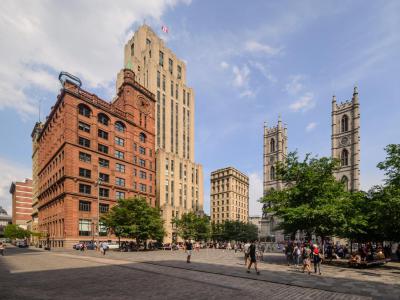
However, its real significance comes not so much from the spot itself as from what surrounds it. The structures bordering Arms' Square on all sides define Montreal's diverse heritage and represent major periods of the city's development. Primarily, these are the Notre Dame Basilica and the Saint Sulpice Seminary, Montréal's oldest building, constructed in the 1680s.
Other structures of note include the Bank of Montreal head office – Canada's first bank – opened in 1859, and the New York Life Building – Montreal's first skyscraper – constructed in 1887 and furnished with an elevator that was quite a novelty at that time. Across the way, the Royal Trust and the Duluth Building (to the left of the basilica) are the two early-20th-century high-risers that mark a distinct architectural shift, cemented with the arrival, in 1931, of the Art-Deco-style Aldred Building, designed to ensure maximum natural lighting for the streets below. Another landmark, a post-war glass and steel structure, the only one of its kind in the city, now known as the National Bank Tower, completed the square's architectural timeline in 1968.
Directly in front of it, you will find two sculptures: a caricature of a haughty Englishman with a pug, and one of a French woman with a poodle. While the dogs eye each other with eagerness to play, the lady gives an evident look of disdain towards the symbol of English power (that is the old Bank of Montreal), while the gentleman looks down his nose at the Notre Dame Basilica, symbolizing historical French influence in the region.
The pedestrian-friendly square is also a departure point for horse-drawn tours of Old Montreal. Fitted with sprawling benches which offer relief from the surrounding concrete, it is a beautiful place to stop, have a coffee or snack and marvel at the historical surroundings.
Originally, when first built in 1693, the place was called Factory Square (Place de la Fabrique) and was renamed Arms' Square only in 1721 when it became a stage for military drills, parades, and suchlike events. From 1781 to 1813, the site was used as a hay and wood market and later developed as a Victorian garden, after being acquired by the city in 1836. The square took its current shape in 1850 when Notre Dame Street was completed.
However, its real significance comes not so much from the spot itself as from what surrounds it. The structures bordering Arms' Square on all sides define Montreal's diverse heritage and represent major periods of the city's development. Primarily, these are the Notre Dame Basilica and the Saint Sulpice Seminary, Montréal's oldest building, constructed in the 1680s.
Other structures of note include the Bank of Montreal head office – Canada's first bank – opened in 1859, and the New York Life Building – Montreal's first skyscraper – constructed in 1887 and furnished with an elevator that was quite a novelty at that time. Across the way, the Royal Trust and the Duluth Building (to the left of the basilica) are the two early-20th-century high-risers that mark a distinct architectural shift, cemented with the arrival, in 1931, of the Art-Deco-style Aldred Building, designed to ensure maximum natural lighting for the streets below. Another landmark, a post-war glass and steel structure, the only one of its kind in the city, now known as the National Bank Tower, completed the square's architectural timeline in 1968.
Directly in front of it, you will find two sculptures: a caricature of a haughty Englishman with a pug, and one of a French woman with a poodle. While the dogs eye each other with eagerness to play, the lady gives an evident look of disdain towards the symbol of English power (that is the old Bank of Montreal), while the gentleman looks down his nose at the Notre Dame Basilica, symbolizing historical French influence in the region.
The pedestrian-friendly square is also a departure point for horse-drawn tours of Old Montreal. Fitted with sprawling benches which offer relief from the surrounding concrete, it is a beautiful place to stop, have a coffee or snack and marvel at the historical surroundings.
7) Old Saint-Sulpice Seminary
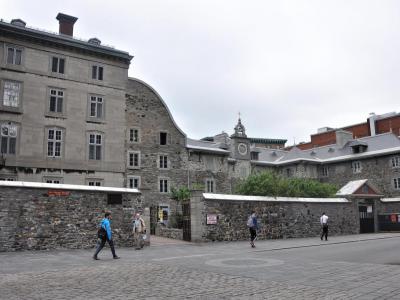
Montréal's second-oldest structure, the Sulpician Seminary located next to Notre-Dame Basilica was declared a National Historic Site of Canada in 1980, taking into consideration the quality of the architecture, which is a rare and remarkable example of 17th-century classical design built during the French Regime, but also the remarkable integrity of its convent garden, which once served as a means of subsistence, besides its use for meditation and leisure.
Since the 1680s, the seminary has served as the residence and administrative centre of the Messieurs of Saint-Sulpice who were the seigneurs of the Island of Montréal until the end of the seigneurial regime. The main building, which is the oldest part, is also the one that has been the least changed over the centuries. Its façade, of rough-cut limestone masonry, has a remarkable neoclassical-style entrance gate, built in 1740, through which you can peek at the clock – one of the oldest of its kind in North America. A real window on Montréal's past, and the oldest Seminary where priests still live today!
Since the 1680s, the seminary has served as the residence and administrative centre of the Messieurs of Saint-Sulpice who were the seigneurs of the Island of Montréal until the end of the seigneurial regime. The main building, which is the oldest part, is also the one that has been the least changed over the centuries. Its façade, of rough-cut limestone masonry, has a remarkable neoclassical-style entrance gate, built in 1740, through which you can peek at the clock – one of the oldest of its kind in North America. A real window on Montréal's past, and the oldest Seminary where priests still live today!
8) Canadian Imperial Bank of Commerce Building
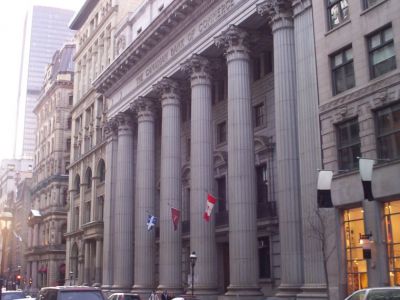
The five-storey building was designed by Darling and Pearson in the Edwardian Baroque style and is fronted by a monumental hexastyle Corinthian portico carved from grey Stanstead granite from Stanstead in Quebec's Eastern Townships. The building was constructed as the main Montreal branch of the Canadian Bank of Commerce (which merged with the Imperial Bank of Canada in 1961 to form the Canadian Imperial Bank of Commerce). From 1909 to 1939, it also housed the Montreal offices of the White Star Line, which sold tickets to the maiden voyage of Titanic in 1912.
In 2012, the owners of the Montreal landmark, The Rialto Theatre, purchased the former bank and crowned it The Saint James Theatre. While staying true to the history of the building and highlighting its breathtaking architecture, the Saint James Theatre is one of Montreal newest high-end venues for private events.
In 2012, the owners of the Montreal landmark, The Rialto Theatre, purchased the former bank and crowned it The Saint James Theatre. While staying true to the history of the building and highlighting its breathtaking architecture, the Saint James Theatre is one of Montreal newest high-end venues for private events.
9) Molson Bank
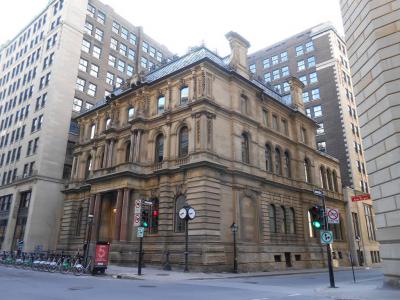
Molson Bank sits at the heart of the city's (and country's) former business center, in the western part of Rue Saint-Jacques, which speaks favorably of, and largely added to, its commercial prestige over the years. The bank's mansion-like appearance is in dramatic contrast with the very tall neighboring structures built in later periods; that notwithstanding, the Ohio buff sandstone facing, an innovation at the time, harmonizes well with the variety of stone used later in the area.
As part of the classical-minded composition, the ground floor's rusticated masonry, and the more delicately treated floor above, owe their architectural vocabulary to northern Italian Renaissance design, recalled by the mascaron keystones. The centre porch and all of the upper part of the building, on the other hand, derived their design from contemporaneous French architecture, as evidenced by the red granite twin columns, segmental windows, spiral-shaped window fins, the crowning sculpture, the mansard roof and the metallic cresting. Imported from London, this manner of combining Italian Renaissance and French influences made the Molson Bank building a participant, before any New York bank, in what would later be designated as the Second Empire style.
Harry Markland Molson, one of the bank's directors, was among the passengers who died in the Titanic disaster. He was last seen on board, removing his shoes with intentions to swim to a nearby ship. His body was never recovered.
As part of the classical-minded composition, the ground floor's rusticated masonry, and the more delicately treated floor above, owe their architectural vocabulary to northern Italian Renaissance design, recalled by the mascaron keystones. The centre porch and all of the upper part of the building, on the other hand, derived their design from contemporaneous French architecture, as evidenced by the red granite twin columns, segmental windows, spiral-shaped window fins, the crowning sculpture, the mansard roof and the metallic cresting. Imported from London, this manner of combining Italian Renaissance and French influences made the Molson Bank building a participant, before any New York bank, in what would later be designated as the Second Empire style.
Harry Markland Molson, one of the bank's directors, was among the passengers who died in the Titanic disaster. He was last seen on board, removing his shoes with intentions to swim to a nearby ship. His body was never recovered.
10) Montreal World Trade Centre
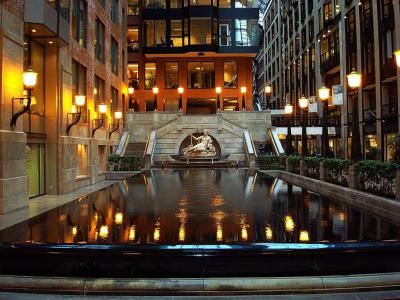
The Montreal World Trade Centre stands as one of Montreal's most renowned buildings, situated in the Quartier International district. Constructed in 1992 by Arcop, a distinguished Canadian architectural firm, this ten-story edifice boasts an abundance of architectural and historical treasures.
Beyond its role as a treasure trove of artifacts, the center features a grand glass atrium formerly referred to as Fortification Lane. Within the building, visitors can marvel at notable attractions such as a preserved segment of the Berlin Wall and a sculpted fountain by the renowned seventeenth-century French sculptor, D-B Guibal.
Serving as the pulsating heart of Montreal's commercial platform, the Montreal World Trade Centre accommodates offices, stores, and restaurants across its ten floors. Moreover, it houses the esteemed Montreal Intercontinental Hotel, where visitors from around the globe find solace during their exploration of the city.
The Montreal World Trade Centre holds a direct connection to Montreal's Underground City and the Square-Victoria metro station. Thanks to its convenient accessibility and central position, this center has become a cherished tourist destination in Montreal. No visit to the marvelous city of Montreal would be complete without a journey to the illustrious World Trade Centre.
Beyond its role as a treasure trove of artifacts, the center features a grand glass atrium formerly referred to as Fortification Lane. Within the building, visitors can marvel at notable attractions such as a preserved segment of the Berlin Wall and a sculpted fountain by the renowned seventeenth-century French sculptor, D-B Guibal.
Serving as the pulsating heart of Montreal's commercial platform, the Montreal World Trade Centre accommodates offices, stores, and restaurants across its ten floors. Moreover, it houses the esteemed Montreal Intercontinental Hotel, where visitors from around the globe find solace during their exploration of the city.
The Montreal World Trade Centre holds a direct connection to Montreal's Underground City and the Square-Victoria metro station. Thanks to its convenient accessibility and central position, this center has become a cherished tourist destination in Montreal. No visit to the marvelous city of Montreal would be complete without a journey to the illustrious World Trade Centre.
