Custom Walk in Bratislava, Slovakia by alanmanicom_598ea created on 2025-06-25
Guide Location: Slovakia » Bratislava
Guide Type: Custom Walk
# of Sights: 7
Tour Duration: 1 Hour(s)
Travel Distance: 2 Km or 1.2 Miles
Share Key: A5PRE
Guide Type: Custom Walk
# of Sights: 7
Tour Duration: 1 Hour(s)
Travel Distance: 2 Km or 1.2 Miles
Share Key: A5PRE
How It Works
Please retrieve this walk in the GPSmyCity app. Once done, the app will guide you from one tour stop to the next as if you had a personal tour guide. If you created the walk on this website or come to the page via a link, please follow the instructions below to retrieve the walk in the app.
Retrieve This Walk in App
Step 1. Download the app "GPSmyCity: Walks in 1K+ Cities" on Apple App Store or Google Play Store.



Step 2. In the GPSmyCity app, download(or launch) the guide "Bratislava Map and Walking Tours".
Step 3. Tap the menu button located at upper right corner of the "Walks" screen and select "Retrieve custom walk". Enter the share key: A5PRE
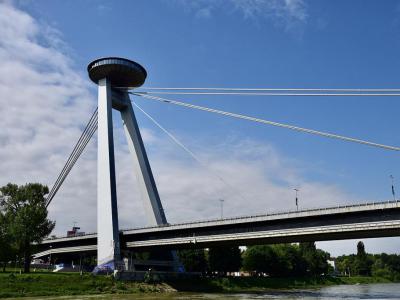
1) New Bridge and UFO Observation Deck (must see)
One of the most iconic features of modern-day Bratislava is the Novy Most, or "New Bridge." This modern thoroughfare connects the two halves of the city separated by the river Danube. Since 2012, the official name of the bridge was changed to "Bridge of the Slovak National Uprising" to commemorate the Slovak National Uprising against Nazi during World War II, but locals prefer to call it "UFO Bridge" for its UFO-shaped observation desk at the top.
The Novy Most was built between 1967 and 1972. The total length of the bridge is 1,413 feet or 430 meters. It is an asymmetrical cable-stayed bridge made of steel. It is the world's longest bridge that has only one pylon with one cable-stayed plane. One of the best features of the bridge is that the lower levels are reserved for pedestrian and bicycle traffic only.
Of course, the most notable feature of the Novy Most is the UFO-shaped restaurant and observation deck. The building is mounted on top of the bridge's 278-foot-tall (84.6-meter) pylon.
While the restaurant serves some delicious Slovak and international cuisine, the real lure of the UFO is the view of the city and river from above.
The Novy Most was built between 1967 and 1972. The total length of the bridge is 1,413 feet or 430 meters. It is an asymmetrical cable-stayed bridge made of steel. It is the world's longest bridge that has only one pylon with one cable-stayed plane. One of the best features of the bridge is that the lower levels are reserved for pedestrian and bicycle traffic only.
Of course, the most notable feature of the Novy Most is the UFO-shaped restaurant and observation deck. The building is mounted on top of the bridge's 278-foot-tall (84.6-meter) pylon.
While the restaurant serves some delicious Slovak and international cuisine, the real lure of the UFO is the view of the city and river from above.
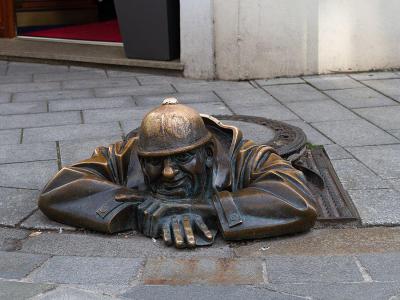
2) Cumil Statue (must see)
The Čumil Statue in Bratislava is a quirky bronze sculpture crafted by Viktor Hulík. Located at the crossroads of Panská and Rybárska Brána streets near the Main Square, this statue doesn’t depict any real person but comes from Hulík’s creative vision. It shows Čumil, a figure taking a break and peeking out from a manhole, watching people go by and seemingly enjoying the view of young women.
Kids particularly love this statue because they get to touch Čumil’s head and sit on the statue, making it more engaging. Yet, its placement has caused several accidents with passing vehicles bumping into it. To address this, a sign reading "Man at Work" has been placed beside the statue to alert drivers and add a touch of humor for tourists taking pictures.
Čumil is a popular spot for photos in Bratislava, drawing many tourists. Locals have come up with various fun and symbolic stories about why Čumil is there, ranging from jokes about him being nosy to deeper meanings depicting him as a typical Slovak worker. These stories and the statue’s playful nature spark lively conversations among visitors and locals alike.
Even though Čumil is now protected from traffic by a sign, he still faces the wear and tear of being a beloved interactive landmark. There’s even a light-hearted warning for women about mythical risks involving storks. More than just a piece of art, Čumil helps weave the rich cultural stories and legends of Bratislava.
Kids particularly love this statue because they get to touch Čumil’s head and sit on the statue, making it more engaging. Yet, its placement has caused several accidents with passing vehicles bumping into it. To address this, a sign reading "Man at Work" has been placed beside the statue to alert drivers and add a touch of humor for tourists taking pictures.
Čumil is a popular spot for photos in Bratislava, drawing many tourists. Locals have come up with various fun and symbolic stories about why Čumil is there, ranging from jokes about him being nosy to deeper meanings depicting him as a typical Slovak worker. These stories and the statue’s playful nature spark lively conversations among visitors and locals alike.
Even though Čumil is now protected from traffic by a sign, he still faces the wear and tear of being a beloved interactive landmark. There’s even a light-hearted warning for women about mythical risks involving storks. More than just a piece of art, Čumil helps weave the rich cultural stories and legends of Bratislava.
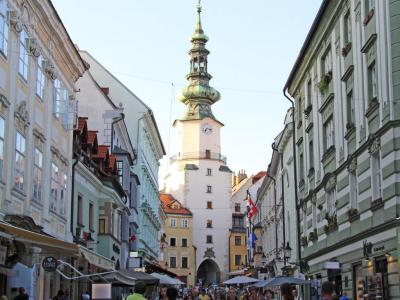
3) Michael's Tower and Street (must see)
The only surviving gate from the city's medieval walls lies at the end of Michael's Street. Michael's Gate (Michalska Brana) was built around 1300 and once stood with three others leading into town. It is one of the oldest buildings in town.
The tower's baroque exterior is a result of reconstruction works carried out in the 1750s. The statue of Saint Michael and the Dragon was placed at the top during this time.
The gate got its name as the Church of Saint Michael stood just outside the city walls here.
At one point, the city was surrounded by medieval fortifications. Entrance to town was only possible through the four gates, all of which were guarded and fortified. The other gates, now demolished, were the Laurens Gate, Fisherman's Gate on the river Danube, and Vydrica Gate.
At its height, the gate was part of a much larger system of fortifications. They included two rings of city walls, two bastions, a barbican, and a bridge over a moat. The barbican is still present and today has been built into houses. The original bridge over the moat was replaced by a stone one in 1727. Some of the moat is also still visible.
The view from the top of the seven-floor, 51-meter tall tower is spectacular. There is no better place from which to view the old town of Bratislava. To get in the tower, enter through the Museum of Arms. The museum contains excellent exhibits about the fortifications and the history of the city.
The street leading from the Michael's Gate, Michael's Street, is lined with shops and attractions. In addition to the Arms Museum, you'll also find the Pharmacy Museum nearby in a very old shop building. There are also bars, cafes, and restaurants lining the street.
The tower's baroque exterior is a result of reconstruction works carried out in the 1750s. The statue of Saint Michael and the Dragon was placed at the top during this time.
The gate got its name as the Church of Saint Michael stood just outside the city walls here.
At one point, the city was surrounded by medieval fortifications. Entrance to town was only possible through the four gates, all of which were guarded and fortified. The other gates, now demolished, were the Laurens Gate, Fisherman's Gate on the river Danube, and Vydrica Gate.
At its height, the gate was part of a much larger system of fortifications. They included two rings of city walls, two bastions, a barbican, and a bridge over a moat. The barbican is still present and today has been built into houses. The original bridge over the moat was replaced by a stone one in 1727. Some of the moat is also still visible.
The view from the top of the seven-floor, 51-meter tall tower is spectacular. There is no better place from which to view the old town of Bratislava. To get in the tower, enter through the Museum of Arms. The museum contains excellent exhibits about the fortifications and the history of the city.
The street leading from the Michael's Gate, Michael's Street, is lined with shops and attractions. In addition to the Arms Museum, you'll also find the Pharmacy Museum nearby in a very old shop building. There are also bars, cafes, and restaurants lining the street.
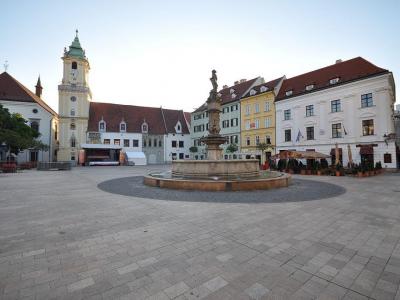
4) Hlavne Namestie (Main Square) (must see)
The central point in old town Bratislava, the Main Square, has been the hub of the town for centuries. It is surrounded by landmarks, including Kutscherfeldov Palace, Pawera House, Ungerov Dom, and the Maximillian Fountain. Additionally, tons of restaurants, cafes, and bars in the area keep it bustling.
During the winter months, the Main Square is home to Bratislava's Christmas fair. The entire area is decorated, and vendors set up stalls throughout the square. You'll find souvenirs, boiled wine, beer, and many different Slovak foods.
Over the years, the square has changed names several times. During World War II, it was named to honor Hilter. From 1948 to 1989, it was named for the day Bratislava was liberated by the Red Army - 4 April Square.
The square is home to the Old Town Hall building and several other landmark buildings. Old Town Hall was built in 1599 and is the oldest in the country. Today, it houses a museum all about the town's history.
The Japanese and French Embassy are also located here.
During the winter months, the Main Square is home to Bratislava's Christmas fair. The entire area is decorated, and vendors set up stalls throughout the square. You'll find souvenirs, boiled wine, beer, and many different Slovak foods.
Over the years, the square has changed names several times. During World War II, it was named to honor Hilter. From 1948 to 1989, it was named for the day Bratislava was liberated by the Red Army - 4 April Square.
The square is home to the Old Town Hall building and several other landmark buildings. Old Town Hall was built in 1599 and is the oldest in the country. Today, it houses a museum all about the town's history.
The Japanese and French Embassy are also located here.
5) Old Town Hall
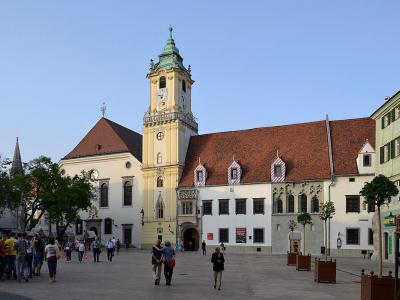
The Old Town Hall of Bratislava is an excellent example of Gothic architecture. Originally constructed in the 14th century, with the tower dating back from approximately 1370, this is one of the oldest stone buildings in the Slovakian capital. It was originally designed to accommodate soldiers guarding the fortress surrounding the medieval town.
Presently, the Old Town Hall represents a complex of buildings created through merger of several adjacent townhouses, namely: Jacobus' house with a tower, Pawer's house, Unger's house, and the Apponyi palace. Over the ages, the property had undergone numerous reconstructions and served different purposes: as a prison, mint, market, municipal archive, and arsenal depository, until it finally became a town hall in the 15th century. In this capacity it had served until the late 19th century.
During the Renaissance period, the complex passed through various transformations, including those after being damaged by an earthquake and then fire.
Today, it houses the Bratislava City Museum, featuring a collection of historic artifacts: cannonballs; dungeons with instruments of torture; antique weaponry and armour; as well as paintings and miniatures. One of the cannonballs, the one embedded in the tower wall, is of a particular interest to visitors. It has been there since 1809, resulted from the bombardment of the city by the invading Napoleonic army.
In the summer, the courtyard plays host to musical concerts. In the attic of the Apponyi Palace there is a Study Depository of Glass and Ceramics. The beautifully-tiled roof of the building is one of the city's most recognizable landmarks. The top of the Old Town Hall tower is open to visitors, as part of the Bratislava City Museum exhibition, offering a round view of the old part of Bratislava and its environs.
Presently, the Old Town Hall represents a complex of buildings created through merger of several adjacent townhouses, namely: Jacobus' house with a tower, Pawer's house, Unger's house, and the Apponyi palace. Over the ages, the property had undergone numerous reconstructions and served different purposes: as a prison, mint, market, municipal archive, and arsenal depository, until it finally became a town hall in the 15th century. In this capacity it had served until the late 19th century.
During the Renaissance period, the complex passed through various transformations, including those after being damaged by an earthquake and then fire.
Today, it houses the Bratislava City Museum, featuring a collection of historic artifacts: cannonballs; dungeons with instruments of torture; antique weaponry and armour; as well as paintings and miniatures. One of the cannonballs, the one embedded in the tower wall, is of a particular interest to visitors. It has been there since 1809, resulted from the bombardment of the city by the invading Napoleonic army.
In the summer, the courtyard plays host to musical concerts. In the attic of the Apponyi Palace there is a Study Depository of Glass and Ceramics. The beautifully-tiled roof of the building is one of the city's most recognizable landmarks. The top of the Old Town Hall tower is open to visitors, as part of the Bratislava City Museum exhibition, offering a round view of the old part of Bratislava and its environs.
6) Primate's Palace
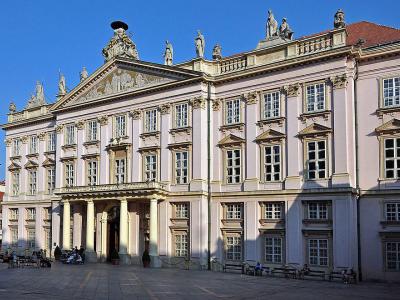
Today this impressive baroque building is the home of the Mayor of Bratislava, but there is much more history to uncover here.
The Primate's Palace was built from 1777 to 1781 and was designed by Melchoir Hefele. At one time, the palace was home to the primary bishops.
The palace's greatest claim to fame was that it served as a backdrop for signing the fourth Peace of Pressburg in 1805. This document, signed in the building's famous Hall of Mirrors, dissolved the Holy Roman Empire. A bust of Emperor Francis II, the last Roman Emperor, stands near the hall to commemorate the event.
The city purchased the palace in 1903 and began an extensive reconstruction project. During the work, 17th-century tapestries were found behind walls.
For a brief time, the palace was home to the President of Slovakia before his permanent residence was built at Grassalkovich Palace.
The palace is open for tours. You can even see the famous Hall of Mirrors, now used for Bratislava City Council meetings.
The Primate's Palace was built from 1777 to 1781 and was designed by Melchoir Hefele. At one time, the palace was home to the primary bishops.
The palace's greatest claim to fame was that it served as a backdrop for signing the fourth Peace of Pressburg in 1805. This document, signed in the building's famous Hall of Mirrors, dissolved the Holy Roman Empire. A bust of Emperor Francis II, the last Roman Emperor, stands near the hall to commemorate the event.
The city purchased the palace in 1903 and began an extensive reconstruction project. During the work, 17th-century tapestries were found behind walls.
For a brief time, the palace was home to the President of Slovakia before his permanent residence was built at Grassalkovich Palace.
The palace is open for tours. You can even see the famous Hall of Mirrors, now used for Bratislava City Council meetings.
7) Blue Church (must see)
The Hungarian Secessionist Catholic Church, known as the Church of Saint Elisabeth or the Blue Church, is located in Old Town Bratislava. The construction was consecrated to Elisabeth of Hungary, who was a princess and, later, became a Roman Catholic saint. She was widowed young and surrendered her wealth for a life devoted to the poor and indigent. After her death at the age of 24, many miracles of healing were accredited to her. She was canonized by Pope Gregory IX in 1235.
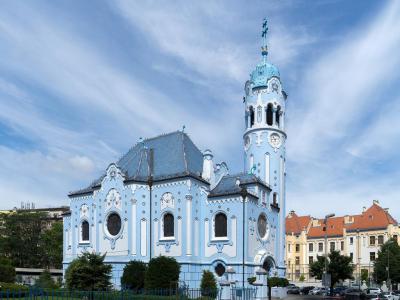
Built in 1908, the structure was designed by Odon Lechner, a recognized Hungarian architect. He was known to embellish his constructions with Zsolnay tile patterns. Zsolnay tiles were manufactured by a Hungarian company known for its intricate porcelain, tiles, stoneware and pottery. The tiles on the church’s roof were generated using the pyrogranite process, which involves firing ceramic under exceptionally high temperatures, producing resilient materials which are resistant to acid and frost. The structure has attained its name because of the blue color of the mosaics, which decorate its roof and walls.
The building features a cylindrical tower and bell dome common to the Hungarian Art Nouveau and the Romanesque movement in art and architecture. The single nave church contains vaulted ceilings along with hints of barrel vaults. Romanesque double pillars encompass the entrances and the windows.
Built in 1908, the structure was designed by Odon Lechner, a recognized Hungarian architect. He was known to embellish his constructions with Zsolnay tile patterns. Zsolnay tiles were manufactured by a Hungarian company known for its intricate porcelain, tiles, stoneware and pottery. The tiles on the church’s roof were generated using the pyrogranite process, which involves firing ceramic under exceptionally high temperatures, producing resilient materials which are resistant to acid and frost. The structure has attained its name because of the blue color of the mosaics, which decorate its roof and walls.
The building features a cylindrical tower and bell dome common to the Hungarian Art Nouveau and the Romanesque movement in art and architecture. The single nave church contains vaulted ceilings along with hints of barrel vaults. Romanesque double pillars encompass the entrances and the windows.
