Custom Walk in Pisa, Italy by luypaert_t_43668 created on 2025-07-18
Guide Location: Italy » Pisa
Guide Type: Custom Walk
# of Sights: 6
Tour Duration: 1 Hour(s)
Travel Distance: 1.2 Km or 0.7 Miles
Share Key: JCQDG
Guide Type: Custom Walk
# of Sights: 6
Tour Duration: 1 Hour(s)
Travel Distance: 1.2 Km or 0.7 Miles
Share Key: JCQDG
How It Works
Please retrieve this walk in the GPSmyCity app. Once done, the app will guide you from one tour stop to the next as if you had a personal tour guide. If you created the walk on this website or come to the page via a link, please follow the instructions below to retrieve the walk in the app.
Retrieve This Walk in App
Step 1. Download the app "GPSmyCity: Walks in 1K+ Cities" on Apple App Store or Google Play Store.



Step 2. In the GPSmyCity app, download(or launch) the guide "Pisa Map and Walking Tours".
Step 3. Tap the menu button located at upper right corner of the "Walks" screen and select "Retrieve custom walk". Enter the share key: JCQDG
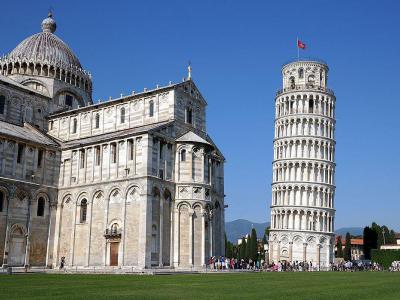
1) The Leaning Tower (must see)
The Leaning Tower of Pisa is the most famous freestanding bell tower in the world. It was built between 1173 and 1372 as a companion to the Pisa Cathedral.
The ground floor features a blind arcade with Corinthian columns. The second floor was added in 1178, and the tower began to sink in the soft, sandy soil. Construction was then halted for almost a century as the Republic of Pisa engaged in battles with their neighbors.
Construction restarted in 1272, and the upper floors were built with one side taller than the other to compensate for the already leaning tower. Finally, in 1319, the seventh floor was completed, and the bell tower was added in 1372.
Between 1589 and 1592, Galileo Galilei (then professor of mathematics at the University of Pisa) dropped two spheres of different masses from the Leaning Tower of Pisa to demonstrate that their time of descent was independent of their mass. Galileo discovered through this experiment that the objects fell with the same acceleration, proving his prediction true, while at the same time disproving Aristotle's theory of gravity which states that objects fall at speed proportional to their mass.
The tower has impressively survived at least four major earthquakes. The combination of the height of the tower and the soft soil helped it resist earthquake damage.
In more recent years, efforts have been made to stabilize the tower, stop it from toppling over, and keep this historic building intact as a Pisa landmark. The tower was closed from 1990-2001 to effect this stabilization. At that time, the tower was leaning at a 5.5-degree angle (4.5 meters or 15 feet).
In 1990, the bells were removed to take away some of the weight of the building. Cables were added to the third level and anchored hundreds of meters away. Counterweights were added in 1993 to keep the tower from toppling over. Engineers worked to reduce the tilt by shifting soil from underneath the tower. The tilt was reduced by 45 centimeters and matched the 1838 tilt level.
The structural interventions were so successful that the tower has been stable, and no additional leaning has occurred.
The Leaning Tower now leans by 3.97 degrees, or 3.9 meters (12 feet 10 inches). The original height of the tower was 60 meters. Today it is 56.67 meters on the high side and 55.86 meters on the low side.
Why You Should Visit:
No visit to Pisa is complete without seeing this iconic landmark in person. Don't forget your camera for cheesy "holding up the tower" photos and the view from the top.
Tips:
Visitors can climb the 251 steps and enjoy the fantastic views from the top. Children under eight are not permitted to climb. It's advisable to buy tickets in advance to this busy and popular attraction.
The ground floor features a blind arcade with Corinthian columns. The second floor was added in 1178, and the tower began to sink in the soft, sandy soil. Construction was then halted for almost a century as the Republic of Pisa engaged in battles with their neighbors.
Construction restarted in 1272, and the upper floors were built with one side taller than the other to compensate for the already leaning tower. Finally, in 1319, the seventh floor was completed, and the bell tower was added in 1372.
Between 1589 and 1592, Galileo Galilei (then professor of mathematics at the University of Pisa) dropped two spheres of different masses from the Leaning Tower of Pisa to demonstrate that their time of descent was independent of their mass. Galileo discovered through this experiment that the objects fell with the same acceleration, proving his prediction true, while at the same time disproving Aristotle's theory of gravity which states that objects fall at speed proportional to their mass.
The tower has impressively survived at least four major earthquakes. The combination of the height of the tower and the soft soil helped it resist earthquake damage.
In more recent years, efforts have been made to stabilize the tower, stop it from toppling over, and keep this historic building intact as a Pisa landmark. The tower was closed from 1990-2001 to effect this stabilization. At that time, the tower was leaning at a 5.5-degree angle (4.5 meters or 15 feet).
In 1990, the bells were removed to take away some of the weight of the building. Cables were added to the third level and anchored hundreds of meters away. Counterweights were added in 1993 to keep the tower from toppling over. Engineers worked to reduce the tilt by shifting soil from underneath the tower. The tilt was reduced by 45 centimeters and matched the 1838 tilt level.
The structural interventions were so successful that the tower has been stable, and no additional leaning has occurred.
The Leaning Tower now leans by 3.97 degrees, or 3.9 meters (12 feet 10 inches). The original height of the tower was 60 meters. Today it is 56.67 meters on the high side and 55.86 meters on the low side.
Why You Should Visit:
No visit to Pisa is complete without seeing this iconic landmark in person. Don't forget your camera for cheesy "holding up the tower" photos and the view from the top.
Tips:
Visitors can climb the 251 steps and enjoy the fantastic views from the top. Children under eight are not permitted to climb. It's advisable to buy tickets in advance to this busy and popular attraction.
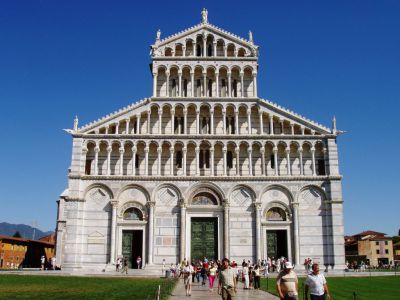
2) Duomo di Pisa (Pisa Cathedral) (must see)
The Pisa Cathedral is the medieval cathedral that stands on the Miracles Square and it is a fine example of Italian-Romanesque architecture.
Busketo began work on the building in 1064 and his tomb is built into the façade in white stone and grey marble with colored marble discs. You will see an inscription about the foundation of the Cathedral and Pisa’s victory against the Saracens.
On the eastern end of the building there is the replica of the Pisa Griffon. The 11th century original, which is the largest known Islamic metal sculpture, can be seen in the Cathedral Museum.
The huge bronze doors were added after the original wooden ones were destroyed by fire in 1595. Above the doors are four rows of open galleries; there is a statue of the Madonna and Child and the Four Evangelists. Worshippers usually enter the church by a door built in 1180 by Pisano on the bell tower side of the cathedral.
The interior of the cathedral has black and white marble facings and the mosaics are in Byzantine style. The granite Corinthian columns come from the mosque in Palermo, which was captured by Pisa in 1063.
The gilded ceiling and frescoed dome were restored after the 1595 fire, as was the nave’s coffer ceiling. The fresco of “Christ in Majesty with the Virgin Mary and Saint John the Evangelist” luckily survived the fire and can be find in the apse.
To mark the beginning of the Pisan new year a system was devised in the cathedral whereby a beam of light shines through a round window on the south side of the nave and, precisely at noon on March 25, lands on the same spot every year: on top of a shelf affixed to a pylon on the opposite side of the church. The lamp at the center of the nave is called Galileo's lamp, because a legend says that the great scientist formulated his theory of isochronism of the pendulum while watching its oscillations from the roof of the nave. The original, however, smaller and very different than this one, is found today in the Camposanto.
Galileo Galilei was consecrated as a scientist here.
Busketo began work on the building in 1064 and his tomb is built into the façade in white stone and grey marble with colored marble discs. You will see an inscription about the foundation of the Cathedral and Pisa’s victory against the Saracens.
On the eastern end of the building there is the replica of the Pisa Griffon. The 11th century original, which is the largest known Islamic metal sculpture, can be seen in the Cathedral Museum.
The huge bronze doors were added after the original wooden ones were destroyed by fire in 1595. Above the doors are four rows of open galleries; there is a statue of the Madonna and Child and the Four Evangelists. Worshippers usually enter the church by a door built in 1180 by Pisano on the bell tower side of the cathedral.
The interior of the cathedral has black and white marble facings and the mosaics are in Byzantine style. The granite Corinthian columns come from the mosque in Palermo, which was captured by Pisa in 1063.
The gilded ceiling and frescoed dome were restored after the 1595 fire, as was the nave’s coffer ceiling. The fresco of “Christ in Majesty with the Virgin Mary and Saint John the Evangelist” luckily survived the fire and can be find in the apse.
To mark the beginning of the Pisan new year a system was devised in the cathedral whereby a beam of light shines through a round window on the south side of the nave and, precisely at noon on March 25, lands on the same spot every year: on top of a shelf affixed to a pylon on the opposite side of the church. The lamp at the center of the nave is called Galileo's lamp, because a legend says that the great scientist formulated his theory of isochronism of the pendulum while watching its oscillations from the roof of the nave. The original, however, smaller and very different than this one, is found today in the Camposanto.
Galileo Galilei was consecrated as a scientist here.
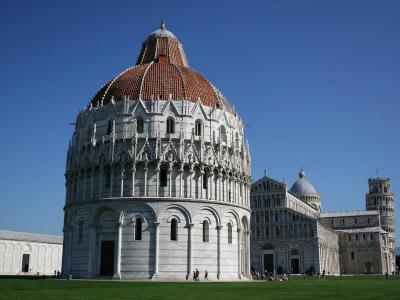
3) Battistero di San Giovanni (Pisa Baptistery) (must see)
Construction on the Pisa Baptistery began in 1152. Designer Diotisalvi signed an interior pillar with the date 1153, but the Baptistery wasn't completed until 1363.
The impressive marble Pisa Baptistery is the largest baptistery in Italy and stands at 54.86 meters (180 feet) tall, making it almost as tall as its neighbor, the Leaning Tower. The lower portion represents Romanesque styling, whereas the upper sections with pointed arches are Gothic.
Two classical columns flank the portal. The lintel has two tiers. The lower tier portrays several scenes from John the Baptist's life. The upper tier shows John the Baptist surrounded by Christ, the Madonna, and angels.
The interior features 12 columns that represent the 12 apostles. A bronze sculpture of John the Baptist stands in the center of the baptismal font. The font's three steps represent The Father, Son, and Holy Spirit. Famed astronomer and scientist Galileo was baptized here in 1564.
The pulpit was sculpted by Nicola Pisano and completed in 1260. The artistry represents a new focus on more realistic art and represents the beginning of the Italian Renaissance period.
The Pisa Baptistery was built on the same sand as the leaning tower and leans 0.6 degrees. Visitors can climb to the viewing level and look out over the Piazza dei Miracoli (Square of Miracles).
Tips:
Every half an hour, a guardian comes in to say a few words and demonstrate Pisa Baptistery's unique acoustics. This is a good time to be on the upper viewing level, as the acoustics here are impressive.
The impressive marble Pisa Baptistery is the largest baptistery in Italy and stands at 54.86 meters (180 feet) tall, making it almost as tall as its neighbor, the Leaning Tower. The lower portion represents Romanesque styling, whereas the upper sections with pointed arches are Gothic.
Two classical columns flank the portal. The lintel has two tiers. The lower tier portrays several scenes from John the Baptist's life. The upper tier shows John the Baptist surrounded by Christ, the Madonna, and angels.
The interior features 12 columns that represent the 12 apostles. A bronze sculpture of John the Baptist stands in the center of the baptismal font. The font's three steps represent The Father, Son, and Holy Spirit. Famed astronomer and scientist Galileo was baptized here in 1564.
The pulpit was sculpted by Nicola Pisano and completed in 1260. The artistry represents a new focus on more realistic art and represents the beginning of the Italian Renaissance period.
The Pisa Baptistery was built on the same sand as the leaning tower and leans 0.6 degrees. Visitors can climb to the viewing level and look out over the Piazza dei Miracoli (Square of Miracles).
Tips:
Every half an hour, a guardian comes in to say a few words and demonstrate Pisa Baptistery's unique acoustics. This is a good time to be on the upper viewing level, as the acoustics here are impressive.
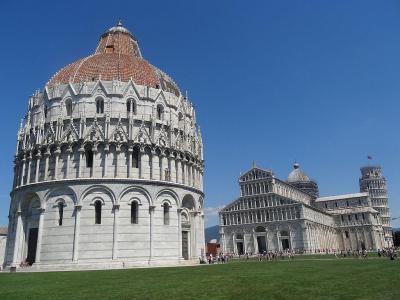
4) Piazza dei Miracoli (Miracles Square) (must see)
The Miracles Square is, of course, at the top of your “must see” list in Pisa. It is the most famous and most visited square in Europe after Saint Peter’s Square in Rome. It is a walled area and its real name is the Cathedral Square but the writer Gabriele D’Annunzio dubbed it the Square of Miracles in one of his books and the name stuck. Many people misguidedly call it the "Field of Miracles" but that field was invented by Carlo Collodi in his book “The Adventures of Pinocchio”. In Collodi's book, two scoundrels, the Cat and the Fox, told Pinocchio that if he planted his gold there it would grow into money trees.
The square is made up of an area that is partly paved and partly neatly trimmed lawns and some of the most famous buildings in Pisa are found on this square. The three buildings (Baptistery, Cathedral, Hospital) and the Cemetery are said to represent the four stages of human.
If we take them in these stages in chronological order, we start with the Pisa Baptistery, dedicated to Saint John the Baptist, represents Birth. The Pisa Cathedral portrays Life, while the New Hospital of the Holy Spirit represents Illness and the end of life. The cemetery, of course, represents Death.
The other famous building on the square, the bell tower of the Cathedral – also known as the Leaning Tower – doesn’t come into the allegory, but if you are in a whimsical frame of mind you might say that it represents the rather shaky path humans take during their Life!
The square is made up of an area that is partly paved and partly neatly trimmed lawns and some of the most famous buildings in Pisa are found on this square. The three buildings (Baptistery, Cathedral, Hospital) and the Cemetery are said to represent the four stages of human.
If we take them in these stages in chronological order, we start with the Pisa Baptistery, dedicated to Saint John the Baptist, represents Birth. The Pisa Cathedral portrays Life, while the New Hospital of the Holy Spirit represents Illness and the end of life. The cemetery, of course, represents Death.
The other famous building on the square, the bell tower of the Cathedral – also known as the Leaning Tower – doesn’t come into the allegory, but if you are in a whimsical frame of mind you might say that it represents the rather shaky path humans take during their Life!
5) Piazza dei Cavalieri (Knights Square) (must see)
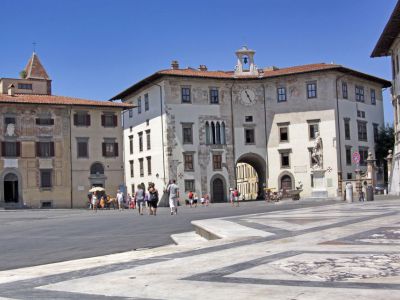
During medieval times, Knights' Square was Pisa's political center. Before that, it was likely the site of the Roman Forum.
In 1406, Florence's emissary announced the end of Pisa's independence in this square.
In the 16th century, Cosimo I de Medici, the Grand Duke of Tuscany, commissioned Vasari to recreated the square in Renaissance style. The Knights of Saint Stephen had recently inaugurated the Order of the Knights, and the square was dedicated to them. The Order of the Knights of Saint Stephen was established to defend the coast from Turkish pirates.
A 1596 statue of the Grand Duke of Tuscany stands in the center of the square.
Knights Square is home to several landmark buildings. The Cavalieri Palace was also called Palace of the Convoy due to the three-year training Order initiates undertook here. The palace is adorned with artistic graffiti representing allegorical figures, zodiac signs, and busts representing the Grandukes of Tuscany.
The Clock Palace is famous as the site where Count Ugolino was held prisoner and died of starvation. Today, the palace is home to the University library.
The Puteano College was established in 1605. In addition, the Consiglio dei Dodici Palace features valuable 18th-century paintings.
The Church of the Knights of the Holy and Military Order of Saint Stephen was designed by Vasari and completed in 1569. Inside, visitors will see naval banners captured by successful Knights of Saint Stephen.
In 1406, Florence's emissary announced the end of Pisa's independence in this square.
In the 16th century, Cosimo I de Medici, the Grand Duke of Tuscany, commissioned Vasari to recreated the square in Renaissance style. The Knights of Saint Stephen had recently inaugurated the Order of the Knights, and the square was dedicated to them. The Order of the Knights of Saint Stephen was established to defend the coast from Turkish pirates.
A 1596 statue of the Grand Duke of Tuscany stands in the center of the square.
Knights Square is home to several landmark buildings. The Cavalieri Palace was also called Palace of the Convoy due to the three-year training Order initiates undertook here. The palace is adorned with artistic graffiti representing allegorical figures, zodiac signs, and busts representing the Grandukes of Tuscany.
The Clock Palace is famous as the site where Count Ugolino was held prisoner and died of starvation. Today, the palace is home to the University library.
The Puteano College was established in 1605. In addition, the Consiglio dei Dodici Palace features valuable 18th-century paintings.
The Church of the Knights of the Holy and Military Order of Saint Stephen was designed by Vasari and completed in 1569. Inside, visitors will see naval banners captured by successful Knights of Saint Stephen.
6) Borgo Stretto (Narrow Street) (must see)
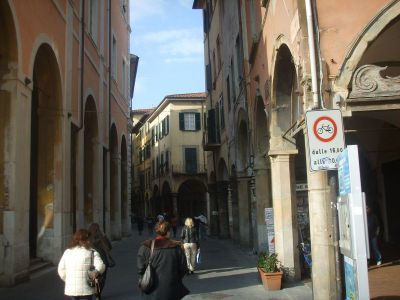
If you want to do some shopping or simply wander through the narrow streets of medieval Pisa, you should go to the Narrow Street. This long street is mostly pedestrian and filled with shops from simple stores selling books and souvenirs to some of the most exclusive shops in the city.
Most of the street is lined on each side with arcades supported by Corinthian columns. In the arcades you will find plenty of bars, restaurants and shops. Look for Café Settimelli. Over the arched entrance to the Café Settimelli a sign proudly announces that this was once the house of the Galilei family and Galileo was born there.
The two and three story houses on both sides of the street were once the homes of rich merchant families. On the corner of via San Francesco you will find the 15 century Poschi Palace. There are plenty of narrow side streets leading off the Narrow Street and some of these will lead you to delightful open air markets that sell flowers, fresh fruits and vegetables.
Most of the street is lined on each side with arcades supported by Corinthian columns. In the arcades you will find plenty of bars, restaurants and shops. Look for Café Settimelli. Over the arched entrance to the Café Settimelli a sign proudly announces that this was once the house of the Galilei family and Galileo was born there.
The two and three story houses on both sides of the street were once the homes of rich merchant families. On the corner of via San Francesco you will find the 15 century Poschi Palace. There are plenty of narrow side streets leading off the Narrow Street and some of these will lead you to delightful open air markets that sell flowers, fresh fruits and vegetables.
