Custom Walk in Florence, Italy by cpmorris_8ebb8 created on 2025-07-20
Guide Location: Italy » Florence
Guide Type: Custom Walk
# of Sights: 10
Tour Duration: 3 Hour(s)
Travel Distance: 5.8 Km or 3.6 Miles
Share Key: ZDKHF
Guide Type: Custom Walk
# of Sights: 10
Tour Duration: 3 Hour(s)
Travel Distance: 5.8 Km or 3.6 Miles
Share Key: ZDKHF
How It Works
Please retrieve this walk in the GPSmyCity app. Once done, the app will guide you from one tour stop to the next as if you had a personal tour guide. If you created the walk on this website or come to the page via a link, please follow the instructions below to retrieve the walk in the app.
Retrieve This Walk in App
Step 1. Download the app "GPSmyCity: Walks in 1K+ Cities" on Apple App Store or Google Play Store.



Step 2. In the GPSmyCity app, download(or launch) the guide "Florence Map and Walking Tours".
Step 3. Tap the menu button located at upper right corner of the "Walks" screen and select "Retrieve custom walk". Enter the share key: ZDKHF
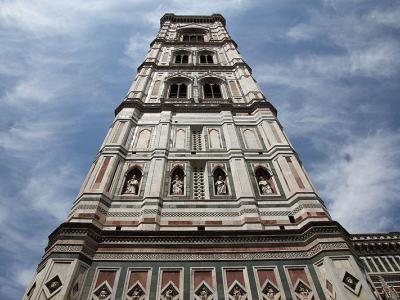
1) Campanile di Giotto (Giotto's Bell Tower) (must see)
The famous Bell Tower of Giotto is one of Florence’s most iconic landmarks. Though it stands beside the Cathedral, it’s actually a freestanding belfry, designed by the legendary artist and architect Giotto di Bondone-the very same Giotto who’s often credited as the first great figure of the Italian Renaissance. Rising to a height of 85 meters, this stunning structure is a remarkable example of Florentine Gothic architecture, adorned with sculptural details and colorful marble inlays in white, green, and red.
Sadly, Giotto passed away before the tower was completed, and two other architects had to carry on the work. Still, his artistic touch is unmistakable-from the marble patterns on the façade to the figurative cycle within the belfry. He may not have finished it, but his vision set the tone for everything that followed.
Yes, you can climb the tower-and of the three major ones in Florence, this one is actually the easiest to scale. The staircase has 414 steps, but they’re well spaced, with rest areas between levels. Each stop reveals one of the seven bells inside-one for each note on the musical scale. Unlike the often-crowded Cathedral, this famous landmark feels more open, with room to pause, catch your breath, and enjoy the views.
And those views are something else. From the top, you’ll get a rare angle on the Cathedral’s dome, a neat view of the Baptistery, and a sweeping look across the city’s red-tiled rooftops and winding streets-many of which have barely changed in centuries.
Tip: Your combo ticket for the Florence Cathedral complex includes access to the Bell Tower-no reservation needed. Once activated, the ticket is valid for 72 hours, giving you plenty of time to visit the other sites. While you may have to wait in line, the queue for the tower is usually short and moves quickly.
Sadly, Giotto passed away before the tower was completed, and two other architects had to carry on the work. Still, his artistic touch is unmistakable-from the marble patterns on the façade to the figurative cycle within the belfry. He may not have finished it, but his vision set the tone for everything that followed.
Yes, you can climb the tower-and of the three major ones in Florence, this one is actually the easiest to scale. The staircase has 414 steps, but they’re well spaced, with rest areas between levels. Each stop reveals one of the seven bells inside-one for each note on the musical scale. Unlike the often-crowded Cathedral, this famous landmark feels more open, with room to pause, catch your breath, and enjoy the views.
And those views are something else. From the top, you’ll get a rare angle on the Cathedral’s dome, a neat view of the Baptistery, and a sweeping look across the city’s red-tiled rooftops and winding streets-many of which have barely changed in centuries.
Tip: Your combo ticket for the Florence Cathedral complex includes access to the Bell Tower-no reservation needed. Once activated, the ticket is valid for 72 hours, giving you plenty of time to visit the other sites. While you may have to wait in line, the queue for the tower is usually short and moves quickly.
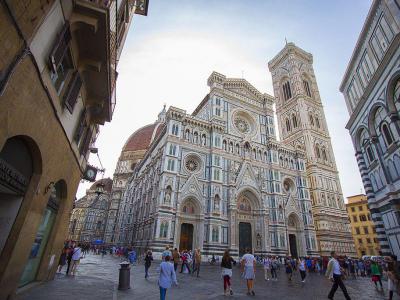
2) Cattedrale di Santa Maria del Fiore (Florence Cathedral) (must see)
Towering over the city of Florence, the Florence Cathedral is a true Renaissance masterpiece-best known for its massive masonry dome, the largest of its kind in the world. Completed in 1465, this remarkable double-shell structure is entirely self-supporting and remains one of the greatest engineering marvels of its time.
The cathedral’s story begins in 1296, when construction of its Gothic design first got underway. The real breakthrough, however, came nearly 150 years later, when architect Filippo Brunelleschi stepped in to solve what many thought was an impossible challenge-building the dome. Inspired by the ancient Pantheon in Rome, Brunelleschi ran countless experiments using large-scale models and even invented custom machinery to get the job done.
Among his most remarkable inventions were lifting devices and pulley systems capable of raising over 37,000 tons of materials-including more than four million bricks. His work impressed a young apprentice named Leonardo da Vinci, who sketched the machines-drawings that were later mistakenly credited to him. But history has remembered the true innovator. Today, Brunelleschi’s statue stands in the piazza outside the Cathedral as a tribute to his genius.
Step inside, and you’ll find more treasures-like the fresco “Dante and the Divine Comedy” by Domenico di Michelino, painted in 1465. It shows the poet holding his famous book, surrounded by vivid imagery of Hell, Purgatory, and Heaven, along with a detailed view of Florence as it looked in the 15th century-ironically, a version of the city Dante himself never saw. To see it up close, be prepared to climb about 450 steps up a narrow staircase that spirals inside the dome.
And then there's the exterior-a stunning patchwork of colorful marbles so intricate it almost looks painted. The craftsmanship is nothing short of extraordinary.
Tip: When booking online, you’ll get free access to the top of the dome-but you’ll need to reserve a time slot separately. The reward is a 360-degree view of Florence, the Tuscan countryside, and the mountains beyond. Totally worth the climb.
The cathedral’s story begins in 1296, when construction of its Gothic design first got underway. The real breakthrough, however, came nearly 150 years later, when architect Filippo Brunelleschi stepped in to solve what many thought was an impossible challenge-building the dome. Inspired by the ancient Pantheon in Rome, Brunelleschi ran countless experiments using large-scale models and even invented custom machinery to get the job done.
Among his most remarkable inventions were lifting devices and pulley systems capable of raising over 37,000 tons of materials-including more than four million bricks. His work impressed a young apprentice named Leonardo da Vinci, who sketched the machines-drawings that were later mistakenly credited to him. But history has remembered the true innovator. Today, Brunelleschi’s statue stands in the piazza outside the Cathedral as a tribute to his genius.
Step inside, and you’ll find more treasures-like the fresco “Dante and the Divine Comedy” by Domenico di Michelino, painted in 1465. It shows the poet holding his famous book, surrounded by vivid imagery of Hell, Purgatory, and Heaven, along with a detailed view of Florence as it looked in the 15th century-ironically, a version of the city Dante himself never saw. To see it up close, be prepared to climb about 450 steps up a narrow staircase that spirals inside the dome.
And then there's the exterior-a stunning patchwork of colorful marbles so intricate it almost looks painted. The craftsmanship is nothing short of extraordinary.
Tip: When booking online, you’ll get free access to the top of the dome-but you’ll need to reserve a time slot separately. The reward is a 360-degree view of Florence, the Tuscan countryside, and the mountains beyond. Totally worth the climb.
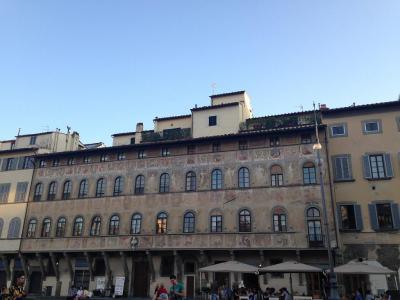
3) Palazzo dell'Antella (Antella Palace)
While strolling through Piazza Santa Croce, one's attention is immediately drawn to the facade of an exceptionally unique and stunning building. This is none other than the Palazzo dell'Antella or degli Antellesi, situated on the right side of the square.
Of medieval origins, this palace is the fruit of a series of restructurings and mergers of several housing estates during the course of time. Although it is not open for public visits, the observation of its facade offers a multitude of intriguing details. One notable feature is the presence of prominent projecting corbels, adding a distinct and elegant touch. Another captivating characteristic is the progressively narrowing spacing between the windows as you approach Santa Croce, creating a fascinating perspective effect (though for many onlookers it is just a funny architectural solution that poses the question of how the rooms look on the inside).
However, the true marvel lies in the frescoes that adorn the facade. Executed by renowned artists of the time, such as Giovanni da San Giovanni, Domenico Passignano, Cosimo Milanesi, Matteo Rosselli, and others, these breathtaking frescoes were completed within a mere twenty days between 1619 and 1620, with a total of twelve artists contributing to this masterpiece. Additionally, adorning the facade is a prominent bust of Cosimo II dei Medici, serving as the central figure within the entire iconography.
Lastly, an intriguing feature is the palace having become known as the "Palazzo degli Sporti" at one point, because spectators used to watch the "calcio fiorentino" in costume from the windows. This was, apparently, an early form of football whose cradle is now considered to be the Piazza Santa Croce, where the palace lies. Below the palace's third window one can even spot a marble disk, said by some to mark where the dividing line was drawn across the piazza when the game was played.
Of medieval origins, this palace is the fruit of a series of restructurings and mergers of several housing estates during the course of time. Although it is not open for public visits, the observation of its facade offers a multitude of intriguing details. One notable feature is the presence of prominent projecting corbels, adding a distinct and elegant touch. Another captivating characteristic is the progressively narrowing spacing between the windows as you approach Santa Croce, creating a fascinating perspective effect (though for many onlookers it is just a funny architectural solution that poses the question of how the rooms look on the inside).
However, the true marvel lies in the frescoes that adorn the facade. Executed by renowned artists of the time, such as Giovanni da San Giovanni, Domenico Passignano, Cosimo Milanesi, Matteo Rosselli, and others, these breathtaking frescoes were completed within a mere twenty days between 1619 and 1620, with a total of twelve artists contributing to this masterpiece. Additionally, adorning the facade is a prominent bust of Cosimo II dei Medici, serving as the central figure within the entire iconography.
Lastly, an intriguing feature is the palace having become known as the "Palazzo degli Sporti" at one point, because spectators used to watch the "calcio fiorentino" in costume from the windows. This was, apparently, an early form of football whose cradle is now considered to be the Piazza Santa Croce, where the palace lies. Below the palace's third window one can even spot a marble disk, said by some to mark where the dividing line was drawn across the piazza when the game was played.
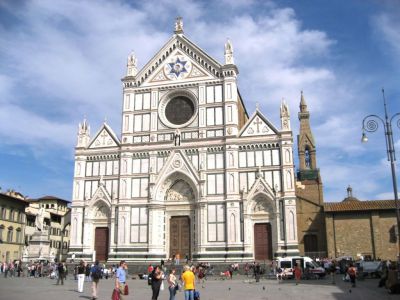
4) Basilica di Santa Croce (Basilica of the Holy Cross) (must see)
Santa Croce is one of the most celebrated Franciscan churches in the world and a jewel of Gothic architecture in Florence. Built over the 13th and 14th centuries, it’s often called the “Temple of Italian Glories”-and for good reason. This is where some of Italy’s greatest minds and artists are buried-among them Michelangelo, Galileo, Machiavelli, the poet Foscolo, and the composer Rossini.
Michelangelo’s journey back to Florence after death is itself the stuff of legend. Though he died in Rome, Cosimo de’ Medici made sure his remains returned home. The Medici ruler, unable to properly honor the artist in life, vowed to do so in death-and, to this end, commissioned an elaborate tomb. Designed by Giorgio Vasari, the tomb took 14 years to complete and features symbols tied to Michelangelo’s creative legacy. Three laurel wreaths represent his mastery of painting, sculpture, and architecture, each mourned by a figure carved in deep sorrow below his bust.
Galileo’s story follows a similarly complicated path. Though he died in 1642, his tomb wasn’t built until nearly a century later, in 1737, now facing Michelangelo’s across the nave. It’s adorned with allegorical figures representing Astronomy and Geometry, and quietly also includes the tomb of his daughter, Maria Celeste-though her presence often goes unnoticed.
Dante, however, remains absent. While Florence tried for years to reclaim his remains, the poet still lies in Ravenna, the city that welcomed him after exile. Here in Santa Croce, an empty sarcophagus stands in his honor, and a grand statue was erected outside the church in 1865 for his 600th birth anniversary.
The interior is filled with masterpieces by Giotto, Donatello, Vasari, Canova, and others too numerous to list in one breath. Outside, the tranquil cloisters and green courtyard offer a quiet space to pause or sketch, while the square hosts everything from live concerts to raucous games of Florentine “rugby.”
Tip: Be sure to stop by the Leather School just behind the church. You can watch apprentices at work and maybe find a unique handmade piece to take home. Just remember: modest attire is required-no bare shoulders or short shorts, especially for women, as the dress code is firmly enforced.
Michelangelo’s journey back to Florence after death is itself the stuff of legend. Though he died in Rome, Cosimo de’ Medici made sure his remains returned home. The Medici ruler, unable to properly honor the artist in life, vowed to do so in death-and, to this end, commissioned an elaborate tomb. Designed by Giorgio Vasari, the tomb took 14 years to complete and features symbols tied to Michelangelo’s creative legacy. Three laurel wreaths represent his mastery of painting, sculpture, and architecture, each mourned by a figure carved in deep sorrow below his bust.
Galileo’s story follows a similarly complicated path. Though he died in 1642, his tomb wasn’t built until nearly a century later, in 1737, now facing Michelangelo’s across the nave. It’s adorned with allegorical figures representing Astronomy and Geometry, and quietly also includes the tomb of his daughter, Maria Celeste-though her presence often goes unnoticed.
Dante, however, remains absent. While Florence tried for years to reclaim his remains, the poet still lies in Ravenna, the city that welcomed him after exile. Here in Santa Croce, an empty sarcophagus stands in his honor, and a grand statue was erected outside the church in 1865 for his 600th birth anniversary.
The interior is filled with masterpieces by Giotto, Donatello, Vasari, Canova, and others too numerous to list in one breath. Outside, the tranquil cloisters and green courtyard offer a quiet space to pause or sketch, while the square hosts everything from live concerts to raucous games of Florentine “rugby.”
Tip: Be sure to stop by the Leather School just behind the church. You can watch apprentices at work and maybe find a unique handmade piece to take home. Just remember: modest attire is required-no bare shoulders or short shorts, especially for women, as the dress code is firmly enforced.
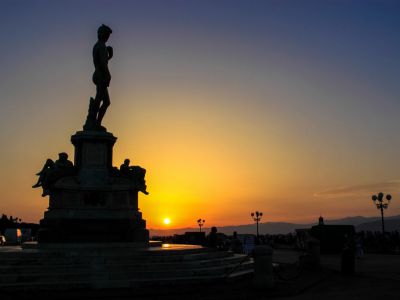
5) Piazzale Michelangelo (Michelangelo Square) (must see)
Florence is undebiably a stunning city, and this hilltop terrace proves it beyond question. Perched just south of the Arno River, the spacious overlook is lined with souvenir stalls and draws crowds for its panoramas of the city’s red-tiled rooftops. From here, you’ll spot the majestic Cathedral and its dome, along with the Giotto Bell Tower and Old Palace-a postcard-perfect scene has been captured thousands of times. But there’s more to take in. Scan the horizon and you’ll also spot Fort Belvedere, the Holy Cross Basilica, and the timelessly charming Old Bridge.
The square was laid out in 1869, during a period of major urban development known as the “Risanamento,” when Florence briefly served as Italy’s capital. As the name suggests, it was meant to honor Michelangelo, and features bronze copies of his most famous works-“David”, along with the four allegorical figures from the Medici Chapel. While the originals are in marble, these replicas were hauled up the hill by nine pairs of oxen-no small feat, especially on a warm Tuscan day.
As evening sets in, the square becomes a magnet for sunset seekers. Find a comfortable spot, sip a glass of wine, and watch the sun paint the city in golden tones. You can bring your own bottle or choose one of the nearby cafés and restaurants. The most famous one here is housed in a lovely Neoclassical building, and surprisingly, the prices are pretty fair for such a prime location.
Halfway up the main staircase, you’ll also find the charming rose garden-a peaceful hideaway filled with greenery and floral scents, with views of the city peeking through the trees.
Tip: Sunny days can get quite hot up here, so be sure to pack a hat or something to shield yourself from the sun.
The square was laid out in 1869, during a period of major urban development known as the “Risanamento,” when Florence briefly served as Italy’s capital. As the name suggests, it was meant to honor Michelangelo, and features bronze copies of his most famous works-“David”, along with the four allegorical figures from the Medici Chapel. While the originals are in marble, these replicas were hauled up the hill by nine pairs of oxen-no small feat, especially on a warm Tuscan day.
As evening sets in, the square becomes a magnet for sunset seekers. Find a comfortable spot, sip a glass of wine, and watch the sun paint the city in golden tones. You can bring your own bottle or choose one of the nearby cafés and restaurants. The most famous one here is housed in a lovely Neoclassical building, and surprisingly, the prices are pretty fair for such a prime location.
Halfway up the main staircase, you’ll also find the charming rose garden-a peaceful hideaway filled with greenery and floral scents, with views of the city peeking through the trees.
Tip: Sunny days can get quite hot up here, so be sure to pack a hat or something to shield yourself from the sun.
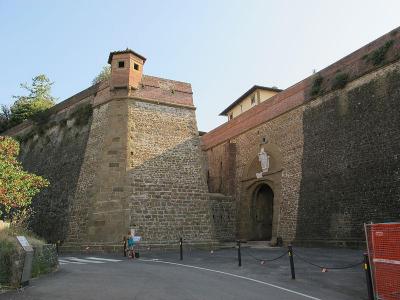
6) Forte di Belvedere (Fort Belvedere)
Fort Belvedere is a striking example of both Italian Renaissance elegance and strategic military design. Built at the end of the 16th century by Grand Duke Ferdinando de’ Medici, the fortress had a dual mission: to protect Florence and to demonstrate the might and wealth of the Medici family. It also served as a secure vault for their treasury and provided a refuge for the Grand Duke during times of unrest or siege.
To allow safe and quick movement, the fort was smartly connected to key spots in the city-like the Old Palace, the Pitti Palace, and the Boboli Gardens-through a network of hidden passageways. Positioned high above Florence, this landmark offered an ideal lookout over the surrounding area. During the Renaissance, fortifications were critical to military strategy. Belvedere’s angled walls were designed for both surveillance and defense, allowing for overlapping lines of fire to protect each section. Interestingly, the great Galileo Galilei once used the site for his astronomical studies. After being sentenced to life imprisonment in 1633, he lived nearby at Villa Arcetri, just beyond the walls.
At the heart of the fort lies a luxurious villa, completed around 1570-before the fortress itself. Meant to shelter the Grand Duke during crises or epidemics, this residence was built for comfort rather than defense. Legend has it the Medici treasures were hidden at the bottom of a heavily guarded well, rigged with traps that would spring on any intruder foolish enough to tamper with the locks.
Following a restoration, Fort Belvedere reopened in 2013, now serving mainly as a cultural venue and exhibition space. The small entrance fee grants access to sweeping views of Florence and the surrounding Tuscan hills-truly one of the city's best panoramic spots.
Tip: Head up to the upper floor for a cozy café-perfect for a relaxed lunch or a cool drink with a view.
To allow safe and quick movement, the fort was smartly connected to key spots in the city-like the Old Palace, the Pitti Palace, and the Boboli Gardens-through a network of hidden passageways. Positioned high above Florence, this landmark offered an ideal lookout over the surrounding area. During the Renaissance, fortifications were critical to military strategy. Belvedere’s angled walls were designed for both surveillance and defense, allowing for overlapping lines of fire to protect each section. Interestingly, the great Galileo Galilei once used the site for his astronomical studies. After being sentenced to life imprisonment in 1633, he lived nearby at Villa Arcetri, just beyond the walls.
At the heart of the fort lies a luxurious villa, completed around 1570-before the fortress itself. Meant to shelter the Grand Duke during crises or epidemics, this residence was built for comfort rather than defense. Legend has it the Medici treasures were hidden at the bottom of a heavily guarded well, rigged with traps that would spring on any intruder foolish enough to tamper with the locks.
Following a restoration, Fort Belvedere reopened in 2013, now serving mainly as a cultural venue and exhibition space. The small entrance fee grants access to sweeping views of Florence and the surrounding Tuscan hills-truly one of the city's best panoramic spots.
Tip: Head up to the upper floor for a cozy café-perfect for a relaxed lunch or a cool drink with a view.
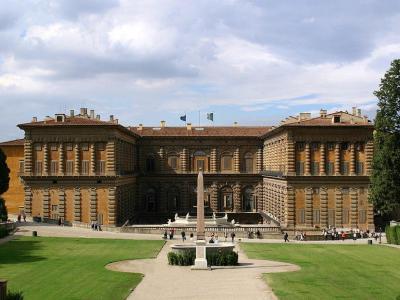
7) Palazzo Pitti (Pitti Palace) (must see)
The Pitti Palace is one of Florence’s grandest landmarks-missing it would be like skipping a chapter in the city’s history. This massive 15th-century residence is a celebration of Renaissance architecture, and its vast gardens, full of winding paths and hidden corners, offer a new surprise with every turn.
Originally built for the powerful Medici family, the palace served as their official residence from the 16th to the 18th century. After the Medici dynasty ended, the property passed to the House of Lorraine, and later, Napoleon Bonaparte used it as a stronghold during his rule over Italy. Today, the palace houses a remarkable collection of museums- yet, it still holds what may be the richest concentration of Medici art and history. Alongside priceless paintings are beautifully preserved furnishings and interior details that once belonged to the family.
Every part of the palace reflects elegance and power-from the Palatine Gallery, with over 500 Renaissance paintings, to the opulent Royal Apartments, the glittering Medici Treasury, and the Gallery of Costume and Fashion. You’ll also find specialized museums showcasing porcelain and royal carriages, offering a different glimpse into court life.
In short, although it’s been state property since 1919, the palace still carries the atmosphere of a private royal home. And with over 5 million visitors each year, it remains one of Florence’s most admired cultural spots.
Tip: A combo ticket gives you access to both the museums and the gardens for two full days-plenty of time to explore at a relaxed pace. If you plan to spend a few hours in the gardens, don’t forget a hat and water, especially in warmer months. To avoid waiting in long lines at the entrance, booking a guided tour is a smart move. Yes, there's an added cost, but you'll skip the queue and get deeper insights into this piece of Florentine history.
Originally built for the powerful Medici family, the palace served as their official residence from the 16th to the 18th century. After the Medici dynasty ended, the property passed to the House of Lorraine, and later, Napoleon Bonaparte used it as a stronghold during his rule over Italy. Today, the palace houses a remarkable collection of museums- yet, it still holds what may be the richest concentration of Medici art and history. Alongside priceless paintings are beautifully preserved furnishings and interior details that once belonged to the family.
Every part of the palace reflects elegance and power-from the Palatine Gallery, with over 500 Renaissance paintings, to the opulent Royal Apartments, the glittering Medici Treasury, and the Gallery of Costume and Fashion. You’ll also find specialized museums showcasing porcelain and royal carriages, offering a different glimpse into court life.
In short, although it’s been state property since 1919, the palace still carries the atmosphere of a private royal home. And with over 5 million visitors each year, it remains one of Florence’s most admired cultural spots.
Tip: A combo ticket gives you access to both the museums and the gardens for two full days-plenty of time to explore at a relaxed pace. If you plan to spend a few hours in the gardens, don’t forget a hat and water, especially in warmer months. To avoid waiting in long lines at the entrance, booking a guided tour is a smart move. Yes, there's an added cost, but you'll skip the queue and get deeper insights into this piece of Florentine history.
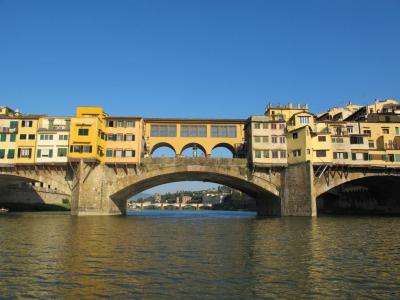
8) Ponte Vecchio (Old Bridge) (must see)
Ponte Vecchio, or The Old Bridge, first appeared in written records all the way back in 996. Of the six bridges that span the Arno River in Florence, it’s the only one that survived World War II intact-spared by retreating German forces. Today, this medieval stone arch structure stands as a powerful reminder of how a ruler’s vision can shape a city’s legacy.
As in the Middle Ages, the bridge is still lined with shops-but what’s sold here has changed quite a bit over time. Originally, it was occupied by butchers, who were know for tossing animal waste directly into the river-hardly ideal for anyone strolling by. That all changed in the 16th century, when Grand Duke Ferdinando de’ Medici had the meat merchants removed and replaced with goldsmiths. Not only did this improve the smell, but it also turned the bridge into one of the most glittering, upscale corners of Florence.
Take a look from a distance, and you might spot something unusual-a raised corridor running above the shops. This hidden passage is part of the Vasari Corridor, a nearly kilometer-long tunnel that connects the Pitti Palace with the Old Palace. It was built so that the Grand Duke could move between his residence and government offices without mingling with the crowds. Although closed since 2016 for safety reasons, there are plans to reopen it for visitors.
There’s even a bit of financial folklore tied to this spot, which is said to be the birthplace of the term “bankruptcy.” When a moneylender couldn’t pay his debts, soldiers smashed his trading bench-called a banco-to pieces, a symbolic act that left him unable to operate. Hence the term “bancorotto”, or “broken bench”, was born.
These days, the Old Bridge is a lovely place for a walk-especially at sunset, when the light casts a golden glow over the Arno. Early mornings are just as magical, with soft reflections on the water and, if you’re lucky, the bridge nearly all to yourself.
As in the Middle Ages, the bridge is still lined with shops-but what’s sold here has changed quite a bit over time. Originally, it was occupied by butchers, who were know for tossing animal waste directly into the river-hardly ideal for anyone strolling by. That all changed in the 16th century, when Grand Duke Ferdinando de’ Medici had the meat merchants removed and replaced with goldsmiths. Not only did this improve the smell, but it also turned the bridge into one of the most glittering, upscale corners of Florence.
Take a look from a distance, and you might spot something unusual-a raised corridor running above the shops. This hidden passage is part of the Vasari Corridor, a nearly kilometer-long tunnel that connects the Pitti Palace with the Old Palace. It was built so that the Grand Duke could move between his residence and government offices without mingling with the crowds. Although closed since 2016 for safety reasons, there are plans to reopen it for visitors.
There’s even a bit of financial folklore tied to this spot, which is said to be the birthplace of the term “bankruptcy.” When a moneylender couldn’t pay his debts, soldiers smashed his trading bench-called a banco-to pieces, a symbolic act that left him unable to operate. Hence the term “bancorotto”, or “broken bench”, was born.
These days, the Old Bridge is a lovely place for a walk-especially at sunset, when the light casts a golden glow over the Arno. Early mornings are just as magical, with soft reflections on the water and, if you’re lucky, the bridge nearly all to yourself.
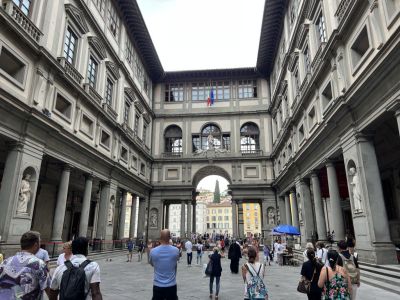
9) Piazzale degli Uffizi (Uffizi Courtyard)
The Uffizi Courtyard is a grand and elegant space in the heart of Florence, framed by the historic Uffizi Gallery. Before its transformation, this area was far from refined-home to tanners, dyers, and widespread prostitution, earning it the Red-Light District nickname. Seeking to bring order and centralization to the city’s administration, Cosimo de’ Medici commissioned Giorgio Vasari in 1560 to design a new building that would house all major public offices near his residence at the Old Palace. Inspired by Venetian architecture, Vasari created a symmetrical row of buildings with graceful arches and columns, transforming the area into one of structured beauty and civic pride.
After Vasari’s death, construction continued, and by 1580, the Uffizi complex was connected to nearby buildings like the Mint and the Loggia dei Lanzi. The addition of the Vasari Corridor, an elevated walkway leading from the Uffizi to the Pitti Palace, allowed the Medici family to traverse the city in private. Today, the courtyard is a lively and symbolic space-bridging Florence’s gritty past with its Renaissance grandeur. It serves as both a cultural landmark and a busy walkway, often animated by artists, musicians, and the steady stream of visitors heading toward one of the world’s most important art museums.
Outside the Uffizi Gallery, twenty-eight marble statues of prominent Tuscans line the niches of the portico’s pillars, including four that overlook the Arno along Lungarno Anna Maria Luisa de' Medici; these sculptures, completed between 1842 and 1856 by some of the finest artists of the era, celebrate the region’s intellectual and artistic legacy. At the far end of the courtyard, just to the right of the archway leading to the Arno embankment, stands a full-length statue of Galileo Galilei, gazing thoughtfully skyward with a telescope in hand-a tribute sculpted by Aristodemus Costoli and gifted by Crown Prince Ferdinand, located on the square-facing side of the Verone Loggia.
After Vasari’s death, construction continued, and by 1580, the Uffizi complex was connected to nearby buildings like the Mint and the Loggia dei Lanzi. The addition of the Vasari Corridor, an elevated walkway leading from the Uffizi to the Pitti Palace, allowed the Medici family to traverse the city in private. Today, the courtyard is a lively and symbolic space-bridging Florence’s gritty past with its Renaissance grandeur. It serves as both a cultural landmark and a busy walkway, often animated by artists, musicians, and the steady stream of visitors heading toward one of the world’s most important art museums.
Outside the Uffizi Gallery, twenty-eight marble statues of prominent Tuscans line the niches of the portico’s pillars, including four that overlook the Arno along Lungarno Anna Maria Luisa de' Medici; these sculptures, completed between 1842 and 1856 by some of the finest artists of the era, celebrate the region’s intellectual and artistic legacy. At the far end of the courtyard, just to the right of the archway leading to the Arno embankment, stands a full-length statue of Galileo Galilei, gazing thoughtfully skyward with a telescope in hand-a tribute sculpted by Aristodemus Costoli and gifted by Crown Prince Ferdinand, located on the square-facing side of the Verone Loggia.
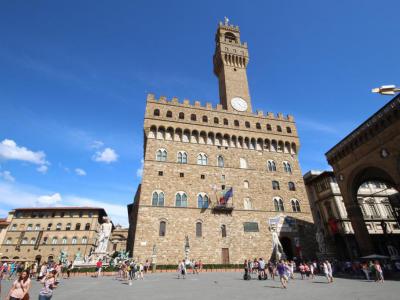
10) Palazzo Vecchio (Old Palace) (must see)
Just like the Cathedral complex and Florence’s world-class galleries, the Old Palace is essential for anyone wanting to grasp the city's history and cultural identity. This massive Romanesque fortress is one of the most striking town halls in all of Tuscany. Since 1872, it has served as the office of Florence’s mayor, but its legacy stretches much further back. Built in 1299, the edifice was the political heart of the Florentine Republic for centuries. When Cosimo de’ Medici moved in with his family in 1540 as Grand Duke, he had it expanded and transformed, blending its medieval bones with elegant Renaissance flair.
The rugged stone façade, lined with shields chronicling Florence’s political past, is also home to an impressive lineup of statues. These include Florence’s heraldic symbol- the Marzocco lion, along with Donatello’s powerful “Judith and Holofernes”, and “Hercules and Cacus”. The nearby Tower of Arnolfo, rising above the palace, offers a climbable vantage point-though access requires a separate ticket.
Meanwhile, inside, every room tells a chapter of the city’s history. You’ll walk through the spectacular Hall of the Five Hundred, designed to glorify Medici rule, and into the more private quarters where the family lived. Decorated under the artistic direction of Giorgio Vasari, these spaces are rich in symbolism and political narrative. Give yourself time to move slowly through the rooms-it’s an immersive dive into Florentine grandeur. And be warned: you may leave with a crick in your neck from gazing.
One standout work here is Michelangelo’s “Genius of Victory”. Originally meant for the tomb of Pope Julius II, the sculpture depicts a young, triumphant figure standing over a defeated older man. The contrast between the two is striking-the victor is smooth and polished, the vanquished figure unfinished and rough, still bearing the weight of the stone.
You’ll also come across something rather haunting-a death mask of Dante Alighieri, displayed between the Apartments of Eleanor and the Halls of the Priors. Though the poet was buried in Ravenna, this plaster cast has become a powerful reminder of his influence on Florence, both politically and culturally. Fans of Dan Brown’s “Inferno” will surely recognize it from the novel.
Tip: If you’re planning a guided visit, it’s best to book directly with the museum by email-include your preferred date and time, and wait for confirmation. Payment is made on the day of your tour, and afterward, you’re free to continue exploring on your own. Just keep in mind: because this is still a working municipal building, access may occasionally be restricted. It’s a good idea to check the official website before you go.
The rugged stone façade, lined with shields chronicling Florence’s political past, is also home to an impressive lineup of statues. These include Florence’s heraldic symbol- the Marzocco lion, along with Donatello’s powerful “Judith and Holofernes”, and “Hercules and Cacus”. The nearby Tower of Arnolfo, rising above the palace, offers a climbable vantage point-though access requires a separate ticket.
Meanwhile, inside, every room tells a chapter of the city’s history. You’ll walk through the spectacular Hall of the Five Hundred, designed to glorify Medici rule, and into the more private quarters where the family lived. Decorated under the artistic direction of Giorgio Vasari, these spaces are rich in symbolism and political narrative. Give yourself time to move slowly through the rooms-it’s an immersive dive into Florentine grandeur. And be warned: you may leave with a crick in your neck from gazing.
One standout work here is Michelangelo’s “Genius of Victory”. Originally meant for the tomb of Pope Julius II, the sculpture depicts a young, triumphant figure standing over a defeated older man. The contrast between the two is striking-the victor is smooth and polished, the vanquished figure unfinished and rough, still bearing the weight of the stone.
You’ll also come across something rather haunting-a death mask of Dante Alighieri, displayed between the Apartments of Eleanor and the Halls of the Priors. Though the poet was buried in Ravenna, this plaster cast has become a powerful reminder of his influence on Florence, both politically and culturally. Fans of Dan Brown’s “Inferno” will surely recognize it from the novel.
Tip: If you’re planning a guided visit, it’s best to book directly with the museum by email-include your preferred date and time, and wait for confirmation. Payment is made on the day of your tour, and afterward, you’re free to continue exploring on your own. Just keep in mind: because this is still a working municipal building, access may occasionally be restricted. It’s a good idea to check the official website before you go.
