Custom Walk in Quebec City, Quebec by dschiavone106_23537 created on 2025-08-23
Guide Location: Canada » Quebec City
Guide Type: Custom Walk
# of Sights: 7
Tour Duration: 1 Hour(s)
Travel Distance: 0.8 Km or 0.5 Miles
Share Key: UJT78
Guide Type: Custom Walk
# of Sights: 7
Tour Duration: 1 Hour(s)
Travel Distance: 0.8 Km or 0.5 Miles
Share Key: UJT78
How It Works
Please retrieve this walk in the GPSmyCity app. Once done, the app will guide you from one tour stop to the next as if you had a personal tour guide. If you created the walk on this website or come to the page via a link, please follow the instructions below to retrieve the walk in the app.
Retrieve This Walk in App
Step 1. Download the app "GPSmyCity: Walks in 1K+ Cities" on Apple App Store or Google Play Store.



Step 2. In the GPSmyCity app, download(or launch) the guide "Quebec City Map and Walking Tours".
Step 3. Tap the menu button located at upper right corner of the "Walks" screen and select "Retrieve custom walk". Enter the share key: UJT78
1) Old Quebec (must see)
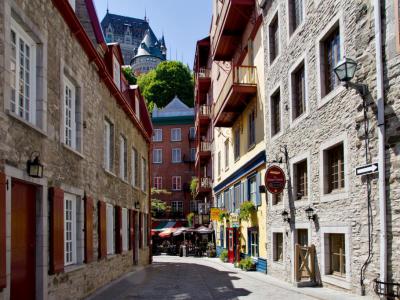
Old Québec is a historically significant neighborhood within Quebec City, encompassing both the Upper Town and Lower Town areas. This locale holds the prestigious designation of being a UNESCO World Heritage Site. From an administrative perspective, Old Quebec is situated within the Vieux-Québec–Cap-Blanc–colline Parlementaire district, which falls under the jurisdiction of the La Cité-Limoilou borough. In English, it is commonly referred to as "the Old City" or "Québec's Old City."
The majority of the buildings in the Upper Town section of Old Québec originate from the 19th century, with a few dating back to the 17th and 18th centuries. This area boasts several commercial streets, such as Saint Jean, Sainte Anne, and De Buade, with numerous hotels, including the renowned Château Frontenac, making it a highly sought-after tourist destination. In the Upper Town, you can find parks like De l'Esplanade, Artillerie, Des Gouverneurs, Montmorency, and the grounds of l’Hotel-de-Ville.
The Lower Town, situated at the base of Cap Diamant, holds historical significance. The construction of the Church of Notre-Dame-des-Victoires commenced in 1687 at this location and was completed in 1723. Lower Town features notable cultural institutions such as the Musée de la civilisation, the Musée naval de Québec, the caserne Dalhousie, and the Théâtre Petit Champlain, which encompass museums, performance venues, theaters, and exhibition spaces.
The majority of the buildings in the Upper Town section of Old Québec originate from the 19th century, with a few dating back to the 17th and 18th centuries. This area boasts several commercial streets, such as Saint Jean, Sainte Anne, and De Buade, with numerous hotels, including the renowned Château Frontenac, making it a highly sought-after tourist destination. In the Upper Town, you can find parks like De l'Esplanade, Artillerie, Des Gouverneurs, Montmorency, and the grounds of l’Hotel-de-Ville.
The Lower Town, situated at the base of Cap Diamant, holds historical significance. The construction of the Church of Notre-Dame-des-Victoires commenced in 1687 at this location and was completed in 1723. Lower Town features notable cultural institutions such as the Musée de la civilisation, the Musée naval de Québec, the caserne Dalhousie, and the Théâtre Petit Champlain, which encompass museums, performance venues, theaters, and exhibition spaces.
2) Chateau Frontenac
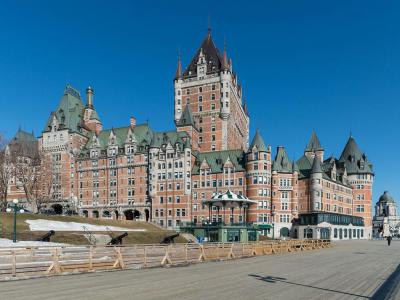
One of the most astonishing buildings in Quebec, renowned for its fortress-like architecture and majestic location – sitting on top of the Cape Diamond (Cap Diamant) ridge, the Frontenac Castle (Château Frontenac) proudly holds the title of the "most photographed hotel in the world".
Opened in 1893, this was one of the first grand railway hotels built by the Canadian Pacific Railway in the country, whose 18-floor grandness, augmented by the 54-meter (177-foot) elevation that it sits at, rivaled any European hotel of the day and grabbed the attention of travelers visiting the city.
The Châteauesque style of the building was later replicated in other grand railway hotels erected throughout Canada from the late 19th to the early 20th centuries. American architect Bruce Price drew inspiration from Medieval, Renaissance, and Victorian architecture, incorporating into his design such elements as turrets from Scottish castles and bastion towers of French châteaus. The hotel was designated a National Historic Site of Canada in 1981 and expanded on three occasions, most recently in 1993.
The building is named after Louis de Buade de Frontenac, who served twice as the Governor General of New France, and it sits on the site previously occupied by Saint Louis Castle (Château Saint-Louis). The remains of this former seat of the French and later of the British governors of the territory now lie in front of the hotel as an archaeological site.
Over the years, the Frontenac Castle has welcomed many guests of honour among whom were the likes of Queen Elizabeth II, Charles Lindbergh, and other dignitaries and celebrities. Alfred Hitchcock used the building as the setting for his 1953 drama "I Confess", however, the most memorable historic events associated with the hotel are the two Quebec Conferences, held in 1943 and 1944, during which U.S. President Franklin D. Roosevelt, British Prime Minister Winston Churchill, and Canadian Prime Minister William Lyon Mackenzie King discussed Allied strategy for WWII including plans for the invasion of Normandy.
Tip:
If you ever book a room here, ask for a high floor – the 18th floor offers a particularly stunning city view!
Consider taking a hotel tour, offered every day, as there are some good anecdotes and stories to hear from the hotel's history.
Opened in 1893, this was one of the first grand railway hotels built by the Canadian Pacific Railway in the country, whose 18-floor grandness, augmented by the 54-meter (177-foot) elevation that it sits at, rivaled any European hotel of the day and grabbed the attention of travelers visiting the city.
The Châteauesque style of the building was later replicated in other grand railway hotels erected throughout Canada from the late 19th to the early 20th centuries. American architect Bruce Price drew inspiration from Medieval, Renaissance, and Victorian architecture, incorporating into his design such elements as turrets from Scottish castles and bastion towers of French châteaus. The hotel was designated a National Historic Site of Canada in 1981 and expanded on three occasions, most recently in 1993.
The building is named after Louis de Buade de Frontenac, who served twice as the Governor General of New France, and it sits on the site previously occupied by Saint Louis Castle (Château Saint-Louis). The remains of this former seat of the French and later of the British governors of the territory now lie in front of the hotel as an archaeological site.
Over the years, the Frontenac Castle has welcomed many guests of honour among whom were the likes of Queen Elizabeth II, Charles Lindbergh, and other dignitaries and celebrities. Alfred Hitchcock used the building as the setting for his 1953 drama "I Confess", however, the most memorable historic events associated with the hotel are the two Quebec Conferences, held in 1943 and 1944, during which U.S. President Franklin D. Roosevelt, British Prime Minister Winston Churchill, and Canadian Prime Minister William Lyon Mackenzie King discussed Allied strategy for WWII including plans for the invasion of Normandy.
Tip:
If you ever book a room here, ask for a high floor – the 18th floor offers a particularly stunning city view!
Consider taking a hotel tour, offered every day, as there are some good anecdotes and stories to hear from the hotel's history.
3) Dufferin Terrace (Terrasse Dufferin) (must see)
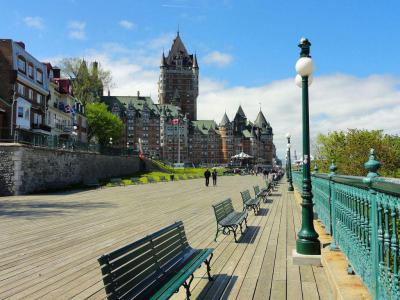
The Dufferin Terrace (Terrasse Dufferin) is a wide, wooden boardwalk wrapping around the front of the Frontenac Castle (Château Frontenac) towards the Citadel of Quebec. The abundance of gazebos and benches here, not to mention the panoramic views of the Saint Lawrence River, the South Shore, and Orleans Island (Île d'Orléans), makes this place an equally loved leisure spot by both locals and tourists.
Remarkably, the use of wooden planks gives this whole thing an “air of summer”, even in the middle of winter when the famous Terrasse Dufferin Slides, a huge (150-metre/490-foot) toboggan on the south end of the terrace, is open during the Quebec Winter Carnival (Carnaval de Québec), from late January to mid-February.
The promenade was built in 1838 and was first known as Durham Terrace. It was enlarged in 1854 and then remodeled, in 1878-1879, under the direction of the then Governor General of Canada, Marquess of Dufferin, whose name it now bears. Each of the six gazebos found on this boardwalk has a name – going north-south, it is Frontenac, Lorne, Princess Louise, Victoria, Dufferin, and Plessis.
Underneath the terrace is the archaeological site of Saint Louis Fort and Castle (Château Saint-Louis), featuring the remains of the former seat of power occupied by the French and British governors of the territory from 1620 to 1834 (when it was destroyed by fire) – it is now open for viewing through the three specially built-in peek-a-boo windows.
Also, at the southern end of the terrace is the entry to the Governors' Promenade, a walkway to the Plains of Abraham built into the cliffs below the Citadel. Nearby, a few old guns recall the strategic position of the place once guarded by artillery batteries.
Remarkably, the use of wooden planks gives this whole thing an “air of summer”, even in the middle of winter when the famous Terrasse Dufferin Slides, a huge (150-metre/490-foot) toboggan on the south end of the terrace, is open during the Quebec Winter Carnival (Carnaval de Québec), from late January to mid-February.
The promenade was built in 1838 and was first known as Durham Terrace. It was enlarged in 1854 and then remodeled, in 1878-1879, under the direction of the then Governor General of Canada, Marquess of Dufferin, whose name it now bears. Each of the six gazebos found on this boardwalk has a name – going north-south, it is Frontenac, Lorne, Princess Louise, Victoria, Dufferin, and Plessis.
Underneath the terrace is the archaeological site of Saint Louis Fort and Castle (Château Saint-Louis), featuring the remains of the former seat of power occupied by the French and British governors of the territory from 1620 to 1834 (when it was destroyed by fire) – it is now open for viewing through the three specially built-in peek-a-boo windows.
Also, at the southern end of the terrace is the entry to the Governors' Promenade, a walkway to the Plains of Abraham built into the cliffs below the Citadel. Nearby, a few old guns recall the strategic position of the place once guarded by artillery batteries.
4) Old Quebec Funicular (Funiculaire du Vieux-Quebec) (must see)
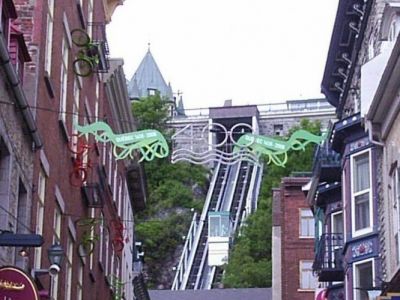
The Old Quebec Funicular, known as the Funiculaire du Vieux-Québec, is a cable railway that connects the Upper and Lower Towns of Old Quebec. It runs between Dufferin Terrace and Petit-Champlain Street.
Besides its speed and convenience, this mode of transportation holds historical significance. The funicular was originally established in 1879. Initially, it operated using a hydraulic system that required the transfer of water between reservoirs before it could function. However, in 1907, it underwent a conversion to electricity.
In 1945, a significant fire damaged the structure, necessitating its reconstruction, which was completed within a year. Subsequent renovations in 1978 and 1998 made both cabins fully autonomous, essentially operating as elevators. From a technical standpoint, it's now more of an inclined lift than a traditional funicular.
Despite its small size, the funicular provides a remarkable way to enjoy the scenery. When traveling uphill, you enter through the Louis Jolliet House and, after obtaining your ticket (which usually takes about 10 minutes on a summer afternoon), ascend 64 meters (210 feet) at a 45-degree angle. During the ride, you can take in stunning views of the Lower Town, the Saint Lawrence River, and the iconic Frontenac Castle (Château Frontenac).
Being here offers a one-of-a-kind experience that you're unlikely to find in many other places around the world. Although the ride itself is short, the enjoyment it provides is long-lasting!
For added enjoyment, there is an on-site gift shop and café.
Besides its speed and convenience, this mode of transportation holds historical significance. The funicular was originally established in 1879. Initially, it operated using a hydraulic system that required the transfer of water between reservoirs before it could function. However, in 1907, it underwent a conversion to electricity.
In 1945, a significant fire damaged the structure, necessitating its reconstruction, which was completed within a year. Subsequent renovations in 1978 and 1998 made both cabins fully autonomous, essentially operating as elevators. From a technical standpoint, it's now more of an inclined lift than a traditional funicular.
Despite its small size, the funicular provides a remarkable way to enjoy the scenery. When traveling uphill, you enter through the Louis Jolliet House and, after obtaining your ticket (which usually takes about 10 minutes on a summer afternoon), ascend 64 meters (210 feet) at a 45-degree angle. During the ride, you can take in stunning views of the Lower Town, the Saint Lawrence River, and the iconic Frontenac Castle (Château Frontenac).
Being here offers a one-of-a-kind experience that you're unlikely to find in many other places around the world. Although the ride itself is short, the enjoyment it provides is long-lasting!
For added enjoyment, there is an on-site gift shop and café.
5) Notre-Dame de Québec (must see)
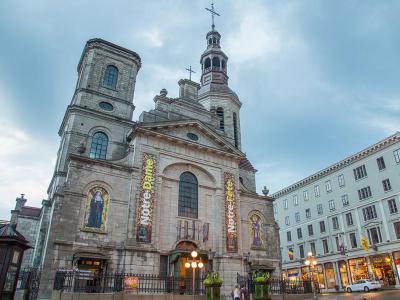
The Cathedral-Basilica of Our Lady of Quebec City (Notre-Dame de Québec) is the oldest church in Canada. It sits on the site of the former chapel of Our Lady of Recovery (Notre Dame de la Recouvrance), which was built by Samuel de Champlain in 1633.
This is also the first church in Canada to be ranked as a minor basilica – by Pope Pius IX, in 1874.
Over the years, the cathedral has been destroyed twice by fires: the first time during the Siege of Quebec, in 1759; and then in 1922, gutted by arson by the members of the Canadian faction of the Ku Klux Klan.
The church was designated a National Historic Site of Canada in 1989. Inside, you will find a chancel lamp donated by Louis XIV and impressive adornments such as stained glass windows, paintings of the Virgin Mary dating back to the French colonial regime, the old bishop's throne, and a stunning gold-plated baldaquin canopy suspended above the altar.
From 1654 to 1898, some 900 people were buried in the church crypt; among them four governors of New France and twenty bishops of Quebec, including François de Laval, Quebec's first bishop. It is also rumored that Samuel de Champlain himself is buried somewhere nearby; archaeologists have been searching for his grave for decades.
In 2014, when the cathedral celebrated its 350th anniversary, a holy door – a special entrance portal traditionally located within the Papal major basilicas in Rome – was installed here, being the only one of its kind in North America and one of eight across the entire world.
Tip:
See the basilica during the day, but consider the laser light show in the evening. The line to get in is very long, so buy your tickets online and pick them up at the office the night of the performance. Not the cheapest 30 minutes, but well worth it if you want to see the magnificent building shine in a whole new way.
Entry is free for self-guided visits; it is also possible to visit the crypt on a guided tour, for a charge.
This is also the first church in Canada to be ranked as a minor basilica – by Pope Pius IX, in 1874.
Over the years, the cathedral has been destroyed twice by fires: the first time during the Siege of Quebec, in 1759; and then in 1922, gutted by arson by the members of the Canadian faction of the Ku Klux Klan.
The church was designated a National Historic Site of Canada in 1989. Inside, you will find a chancel lamp donated by Louis XIV and impressive adornments such as stained glass windows, paintings of the Virgin Mary dating back to the French colonial regime, the old bishop's throne, and a stunning gold-plated baldaquin canopy suspended above the altar.
From 1654 to 1898, some 900 people were buried in the church crypt; among them four governors of New France and twenty bishops of Quebec, including François de Laval, Quebec's first bishop. It is also rumored that Samuel de Champlain himself is buried somewhere nearby; archaeologists have been searching for his grave for decades.
In 2014, when the cathedral celebrated its 350th anniversary, a holy door – a special entrance portal traditionally located within the Papal major basilicas in Rome – was installed here, being the only one of its kind in North America and one of eight across the entire world.
Tip:
See the basilica during the day, but consider the laser light show in the evening. The line to get in is very long, so buy your tickets online and pick them up at the office the night of the performance. Not the cheapest 30 minutes, but well worth it if you want to see the magnificent building shine in a whole new way.
Entry is free for self-guided visits; it is also possible to visit the crypt on a guided tour, for a charge.
6) Breakneck Steps (L'Escalier Casse-Cou) (must see)
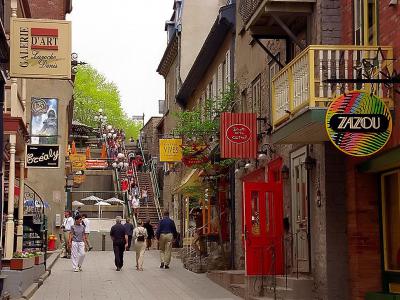
Built in 1635, the legendary Breakneck Stairs or Steps (Escalier Casse-Cou) is the oldest stairway in Quebec City. Named so for its steepness, the staircase was previously known as Champlain Stairs (escalier Champlain), Beggars' Stairs (escalier du Quêteux), and Lower Town Stairs (escalier de la Basse-Ville).
The first steps and landings were made of wood and were much narrower and steeper than today. In 1889, the staircase was replaced with a larger iron one, expanded from a single to three parallel flights, designed by the celebrated local architect and engineer, Charles Baillargé. The stairs that we see now, however, resulted from the major overhaul in the late 1960s.
While not Quebec City's longest staircase (59 steps only), the Breakneck Stairs is probably the city's most useful as it provides a shortcut between Côte de la Montagne street in the Upper Town to the corner of Petit-Champlain and Sous-le-Fort streets in the Lower Town. Despite the ominous name, coined by British tour guides in the mid-19th century (and made official in the 1960s), no serious injuries have ever been reported on the stairs.
The upper level, near Côte de la Montagne, hosts a few artisan kiosks. Tourists adore this location for the wonderful view it affords. As you gaze down upon Petit-Champlain – one of Canada's most picturesque streets, stretching along the foot of the cliff – you may think you are looking at a postcard come to life.
In the winter, the scene is even more sublime with the Christmas lights twinkling and snow gently falling. In the summer, the ultimate experience on the Stairs consists of eating or having a drink at one of the restaurant terraces located on different landings. And when it comes to taking pictures, any time of the year is good, on any of the landings, for a personalized postcard made.
At the bottom of the Stairs, you will find several boutiques, including the famed confectionery La Fudgerie, plus a number restaurants and other delights.
The first steps and landings were made of wood and were much narrower and steeper than today. In 1889, the staircase was replaced with a larger iron one, expanded from a single to three parallel flights, designed by the celebrated local architect and engineer, Charles Baillargé. The stairs that we see now, however, resulted from the major overhaul in the late 1960s.
While not Quebec City's longest staircase (59 steps only), the Breakneck Stairs is probably the city's most useful as it provides a shortcut between Côte de la Montagne street in the Upper Town to the corner of Petit-Champlain and Sous-le-Fort streets in the Lower Town. Despite the ominous name, coined by British tour guides in the mid-19th century (and made official in the 1960s), no serious injuries have ever been reported on the stairs.
The upper level, near Côte de la Montagne, hosts a few artisan kiosks. Tourists adore this location for the wonderful view it affords. As you gaze down upon Petit-Champlain – one of Canada's most picturesque streets, stretching along the foot of the cliff – you may think you are looking at a postcard come to life.
In the winter, the scene is even more sublime with the Christmas lights twinkling and snow gently falling. In the summer, the ultimate experience on the Stairs consists of eating or having a drink at one of the restaurant terraces located on different landings. And when it comes to taking pictures, any time of the year is good, on any of the landings, for a personalized postcard made.
At the bottom of the Stairs, you will find several boutiques, including the famed confectionery La Fudgerie, plus a number restaurants and other delights.
7) Lower Town (Basse-Ville) (must see)
The Lower Town is a historic area situated at the foot of Cap Diamant. In 1608, Samuel de Champlain established a settlement here, which you can still see remnants of today, centered around Place Royale. It has been carefully restored to capture its original French charm. The construction of the Church of Notre-Dame-des-Victoires began in 1687 and was completed in 1723 at this very location.
Lower Town is home to several museums, performance venues, theaters, and exhibition spaces, including the Musée de la Civilisation, the Musée Naval de Québec, the caserne Dalhousie, and the Théâtre Petit Champlain. Additionally, Lower Town offers picturesque sights such as the Louise Basin, Brown Basin, La Pointe-à-Carcy, the Gare du Palais, and the Marche du Vieux-Port, all of which are visible from the Port of Québec.
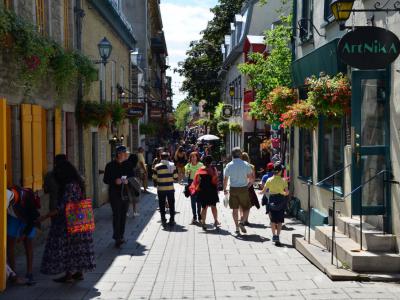
If you're interested in shopping, Lower Town features charming narrow cobblestone streets lined with unique boutiques and galleries. To make it easier to ascend Cap Diamant, there's a funicular car that conveniently connects Lower Town to Upper Town via the petite Petit-Champlain road at the base of the Cape. This ride offers a magnificent panoramic view of the city from the top.
Lower Town is home to several museums, performance venues, theaters, and exhibition spaces, including the Musée de la Civilisation, the Musée Naval de Québec, the caserne Dalhousie, and the Théâtre Petit Champlain. Additionally, Lower Town offers picturesque sights such as the Louise Basin, Brown Basin, La Pointe-à-Carcy, the Gare du Palais, and the Marche du Vieux-Port, all of which are visible from the Port of Québec.
If you're interested in shopping, Lower Town features charming narrow cobblestone streets lined with unique boutiques and galleries. To make it easier to ascend Cap Diamant, there's a funicular car that conveniently connects Lower Town to Upper Town via the petite Petit-Champlain road at the base of the Cape. This ride offers a magnificent panoramic view of the city from the top.
