Custom Walk in Ann Arbor, Michigan by jotyson44_e6b99 created on 2025-09-02
Guide Location: USA » Ann Arbor
Guide Type: Custom Walk
# of Sights: 14
Tour Duration: 2 Hour(s)
Travel Distance: 3.3 Km or 2.1 Miles
Share Key: ZSMF5
Guide Type: Custom Walk
# of Sights: 14
Tour Duration: 2 Hour(s)
Travel Distance: 3.3 Km or 2.1 Miles
Share Key: ZSMF5
How It Works
Please retrieve this walk in the GPSmyCity app. Once done, the app will guide you from one tour stop to the next as if you had a personal tour guide. If you created the walk on this website or come to the page via a link, please follow the instructions below to retrieve the walk in the app.
Retrieve This Walk in App
Step 1. Download the app "GPSmyCity: Walks in 1K+ Cities" on Apple App Store or Google Play Store.



Step 2. In the GPSmyCity app, download(or launch) the guide "Ann Arbor Map and Walking Tours".
Step 3. Tap the menu button located at upper right corner of the "Walks" screen and select "Retrieve custom walk". Enter the share key: ZSMF5
1) State Theater
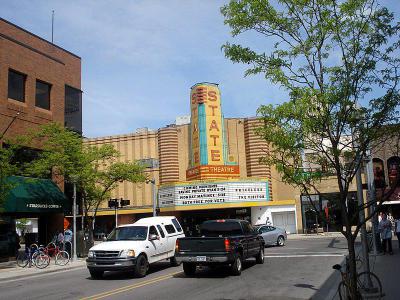
The State Theatre stands as a striking example of Streamline Moderne Art Deco architecture. Designed by C. Howard Crane and opened on March 18, 1942, the single-screen movie palace originally seated over 1,700 patrons and featured Ann Arbor’s first air-conditioning system. Its signature green, yellow, and red neon marquee-meticulously restored in 1976-remains a vivid reminder of its mid-century grandeur.
Through the decades, the theater adapted to shifting cinematic landscapes. In 1979, Butterfield divided the auditorium into a four-screen complex, a change aligned with multiplex trends. By 1989, the ground floor had been converted into retail space-most recently housing a small-format Target-while the balcony-level cinemas remained active. In 1999, Marquee Arts (formerly the Michigan Theater Foundation) took over operations, linking its programming closely with the nearby Michigan Theater and restoring the State’s cultural role.
A major renovation completed in 2017 refreshed the interior, revived original Art Deco motifs, installed contemporary projection and sound systems, and reconfigured four fully accessible auditoria. Today, the State offers an eclectic mix of independent films, classic revivals, and cult favorites, often combined with late-night showings-an ideal complement to the nearby Michigan Theater’s slate of live concerts and festivals.
Located in the heart of downtown, the State Theatre remains a beloved local landmark. Whether attracted by its historic charm, its engaging film programmes, or its neon-lit marquee on a summer evening, tourists will find it a memorable stop. Pair a visit with a stroll along State Street or time your trip with the annual Art Fair or Summer Festival nearby-embracing the unique blend of cinematic history and contemporary culture that defines Ann Arbor.
Through the decades, the theater adapted to shifting cinematic landscapes. In 1979, Butterfield divided the auditorium into a four-screen complex, a change aligned with multiplex trends. By 1989, the ground floor had been converted into retail space-most recently housing a small-format Target-while the balcony-level cinemas remained active. In 1999, Marquee Arts (formerly the Michigan Theater Foundation) took over operations, linking its programming closely with the nearby Michigan Theater and restoring the State’s cultural role.
A major renovation completed in 2017 refreshed the interior, revived original Art Deco motifs, installed contemporary projection and sound systems, and reconfigured four fully accessible auditoria. Today, the State offers an eclectic mix of independent films, classic revivals, and cult favorites, often combined with late-night showings-an ideal complement to the nearby Michigan Theater’s slate of live concerts and festivals.
Located in the heart of downtown, the State Theatre remains a beloved local landmark. Whether attracted by its historic charm, its engaging film programmes, or its neon-lit marquee on a summer evening, tourists will find it a memorable stop. Pair a visit with a stroll along State Street or time your trip with the annual Art Fair or Summer Festival nearby-embracing the unique blend of cinematic history and contemporary culture that defines Ann Arbor.
2) Michigan Theater (must see)
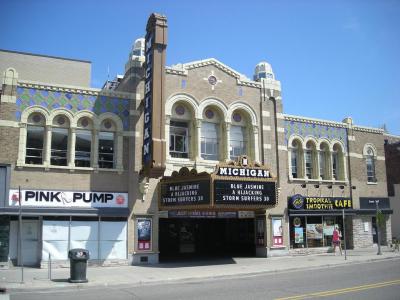
The Michigan Theater is a movie palace in Ann Arbor. It shows independent films and stage productions, and hosts musical concerts.
Designed by Detroit-based architect Maurice Finkel and built in 1927, the historic auditorium seats 1610 and features the theater's original 1927 Barton Theatre Pipe Organ, orchestra pit, stage, and elaborate architectural details.
The Michigan Theater opened on January 5, 1928, and was at the time the finest theater in Ann Arbor. The theater not only showed movies, but also hosted vaudeville acts, live concerts, and touring stage plays. Over the years, Jack Benny, Bing Crosby, Paul Robeson, and Ethel Barrymore all appeared at the theater.
During a renovation in 1956, many of the original ornate designs were destroyed. After a period of low attendance, the theater was threatened with demolition when its 50-year lease to Butterfield Theatres ran out in 1978, but members of the community and local organists helped raise funds to save and renovate the theater, returning it to its original design. A second screen, the Screening Room, with a state-of-the-art sound system, seating for 200, and the ability to project films digitally, was added in 1999.
The Michigan Theater is the current home of the annual Ann Arbor Film Festival, the Ann Arbor Symphony, and the Ann Arbor Concert Band. The theater has been named Outstanding Historic Theatre by the League of Historic American Theaters in 2006.
Designed by Detroit-based architect Maurice Finkel and built in 1927, the historic auditorium seats 1610 and features the theater's original 1927 Barton Theatre Pipe Organ, orchestra pit, stage, and elaborate architectural details.
The Michigan Theater opened on January 5, 1928, and was at the time the finest theater in Ann Arbor. The theater not only showed movies, but also hosted vaudeville acts, live concerts, and touring stage plays. Over the years, Jack Benny, Bing Crosby, Paul Robeson, and Ethel Barrymore all appeared at the theater.
During a renovation in 1956, many of the original ornate designs were destroyed. After a period of low attendance, the theater was threatened with demolition when its 50-year lease to Butterfield Theatres ran out in 1978, but members of the community and local organists helped raise funds to save and renovate the theater, returning it to its original design. A second screen, the Screening Room, with a state-of-the-art sound system, seating for 200, and the ability to project films digitally, was added in 1999.
The Michigan Theater is the current home of the annual Ann Arbor Film Festival, the Ann Arbor Symphony, and the Ann Arbor Concert Band. The theater has been named Outstanding Historic Theatre by the League of Historic American Theaters in 2006.
3) Graffiti Alley
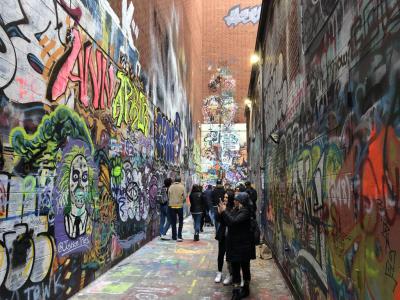
Tucked away just off East Liberty Street in Ann Arbor, right next to Michigan Theatre, is a narrow alley densely covered in graffiti. This colorful alley, a unique place for artists and lovers of this media, emerged on the scene in 1999, when the artist named Katherine Cost first painted here a piece, called Infinite Possibilities. Sadly, that original work was defaced by other graffiti artists only a few weeks later. Still, the mark made by Ms. Cost lingers on, as the new artists continue to leave theirs, seeing this place constantly evolve.
The result is a pretty cool, if not say crazy, mixture of colors, messages and images perpetually changing, as time goes by. A hotbed for artists, Graffiti Alley is open for everyone to leave their statement for the world... literally, if only for a week or so, till it gets painted over by something else. This, in turn, makes it ever more interesting to explore.
The spot may well not be too much publicized, but it is popular nonetheless. People simply cannot help stepping in to check it out whilst passing by. If you wish to tag the wall, or snap a few selfies, or are just curious to see what's inside, don't be shy and pop in. Although open all year round, the alley is particularly packed during summer with those anxious to take selfies and photos for Instagram.
Indeed, Graffiti Alley is a new kind of art in the city that you don't want to miss.... Even if graffiti is not your thing, you may still have some ideas that may change your perspective. Plus it's free! So, it's a win-win all the same...
The result is a pretty cool, if not say crazy, mixture of colors, messages and images perpetually changing, as time goes by. A hotbed for artists, Graffiti Alley is open for everyone to leave their statement for the world... literally, if only for a week or so, till it gets painted over by something else. This, in turn, makes it ever more interesting to explore.
The spot may well not be too much publicized, but it is popular nonetheless. People simply cannot help stepping in to check it out whilst passing by. If you wish to tag the wall, or snap a few selfies, or are just curious to see what's inside, don't be shy and pop in. Although open all year round, the alley is particularly packed during summer with those anxious to take selfies and photos for Instagram.
Indeed, Graffiti Alley is a new kind of art in the city that you don't want to miss.... Even if graffiti is not your thing, you may still have some ideas that may change your perspective. Plus it's free! So, it's a win-win all the same...
4) Kempf House Museum
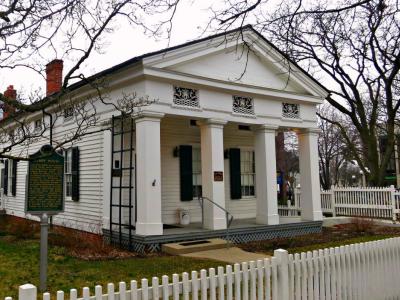
The Kempf House Museum, also known as the Henry Bennett House or the Reuben Kempf House, is a house museum in downtown Ann Arbor. It was originally built as a single-family home in 1853. It was listed on the National Register of Historic Places in 1973.
Henry DeWitt Bennet was the postmaster of Ann Arbor during most of the 1850s. In about 1853, Bennett had this house built. Bennett was later the secretary and steward of the University of Michigan. In 1886 Bennet retired and moved to California, selling his house to a neighbor. The neighbor rented it out for a few years, and in 1890 sold the house to Reuben and Pauline Kempf.
Both Reuben and Pauline Kempf were musicians, and they give music lessons in their house. Pauline taught vocal lessons and Reuben gave piano lessons. The Kempfs were very active in the community music events. Pauline served as the choir director of the Congregational Church, and Reuben was the first organist and choir director at Saint Andrew's. Reuben also served as the music director of the University Glee Club and the Michigan Union Opera.
The Kempfs turned their house into a local center for the musical arts often hosting diverse groups from students to dignitaries. Among their guests are musical figures such as Ignacy Jan Paderewski, Victor Herbert, and Ernestine Schumann-Heink. The Kempfs lived in the house until their deaths: Reuben's in 1945 and Pauline's in 1953.
In 1969 the city of Ann Arbor acquired the house and turned the house into a historic museum. The house has been restored, and includes a music studio that looks as it did when the Kempfs were first giving lessons. The house is open for tours weekly.
The Bennett House is a frame, 1-1/2 story, temple style Greek Revival house sitting on a brick foundation. The facade has four massive, squared Doric columns, along with three frieze windows and a graceful tympanum. A small, two-room addition holding the kitchen, built in the 1890s, is attached to the rear.
Kempf House is open for guided tours on Sundays 1-4pm (except holidays), from September through December, and April through May. Tours are also available by appointment for groups or individuals. Admission is free.
Henry DeWitt Bennet was the postmaster of Ann Arbor during most of the 1850s. In about 1853, Bennett had this house built. Bennett was later the secretary and steward of the University of Michigan. In 1886 Bennet retired and moved to California, selling his house to a neighbor. The neighbor rented it out for a few years, and in 1890 sold the house to Reuben and Pauline Kempf.
Both Reuben and Pauline Kempf were musicians, and they give music lessons in their house. Pauline taught vocal lessons and Reuben gave piano lessons. The Kempfs were very active in the community music events. Pauline served as the choir director of the Congregational Church, and Reuben was the first organist and choir director at Saint Andrew's. Reuben also served as the music director of the University Glee Club and the Michigan Union Opera.
The Kempfs turned their house into a local center for the musical arts often hosting diverse groups from students to dignitaries. Among their guests are musical figures such as Ignacy Jan Paderewski, Victor Herbert, and Ernestine Schumann-Heink. The Kempfs lived in the house until their deaths: Reuben's in 1945 and Pauline's in 1953.
In 1969 the city of Ann Arbor acquired the house and turned the house into a historic museum. The house has been restored, and includes a music studio that looks as it did when the Kempfs were first giving lessons. The house is open for tours weekly.
The Bennett House is a frame, 1-1/2 story, temple style Greek Revival house sitting on a brick foundation. The facade has four massive, squared Doric columns, along with three frieze windows and a graceful tympanum. A small, two-room addition holding the kitchen, built in the 1890s, is attached to the rear.
Kempf House is open for guided tours on Sundays 1-4pm (except holidays), from September through December, and April through May. Tours are also available by appointment for groups or individuals. Admission is free.
5) Comedy Showcase
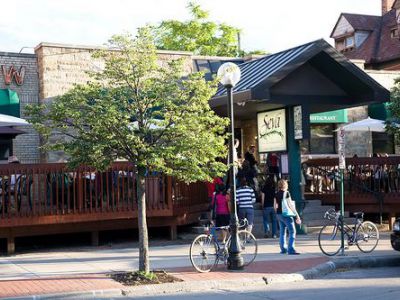
Ann Arbor Comedy Showcase has been a cornerstone of the local entertainment scene since its founding in 1984. What began as the Mainstreet Comedy Showcase above the Heidelberg Restaurant has evolved through several iconic downtown locations, finally settling in its current basement venue in 2014. Today, it stands as a 250‑seat intimate setting where laughter feels personal, the bar is lively, and the energy is warm-all contributing to a quintessentially Ann Arbor experience.
Each week, visitors can choose from multiple showtimes-typically Thursday through Saturday evenings-with double features on Friday and Saturday nights. The Showcase presents a well-curated lineup that blends the national touring circuit’s rising stars and established pros with beloved regional acts. Every Thursday, intrepid locals take the stage during “Comedy Jamm” open mic night-a lively, unpredictable variety of amateur and semi-pro performers testing new material. It’s a rare glimpse at comedy’s creative ferment, raw and unfiltered.
Inside, the atmosphere is cozy and convivial. Low lighting, table service for food and drinks, and audience proximity to the stage forge a sense of shared communal experience. Many reviews praise the attentive service and well-stocked bar, ensuring your beverage stays full as the jokes unfold. It’s a night out for locals and tourists alike, combining polished stand‑up with a relaxed, welcoming vibe.
For travellers seeking a taste of Ann Arbor’s after‑hours energy, a trip to the Comedy Showcase is a must. It’s more than just a comedy club-it’s a lively cultural hub where old friends laugh, new memories form, and the city’s creative pulse beats loudest on stage. Expect evenings rich in punchlines, carefree camaraderie, and a slice of Michigan’s spirited nightlife.
Each week, visitors can choose from multiple showtimes-typically Thursday through Saturday evenings-with double features on Friday and Saturday nights. The Showcase presents a well-curated lineup that blends the national touring circuit’s rising stars and established pros with beloved regional acts. Every Thursday, intrepid locals take the stage during “Comedy Jamm” open mic night-a lively, unpredictable variety of amateur and semi-pro performers testing new material. It’s a rare glimpse at comedy’s creative ferment, raw and unfiltered.
Inside, the atmosphere is cozy and convivial. Low lighting, table service for food and drinks, and audience proximity to the stage forge a sense of shared communal experience. Many reviews praise the attentive service and well-stocked bar, ensuring your beverage stays full as the jokes unfold. It’s a night out for locals and tourists alike, combining polished stand‑up with a relaxed, welcoming vibe.
For travellers seeking a taste of Ann Arbor’s after‑hours energy, a trip to the Comedy Showcase is a must. It’s more than just a comedy club-it’s a lively cultural hub where old friends laugh, new memories form, and the city’s creative pulse beats loudest on stage. Expect evenings rich in punchlines, carefree camaraderie, and a slice of Michigan’s spirited nightlife.
6) Jacob Hoffstetter House
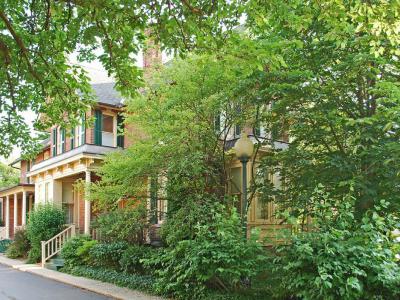
Jacob Hoffstetter House stands as a striking testament to late Victorian elegance. Built in 1887 for German immigrant Jacob Hoffstetter, the two-story red‑brick residence sits proudly on a coursed ashlar foundation. Guests will be drawn to its Queen Anne details-segmental-arched windows capped with carved stone keystones, oculus attic windows, king-post gable ornaments adorned with pierced trefoils, and bracketed cornices gracing the bay windows.
Jacob Hoffstetter emigrated to Ann Arbor at five years old in 1854, joining a wave of German settlers who shaped the city’s cultural character. By 1872, he had built a thriving grocery and saloon on Main Street, living above it with his wife and two sons. With the success of his business, Hoffstetter sold it in 1887 and commissioned this elegant home. Within a year, parts of the house began to serve as lodgings, most notably housing members of the newly formed Alpha Tau Omega fraternity from 1888 to 1894.
In 1937, the house underwent adaptation, converted into apartments with a new southeast entry. Nonetheless, many original wood trims were preserved. Then, in 1980, Peter Heydon restored the structure for mixed commercial and residential use, earning recognition from the Historical Society of Michigan for his careful work.
Today, the Jacob Hoffstetter House endures as one of Ann Arbor’s most handsome late-19th‑century structures and a rare relic of the neighborhood that once surrounded it. Visitors traversing Washington Street are invited to pause and reflect on its architectural flourishes-a tangible echo of the city’s immigrant heritage and the success stories that helped shape its history.
Jacob Hoffstetter emigrated to Ann Arbor at five years old in 1854, joining a wave of German settlers who shaped the city’s cultural character. By 1872, he had built a thriving grocery and saloon on Main Street, living above it with his wife and two sons. With the success of his business, Hoffstetter sold it in 1887 and commissioned this elegant home. Within a year, parts of the house began to serve as lodgings, most notably housing members of the newly formed Alpha Tau Omega fraternity from 1888 to 1894.
In 1937, the house underwent adaptation, converted into apartments with a new southeast entry. Nonetheless, many original wood trims were preserved. Then, in 1980, Peter Heydon restored the structure for mixed commercial and residential use, earning recognition from the Historical Society of Michigan for his careful work.
Today, the Jacob Hoffstetter House endures as one of Ann Arbor’s most handsome late-19th‑century structures and a rare relic of the neighborhood that once surrounded it. Visitors traversing Washington Street are invited to pause and reflect on its architectural flourishes-a tangible echo of the city’s immigrant heritage and the success stories that helped shape its history.
7) Weinmann Block
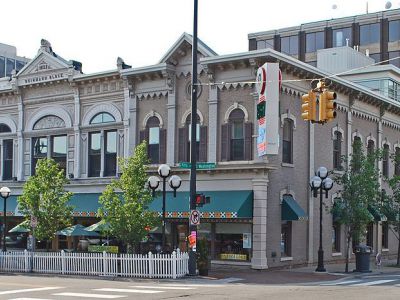
The Weinmann Block stands as a finely preserved example of late‑Victorian Italianate commercial architecture, built in two stages in the 1880s–1890s. Originally established by German immigrant John M. Weinmann, the eastern corner section was constructed in 1885 to house his prosperous butcher shop. In 1891, his son Louis and nephew George Stein expanded the block, adding a western portion adorned with ornate galvanized‑iron ornamentation designed to mimic stone detailing, a fashionable and economical technique of the day.
The building’s façade captures the attention of every passerby: arched window pediments, bracketed wooden cornice, and metal‑front fluted pilasters impart a refined elegance to the streetfront. A prominent central pediment on the western half still proudly displays the “Weinmann Block” name and construction date, conveying a sense of architectural storytelling that connects visitors directly to Ann Arbor’s commercial emergence in the nineteenth century.
Throughout the early 1900s, the Weinmann Block remained a bustling center of daily commerce. The original meat market operated until 1937, after which the esteemed Jno. C. Fischer hardware company took residence until the early 1980s. In later years, a development firm sensitively rehabilitated the structure into modern retail and office spaces, most recently featuring the Blue Nile Ethiopian Restaurant and other downtown establishments, while preserving its historical character.
Today, the Weinmann Block is more than just a building-it is a lively testament to downtown Ann Arbor’s layered history. For tourists, it offers both visual delight and a connection to the city’s story: of immigrant ambition, evolving commerce, and architectural ingenuity. As part of any walking tour of Ann Arbor’s historic core, this building reveals how craftsmanship and community converge on East Washington’s streetscape.
The building’s façade captures the attention of every passerby: arched window pediments, bracketed wooden cornice, and metal‑front fluted pilasters impart a refined elegance to the streetfront. A prominent central pediment on the western half still proudly displays the “Weinmann Block” name and construction date, conveying a sense of architectural storytelling that connects visitors directly to Ann Arbor’s commercial emergence in the nineteenth century.
Throughout the early 1900s, the Weinmann Block remained a bustling center of daily commerce. The original meat market operated until 1937, after which the esteemed Jno. C. Fischer hardware company took residence until the early 1980s. In later years, a development firm sensitively rehabilitated the structure into modern retail and office spaces, most recently featuring the Blue Nile Ethiopian Restaurant and other downtown establishments, while preserving its historical character.
Today, the Weinmann Block is more than just a building-it is a lively testament to downtown Ann Arbor’s layered history. For tourists, it offers both visual delight and a connection to the city’s story: of immigrant ambition, evolving commerce, and architectural ingenuity. As part of any walking tour of Ann Arbor’s historic core, this building reveals how craftsmanship and community converge on East Washington’s streetscape.
8) First National Bank Building
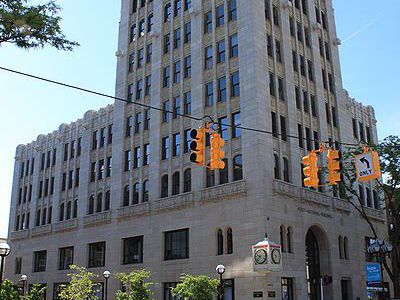
The First National Bank Building is a ten‑story limestone- and terra-cotta‑clad structure that first crowned the city skyline upon its completion in 1930. Designed by local architects Fry and Kasurin between 1927 and 1930, it rose as Ann Arbor’s tallest building and was celebrated for its refined blend of Art Deco, Streamline Moderne, and subdued Romanesque revival detailing-including broad terra-cotta verticals, decorative gargoyles, and a dignified cornice that crowns the tower.
Commissioned by Michigan’s first nationally chartered bank-established in 1863-the building was more than a financial landmark: it hosted the bank’s main offices and eight floors of professional suites. Nearly 5,000 people attended the grand opening in February 1929, marking the end of a roaring era before the onset of the Great Depression. By 1936, following a merger, the bank departed, and the elegant banking hall was adapted into ground‑floor retail, with offices above-a change that preserved the building’s civic role while reimagining its interior life.
Despite the economic upheavals, the building endured as Ann Arbor’s visual beacon. Floodlit at night in its early years, it remained the city’s tallest structure until the 1980s. Its architectural finesse earned a place on the National Register of Historic Places in 1982, following purchase and renovation by First Martin Corporation in 1981–82.
Today, the First National Bank Building continues to anchor downtown. Visitors admire its ornamental façade, towering presence on the corner of Main and Liberty, and ornate detailing-especially the restored banking lobby, gargoyles, and terra-cotta craft.
Commissioned by Michigan’s first nationally chartered bank-established in 1863-the building was more than a financial landmark: it hosted the bank’s main offices and eight floors of professional suites. Nearly 5,000 people attended the grand opening in February 1929, marking the end of a roaring era before the onset of the Great Depression. By 1936, following a merger, the bank departed, and the elegant banking hall was adapted into ground‑floor retail, with offices above-a change that preserved the building’s civic role while reimagining its interior life.
Despite the economic upheavals, the building endured as Ann Arbor’s visual beacon. Floodlit at night in its early years, it remained the city’s tallest structure until the 1980s. Its architectural finesse earned a place on the National Register of Historic Places in 1982, following purchase and renovation by First Martin Corporation in 1981–82.
Today, the First National Bank Building continues to anchor downtown. Visitors admire its ornamental façade, towering presence on the corner of Main and Liberty, and ornate detailing-especially the restored banking lobby, gargoyles, and terra-cotta craft.
9) Main Street (must see)
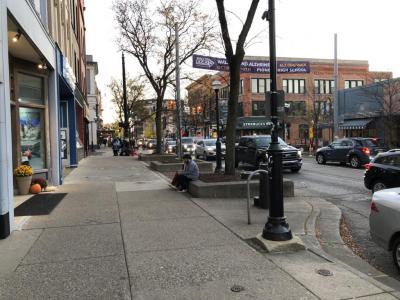
Ann Arbor's Main Street technically starts near the Huron River, between Bandemer Park and Bluffs Nature Area, and then snakes through the downtown area, past the University of Michigan Golf Course, culminating at Eisenhower Parkway. Still, for most locals Main Street is the lively portion of it that bustles day and night, dominated by numerous shopping, dining, entertainment and nightlife venues, collectively exuding a strong sense of place and local culture.
As a center of activity and community gathering place, Main Street offers so much to see and do that many visitors plan their time around this eclectic area. The vibrant thoroughfare literally bursts at the seams with progressive restaurants, creative cocktail bars, unique meeting spaces, popular music joints and boundary-breaking art galleries.
Some of the spots a tourist will find on and around Main Street include the Ann Arbor Art Center, the Blue Llama Jazz Club, and Downtown Home and Garden. Those who want to spend their time outdoors will find Liberty Plaza to be a true treat. This park area has benches for seating, shade trees and regular musical performances in the summer.
However, dynamic dining is what most defines Main Street. Classical steaks, Asian cuisine, or other internationally-inspired casual fare (like Cuban or Greek), as well as healthful comfort food, crepes and waffles, or farm-to-table stuff – are all offered here in great supply. The bar scene on Main Street is just as exciting.
Shopping-wise, the area is second to none either and hosts several annual events to celebrate their unique retailers. Bookstores may be the most famous of them. Known for decades as a book-lover’s destination, Ann Arbor is home to a plethora of niche, unique, independent booksellers, many of which are based on Main Street or nearby side streets.
The continuous rhythm of historic 19th and early 20th-century building storefronts (featuring a variety of styles like Commercial, Italianate, Beaux Arts, Moderne and Art Deco) contribute to an exciting pedestrian environment.
There are also more than a dozen events organized on Main Street throughout the year (such as Festifools, Taste of Ann Arbor, Ann Arbor Restaurant Week, or Rolling Sculpture Car Show) which attract residents and visitors of all ages.
As a center of activity and community gathering place, Main Street offers so much to see and do that many visitors plan their time around this eclectic area. The vibrant thoroughfare literally bursts at the seams with progressive restaurants, creative cocktail bars, unique meeting spaces, popular music joints and boundary-breaking art galleries.
Some of the spots a tourist will find on and around Main Street include the Ann Arbor Art Center, the Blue Llama Jazz Club, and Downtown Home and Garden. Those who want to spend their time outdoors will find Liberty Plaza to be a true treat. This park area has benches for seating, shade trees and regular musical performances in the summer.
However, dynamic dining is what most defines Main Street. Classical steaks, Asian cuisine, or other internationally-inspired casual fare (like Cuban or Greek), as well as healthful comfort food, crepes and waffles, or farm-to-table stuff – are all offered here in great supply. The bar scene on Main Street is just as exciting.
Shopping-wise, the area is second to none either and hosts several annual events to celebrate their unique retailers. Bookstores may be the most famous of them. Known for decades as a book-lover’s destination, Ann Arbor is home to a plethora of niche, unique, independent booksellers, many of which are based on Main Street or nearby side streets.
The continuous rhythm of historic 19th and early 20th-century building storefronts (featuring a variety of styles like Commercial, Italianate, Beaux Arts, Moderne and Art Deco) contribute to an exciting pedestrian environment.
There are also more than a dozen events organized on Main Street throughout the year (such as Festifools, Taste of Ann Arbor, Ann Arbor Restaurant Week, or Rolling Sculpture Car Show) which attract residents and visitors of all ages.
10) Kellogg-Warden House (Museum on Main Street)
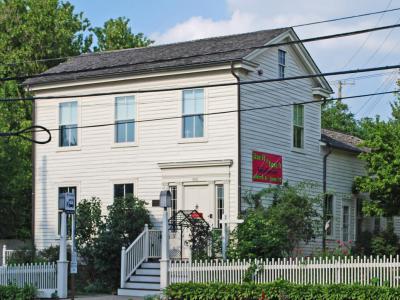
The Kellogg-Warden House is a single-family house located on North Main Street in Ann Arbor. It was listed on the National Register of Historic Places in 1994. It now houses the Washtenaw County Historical Society's Museum on Main Street.
The Kellogg-Warden House is a side-gable, side hall, Greek Revival half-I-house with a one-and-one-half-story gable-roof rear addition. It measures approximately twenty-six feet by forty-six feet. The house is sided with clapboard, and currently sits on a concrete block foundation, which has been faced with the fieldstones and bricks form the original foundation. The house has a box cornice with returns in the gable ends. The main facade is three bays wide, with the front door at one end. The door is flanked by four fluted pilasters. The windows are primarily double-hung sash units with two-over-two lights, save for a six-over-six window in the attic.
This house was originally located at what is now 1015 Wall Street. Although the date of construction cannot be verified, tax and sales records suggest that the original section of the house was built in about 1835. In 1837, Dan W. Kellogg purchased five contiguous lots, including the one this house sat on. In 1838, Kellogg sold them to his brother-in-law Ethan A. Warden. In 1839, Warden sold two of the lots, including the one containing this house, to his father-in-law (and Dan Kellogg's father) Charles Kellogg, who had moved to the Ann Arbor about this time. The sales prices suggest that the main portion of the house was constructed by Warden before his father-in-law's arrival.
In 1988 the house was sold to the University of Michigan. The University planned to use the land for a parking lot, but recognizing the historical significance, gave the house to the Washtenaw County Historical Society. In 1990, the house was moved to its current location on North Main. The Washtenaw County Historical Society refurbished the house and it now houses the Museum on Main Street.
The Kellogg-Warden House is a side-gable, side hall, Greek Revival half-I-house with a one-and-one-half-story gable-roof rear addition. It measures approximately twenty-six feet by forty-six feet. The house is sided with clapboard, and currently sits on a concrete block foundation, which has been faced with the fieldstones and bricks form the original foundation. The house has a box cornice with returns in the gable ends. The main facade is three bays wide, with the front door at one end. The door is flanked by four fluted pilasters. The windows are primarily double-hung sash units with two-over-two lights, save for a six-over-six window in the attic.
This house was originally located at what is now 1015 Wall Street. Although the date of construction cannot be verified, tax and sales records suggest that the original section of the house was built in about 1835. In 1837, Dan W. Kellogg purchased five contiguous lots, including the one this house sat on. In 1838, Kellogg sold them to his brother-in-law Ethan A. Warden. In 1839, Warden sold two of the lots, including the one containing this house, to his father-in-law (and Dan Kellogg's father) Charles Kellogg, who had moved to the Ann Arbor about this time. The sales prices suggest that the main portion of the house was constructed by Warden before his father-in-law's arrival.
In 1988 the house was sold to the University of Michigan. The University planned to use the land for a parking lot, but recognizing the historical significance, gave the house to the Washtenaw County Historical Society. In 1990, the house was moved to its current location on North Main. The Washtenaw County Historical Society refurbished the house and it now houses the Museum on Main Street.
11) Kerrytown Concert House
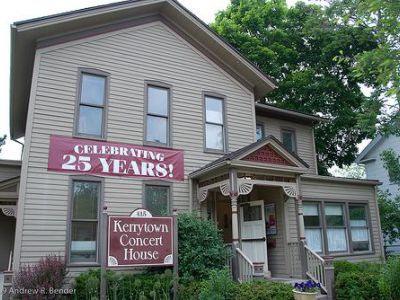
Nestled within the historic, brick‑lined streets of Kerrytown, the Kerrytown Concert House (KCH) offers a warm, welcoming escape from the bustle of downtown Ann Arbor. Housed in a restored 19th‑century home, this nonprofit venue provides an intimate listening room atmosphere-just 110 seats-where visitors can enjoy world‑class performances up close, from jazz and classical to cabaret and world music. The building itself retains its original charm, with architectural details that create both a sense of history and an intimate acoustic presence.
Since opening in September 1984, KCH has been guided by a thoughtful mission: to engage, educate, and entertain through high‑quality artistic experiences. Founder and longtime director Deanna Relyea envisioned a space where emerging local musicians share the stage with touring artists, fostering community connections and offering accessible ticket prices. Today, that vision comes alive in performances ranging from solo piano recitals to cabaret evenings and small ensemble concerts set against ever‑changing art exhibits on the walls.
One of the venue’s signature offerings is Edgefest, an acclaimed festival of avant‑garde and improvised music born in the late 1990s under Relyea’s stewardship. It brings together adventurous musicians-from free jazz pioneers to experimental ensembles-in a celebration of musical boundary‑pushing, taking full advantage of the house’s intimate scale to create profound audience‑artist connections.
For visitors to Ann Arbor, the Kerrytown Concert House is more than a performance space-it’s a cultural destination. Its location in Kerrytown places it amid art galleries, eclectic shops, and the vibrant Farmers’ Market. Whether you’re a devoted music lover or a traveler seeking a memorable evening out, an intimate show here promises artistry, local spirit, and a welcoming ambiance that lingers long after the final note.
Since opening in September 1984, KCH has been guided by a thoughtful mission: to engage, educate, and entertain through high‑quality artistic experiences. Founder and longtime director Deanna Relyea envisioned a space where emerging local musicians share the stage with touring artists, fostering community connections and offering accessible ticket prices. Today, that vision comes alive in performances ranging from solo piano recitals to cabaret evenings and small ensemble concerts set against ever‑changing art exhibits on the walls.
One of the venue’s signature offerings is Edgefest, an acclaimed festival of avant‑garde and improvised music born in the late 1990s under Relyea’s stewardship. It brings together adventurous musicians-from free jazz pioneers to experimental ensembles-in a celebration of musical boundary‑pushing, taking full advantage of the house’s intimate scale to create profound audience‑artist connections.
For visitors to Ann Arbor, the Kerrytown Concert House is more than a performance space-it’s a cultural destination. Its location in Kerrytown places it amid art galleries, eclectic shops, and the vibrant Farmers’ Market. Whether you’re a devoted music lover or a traveler seeking a memorable evening out, an intimate show here promises artistry, local spirit, and a welcoming ambiance that lingers long after the final note.
12) Judge Robert S. Wilson House
The Judge Robert S. Wilson House, also known as the Wilson-Wahr House, is a historic residence constructed around 1839 for Robert S. Wilson, an attorney who relocated to Ann Arbor from New York in 1835. The house embodies the professional and political legacy of its original owner. Wilson served briefly as a probate judge and later held a seat in the Michigan House of Representatives. He lived in the house until 1850 before relocating to Chicago, after which the property was sold to John H. Welles.
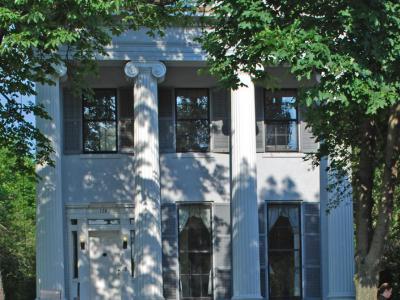
Architecturally, the house is a well-preserved example of Greek Revival design, with elements that have drawn attention in architectural surveys of the region. Its most distinctive feature is the temple-style façade, complete with four fluted Ionic columns rising two stories, which architectural historian Fiske Kimball traced to the ancient Temple of the Wingless Victory in Athens. The symmetrical front portico and entry framed by pilasters enhance the building’s classical proportions, while external shutters and a stucco finish over brick complete its formal exterior. A rear addition, thought to have been built by Welles, expanded the structure and added space for a kitchen and servants' quarters.
The interior maintains a period-appropriate layout, with a central hallway and staircase flanked by parlors, and fireplaces in all principal rooms. The house remained in private hands through several generations, including a period when it was rented out by the Wahr family to student organizations. It returned to residential use in the early 20th century and was last known to be owned by Norman and Ilene Tyler after 2002. The building was listed on the National Register of Historic Places in 1972.
Architecturally, the house is a well-preserved example of Greek Revival design, with elements that have drawn attention in architectural surveys of the region. Its most distinctive feature is the temple-style façade, complete with four fluted Ionic columns rising two stories, which architectural historian Fiske Kimball traced to the ancient Temple of the Wingless Victory in Athens. The symmetrical front portico and entry framed by pilasters enhance the building’s classical proportions, while external shutters and a stucco finish over brick complete its formal exterior. A rear addition, thought to have been built by Welles, expanded the structure and added space for a kitchen and servants' quarters.
The interior maintains a period-appropriate layout, with a central hallway and staircase flanked by parlors, and fireplaces in all principal rooms. The house remained in private hands through several generations, including a period when it was rented out by the Wahr family to student organizations. It returned to residential use in the early 20th century and was last known to be owned by Norman and Ilene Tyler after 2002. The building was listed on the National Register of Historic Places in 1972.
13) Nickels Arcade
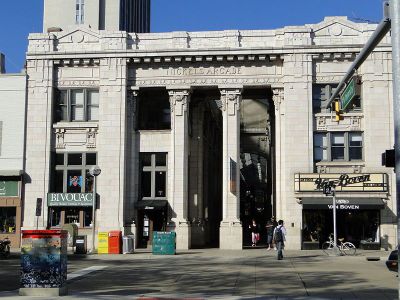
Nickels Arcade is a historical commercial building on South State Street in Ann Arbor. It was listed on the National Register of Historic Places in 1987. The building is notable as perhaps the only remaining example in Michigan of a free-standing commercial arcade building of a type that was popularized by the Cleveland Arcade.
John Nickels owned and operated a meat market at this location on State Street. His grandson Tom Nickels inherited a portion of the property, and bought other portions of the property from his brothers and sister. Nickels hired local architect Hermann Pipp to design this building. Construction began in 1915. The first tenant, the Farmers and Mechanics bank, moved in that year. The entire building, however, was not completed until 1918, due in part to delays caused by the onset of World War I. Nickels owned the Arcade until his death in 1932, when he passed it on to his children, James and Nora.
Nickels Arcade is a 261-foot-long gallery linking State Street on one side to Maynard Street on the other. The principal facade faces onto State Street, and consists of a three-story, three-bay open portico flanked with store and office blocks. The facade is clad with a buff-colored decorative architectural terra cotta. The Maynard Street facade is similar to the State Street facade in design, but is clad primarily with yellow brick, with additional ornamental detailing of terra cotta. The gallery running between the facades is covered with a gable skylight of metal-framed wire-glass panels.
On each side of the gallery are ground-level shops which face onto the roofed passage. These shops are essentially two stories in height, some with a mezzanine level. Upper-story office windows above the commercial spaces also face onto the gallery. The arcade is floored with blocks of square red tile in black borders. The arcade is divided into three sections: the section nearest State Street continues the terra cotta cladding and detailing of the State Street facade. This section is separated from the next by a segmental archway; a similar archway near the other end separates the center section from an entrance vestibule.
John Nickels owned and operated a meat market at this location on State Street. His grandson Tom Nickels inherited a portion of the property, and bought other portions of the property from his brothers and sister. Nickels hired local architect Hermann Pipp to design this building. Construction began in 1915. The first tenant, the Farmers and Mechanics bank, moved in that year. The entire building, however, was not completed until 1918, due in part to delays caused by the onset of World War I. Nickels owned the Arcade until his death in 1932, when he passed it on to his children, James and Nora.
Nickels Arcade is a 261-foot-long gallery linking State Street on one side to Maynard Street on the other. The principal facade faces onto State Street, and consists of a three-story, three-bay open portico flanked with store and office blocks. The facade is clad with a buff-colored decorative architectural terra cotta. The Maynard Street facade is similar to the State Street facade in design, but is clad primarily with yellow brick, with additional ornamental detailing of terra cotta. The gallery running between the facades is covered with a gable skylight of metal-framed wire-glass panels.
On each side of the gallery are ground-level shops which face onto the roofed passage. These shops are essentially two stories in height, some with a mezzanine level. Upper-story office windows above the commercial spaces also face onto the gallery. The arcade is floored with blocks of square red tile in black borders. The arcade is divided into three sections: the section nearest State Street continues the terra cotta cladding and detailing of the State Street facade. This section is separated from the next by a segmental archway; a similar archway near the other end separates the center section from an entrance vestibule.
14) State Street
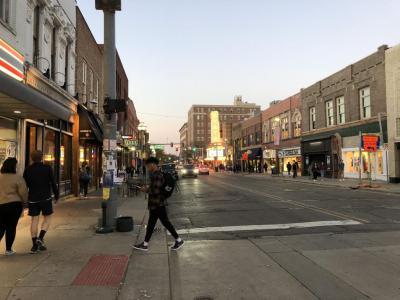
Found near the University of Michigan campus, the State Street and its surrounding area is deservedly regarded as the "entertainment capital " of Ann Arbor – a true mecca for arts and culture lovers, as well as shoppers of all stripes and passionate foodies.
In particular, those keen on history, science, and other intellectual entertainment, will find it in abundance in this artistic and theatrical giant of the community. Places like the University of Michigan Museum of Natural History, Planetarium & Dome Theater, and the Kelsey Museum of Archaeology are fit to blow anyone away with their exhibits.
And if you're a fan of classical music, then the Ann Arbor Symphony Orchestra is your place. Even those digging on pop more, will find it equally entertaining, as the place regularly runs pieces rooted in pop culture, such as their Harry Potter-inspired event and annual Disney show. University Musical Society is a world-renowned institution that brings world music and barrier-busting performances to Ann Arbor’s historic venues.
The Michigan and State Theaters, in addition to being historic gems, play host to two annual film festivals. The Ann Arbor Film Festival in January is the oldest experimental film festival in North America, while the Ann Arbor Summer Festival is an annual display of performing arts, outdoor entertainment, offering film screenings as well as live performances by stand-up comedians and other artists.
In terms of food and drink, the street stands tall with many outstanding restaurants and bars, serving both American culinary classics and international cuisine. The shopping scene is just as fantastic, fitting the trendy needs of all ages and genders.
In particular, those keen on history, science, and other intellectual entertainment, will find it in abundance in this artistic and theatrical giant of the community. Places like the University of Michigan Museum of Natural History, Planetarium & Dome Theater, and the Kelsey Museum of Archaeology are fit to blow anyone away with their exhibits.
And if you're a fan of classical music, then the Ann Arbor Symphony Orchestra is your place. Even those digging on pop more, will find it equally entertaining, as the place regularly runs pieces rooted in pop culture, such as their Harry Potter-inspired event and annual Disney show. University Musical Society is a world-renowned institution that brings world music and barrier-busting performances to Ann Arbor’s historic venues.
The Michigan and State Theaters, in addition to being historic gems, play host to two annual film festivals. The Ann Arbor Film Festival in January is the oldest experimental film festival in North America, while the Ann Arbor Summer Festival is an annual display of performing arts, outdoor entertainment, offering film screenings as well as live performances by stand-up comedians and other artists.
In terms of food and drink, the street stands tall with many outstanding restaurants and bars, serving both American culinary classics and international cuisine. The shopping scene is just as fantastic, fitting the trendy needs of all ages and genders.
