Custom Walk in Detroit, Michigan by kaygee1123_d6296 created on 2025-09-06
Guide Location: USA » Detroit
Guide Type: Custom Walk
# of Sights: 10
Tour Duration: 2 Hour(s)
Travel Distance: 3.6 Km or 2.2 Miles
Share Key: 4R4YD
Guide Type: Custom Walk
# of Sights: 10
Tour Duration: 2 Hour(s)
Travel Distance: 3.6 Km or 2.2 Miles
Share Key: 4R4YD
How It Works
Please retrieve this walk in the GPSmyCity app. Once done, the app will guide you from one tour stop to the next as if you had a personal tour guide. If you created the walk on this website or come to the page via a link, please follow the instructions below to retrieve the walk in the app.
Retrieve This Walk in App
Step 1. Download the app "GPSmyCity: Walks in 1K+ Cities" on Apple App Store or Google Play Store.



Step 2. In the GPSmyCity app, download(or launch) the guide "Detroit Map and Walking Tours".
Step 3. Tap the menu button located at upper right corner of the "Walks" screen and select "Retrieve custom walk". Enter the share key: 4R4YD
1) Greektown
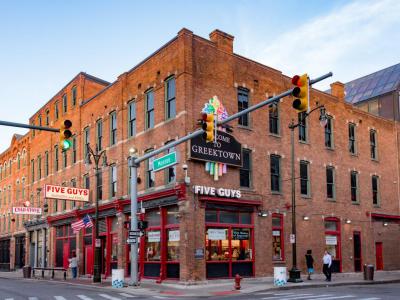
Greektown is one of Detroit's most popular commercial and entertainment districts. During the early 20th century, this district was where most of the Greek immigrants settled. Even when the Greek community started relocating to other areas in the 1920s, the neighborhood still retained many of the restaurants and coffeehouses that made it stand out.
Second Baptist Church and Saint Mary's Roman Catholic Church are two of the churches with the greatest significance. Another landmark historical building is the Atheneum Suite Hotel. This neighborhood has had a place on the National Register of Historic Places since 1982.
The Greektown Casino is one of the highlights of this area. The casino's architectural highlights include elements similar to the Parthenon. Monroe Street, one of the main streets in this area, plays festive Greek music all day, adding to the atmosphere. There are seven Greek-style restaurants, each serving unique types of cuisine.
Second Baptist Church and Saint Mary's Roman Catholic Church are two of the churches with the greatest significance. Another landmark historical building is the Atheneum Suite Hotel. This neighborhood has had a place on the National Register of Historic Places since 1982.
The Greektown Casino is one of the highlights of this area. The casino's architectural highlights include elements similar to the Parthenon. Monroe Street, one of the main streets in this area, plays festive Greek music all day, adding to the atmosphere. There are seven Greek-style restaurants, each serving unique types of cuisine.
2) Detroit Riverfront (must see)
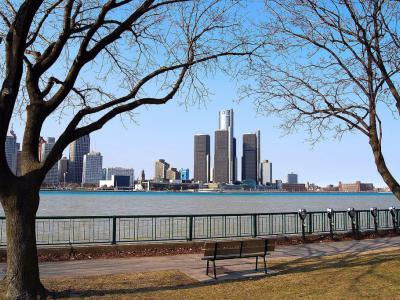
The Detroit Riverfront spans three and a half miles in an area ranging from the Joe Louis Arena to Gabriel Richard Park. A popular greenway known as the Dequindre Cut connects visitors to the green spaces accessible along the RiverWalk. This area is popular with runners and walkers and a favorite place for city residents to gather.
Milliken State Park and Harbor is one of the most popular green spaces found along the waterfront. One of the biggest attractions that draws people to this park is a lighthouse. This park also boasts a wetlands area, providing a nice touch of nature in the city.
The Aretha Franklin Amphitheater is one of the city's most popular outdoor entertainment venues, and you might have a chance to catch a performance as you make your way along the Riverfront. The Riverwalk Garden Rooms are also worth your time, giving you access to beautifully landscaped garden areas.
Milliken State Park and Harbor is one of the most popular green spaces found along the waterfront. One of the biggest attractions that draws people to this park is a lighthouse. This park also boasts a wetlands area, providing a nice touch of nature in the city.
The Aretha Franklin Amphitheater is one of the city's most popular outdoor entertainment venues, and you might have a chance to catch a performance as you make your way along the Riverfront. The Riverwalk Garden Rooms are also worth your time, giving you access to beautifully landscaped garden areas.
3) Spirit of Detroit
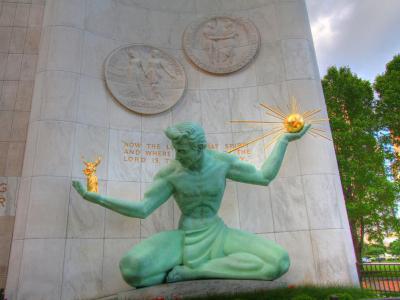
The Spirit of Detroit is one of Detroit's most popular monuments. This Marshall Fredericks-created bronze statue is at the Coleman A. Young Municipal Center. One of the things that makes this statue stand out is its status as the biggest bronze statue cast since the Renaissance. The figure stands 26 feet high.
Two of the highlights of the sculpture include the items held in its hands. The right hand contains figures of a family, symbolizing human interconnectedness. A sphere in the right hand features rays and is of gilt bronze, representing God. An inscription from 2 Corinthians 3:17 is on the wall behind the sculpture.
This monument's importance as a civic symbol is seen with the seals for the City of Detroit and Wayne County; both featured in the wall. One of the highlights is a plaque that describes the symbolism demonstrated through the various parts of the memorial. The importance of faith and family for the community is aptly highlighted.
Two of the highlights of the sculpture include the items held in its hands. The right hand contains figures of a family, symbolizing human interconnectedness. A sphere in the right hand features rays and is of gilt bronze, representing God. An inscription from 2 Corinthians 3:17 is on the wall behind the sculpture.
This monument's importance as a civic symbol is seen with the seals for the City of Detroit and Wayne County; both featured in the wall. One of the highlights is a plaque that describes the symbolism demonstrated through the various parts of the memorial. The importance of faith and family for the community is aptly highlighted.
4) Joe Louis Memorial
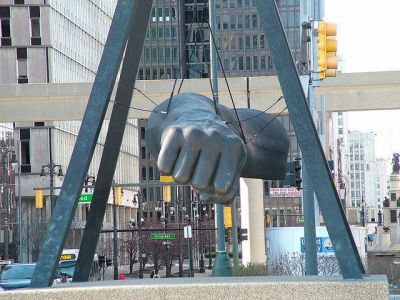
The Joe Louis Memorial is one of Detroit's most iconic sites. With its nickname "The Fist," this sculpture has a prominent place in Hart Plaza, making it one of the city's most popular attractions. Robert Graham designed to sculpture, while Rolf Kriken was the bronze artist responsible for the pouring.
This sculpture features an arm featuring 24 feet long. A 24-foot high pyramid-style framework supports a replica of Joe Louis' fist. The fist is an effective symbol highlighting Louis' history as a boxer, as well as a powerful symbol against racism.
The artist has described the fist like a battering ram to demonstrate its power. Another interesting feature is how the fist points towards Canada, showing that the American fight for democracy has crossed borders. This sculpture is a powerful symbol that is worthy of a photo opportunity.
This sculpture features an arm featuring 24 feet long. A 24-foot high pyramid-style framework supports a replica of Joe Louis' fist. The fist is an effective symbol highlighting Louis' history as a boxer, as well as a powerful symbol against racism.
The artist has described the fist like a battering ram to demonstrate its power. Another interesting feature is how the fist points towards Canada, showing that the American fight for democracy has crossed borders. This sculpture is a powerful symbol that is worthy of a photo opportunity.
5) Hart Plaza
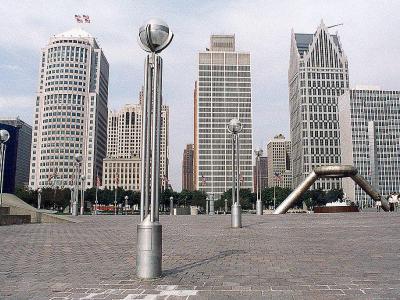
Hart Plaza is a 14-acre plaza in Detroit that easily accommodates 40,000 people. This popular gathering place has been an essential part of the city's landscape since its opening in 1975. The plaza is named after U.S. Senator Philip Hart, who was a Detroit resident and one of the city's key figures.
The plaza has a location that is easy to find at the intersection of Jefferson and Woodward Avenues. One of the highlights is the Horace E. Dodge and Son Memorial Fountain, which stands out for its unique contemporary style. Isamu Noguchi designed the fountain in 1978.
Hart Plaza has enjoyed status as a favorite place for summer festivals, perfect for its open spaces. Concerts are also a popular type of event, representing many different musical styles. You can also catch other special events, ranging from artistic events to ethnic and culinary festivals. The plaza is an excellent place to sit back and enjoy people-watching.
The plaza has a location that is easy to find at the intersection of Jefferson and Woodward Avenues. One of the highlights is the Horace E. Dodge and Son Memorial Fountain, which stands out for its unique contemporary style. Isamu Noguchi designed the fountain in 1978.
Hart Plaza has enjoyed status as a favorite place for summer festivals, perfect for its open spaces. Concerts are also a popular type of event, representing many different musical styles. You can also catch other special events, ranging from artistic events to ethnic and culinary festivals. The plaza is an excellent place to sit back and enjoy people-watching.
6) Guardian Building (must see)
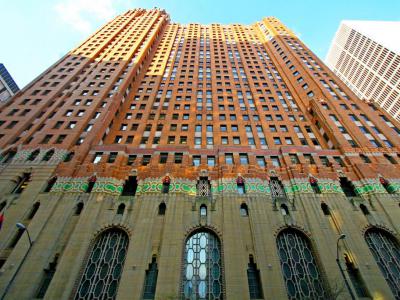
The Guardian Building is one of Detroit's most famous skyscrapers, with a location at 500 Griswold Street, in the city's Financial District. This building was completed in 1929 and demonstrates the Art Deco style that was popular at that time. A highlight that makes the building stand out, in addition to its architecture, is the size of the American flag at the top of the building.
Most of the building spans 36 stories, with one of the spires featuring 40 stories. In addition to brickwork, the building features terra cotta, limestone, and tile. Sculptures make up part of the building's exterior, demonstrating the importance of commerce to the city.
The main entrance features a semi-circular dome that is colorful. Inside the building, the lower lobby has many features similar to the inside of a cathedral, including a ceiling with colorful tile designs. The elevator lobby has colorful lamps that are in keeping with the Art Deco design.
Most of the building spans 36 stories, with one of the spires featuring 40 stories. In addition to brickwork, the building features terra cotta, limestone, and tile. Sculptures make up part of the building's exterior, demonstrating the importance of commerce to the city.
The main entrance features a semi-circular dome that is colorful. Inside the building, the lower lobby has many features similar to the inside of a cathedral, including a ceiling with colorful tile designs. The elevator lobby has colorful lamps that are in keeping with the Art Deco design.
7) Campus Martius Park
Campus Martius Park is a vibrant public space located in Downtown Detroit. Its history dates back to the aftermath of the Great Fire of 1805 when Judge Augustus Woodward used the area as the focal point for his plans to rebuild the city. The park's name, "Campus Martius," is derived from the Latin term for "Field of Mars," symbolizing a space where Roman heroes once walked. It was also named after the principal square in Marietta, Ohio, the first capital of the Northwest Territory.
Campus Martius was once a large central gathering space in Detroit but was lost in the early 1900s due to downtown reconfiguration for traffic. Although Hart Plaza was created as a replacement, its lack of greenery sparked efforts to restore Campus Martius, which reopened on November 19, 2004.
The revitalized Campus Martius Park covers 1.2 acres and features two performance stages, public spaces, sculptures, and a seasonal ice skating rink inspired by, and larger than, the iconic rink at Rockefeller Center in New York City. Although smaller than the original park, additional green space was created nearby with the opening of Cadillac Square Park in 2007.
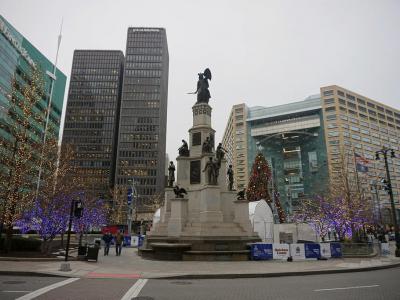
The Woodward Fountain, surrounded by seating and beautiful landscaping, is a park highlight. Attractions include the Michigan Soldiers and Sailors Monument and the Point of Origin 1806 marker, which designates Detroit's coordinate system's starting point, aligning with roads like Seven Mile and Eight Mile.
Campus Martius Park has become a hub for year-round activities. It is the site of the annual Motown Winter Blast, attracting over 450,000 visitors to the downtown area, and it hosts Detroit’s official Christmas tree lighting celebration each November, drawing thousands for live music, festive decorations, and the holiday countdown.
Campus Martius was once a large central gathering space in Detroit but was lost in the early 1900s due to downtown reconfiguration for traffic. Although Hart Plaza was created as a replacement, its lack of greenery sparked efforts to restore Campus Martius, which reopened on November 19, 2004.
The revitalized Campus Martius Park covers 1.2 acres and features two performance stages, public spaces, sculptures, and a seasonal ice skating rink inspired by, and larger than, the iconic rink at Rockefeller Center in New York City. Although smaller than the original park, additional green space was created nearby with the opening of Cadillac Square Park in 2007.
The Woodward Fountain, surrounded by seating and beautiful landscaping, is a park highlight. Attractions include the Michigan Soldiers and Sailors Monument and the Point of Origin 1806 marker, which designates Detroit's coordinate system's starting point, aligning with roads like Seven Mile and Eight Mile.
Campus Martius Park has become a hub for year-round activities. It is the site of the annual Motown Winter Blast, attracting over 450,000 visitors to the downtown area, and it hosts Detroit’s official Christmas tree lighting celebration each November, drawing thousands for live music, festive decorations, and the holiday countdown.
8) Grand Circus Park Historic District
The Grand Circus Park Historic District is a prominent area in downtown Detroit, encompassing the 5-acre (2.0 hectares) Grand Circus Park. Established in 1850 as part of Judge Augustus Woodward's plan to rebuild the city after the Great Fire of 1805, the park was originally intended to be a full circle. However, due to property owners north of Adams Street being reluctant to sell, it resulted in the current half-moon shape.
The district is bisected by Woodward Avenue and is roughly bounded by Clifford, John R., and Adams Streets. It serves as a connector between Detroit's theater district and financial district. Notable buildings surrounding the park include the David Broderick Tower, David Whitney Building, Kales Building, and the Central United Methodist Church. The Detroit Opera House overlooks the eastern edge of the park, adding to the area's cultural significance.
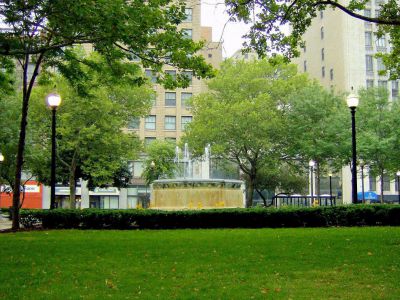
Grand Circus Park features several historic monuments and fountains. The eastern half houses the Russell Alger Memorial Fountain, designed by architect Henry Bacon in 1921, with a statue symbolizing Michigan by sculptor Daniel French. Additionally, there are statues of Mayor William Cotter Maybury and Mayor Hazen Pingree, both significant figures in Detroit's history.
In 1957, the City of Detroit constructed a parking garage beneath the two halves of the park to accommodate the growing need for parking spaces. The district was listed on the National Register of Historic Places in 1983, recognizing its architectural and historical significance.
Today, Grand Circus Park continues to be a central gathering place in Detroit, hosting various events and serving as a green oasis amidst the urban landscape.
The district is bisected by Woodward Avenue and is roughly bounded by Clifford, John R., and Adams Streets. It serves as a connector between Detroit's theater district and financial district. Notable buildings surrounding the park include the David Broderick Tower, David Whitney Building, Kales Building, and the Central United Methodist Church. The Detroit Opera House overlooks the eastern edge of the park, adding to the area's cultural significance.
Grand Circus Park features several historic monuments and fountains. The eastern half houses the Russell Alger Memorial Fountain, designed by architect Henry Bacon in 1921, with a statue symbolizing Michigan by sculptor Daniel French. Additionally, there are statues of Mayor William Cotter Maybury and Mayor Hazen Pingree, both significant figures in Detroit's history.
In 1957, the City of Detroit constructed a parking garage beneath the two halves of the park to accommodate the growing need for parking spaces. The district was listed on the National Register of Historic Places in 1983, recognizing its architectural and historical significance.
Today, Grand Circus Park continues to be a central gathering place in Detroit, hosting various events and serving as a green oasis amidst the urban landscape.
9) Fillmore Detroit
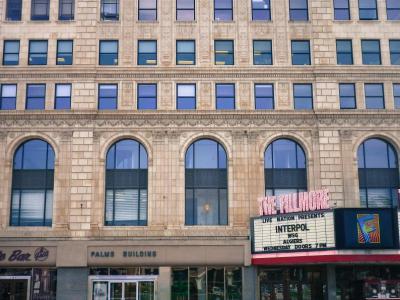
The Fillmore Detroit, located in the vibrant Detroit Theatre District along Woodward Avenue, stands as a multi-use entertainment venue steeped in history. Operated by Live Nation, the venue opened its doors in 1925 and has undergone various transformations, including its original identity as the State Theatre. Today, it serves as a cultural hub for concerts, special events, and the annual Detroit Music Awards.
The Fillmore Detroit is housed within the Francis Palms Building, a 12-story Renaissance Revival structure designed by architect C. Howard Crane. Its stunning façade is adorned with elaborate Beaux-Arts Italian Renaissance terra cotta decorations, which remain a defining feature. The building also features an eight-story auditorium at the rear, complete with a barrel-vaulted ceiling in the grand foyer and original theatre seating on its mezzanine and balcony levels. Listed on the National Register of Historic Places in 1982, the Fillmore Detroit stands as a testament to Detroit’s architectural legacy.
The site’s entertainment roots date back to the early 20th century with the Grand Circus Theatre (1913–1923). The current structure was built during a boom in Detroit’s population and film industry and opened as the State Theatre in 1925. It underwent several name changes before being rebranded as the Fillmore Detroit in 2007, aligning with Live Nation’s effort to expand the iconic Fillmore brand, originally from San Francisco.
From hosting Fergie’s inaugural 2007 performance under its new name to welcoming a diverse array of artists and events, the Fillmore Detroit exemplifies the seamless blending of historical preservation with contemporary entertainment.
The Fillmore Detroit is housed within the Francis Palms Building, a 12-story Renaissance Revival structure designed by architect C. Howard Crane. Its stunning façade is adorned with elaborate Beaux-Arts Italian Renaissance terra cotta decorations, which remain a defining feature. The building also features an eight-story auditorium at the rear, complete with a barrel-vaulted ceiling in the grand foyer and original theatre seating on its mezzanine and balcony levels. Listed on the National Register of Historic Places in 1982, the Fillmore Detroit stands as a testament to Detroit’s architectural legacy.
The site’s entertainment roots date back to the early 20th century with the Grand Circus Theatre (1913–1923). The current structure was built during a boom in Detroit’s population and film industry and opened as the State Theatre in 1925. It underwent several name changes before being rebranded as the Fillmore Detroit in 2007, aligning with Live Nation’s effort to expand the iconic Fillmore brand, originally from San Francisco.
From hosting Fergie’s inaugural 2007 performance under its new name to welcoming a diverse array of artists and events, the Fillmore Detroit exemplifies the seamless blending of historical preservation with contemporary entertainment.
10) Fox Theater
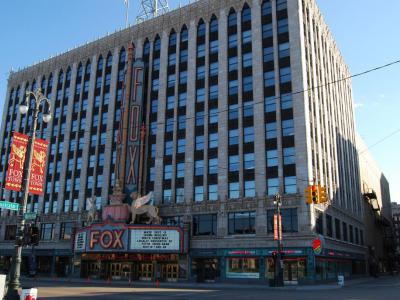
The Fox Theatre, located on Woodward Avenue in downtown Detroit, is a historic performing arts center renowned for its opulent design and significant cultural impact. Opened in 1928 as the flagship movie palace for the Fox Theatre chain, it was the largest theater in Detroit, boasting over 5,000 seats.
Designed by architect C. Howard Crane, the theater's interior showcases an eclectic blend of Burmese, Chinese, Indian, and Persian motifs, contributing to its exotic and lavish ambiance. The auditorium features three levels of seating: the Main Floor, Mezzanine, and Gallery (balcony). The attached 10-story office building's exterior is adorned with Asian-inspired designs, which, when illuminated at night, are visible from several blocks away.
Throughout its history, the Fox Theatre has hosted a diverse array of performances, including films, live stage shows, concerts, and special events. Notably, in May 1956, Elvis Presley performed three shows at the venue. During the 1960s, it became a popular stage for many Motown artists. Despite facing periods of decline, the theater remained operational, adapting its programming to include blaxploitation and martial arts films in the 1970s.
In 1988, under the ownership of Mike and Marian Ilitch, the Fox Theatre underwent a comprehensive $12 million restoration, revitalizing its original grandeur. This restoration led to its designation as a National Historic Landmark in 1989. Today, the theater continues to serve as a premier venue for a wide range of events, including concerts, Broadway shows, and special ceremonies, maintaining its status as a cultural cornerstone in Detroit.
Designed by architect C. Howard Crane, the theater's interior showcases an eclectic blend of Burmese, Chinese, Indian, and Persian motifs, contributing to its exotic and lavish ambiance. The auditorium features three levels of seating: the Main Floor, Mezzanine, and Gallery (balcony). The attached 10-story office building's exterior is adorned with Asian-inspired designs, which, when illuminated at night, are visible from several blocks away.
Throughout its history, the Fox Theatre has hosted a diverse array of performances, including films, live stage shows, concerts, and special events. Notably, in May 1956, Elvis Presley performed three shows at the venue. During the 1960s, it became a popular stage for many Motown artists. Despite facing periods of decline, the theater remained operational, adapting its programming to include blaxploitation and martial arts films in the 1970s.
In 1988, under the ownership of Mike and Marian Ilitch, the Fox Theatre underwent a comprehensive $12 million restoration, revitalizing its original grandeur. This restoration led to its designation as a National Historic Landmark in 1989. Today, the theater continues to serve as a premier venue for a wide range of events, including concerts, Broadway shows, and special ceremonies, maintaining its status as a cultural cornerstone in Detroit.
