Custom Walk in New York, New York by raqmathi_fd825 created on 2025-10-07
Guide Location: USA » New York
Guide Type: Custom Walk
# of Sights: 10
Tour Duration: 5 Hour(s)
Travel Distance: 11 Km or 6.8 Miles
Share Key: YV4PR
Guide Type: Custom Walk
# of Sights: 10
Tour Duration: 5 Hour(s)
Travel Distance: 11 Km or 6.8 Miles
Share Key: YV4PR
How It Works
Please retrieve this walk in the GPSmyCity app. Once done, the app will guide you from one tour stop to the next as if you had a personal tour guide. If you created the walk on this website or come to the page via a link, please follow the instructions below to retrieve the walk in the app.
Retrieve This Walk in App
Step 1. Download the app "GPSmyCity: Walks in 1K+ Cities" on Apple App Store or Google Play Store.



Step 2. In the GPSmyCity app, download(or launch) the guide "New York Map and Walking Tours".
Step 3. Tap the menu button located at upper right corner of the "Walks" screen and select "Retrieve custom walk". Enter the share key: YV4PR
1) Brooklyn Bridge (must see)
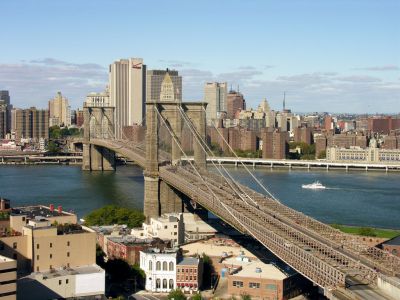
Seeking the most dramatic entrance into Manhattan?—The Brooklyn Bridge is the one. Stretching across the East River like a steel-wire tightrope for giants, this is one of New York’s most recognizable silhouettes since 1883—equal parts engineering flex and architectural poetry. The country took notice of it rather early, awarding the bridge the National Historic Landmark status in 1964, following which, civil engineers gave it their own stamp of admiration (as a National Historic Civil Engineering Landmark) in 1972.
The idea of linking Brooklyn and Manhattan had been floating around since the early 1800s, but it took the engineering duo—of John Augustus Roebling with the design, and his son Washington with the execution—to actually make it happen. Construction kicked off in 1869, and after fourteen ambitious, chaotic, and occasionally hazardous years, the bridge finally opened on May 24, 1883. President Chester A. Arthur even showed up for the ceremony, thus proving that ribbon-cuttings were the hot ticket long before Instagram...
Architecturally, the bridge is a hybrid marvel: part suspension bridge, part cable-stayed experiment, all held together by an orchestra of vertical and diagonal cables. Its stone towers, crowned with Neo-Gothic arches, rise from the river like a pair of cathedral doorways, guiding a roadway that stays well above passing ships thanks to long, raised viaducts.
The structure's numbers are just as solid. The main span clocks in at nearly 2,000 feet, the bridge itself expands and contracts by up to 16 inches, depending on the weather’s mood swings, and ships can glide under it with 127 feet of clearance to spare. Six trusses run beneath the roadway, while four enormous cables hold everything aloft—convincing evidence that 19th-century engineering was not messing around...
But the bridge saves its finest touch for people on foot. Eighteen feet above the cars is the elevated promenade, a wooden boardwalk divided down the middle, so cyclists and pedestrians can coexist in relative peace. Step onto it, and the city opens around you—skyline ahead, river below, and the gentle hum of New York all around. Indeed, it’s more than just a crossing, but a small, unforgettable performance...
The idea of linking Brooklyn and Manhattan had been floating around since the early 1800s, but it took the engineering duo—of John Augustus Roebling with the design, and his son Washington with the execution—to actually make it happen. Construction kicked off in 1869, and after fourteen ambitious, chaotic, and occasionally hazardous years, the bridge finally opened on May 24, 1883. President Chester A. Arthur even showed up for the ceremony, thus proving that ribbon-cuttings were the hot ticket long before Instagram...
Architecturally, the bridge is a hybrid marvel: part suspension bridge, part cable-stayed experiment, all held together by an orchestra of vertical and diagonal cables. Its stone towers, crowned with Neo-Gothic arches, rise from the river like a pair of cathedral doorways, guiding a roadway that stays well above passing ships thanks to long, raised viaducts.
The structure's numbers are just as solid. The main span clocks in at nearly 2,000 feet, the bridge itself expands and contracts by up to 16 inches, depending on the weather’s mood swings, and ships can glide under it with 127 feet of clearance to spare. Six trusses run beneath the roadway, while four enormous cables hold everything aloft—convincing evidence that 19th-century engineering was not messing around...
But the bridge saves its finest touch for people on foot. Eighteen feet above the cars is the elevated promenade, a wooden boardwalk divided down the middle, so cyclists and pedestrians can coexist in relative peace. Step onto it, and the city opens around you—skyline ahead, river below, and the gentle hum of New York all around. Indeed, it’s more than just a crossing, but a small, unforgettable performance...
2) Kimlau Square
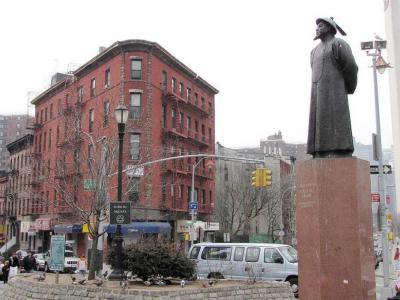
As you drift into what many New Yorkers casually call “Little China,” you’ll notice something: this neighborhood doesn’t grow in sudden leaps—it expands like a slow but determined tide, inching toward the Manhattan Bridge and pushing eastward to a crossroads that could give a GPS a nervous breakdown. That chaotic starburst of streets is Kimlau Square, and right in the middle of it stands the Kim Lau Arch. It’s named after a New York–raised Chinese-American airman who died heroically in World War II. But the memorial honors all Chinese who served the nation—stretching back to the laborers who laid the tracks of America’s coast-to-coast railroads.
A few steps away, the mood shifts from military valor to imperial resolve. Here, you’ll find the statue of Lin Zexu, the Qing Dynasty official, who famously tried to save China from the swelling opium trade and British interference. He pushed so hard for reform that he managed to kick off the First Opium War—proof that even good intentions can light historical fireworks. When the statue arrived in the 1990s, The New York Times noted it carried more than just an anti-drug message. It also reflected a shifting balance of power within Chinatown, as newcomers from mainland China—especially the Fujianese—were gaining influence over the older Cantonese community.
Continue east along Division Street, and you’ll reach Confucius Plaza, a 1970s residential complex that still counts as prime real estate by neighborhood standards. Its bronze statue of Confucius, installed in 1976, watches over the square with the calm patience of someone who has seen centuries of human chaos. For locals, it’s not just decoration; it’s a gathering place, a landmark, and a reminder that wisdom is always welcome—especially in a neighborhood where the streets meet at angles no philosopher ever planned for...
A few steps away, the mood shifts from military valor to imperial resolve. Here, you’ll find the statue of Lin Zexu, the Qing Dynasty official, who famously tried to save China from the swelling opium trade and British interference. He pushed so hard for reform that he managed to kick off the First Opium War—proof that even good intentions can light historical fireworks. When the statue arrived in the 1990s, The New York Times noted it carried more than just an anti-drug message. It also reflected a shifting balance of power within Chinatown, as newcomers from mainland China—especially the Fujianese—were gaining influence over the older Cantonese community.
Continue east along Division Street, and you’ll reach Confucius Plaza, a 1970s residential complex that still counts as prime real estate by neighborhood standards. Its bronze statue of Confucius, installed in 1976, watches over the square with the calm patience of someone who has seen centuries of human chaos. For locals, it’s not just decoration; it’s a gathering place, a landmark, and a reminder that wisdom is always welcome—especially in a neighborhood where the streets meet at angles no philosopher ever planned for...
3) Mott Street
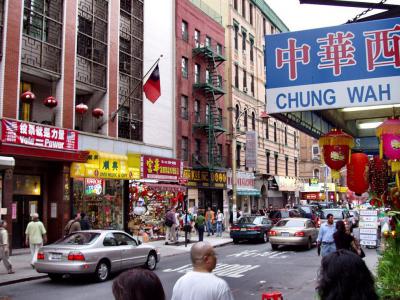
In a way, Mott Street can be regarded as Chinatown’s greatest hits album: all the flavors, colors, and characters packed into one compact stretch. For visitors, it’s a buffet of everything you came for—steaming dumplings, crowded fish markets, bargain-packed gift shops, tea houses that smell like comfort, and jewelry stores that sparkle suspiciously close to payday. And tucked between all that, you still find a few stubborn Italian holdouts from the neighborhood's earlier era, adding their own charm to the mix.
For locals, though, Mott Street isn’t a sightseeing list—it’s the front porch. More than a century after the first Chinese families arrived, this street still functions as a genuine community, not just a themed backdrop. Kids grow up here, grandparents trade news on the sidewalk, and generations layer their stories into the brickwork.
Now, about the food—because let’s be honest, this is why most people end up here. Make your way to WO HOP on the south end of Mott. The place is practically a rite of passage: open until 4:30 a.m., blissfully unfussy, and split into two worlds—the “new” upstairs with booths and the “classic” downstairs with plain tables that look like they’ve heard some serious late-night confessions. The menu reads like a greatest-hits playlist of Chinese comfort dishes. Go for the house special fried rice or the shrimp in lobster sauce. Portions are big enough to feed your future self.
Keep moving north to Grand Street, and suddenly you’re in vegetable paradise—row after row of fresh produce priced so attractively you’ll consider picking up ingredients you can’t even identify. Then there’s DI PALO’S FINE FOODS, an Italian family institution representing all 20 regions of Italy with cheeses, meats, olive oils, and vinegars that could start an argument on their own. The staff offers generous guidance and samples, and yes, they’ll even ship your discoveries to friends in other states.
As you wander these streets, look up from time to time. Many buildings still wear delicate Eastern design touches—sunbursts, swirls, shells, even expressive faces—all quiet reminders of the cultures that have shaped this neighborhood, one generation after another...
For locals, though, Mott Street isn’t a sightseeing list—it’s the front porch. More than a century after the first Chinese families arrived, this street still functions as a genuine community, not just a themed backdrop. Kids grow up here, grandparents trade news on the sidewalk, and generations layer their stories into the brickwork.
Now, about the food—because let’s be honest, this is why most people end up here. Make your way to WO HOP on the south end of Mott. The place is practically a rite of passage: open until 4:30 a.m., blissfully unfussy, and split into two worlds—the “new” upstairs with booths and the “classic” downstairs with plain tables that look like they’ve heard some serious late-night confessions. The menu reads like a greatest-hits playlist of Chinese comfort dishes. Go for the house special fried rice or the shrimp in lobster sauce. Portions are big enough to feed your future self.
Keep moving north to Grand Street, and suddenly you’re in vegetable paradise—row after row of fresh produce priced so attractively you’ll consider picking up ingredients you can’t even identify. Then there’s DI PALO’S FINE FOODS, an Italian family institution representing all 20 regions of Italy with cheeses, meats, olive oils, and vinegars that could start an argument on their own. The staff offers generous guidance and samples, and yes, they’ll even ship your discoveries to friends in other states.
As you wander these streets, look up from time to time. Many buildings still wear delicate Eastern design touches—sunbursts, swirls, shells, even expressive faces—all quiet reminders of the cultures that have shaped this neighborhood, one generation after another...
4) Bayard Street
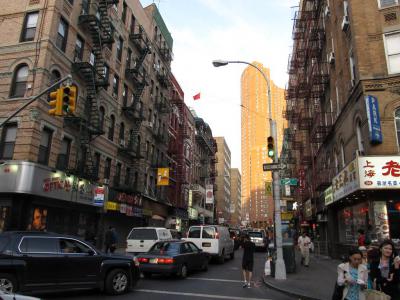
Sliding into Bayard Street, you’ll notice right away—it doesn’t try to hide its identity but leans boldly into its Chinese roots. With steam, aromas, and neon drifting through the air, the whole place feels like someone picked up a Hong Kong side street and gently placed it in Lower Manhattan. Down at street level, fish markets, bakeries, and tiny restaurants compete for your attention; above them, walk-up apartments house multi-generation families whose stories stretch back to southern China and Hong Kong.
Keep moving, and you’ll eventually spot a small crowd doing the universal sign for “this is the place”—eating ice cream directly on the sidewalk. That’s your cue: you’ve reached the Chinatown Ice Cream Factory. This family-run shop has been scooping happiness for more than three decades, offering flavors that are creamy, silky, and just adventurous enough to make you wonder why you ever settled for vanilla. Arrive before the big rush, and you might snag samples of Ginger, Durian, Green Tea, Egg Custard, Black Sesame, or the ever-beloved Lychee. Choose wisely—or do what most people do and pretend you’ll only try one...
Once you escape the gravitational pull of the ice cream line, glance across the street at Mei Li Wah, the kingdom of steamed buns. They churn out warm, fluffy pockets filled with pork, chicken, pineapple, egg yolk—you name it. Most customers grab a bag and eat as they wander, but you can also sit down and point at the gigantic wall photos if decision-making isn’t your strong suit. Be patient if the trays are empty; locals sometimes buy buns in bulk, and the staff works at a pace that means business.
Before you leave the area behind, pause at the corner of Bayard and Mott. Here, Sun’s Organic Garden offers shelves of fragrant teas, with shopkeepers happy to steer you toward something soothing, energizing, or simply intriguing. Whether you’re after a gentle jasmine or a bold oolong, they’ll help you find your perfect cup before you continue your Chinatown adventure.
Keep moving, and you’ll eventually spot a small crowd doing the universal sign for “this is the place”—eating ice cream directly on the sidewalk. That’s your cue: you’ve reached the Chinatown Ice Cream Factory. This family-run shop has been scooping happiness for more than three decades, offering flavors that are creamy, silky, and just adventurous enough to make you wonder why you ever settled for vanilla. Arrive before the big rush, and you might snag samples of Ginger, Durian, Green Tea, Egg Custard, Black Sesame, or the ever-beloved Lychee. Choose wisely—or do what most people do and pretend you’ll only try one...
Once you escape the gravitational pull of the ice cream line, glance across the street at Mei Li Wah, the kingdom of steamed buns. They churn out warm, fluffy pockets filled with pork, chicken, pineapple, egg yolk—you name it. Most customers grab a bag and eat as they wander, but you can also sit down and point at the gigantic wall photos if decision-making isn’t your strong suit. Be patient if the trays are empty; locals sometimes buy buns in bulk, and the staff works at a pace that means business.
Before you leave the area behind, pause at the corner of Bayard and Mott. Here, Sun’s Organic Garden offers shelves of fragrant teas, with shopkeepers happy to steer you toward something soothing, energizing, or simply intriguing. Whether you’re after a gentle jasmine or a bold oolong, they’ll help you find your perfect cup before you continue your Chinatown adventure.
5) Canal Street
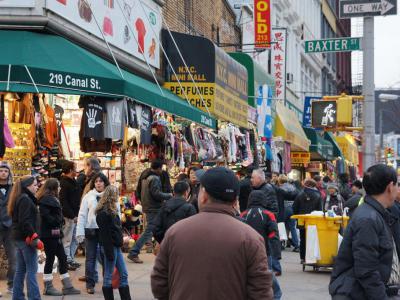
Roll the tape back to the 1980s, when Canal Street was every tinkerer’s paradise. Popular Electronics dropped its latest DIY project each month, and hobbyists would march straight here, list in hand, knowing they could find every resistor, capacitor, and mystery widget tucked into the cluttered counters of its electronics shops. Fast-forward a few decades, and the silicon dreamscape has given way to racks of industrial plastics and an impressive economy of knockoff handbags, fragrances, jewelry, watches, and designer fashions—almost all made in China and arriving by the container load.
Even with the tech era long gone, Canal Street still knows how to put on a show. Vendors line the sidewalks with coconut drinks, durian, vegetables, homemade noodles, and all kinds of Chinese snacks that perfume the air from one end to the Manhattan Bridge. Nearly every doorway is hiding something—sometimes a shop filled with handcrafted Asian ceramics, sometimes a tiny cash-only souvenir store where prices are a fraction of what you’d pay in Times Square. And since no merchant enjoys seeing a customer leave empty-handed, haggling isn’t just welcomed—it’s practically a local sport.
A few steps away, at 200 Canal Street, the NEW KAM MAN Supermarket (working from 9:30 a.m. to 7 p.m.) spreads out across three floors of temptation. Groceries, pottery, cast-iron teapots, chopsticks, Japanese lunch boxes, cosmetics, teas, herbs—you name it. And up on the renovated upper level, Hello Kitty has staged a full takeover: stationery, trinkets, sake sets, skincare, blankets… essentially every cute object known to humankind.
Food lovers won’t go hungry, either. Canal Street and its side streets hold a dense constellation of eateries—mostly Cantonese, with plenty of regional outliers—some of them incredibly good, almost all of them reasonably priced.
And one more note: those whispered offers for “special” watches and handbags are totally normal here. If you’re hunting for a knockoff of a $1,200 bag—sometimes impressively close to the real thing, sometimes not so much—you’ll find options from $20 to $150. Deals happen in doorways, alleys, and side corners. It’s not dangerous; it’s just Canal Street doing what Canal Street does best: running an underground market in broad daylight...
Even with the tech era long gone, Canal Street still knows how to put on a show. Vendors line the sidewalks with coconut drinks, durian, vegetables, homemade noodles, and all kinds of Chinese snacks that perfume the air from one end to the Manhattan Bridge. Nearly every doorway is hiding something—sometimes a shop filled with handcrafted Asian ceramics, sometimes a tiny cash-only souvenir store where prices are a fraction of what you’d pay in Times Square. And since no merchant enjoys seeing a customer leave empty-handed, haggling isn’t just welcomed—it’s practically a local sport.
A few steps away, at 200 Canal Street, the NEW KAM MAN Supermarket (working from 9:30 a.m. to 7 p.m.) spreads out across three floors of temptation. Groceries, pottery, cast-iron teapots, chopsticks, Japanese lunch boxes, cosmetics, teas, herbs—you name it. And up on the renovated upper level, Hello Kitty has staged a full takeover: stationery, trinkets, sake sets, skincare, blankets… essentially every cute object known to humankind.
Food lovers won’t go hungry, either. Canal Street and its side streets hold a dense constellation of eateries—mostly Cantonese, with plenty of regional outliers—some of them incredibly good, almost all of them reasonably priced.
And one more note: those whispered offers for “special” watches and handbags are totally normal here. If you’re hunting for a knockoff of a $1,200 bag—sometimes impressively close to the real thing, sometimes not so much—you’ll find options from $20 to $150. Deals happen in doorways, alleys, and side corners. It’s not dangerous; it’s just Canal Street doing what Canal Street does best: running an underground market in broad daylight...
6) Mulberry Street
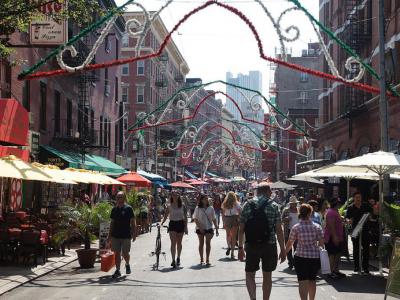
Mulberry Street, Little Italy’s main artery since the early 1900s, still feels like the neighborhood’s most relaxed stretch—a place where Italians from every corner of the city drift in for espresso, conversation, and a little people-watching. By day, it’s all cafés, social clubs, and street vendors slinging quick bites. By night, the lights flicker on, menus appear in the hands of very persuasive hosts, and suddenly the whole street acts like it’s auditioning for a movie set.
Speaking of movies, step onto the edge of the strip, and you’ll find Mulberry Street Bar, a place that’s been pouring drinks (and collecting stories) since 1908. Actors, mob bosses, and actors pretending to be mob bosses have all warmed its barstools. The wood is dark, the ceiling is tin, and the jukebox insists on Sinatra, The Four Tops, and Elvis—as it should. It’s been a backdrop for Donnie Brasco, Godfather III, The Sopranos, and other hit productions. Order a Peroni, settle in, and enjoy the atmosphere. Despite its résumé, you’re perfectly safe here—promise...
And if you prefer your dinner with a dash of mafia lore, Umberto’s Clam House is waiting. Slide into the last table in the back—the very spot where Italian-American mobster “Crazy Joe” Gallo met his fate in 1972. These days, the loudest thing in the room is the conversation, and the baked clams and linguine with white clam sauce are famous for far better reasons.
For something sweet, wander over to Caffé Roma, a cash-only institution dating back to 1891. The décor is charmingly old-school, the pastries are worth every calorie, and no one rushes you out the door. If you spot a free seat by the window, consider it an invitation from the dessert gods.
Then there’s Ferrara Bakery & Café, another Little Italy classic. Whether you’re craving a cappuccino, a cannoli, or something to smuggle home for later, you'll find it all here in abundance.
But when hunger returns, Sapori d’Italia offers cozy pasta and pizza indoors or breezy outdoor tables. And for a quick detour into Chinatown flavor, Tasty Dumpling serves some of the city’s best budget-friendly dumplings and a hot-and-sour soup that could convert anyone. Also note that, if you happen to arrive in mid-September, the 11-day Feast of San Gennaro turns Mulberry Street into a joyful festival of parades, music, rides, and food—lots of food...
Speaking of movies, step onto the edge of the strip, and you’ll find Mulberry Street Bar, a place that’s been pouring drinks (and collecting stories) since 1908. Actors, mob bosses, and actors pretending to be mob bosses have all warmed its barstools. The wood is dark, the ceiling is tin, and the jukebox insists on Sinatra, The Four Tops, and Elvis—as it should. It’s been a backdrop for Donnie Brasco, Godfather III, The Sopranos, and other hit productions. Order a Peroni, settle in, and enjoy the atmosphere. Despite its résumé, you’re perfectly safe here—promise...
And if you prefer your dinner with a dash of mafia lore, Umberto’s Clam House is waiting. Slide into the last table in the back—the very spot where Italian-American mobster “Crazy Joe” Gallo met his fate in 1972. These days, the loudest thing in the room is the conversation, and the baked clams and linguine with white clam sauce are famous for far better reasons.
For something sweet, wander over to Caffé Roma, a cash-only institution dating back to 1891. The décor is charmingly old-school, the pastries are worth every calorie, and no one rushes you out the door. If you spot a free seat by the window, consider it an invitation from the dessert gods.
Then there’s Ferrara Bakery & Café, another Little Italy classic. Whether you’re craving a cappuccino, a cannoli, or something to smuggle home for later, you'll find it all here in abundance.
But when hunger returns, Sapori d’Italia offers cozy pasta and pizza indoors or breezy outdoor tables. And for a quick detour into Chinatown flavor, Tasty Dumpling serves some of the city’s best budget-friendly dumplings and a hot-and-sour soup that could convert anyone. Also note that, if you happen to arrive in mid-September, the 11-day Feast of San Gennaro turns Mulberry Street into a joyful festival of parades, music, rides, and food—lots of food...
7) Chelsea Market (must see)
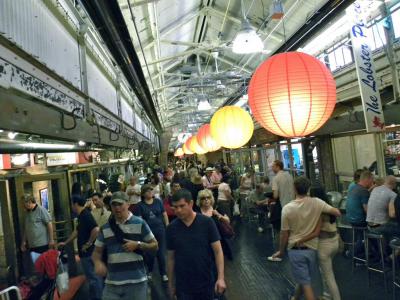
The Chelsea Market stands as a remarkable testament to both redevelopment and preservation, as it has revitalized a former Nabisco factory (where the iconic Oreo cookie was originally crafted), into a bustling shopping destination, appealing to both culinary enthusiasts and fashion aficionados. With over two dozen food vendors to choose from, foodies can revel in a myriad of delectable options. Experience the fusion of Korean flavors with ramen at MOKBAR, savor delectable crepes at BAR SUZETTE, relish in Cambodian sandwiches at NUM PANG, or indulge in piping hot mini-doughnuts at DOUGHNUTTERY. For a more indulgent treat, savor the impeccable seafood and raw bar at CULL & PISTOL, or enjoy upscale American comfort food at Friedman's Lunch.
Those seeking non-food delights may peruse the curated collection of Moroccan art and design at IMPORTS FROM MARRAKESH, explore the latest literary gems at POSMAN BOOKS, find a fashionable outfit at ANTHROPOLOGIE, or browse the expertly-staffed CHELSEA WINE VAULT for a bottle of fine wine. At the Tenth Ave entrance, you'll discover ARTISTS AND FLEAS, a permanent market showcasing the creations of local designers and craftspeople. This vibrant marketplace is the perfect spot to uncover a unique wallet, trendy sunglasses, or a striking statement piece of jewelry.
Those seeking non-food delights may peruse the curated collection of Moroccan art and design at IMPORTS FROM MARRAKESH, explore the latest literary gems at POSMAN BOOKS, find a fashionable outfit at ANTHROPOLOGIE, or browse the expertly-staffed CHELSEA WINE VAULT for a bottle of fine wine. At the Tenth Ave entrance, you'll discover ARTISTS AND FLEAS, a permanent market showcasing the creations of local designers and craftspeople. This vibrant marketplace is the perfect spot to uncover a unique wallet, trendy sunglasses, or a striking statement piece of jewelry.
8) High Line (must see)
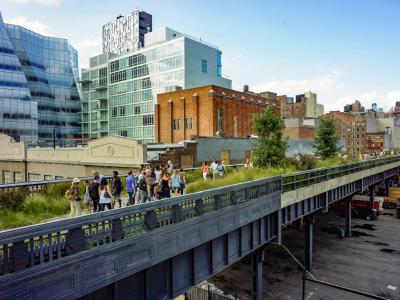
Constructed on a repurposed section of elevated freight train tracks, The High Line offers a dual experience as both an urban sanctuary, providing respite from the bustling city streets, and a tribute to Manhattan's West Side, particularly its remarkable architecture. The initial segment, spanning from Gansevoort Street to West 20th Street, opened in 2009 and became an instant hit, demonstrating that open spaces could be trendy and fashionable. This sudden success also caught the attention of the city tax assessor, who saw the surrounding properties in a new light. The park's second section opened in June 2011, doubling its length to 30th Street. The third section, completed in 2014, extends along the elevated tracks until 34th Street.
The High Line incorporates various environmentally friendly features, starting with the plant life that reflects the native ecology of the region, with half of the plants being indigenous to North America and 30% native to the Northeast. This design attracts birds and butterflies, creating a natural habitat. Additionally, the park employs rainwater absorption systems, preventing water from simply flowing into gutters. While the park aims for a low environmental impact, it has undeniably made a significant impact on the surrounding neighborhood. Not only does it offer an aesthetically pleasing pathway to the heart of Chelsea's art galleries, but it has also acted as a catalyst for both architectural and cultural developments, including the relocation of The Whitney Museum to the Meatpacking District.
By glancing upwards, visitors can appreciate the surrounding architecture. The High Line is flanked by notable structures such as The Standard, located just south of 14th Street, which features an upscale restaurant and a beer garden beneath the park. Other architectural gems visible from the High Line include Frank Gehry's first commercial office building in New York, the IAC Building owned by Barry Diller, and Jean Nouvel's 100 Eleventh Avenue condo building across the street. The IAC Building captivates with its radiant appearance, while Nouvel's facade, composed of variously sized glass panes, has become an instant classic.
The architectural brilliance of the High Line itself is simply awe-inspiring. Visitors particularly enjoy the 10th Avenue Square area, featuring amphitheater-style seating and a view of the northbound traffic on Tenth Avenue, making it a favorite spot for picnics (adjacent to the nearby Chelsea Market food vendors).
While the High Line can get crowded on weekends during the summer, taking an early morning or evening stroll is highly recommended. The nighttime cityscape views are breathtaking, while early mornings offer a tranquil and refreshing experience until the sun rises above the skyscrapers to the east of the park. In truth, any time of day is perfect for a visit to the High Line as the views are always splendid.
Tip:
Food enthusiasts will find a plethora of excellent dining options nearby. Hip establishments like Cookshop and cozy Italian eatery Bottino are great choices. For more affordable meals, try the classic diner Hector's or wait for the arrival of gourmet food trucks around the corner from the Gansevoort stairs. Alternatively, you can explore the culinary delights of Chelsea Market.
The High Line incorporates various environmentally friendly features, starting with the plant life that reflects the native ecology of the region, with half of the plants being indigenous to North America and 30% native to the Northeast. This design attracts birds and butterflies, creating a natural habitat. Additionally, the park employs rainwater absorption systems, preventing water from simply flowing into gutters. While the park aims for a low environmental impact, it has undeniably made a significant impact on the surrounding neighborhood. Not only does it offer an aesthetically pleasing pathway to the heart of Chelsea's art galleries, but it has also acted as a catalyst for both architectural and cultural developments, including the relocation of The Whitney Museum to the Meatpacking District.
By glancing upwards, visitors can appreciate the surrounding architecture. The High Line is flanked by notable structures such as The Standard, located just south of 14th Street, which features an upscale restaurant and a beer garden beneath the park. Other architectural gems visible from the High Line include Frank Gehry's first commercial office building in New York, the IAC Building owned by Barry Diller, and Jean Nouvel's 100 Eleventh Avenue condo building across the street. The IAC Building captivates with its radiant appearance, while Nouvel's facade, composed of variously sized glass panes, has become an instant classic.
The architectural brilliance of the High Line itself is simply awe-inspiring. Visitors particularly enjoy the 10th Avenue Square area, featuring amphitheater-style seating and a view of the northbound traffic on Tenth Avenue, making it a favorite spot for picnics (adjacent to the nearby Chelsea Market food vendors).
While the High Line can get crowded on weekends during the summer, taking an early morning or evening stroll is highly recommended. The nighttime cityscape views are breathtaking, while early mornings offer a tranquil and refreshing experience until the sun rises above the skyscrapers to the east of the park. In truth, any time of day is perfect for a visit to the High Line as the views are always splendid.
Tip:
Food enthusiasts will find a plethora of excellent dining options nearby. Hip establishments like Cookshop and cozy Italian eatery Bottino are great choices. For more affordable meals, try the classic diner Hector's or wait for the arrival of gourmet food trucks around the corner from the Gansevoort stairs. Alternatively, you can explore the culinary delights of Chelsea Market.
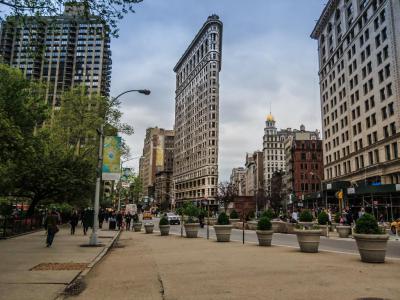
9) Flatiron Building
Perhaps the most photographed edifice in New York City, the Flatiron Building owes its popularity and name to the unique design. The isosceles triangle-shaped building may not be as high as the nearby high risers of today, but when it opened its doors for the first time in 1901, it surely was one of the tallest in New York – 307 feet, 21 floors – rising like a Greek column, contrary to the other New York skyscrapers rising from a lower base block.
The Flatiron building was designed by Chicago architect, Daniel Burnham, as an office building for the Fuller Construction Company. Styled renaissance palazzo with beaux art detailing, it has the exterior of steel clad with terra cotta. Upon inauguration, the building was dubbed Burnham’s Folly by skeptics who doubted it would stand against strong winds. The design, however, has defied their misgivings and remained structurally sound till the present. Nowadays, it houses the headquarters of the McMillan Publishing Company.
The Flatiron building symbolizes New York City in picture postcards, television commercials and documentaries. It became a New York City landmark in 1966 and was added to the National Register of Historic Places in 1976.
Why You Should Visit:
The exterior of the structure is certainly unique and well worth a photo!
Tip:
At the crossroads between 5th Avenue and Broadway, this should be not the only attraction in the area. The district is trendy, and you can sit outside at one of the many local cafes or in Madison Square Park and just watch people go about their lives all day long. Alternatively, if you're more creatively inclined, the area has plenty of stores catering to those loving artistic design, as well as hip cafes and restaurants.
The Flatiron building was designed by Chicago architect, Daniel Burnham, as an office building for the Fuller Construction Company. Styled renaissance palazzo with beaux art detailing, it has the exterior of steel clad with terra cotta. Upon inauguration, the building was dubbed Burnham’s Folly by skeptics who doubted it would stand against strong winds. The design, however, has defied their misgivings and remained structurally sound till the present. Nowadays, it houses the headquarters of the McMillan Publishing Company.
The Flatiron building symbolizes New York City in picture postcards, television commercials and documentaries. It became a New York City landmark in 1966 and was added to the National Register of Historic Places in 1976.
Why You Should Visit:
The exterior of the structure is certainly unique and well worth a photo!
Tip:
At the crossroads between 5th Avenue and Broadway, this should be not the only attraction in the area. The district is trendy, and you can sit outside at one of the many local cafes or in Madison Square Park and just watch people go about their lives all day long. Alternatively, if you're more creatively inclined, the area has plenty of stores catering to those loving artistic design, as well as hip cafes and restaurants.
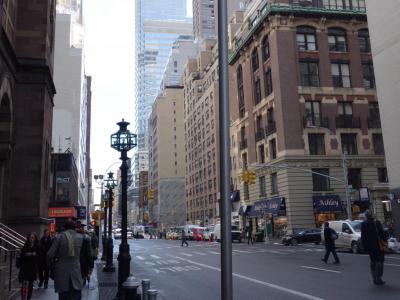
10) Lexington Avenue
Running one-way southbound for its entire length, from 131st to 21st Streets, Lexington Avenue is largely commercial at the ground level, with offices above. Alongside the clusters of hotels in the 30s and 40s, there are numerous structures on Lexington designated as New York City Landmarks, National Historic Landmarks, and National Register of Historic Places.
Still, when it comes to attractions, the avenue is known primarily for its unique and more affordable shopping that makes Lexington stand out from the more touristy neighbors like Madison, Park, and Fifth Avenues. Most of Lexington's shops are relatively little-known outlets offering rather specific products. Transitioning from Midtown to the Upper East Side, the 20-block stretch from 50th to 69th street houses a variety of small stores, including jewelry, shoe, and home furnishing boutiques.
Among the ones worth visiting here are Elle W Collection, a high-end antique jewelry and home furnishings dealer (864 Lexington Avenue); Pan American Pheonix, specialized in hand-made Mexican clothing, accessories, and pottery; Diane B. Lady Shoes (at 63rd street) for women's shoes and handbags; and Galo (at 63rd street) for men's and women's comfortable and reasonably priced footwear, including comfortable shoes for wedding. And if you're shopping for a gift, stop by Le Sabon and Baby Too (at 64th street), which carries dainty gift items and adorable baby shower gifts.
Lexington Avenue is also home to a number of well-known retailers, such as Bloomingdale's, Zara, Levi's, and Nine West, offering a wide range of clothing, from moderately priced to some rather expensive, trendy garments.
Still, when it comes to attractions, the avenue is known primarily for its unique and more affordable shopping that makes Lexington stand out from the more touristy neighbors like Madison, Park, and Fifth Avenues. Most of Lexington's shops are relatively little-known outlets offering rather specific products. Transitioning from Midtown to the Upper East Side, the 20-block stretch from 50th to 69th street houses a variety of small stores, including jewelry, shoe, and home furnishing boutiques.
Among the ones worth visiting here are Elle W Collection, a high-end antique jewelry and home furnishings dealer (864 Lexington Avenue); Pan American Pheonix, specialized in hand-made Mexican clothing, accessories, and pottery; Diane B. Lady Shoes (at 63rd street) for women's shoes and handbags; and Galo (at 63rd street) for men's and women's comfortable and reasonably priced footwear, including comfortable shoes for wedding. And if you're shopping for a gift, stop by Le Sabon and Baby Too (at 64th street), which carries dainty gift items and adorable baby shower gifts.
Lexington Avenue is also home to a number of well-known retailers, such as Bloomingdale's, Zara, Levi's, and Nine West, offering a wide range of clothing, from moderately priced to some rather expensive, trendy garments.
Sight description based on Wikipedia.
