Custom Walk in Baltimore, Maryland by bepperwife_de739 created on 2025-10-11
Guide Location: USA » Baltimore
Guide Type: Custom Walk
# of Sights: 11
Tour Duration: 4 Hour(s)
Travel Distance: 8.7 Km or 5.4 Miles
Share Key: GY928
Guide Type: Custom Walk
# of Sights: 11
Tour Duration: 4 Hour(s)
Travel Distance: 8.7 Km or 5.4 Miles
Share Key: GY928
How It Works
Please retrieve this walk in the GPSmyCity app. Once done, the app will guide you from one tour stop to the next as if you had a personal tour guide. If you created the walk on this website or come to the page via a link, please follow the instructions below to retrieve the walk in the app.
Retrieve This Walk in App
Step 1. Download the app "GPSmyCity: Walks in 1K+ Cities" on Apple App Store or Google Play Store.



Step 2. In the GPSmyCity app, download(or launch) the guide "Baltimore Map and Walking Tours".
Step 3. Tap the menu button located at upper right corner of the "Walks" screen and select "Retrieve custom walk". Enter the share key: GY928
1) Washington Monument and Museum at Mount Vernon Place
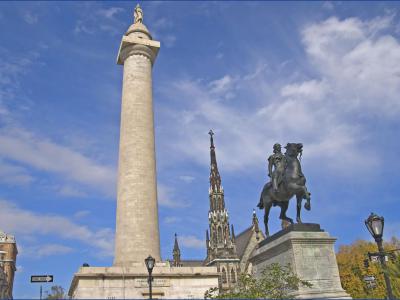
The Washington Monument at Mount Vernon Place was the first significant monument built in honor of President George Washington. Construction on the memorial began in 1815 and was completed in 1829.
The monument was designed by a famed architect Robert Mills who also designed the Washington Monument in Washington, D.C. The Washington Monument in Baltimore is a marble, Doric column that is 178 feet high. There are 227 steps to climb to the top of the monument tower to look through a viewing window.
A statue of George Washington, carved by sculptor Enrico Causici, stands atop the monument. Other details include bronze inscriptions that describe Washington's life and career. These plaques were added with the advisement of John Quincy Adams.
The museum is located on the ground floor of the monument. It contains digital exhibits detailing the construction process, the history of Mount Vernon, and the life of George Washington.
The monument was designed by a famed architect Robert Mills who also designed the Washington Monument in Washington, D.C. The Washington Monument in Baltimore is a marble, Doric column that is 178 feet high. There are 227 steps to climb to the top of the monument tower to look through a viewing window.
A statue of George Washington, carved by sculptor Enrico Causici, stands atop the monument. Other details include bronze inscriptions that describe Washington's life and career. These plaques were added with the advisement of John Quincy Adams.
The museum is located on the ground floor of the monument. It contains digital exhibits detailing the construction process, the history of Mount Vernon, and the life of George Washington.
2) Edgar Allan Poe House and Museum
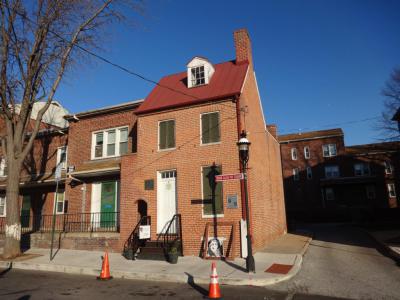
The Edgar Allan Poe House and Museum was once the home of American writer and poet Edgar Allan Poe. It is now an unfurnished house museum. Much of the original woodwork remains in the house, but no artifacts from Poe's time there are on display.
The home was built in 1830. Poe moved into the house in 1833 when he was 23 years old. He lived in the house for two years. It is thought that Poe wrote several stories while living in the house. Among these are "Berenice," "Morella," and "The Unparalleled Adventure of One Hans Pfaall." It is also thought that he wrote the poems "Latin Hymn," "Enigma," "Serenade," and "The Coliseum" under this roof.
The house was opened as a museum in 1949. The museum hosts the International Edgar Allan Poe Festival and Awards each October. Tours of the house are only available through reservations.
The Edgar Allan Poe House and Museum is a U.S. National Historic Landmark and a Baltimore City Landmark, listed on the U.S. National Register of Historic Places.
The home was built in 1830. Poe moved into the house in 1833 when he was 23 years old. He lived in the house for two years. It is thought that Poe wrote several stories while living in the house. Among these are "Berenice," "Morella," and "The Unparalleled Adventure of One Hans Pfaall." It is also thought that he wrote the poems "Latin Hymn," "Enigma," "Serenade," and "The Coliseum" under this roof.
The house was opened as a museum in 1949. The museum hosts the International Edgar Allan Poe Festival and Awards each October. Tours of the house are only available through reservations.
The Edgar Allan Poe House and Museum is a U.S. National Historic Landmark and a Baltimore City Landmark, listed on the U.S. National Register of Historic Places.
3) Edgar Allan Poe's Grave Site and Memorial
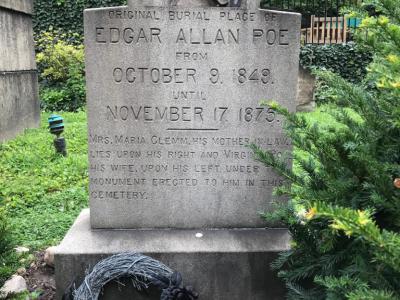
Edgar Allan Poe's Grave Site and Memorial is a monument to one of the greatest writers from the United States. After he died in 1849, Poe was buried in an unmarked grave at the Westminster Presbyterian Church in West Baltimore. Eleven years later, it was finally marked with a small tombstone.
The monument was erected in 1874. It was designed by George A. Frederick and carved by Hugh Sisson. The marble stone has no epitaph and only provides Poe's name, date of death, and an incorrect birthdate.
The monument is located in the front corner of Westminster Hall and Burying Ground. His remains were moved to this spot in 1875. His wife's remains were also moved from their resting place in New York near Poe.
A bas-relief bust of Poe rests in front of the monument. It is a bronze-cast copy of an original marble bust crafted by Frederick Volck. The first bust eroded quickly due to the soft marble that was used.
A second stone was added in 1913 to mark Poe's original burial site in the back of the church.
The monument was erected in 1874. It was designed by George A. Frederick and carved by Hugh Sisson. The marble stone has no epitaph and only provides Poe's name, date of death, and an incorrect birthdate.
The monument is located in the front corner of Westminster Hall and Burying Ground. His remains were moved to this spot in 1875. His wife's remains were also moved from their resting place in New York near Poe.
A bas-relief bust of Poe rests in front of the monument. It is a bronze-cast copy of an original marble bust crafted by Frederick Volck. The first bust eroded quickly due to the soft marble that was used.
A second stone was added in 1913 to mark Poe's original burial site in the back of the church.
4) Oriole Park at Camden Yards
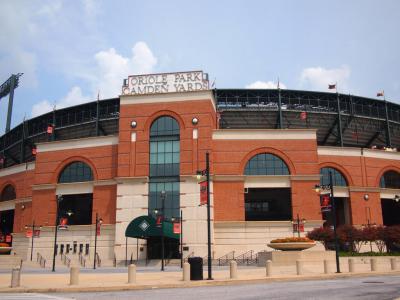
Oriole Park at Camden Yards is a renowned baseball stadium located in the Camden Yards Sports Complex in downtown Baltimore. Completed in 1992, it serves as the home field for the Baltimore Orioles, a Major League Baseball team. The construction of the stadium was part of an effort to keep the Orioles in Baltimore, after the city had lost its NFL team, the Baltimore Colts.
The stadium's design, created by architectural firm HOK Sport, was heavily influenced by the "retro" trend that was popular in the 1990s. Prior to Camden Yards, most big league ballparks were symmetrical multi-purpose stadiums. The Orioles' previous home, Memorial Stadium, was one such example. However, the trend shifted towards designing ballparks with unique features and a nostalgic feel.
The design process was led by Orioles President and CEO, Larry Lucchino, and architectural consultant Janet Marie Smith. Smith's influence led the Orioles to reject HOK Sport's original design in favor of a retro-style park, with vintage designs from Baltimore-based firm Ashton Design completing the look.
Construction of the stadium began in 1989 and lasted for 33 months. The naming of the stadium caused some controversy, with former Orioles owner Eli Jacobs wanting to name it Oriole Park, while then-Maryland Governor William Donald Schaefer favored Camden Yards. Eventually, a compromise was reached and both names were used, resulting in the stadium's full name: Oriole Park at Camden Yards.
Today, Oriole Park at Camden Yards is considered a classic ballpark, known for its unique features such as the B&O Warehouse that looms behind right field and the 19th-century style clock above the scoreboard. It was the first of many retro ballparks built in the 1990s and early 2000s, and its design has influenced many other ballparks since its opening. Despite its long name, Camden Yards remains a beloved and iconic destination for baseball fans from around the world.
The stadium's design, created by architectural firm HOK Sport, was heavily influenced by the "retro" trend that was popular in the 1990s. Prior to Camden Yards, most big league ballparks were symmetrical multi-purpose stadiums. The Orioles' previous home, Memorial Stadium, was one such example. However, the trend shifted towards designing ballparks with unique features and a nostalgic feel.
The design process was led by Orioles President and CEO, Larry Lucchino, and architectural consultant Janet Marie Smith. Smith's influence led the Orioles to reject HOK Sport's original design in favor of a retro-style park, with vintage designs from Baltimore-based firm Ashton Design completing the look.
Construction of the stadium began in 1989 and lasted for 33 months. The naming of the stadium caused some controversy, with former Orioles owner Eli Jacobs wanting to name it Oriole Park, while then-Maryland Governor William Donald Schaefer favored Camden Yards. Eventually, a compromise was reached and both names were used, resulting in the stadium's full name: Oriole Park at Camden Yards.
Today, Oriole Park at Camden Yards is considered a classic ballpark, known for its unique features such as the B&O Warehouse that looms behind right field and the 19th-century style clock above the scoreboard. It was the first of many retro ballparks built in the 1990s and early 2000s, and its design has influenced many other ballparks since its opening. Despite its long name, Camden Yards remains a beloved and iconic destination for baseball fans from around the world.
5) Inner Harbor Waterfront Promenade (must see)
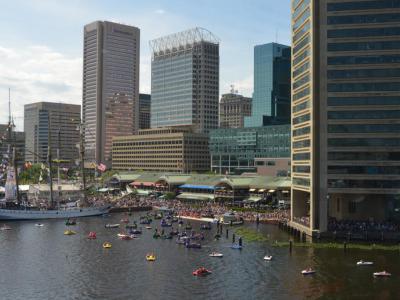
The Inner Harbor Waterfront Promenade is an eight-mile pedestrian walkway and bicycle path. It provides access to the views of the Patapsco River harbor and the many shops, dining areas, entertainment, and public spaces near the promenade.
The Inner Harbor Waterfront Promenade offers access to multiple museums and attractions. The most popular attraction is the National Aquarium, which is not only the most widely visited aquarium along the pedestrian walkway but also the most highly trafficked tourist attraction in Maryland.
Another favored museum with access to the promenade is the USS Constellation. The restored naval vessel is the only surviving, intact ship from the Civil War. Other places of interest along the promenade include the Maryland Science Center and Port Discovery Children's Museum.
There are many attractive spots for photo opportunities along the Inner Harbor Waterfront Promenade. Tourists should check out the Mr. Trash Wheel Sculpture, which serves double duty as a fun work of art and a trash-collecting vessel. Seven Foot Knoll Lighthouse, the Top of the World Observation Level, and the Pride of Baltimore Memorial are worth visiting.
The Inner Harbor Waterfront Promenade offers access to multiple museums and attractions. The most popular attraction is the National Aquarium, which is not only the most widely visited aquarium along the pedestrian walkway but also the most highly trafficked tourist attraction in Maryland.
Another favored museum with access to the promenade is the USS Constellation. The restored naval vessel is the only surviving, intact ship from the Civil War. Other places of interest along the promenade include the Maryland Science Center and Port Discovery Children's Museum.
There are many attractive spots for photo opportunities along the Inner Harbor Waterfront Promenade. Tourists should check out the Mr. Trash Wheel Sculpture, which serves double duty as a fun work of art and a trash-collecting vessel. Seven Foot Knoll Lighthouse, the Top of the World Observation Level, and the Pride of Baltimore Memorial are worth visiting.
6) U.S.S. Constellation
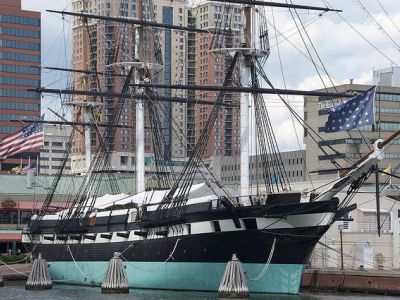
The USS Constellation is the last sail-only warship built by the United States Navy and the last intact naval ship from the U.S. Civil War. The sloop-of-war was built between 1853 and 1855. The construction used material salvaged from the disassembled frigate USS Constellation.
The ship is now a functioning museum in Baltimore's Inner Harbor, moored at Constellation Dock. The USS Constellation is part of the Historic Ships in Baltimore. Other Historic Ships in Baltimore include a Coast Guard cutter, a World War II submarine, the Seven Foot Knoll Light, and the lightship Chesapeake.
Visitors to the USS Constellation may attend the ship's museum gallery at Pier 1 in the Inner Harbor. Patrons can participate in a Parrott rifle drill, experience a tour and speak with a crew member about the ship and its history. Aboard, four decks are restored to represent the same appearance from her days serving in the Civil War.
The museum included about 50,000 artifacts, mainly documents, and photographs. Personal items have been donated by the descendants of former crew members.
The ship is now a functioning museum in Baltimore's Inner Harbor, moored at Constellation Dock. The USS Constellation is part of the Historic Ships in Baltimore. Other Historic Ships in Baltimore include a Coast Guard cutter, a World War II submarine, the Seven Foot Knoll Light, and the lightship Chesapeake.
Visitors to the USS Constellation may attend the ship's museum gallery at Pier 1 in the Inner Harbor. Patrons can participate in a Parrott rifle drill, experience a tour and speak with a crew member about the ship and its history. Aboard, four decks are restored to represent the same appearance from her days serving in the Civil War.
The museum included about 50,000 artifacts, mainly documents, and photographs. Personal items have been donated by the descendants of former crew members.
7) Top of the World Observation Level and Museum (must see)
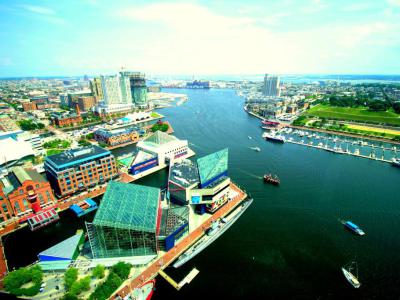
The Top of the World Observation Level is a viewing area on the 27th floor of the World Trade Center. It offers views of the Baltimore skyline and inner harbor.
The Observation Level is fully enclosed. It offers a 360-degree panoramic view, art exhibits, and an exhibit on the city's history. The Top of the World Observation Level also hosts the 9/11 Memorial of Maryland.
Baltimore World Trade Center is the world's tallest pentagonal building. The 30-floor structure 405 feet high was completed in 1977. The building was designed by the firm of the famous architect I.M. Pei (Pei Cobb Freed & Partners,) with the principal architects being Henry Cobb and Pershing Wong.
The Top of the World Observation Level is operated by the Baltimore Office of Promotion and the Arts. The non-profit organization provides support to artists and art programs across Baltimore.
The Top of the World Observation Level is open Wednesday through Sunday. Large groups can schedule private tours of the Observation Level on Mondays and Tuesdays.
The Observation Level is fully enclosed. It offers a 360-degree panoramic view, art exhibits, and an exhibit on the city's history. The Top of the World Observation Level also hosts the 9/11 Memorial of Maryland.
Baltimore World Trade Center is the world's tallest pentagonal building. The 30-floor structure 405 feet high was completed in 1977. The building was designed by the firm of the famous architect I.M. Pei (Pei Cobb Freed & Partners,) with the principal architects being Henry Cobb and Pershing Wong.
The Top of the World Observation Level is operated by the Baltimore Office of Promotion and the Arts. The non-profit organization provides support to artists and art programs across Baltimore.
The Top of the World Observation Level is open Wednesday through Sunday. Large groups can schedule private tours of the Observation Level on Mondays and Tuesdays.
8) Star Spangled Banner Flag House
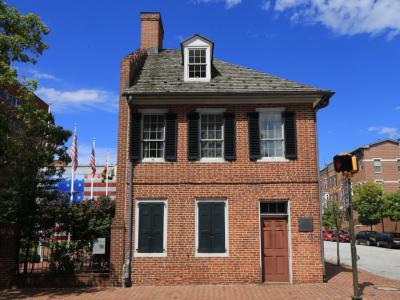
The Star-Spangled Banner Flag House is a museum located in downtown Baltimore. Built in 1793, it was the home of Mary Young Pickersgill, who later sewed the "Star Spangled Banner," the huge out-sized garrison flag that flew over Fort McHenry during the British Royal Navy attack in the Battle of Baltimore during the War of 1812.
The museum contains furniture and antiques from the Federal period as well as items from the Pickersgill family. A supplemental 12,600-square-foot museum was constructed to the rear next to Pickersgill's home. This museum houses exhibits on the War of 1812 and the Battle of Baltimore, featuring a 30 by 42-foot tall window created to be the same color, size, and design of the original "Star-Spangled Banner" flag made by Pickersgill in the adjacent Flag House.
The museum contains furniture and antiques from the Federal period as well as items from the Pickersgill family. A supplemental 12,600-square-foot museum was constructed to the rear next to Pickersgill's home. This museum houses exhibits on the War of 1812 and the Battle of Baltimore, featuring a 30 by 42-foot tall window created to be the same color, size, and design of the original "Star-Spangled Banner" flag made by Pickersgill in the adjacent Flag House.
9) Seven Foot Knoll Light
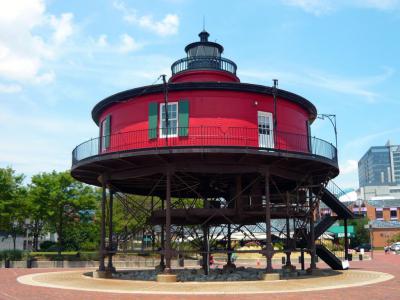
The Seven Foot Knoll Light is a historic lighthouse located in Maryland. It was built in 1855 and is the oldest screw-pile lighthouse in the state. Originally situated atop Seven Foot Knoll in the Chesapeake Bay, the lighthouse was replaced by a modern navigational aid and relocated to Baltimore's Inner Harbor as a museum exhibit.
Constructed of 1-inch rolled iron, the lighthouse is divided into three main sections. The gallery deck, located 9 feet above the average high tide waters, is the first section. The second section is the house where the keeper and his family would live, while the third section is the light beacon, housing a 4th order Fresnel lens visible for 12 nautical miles.
The first requests for a light were made in 1848, and construction began in 1854, with most of the parts fabricated at the Murray and Hazelhurst iron foundry in Baltimore. After being shipped to Seven Foot Knoll, the parts were assembled atop the screw piles. Ice, a perennial threat to screw-pile structures, caused damage in 1884 and 1894, leading to the piling of riprap around the piles.
The light was automated in 1949 and fell into disrepair, eventually being replaced by a skeleton tower. In 1988, the lighthouse was removed from Seven Foot Knoll and placed ashore in Baltimore's Inner Harbor, where it was donated to the city. It was listed on the National Register of Historic Places in 1989 and restored by members of the Steinhice family descendants prior to its re-opening.
The lighthouse is a contributing element in the Baltimore National Heritage Area and part of the Historic American Engineering Record. Thomas Jefferson Steinhise, who served as the keeper from 1930 to 1941, was awarded the Silver Lifesaving Medal for his role in rescuing the crew of the tugboat Point Breeze in 1933. He is buried in Holy Cross Cemetery in Glen Burnie, MD, with a U.S. Lighthouse Service grave-marker.
Constructed of 1-inch rolled iron, the lighthouse is divided into three main sections. The gallery deck, located 9 feet above the average high tide waters, is the first section. The second section is the house where the keeper and his family would live, while the third section is the light beacon, housing a 4th order Fresnel lens visible for 12 nautical miles.
The first requests for a light were made in 1848, and construction began in 1854, with most of the parts fabricated at the Murray and Hazelhurst iron foundry in Baltimore. After being shipped to Seven Foot Knoll, the parts were assembled atop the screw piles. Ice, a perennial threat to screw-pile structures, caused damage in 1884 and 1894, leading to the piling of riprap around the piles.
The light was automated in 1949 and fell into disrepair, eventually being replaced by a skeleton tower. In 1988, the lighthouse was removed from Seven Foot Knoll and placed ashore in Baltimore's Inner Harbor, where it was donated to the city. It was listed on the National Register of Historic Places in 1989 and restored by members of the Steinhice family descendants prior to its re-opening.
The lighthouse is a contributing element in the Baltimore National Heritage Area and part of the Historic American Engineering Record. Thomas Jefferson Steinhise, who served as the keeper from 1930 to 1941, was awarded the Silver Lifesaving Medal for his role in rescuing the crew of the tugboat Point Breeze in 1933. He is buried in Holy Cross Cemetery in Glen Burnie, MD, with a U.S. Lighthouse Service grave-marker.
10) The Horse You Came in On
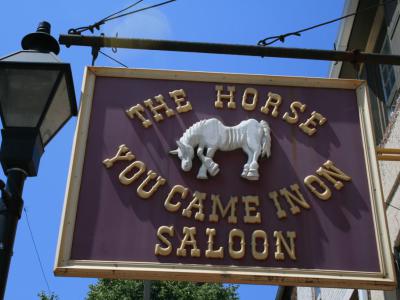
The Horse You Came In On Saloon, commonly known in Baltimore as The Horse, is a saloon in Baltimore. It is the oldest continuously operating saloon in the United States, established in 1775.
The Horse was first called Al and Ann's when built. The name change did not happen until 1972 when it was purchased by Howard Gerber. Though there have been many renovations, the saloon retains the colonial architecture of its 18th-century construction.
The saloon is a popular spot for those on Edgar Allan Poe walking tours. It is believed the last place the poet visited before he died in 1849. A seat at the bar is marked as Poe's Last Stop.
The Horse offers drinks, food, live music, and special events. It is open from 6 PM to 1:30 AM on weeknights, from noon to 1:30 AM on Saturdays, and from noon to 10 PM on Sundays.
The Horse was first called Al and Ann's when built. The name change did not happen until 1972 when it was purchased by Howard Gerber. Though there have been many renovations, the saloon retains the colonial architecture of its 18th-century construction.
The saloon is a popular spot for those on Edgar Allan Poe walking tours. It is believed the last place the poet visited before he died in 1849. A seat at the bar is marked as Poe's Last Stop.
The Horse offers drinks, food, live music, and special events. It is open from 6 PM to 1:30 AM on weeknights, from noon to 1:30 AM on Saturdays, and from noon to 10 PM on Sundays.
11) Frederick Douglass-Isaac Myers Museum & Maritime Park
The Frederick Douglass-Isaac Myers Museum & Maritime Park is a fascinating national heritage site in Baltimore that honors the contributions of African Americans in the city's maritime industry. The museum is housed in one of the oldest waterfront industrial buildings in the city and is a part of the Living Classrooms Foundation campus, which serves as their headquarters.
The museum provides a wealth of information on the African American community's establishment in Baltimore during the 1800s, and the founding of the Chesapeake Marine Railway and Dry Dock Company.
Visitors can learn about the life of Frederick Douglass, one of America's most prominent abolitionists, who spent his childhood and youth enslaved in Baltimore. The museum also features exhibits on Isaac Myers, a freeborn African American who became a national leader.
Whether you're looking for a fun and informative experience for your students or group, or planning a family day out, the Frederick Douglass-Isaac Myers Museum & Maritime Park is an excellent choice.
Visitors can explore the museum and campus to gain a better understanding of Baltimore's African American maritime history and the significant role played by the community in the city's development.
The Frederick Douglass-Isaac Myers Museum & Maritime Park is a must-visit destination for those interested in learning about Baltimore's rich maritime history and the contributions of the African American community. Through its exhibits and educational programs, the museum offers a unique perspective on the city's past and present and serves as a source of inspiration for visitors of all ages.
The museum provides a wealth of information on the African American community's establishment in Baltimore during the 1800s, and the founding of the Chesapeake Marine Railway and Dry Dock Company.
Visitors can learn about the life of Frederick Douglass, one of America's most prominent abolitionists, who spent his childhood and youth enslaved in Baltimore. The museum also features exhibits on Isaac Myers, a freeborn African American who became a national leader.
Whether you're looking for a fun and informative experience for your students or group, or planning a family day out, the Frederick Douglass-Isaac Myers Museum & Maritime Park is an excellent choice.
Visitors can explore the museum and campus to gain a better understanding of Baltimore's African American maritime history and the significant role played by the community in the city's development.
The Frederick Douglass-Isaac Myers Museum & Maritime Park is a must-visit destination for those interested in learning about Baltimore's rich maritime history and the contributions of the African American community. Through its exhibits and educational programs, the museum offers a unique perspective on the city's past and present and serves as a source of inspiration for visitors of all ages.
