Custom Walk in Lucca, Italy by camilleroald_e98c5 created on 2025-11-30
Guide Location: Italy » Lucca
Guide Type: Custom Walk
# of Sights: 7
Tour Duration: 1 Hour(s)
Travel Distance: 2 Km or 1.2 Miles
Share Key: 4JWTZ
Guide Type: Custom Walk
# of Sights: 7
Tour Duration: 1 Hour(s)
Travel Distance: 2 Km or 1.2 Miles
Share Key: 4JWTZ
How It Works
Please retrieve this walk in the GPSmyCity app. Once done, the app will guide you from one tour stop to the next as if you had a personal tour guide. If you created the walk on this website or come to the page via a link, please follow the instructions below to retrieve the walk in the app.
Retrieve This Walk in App
Step 1. Download the app "GPSmyCity: Walks in 1K+ Cities" on Apple App Store or Google Play Store.



Step 2. In the GPSmyCity app, download(or launch) the guide "Lucca Map and Walking Tours".
Step 3. Tap the menu button located at upper right corner of the "Walks" screen and select "Retrieve custom walk". Enter the share key: 4JWTZ
1) Church of San Frediano (must see)
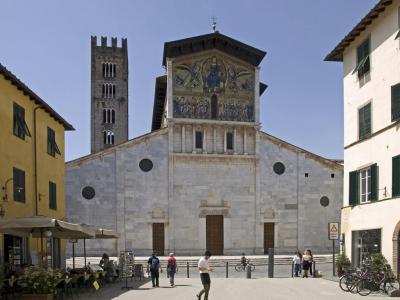
In the 6th century AD, a church was built in Lucca dedicated to the Levites Vincenzo, Stefano and Lorenzo. Fredianus, an Irish pilgrim who became bishop of Lucca in 560 AD, gets credit for the construction. The Basilica today is built in the Romanesque style and it is located in the Piazza San Frediano.
In 1112 the church was rebuilt. It was reconsecrated in 1147 by Pope Eugene III. The church had three naves and an apse. The facade faced east. This was departure from the Dominican custom of facades facing west.
Sometime in the 13th century the central nave was raised and a wooden ceiling installed. In the same period the upper facade received a mosaic of the Ascension of Christ with angels and apostles around the Madonna. The Madonna image was later replaced by the center window.
In the 14th and 16th centuries chapels were built in the side aisles and the facade was extended. The three portals of the facade are marked by pillars under an architrave and blind arches. There is a loggia at the middle level with columns and two single lancet windows. The bell tower, near the apse, dates back to the 13th century.
Inside the church the aisles and nave are set off by columns with round arches. The center nave is high with a wooden truss ceiling.
The basilica is a short walk from the Ampitheater Square.
In 1112 the church was rebuilt. It was reconsecrated in 1147 by Pope Eugene III. The church had three naves and an apse. The facade faced east. This was departure from the Dominican custom of facades facing west.
Sometime in the 13th century the central nave was raised and a wooden ceiling installed. In the same period the upper facade received a mosaic of the Ascension of Christ with angels and apostles around the Madonna. The Madonna image was later replaced by the center window.
In the 14th and 16th centuries chapels were built in the side aisles and the facade was extended. The three portals of the facade are marked by pillars under an architrave and blind arches. There is a loggia at the middle level with columns and two single lancet windows. The bell tower, near the apse, dates back to the 13th century.
Inside the church the aisles and nave are set off by columns with round arches. The center nave is high with a wooden truss ceiling.
The basilica is a short walk from the Ampitheater Square.
2) Piazza dell'Anfiteatro (Amphitheater Square) (must see)
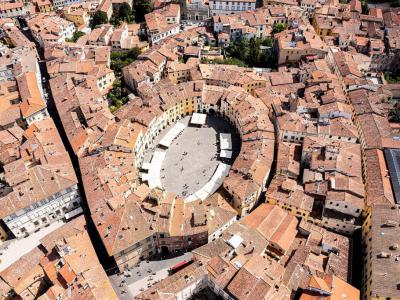
The elliptical square used to be a Roman amphitheater. Built in the 1st century AD in the reign of the Emperor Claudius, it was originally outside the city walls. It was rather large, having fifty-four arches and a seating capacity of ten thousand. Public meetings as well as games and dramas were held in the arena.
In the 6th century AD, during the Gothic wars, the amphitheater became a defensive liability because of its size and position outside the city walls. The amphitheater was fortified by closing the outer arches. In time, other buildings used as houses, storage spaces or prisons were added to the structures around the arena.
During the middle ages the upper parts of the original amphitheater began to disappear. The materials taken were used in the constructions. The arena remained along with a ruined arch or two. Buildings enclosed the space, creating a de facto square. Most of these buildings were military storehouses or used to stock salt or such.
In the early 19th century, architect Lornzo Nottolini, was deeply involved in what was called the Great Project of Tuscany, including the urban renewal of Lucca. Nottolini was commissioned to restore and revive the Piazza based on the Roman ruins of the amphitheater.
Nottolini designed a new open square just as big as the original structure. It followed the elliptical shape of the arena exactly. It became an urban market center and space for open shops. In the early 20th century the official market was shifted to another area but the square continued to be called Market Square (Piazza del Maercato).
The square can be entered only through one of its four doorways. The lowest one of these is part of the original structure of the amphitheater. To enter the market square is to follow in the steps of the Lucchese from ancient times until now.
In the 6th century AD, during the Gothic wars, the amphitheater became a defensive liability because of its size and position outside the city walls. The amphitheater was fortified by closing the outer arches. In time, other buildings used as houses, storage spaces or prisons were added to the structures around the arena.
During the middle ages the upper parts of the original amphitheater began to disappear. The materials taken were used in the constructions. The arena remained along with a ruined arch or two. Buildings enclosed the space, creating a de facto square. Most of these buildings were military storehouses or used to stock salt or such.
In the early 19th century, architect Lornzo Nottolini, was deeply involved in what was called the Great Project of Tuscany, including the urban renewal of Lucca. Nottolini was commissioned to restore and revive the Piazza based on the Roman ruins of the amphitheater.
Nottolini designed a new open square just as big as the original structure. It followed the elliptical shape of the arena exactly. It became an urban market center and space for open shops. In the early 20th century the official market was shifted to another area but the square continued to be called Market Square (Piazza del Maercato).
The square can be entered only through one of its four doorways. The lowest one of these is part of the original structure of the amphitheater. To enter the market square is to follow in the steps of the Lucchese from ancient times until now.
3) Torre Guinigi (Guinigi Tower) (must see)
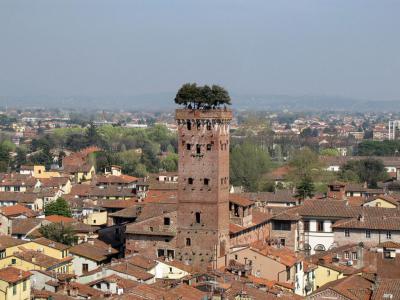
The Guinigi Tower is easy to spot. It is a square tower of bright red brick. It rises to a height of 125 feet and there are Holm oak trees growing on the roof. There is a need to climb the tower, sit in the shade of aged oaks and look out over the ancient city of Lucca. Alert: this urge is irresistible.
The Guinigi Tower was built in 1384. The Guinigis were rich from the silk trade that passed through Lucca at the time. Once Lucca had as many as 250 such towers. Only nine remained after the warlord Castruccio Castracani ordered them demolished. This was in the 14th century, the interesting time of plagues, raids, violence. It was a time for towers.
The towers were not only havens and defensive assets, they were symbols of wealth and power and respect. Every player had to have one. At least one. When Castracani died, the Guinigi took over the city. They would keep their Tower of Power forever.
In 1805 Napoleon ruled in Tuscany. He gave the region to his sister, Elisa, making her the Grand Duchess of Tuscany. It is because of her the walls of the Tower were maintained. It is possible to visit the tower. It is 230 steps up to the observation deck. The original stairs were on the outside. Now they are inside. It's a small mercy.
Of course there are legends about the tower. If one climbs to the top in the evening, one may see a ghostly lady sitting under an oak tree with her pet dog. This is the lady Ilaria, the deceased wife of Paolo Guinigi. If she smiles at you, your heart is pure. If not, well...
The tower is open to the public for a modest fee. Reach the top and the amazing panorama of Lucca will unravel at your feet.
The Guinigi Tower was built in 1384. The Guinigis were rich from the silk trade that passed through Lucca at the time. Once Lucca had as many as 250 such towers. Only nine remained after the warlord Castruccio Castracani ordered them demolished. This was in the 14th century, the interesting time of plagues, raids, violence. It was a time for towers.
The towers were not only havens and defensive assets, they were symbols of wealth and power and respect. Every player had to have one. At least one. When Castracani died, the Guinigi took over the city. They would keep their Tower of Power forever.
In 1805 Napoleon ruled in Tuscany. He gave the region to his sister, Elisa, making her the Grand Duchess of Tuscany. It is because of her the walls of the Tower were maintained. It is possible to visit the tower. It is 230 steps up to the observation deck. The original stairs were on the outside. Now they are inside. It's a small mercy.
Of course there are legends about the tower. If one climbs to the top in the evening, one may see a ghostly lady sitting under an oak tree with her pet dog. This is the lady Ilaria, the deceased wife of Paolo Guinigi. If she smiles at you, your heart is pure. If not, well...
The tower is open to the public for a modest fee. Reach the top and the amazing panorama of Lucca will unravel at your feet.
4) Duomo di San Martino (St. Martin's Cathedral) (must see)
It is said the Cathedral of Saint Martin was founded by San Frediano in the 6th century and rebuilt by Bishop Anselmo da Baggio in 1060. It came into its current form in the 12th and 13th centuries. Anselmo later became Pope Alexander II. In 1372, the apse of the church and the wall of the transept were completed. The style was Gothic.
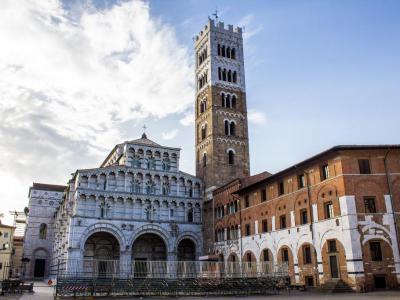
The facade of the church is in three great arches surmounted by three rows of galleries filled with sculptures. To the right of the facade is the bell tower. It has a four-sided base and five rows of windows divided by pilasters. The crown is made of Ghibeline merlons.
The interior is laid out in a Latin cross with three naves. The two side naves are topped by false galleries. The central nave is contained in a semicircular apse with three large Romanesque windows.
The left aisle has a small chapel holding the sacred relic, the Holy Face of Lucca. The relic is a wooden crucifix with the image of Christ, supposedly carved by Christ's contemporary Nicodemus. It is said to have suddenly appeared in Lucca in 742 AD. The chapel itself was built by Matteo Civitali in 1484. Civitali was a sculptor of Renaissance Lucca.
Off the sacristy is the funeral monument of Ilaria del Carretto, made by the sculptor Jacabo della Quercia. Ilaria was the wife of Paolo Guinigi, Lord of Lucca until 1430. The Lady Ilaria died very young. Her image depicts her lying on the sarcophagus as if asleep, her faithful dog at her feet. Her ghost is said to haunt the Guinigi tower at night.
The Cathedral is also famous for its long association with members of the Puccini family who moved to Lucca from the mountain village of Celle in 1719. Giacomo Puccini’s personal involvement with the Duomo began when he was sent here to attend a seminary school.
The Cathedral, at one time, was a home of two magnificent organs: one from the 15th century and the other from the 17th. Little remains of these instruments today but the gallery and frontal pipes are still visible. From the early 1870s, Puccini took part in the Festival of Santa Croce at the Cathedral, first as a boy singer, then as a member of the choir, and later as a deputy organist.
The facade of the church is in three great arches surmounted by three rows of galleries filled with sculptures. To the right of the facade is the bell tower. It has a four-sided base and five rows of windows divided by pilasters. The crown is made of Ghibeline merlons.
The interior is laid out in a Latin cross with three naves. The two side naves are topped by false galleries. The central nave is contained in a semicircular apse with three large Romanesque windows.
The left aisle has a small chapel holding the sacred relic, the Holy Face of Lucca. The relic is a wooden crucifix with the image of Christ, supposedly carved by Christ's contemporary Nicodemus. It is said to have suddenly appeared in Lucca in 742 AD. The chapel itself was built by Matteo Civitali in 1484. Civitali was a sculptor of Renaissance Lucca.
Off the sacristy is the funeral monument of Ilaria del Carretto, made by the sculptor Jacabo della Quercia. Ilaria was the wife of Paolo Guinigi, Lord of Lucca until 1430. The Lady Ilaria died very young. Her image depicts her lying on the sarcophagus as if asleep, her faithful dog at her feet. Her ghost is said to haunt the Guinigi tower at night.
The Cathedral is also famous for its long association with members of the Puccini family who moved to Lucca from the mountain village of Celle in 1719. Giacomo Puccini’s personal involvement with the Duomo began when he was sent here to attend a seminary school.
The Cathedral, at one time, was a home of two magnificent organs: one from the 15th century and the other from the 17th. Little remains of these instruments today but the gallery and frontal pipes are still visible. From the early 1870s, Puccini took part in the Festival of Santa Croce at the Cathedral, first as a boy singer, then as a member of the choir, and later as a deputy organist.
5) Piazza San Michele (San Michele Square)
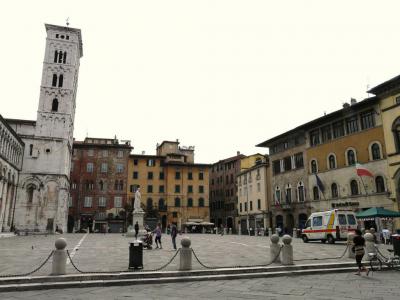
San Michele Square (Piazza San Michele), often called Piazza delle Catene due to its marble columns linked by heavy chains, is one of the most historic and atmospheric squares in Lucca. Its name is derived from the grand Church of San Michele in Foro, which dominates the square with its elaborate Romanesque Gothic façade. Originally established in the 8th century, the church once stood alongside a monastery and a hospice. During medieval times, the piazza was encircled by the Fossa Natali canal, requiring visitors to cross a wooden bridge, Ponte al Foro, to access the church.
The Church of San Michele is a masterpiece of medieval architecture, featuring four tiers of loggias and an imposing marble statue of Archangel Michael slaying a dragon. A local legend whispers that on the sunniest days, an emerald embedded in the statue still gleams-a relic of the past, hidden in plain sight. The church's bell tower, built in the 12th century, was originally taller but was shortened by Giovanni dell’Agnello, Doge of Pisa, to diminish Lucca’s skyline.
The square is framed by medieval buildings, many of which showcase round arches and mullioned windows. Notable among them is Praetorian Palace (Palazzo Pretorio), a striking Renaissance structure located at the corner of Via Vittorio Veneto. Its façade boasts an ornate clock, and within its loggia stand monuments to Matteo Civitali, the renowned Lucchese architect, along with busts of explorer Piaggia and the heroic Strocchi.
Another eye-catching landmark in the square is the statue of Francesco Burlamacchi, sculpted by Ulisse Cambi in 1863. Burlamacchi, a fervent republican and former Gonfaloniere of Lucca, was executed in the 16th century for his ambitious political vision.
Nearby, the Gigli Palace, constructed in 1529, adds to the grandeur of the square. Meanwhile, a bronze statue of Matteo Civitali, crafted by Arnaldo Fazzi, serves as a tribute to the city's artistic heritage.
With its rich blend of Romanesque, Gothic, and Renaissance architecture, San Michele Square remains one of Lucca’s most vibrant spaces, seamlessly merging history, legend, and daily life.
The Church of San Michele is a masterpiece of medieval architecture, featuring four tiers of loggias and an imposing marble statue of Archangel Michael slaying a dragon. A local legend whispers that on the sunniest days, an emerald embedded in the statue still gleams-a relic of the past, hidden in plain sight. The church's bell tower, built in the 12th century, was originally taller but was shortened by Giovanni dell’Agnello, Doge of Pisa, to diminish Lucca’s skyline.
The square is framed by medieval buildings, many of which showcase round arches and mullioned windows. Notable among them is Praetorian Palace (Palazzo Pretorio), a striking Renaissance structure located at the corner of Via Vittorio Veneto. Its façade boasts an ornate clock, and within its loggia stand monuments to Matteo Civitali, the renowned Lucchese architect, along with busts of explorer Piaggia and the heroic Strocchi.
Another eye-catching landmark in the square is the statue of Francesco Burlamacchi, sculpted by Ulisse Cambi in 1863. Burlamacchi, a fervent republican and former Gonfaloniere of Lucca, was executed in the 16th century for his ambitious political vision.
Nearby, the Gigli Palace, constructed in 1529, adds to the grandeur of the square. Meanwhile, a bronze statue of Matteo Civitali, crafted by Arnaldo Fazzi, serves as a tribute to the city's artistic heritage.
With its rich blend of Romanesque, Gothic, and Renaissance architecture, San Michele Square remains one of Lucca’s most vibrant spaces, seamlessly merging history, legend, and daily life.
6) Casa di Puccini (Puccini's Birth Home) (must see)
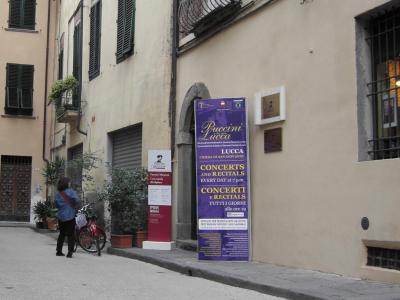
The Puccini Birth Home, located in Corte San Lorenzo, Lucca, is a museum dedicated to the life and works of Giacomo Puccini, one of the most celebrated opera composers in history. This historic house, where Puccini was born on December 22, 1858, and spent his formative years, remains a central piece of the Puccini Museum, preserving the composer’s legacy through an extensive collection of memorabilia, documents, and personal items.
The Puccini family settled in Lucca in the early 18th century, and after the untimely death of Domenico Puccini, Giacomo’s grandfather, in 1815, they relocated to Corte San Lorenzo. His widowed grandmother, Angela Cerù, moved the family there, likely to be closer to her brother Arcangelo Cerù, who provided both moral and financial support to the Puccinis. The house was originally home to multiple generations, including Antonio Puccini, his wife Caterina Tesei, Angela Cerù, and her children, including Michele Puccini, Giacomo’s father.
The museum collection, first established in 1979, has been continuously enriched by private donations and acquisitions. The house was converted into a museum in 1925 by Puccini’s son Antonio, and despite modern enhancements, it retains its original historical appearance. The museum’s restoration efforts have ensured that visitors can experience the home as it was during Puccini’s lifetime, preserving its original furnishings and atmosphere.
Among the notable exhibits inside the museum are Puccini’s Forster and Steinway & Sons pianos, the latter used for composing Turandot. It also features signed scores, manuscripts, rare librettos, and letters with publisher Giulio Ricordi. Highlights include Macchiaioli paintings, hunting trophies, and handwritten drafts of Tosca, La Fanciulla del West, and La Rondine. A standout is a Turandot costume by Umberto Brunelleschi, worn by Maria Jeritza at its 1926 Metropolitan Opera premiere.
The museum includes rooms showcasing Puccini’s personal life, such as the kitchen, veranda, and omnibus room, which holds his funeral mask and portraits. His hunting room displays rifles, boots, and gear. In 1926, his remains were moved to a chapel in the house, where he rests with his family amid musical-themed decor.
Today, the Puccini Birth Home stands as an immersive tribute to the composer’s genius and artistic journey. Located in the heart of Lucca’s historic center, the museum continues to be a cultural landmark, celebrating the enduring legacy of one of opera’s greatest composers.
The Puccini family settled in Lucca in the early 18th century, and after the untimely death of Domenico Puccini, Giacomo’s grandfather, in 1815, they relocated to Corte San Lorenzo. His widowed grandmother, Angela Cerù, moved the family there, likely to be closer to her brother Arcangelo Cerù, who provided both moral and financial support to the Puccinis. The house was originally home to multiple generations, including Antonio Puccini, his wife Caterina Tesei, Angela Cerù, and her children, including Michele Puccini, Giacomo’s father.
The museum collection, first established in 1979, has been continuously enriched by private donations and acquisitions. The house was converted into a museum in 1925 by Puccini’s son Antonio, and despite modern enhancements, it retains its original historical appearance. The museum’s restoration efforts have ensured that visitors can experience the home as it was during Puccini’s lifetime, preserving its original furnishings and atmosphere.
Among the notable exhibits inside the museum are Puccini’s Forster and Steinway & Sons pianos, the latter used for composing Turandot. It also features signed scores, manuscripts, rare librettos, and letters with publisher Giulio Ricordi. Highlights include Macchiaioli paintings, hunting trophies, and handwritten drafts of Tosca, La Fanciulla del West, and La Rondine. A standout is a Turandot costume by Umberto Brunelleschi, worn by Maria Jeritza at its 1926 Metropolitan Opera premiere.
The museum includes rooms showcasing Puccini’s personal life, such as the kitchen, veranda, and omnibus room, which holds his funeral mask and portraits. His hunting room displays rifles, boots, and gear. In 1926, his remains were moved to a chapel in the house, where he rests with his family amid musical-themed decor.
Today, the Puccini Birth Home stands as an immersive tribute to the composer’s genius and artistic journey. Located in the heart of Lucca’s historic center, the museum continues to be a cultural landmark, celebrating the enduring legacy of one of opera’s greatest composers.
7) Church of San Michele (must see)
The full name of the Church is San Michele in Foro. It was built in the Forum, the center of public life in the Commune of the City. The Church dates from 795 AD. Pope Alexander II ordered the Church rebuilt in 1070. The massive Pisan-Baroque facade resembles nothing less than a gigantic wedding cake.
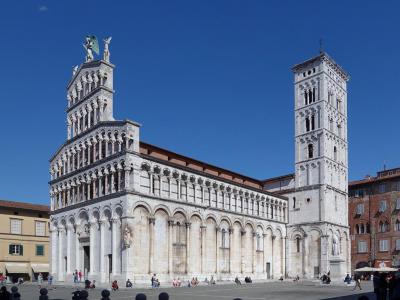
There are four levels of arcades. The upper two tiers are free-standing loggias. The lower section is faced with white marble blind arcades. The center part of the upper facade has an iron-winged statue of Saint Michael spearing the dragon. If one looks closely one may see the emerald on Michael's finger ring.
On the lower right corner of the facade is a statue of Madonna Salute Portus, Made by Matteo Civitali to mark the end of the plague of 1476.
The interior has two aisles and a nave and a transept design with a semicircular apse. The nave is supported by arcades with massive columns. There is a terra-cotta image of the Madonna and child by Andrea della Robbia. A painted mural by Filippo Lippi celebrates saints Helen, Rocco, Gerome, and Sebastian.
The bell tower was built in the 13th century. It rises over the southern transept of the building. The upper level of the tower was cut off in 1366 by the Doge of Pisa, Giovanni dell'Angello, because the bells were too loud.
The basilica is only a short walk from the Lucca train station. The nearest bus station is San Salvatore on the LAM Verde route.
There are four levels of arcades. The upper two tiers are free-standing loggias. The lower section is faced with white marble blind arcades. The center part of the upper facade has an iron-winged statue of Saint Michael spearing the dragon. If one looks closely one may see the emerald on Michael's finger ring.
On the lower right corner of the facade is a statue of Madonna Salute Portus, Made by Matteo Civitali to mark the end of the plague of 1476.
The interior has two aisles and a nave and a transept design with a semicircular apse. The nave is supported by arcades with massive columns. There is a terra-cotta image of the Madonna and child by Andrea della Robbia. A painted mural by Filippo Lippi celebrates saints Helen, Rocco, Gerome, and Sebastian.
The bell tower was built in the 13th century. It rises over the southern transept of the building. The upper level of the tower was cut off in 1366 by the Doge of Pisa, Giovanni dell'Angello, because the bells were too loud.
The basilica is only a short walk from the Lucca train station. The nearest bus station is San Salvatore on the LAM Verde route.
