Custom Walk in Frankfurt, Germany by trevorbradfield8349 created on 2025-12-01
Guide Location: Germany » Frankfurt
Guide Type: Custom Walk
# of Sights: 13
Tour Duration: 4 Hour(s)
Travel Distance: 9.6 Km or 6 Miles
Share Key: FHX22
Guide Type: Custom Walk
# of Sights: 13
Tour Duration: 4 Hour(s)
Travel Distance: 9.6 Km or 6 Miles
Share Key: FHX22
How It Works
Please retrieve this walk in the GPSmyCity app. Once done, the app will guide you from one tour stop to the next as if you had a personal tour guide. If you created the walk on this website or come to the page via a link, please follow the instructions below to retrieve the walk in the app.
Retrieve This Walk in App
Step 1. Download the app "GPSmyCity: Walks in 1K+ Cities" on Apple App Store or Google Play Store.



Step 2. In the GPSmyCity app, download(or launch) the guide "Frankfurt Map and Walking Tours".
Step 3. Tap the menu button located at upper right corner of the "Walks" screen and select "Retrieve custom walk". Enter the share key: FHX22
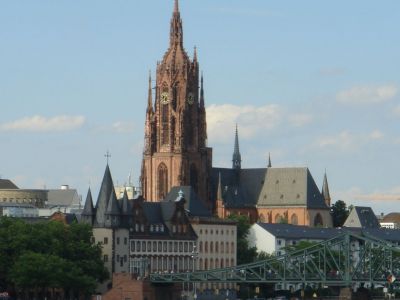
1) Frankfurt Cathedral (Cathedral of St. Bartholomew) (must see)
Frankfurt Cathedral, officially the Cathedral of Saint Bartholomew, is one of the most important historic landmarks in Frankfurt. Built mainly between the 14th and 15th centuries from deep red Main sandstone, the church rises prominently above the surrounding Old Town. Its Gothic tower reaches about 95 meters and remains one of the city’s most recognizable landmarks.
Although it was never a bishop’s seat, the cathedral played a major political role in the Holy Roman Empire. Between 1562 and 1792, ten Holy Roman Emperors were crowned here, giving the church its long-standing nickname, the “Imperial Cathedral.”
Enter through the vestibule, the modern entrance added in 1879 or 1880. From here you can access the cloister, which today houses the Frankfurt Cathedral Museum, as well as the tower hall. Inside the church, the central nave is flanked by two aisles separated by six great Gothic pillars, three on each side, and along the wall of the left aisle you’ll notice several tombs dating from the 16th to the 18th centuries.
Continue toward the High Choir just ahead, built between 1315 and 1349 and one of the best-preserved parts of the cathedral. It survived both the major fire of 1867 and much of the destruction caused by Allied bombing in 1944. At its center stands the high altar, on the left of it you’ll see the Apostles’ Farewell Altar from 1523, while on the right stands the Altar of Our Lady, made in southern Germany in the 15th century. Wooden choir stalls line the walls and are decorated with carved scenes of the Resurrection, reflecting the central Christian theme of redemption and eternal life.
Here you’ll also find one of the cathedral’s most important monuments: the tomb of King Günther von Schwarzburg, the only German king buried in Frankfurt. The tomb shows the king in full armor with a sword and shield, with two lions at his feet. The cathedral also preserves a relic of Saint Bartholomew—part of the apostle’s skull kept here since the 13th century, which helped establish the church as an important religious center in medieval Frankfurt.
Make sure to climb the cathedral tower during your visit. After 328 steps you reach a viewing platform about 66 meters above the ground. From here, you’ll enjoy a beautiful panoramic view over the narrow streets of the reconstructed Old Town, the River Main, and Frankfurt’s modern skyline.
Although it was never a bishop’s seat, the cathedral played a major political role in the Holy Roman Empire. Between 1562 and 1792, ten Holy Roman Emperors were crowned here, giving the church its long-standing nickname, the “Imperial Cathedral.”
Enter through the vestibule, the modern entrance added in 1879 or 1880. From here you can access the cloister, which today houses the Frankfurt Cathedral Museum, as well as the tower hall. Inside the church, the central nave is flanked by two aisles separated by six great Gothic pillars, three on each side, and along the wall of the left aisle you’ll notice several tombs dating from the 16th to the 18th centuries.
Continue toward the High Choir just ahead, built between 1315 and 1349 and one of the best-preserved parts of the cathedral. It survived both the major fire of 1867 and much of the destruction caused by Allied bombing in 1944. At its center stands the high altar, on the left of it you’ll see the Apostles’ Farewell Altar from 1523, while on the right stands the Altar of Our Lady, made in southern Germany in the 15th century. Wooden choir stalls line the walls and are decorated with carved scenes of the Resurrection, reflecting the central Christian theme of redemption and eternal life.
Here you’ll also find one of the cathedral’s most important monuments: the tomb of King Günther von Schwarzburg, the only German king buried in Frankfurt. The tomb shows the king in full armor with a sword and shield, with two lions at his feet. The cathedral also preserves a relic of Saint Bartholomew—part of the apostle’s skull kept here since the 13th century, which helped establish the church as an important religious center in medieval Frankfurt.
Make sure to climb the cathedral tower during your visit. After 328 steps you reach a viewing platform about 66 meters above the ground. From here, you’ll enjoy a beautiful panoramic view over the narrow streets of the reconstructed Old Town, the River Main, and Frankfurt’s modern skyline.
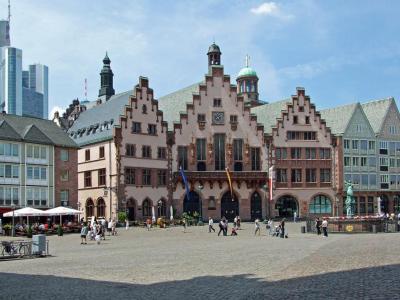
2) Römerberg (Square) (must see)
Römerberg Square is the historic heart of Frankfurt’s Old Town and one of the most recognizable places in the city. For centuries this square served as Frankfurt’s main marketplace and the stage for major public events, including imperial ceremonies, medieval trade fairs, and civic celebrations. Today it remains one of the most visited parts of the city, surrounded by historic buildings that reflect Frankfurt’s long past. At the western side of the square stands the Römer, Frankfurt’s historic city hall, whose distinctive stepped gables have become one of the city’s most iconic architectural images.
As you stand in the square, look toward the row of colorful half-timbered houses on the eastern side. This line of buildings, known as the Eastern Row, was reconstructed in the 1980s to recreate the historic appearance of Römerberg before the destruction of the Second World War. Each house features steep roofs, wooden beams, and decorative façades typical of traditional German architecture. Today these buildings house cafés, restaurants, and small shops, making this side of the square one of the most photographed spots in Frankfurt.
Walk toward the center of the square and you’ll find the Justice Fountain, a Renaissance fountain dating from the 16th century. At the top stands a statue of Lady Justice holding a sword and scales. During the coronation celebrations of Holy Roman Emperors, the fountain famously flowed with wine instead of water so that the crowds gathered here could join the festivities. Nearby, on the southern side, stands Old Saint Nicholas Church, a Gothic church that has watched over the square since the 13th century and once served merchants and travelers who came to the city’s markets.
Today Römerberg remains one of the liveliest places in Frankfurt. The square regularly hosts festivals, public gatherings, and seasonal markets, including the famous Frankfurt Christmas Market, which attracts visitors from around the world each winter. Surrounded by reconstructed historic buildings and anchored by the city hall, the square offers one of the clearest glimpses into Frankfurt’s medieval past while remaining an active gathering place for the city today.
As you stand in the square, look toward the row of colorful half-timbered houses on the eastern side. This line of buildings, known as the Eastern Row, was reconstructed in the 1980s to recreate the historic appearance of Römerberg before the destruction of the Second World War. Each house features steep roofs, wooden beams, and decorative façades typical of traditional German architecture. Today these buildings house cafés, restaurants, and small shops, making this side of the square one of the most photographed spots in Frankfurt.
Walk toward the center of the square and you’ll find the Justice Fountain, a Renaissance fountain dating from the 16th century. At the top stands a statue of Lady Justice holding a sword and scales. During the coronation celebrations of Holy Roman Emperors, the fountain famously flowed with wine instead of water so that the crowds gathered here could join the festivities. Nearby, on the southern side, stands Old Saint Nicholas Church, a Gothic church that has watched over the square since the 13th century and once served merchants and travelers who came to the city’s markets.
Today Römerberg remains one of the liveliest places in Frankfurt. The square regularly hosts festivals, public gatherings, and seasonal markets, including the famous Frankfurt Christmas Market, which attracts visitors from around the world each winter. Surrounded by reconstructed historic buildings and anchored by the city hall, the square offers one of the clearest glimpses into Frankfurt’s medieval past while remaining an active gathering place for the city today.
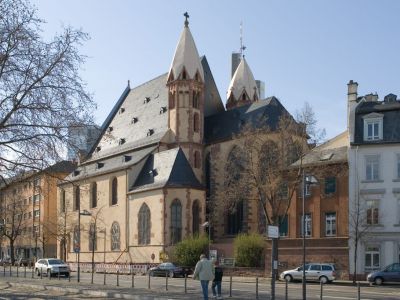
3) St. Leonhard Church
Founded in 1219, this Roman Catholic parish church, located in the heart of Frankfurt, offers an English liturgy to an international congregation. The church has six heavy bells that peal and resonate across the city and one of the best stained glass windows in Hesse.
The Saint Leonhard’s church was first dedicated to the Virgin Mary and Saint George under a decree by Emperor Freidrich II in 1219. The first building had a Romanesque design and the original portals still remain. In 1323, the parish officials obtained a relic of Saint Leonhard and the church adopted Saint Leonhard as its patron saint. Between the 1400s and 1500s, gothic style structures were added to the building including the five aisles. The structure served other purposes through the years including as a warehouse for the nearby Book Fair and in the 1700s, as a place to store ammunition. In the 1800s donations by a wealthy parishioner Von Dalberg and purchases made by the then pastor Father Muenzenberger gave the church its ornate altarpieces and sculpted figures that survive till today. In the 1900s the floor of Saint Leonhard’s Church was raised to prevent flooding by the River Main.
Saint Leonhard’s remains a thriving international catholic parish with a congregation composed of people from over 50 countries coming to mass every week.
The Saint Leonhard’s church was first dedicated to the Virgin Mary and Saint George under a decree by Emperor Freidrich II in 1219. The first building had a Romanesque design and the original portals still remain. In 1323, the parish officials obtained a relic of Saint Leonhard and the church adopted Saint Leonhard as its patron saint. Between the 1400s and 1500s, gothic style structures were added to the building including the five aisles. The structure served other purposes through the years including as a warehouse for the nearby Book Fair and in the 1700s, as a place to store ammunition. In the 1800s donations by a wealthy parishioner Von Dalberg and purchases made by the then pastor Father Muenzenberger gave the church its ornate altarpieces and sculpted figures that survive till today. In the 1900s the floor of Saint Leonhard’s Church was raised to prevent flooding by the River Main.
Saint Leonhard’s remains a thriving international catholic parish with a congregation composed of people from over 50 countries coming to mass every week.
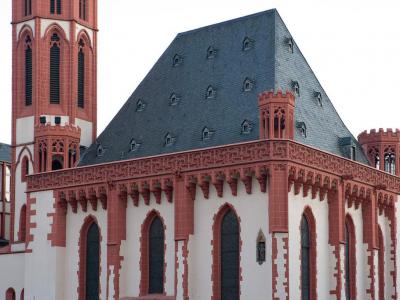
4) Old Saint Nicholas Church (Alte Nikolaikirche)
Old Saint Nicholas Church stands on the southern edge of Römerberg, Frankfurt’s historic market square, and is one of the oldest surviving buildings in the Old Town. The church dates back to the 13th century, when a small chapel was built near the busy trade route that crossed the River Main. Its location beside the square meant that merchants, travelers, and city officials regularly passed through this area, making the church closely connected to the daily life of medieval Frankfurt.
The present structure largely reflects late Gothic architecture from the 15th century. From Römerberg Square, you can easily recognize the church by its slender tower and steep rooflines, which stand out among the surrounding historic buildings. The tower also houses a carillon, a set of tuned bells that are played at regular times during the day. Their sound carries across the square and has become part of the atmosphere of Frankfurt’s historic center.
Inside you’ll notice that the interior feels modest compared with the nearby Frankfurt Cathedral. The church has a simple layout with a bright nave and Gothic elements that reflect its medieval origins. Over the centuries, Old Saint Nicholas Church was closely connected to civic ceremonies held in the square and nearby city hall.
Today the church belongs to the Evangelical Church in Frankfurt and continues to host services, concerts, and small events. Its position beside Römerberg Square makes it one of the most recognizable historic buildings in the Old Town.
The present structure largely reflects late Gothic architecture from the 15th century. From Römerberg Square, you can easily recognize the church by its slender tower and steep rooflines, which stand out among the surrounding historic buildings. The tower also houses a carillon, a set of tuned bells that are played at regular times during the day. Their sound carries across the square and has become part of the atmosphere of Frankfurt’s historic center.
Inside you’ll notice that the interior feels modest compared with the nearby Frankfurt Cathedral. The church has a simple layout with a bright nave and Gothic elements that reflect its medieval origins. Over the centuries, Old Saint Nicholas Church was closely connected to civic ceremonies held in the square and nearby city hall.
Today the church belongs to the Evangelical Church in Frankfurt and continues to host services, concerts, and small events. Its position beside Römerberg Square makes it one of the most recognizable historic buildings in the Old Town.
5) Römer (City Hall) (must see)
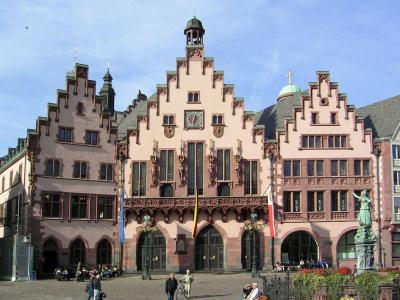
The Römer, Frankfurt’s historic city hall, stands at the heart of Römerberg Square and has been the political center of the city for more than six centuries. The complex takes its name from the central medieval house called House of the Romans (or Haus Römer in german), which the city council purchased in 1405 along with a neighboring building. Over time, additional houses were incorporated, eventually forming a complex of several interconnected buildings that still serve as Frankfurt’s municipal government today. Because of its long history and prominent location, the Römer has become one of the most recognizable landmarks in the city and a focal point of Frankfurt’s historic Old Town.
Facing Römerberg Square is the building’s famous façade with three distinctive stepped gables, a design that has become one of Frankfurt’s most recognizable architectural images. The statues placed on the façade represent four Holy Roman Emperors connected to Frankfurt’s imperial history. They depict Frederick Barbarossa, the first king elected in Frankfurt; Louis the Bavarian, who granted important trade and fair privileges that allowed the city to expand; Charles IV, who established Frankfurt as the official location for imperial elections; and Maximilian II, the first emperor to be crowned in Frankfurt Cathedral. These emperors recall Frankfurt’s importance as the place where German kings were elected and later crowned.
Inside the building is one of the City Hall's most significant historic spaces: the Imperial Hall (or Kaisersaal in german). After coronations at the nearby Frankfurt Cathedral, newly crowned Holy Roman Emperors traditionally held their ceremonial banquets here. The hall is lined with portraits of all Holy Roman Emperors, creating a visual record of imperial history that stretches from Charlemagne to Francis II.
The balcony on the front of the Römer has taken on a new role in modern times. Today it is the place where Frankfurt’s sports teams celebrate major victories, appearing on the balcony to greet thousands of fans gathered in Römerberg Square below.
Facing Römerberg Square is the building’s famous façade with three distinctive stepped gables, a design that has become one of Frankfurt’s most recognizable architectural images. The statues placed on the façade represent four Holy Roman Emperors connected to Frankfurt’s imperial history. They depict Frederick Barbarossa, the first king elected in Frankfurt; Louis the Bavarian, who granted important trade and fair privileges that allowed the city to expand; Charles IV, who established Frankfurt as the official location for imperial elections; and Maximilian II, the first emperor to be crowned in Frankfurt Cathedral. These emperors recall Frankfurt’s importance as the place where German kings were elected and later crowned.
Inside the building is one of the City Hall's most significant historic spaces: the Imperial Hall (or Kaisersaal in german). After coronations at the nearby Frankfurt Cathedral, newly crowned Holy Roman Emperors traditionally held their ceremonial banquets here. The hall is lined with portraits of all Holy Roman Emperors, creating a visual record of imperial history that stretches from Charlemagne to Francis II.
The balcony on the front of the Römer has taken on a new role in modern times. Today it is the place where Frankfurt’s sports teams celebrate major victories, appearing on the balcony to greet thousands of fans gathered in Römerberg Square below.
6) Paulskirche (St. Paul's Church)
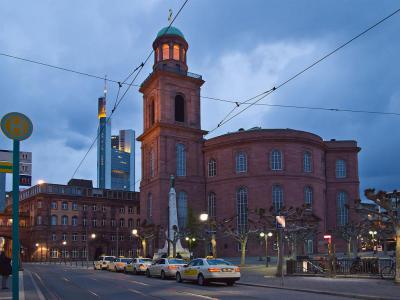
The oval-shaped church of Saint Paul in the Zeil district of Frankfurt is easily spotted for its red sandstone exterior. Formerly a protestant temple, it was built between 1789 and 1833 to serve the local Evangelical Lutheran congregation. Still, more than for its religious service and architecture, this neoclassical-style edifice is renowned for its role in the shaping of German democracy.
In 1848, during the so-called German revolutions, the Frankfurt Parliament convened here, being the first publicly and freely-elected German legislative body. The parliamentarians chose the building because of its typical Protestant centralized design, allowing everybody to easily hear the speaker.
In 1848, the National Assembly met inside the church for the first time and was therefore named the Paulskirchenparlament. Representatives from Germany and Austria worked on the premises until 1849 to draft a Charter of Basic Rights and a Constitution for a united Germany on the basis of popular self-determination. The attempt subsequently failed and the building resumed service as a church.
During WWII, Paulskirsche suffered extensive damage from bombings. After the war, its exterior was painstakingly restored, while the interior was somewhat simplified. Nonetheless, the striking feature of the interior is a modern mural depicting the procession of the people’s representatives into Paulskrische which today stands as the symbol of German democracy.
Presently, the building is used as a venue for various events and exhibitions including the Peace Prize of the German Book Trade and the Goethe Prize by the city of Frankfurt. The hall on the first floor is used for municipal and other functions.
Why You Should Visit:
Free entry, with a wealth of information in English covering the German democratic process.
Tip:
Pop in for the excellent art exhibition in the basement (pieces are for sale but are on the expensive side).
Upstairs you can visit the room in which JFK gave his brief speech in 1963.
In 1848, during the so-called German revolutions, the Frankfurt Parliament convened here, being the first publicly and freely-elected German legislative body. The parliamentarians chose the building because of its typical Protestant centralized design, allowing everybody to easily hear the speaker.
In 1848, the National Assembly met inside the church for the first time and was therefore named the Paulskirchenparlament. Representatives from Germany and Austria worked on the premises until 1849 to draft a Charter of Basic Rights and a Constitution for a united Germany on the basis of popular self-determination. The attempt subsequently failed and the building resumed service as a church.
During WWII, Paulskirsche suffered extensive damage from bombings. After the war, its exterior was painstakingly restored, while the interior was somewhat simplified. Nonetheless, the striking feature of the interior is a modern mural depicting the procession of the people’s representatives into Paulskrische which today stands as the symbol of German democracy.
Presently, the building is used as a venue for various events and exhibitions including the Peace Prize of the German Book Trade and the Goethe Prize by the city of Frankfurt. The hall on the first floor is used for municipal and other functions.
Why You Should Visit:
Free entry, with a wealth of information in English covering the German democratic process.
Tip:
Pop in for the excellent art exhibition in the basement (pieces are for sale but are on the expensive side).
Upstairs you can visit the room in which JFK gave his brief speech in 1963.
7) Saint Catherine's (Katharinenkirche)
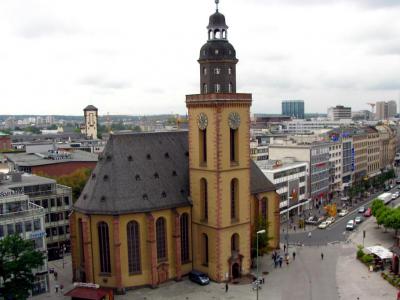
The Saint Catherine Church (Katherinenkirche), located near the busy Hauptwache Plaza in Frankfurt, is the largest Lutheran church in the city and was constructed between 1678 and 1681.
It stands on the site of a vestal cloister and hospital once run by the Teutonic Knights order. Later, a small parish church was built on the site which gained importance in history because, in 1522, it became the setting of the first protestant sermon in Frankfurt. The church was consecrated in 1681 and dedicated to the martyred Saint Catherine of Alexandria.
The single-vessel hall church had a tower at the side and ornamental gateways; just like many other buildings in the city, it was destroyed during the bombings of 1944. The parishioners and citizens of Frankfurt rebuilt the property in 1954, carefully reconstructing the original exterior, although with a somewhat simpler interior.
Among the well-known parishioners who have worshiped at Ketherinenkirche, over the years, were the likes of the Goethe family; Johann Wolfgang von Goethe was baptized here. Also, near the church, at some point, was the Katharinenpforte prison where, in 1771, a child murderer Susanna Margaretha Brandt was incarcerated. Her beheading strongly affected 22-year-old Goethe, who witnessed it. Later, he used some of the Brandt case details in the ‘Faust’ poem.
It stands on the site of a vestal cloister and hospital once run by the Teutonic Knights order. Later, a small parish church was built on the site which gained importance in history because, in 1522, it became the setting of the first protestant sermon in Frankfurt. The church was consecrated in 1681 and dedicated to the martyred Saint Catherine of Alexandria.
The single-vessel hall church had a tower at the side and ornamental gateways; just like many other buildings in the city, it was destroyed during the bombings of 1944. The parishioners and citizens of Frankfurt rebuilt the property in 1954, carefully reconstructing the original exterior, although with a somewhat simpler interior.
Among the well-known parishioners who have worshiped at Ketherinenkirche, over the years, were the likes of the Goethe family; Johann Wolfgang von Goethe was baptized here. Also, near the church, at some point, was the Katharinenpforte prison where, in 1771, a child murderer Susanna Margaretha Brandt was incarcerated. Her beheading strongly affected 22-year-old Goethe, who witnessed it. Later, he used some of the Brandt case details in the ‘Faust’ poem.
8) Old Opera House (Alte Oper) (must see)
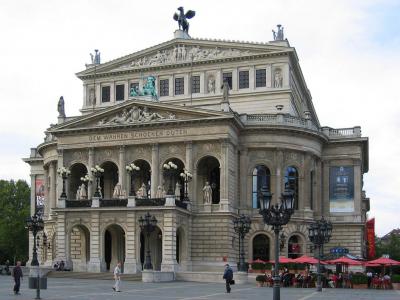
Perched above a picturesque square adorned with a graceful fountain lies the Opera House, sporting a Renaissance-style façade. This historic edifice, known by the moniker "Alte Oper," or "the Old Opera House," stands in place of a predecessor that graced the location from 1880 to 1944.
The inaugural Frankfurt Opera House, conceived by the Berlin-based architect Richard Lucae, made its debut in 1880, with Kaiser Wilhelm I presiding over the grand opening. The architectural design exuded the opulence expected of a venue patronized by royalty, showcasing Renaissance aesthetics. Tragically, during World War II, the structure suffered complete devastation. Following extensive deliberations among Frankfurt's residents, a new building arose, echoing the design of its predecessor. While the lobby and façade maintained their Renaissance architectural charm, the remainder of the structure underwent a transformation into a versatile modern complex, housing banquet halls, concert venues, and a convention center. This Opera House now fulfills the dual role of a cultural hub and a gathering place for Frankfurt's denizens.
At the Alte Oper, visitors can relish classical and popular music concerts. The edifice takes on an enchanting allure in the evening, its exterior adorned with splendid statues of Goethe and Mozart, who preside over the square below.
Why You Should Visit:
Great location to spend time in Frankfurt – beautifully restored theatre in a beautifully designed square.
Tip:
Both the café and the restaurant are generally busy in the evening, so try and reserve a spot in advance.
During a nice warm day, try and grab a seat outside, enjoy a cup of coffee/glass of wine and people watch.
The inaugural Frankfurt Opera House, conceived by the Berlin-based architect Richard Lucae, made its debut in 1880, with Kaiser Wilhelm I presiding over the grand opening. The architectural design exuded the opulence expected of a venue patronized by royalty, showcasing Renaissance aesthetics. Tragically, during World War II, the structure suffered complete devastation. Following extensive deliberations among Frankfurt's residents, a new building arose, echoing the design of its predecessor. While the lobby and façade maintained their Renaissance architectural charm, the remainder of the structure underwent a transformation into a versatile modern complex, housing banquet halls, concert venues, and a convention center. This Opera House now fulfills the dual role of a cultural hub and a gathering place for Frankfurt's denizens.
At the Alte Oper, visitors can relish classical and popular music concerts. The edifice takes on an enchanting allure in the evening, its exterior adorned with splendid statues of Goethe and Mozart, who preside over the square below.
Why You Should Visit:
Great location to spend time in Frankfurt – beautifully restored theatre in a beautifully designed square.
Tip:
Both the café and the restaurant are generally busy in the evening, so try and reserve a spot in advance.
During a nice warm day, try and grab a seat outside, enjoy a cup of coffee/glass of wine and people watch.
9) Naturmuseum Senckenberg (must see)
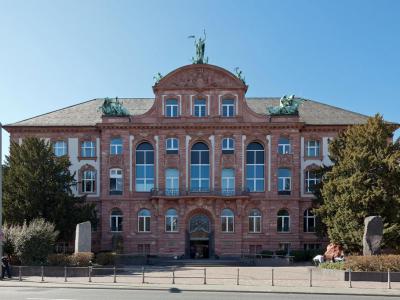
The Naturmuseum Senckenberg is a natural history museum, and it's the second-largest of its kind in Germany. It's particularly popular among children because of its extensive collection of dinosaur fossils, which is the largest exhibition of large dinosaurs in Europe. One remarkable exhibit in the museum features a dinosaur fossil with well-preserved scaled skin.
Inside the museum, you'll find a vast and diverse collection of birds, including 90,000 bird skins, 5,050 egg sets, 17,000 skeletons, and 3,375 spirit specimens. In 2010, nearly 517,000 people visited the museum.
Today at the museum, you'll encounter life-size dinosaur recreations outside, crafted using the latest scientific knowledge. Inside, follow Titanosaurus tracks on the floor to its skeleton on a covered patio.
Some of the main attractions at the museum include a Diplodocus (donated by the American Museum of Natural History in 1907), the crested Hadrosaur Parasaurolophus, a fossilized Psittacosaurus with visible bristles around its tail and fossilized stomach contents, and an Oviraptor. The Tyrannosaurus rex, an original Iguanodon, and the museum's mascot, the Triceratops, are also big crowd-pleasers.
While the dinosaurs draw the most attention due to their size, the Senckenberg Museum also houses a comprehensive collection of animal exhibits from different epochs in Earth's history. For instance, there are original specimens from the Messel pit, such as field mice, reptiles, fish, and a prehistoric horse that lived approximately 50 million years ago and stood less than 60 centimeters tall.
One of the museum's unique features in Europe is a cast of Lucy, an almost complete skeleton of the upright hominid Australopithecus afarensis. The upper levels of the museum are adorned with historical cabinets filled with stuffed animals, including one of only twenty known examples of the quagga, an extinct animal since 1883.
Since its remodeling in 2003, the museum's new reptile exhibit addresses both the biodiversity of reptiles and amphibians and the topic of nature conservation. An accessible rainforest tree provides views of various zones within the rainforest, from the forest floor to the canopy, showcasing the habitats to which exotic reptiles have adapted.
The Senckenberg Museum also hosts regular evening lectures and tours, including a notable lecture by Alfred Wegener on January 6, 1912, which marked the first public presentation of the theory of Continental Drift.
Inside the museum, you'll find a vast and diverse collection of birds, including 90,000 bird skins, 5,050 egg sets, 17,000 skeletons, and 3,375 spirit specimens. In 2010, nearly 517,000 people visited the museum.
Today at the museum, you'll encounter life-size dinosaur recreations outside, crafted using the latest scientific knowledge. Inside, follow Titanosaurus tracks on the floor to its skeleton on a covered patio.
Some of the main attractions at the museum include a Diplodocus (donated by the American Museum of Natural History in 1907), the crested Hadrosaur Parasaurolophus, a fossilized Psittacosaurus with visible bristles around its tail and fossilized stomach contents, and an Oviraptor. The Tyrannosaurus rex, an original Iguanodon, and the museum's mascot, the Triceratops, are also big crowd-pleasers.
While the dinosaurs draw the most attention due to their size, the Senckenberg Museum also houses a comprehensive collection of animal exhibits from different epochs in Earth's history. For instance, there are original specimens from the Messel pit, such as field mice, reptiles, fish, and a prehistoric horse that lived approximately 50 million years ago and stood less than 60 centimeters tall.
One of the museum's unique features in Europe is a cast of Lucy, an almost complete skeleton of the upright hominid Australopithecus afarensis. The upper levels of the museum are adorned with historical cabinets filled with stuffed animals, including one of only twenty known examples of the quagga, an extinct animal since 1883.
Since its remodeling in 2003, the museum's new reptile exhibit addresses both the biodiversity of reptiles and amphibians and the topic of nature conservation. An accessible rainforest tree provides views of various zones within the rainforest, from the forest floor to the canopy, showcasing the habitats to which exotic reptiles have adapted.
The Senckenberg Museum also hosts regular evening lectures and tours, including a notable lecture by Alfred Wegener on January 6, 1912, which marked the first public presentation of the theory of Continental Drift.
10) Städel Art Museum (must see)
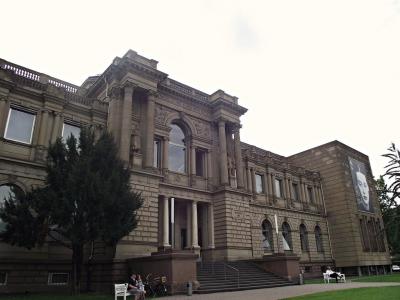
The Städel Museum, situated along the River Main, holds an extensive collection of artworks spanning seven centuries. Its galleries showcase paintings created by renowned artists from the 14th century to the present day. The Städel Institute is dedicated to the instruction and support of local artists.
Founded in 1816 by the influential Frankfurt banker Johann Friedrich Städel, the museum was established to house his extensive art collection. Städel generously donated both his collection and his residence to the city. In 1878, a new, grand building in the German Grunderzeit architectural style was designed by architect Oskar Sommer to serve as a repository for the subsequent art acquisitions made by the museum.
The museum's art collection encompasses a diverse range, including Flemish primitives, Impressionist and Post-Modernist works, pieces by Dutch and German masters from the 17th and 18th centuries, 19th-century French and German Romantic paintings, as well as creations from later artistic movements such as Cubism, Impressionism, and Expressionism. Notable modern artworks in the collection include pieces by artists like Bacon, Dubuffet, and Yves Klein. Some of the gallery's treasures include the portrait of Goethe in the Italian countryside by Tischbein, 'The Geographer' by Johannes Vermeer, and the 'Lucca Madonna' by Jan van Eyck. Additionally, the building houses a sizable library featuring a wide range of art books and periodicals.
Why You Should Visit:
Based on ease of access and the permanent exhibits (including not just modern and some contemporary art, but also items going back a very long time), quite a terrific museum.
It is large and you can easily spend hours and hours here. The presentation is spacious and generally well-lit while the staff are friendly and helpful.
Tip:
Come early to enjoy the quietness of the place.
Consider downloading the museum's app on your phone, as it gives a great insight into much of the artwork.
Founded in 1816 by the influential Frankfurt banker Johann Friedrich Städel, the museum was established to house his extensive art collection. Städel generously donated both his collection and his residence to the city. In 1878, a new, grand building in the German Grunderzeit architectural style was designed by architect Oskar Sommer to serve as a repository for the subsequent art acquisitions made by the museum.
The museum's art collection encompasses a diverse range, including Flemish primitives, Impressionist and Post-Modernist works, pieces by Dutch and German masters from the 17th and 18th centuries, 19th-century French and German Romantic paintings, as well as creations from later artistic movements such as Cubism, Impressionism, and Expressionism. Notable modern artworks in the collection include pieces by artists like Bacon, Dubuffet, and Yves Klein. Some of the gallery's treasures include the portrait of Goethe in the Italian countryside by Tischbein, 'The Geographer' by Johannes Vermeer, and the 'Lucca Madonna' by Jan van Eyck. Additionally, the building houses a sizable library featuring a wide range of art books and periodicals.
Why You Should Visit:
Based on ease of access and the permanent exhibits (including not just modern and some contemporary art, but also items going back a very long time), quite a terrific museum.
It is large and you can easily spend hours and hours here. The presentation is spacious and generally well-lit while the staff are friendly and helpful.
Tip:
Come early to enjoy the quietness of the place.
Consider downloading the museum's app on your phone, as it gives a great insight into much of the artwork.
11) Museumsufer (must see)
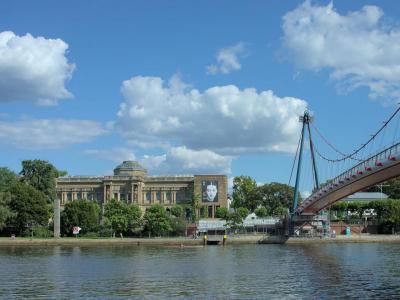
Museumsufer is a collection of museums located in Frankfurt, Hesse, Germany. These museums are situated along both sides of the Main River or in its immediate vicinity. The centerpiece of this cultural enclave is the historic Städel art museum. Other museums were incorporated into this complex during the 1980s, either by repurposing historic villas or constructing new museum buildings. This expansion was spearheaded by the cultural leader, Hilmar Hoffmann.
The concept of establishing a group of diverse museums in Frankfurt was initially proposed by Hoffmann in 1977, during his tenure as the city's cultural director (Kulturdezernent). Previously, architect Till Behrens had presented the "Frankfurter Grüngürtel" concept to the Forum for Development (Frankfurter Forum für Stadtentwicklung).
From 1980 to 1990, the existing museums underwent expansions, and numerous new ones were constructed. These endeavors often involved the adaptation of historic villas. Renowned architects such as Richard Meier, Oswald Mathias Ungers, Josef Paul Kleihues, Günter Behnisch, and Hans Hollein contributed to these architectural projects.
Starting in 2008, Frankfurt embarked on a program to restore and enhance some of its museums. Notable developments include an annex to the Städel and the renovation of the Fil Museum.
Two prominent festivals revolve around the Museumsufer: the "Nacht der Museen," during which several museums open their doors at night, and the "Museumsuferfest," held in August.
The concept of establishing a group of diverse museums in Frankfurt was initially proposed by Hoffmann in 1977, during his tenure as the city's cultural director (Kulturdezernent). Previously, architect Till Behrens had presented the "Frankfurter Grüngürtel" concept to the Forum for Development (Frankfurter Forum für Stadtentwicklung).
From 1980 to 1990, the existing museums underwent expansions, and numerous new ones were constructed. These endeavors often involved the adaptation of historic villas. Renowned architects such as Richard Meier, Oswald Mathias Ungers, Josef Paul Kleihues, Günter Behnisch, and Hans Hollein contributed to these architectural projects.
Starting in 2008, Frankfurt embarked on a program to restore and enhance some of its museums. Notable developments include an annex to the Städel and the renovation of the Fil Museum.
Two prominent festivals revolve around the Museumsufer: the "Nacht der Museen," during which several museums open their doors at night, and the "Museumsuferfest," held in August.
12) Synagogue Friedberger Anlage
Synagogue Friedberger Anlage is the former location of a Jewish synagogue in Frankfurt that was deliberately destroyed by the Nazis.
The synagogue was built from 1905 to 1907 and was characterized by a transitional style of Reform architecture with elements of Romanesque and Orientalism. On November 10, 1938, it fell victim to arson organized by the Nazis as part of the November pogroms of 1938. The police ordered the demolition of the building due to the risk of collapse. The destruction began on November 17, 1938, and was completed on June 12, 1939.
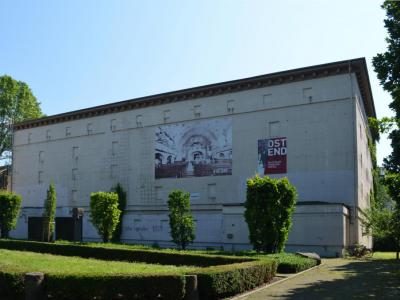
In 1942 or 1943, a five-story bunker was built on the site. While the surrounding East End district was badly damaged by air raids, the bunker remained intact. After the war, from 1947 to 1965, it served as book storage and a university library, and then as a furniture store from 1968 to 1988.
The Friedberger Anlage Synagogue Memorial Site, designed by landscape architect Jeannette Garnhartner, was erected in the forecourt of the bunker in 1988. The bunker itself now houses a permanent exhibition about Jewish life in Frankfurt's East End.
The synagogue was built from 1905 to 1907 and was characterized by a transitional style of Reform architecture with elements of Romanesque and Orientalism. On November 10, 1938, it fell victim to arson organized by the Nazis as part of the November pogroms of 1938. The police ordered the demolition of the building due to the risk of collapse. The destruction began on November 17, 1938, and was completed on June 12, 1939.
In 1942 or 1943, a five-story bunker was built on the site. While the surrounding East End district was badly damaged by air raids, the bunker remained intact. After the war, from 1947 to 1965, it served as book storage and a university library, and then as a furniture store from 1968 to 1988.
The Friedberger Anlage Synagogue Memorial Site, designed by landscape architect Jeannette Garnhartner, was erected in the forecourt of the bunker in 1988. The bunker itself now houses a permanent exhibition about Jewish life in Frankfurt's East End.
13) The Old Jewish Cemetery, Battonn Street
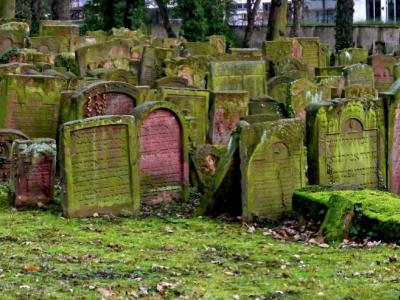
Battonn Street Cemetery in Frankfurt is the second-oldest Jewish burial site in Germany; the first documented mention of it dates back to 1180. Throughout history, the size of the cemetery has hardly changed. The oldest surviving tombstone at Battonn Street is dated July 12, 1272, whereas many Frankfurt Jews – victims of the pogrom known as the “Frankfurt Jewish Battle” – had found their final resting place here as early as 1241. The very last burial at the cemetery took place on September 16, 1828, after which the cemetery had to be closed, being overcrowded with nearly 6,500 graves.
Under the Nazi regime, in 1942, 4,666 gravestones were demolished and piled up as rubble for removal. Some of these stone heaps can still be seen today. One hundred seventy-five gravestones were removed but not crushed, and ended up in the newer Jewish cemetery on Rat-Beil Street. In the 1950s, they were returned, but because there was no information about their original location, they could only be placed along the cemetery wall.
The gravestones of important religious and secular personalities have been grouped together in a place of honor. The grave of Meir Anschel Rothschild, founder of the Rothschild banking house, is one of the most famous grave sites on the grounds.
The Battonn Street Cemetery is permanently closed; those who wish to visit may obtain the key at the neighboring Jewish Lane Museum, except on Jewish holidays, Mondays, and Saturdays. Guided tours are offered every second Sunday and can be booked by phone at the museum. The entrance to the cemetery is via the gate on Battonn Street.
Under the Nazi regime, in 1942, 4,666 gravestones were demolished and piled up as rubble for removal. Some of these stone heaps can still be seen today. One hundred seventy-five gravestones were removed but not crushed, and ended up in the newer Jewish cemetery on Rat-Beil Street. In the 1950s, they were returned, but because there was no information about their original location, they could only be placed along the cemetery wall.
The gravestones of important religious and secular personalities have been grouped together in a place of honor. The grave of Meir Anschel Rothschild, founder of the Rothschild banking house, is one of the most famous grave sites on the grounds.
The Battonn Street Cemetery is permanently closed; those who wish to visit may obtain the key at the neighboring Jewish Lane Museum, except on Jewish holidays, Mondays, and Saturdays. Guided tours are offered every second Sunday and can be booked by phone at the museum. The entrance to the cemetery is via the gate on Battonn Street.
