Custom Walk in Milan, Italy by pbelonojko_94b77 created on 2025-12-11
Guide Location: Italy » Milan
Guide Type: Custom Walk
# of Sights: 16
Tour Duration: 4 Hour(s)
Travel Distance: 7.7 Km or 4.8 Miles
Share Key: 7JNES
Guide Type: Custom Walk
# of Sights: 16
Tour Duration: 4 Hour(s)
Travel Distance: 7.7 Km or 4.8 Miles
Share Key: 7JNES
How It Works
Please retrieve this walk in the GPSmyCity app. Once done, the app will guide you from one tour stop to the next as if you had a personal tour guide. If you created the walk on this website or come to the page via a link, please follow the instructions below to retrieve the walk in the app.
Retrieve This Walk in App
Step 1. Download the app "GPSmyCity: Walks in 1K+ Cities" on Apple App Store or Google Play Store.



Step 2. In the GPSmyCity app, download(or launch) the guide "Milan Map and Walking Tours".
Step 3. Tap the menu button located at upper right corner of the "Walks" screen and select "Retrieve custom walk". Enter the share key: 7JNES
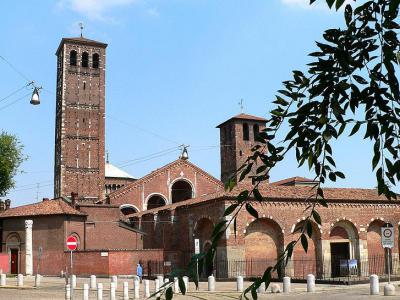
1) Basilica di Sant'Ambrogio (Basilica of St. Ambrose)
Saint Ambrose, Milan's patron saint and one-time superstar bishop, is buried in the crypt of this red-brick cathedral, which he founded in 379 CE. It's a fitting legacy, built and rebuilt with a purposeful simplicity that is truly uplifting: the seminal Lombard Romanesque basilica, considered to be one of the most ancient churches in Italy and one of the most historically interesting medieval buildings in Lombardy.
Over the years, the cathedral has undergone several restorations and partial reconstructions, culminating in its current appearance in the 12th century. The structure is adorned with two bell towers: the right one, called dei Monaci ("of the Monks"), dates back to the 9th century, and exudes a defensive severity typical of such structures. The left tower, higher than the former, was constructed in 1144, with the last two floors added in 1889.
As you step inside, you will be greeted by shimmering altar mosaics and a biographical golden altarpiece that once clad the saint's sarcophagus. The shadowy vaulted interior of the cathedral is brilliantly illuminated by these stunning artworks, taking visitors on a journey back in time to a bygone era.
Why You Should Visit:
The impressive architecture is best to be seen from afar and you won't be disappointed at entering. You won't find fancy, elaborate gilded decorations but will be able to see 6th-century columns, a 4th-century mosaic, a 10-century ciborium, medieval statues, Renaissance frescoes and a magnificent golden altar from the year 835.
Over the years, the cathedral has undergone several restorations and partial reconstructions, culminating in its current appearance in the 12th century. The structure is adorned with two bell towers: the right one, called dei Monaci ("of the Monks"), dates back to the 9th century, and exudes a defensive severity typical of such structures. The left tower, higher than the former, was constructed in 1144, with the last two floors added in 1889.
As you step inside, you will be greeted by shimmering altar mosaics and a biographical golden altarpiece that once clad the saint's sarcophagus. The shadowy vaulted interior of the cathedral is brilliantly illuminated by these stunning artworks, taking visitors on a journey back in time to a bygone era.
Why You Should Visit:
The impressive architecture is best to be seen from afar and you won't be disappointed at entering. You won't find fancy, elaborate gilded decorations but will be able to see 6th-century columns, a 4th-century mosaic, a 10-century ciborium, medieval statues, Renaissance frescoes and a magnificent golden altar from the year 835.
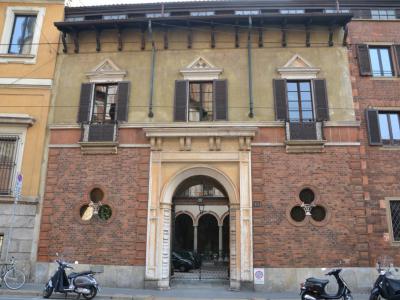
2) Casa Atellani (Atellani House)
Behold Casa Atellani, an awe-inspiring 15th-century palace located in the heart of Milan. During the reign of Ludovico Maria Sforza, regent of the Duchy of Milan, he generously granted building permits to his courtiers and collaborators to construct lavish buildings along the road axis of the ancient village of Porta Vercellina. The Atellani family, one of the privileged courtiers, purchased this palace from the Landi counts of Piacenza in 1490, and the Duke donated it to them. The palace was famous for the sumptuous parties thrown by the Atellanis, which attracted the most prominent personalities of the Sforza court, and the tales of their grandeur were documented in several chronicles of that era.
Besides featuring 15th-century frescoes, coats of arms, and paintings, this palace also boasts of neoclassical elements dating back to the 1920s restoration executed by the iconic architect Piero Portaluppi. Regrettably, the palace was severely damaged during the Second World War by air raids; however, its glorious garden, which encompasses the renowned Da Vinci's Vineyard, has endured the ravages of time.
When Leonardo da Vinci was working on The Last Supper mural, he lodged in Casa Atellani. The Duke gifted the property's vineyard, a rectangular plot of 60x175 meters, to the artist in 1498 as a tribute to his prodigious talent. Being from a family of winemakers, Leonardo cherished this vineyard, and even after he left Milan, he remained emotionally attached to it.
During the Expo 2015, the University of Milan collaborated with the Casa Atellani administration to replant Leonardo's vineyard. The replanting was based on the DNA analysis of the remains of the Malvasia di Candia Aromatica vines, a white grape variety that was popular during the Renaissance period, discovered during excavations. This was done in an attempt to recreate the wine that Leonardo may have tasted himself.
A visit to the vineyard is undoubtedly a must-do activity while in Da Vinci's Milan. However, one needs to book in advance to witness the glory of this living history.
Besides featuring 15th-century frescoes, coats of arms, and paintings, this palace also boasts of neoclassical elements dating back to the 1920s restoration executed by the iconic architect Piero Portaluppi. Regrettably, the palace was severely damaged during the Second World War by air raids; however, its glorious garden, which encompasses the renowned Da Vinci's Vineyard, has endured the ravages of time.
When Leonardo da Vinci was working on The Last Supper mural, he lodged in Casa Atellani. The Duke gifted the property's vineyard, a rectangular plot of 60x175 meters, to the artist in 1498 as a tribute to his prodigious talent. Being from a family of winemakers, Leonardo cherished this vineyard, and even after he left Milan, he remained emotionally attached to it.
During the Expo 2015, the University of Milan collaborated with the Casa Atellani administration to replant Leonardo's vineyard. The replanting was based on the DNA analysis of the remains of the Malvasia di Candia Aromatica vines, a white grape variety that was popular during the Renaissance period, discovered during excavations. This was done in an attempt to recreate the wine that Leonardo may have tasted himself.
A visit to the vineyard is undoubtedly a must-do activity while in Da Vinci's Milan. However, one needs to book in advance to witness the glory of this living history.
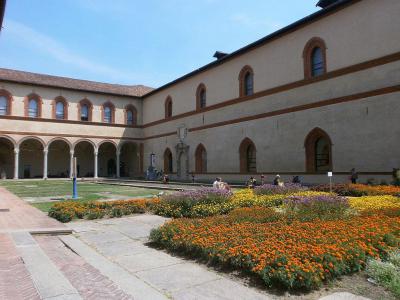
3) Pinacoteca Castello Sforzesco (Sforzesco Castle Art Gallery)
Inaugurated in 1878, this well-known art gallery, part of the Sforza Castle Museums complex in Milan, showcases more than 230 artworks, including masterpieces by Titian, Andrea Mantegna, Canaletto, Antonello da Messina, Pisanello, Vincenzo Foppa, Giovanni Bellini, Correggio, Bernardino Luini, Lorenzo Lotto, and Tintoretto, among others. The museum's complete collection has been enriched over the last two centuries by generous donations from illustrious citizens and collectors and now boasts over 1,500 artworks.
The first section of the Pinacoteca features religious paintings from the 15th and 16th centuries, including works by Lombard and Italian Renaissance painters such as Vincenzo Foppa, Bergognone, Bramantino, Carlo Crivelli, and Bernardino Luini. This part of the museum includes the Trivulzio Madonna, a masterpiece by Andrea Mantegna dating back to 1497, and another Trivulzio Madonna by Filippo Lippi.
The second half of the Pinacoteca displays works from the 16th, 17th, and 18th centuries, including secular and religious pieces by artists such as Canaletto, Giambattista Tiepolo, Bernardo Bellotto, Titian, and Tintoretto.
Visitors can also view portraits of members of the Sforza family from the 15th and 16th centuries.
Tip:
Definitely get the audio guide and be prepared with a proximity card for your payment as for some odd reason they do not have the capability of accepting the usual chip card (fortunately, Google Pay works).
While there are 14 different exhibitions in the Castle itself, please note that some of these are closed in the afternoon. A ticket for all exhibitions in the Castle comes at a very reasonable cost.
The first section of the Pinacoteca features religious paintings from the 15th and 16th centuries, including works by Lombard and Italian Renaissance painters such as Vincenzo Foppa, Bergognone, Bramantino, Carlo Crivelli, and Bernardino Luini. This part of the museum includes the Trivulzio Madonna, a masterpiece by Andrea Mantegna dating back to 1497, and another Trivulzio Madonna by Filippo Lippi.
The second half of the Pinacoteca displays works from the 16th, 17th, and 18th centuries, including secular and religious pieces by artists such as Canaletto, Giambattista Tiepolo, Bernardo Bellotto, Titian, and Tintoretto.
Visitors can also view portraits of members of the Sforza family from the 15th and 16th centuries.
Tip:
Definitely get the audio guide and be prepared with a proximity card for your payment as for some odd reason they do not have the capability of accepting the usual chip card (fortunately, Google Pay works).
While there are 14 different exhibitions in the Castle itself, please note that some of these are closed in the afternoon. A ticket for all exhibitions in the Castle comes at a very reasonable cost.
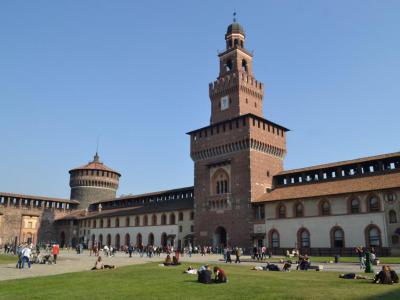
4) Castello Sforzesco (Sforzesco Castle) (must see)
Castello Sforzesco, one of the largest fortresses in Europe, was originally built in the 14th century to house the Duchy of Milan. Despite its long history of battles, invasions, sacking and destruction, the castle has endured and been restored many times. One of its towers, the Filarete tower, once used to store ammunition, famously exploded in 1521 after being struck by lightning, causing many casualties and significant damage to the fortress.
During the Napoleonic era, the castle was severely damaged and used as quarters for troops, including stables in the frescoed rooms on the ground floor of the Corte Ducale. However, following Italy's Unification in the late 19th century, the castle was reconstructed by architect Luca Beltrami and returned to the city of Milan in 1905. Today, it is a prominent hub of art and culture, boasting seven museums accessible to the public.
The interior of is adorned with exquisitely detailed works of art, notably the intricate ceiling fresco in the magnificent Sala delle Asse, painted by Leonardo da Vinci, who was commissioned by his patrons, the Sforza family. The fresco depicts a pergola in a garden with 16 mulberry trees held together by a golden rope.
Why You Should Visit:
Each room herein is a treasure, not only for the exhibited items, but also for the ceiling frescoes which are wonders in their own right.
Entrance to the castle is free, so if you're on a budget, just walk through and admire the courtyards and architecture. As for the "all museums" fee, it is quite reasonable.
Tip:
Exploring the entire Castello Sforzesco, complete with its gardens, may take a few days.
Try to go on Tuesday around 2pm to get free entry (entry on the 1st and 3rd Tuesday of every month is free for all public museums).
There's no way to access the battlements or the "inside" (aside from the museums) except by a guided tour, so consider booking one in advance.
During the Napoleonic era, the castle was severely damaged and used as quarters for troops, including stables in the frescoed rooms on the ground floor of the Corte Ducale. However, following Italy's Unification in the late 19th century, the castle was reconstructed by architect Luca Beltrami and returned to the city of Milan in 1905. Today, it is a prominent hub of art and culture, boasting seven museums accessible to the public.
The interior of is adorned with exquisitely detailed works of art, notably the intricate ceiling fresco in the magnificent Sala delle Asse, painted by Leonardo da Vinci, who was commissioned by his patrons, the Sforza family. The fresco depicts a pergola in a garden with 16 mulberry trees held together by a golden rope.
Why You Should Visit:
Each room herein is a treasure, not only for the exhibited items, but also for the ceiling frescoes which are wonders in their own right.
Entrance to the castle is free, so if you're on a budget, just walk through and admire the courtyards and architecture. As for the "all museums" fee, it is quite reasonable.
Tip:
Exploring the entire Castello Sforzesco, complete with its gardens, may take a few days.
Try to go on Tuesday around 2pm to get free entry (entry on the 1st and 3rd Tuesday of every month is free for all public museums).
There's no way to access the battlements or the "inside" (aside from the museums) except by a guided tour, so consider booking one in advance.
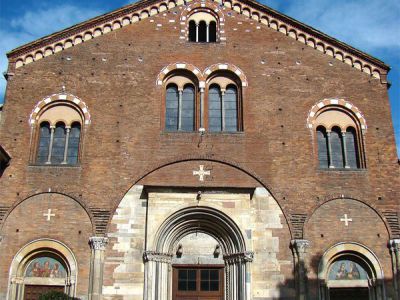
5) Basilica di San Simpliciano (Basilica of St. Simplician)
This basilica dates back to the early days of Christianity, with its construction beginning in the 4th century. Dedicated to Saint Simplician, an early Christian martyr who served as the bishop of Milan at that time, it has undergone several renovations and restorations over time, including significant ones during the Romanesque and Gothic periods, resulting in its present-day Romanesque appearance. Despite the renovations, the basilica remains the second oldest known Christian church with a Latin cross layout.
The bell tower, situated on the right side of the facade, was lowered by 25 meters in the 16th century due to Don Ferrante Gonzaga finding it annoying that it was higher than his castle, which was a common practice at the time.
Inside, the basilica's side chapels feature decorations from various eras, including the Renaissance, Baroque, Rococo, and Neoclassical. The right transept houses a painting by Alessandro Varotari depicting the "Defeat of the Cammolesi", while the apse vault features what is considered Ambrogio da Fossano's masterpiece, the "Incoronation of Mary".
The bell tower, situated on the right side of the facade, was lowered by 25 meters in the 16th century due to Don Ferrante Gonzaga finding it annoying that it was higher than his castle, which was a common practice at the time.
Inside, the basilica's side chapels feature decorations from various eras, including the Renaissance, Baroque, Rococo, and Neoclassical. The right transept houses a painting by Alessandro Varotari depicting the "Defeat of the Cammolesi", while the apse vault features what is considered Ambrogio da Fossano's masterpiece, the "Incoronation of Mary".
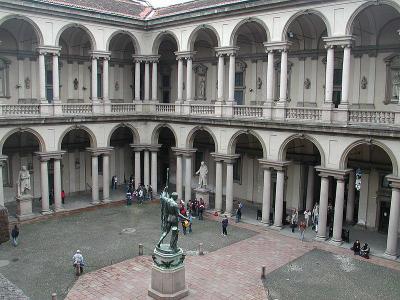
6) Pinacoteca di Brera (Brera Art Gallery) (must see)
Pinacoteca di Brera is an art collection containing some of the most valuable Italian paintings gathered from the churches and monasteries taken over during the Napoleonic rule. Located on the street of the same name, the gallery is surrounded by traditional cafes loved by the locals. The statue of Napoleon greets visitors upon entering through the main gate. The first floor of the building is occupied by the Accademia di Belle Arti, while the picture gallery itself is situated on the second floor.
There are nearly 40 rooms featuring great masterpieces, like Andrea Mantegna's amazingly foreshortened "Dead Christ", Raphael's "Betrothal of the Virgin", and Piero della Francesca's "Madonna with Saints". The museum also showcases over 500 paintings from the Venetian and Lombard schools spanning the 14th-19th centuries, in a chronological order that demonstrates the progression of painting techniques. Additionally, there is a modern art section with paintings by Modigliani and Picasso.
The gallery has an onsite restoration lab, plus a cute little garden in the backyard, filled with aromatic herbs, flowers, climbers and vegetable plants. Among them are Europe's oldest ginkgo biloba trees, which were brought from China in the early 1700s and reach up to 30 feet in height.
Why You Should Visit:
Visiting Pinacoteca di Brera is an opportunity to appreciate exclusive works by Italy's most renowned artists from the 13th-20th centuries, and after finishing your visit, you can explore the lovely Brera neighborhood for food and drinks. Great way to spend a morning or afternoon!
Tip:
Take a good look at the free map to understand the flow of the gallery and to find the rooms that interest you most. To appreciate the paintings fully, get an audio guide.
Another advice would be to use the seats whenever available; there is much to see here, so sitting down every now and again is highly recommended.
There are nearly 40 rooms featuring great masterpieces, like Andrea Mantegna's amazingly foreshortened "Dead Christ", Raphael's "Betrothal of the Virgin", and Piero della Francesca's "Madonna with Saints". The museum also showcases over 500 paintings from the Venetian and Lombard schools spanning the 14th-19th centuries, in a chronological order that demonstrates the progression of painting techniques. Additionally, there is a modern art section with paintings by Modigliani and Picasso.
The gallery has an onsite restoration lab, plus a cute little garden in the backyard, filled with aromatic herbs, flowers, climbers and vegetable plants. Among them are Europe's oldest ginkgo biloba trees, which were brought from China in the early 1700s and reach up to 30 feet in height.
Why You Should Visit:
Visiting Pinacoteca di Brera is an opportunity to appreciate exclusive works by Italy's most renowned artists from the 13th-20th centuries, and after finishing your visit, you can explore the lovely Brera neighborhood for food and drinks. Great way to spend a morning or afternoon!
Tip:
Take a good look at the free map to understand the flow of the gallery and to find the rooms that interest you most. To appreciate the paintings fully, get an audio guide.
Another advice would be to use the seats whenever available; there is much to see here, so sitting down every now and again is highly recommended.
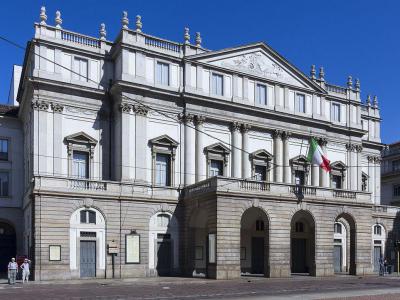
7) La Scala (Opera House and Museum) (must see)
The La Scala Theatre Chorus, Ballet, and Orchestra make it one of the premier musical theaters worldwide. Inaugurated in 1778, the famous opera house in Milan has welcomed some of the finest singers from Italy and around the globe.
After the Teatro Regio Ducale burned down in 1776, a new theater was erected on the site of the former church of Santa Maria alla Scala, from which it derived its name. The cost of building the theater was covered by sales of theatrical boxes, which were exquisitely decorated and made a lasting impression on guests, including the prominent French author Stendhal. Soon, La Scala became a preferred gathering spot for high society. In accordance with the tradition of the time, the main floor had no chairs, and audiences had to stand to watch the shows. Additionally, the orchestra pit had yet to be constructed.
Badly damaged during World War II, La Scala underwent a complete restoration before reopening in 1946. To commemorate the occasion, Arturo Toscanini arranged an unforgettable concert featuring a sensational solo by Renata Tebaldi. From 2002 to 2004, the theater underwent a major renovation. Despite its plain facade, the La Scala interior is stunningly elegant and intimate, surpassing that of opera houses in New York and London.
Why You Should Visit:
The La Scala Orchestra, comprising 135 musicians, is one of the world's most outstanding orchestras for opera productions, known for its ability to produce a uniform and distinguished sound. The theater is also internationally acclaimed for its symphonic activities. The La Scala museum houses one of the richest and most coveted collections of music-themed artifacts worldwide. A tour of the theater provides a rare opportunity to sit in its most prominent box and take photos.
Tip:
Do not buy second-row balcony tickets unless you are quite tall.
After 6pm, same-day tickets are sold at a substantial discount.
After the Teatro Regio Ducale burned down in 1776, a new theater was erected on the site of the former church of Santa Maria alla Scala, from which it derived its name. The cost of building the theater was covered by sales of theatrical boxes, which were exquisitely decorated and made a lasting impression on guests, including the prominent French author Stendhal. Soon, La Scala became a preferred gathering spot for high society. In accordance with the tradition of the time, the main floor had no chairs, and audiences had to stand to watch the shows. Additionally, the orchestra pit had yet to be constructed.
Badly damaged during World War II, La Scala underwent a complete restoration before reopening in 1946. To commemorate the occasion, Arturo Toscanini arranged an unforgettable concert featuring a sensational solo by Renata Tebaldi. From 2002 to 2004, the theater underwent a major renovation. Despite its plain facade, the La Scala interior is stunningly elegant and intimate, surpassing that of opera houses in New York and London.
Why You Should Visit:
The La Scala Orchestra, comprising 135 musicians, is one of the world's most outstanding orchestras for opera productions, known for its ability to produce a uniform and distinguished sound. The theater is also internationally acclaimed for its symphonic activities. The La Scala museum houses one of the richest and most coveted collections of music-themed artifacts worldwide. A tour of the theater provides a rare opportunity to sit in its most prominent box and take photos.
Tip:
Do not buy second-row balcony tickets unless you are quite tall.
After 6pm, same-day tickets are sold at a substantial discount.
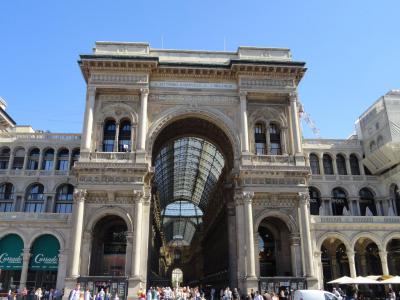
8) Galleria Vittorio Emanuele II (Vittorio Emanuele II Gallery) (must see)
Galleria Vittorio Emanuele II is a fashionable five-storey mall covered in curved glass, topped with iron roof and lavishly decorated with patriotic mosaics and statues – legacy of the chaotic era of Italian unification, manifesting the country's newly-acquired self-confidence.
It was built between 1865 and 1877 by architect Giuseppe Mengoni – who is also credited with the monumental design of the entire area between the Milan Cathedral and La Scala – and is named after Vittorio Emanuele II, the first king of unified Italy. Officially inaugurated on September 15, 1867, the Galleria's completion took another ten years of continuous work. Tragically, just a day before it was over, in December 1877, Giuseppe Mengoni died in accident, falling down from the top of the triumphal arch.
Designed in the form of a Latin cross, the gallery comprises two glass-vaulted covered passages, with the longer one being 196 meters and the shorter – 105.5 meters long, crossing in an octagonal central piazza below an impressive 47-meter high, 36-meter wide glass dome. Incorporating iron and arching glass, the Galleria's architectural design proved groundbreaking for the creation of enclosed shopping malls in the 19th century. Moreover, its use of an iron structure inspired the Eiffel Tower in Paris.
An interesting feature of the gallery is the floor adorned with marble mosaics depicting emblems of the main Italian cities. Locals believe that stepping on the bull's image in the middle of the floor with a heel of the right foot and spinning around can bring good luck. Adherence to this tradition has already left a hole there.
Why You Should Visit:
Almost like stepping into the picture of 19th-century Milan with its lights, colors, windows and landscaping that will never fade in your memory.
There are a few restaurants (incidentally not very expensive, considering it's 'the mall') where you can sit back, eat to your heart's content, and watch the crowds go by.
There's also a very nice Leonardo Museum at the end of the mall, bang opposite the statue of Leonardo da Vinci.
Tip:
Try to visit late at night or early in the morning when there aren't that many people in.
Don't forget to find the "bull" on the floor and have fun!
It was built between 1865 and 1877 by architect Giuseppe Mengoni – who is also credited with the monumental design of the entire area between the Milan Cathedral and La Scala – and is named after Vittorio Emanuele II, the first king of unified Italy. Officially inaugurated on September 15, 1867, the Galleria's completion took another ten years of continuous work. Tragically, just a day before it was over, in December 1877, Giuseppe Mengoni died in accident, falling down from the top of the triumphal arch.
Designed in the form of a Latin cross, the gallery comprises two glass-vaulted covered passages, with the longer one being 196 meters and the shorter – 105.5 meters long, crossing in an octagonal central piazza below an impressive 47-meter high, 36-meter wide glass dome. Incorporating iron and arching glass, the Galleria's architectural design proved groundbreaking for the creation of enclosed shopping malls in the 19th century. Moreover, its use of an iron structure inspired the Eiffel Tower in Paris.
An interesting feature of the gallery is the floor adorned with marble mosaics depicting emblems of the main Italian cities. Locals believe that stepping on the bull's image in the middle of the floor with a heel of the right foot and spinning around can bring good luck. Adherence to this tradition has already left a hole there.
Why You Should Visit:
Almost like stepping into the picture of 19th-century Milan with its lights, colors, windows and landscaping that will never fade in your memory.
There are a few restaurants (incidentally not very expensive, considering it's 'the mall') where you can sit back, eat to your heart's content, and watch the crowds go by.
There's also a very nice Leonardo Museum at the end of the mall, bang opposite the statue of Leonardo da Vinci.
Tip:
Try to visit late at night or early in the morning when there aren't that many people in.
Don't forget to find the "bull" on the floor and have fun!
9) AC Milan store
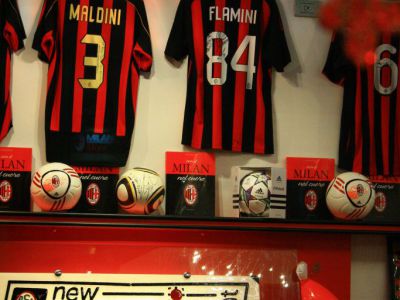
Italians' passion for soccer is a well-known fact worldwide, and naturally, every Italian city has its own football team that its citizens passionately support. Milan, a city famous for fashion and design, is home to two prominent football clubs: AC Milan and Internazionale, also known as Inter. The term "football" has entered the Italian lexicon as a synonym for "calcio," and AC Milan is the preferred team for the majority of locals and foreigners living in Milan. If you're a fan of the game and want to show your love for Milan's football spirit, purchasing official merchandise from AC Milan or Inter is a must.
This store, located on Galleria S. Carlo, is the perfect destination for fans looking for original jerseys of their favorite football players. Prices range between 75 to 125 euros, depending on the star player you wish to represent. The store also carries a vast selection of other items, such as scarves (10 to 20 euros), mugs (~5 euros), woolen caps (16 to 25 euros), bathrobes (55 euros), and more, making it easy to find unique gifts for friends and family.
This store, located on Galleria S. Carlo, is the perfect destination for fans looking for original jerseys of their favorite football players. Prices range between 75 to 125 euros, depending on the star player you wish to represent. The store also carries a vast selection of other items, such as scarves (10 to 20 euros), mugs (~5 euros), woolen caps (16 to 25 euros), bathrobes (55 euros), and more, making it easy to find unique gifts for friends and family.
10) Chiesa di San Bernardino alle Ossa (Church of Bones) (must see)
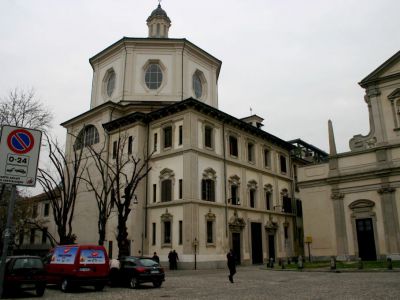
The small church of San Bernardino alle Ossa is famous for its unique decoration, which includes human skulls and bones; a fascinating example of how death and religion have been intertwined throughout history.
The church has origins dating back to the 13th century, when its ossuary served as the final resting place for the victims of the plague from the nearby San Barnaba hospital. It was reconstructed in rococo style in 1679 after its collapse due to the fallen bell tower of the neighboring Santo Stefano church. The walls of the reconstructed ossuary, adorned with a frescoed vault depicting the "Triumph of Souls among Flying Angels," are now adorned with an eerie display of human bones, including the skulls of executed prisoners.
The chapel-Ossuary left such an impression on King John V of Portugal that in 1738 he had an exact replica made in Évora, near Lisbon.
All in all, a must-see destination for anyone interested in macabre art and architecture.
Why You Should Visit:
Not many churches out there are decorated with thousands of human bones – in Rococo style, at that!
For those with a macabre side or an interest in medieval Christianity, you have to see this place in the middle of urban Milan.
Tip:
You can take photos in here but are not allowed to use flash... or talk.
The church has origins dating back to the 13th century, when its ossuary served as the final resting place for the victims of the plague from the nearby San Barnaba hospital. It was reconstructed in rococo style in 1679 after its collapse due to the fallen bell tower of the neighboring Santo Stefano church. The walls of the reconstructed ossuary, adorned with a frescoed vault depicting the "Triumph of Souls among Flying Angels," are now adorned with an eerie display of human bones, including the skulls of executed prisoners.
The chapel-Ossuary left such an impression on King John V of Portugal that in 1738 he had an exact replica made in Évora, near Lisbon.
All in all, a must-see destination for anyone interested in macabre art and architecture.
Why You Should Visit:
Not many churches out there are decorated with thousands of human bones – in Rococo style, at that!
For those with a macabre side or an interest in medieval Christianity, you have to see this place in the middle of urban Milan.
Tip:
You can take photos in here but are not allowed to use flash... or talk.
11) Chiesa di San Gottardo in Corte (Church of St. Gotthard of Hildesheim)
The Church of Saint Gotthard is a hidden gem of undeniable beauty, almost entirely concealed by Milan's Royal Palace ("Palazzo Reale"). Its external appearance was completely transformed during the Neoclassicist era when the entrance was moved to the south side.
The church's construction may have started as a small temple by the Torriani, but was completed by Azzone Visconti, with the help of architect Pecorari and painter Giotto. Visitors entering the church can admire the nave, which is preceded by a vestibule featuring an impressive fresco of the Giotto school.
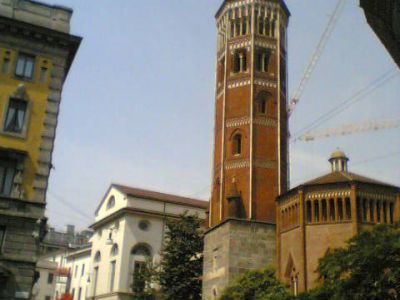
One should also take a moment to appreciate the slender, octagonal bell tower, which offers a striking contrast between its red brick and marble materials. Home to the first public clock in Milan and likely in Italy as well, it has retained its original structure since its construction in 1330. The clock itself was one of the earliest to strike the hours and was immensely popular. In 1335, Galvano Fiamma described it as "a wonderful clock with a huge clapper that strikes a bell 24 times a day, making it of great use to people of every social class". The clock and its automatic mechanism were so impressive that the surrounding area became known as the "Street of the Hours" ("Contrada delle Ore").
At the top of the bell tower, the Archangel Saint Michael overlooks the area and appears to beckon the many tourists who visit Piazza del Duomo to admire his splendor as well.
The church's construction may have started as a small temple by the Torriani, but was completed by Azzone Visconti, with the help of architect Pecorari and painter Giotto. Visitors entering the church can admire the nave, which is preceded by a vestibule featuring an impressive fresco of the Giotto school.
One should also take a moment to appreciate the slender, octagonal bell tower, which offers a striking contrast between its red brick and marble materials. Home to the first public clock in Milan and likely in Italy as well, it has retained its original structure since its construction in 1330. The clock itself was one of the earliest to strike the hours and was immensely popular. In 1335, Galvano Fiamma described it as "a wonderful clock with a huge clapper that strikes a bell 24 times a day, making it of great use to people of every social class". The clock and its automatic mechanism were so impressive that the surrounding area became known as the "Street of the Hours" ("Contrada delle Ore").
At the top of the bell tower, the Archangel Saint Michael overlooks the area and appears to beckon the many tourists who visit Piazza del Duomo to admire his splendor as well.
12) Piazza del Duomo (Cathedral Square) (must see)
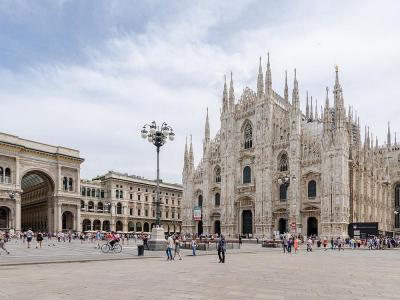
The gigantic central piazza, milling with people and pigeons, is awe-inspiring, with the Museo del Novecento being a particularly impressive sight. No cafés spill onto it, but the historic Camparino is tucked under the porticoes, created by the founder of the Campari dynasty in 1867. It was here, at the entrance to Galleria Vittorio Emanuele, that Verdi used to enjoy a drink after concerts and where, in 1877, Milanese nobility flocked to see the first experiment in electric lighting. It was also here, in this Art Nouveau interior, that stressed Milanese still relax over a coffee or Campari, served with over-sized olives.
The Palazzo Reale (Royal Palace) on the south side of the Duomo stands on the site of the original Broletto or town hall, destroyed by Frederick Barbarossa in 1162. It was rebuilt in 1171, then later transformed into the Ducal Palace for the Visconti and Sforza dynasties. On the occasion of Galeazzo Visconti’s marriage to Beatrice d’Este in Modena, their entry into Milan was marked by eight days of festivities at the palace. In 1336 the Church of San Gottardo in Corte was built as the Visconti’s private chapel. You can still see the charming colonnaded campanile rising to the rear of the palace, but the church itself was destroyed when the building was incorporated into the neoclassical palace. In 1412 the church steps were the scene of the murder of Giovanni Maria Visconti; as a consequence, the family decided to reside in the safer environs of the fortified castle. Under the Sforza a theatre was established at the palace, and in 1595 Mozart, who was only 14, performed here.
Another unmissable landmark in the piazza is, of course, Ercole Rosa's 1896 equestrian statue of Vittorio Emanuele II, first king of Italy, who triumphantly entered Milan in 1859.
The Palazzo Reale (Royal Palace) on the south side of the Duomo stands on the site of the original Broletto or town hall, destroyed by Frederick Barbarossa in 1162. It was rebuilt in 1171, then later transformed into the Ducal Palace for the Visconti and Sforza dynasties. On the occasion of Galeazzo Visconti’s marriage to Beatrice d’Este in Modena, their entry into Milan was marked by eight days of festivities at the palace. In 1336 the Church of San Gottardo in Corte was built as the Visconti’s private chapel. You can still see the charming colonnaded campanile rising to the rear of the palace, but the church itself was destroyed when the building was incorporated into the neoclassical palace. In 1412 the church steps were the scene of the murder of Giovanni Maria Visconti; as a consequence, the family decided to reside in the safer environs of the fortified castle. Under the Sforza a theatre was established at the palace, and in 1595 Mozart, who was only 14, performed here.
Another unmissable landmark in the piazza is, of course, Ercole Rosa's 1896 equestrian statue of Vittorio Emanuele II, first king of Italy, who triumphantly entered Milan in 1859.
13) Piazza Mercanti (Merchants Square)
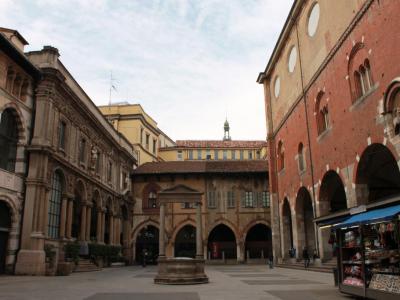
Located in the historic center of Milan, Piazza Mercanti has been a hub of commerce and politics since the Middle Ages. In the 13th century, it had six entry points that were associated with specific trades, from sword blacksmiths to hat makers. The most important and traditional fair of Milan, "Oh bej! Oh bej!" was held here until the late 19th century.
The square is still surrounded by beautiful buildings such as the Palazzo della Ragione, built in 1233, which served as the "broletto", i.e., the administrative headquarters of the city, and the Loggia degli Osii, a Renaissance-style arcade. Palazzo delle Scuole Palatine, a baroque palace built in the 17th century, occupies the south-eastern side, while the nearby Casa Panigarola, also known as "Palazzo dei Notai" (Notary's Palace), is a Gothic palace built in the 15th century.
At the center of the square is a 16th-century pit, topped by two 18th-century columns. Previously, a large stone known as the "pietra dei falliti" ("bankrupts stone") was located here, where those declared bankrupt had to sit as a penance with their naked bottoms exposed.
Woth stopping for a brief look!
The square is still surrounded by beautiful buildings such as the Palazzo della Ragione, built in 1233, which served as the "broletto", i.e., the administrative headquarters of the city, and the Loggia degli Osii, a Renaissance-style arcade. Palazzo delle Scuole Palatine, a baroque palace built in the 17th century, occupies the south-eastern side, while the nearby Casa Panigarola, also known as "Palazzo dei Notai" (Notary's Palace), is a Gothic palace built in the 15th century.
At the center of the square is a 16th-century pit, topped by two 18th-century columns. Previously, a large stone known as the "pietra dei falliti" ("bankrupts stone") was located here, where those declared bankrupt had to sit as a penance with their naked bottoms exposed.
Woth stopping for a brief look!
14) Biblioteca Ambrosiana (Ambrosian Library & Art Gallery) (must see)
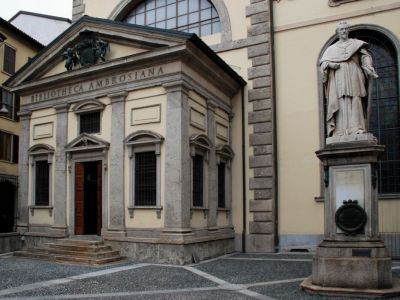
In the bustling city of Milan, amidst its grandeur and energy, lies a place of quiet contemplation, the Ambrosiana Library and Art Gallery. Its origins date back to 1603 when local Cardinal Federico Borromeo, who had just returned from Rome's artistic circles, founded this sanctuary of knowledge and beauty. With over 36,000 manuscripts and more than 750,000 prints, the library is a true treasure trove of intellectual inquiry and spiritual reflection. Named after the patron saint of Milan, Ambrose, it is a testament to the intersection of religion, intellectualism, and aesthetics that defined the Renaissance period.
One of the main attractions here is the Codex Atlanticus, a collection of twelve volumes of drawings and manuscripts created by Leonardo da Vinci between 1478 and 1519. Containing the artist's drawings, sketches and fables, it is undoubtedly the largest collection of Leonardo's writings on practically every area of human knowledge: mechanics, mathematics, astronomy, botany, geography, physics, chemistry, architecture and philosophy.
Part of the library is the famous Pinacoteca Ambrosiana, the art gallery, featuring da Vinci's "Portrait of a Musician", Caravaggio's "Basket of Fruit", as well as Raffaello's life-size, pencil and carbon sketch of the "The School of Athens", a full-color final version of which is displayed in the Vatican.
Among other major acquisitions here are Islamic manuscripts, 11th-century diwan of poets and the oldest copy of the 'Kitab Sibawahaihi', plus a complete set of manuscripts from the Benedictine monastery of Bobbio (1606) and those from Vincenzo Pinelli of Padua, comprising more than 800 pieces, including the famous Ilias Picta (Ambrosian Iliad).
Why You Should Visit:
A chance to immerse yourself in the world of academic tomes and works of art, experience the tranquil ambiance that has enchanted scholars and art lovers for centuries, see art restorers at work on peculiar Renaissance masterpieces -- and in a brilliant building, too.
Tip:
On a weekday, you can practically have the entire place to yourself. The provided map/guide is quite clear, with all the main highlights identified, but if you're pressed for time, taking a guided tour is advisable.
One of the main attractions here is the Codex Atlanticus, a collection of twelve volumes of drawings and manuscripts created by Leonardo da Vinci between 1478 and 1519. Containing the artist's drawings, sketches and fables, it is undoubtedly the largest collection of Leonardo's writings on practically every area of human knowledge: mechanics, mathematics, astronomy, botany, geography, physics, chemistry, architecture and philosophy.
Part of the library is the famous Pinacoteca Ambrosiana, the art gallery, featuring da Vinci's "Portrait of a Musician", Caravaggio's "Basket of Fruit", as well as Raffaello's life-size, pencil and carbon sketch of the "The School of Athens", a full-color final version of which is displayed in the Vatican.
Among other major acquisitions here are Islamic manuscripts, 11th-century diwan of poets and the oldest copy of the 'Kitab Sibawahaihi', plus a complete set of manuscripts from the Benedictine monastery of Bobbio (1606) and those from Vincenzo Pinelli of Padua, comprising more than 800 pieces, including the famous Ilias Picta (Ambrosian Iliad).
Why You Should Visit:
A chance to immerse yourself in the world of academic tomes and works of art, experience the tranquil ambiance that has enchanted scholars and art lovers for centuries, see art restorers at work on peculiar Renaissance masterpieces -- and in a brilliant building, too.
Tip:
On a weekday, you can practically have the entire place to yourself. The provided map/guide is quite clear, with all the main highlights identified, but if you're pressed for time, taking a guided tour is advisable.
15) Basilica di San Lorenzo (Basilica of St. Lawrence - oldest church in Milan)
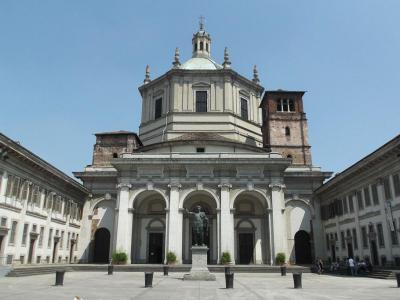
One cannot help but be struck by the seemingly hodgepodge array of towers, lodges, apses and domes that make up this often overlooked architectural landmark. Despite its unconventional appearance, this basilica, established in the 4th century, was actually one of the largest church buildings in all of Europe at the time. The mammoth blocks used for its foundation were taken from other Roman sites, and its interior is uniquely adorned with marble on the lower half and mosaics on the upper.
The chapel, with its octagonal structure, is considered to be one of the most magnificent examples of this style among the remaining Roman octagonal buildings, having played a fundamental role in the history of western art and architecture and having been imitated many times.
A remnant of a Romanesque atrium leads visitors to the heart of the church, where sixteen ancient Roman columns stand guard, now serving as a favorite hangout spot for young couples. The most precious treasures, however, are the fragments of aforementioned mosaics that once adorned the entire structure.
Tip:
Behind the chapel altar you can descend a flight of stairs to view the foundations laid down in Roman times.
The chapel, with its octagonal structure, is considered to be one of the most magnificent examples of this style among the remaining Roman octagonal buildings, having played a fundamental role in the history of western art and architecture and having been imitated many times.
A remnant of a Romanesque atrium leads visitors to the heart of the church, where sixteen ancient Roman columns stand guard, now serving as a favorite hangout spot for young couples. The most precious treasures, however, are the fragments of aforementioned mosaics that once adorned the entire structure.
Tip:
Behind the chapel altar you can descend a flight of stairs to view the foundations laid down in Roman times.
16) Colonne di San Lorenzo (Columns of San Lorenzo)
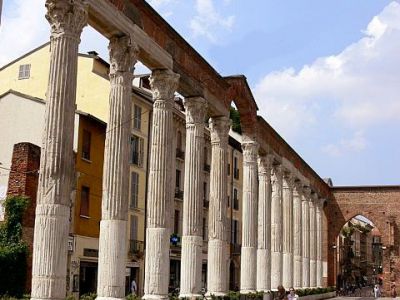
The Columns of San Lorenzo is a popular group of ancient Roman ruins, located in front of the Basilica of San Lorenzo in central Milan, which dates back to the 4th century AD. Consisting mainly of 16 tall Corinthian columns in a row, extracted from a likely 2nd-century pagan temple or public bath house structure, the collonade now fronts an open square. South of the columns, one of the medieval gates still has some Roman marble decoration in place.
Up until 1935, the space between the church and columns was entirely occupied by old houses abutting onto the façade of the church itself. Despite the plans to conserve this ancient urban fabric, the renovations led to the demolition of the old houses and the isolation of the monument on the front side. Following bombing during World War II, the church complex became further isolated on the rear side, where the fenced park now stands, allowing popular views of the Basilica.
A great place to explore and soak up the atmosphere of Milan.
Up until 1935, the space between the church and columns was entirely occupied by old houses abutting onto the façade of the church itself. Despite the plans to conserve this ancient urban fabric, the renovations led to the demolition of the old houses and the isolation of the monument on the front side. Following bombing during World War II, the church complex became further isolated on the rear side, where the fenced park now stands, allowing popular views of the Basilica.
A great place to explore and soak up the atmosphere of Milan.
