Custom Walk in Bridgetown, Barbados by sigal_d_l1948_727b73 created on 2026-01-05
Guide Location: Barbados » Bridgetown
Guide Type: Custom Walk
# of Sights: 13
Tour Duration: 2 Hour(s)
Travel Distance: 4 Km or 2.5 Miles
Share Key: X94K4
Guide Type: Custom Walk
# of Sights: 13
Tour Duration: 2 Hour(s)
Travel Distance: 4 Km or 2.5 Miles
Share Key: X94K4
How It Works
Please retrieve this walk in the GPSmyCity app. Once done, the app will guide you from one tour stop to the next as if you had a personal tour guide. If you created the walk on this website or come to the page via a link, please follow the instructions below to retrieve the walk in the app.
Retrieve This Walk in App
Step 1. Download the app "GPSmyCity: Walks in 1K+ Cities" on Apple App Store or Google Play Store.



Step 2. In the GPSmyCity app, download(or launch) the guide "Bridgetown Map and Walking Tours".
Step 3. Tap the menu button located at upper right corner of the "Walks" screen and select "Retrieve custom walk". Enter the share key: X94K4
1) Barbados Museum & Historical Society (must see)
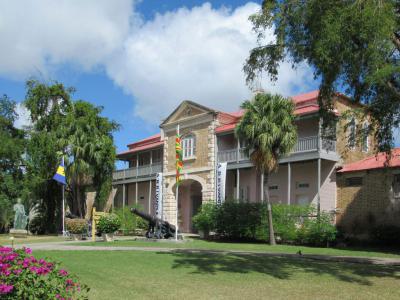
The Barbados Museum & Historical Society is a cornerstone of cultural preservation in Bridgetown. Established in 1933, this non-profit institution was born out of a community-driven effort to safeguard and share the island’s rich history. It stands today as the premier authority on Barbados’ past, with a mandate to collect, document, and conserve the nation’s cultural, historical, and environmental heritage.
Housed in a former military prison built in 1818, the museum is located within Saint Ann’s Garrison, a significant part of the UNESCO-listed Historic Bridgetown and its Garrison. The building itself is a relic of colonial military history, lending an atmospheric backdrop to the vast collection inside.
The museum boasts seven permanent galleries, showcasing over 500,000 artifacts, although only a fraction is publicly displayed. These exhibits cover a wide range of topics, from Barbados’ indigenous cultures, colonial history, and African heritage to the island’s natural environment and coral reef structures. One particularly engaging exhibit, "Yesterday’s Children," offers a historical perspective through the eyes of young Barbadians.
For researchers and history enthusiasts, the Shilstone Memorial Library houses a rare collection of historical maps, manuscripts, and genealogical records, while the Newton Slave Burial Ground, acquired by the museum in 1993, serves as an important site of memory and reflection on Barbados' enslaved past.
Beyond exhibitions, the museum actively engages with the community through educational programs, research services, cultural events, and guided tours, making it an essential resource for scholars, genealogists, and curious visitors alike. With its blend of traditional displays and evolving programming, the Barbados Museum & Historical Society remains an enduring guardian of the island’s heritage.
Housed in a former military prison built in 1818, the museum is located within Saint Ann’s Garrison, a significant part of the UNESCO-listed Historic Bridgetown and its Garrison. The building itself is a relic of colonial military history, lending an atmospheric backdrop to the vast collection inside.
The museum boasts seven permanent galleries, showcasing over 500,000 artifacts, although only a fraction is publicly displayed. These exhibits cover a wide range of topics, from Barbados’ indigenous cultures, colonial history, and African heritage to the island’s natural environment and coral reef structures. One particularly engaging exhibit, "Yesterday’s Children," offers a historical perspective through the eyes of young Barbadians.
For researchers and history enthusiasts, the Shilstone Memorial Library houses a rare collection of historical maps, manuscripts, and genealogical records, while the Newton Slave Burial Ground, acquired by the museum in 1993, serves as an important site of memory and reflection on Barbados' enslaved past.
Beyond exhibitions, the museum actively engages with the community through educational programs, research services, cultural events, and guided tours, making it an essential resource for scholars, genealogists, and curious visitors alike. With its blend of traditional displays and evolving programming, the Barbados Museum & Historical Society remains an enduring guardian of the island’s heritage.
2) George Washington House (must see)
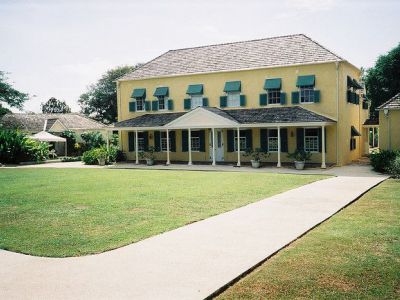
The George Washington House is a 18th century plantation home that was occupied by the man who would become the first President of the United States. It is located in the historic Garrison area of town, on the top of Bush Hill. At the age of 19, Washington lived in the house for two months in 1751. At that time, the house was called Bush House.
One thing that makes this house unique is more of a statement about Washington's life than the house. This is the only place and the only country that Washington visited during his lifetime outside of colonial America.
The two-story house is entirely restored and decorated as it would have been during Washington's stay in 1751. As a result, you see day-to-day furnishings like beds with mosquito netting, chairs, and basic crockery and cutlery. From these items, you can gain some fascinating insights into how people made do during that time.
The second floor hosts a more traditional museum, with items described by audio and visual aids. One display recounts Washington's fight with yellow fever while on the island and the third-generation Barbadian doctor who treated him and restored him to health.
Additionally, the museum is home to countless artifacts of island life. You'll find reminders of the days of slavery, which was still practiced on the island during Washington's visit. You'll see barbed-neck collars, spiked manacles, and agricultural tools like sickles and cane bills.
The house itself has been remodeled over the years. When Washington visited, it was only one level. The second story was added in 1845, and it was impossible to remove it when the home was renovated and restored in 2007.
The house is owned and maintained by the Barbados National Trust. During a visit to the island in 1997, US President Bill Clinton presented a plaque commemorating Washington's visit to the island.
One thing that makes this house unique is more of a statement about Washington's life than the house. This is the only place and the only country that Washington visited during his lifetime outside of colonial America.
The two-story house is entirely restored and decorated as it would have been during Washington's stay in 1751. As a result, you see day-to-day furnishings like beds with mosquito netting, chairs, and basic crockery and cutlery. From these items, you can gain some fascinating insights into how people made do during that time.
The second floor hosts a more traditional museum, with items described by audio and visual aids. One display recounts Washington's fight with yellow fever while on the island and the third-generation Barbadian doctor who treated him and restored him to health.
Additionally, the museum is home to countless artifacts of island life. You'll find reminders of the days of slavery, which was still practiced on the island during Washington's visit. You'll see barbed-neck collars, spiked manacles, and agricultural tools like sickles and cane bills.
The house itself has been remodeled over the years. When Washington visited, it was only one level. The second story was added in 1845, and it was impossible to remove it when the home was renovated and restored in 2007.
The house is owned and maintained by the Barbados National Trust. During a visit to the island in 1997, US President Bill Clinton presented a plaque commemorating Washington's visit to the island.
3) Main Guard House Clock Tower
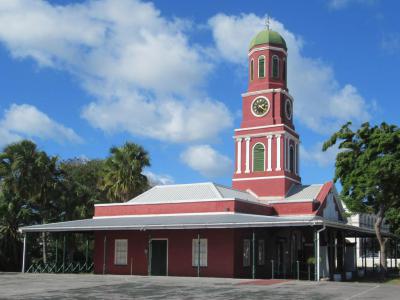
The centerpiece of the Garrison area of town is the Main Guard. With its clock tower and impressive stature, the building has kept an eye on the historic Garrison Savanah since it was built around 1802. The Main Guard is part of Saint Ann's Fort, the remainder of which is across the street.
Saint Ann's Garrison was the headquarters of the British West India Regiment. The Regiment was a division of infantry units of the British Army stationed throughout the British colonies until 1927.
The Georgian-style Main Guard building is one of the island's architectural treasures. It is embellished with the coat of arms of King George III carved from Coade stone and an impressive clock tower. After the Regiment dissolved in 1906, the building was the home of the Savannah Club. Now it is owned by the government and is presently home to several official offices.
If you're lucky, you'll spot some of the military veterans who volunteer at the Main Guard. They often perform duties in full dress uniform, the same as the original West India Regiment full dress. The Barbados Defense Force is based at Saint Anne's Fort.
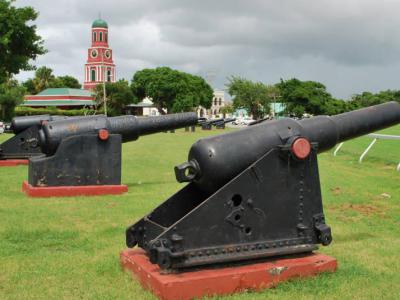
On display around the Main Guard is an impressive collection of 26 historically important cannons. Barbados has one of the best collections of 17th-century cannons in the world. An effort was undertaken to catalog and preserve them, and researchers discovered many rare and valuable pieces. The oldest is from 1620, the youngest is from 1820, and the collection includes some one-of-a-kind treasures.
Saint Ann's Garrison was the headquarters of the British West India Regiment. The Regiment was a division of infantry units of the British Army stationed throughout the British colonies until 1927.
The Georgian-style Main Guard building is one of the island's architectural treasures. It is embellished with the coat of arms of King George III carved from Coade stone and an impressive clock tower. After the Regiment dissolved in 1906, the building was the home of the Savannah Club. Now it is owned by the government and is presently home to several official offices.
If you're lucky, you'll spot some of the military veterans who volunteer at the Main Guard. They often perform duties in full dress uniform, the same as the original West India Regiment full dress. The Barbados Defense Force is based at Saint Anne's Fort.
On display around the Main Guard is an impressive collection of 26 historically important cannons. Barbados has one of the best collections of 17th-century cannons in the world. An effort was undertaken to catalog and preserve them, and researchers discovered many rare and valuable pieces. The oldest is from 1620, the youngest is from 1820, and the collection includes some one-of-a-kind treasures.
4) Garrison Historic Area
The Garrison Historic Area, commonly referred to as "The Garrison," is a significant district in Bridgetown, located about two miles south of Heroes Square and just west of Hastings in the Christ Church parish. This area, once a key British military base, played a crucial role in Barbados' colonial history and is now home to several well-preserved historical sites.
At the heart of the district lies the Garrison Savannah, a 30-acre parade ground that has served as a horse racetrack since the mid-18th century when British regiment troops and prominent Barbadian elites introduced the sport. The tradition continues today, making it one of the island’s most cherished sporting venues.
The area also houses Saint Ann’s Fort, the headquarters of the Barbados Defence Force (BDF), which stands to the west of Highway 7, the road that bisects the district. During the 18th and 19th centuries, the Garrison was the primary military headquarters for British forces in the Caribbean, particularly the British West India Regiment.
One of its most notable landmarks is the George Washington House, located in the Bush Hill section. This restored residence hosted George Washington for six weeks in 1751 while he accompanied his ailing brother. It remains a key historical attraction, offering insight into the island’s ties to American history.
Beyond military heritage, the Garrison holds a place in Barbados' modern history-on 30 November 1966, the site witnessed the ceremonial lowering of the Union Flag and the raising of the Barbadian flag, marking the island’s independence from Britain.
Several other historic buildings remain in the district, including former barracks, prison cells, and the Barbados Museum, which provides deeper insight into the island’s colonial past. Today, the Garrison Historic Area stands as a UNESCO World Heritage Site, blending military history, colonial architecture, and national pride into a must-visit destination in Bridgetown.
At the heart of the district lies the Garrison Savannah, a 30-acre parade ground that has served as a horse racetrack since the mid-18th century when British regiment troops and prominent Barbadian elites introduced the sport. The tradition continues today, making it one of the island’s most cherished sporting venues.
The area also houses Saint Ann’s Fort, the headquarters of the Barbados Defence Force (BDF), which stands to the west of Highway 7, the road that bisects the district. During the 18th and 19th centuries, the Garrison was the primary military headquarters for British forces in the Caribbean, particularly the British West India Regiment.
One of its most notable landmarks is the George Washington House, located in the Bush Hill section. This restored residence hosted George Washington for six weeks in 1751 while he accompanied his ailing brother. It remains a key historical attraction, offering insight into the island’s ties to American history.
Beyond military heritage, the Garrison holds a place in Barbados' modern history-on 30 November 1966, the site witnessed the ceremonial lowering of the Union Flag and the raising of the Barbadian flag, marking the island’s independence from Britain.
Several other historic buildings remain in the district, including former barracks, prison cells, and the Barbados Museum, which provides deeper insight into the island’s colonial past. Today, the Garrison Historic Area stands as a UNESCO World Heritage Site, blending military history, colonial architecture, and national pride into a must-visit destination in Bridgetown.
5) Carlisle Bay Beaches (must see)
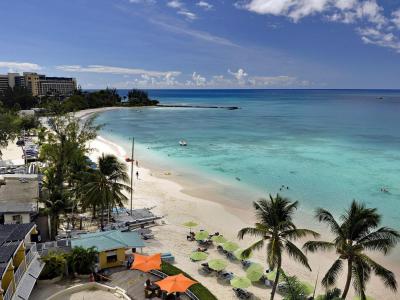
Carlisle Bay stretches from the cruise ship port to the north down to Needham's Point, the location of the Hilton Barbados Resort. The bay is a natural harbor and was Bridgetown's primary anchorage and port location in the early days. You'll likely still see visiting yachts anchored here, but it was full of British Navy and merchant ships back in the day. The location is mostly protected from the prevailing easterly trade winds.
The bay is named after the Earl of Carlisle, James Hay. In the 1600s, he was the Lord Proprietor of Barbados.
South of the river known as the Careenage, the bay's shoreline is one unbroken beautiful sandy beach. You will find many beach clubs and resorts along the shore. The Bay Street Esplanade is a landscaped path that follows the bay's shore. Locals love to gather here after work and watch the sunset.
There is a marine park located in Carlisle Bay that is popular for scuba diving and snorkeling. Along with an abundance of sea life and coral reefs, six shipwrecks lie on the bottom of the bay. You can find the wrecks between 12 and 65 feet below the surface.
Browne's Beach is a calm-water beach with soft sand. It's the perfect spot for sunbathing, swimming, or just relaxing in the sun. The Boatyard is a popular spot if you want to try some watersports, like renting a jetski or trying a sea trampoline.
The bay is named after the Earl of Carlisle, James Hay. In the 1600s, he was the Lord Proprietor of Barbados.
South of the river known as the Careenage, the bay's shoreline is one unbroken beautiful sandy beach. You will find many beach clubs and resorts along the shore. The Bay Street Esplanade is a landscaped path that follows the bay's shore. Locals love to gather here after work and watch the sunset.
There is a marine park located in Carlisle Bay that is popular for scuba diving and snorkeling. Along with an abundance of sea life and coral reefs, six shipwrecks lie on the bottom of the bay. You can find the wrecks between 12 and 65 feet below the surface.
Browne's Beach is a calm-water beach with soft sand. It's the perfect spot for sunbathing, swimming, or just relaxing in the sun. The Boatyard is a popular spot if you want to try some watersports, like renting a jetski or trying a sea trampoline.
6) Independence Square
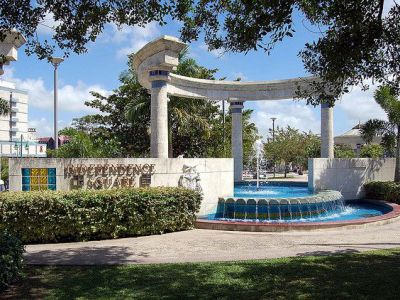
Independence Square, situated on the waterfront in the heart of Bridgetown, offers a serene environment to relax and absorb the city's historic ambiance. Visitors can rest on benches lining the waterfront, providing picturesque views of notable landmarks such as the Parliament Buildings and National Heroes Square.
At the western end of the square, local vendors display crafts and offer light refreshments on the bridge, presenting an opportunity to purchase unique souvenirs. Adjacent to this area stands the Independence Arch, gracefully spanning the Chamberlain Bridge and serving as a symbolic gateway into the square.
To the west, the wooden Bridgetown boardwalk traces the waterfront, inviting strolls along its path. Independence Square itself is adorned with an amphitheater, two large fountains, intricate paving mosaics, and a statue honoring National Hero, the Right Excellent Errol Walton Barrow. Notably, during November, which marks Barbados' independence celebrations, the square is illuminated in the national colors of blue and gold. The festive decor continues into the Christmas season, with numerous illuminated Christmas trees enhancing the square's charm.
Originally one of Bridgetown's busiest car parks, Independence Square was redesigned and reopened to the public in 2007. Today, it serves as a recreational haven, featuring stone benches, mature trees providing ample shade, and a tranquil view of the river with boats gently bobbing on the water. The prominent statue of Errol Walton Barrow stands at the center, gazing across the river toward National Heroes Square.
Whether visiting during the vibrant independence festivities or at another time of year, Independence Square offers a blend of historical significance and contemporary leisure, making it a must-visit destination in Bridgetown.
At the western end of the square, local vendors display crafts and offer light refreshments on the bridge, presenting an opportunity to purchase unique souvenirs. Adjacent to this area stands the Independence Arch, gracefully spanning the Chamberlain Bridge and serving as a symbolic gateway into the square.
To the west, the wooden Bridgetown boardwalk traces the waterfront, inviting strolls along its path. Independence Square itself is adorned with an amphitheater, two large fountains, intricate paving mosaics, and a statue honoring National Hero, the Right Excellent Errol Walton Barrow. Notably, during November, which marks Barbados' independence celebrations, the square is illuminated in the national colors of blue and gold. The festive decor continues into the Christmas season, with numerous illuminated Christmas trees enhancing the square's charm.
Originally one of Bridgetown's busiest car parks, Independence Square was redesigned and reopened to the public in 2007. Today, it serves as a recreational haven, featuring stone benches, mature trees providing ample shade, and a tranquil view of the river with boats gently bobbing on the water. The prominent statue of Errol Walton Barrow stands at the center, gazing across the river toward National Heroes Square.
Whether visiting during the vibrant independence festivities or at another time of year, Independence Square offers a blend of historical significance and contemporary leisure, making it a must-visit destination in Bridgetown.
7) Independence Arch and Chamberlain Bridge
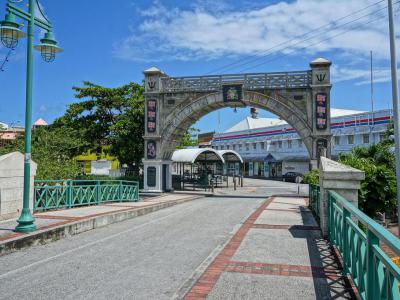
The Independence Arch stands proudly at the southern end of the Chamberlain Bridge in Bridgetown, serving as a lasting tribute to the nation's journey to self-governance. Erected in 1987 to commemorate Barbados' 21st anniversary of independence, the arch celebrates the island’s rich heritage and culture.
Adorned with key national symbols, the arch's pillars feature the flying fish and the pelican-two emblems of Barbadian identity-alongside the Pride of Barbados flower. The arch is crowned with the Coat of Arms of Barbados, which bears the national motto, “Pride and Industry”. At its base, visitors can find the National Pledge, a poignant reminder of the island’s values. Each November 30th, for Independence Day, the arch lights up in Barbados' national colors, blue and gold. Nearby, Independence Square offers a peaceful retreat from the city's hustle.
The Chamberlain Bridge, located in the heart of Bridgetown, has long been an essential crossing over the Careenage (Constitution River) at Carlisle Bay. Originally built as a swing bridge in 1872, it was named after Joseph Chamberlain (1836–1914), the British Colonial Secretary who helped secure funding for its reconstruction following the Great Hurricane of 1898. Over a century later, in 2005–2006, the outdated steel structure was dismantled and replaced with a modern lifting bridge featuring a single-leaf bascule design. Constructed from fiber-reinforced plastic (FRP), the new bridge is lighter, non-corrosive, and built to last.
Together, the Independence Arch and Chamberlain Bridge stand as enduring symbols of Barbados' history, resilience, and national pride, seamlessly blending tradition with modern engineering in the heart of the island’s capital.
Adorned with key national symbols, the arch's pillars feature the flying fish and the pelican-two emblems of Barbadian identity-alongside the Pride of Barbados flower. The arch is crowned with the Coat of Arms of Barbados, which bears the national motto, “Pride and Industry”. At its base, visitors can find the National Pledge, a poignant reminder of the island’s values. Each November 30th, for Independence Day, the arch lights up in Barbados' national colors, blue and gold. Nearby, Independence Square offers a peaceful retreat from the city's hustle.
The Chamberlain Bridge, located in the heart of Bridgetown, has long been an essential crossing over the Careenage (Constitution River) at Carlisle Bay. Originally built as a swing bridge in 1872, it was named after Joseph Chamberlain (1836–1914), the British Colonial Secretary who helped secure funding for its reconstruction following the Great Hurricane of 1898. Over a century later, in 2005–2006, the outdated steel structure was dismantled and replaced with a modern lifting bridge featuring a single-leaf bascule design. Constructed from fiber-reinforced plastic (FRP), the new bridge is lighter, non-corrosive, and built to last.
Together, the Independence Arch and Chamberlain Bridge stand as enduring symbols of Barbados' history, resilience, and national pride, seamlessly blending tradition with modern engineering in the heart of the island’s capital.
8) National Heroes Square
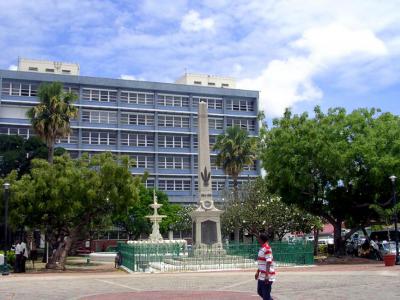
Located between Upper Broad Street, The Wharf Road, and the Careenage, National Heroes Square is one of the centerpieces of Bridgetown. Before 1998, the square was called Trafalgar Square.
The square is dedicated to the Order of National Heroes, and National Heroes Day is celebrated on April 28. On the first commemoration of the day, Trafalgar Square was renamed for the Order. Only 11 people have made the list of National Heroes and have been given the title "The Right Excellent." Of the people on the list, only Sir Garfield Sobers, a former cricketer, and Rhianna, a singer and businesswoman, are alive today.
However, the most prominent statues in the square have been around longer than the Order. The first one to catch your eye is undoubtedly that of Lord Nelson, the famous British Royal Navy Admiral. The statue has stood here since 1813 as a memorial to the Royal Navy's victory in the Battle of Trafalgar.
This statue was dedicated 27 years before the statue of Nelson that stands over Trafalgar Square in London. Nelson's statue here has served as the geographic center for the island since it was erected. Distances have always been measured from the statue.
Other large monuments in the square include the Cenotaph War Memorial and Fountain Gardens. A large fountain commemorates the piping of water into town in 1865.
With its location at the center of town, the square is a great place to spot other attractions. You can see the Barbados Parliament Buildings, the Department of Inland Revenue, and the Chamberlain Bridge.
The square is dedicated to the Order of National Heroes, and National Heroes Day is celebrated on April 28. On the first commemoration of the day, Trafalgar Square was renamed for the Order. Only 11 people have made the list of National Heroes and have been given the title "The Right Excellent." Of the people on the list, only Sir Garfield Sobers, a former cricketer, and Rhianna, a singer and businesswoman, are alive today.
However, the most prominent statues in the square have been around longer than the Order. The first one to catch your eye is undoubtedly that of Lord Nelson, the famous British Royal Navy Admiral. The statue has stood here since 1813 as a memorial to the Royal Navy's victory in the Battle of Trafalgar.
This statue was dedicated 27 years before the statue of Nelson that stands over Trafalgar Square in London. Nelson's statue here has served as the geographic center for the island since it was erected. Distances have always been measured from the statue.
Other large monuments in the square include the Cenotaph War Memorial and Fountain Gardens. A large fountain commemorates the piping of water into town in 1865.
With its location at the center of town, the square is a great place to spot other attractions. You can see the Barbados Parliament Buildings, the Department of Inland Revenue, and the Chamberlain Bridge.
9) Parliament Buildings (must see)
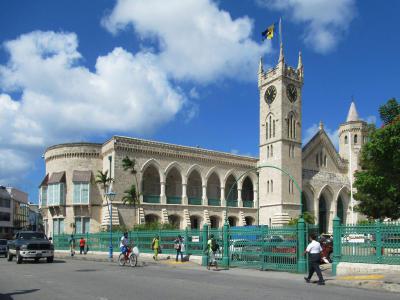
The Parliament Building sits just north of the Careenage on Broad and Rickett Streets. The building was built between 1870 and 1874, but the island's Parliament was established in 1639. That makes it the third oldest Parliament in the Commonwealth. The building is a protected building and part of the UNESCO World Heritage Site of Historic Bridgetown.
The oldest part of the neo-Gothic Victorian-style building is the East Wing, completed in 1873. This is where the chambers of the Senate and House of Assembly are located, which still meet weekly. Over the years, many other offices have been here, too, including the post office, central bank, and public library.
Inside the House of Assembly chambers, you can see stained glass windows showing British sovereigns from the time of James I up to Queen Victoria. In the Senate, the windows show the armorial bearings of past Presidents of the Council and Speakers of the House of Assembly.
The West Wing currently houses the National Heroes Gallery and the Museum of Parliament. In the past, it has housed offices for government officials like the Colonial Secretary and Treasurer, Provost Marshal, and Comptroller of Customs.
The clocktowers and bells above the West Wing were originally located on the East Wing but were moved in 1886. Poor soil at the previous location caused the tower to begin to sink within ten years of being built. The tower is built from coral limestone and is a prominent landmark throughout town.
The oldest part of the neo-Gothic Victorian-style building is the East Wing, completed in 1873. This is where the chambers of the Senate and House of Assembly are located, which still meet weekly. Over the years, many other offices have been here, too, including the post office, central bank, and public library.
Inside the House of Assembly chambers, you can see stained glass windows showing British sovereigns from the time of James I up to Queen Victoria. In the Senate, the windows show the armorial bearings of past Presidents of the Council and Speakers of the House of Assembly.
The West Wing currently houses the National Heroes Gallery and the Museum of Parliament. In the past, it has housed offices for government officials like the Colonial Secretary and Treasurer, Provost Marshal, and Comptroller of Customs.
The clocktowers and bells above the West Wing were originally located on the East Wing but were moved in 1886. Poor soil at the previous location caused the tower to begin to sink within ten years of being built. The tower is built from coral limestone and is a prominent landmark throughout town.
10) Statue of Lord Horatio Nelson
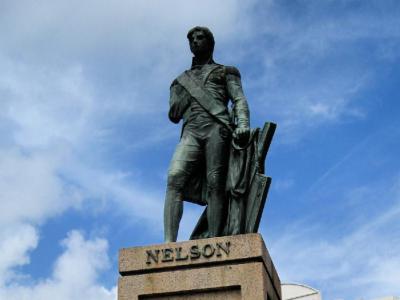
The bronze statue of British naval officer Horatio Nelson, 1st Viscount Nelson, stood in National Heroes Square (formerly Trafalgar Square) in Bridgetown, from 1813 until its removal in 2020. The statue, created by sculptor Richard Westmacott, was erected on 22 March 1813 in honor of Nelson’s 1805 visit to Barbados, during which he and the British fleet pursued the Franco-Spanish navy ahead of the decisive Battle of Trafalgar.
For much of its existence, the monument was a significant landmark in Bridgetown, with the adjacent Parliament Buildings constructed later in the 19th century. It was even featured on Barbadian postage stamps between 1906 and 1964. However, its role as a colonial symbol became increasingly contentious. In 1999, Trafalgar Square was renamed National Heroes Square, reflecting Barbados’ evolving historical narrative. Official tributes to Nelson declined, and by 2017, public opposition became more pronounced-vandals covered the statue in blue and yellow paint on the eve of the nation’s Independence Day, branding Nelson as a "racist and white supremacist."
On 24 July 2020, John King, the Minister responsible for Culture, announced plans to remove the statue during the national Season of Emancipation. Delays pushed the relocation to 16 November 2020, the International Day for Tolerance. The statue was ultimately transferred to the Barbados Museum, marking a shift in how the nation commemorates its past.
For much of its existence, the monument was a significant landmark in Bridgetown, with the adjacent Parliament Buildings constructed later in the 19th century. It was even featured on Barbadian postage stamps between 1906 and 1964. However, its role as a colonial symbol became increasingly contentious. In 1999, Trafalgar Square was renamed National Heroes Square, reflecting Barbados’ evolving historical narrative. Official tributes to Nelson declined, and by 2017, public opposition became more pronounced-vandals covered the statue in blue and yellow paint on the eve of the nation’s Independence Day, branding Nelson as a "racist and white supremacist."
On 24 July 2020, John King, the Minister responsible for Culture, announced plans to remove the statue during the national Season of Emancipation. Delays pushed the relocation to 16 November 2020, the International Day for Tolerance. The statue was ultimately transferred to the Barbados Museum, marking a shift in how the nation commemorates its past.
11) Swan Street
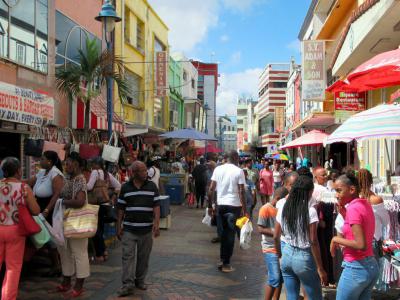
Swan Street parallels Broad Street to the north. It's a narrow alleyway of a street lined with shops and restaurants. It's pedestrian-only, so while it can be quite crowded, it's a great place to wander to meet the locals. There are several electronics stores, home goods, a shopping mall, and takeaway restaurants.
The buildings on Swan Street are traditional homes, with the businesses built on the lower levels. At one time, the street was known as Jew's Street because of the community's successful Jewish merchants. Many of the shopkeepers lived in the upper stories of the buildings. Unfortunately, a major fire swept through the area in 1845. After which, the street was part of what the locals dubbed the Burnt District.
Today, you'll see businesses and haberdasheries from around the world here. But the upper levels are no longer homes. Instead, they are mostly used as warehouses now.
Historians are unsure how the street got its official name. Some suggest that there was an inn named The Swan. Others say it was s tribute to a local surveyor, Captain Swan.
It's a busy place, favored by the locals more than the tourists. Swan Street is a must-see if you're looking for island goods and good prices. This street keeps the Barbadian spirit alive--you can find everything here, from fresh fruit and veggies to local island jewelry and crafts.
The buildings on Swan Street are traditional homes, with the businesses built on the lower levels. At one time, the street was known as Jew's Street because of the community's successful Jewish merchants. Many of the shopkeepers lived in the upper stories of the buildings. Unfortunately, a major fire swept through the area in 1845. After which, the street was part of what the locals dubbed the Burnt District.
Today, you'll see businesses and haberdasheries from around the world here. But the upper levels are no longer homes. Instead, they are mostly used as warehouses now.
Historians are unsure how the street got its official name. Some suggest that there was an inn named The Swan. Others say it was s tribute to a local surveyor, Captain Swan.
It's a busy place, favored by the locals more than the tourists. Swan Street is a must-see if you're looking for island goods and good prices. This street keeps the Barbadian spirit alive--you can find everything here, from fresh fruit and veggies to local island jewelry and crafts.
12) Nidhe Israel Synagogue (must see)
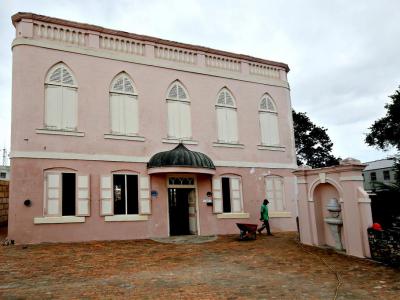
The Nidhe Israel Synagogue is the only synagogue on the island and one of the oldest in the western hemisphere. It was built in 1654. Jews left Dutch Brazil to avoid persecution from the Portuguese and settled on the island. They were skilled in the sugar industry and introduced the sugar crop to Barbados, teaching their skills to the local land owners.
The Barbados Jewish community grew over the years as other settlements dissolved. One group came from Cayenne, French Guana, in 1664, and another from Suriname in 1674. They gathered in two communities on the island, the largest being in Bridgetown, where 54 out of 404 households were Jewish.
The building has gone through many phases. Like other buildings on the island, hurricanes have damaged it over the centuries. It was destroyed by one in 1831 and rebuilt afterward. Unfortunately, it fell into disrepair until it was sold in 1929.
The building was modified, with the upper gallery being converted to a full second level. Over the years, the building changed hands several times until 1983, when the government seized it. The plan was to bulldoze the site and build a new courthouse, but petitioning from the local Jewish community resulted in it being handed over to the Barbados National Trust.
A full renovation began in 1986, and the building returned to being a synagogue. Archaeologists discovered a mikveh on the site of the former rabbi's house in 2008. A mikveh is a ritual bath, and it was constructed over a still-running freshwater spring.
The Nidhe Israel Museum opened in 2008 to tell the story of the Jewish communities on the island and their histories.
The Barbados Jewish community grew over the years as other settlements dissolved. One group came from Cayenne, French Guana, in 1664, and another from Suriname in 1674. They gathered in two communities on the island, the largest being in Bridgetown, where 54 out of 404 households were Jewish.
The building has gone through many phases. Like other buildings on the island, hurricanes have damaged it over the centuries. It was destroyed by one in 1831 and rebuilt afterward. Unfortunately, it fell into disrepair until it was sold in 1929.
The building was modified, with the upper gallery being converted to a full second level. Over the years, the building changed hands several times until 1983, when the government seized it. The plan was to bulldoze the site and build a new courthouse, but petitioning from the local Jewish community resulted in it being handed over to the Barbados National Trust.
A full renovation began in 1986, and the building returned to being a synagogue. Archaeologists discovered a mikveh on the site of the former rabbi's house in 2008. A mikveh is a ritual bath, and it was constructed over a still-running freshwater spring.
The Nidhe Israel Museum opened in 2008 to tell the story of the Jewish communities on the island and their histories.
13) St. Michael's Cathedral (must see)
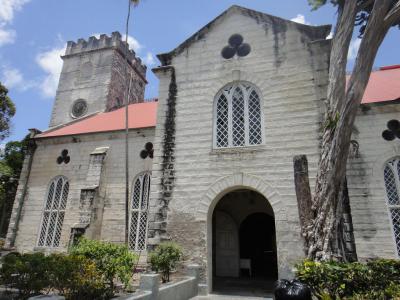
Two blocks east of National Heroes Square, this Anglican church has stood since 1789. It replaced an earlier wooden church built in 1665 that was destroyed by a hurricane in 1780. That first church was located at the site of present-day Saint Mary's Church.
The cathedral is made of coral limestone and features beautiful stained glass windows. In 1938, the Chapel of the Blessed Sacrament was added. The marble baptismal font is from the 17th century. The impressive structure can seat about 1,600 people and has one of the largest pipe organs in the Caribbean.
The church was originally the Saint Michael's Parish Church but was elevated to cathedral status in 1825 when Bishop Coleridge became head of the new Diocese of Barbados and the Leeward Islands.
Some of the most striking stained glass pieces can be seen in the Chapel. The central circular window features the image of Saint Michael. The larger windows to the left and right commemorate the parents of James Challenor Lynch. The windows were made in the late 1800s in London.
In the graveyard, you can see some of Barbados' famous public figures' graves. Sir Grantley Adams, the first chief minister and the only Prime Minister of the West Indies Federation, rests here. His son Tom Adams, the island's second prime minister, is also here.
The cathedral is made of coral limestone and features beautiful stained glass windows. In 1938, the Chapel of the Blessed Sacrament was added. The marble baptismal font is from the 17th century. The impressive structure can seat about 1,600 people and has one of the largest pipe organs in the Caribbean.
The church was originally the Saint Michael's Parish Church but was elevated to cathedral status in 1825 when Bishop Coleridge became head of the new Diocese of Barbados and the Leeward Islands.
Some of the most striking stained glass pieces can be seen in the Chapel. The central circular window features the image of Saint Michael. The larger windows to the left and right commemorate the parents of James Challenor Lynch. The windows were made in the late 1800s in London.
In the graveyard, you can see some of Barbados' famous public figures' graves. Sir Grantley Adams, the first chief minister and the only Prime Minister of the West Indies Federation, rests here. His son Tom Adams, the island's second prime minister, is also here.
