Custom Walk in Porto, Portugal by thulasi_kanagaratnam_fad8d6 created on 2026-01-15
Guide Location: Portugal » Porto
Guide Type: Custom Walk
# of Sights: 7
Tour Duration: 2 Hour(s)
Travel Distance: 3.8 Km or 2.4 Miles
Share Key: JE7FE
Guide Type: Custom Walk
# of Sights: 7
Tour Duration: 2 Hour(s)
Travel Distance: 3.8 Km or 2.4 Miles
Share Key: JE7FE
How It Works
Please retrieve this walk in the GPSmyCity app. Once done, the app will guide you from one tour stop to the next as if you had a personal tour guide. If you created the walk on this website or come to the page via a link, please follow the instructions below to retrieve the walk in the app.
Retrieve This Walk in App
Step 1. Download the app "GPSmyCity: Walks in 1K+ Cities" on Apple App Store or Google Play Store.



Step 2. In the GPSmyCity app, download(or launch) the guide "Porto Map and Walking Tours".
Step 3. Tap the menu button located at upper right corner of the "Walks" screen and select "Retrieve custom walk". Enter the share key: JE7FE
1) Cais da Ribeira (Ribeira Waterfront) (must see)
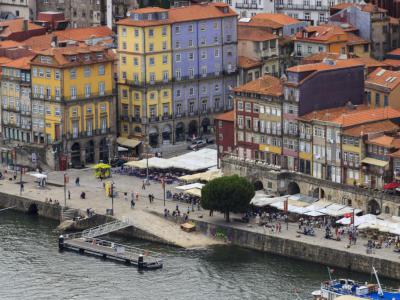
The origins of the settlement along the Ribeira is not really known. A riverside settlement developed near the confluence of the Vila River and the Douro River. Some Roman mosaics from the fourth century have been found in the area. The Ribeira grew along with Porto in the 13th century. Especially by the river and Penaventosa hill.
Two settlements arose. One on the escarpment of Penaventosa by Porto Cathedral. The other appeared below in Ribiera on the banks of the Douro River. Until the last decade of the 14th century the settlements were connected by a web of narrow, constricting streets difficult to move around in. A new street was needed to pierce the labyrinth.
On the initiative of John I a new street was opened. In fact, it was called "New Street" (Rua Nova). It was a perfect contrast to the tangled web of passageways of Porto. It was straight, and wide for its time. It became a prestigious address for the bourgeoisie, clergy and business.
The Ribeira district lures the visitor on. It is a captivating place of medieval streets and alleys ending in a busy waterfront square, the Ribeira Square. The remains of the 14th century wall run next to the Ribeira Wharf. Beyond this point are the steep twisted ways of the Barredo.
In the evenings clubs on the Ribeira Wharf promise a stimulating nightlife to romantic strollers. In days gone by the district alongside the Douro River was a center of lively commerce and business.
The Ribeira Square has many shops and cafes. At the northern part of the square is a huge fountain. The Ribeira Wharf starts on the west side of the Luis I Bridge and it follows the riverside to Ribeira Square.
There is an upper walkway where there are more shops and cafes. The walkway is what is left of the old city walls, once patrolled by medieval soldiers on watch. Sit down, have a drink and watch the river with them. Time glides by like the river.
Two settlements arose. One on the escarpment of Penaventosa by Porto Cathedral. The other appeared below in Ribiera on the banks of the Douro River. Until the last decade of the 14th century the settlements were connected by a web of narrow, constricting streets difficult to move around in. A new street was needed to pierce the labyrinth.
On the initiative of John I a new street was opened. In fact, it was called "New Street" (Rua Nova). It was a perfect contrast to the tangled web of passageways of Porto. It was straight, and wide for its time. It became a prestigious address for the bourgeoisie, clergy and business.
The Ribeira district lures the visitor on. It is a captivating place of medieval streets and alleys ending in a busy waterfront square, the Ribeira Square. The remains of the 14th century wall run next to the Ribeira Wharf. Beyond this point are the steep twisted ways of the Barredo.
In the evenings clubs on the Ribeira Wharf promise a stimulating nightlife to romantic strollers. In days gone by the district alongside the Douro River was a center of lively commerce and business.
The Ribeira Square has many shops and cafes. At the northern part of the square is a huge fountain. The Ribeira Wharf starts on the west side of the Luis I Bridge and it follows the riverside to Ribeira Square.
There is an upper walkway where there are more shops and cafes. The walkway is what is left of the old city walls, once patrolled by medieval soldiers on watch. Sit down, have a drink and watch the river with them. Time glides by like the river.
2) Ponte de Dom Luís I (Luís I Bridge) (must see)
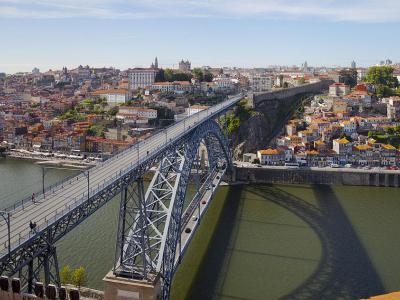
The banks of the River Douro are granite. Spanning the river in two different locations less than a mile apart are the bridges of Luis I, King of Portugal and his royal bride, D. Maria Pia. The bridge of Luis looks remarkably similar to that of Maria. Both bridges have enormous iron webs and arches supporting transit over the river.
The reason they look alike is simple. The D. Maria Pia bridge was designed by Gustave Eiffel, famous for his tower in Paris. The Dom Luis bridge was designed by Teophile Seyrig. Seyrig had partnered with Eiffel on the D. Maria Pia bridge and the Eiffel Tower. The span of the Luis Bridge is 564 feet and the height is 146 feet.
A novel feature of the Luis I bridge is its two levels. One passes over the the highest point of the arch and the other hangs beneath the arch. Originally, both levels were meant for road traffic. However, today the top level carries trains of the Metro alongside pedestrian walkways. Walking on the upper level is a thrill not to be missed.
From the upper level there are matchless views of Porto Cathedral and the Tower of the Clergymen dominating the skyline of old Porto.
Why You Should Visit:
Visit the upper level for the thrill, the view and bragging rights. It may not be the only bridge in town but it's the best.
The reason they look alike is simple. The D. Maria Pia bridge was designed by Gustave Eiffel, famous for his tower in Paris. The Dom Luis bridge was designed by Teophile Seyrig. Seyrig had partnered with Eiffel on the D. Maria Pia bridge and the Eiffel Tower. The span of the Luis Bridge is 564 feet and the height is 146 feet.
A novel feature of the Luis I bridge is its two levels. One passes over the the highest point of the arch and the other hangs beneath the arch. Originally, both levels were meant for road traffic. However, today the top level carries trains of the Metro alongside pedestrian walkways. Walking on the upper level is a thrill not to be missed.
From the upper level there are matchless views of Porto Cathedral and the Tower of the Clergymen dominating the skyline of old Porto.
Why You Should Visit:
Visit the upper level for the thrill, the view and bragging rights. It may not be the only bridge in town but it's the best.
3) Santo Ildefonso Church
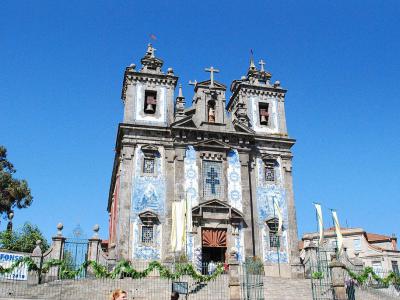
The Church of Saint Ildefonso (Igreja de Santo Ildefonso) is a prominent eighteenth-century church located near Batalha Square in Porto. Completed in 1739, this proto-Baroque church is a testament to the artistic and architectural heritage of Porto. Named in honor of Ildephonsus of Toledo, a Visigothic bishop from the 7th century, the church replaced an earlier chapel, Santo Alifon, which was mentioned as early as 1296 and was in a state of disrepair by the early 18th century. The original chapel was demolished in 1709, and construction of the current church began the same year, spanning three decades.
The architect of the Church of Saint Ildefonso is unknown, but records list craftsmen like carpenters, masons, and a locksmith. The first construction phase ended in 1730 with the completion of the main body and tympanum. From 1730 to 1739, the bell towers, façade, and narthex were added. The façade, made of plain granite with cornices, dentils, spheres, a stone cross, and metalwork flags, features about 11,000 Azulejo tiles by Jorge Colaço from 1932, depicting scenes from Saint Ildefonso’s life and the Gospels.
The church has undergone various restorations and modifications over the years. After suffering damage from a severe storm in 1819 and artillery fire during the Siege of Porto in 1833, it was extensively repaired. Further enhancements included the installation of new stained glass windows by artist Isolino Vaz in 1967 and renovations in 1996 that led to the discovery of nineteen graves in the narthex, corresponding to the original chapel's churchyard.
Constructed of granite in an elongated octagon shape, the church features decorative plaster ceilings and a notable retable designed by the Italian artist Nicolau Nasoni, installed in 1745. Despite the extensive repairs and alterations, the Church of Saint Ildefonso retains much of its original charm and continues to be a significant historical and cultural landmark in Porto, drawing visitors and worshippers alike with its daily masses and striking architectural presence.
The architect of the Church of Saint Ildefonso is unknown, but records list craftsmen like carpenters, masons, and a locksmith. The first construction phase ended in 1730 with the completion of the main body and tympanum. From 1730 to 1739, the bell towers, façade, and narthex were added. The façade, made of plain granite with cornices, dentils, spheres, a stone cross, and metalwork flags, features about 11,000 Azulejo tiles by Jorge Colaço from 1932, depicting scenes from Saint Ildefonso’s life and the Gospels.
The church has undergone various restorations and modifications over the years. After suffering damage from a severe storm in 1819 and artillery fire during the Siege of Porto in 1833, it was extensively repaired. Further enhancements included the installation of new stained glass windows by artist Isolino Vaz in 1967 and renovations in 1996 that led to the discovery of nineteen graves in the narthex, corresponding to the original chapel's churchyard.
Constructed of granite in an elongated octagon shape, the church features decorative plaster ceilings and a notable retable designed by the Italian artist Nicolau Nasoni, installed in 1745. Despite the extensive repairs and alterations, the Church of Saint Ildefonso retains much of its original charm and continues to be a significant historical and cultural landmark in Porto, drawing visitors and worshippers alike with its daily masses and striking architectural presence.
4) Rua Santa Catarina (St. Catherine Street) (must see)
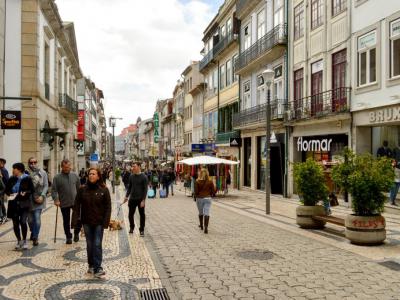
Saint Catherine Street is Porto's main shopping thoroughfare. It is totally pedestrianized and it extends from Marques de Pombal Park in the north to Batalha Park in the south. It runs between buildings with Art Deco facades. It is named for the Chapel of Souls and Saint Catherine of Alexandria.
Shop on Marques de Pombal for clothing, haberdashery goods, and shoes. The Via Catarina shopping center, many street vendors, and cafes make for a busy day for visitors.
Landmarks encountered are the Latina New Art Bookstore at Batalha Park and Palladium Gallery at the intersection of Passos Manuel Street. The Cafe Majestic, since 1921 a watering hole for Porto's intelligencia, is next to the Imperiel Tea Room, also a historic landmark.
The prestigious Porto Grand Hotel is next, since 1880 a haven for the famous. It was a place to die in 1889 for Teresa Cristina, Empress of Brazil. Prime Minister Afonso Costa was held prisoner here in 1917 during a coup d'etat.
At last, there is the Chapel of Santa Catarina also known as Chapel of Souls on the corner of Fernandes Tomas Street.
Shop on Marques de Pombal for clothing, haberdashery goods, and shoes. The Via Catarina shopping center, many street vendors, and cafes make for a busy day for visitors.
Landmarks encountered are the Latina New Art Bookstore at Batalha Park and Palladium Gallery at the intersection of Passos Manuel Street. The Cafe Majestic, since 1921 a watering hole for Porto's intelligencia, is next to the Imperiel Tea Room, also a historic landmark.
The prestigious Porto Grand Hotel is next, since 1880 a haven for the famous. It was a place to die in 1889 for Teresa Cristina, Empress of Brazil. Prime Minister Afonso Costa was held prisoner here in 1917 during a coup d'etat.
At last, there is the Chapel of Santa Catarina also known as Chapel of Souls on the corner of Fernandes Tomas Street.
5) Capela das Almas (Chapel of Souls) (must see)
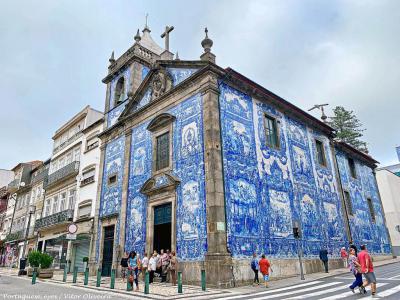
At the end of the eighteenth century the Brotherhood of Souls moved from the Monastery of Santa Clara to the chapel of Santa Catarina. The addition of the Brotherhood swelled the size of the Santa Catarina faction of devotees to the point where a new building was needed. The chapel therefore was expanded and restored in 1801.
The facade has a framed door under a circular pediment. A coat of arms is set on the tympanum showing Saint Francis of Assisi and Santa Catarina. The bell tower has two floors. On the first floor is a door with a window. The second floor has four windows and a balcony. Atop the dome is an iron cross.
The style of the church is basically neoclassical, but the church is noted for its covering of azulejo tiles. The tiles were made at the Viuva Lamego Ceramic Workshop in Lisbon. The 16,000 glowing blue and white tiles depict scenes from the lives of Saint Catherine and Saint Francis of Assisi.
The stained glass windows, made by Amandio Silva, show the souls in Purgatory washed with the redeeming blood of Christ. Inside the chapel is the 18th century image, Virgin of Souls. On the main altar is the large painting called "The Ascension of the Lord" by Joaquin Rafael, a professor of Fine Arts in Lisbon.
This is without a doubt, the most beautiful church in Porto. It must not be overlooked.
The facade has a framed door under a circular pediment. A coat of arms is set on the tympanum showing Saint Francis of Assisi and Santa Catarina. The bell tower has two floors. On the first floor is a door with a window. The second floor has four windows and a balcony. Atop the dome is an iron cross.
The style of the church is basically neoclassical, but the church is noted for its covering of azulejo tiles. The tiles were made at the Viuva Lamego Ceramic Workshop in Lisbon. The 16,000 glowing blue and white tiles depict scenes from the lives of Saint Catherine and Saint Francis of Assisi.
The stained glass windows, made by Amandio Silva, show the souls in Purgatory washed with the redeeming blood of Christ. Inside the chapel is the 18th century image, Virgin of Souls. On the main altar is the large painting called "The Ascension of the Lord" by Joaquin Rafael, a professor of Fine Arts in Lisbon.
This is without a doubt, the most beautiful church in Porto. It must not be overlooked.

6) Avenida dos Aliados (Avenue of the Allies)
In 1147 English Crusaders assisted in the liberation of Portugal from Moorish occupation. Having done this, the British hustled off to save the Holy Land. But their contribution was not forgotten. In 1373 the two countries forged an alliance that has endured through every trial to this day. The Anglo-Portuguese Treaty is the oldest alliance in the world that is still in force.
The alliance of Portugal and the United Kingdom is memorialized in the Avenue of the Allies. This grandiose boulevard was developed from local streets in 1916. The Avenue is lined with buildings in architectural styles ranging from neoclassical to Beaux-arts.
All the buildings are of granite. Many have skylights, domes and spires. The center of the Avenue is covered by a mall paved with cobblestones. On the sides of the mall are entrances to Metro Line D. Construction of the line caused reformation of the avenue.
At the top of the avenue is the imposing Town Hall with its clock tower 220 feet above passers-by on the street below. Before the Hall is the General Humberto Delgado Park, a wide, tree lined square connecting to roads on each side.
The avenue leads past the granite facades to the most famous landmark, the venerable Cafe Imperiale. It has the imperial eagle over the door but the inside is McDonalds.
The alliance of Portugal and the United Kingdom is memorialized in the Avenue of the Allies. This grandiose boulevard was developed from local streets in 1916. The Avenue is lined with buildings in architectural styles ranging from neoclassical to Beaux-arts.
All the buildings are of granite. Many have skylights, domes and spires. The center of the Avenue is covered by a mall paved with cobblestones. On the sides of the mall are entrances to Metro Line D. Construction of the line caused reformation of the avenue.
At the top of the avenue is the imposing Town Hall with its clock tower 220 feet above passers-by on the street below. Before the Hall is the General Humberto Delgado Park, a wide, tree lined square connecting to roads on each side.
The avenue leads past the granite facades to the most famous landmark, the venerable Cafe Imperiale. It has the imperial eagle over the door but the inside is McDonalds.
7) Sé Catedral do Porto (Porto Cathedral) (must see)
In 868, Vimara Peres, an Asturias nobleman born in 820, conquered Moorish held lands north of the river Douro. One of the towns he took went by the name Portus Cale. Portus Cale became Portucale, the county he would rule. The town became Porto. Penaventosa, the highest hill in Portus Cale, became the site of Porto Cathedral.
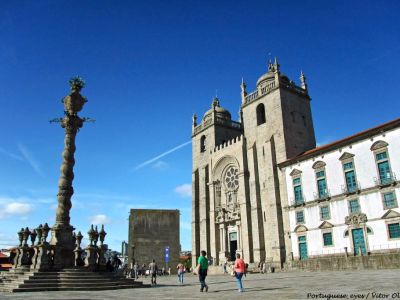
The hill was once the location of a Suebian Church. Work began on the Cathedral in the 12th century. There were fits and starts over the years, but the building was finally considered complete in 1737. It is the most impressive Romanesque style edifice in Porto. On top of Penaventosa it sits, fortress-like, overlooking the town.
The cathedral is flanked by twin square towers. Each tower is buttressed and topped with a cupola. The western façade has 15th century Gothic ornamentation. There is also an impressive Gothic cloister installed in 1736 by Nicolau Nasoni, an architect from Tuscany who settled in Portugal.
On the northern side of the cathedral is a baroque porch and a Romanesque rose window under a crenelated arch. The crenellations reinforce the impression of a fortress. The nave is not wide. It is covered with a barrel vault.
The baroque apse is decorated with paintings by Nasoni. The altarpiece of the chapel was designed by Santos Pacheco. The south transept is decorated with blue azulejo tiles.
Mass is celebrated every day at 11am.
Why You Should Visit:
You wouldn't want to miss the city's oldest and most visited monument! The square also offers impressive views over the city, the Douro River and the wine cellars on the waterfront.
Tip:
While admission to the Porto Cathedral is free, there's a small fee to get into the Sacred Art Museum and the magnificent Gothic cloisters attached to the church. If you're feeling fit you can also climb the tower (steps are steep and numerous!) for amazing views, including at the bits of the cathedral you can't see from further down.
The hill was once the location of a Suebian Church. Work began on the Cathedral in the 12th century. There were fits and starts over the years, but the building was finally considered complete in 1737. It is the most impressive Romanesque style edifice in Porto. On top of Penaventosa it sits, fortress-like, overlooking the town.
The cathedral is flanked by twin square towers. Each tower is buttressed and topped with a cupola. The western façade has 15th century Gothic ornamentation. There is also an impressive Gothic cloister installed in 1736 by Nicolau Nasoni, an architect from Tuscany who settled in Portugal.
On the northern side of the cathedral is a baroque porch and a Romanesque rose window under a crenelated arch. The crenellations reinforce the impression of a fortress. The nave is not wide. It is covered with a barrel vault.
The baroque apse is decorated with paintings by Nasoni. The altarpiece of the chapel was designed by Santos Pacheco. The south transept is decorated with blue azulejo tiles.
Mass is celebrated every day at 11am.
Why You Should Visit:
You wouldn't want to miss the city's oldest and most visited monument! The square also offers impressive views over the city, the Douro River and the wine cellars on the waterfront.
Tip:
While admission to the Porto Cathedral is free, there's a small fee to get into the Sacred Art Museum and the magnificent Gothic cloisters attached to the church. If you're feeling fit you can also climb the tower (steps are steep and numerous!) for amazing views, including at the bits of the cathedral you can't see from further down.
