Custom Walk in Santorini, Greece by morrisdana_395d5 created on 2026-02-03
Guide Location: Greece » Santorini
Guide Type: Custom Walk
# of Sights: 12
Tour Duration: 3 Hour(s)
Travel Distance: 7.2 Km or 4.5 Miles
Share Key:
Guide Type: Custom Walk
# of Sights: 12
Tour Duration: 3 Hour(s)
Travel Distance: 7.2 Km or 4.5 Miles
Share Key:
How It Works
Please retrieve this walk in the GPSmyCity app. Once done, the app will guide you from one tour stop to the next as if you had a personal tour guide. If you created the walk on this website or come to the page via a link, please follow the instructions below to retrieve the walk in the app.
Retrieve This Walk in App
Step 1. Download the app "GPSmyCity: Walks in 1K+ Cities" on Apple App Store or Google Play Store.



Step 2. In the GPSmyCity app, download(or launch) the guide "Santorini Map and Walking Tours".
Step 3. Tap the menu button located at upper right corner of the "Walks" screen and select "Retrieve custom walk". Enter the share key:
1) Orthodox Metropolitan Cathedral
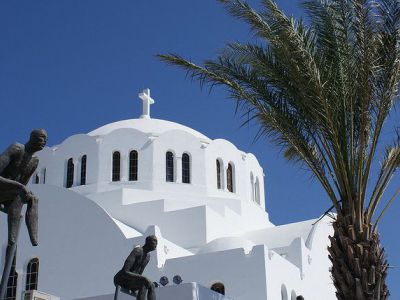
The Orthodox Metropolitan Cathedral of Thera, also known as the Cathedral of Ypapanti, is the island’s principal Orthodox church. An earlier cathedral occupied this site in the 19th century, but the structure you see today was rebuilt after the devastating earthquake of 1956, which destroyed much of Fira. The reconstruction combined traditional Orthodox forms with mid-20th-century building techniques.
From the outside, focus first on the arched arcades that frame the facade. Above them rises the central dome, while the bell tower, set slightly apart, adds vertical emphasis to the composition. Together, these elements create a layered silhouette that is visible from several points along the caldera.
Now step inside and pause near the entrance. Greek Orthodox churches rely on iconography, wall paintings, and carefully structured use of light, rather than stained glass. As your eyes adjust, look toward the upper walls and ceiling, where frescoes by the local artist Christoforos Asimis unfold. His work reflects modern Orthodox painting while remaining firmly rooted in traditional themes and iconographic order.
Move your gaze upward toward the central chandelier, which hangs beneath the dome. Nearby, notice the mosaics added in 1975. The cathedral remains an active place of worship, and visitors are welcome outside of services. Modest dress is required, with shoulders and knees covered, and a respectful atmosphere is expected, especially during religious observances.
From the outside, focus first on the arched arcades that frame the facade. Above them rises the central dome, while the bell tower, set slightly apart, adds vertical emphasis to the composition. Together, these elements create a layered silhouette that is visible from several points along the caldera.
Now step inside and pause near the entrance. Greek Orthodox churches rely on iconography, wall paintings, and carefully structured use of light, rather than stained glass. As your eyes adjust, look toward the upper walls and ceiling, where frescoes by the local artist Christoforos Asimis unfold. His work reflects modern Orthodox painting while remaining firmly rooted in traditional themes and iconographic order.
Move your gaze upward toward the central chandelier, which hangs beneath the dome. Nearby, notice the mosaics added in 1975. The cathedral remains an active place of worship, and visitors are welcome outside of services. Modest dress is required, with shoulders and knees covered, and a respectful atmosphere is expected, especially during religious observances.
2) Museum of Prehistoric Thera (must see)
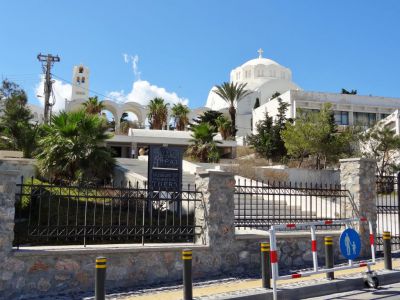
The Museum of Prehistoric Thera offers a focused introduction to Santorini’s prehistoric past, centered on the Bronze Age settlement of Akrotiri. The first displays you encounter provide broad context, introducing the island’s geology, volcanic landscape, and early settlement history. These sections frame the story of Thera before the catastrophic eruption of the 17th century BCE, setting the stage for the archaeological material that follows.
The exhibition then turns to finds drawn primarily from Akrotiri, with additional material from other sites on the island. Here, the focus shifts to the Late Cycladic I period, the final phase of life at Akrotiri. Pottery vessels, jewelry, and bronze tools illustrate everyday activities and technical skill, while more specialized ceramic forms, such as “bird jugs” decorated with swallow motifs, reflect both function and decoration.
Nearby, plaster casts of wooden furniture, including beds and storage units, offer one of the museum’s most tangible connections to daily life. Created from voids left in the volcanic ash after the original wood decayed, these casts preserve forms that are rarely visible in prehistoric archaeology and give a sense of how interior spaces were organized.
The museum’s highlight is presented on the second floor, where a major permanent exhibition opened in 2021 under the title “Thera Wall Paintings: The Masterpieces of Aegean Prehistory”. The frescoes are arranged according to their original iconographic programs, allowing visitors to see how painted scenes once functioned within specific rooms rather than as isolated images.
Among the most celebrated works are the saffron gatherers, the spring fresco with swallows, and compositions known as the Ladies, Papyri, and Blue Monkeys. Their vivid colors, rhythmic movement, and close observation of the natural world form the visual center of the museum. Smaller fragments surrounding them show how decoration extended throughout the interiors of Akrotiri’s houses.
One of the museum’s most exceptional small finds is the Gold Ibex figurine, discovered in 1999. Cast from solid gold, it is unique within Aegean prehistoric art and offers a glimpse into the wealth, craftsmanship, and symbolic culture of Akrotiri shortly before its burial. Together, the galleries present a coherent journey from geological forces to a fully developed Bronze Age settlement, preserved at a precise moment beneath volcanic ash.
The exhibition then turns to finds drawn primarily from Akrotiri, with additional material from other sites on the island. Here, the focus shifts to the Late Cycladic I period, the final phase of life at Akrotiri. Pottery vessels, jewelry, and bronze tools illustrate everyday activities and technical skill, while more specialized ceramic forms, such as “bird jugs” decorated with swallow motifs, reflect both function and decoration.
Nearby, plaster casts of wooden furniture, including beds and storage units, offer one of the museum’s most tangible connections to daily life. Created from voids left in the volcanic ash after the original wood decayed, these casts preserve forms that are rarely visible in prehistoric archaeology and give a sense of how interior spaces were organized.
The museum’s highlight is presented on the second floor, where a major permanent exhibition opened in 2021 under the title “Thera Wall Paintings: The Masterpieces of Aegean Prehistory”. The frescoes are arranged according to their original iconographic programs, allowing visitors to see how painted scenes once functioned within specific rooms rather than as isolated images.
Among the most celebrated works are the saffron gatherers, the spring fresco with swallows, and compositions known as the Ladies, Papyri, and Blue Monkeys. Their vivid colors, rhythmic movement, and close observation of the natural world form the visual center of the museum. Smaller fragments surrounding them show how decoration extended throughout the interiors of Akrotiri’s houses.
One of the museum’s most exceptional small finds is the Gold Ibex figurine, discovered in 1999. Cast from solid gold, it is unique within Aegean prehistoric art and offers a glimpse into the wealth, craftsmanship, and symbolic culture of Akrotiri shortly before its burial. Together, the galleries present a coherent journey from geological forces to a fully developed Bronze Age settlement, preserved at a precise moment beneath volcanic ash.
3) Santorini Old Harbor
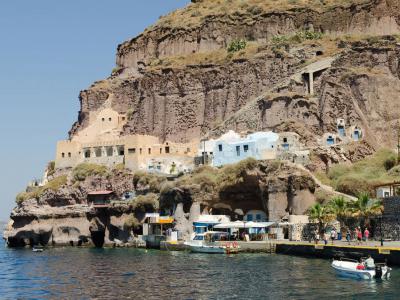
Santorini’s Old Harbor owes its existence to the island’s volcanic formation, shaped primarily by the great Bronze Age eruption around the 16th century BCE. For centuries, it functioned as the island’s main maritime access point, serving small cargo vessels and passenger boats until modern port facilities were developed elsewhere. Today, it no longer handles large-scale traffic but remains active as a tender harbor for cruise ships.
Because the caldera drops steeply into deep water, cruise ships cannot dock directly. Instead, passengers are transferred to the Old Harbor by tender boats, which ferry them ashore from anchored ships. Historically, access between the harbor and Fira was possible only via a steep zigzagging path of approximately 580 steps, carved into the cliff face and still visible today.
Modern visitors can reach the upper town by cable car, introduced in the late 20th century. The ride takes about five minutes and offers wide views over the caldera and harbor below. Donkeys, once an essential means of transport, are still present, though their use today is increasingly discouraged. For those on foot, the climb remains demanding, especially in summer heat.
The Old Harbor waterfront features a small cluster of cafes, taverns, and souvenir shops catering mainly to cruise passengers. From here, boat excursions depart to the Nea Kameni volcano and nearby hot springs, particularly during the warmer months. While the harbor can become crowded during peak cruise days, overall visitor numbers fluctuate depending on ship schedules rather than constant daily traffic.
Because the caldera drops steeply into deep water, cruise ships cannot dock directly. Instead, passengers are transferred to the Old Harbor by tender boats, which ferry them ashore from anchored ships. Historically, access between the harbor and Fira was possible only via a steep zigzagging path of approximately 580 steps, carved into the cliff face and still visible today.
Modern visitors can reach the upper town by cable car, introduced in the late 20th century. The ride takes about five minutes and offers wide views over the caldera and harbor below. Donkeys, once an essential means of transport, are still present, though their use today is increasingly discouraged. For those on foot, the climb remains demanding, especially in summer heat.
The Old Harbor waterfront features a small cluster of cafes, taverns, and souvenir shops catering mainly to cruise passengers. From here, boat excursions depart to the Nea Kameni volcano and nearby hot springs, particularly during the warmer months. While the harbor can become crowded during peak cruise days, overall visitor numbers fluctuate depending on ship schedules rather than constant daily traffic.
4) St. John the Baptist Cathedral (must see)
The Catholic Cathedral of Saint John the Baptist stands out as the principal Roman Catholic church on the island. Originally established in the 17th century during the period of Venetian influence, it reflects the Catholic presence fostered by Western religious orders, including the Jesuits. Like many buildings on Santorini, it was repeatedly affected by seismic activity. The structure seen today dates from a reconstruction completed in 1975, carried out in a restrained, Baroque-inspired style.
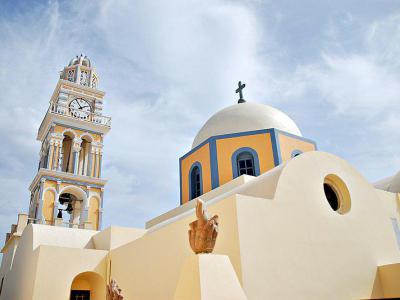
Approaching the cathedral, notice the peach-colored facade, which immediately distinguishes it from the island’s predominantly whitewashed Orthodox churches. The clock tower and bell tower, rising just to one side, serve as an easy visual marker from nearby streets.
As you step inside, pause near the entrance. To one side, you’ll find the confessional, a feature typical of Catholic churches but rarely encountered elsewhere on the island. Moving forward into the nave, your eye is naturally drawn toward the main altar, positioned beneath the dome and arranged according to Western liturgical tradition rather than behind an iconostasis.
Lift your gaze upward to the central chandelier, suspended below the dome. Its placement reinforces the height of the space and acts as the visual center of the interior. Above the altar, a large religious painting forms the focal point of the sanctuary, framed by soft blue, cream, and warm-toned surfaces that emphasize light and balance over heavy ornamentation. Along the side walls, look for a series of framed devotional paintings and portraits of saints, arranged in a clear, orderly sequence.
The cathedral remains an active place of worship, serving both local parishioners and visitors. Sunday Mass is regularly held, often attended by an international congregation, with parts of the service occasionally offered in multiple languages depending on those present. Visitors are expected to dress modestly and maintain a respectful atmosphere, especially during services.
Outside, the surrounding streets form part of Fira’s compact commercial center, with small shops, cafes, and casual eateries unfolding just beyond the church—an everyday setting that contrasts with the quiet, ordered interior you have just explored.
Approaching the cathedral, notice the peach-colored facade, which immediately distinguishes it from the island’s predominantly whitewashed Orthodox churches. The clock tower and bell tower, rising just to one side, serve as an easy visual marker from nearby streets.
As you step inside, pause near the entrance. To one side, you’ll find the confessional, a feature typical of Catholic churches but rarely encountered elsewhere on the island. Moving forward into the nave, your eye is naturally drawn toward the main altar, positioned beneath the dome and arranged according to Western liturgical tradition rather than behind an iconostasis.
Lift your gaze upward to the central chandelier, suspended below the dome. Its placement reinforces the height of the space and acts as the visual center of the interior. Above the altar, a large religious painting forms the focal point of the sanctuary, framed by soft blue, cream, and warm-toned surfaces that emphasize light and balance over heavy ornamentation. Along the side walls, look for a series of framed devotional paintings and portraits of saints, arranged in a clear, orderly sequence.
The cathedral remains an active place of worship, serving both local parishioners and visitors. Sunday Mass is regularly held, often attended by an international congregation, with parts of the service occasionally offered in multiple languages depending on those present. Visitors are expected to dress modestly and maintain a respectful atmosphere, especially during services.
Outside, the surrounding streets form part of Fira’s compact commercial center, with small shops, cafes, and casual eateries unfolding just beyond the church—an everyday setting that contrasts with the quiet, ordered interior you have just explored.
5) Archaeological Museum of Thera
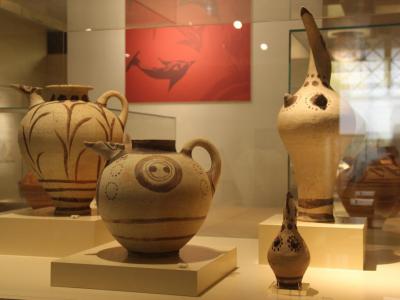
The Archaeological Museum of Thera offers an overview of the island’s history from antiquity through the Roman period, drawing entirely on material uncovered in local excavations. Its permanent exhibition includes sculpture, inscriptions, pottery, and small finds dating from the Archaic, Classical, Hellenistic, and Roman eras, illustrating how Santorini was integrated into wider Greek and Mediterranean cultural networks.
Among the highlights are stone sculptures, as well as vases and clay figurines spanning from the Geometric to the Hellenistic periods. These objects reflect everyday life, religious practices, and funerary customs on the island. A notable geological exhibit, a large volcanic boulder, underscores the close relationship between local history and Santorini’s volcanic environment.
The museum was founded in 1902, making it one of the earliest archaeological museums established in Greece outside Athens. The current building dates from the 1960s, constructed after the earlier structure was destroyed during the 1956 earthquake. While smaller in scale than national collections in Athens, the museum’s significance lies in the local origin of its exhibits. Every major piece comes from Santorini itself, offering visitors a concentrated view of the island’s archaeological record in one place.
Notable objects on display include the Theran amphora with Geometric decoration, fragments of Archaic funerary kouroi, a Daedalic-style clay figurine, and an Attic black-figure kylix. Another significant highlight is the Kore of Thera, a nearly intact Archaic female statue standing 2.48 meters tall, dated to around 640 BCE. Executed in the early Daedalic style, the kore offers rare insight into large-scale sculptural production on the island during the early Archaic period.
Among the highlights are stone sculptures, as well as vases and clay figurines spanning from the Geometric to the Hellenistic periods. These objects reflect everyday life, religious practices, and funerary customs on the island. A notable geological exhibit, a large volcanic boulder, underscores the close relationship between local history and Santorini’s volcanic environment.
The museum was founded in 1902, making it one of the earliest archaeological museums established in Greece outside Athens. The current building dates from the 1960s, constructed after the earlier structure was destroyed during the 1956 earthquake. While smaller in scale than national collections in Athens, the museum’s significance lies in the local origin of its exhibits. Every major piece comes from Santorini itself, offering visitors a concentrated view of the island’s archaeological record in one place.
Notable objects on display include the Theran amphora with Geometric decoration, fragments of Archaic funerary kouroi, a Daedalic-style clay figurine, and an Attic black-figure kylix. Another significant highlight is the Kore of Thera, a nearly intact Archaic female statue standing 2.48 meters tall, dated to around 640 BCE. Executed in the early Daedalic style, the kore offers rare insight into large-scale sculptural production on the island during the early Archaic period.
6) Three Bells of Fira (must see)
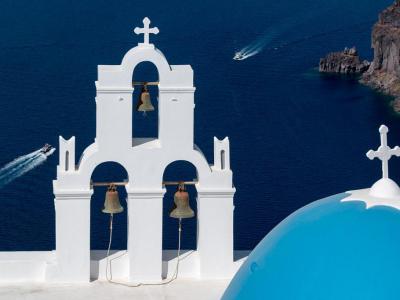
The Three Bells of Fira, officially known as the Catholic Church of the Dormition, belongs to the Greek Catholic Church and falls under the jurisdiction of the Catholic Diocese of Santorini, following the Byzantine liturgical tradition while remaining in communion with Rome.
The site has a long and layered history. In the 17th century, two small cave churches were carved into the cliff face here. As the settlement expanded and the terrain shifted, these early structures were lost. An infirmary was later built on the site and subsequently occupied by Jesuits, before the property was transferred to the Catholic authorities. The present-day church was constructed in 1757, forming the core of the structure seen today.
The church suffered serious damage during the 1956 Amorgos earthquake. Extensive restoration followed, giving the building its current appearance. Architecturally modest in scale, its visual impact comes from its setting and composition: whitewashed walls, a vivid blue dome, and a freestanding bell tower crowned with three bells. The bell tower, positioned slightly apart from the church itself, overlooks the caldera and the Nea Kameni volcanic islet.
The church is dedicated to the Dormition of the Virgin Mary, celebrated on 15 August, which remains its principal feast day. On this occasion, religious services and observances are held in keeping with Byzantine Catholic tradition.
Today, the Three Bells of Fira functions both as an active place of worship and as one of the island’s most photographed viewpoints. Its best-known view is from the clifftop viewpoint and parking area above the church, from where the dome and bell tower are seen framed against the sea and sky.
The site has a long and layered history. In the 17th century, two small cave churches were carved into the cliff face here. As the settlement expanded and the terrain shifted, these early structures were lost. An infirmary was later built on the site and subsequently occupied by Jesuits, before the property was transferred to the Catholic authorities. The present-day church was constructed in 1757, forming the core of the structure seen today.
The church suffered serious damage during the 1956 Amorgos earthquake. Extensive restoration followed, giving the building its current appearance. Architecturally modest in scale, its visual impact comes from its setting and composition: whitewashed walls, a vivid blue dome, and a freestanding bell tower crowned with three bells. The bell tower, positioned slightly apart from the church itself, overlooks the caldera and the Nea Kameni volcanic islet.
The church is dedicated to the Dormition of the Virgin Mary, celebrated on 15 August, which remains its principal feast day. On this occasion, religious services and observances are held in keeping with Byzantine Catholic tradition.
Today, the Three Bells of Fira functions both as an active place of worship and as one of the island’s most photographed viewpoints. Its best-known view is from the clifftop viewpoint and parking area above the church, from where the dome and bell tower are seen framed against the sea and sky.
7) Firostefani Ruins
Firostefani, situated on the island of Santorini, is a significant archaeological site that offers a glimpse into the island's rich historical past. The entire island itself is considered an archaeological treasure, with few exceptions, and the route from Firostefani to Imerovigli is dotted with remnants of ancient settlements, each holding its unique surprises for visitors.
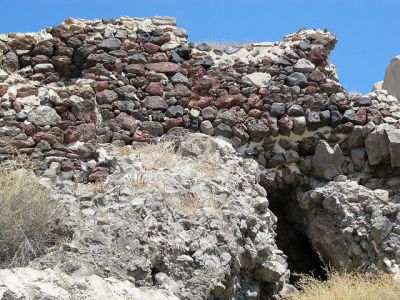
The traditional houses in Firostefani, characterized by their hard, smooth walls moistened by water and ground, were partially dug into the soft tephra, volcanic ash. Unfortunately, many of these structures were destroyed by the devastating earthquake in 1968. The ruins of these houses, which were made of mud and stones, remain as poignant reminders of this natural disaster.
Visitors today can wander through the remains of the city, exploring narrow stone-paved streets and admiring the ruins of large squares. The basements, once used as storage and workshops, add to the historical atmosphere of the site. Significant artifacts uncovered during excavations are displayed at the Museum of Prehistoric Thera in Fira, allowing a deeper understanding of the area's ancient way of life. Additionally, some of the famous wall paintings discovered in Firostefani are exhibited in the National Archaeological Museum in Athens, showcasing the artistic heritage of the region.
Overall, Firostefani offers a compelling journey through time, inviting visitors to uncover the layers of history embedded in its ruins and providing a poignant look at the resilience of this remarkable island.
The traditional houses in Firostefani, characterized by their hard, smooth walls moistened by water and ground, were partially dug into the soft tephra, volcanic ash. Unfortunately, many of these structures were destroyed by the devastating earthquake in 1968. The ruins of these houses, which were made of mud and stones, remain as poignant reminders of this natural disaster.
Visitors today can wander through the remains of the city, exploring narrow stone-paved streets and admiring the ruins of large squares. The basements, once used as storage and workshops, add to the historical atmosphere of the site. Significant artifacts uncovered during excavations are displayed at the Museum of Prehistoric Thera in Fira, allowing a deeper understanding of the area's ancient way of life. Additionally, some of the famous wall paintings discovered in Firostefani are exhibited in the National Archaeological Museum in Athens, showcasing the artistic heritage of the region.
Overall, Firostefani offers a compelling journey through time, inviting visitors to uncover the layers of history embedded in its ruins and providing a poignant look at the resilience of this remarkable island.
8) Firostefani Central Square
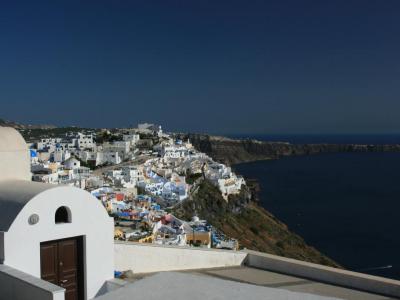
Firostefani Central Square in Santorini offers a quaint and charming spot in the picturesque neighborhood of Firostefani, just a short distance from the bustling town of Fira. Although it might not resemble a typical town square, this small area serves as a delightful gathering spot right next to the main road, making it an excellent stop for both locals and visitors.
This central square is surrounded by the quintessential white-washed buildings adorned with vibrant bougainvillea, reflecting the traditional Greek architectural style that Santorini is famous for. Its prime location on the edge of the caldera provides visitors with breathtaking panoramic views of the volcanic landscape and the deep blue Aegean Sea, making it a perfect vantage point for enjoying the island's natural beauty.
The area around Firostefani Central Square is brimming with a variety of eateries, including local cafés and restaurants that offer delicious local cuisine and a great selection of wines and other beverages. It's an ideal spot for those looking to grab a quick bite or enjoy a leisurely meal while soaking in the scenic views.
Tourists can also explore the narrow, cobbled streets lined with boutique shops, local tavernas, and charming cafes, adding to the square's laid-back ambiance. The square often hosts local events and festivals, providing a glimpse into the authentic culture of the island.
Firostefani Central Square's proximity to notable attractions, such as the Old Port of Fira and Skala, as well as cultural landmarks like the Agios Gerasimos Church and the Archaeological Museum of Thera, makes it a convenient and appealing destination for those seeking both relaxation and cultural exploration on the beautiful island of Santorini.
This central square is surrounded by the quintessential white-washed buildings adorned with vibrant bougainvillea, reflecting the traditional Greek architectural style that Santorini is famous for. Its prime location on the edge of the caldera provides visitors with breathtaking panoramic views of the volcanic landscape and the deep blue Aegean Sea, making it a perfect vantage point for enjoying the island's natural beauty.
The area around Firostefani Central Square is brimming with a variety of eateries, including local cafés and restaurants that offer delicious local cuisine and a great selection of wines and other beverages. It's an ideal spot for those looking to grab a quick bite or enjoy a leisurely meal while soaking in the scenic views.
Tourists can also explore the narrow, cobbled streets lined with boutique shops, local tavernas, and charming cafes, adding to the square's laid-back ambiance. The square often hosts local events and festivals, providing a glimpse into the authentic culture of the island.
Firostefani Central Square's proximity to notable attractions, such as the Old Port of Fira and Skala, as well as cultural landmarks like the Agios Gerasimos Church and the Archaeological Museum of Thera, makes it a convenient and appealing destination for those seeking both relaxation and cultural exploration on the beautiful island of Santorini.
9) Agios Nikolaos Monastery
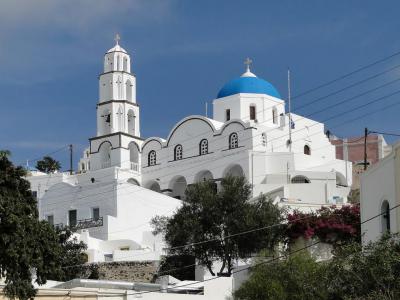
Located in the stunning and blue waters of the Aegean Sea is the Agios Nikolaos Monastery. This female convent is located between the villages of Firostefani and Imerovogli in Santorini. It is dedicated to saints Agios Panteleimon, Agios Nikolaos, and Zoodochos Pigi, and was established by the Gizi family in 1651. Prior to its current use, it was a private family chapel.
The design of the nunnery reflects the clean and simple lines of Cycladic style, while the interior of the edifice features beautiful 17th century artwork and spectacular golden icons. Two museums, folklore and ecclesiastical, are also located on the property.
Each year on August 15th, locals come here to celebrate the religious festival the Feast of the Assumption of the Virgin Mary. After church services, locals and visitors celebrate the holiday with food, song, and dance. Visitors will enjoy viewing the handmade textiles that the nuns make, using hand looms.
The design of the nunnery reflects the clean and simple lines of Cycladic style, while the interior of the edifice features beautiful 17th century artwork and spectacular golden icons. Two museums, folklore and ecclesiastical, are also located on the property.
Each year on August 15th, locals come here to celebrate the religious festival the Feast of the Assumption of the Virgin Mary. After church services, locals and visitors celebrate the holiday with food, song, and dance. Visitors will enjoy viewing the handmade textiles that the nuns make, using hand looms.
10) Skaros Castle Ruins
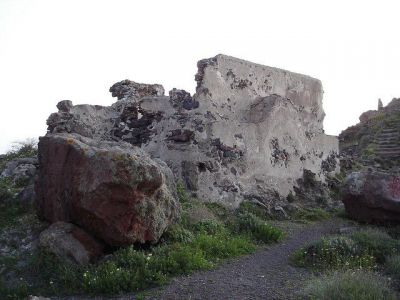
Located in Imerovigli Village, the Skaros Castle Ruins is one of five fortified settlements on the island. This ancient and fascinating site was originally known as Epano Kastro and also as La Roka. It was built by the Venetian, Giacomo Barozzi, in the 1200s and was the capital of the town until the eighteenth century. The castle was also used as an observation tower and featured a bell, at the top of the mountain, to warn townspeople of approaching pirates. It was and still is known as the symbol of Santorini.
Once a populous area, damage from earthquakes in 1650, 1701, 1866, and 1870 caused all of the townspeople to move elsewhere and turned the once glorious castle into rubble. The area is completely uninhabited, except for the Church of Agios Ioannis Apokefalistheis.
Hikers will enjoy the walking trail that starts at the church Agios, makes it way through the cape that connects Skaros with Imerovigli, and ends at the small chapel of Theoskepasti. The island is decorated with miles of beautiful remnants of lava and gorgeous landscape. If you are fortunate enough to reach the summit of Skaros, you will enjoy breathtaking views of the island and the crystal-clear Aegean Sea.
Once a populous area, damage from earthquakes in 1650, 1701, 1866, and 1870 caused all of the townspeople to move elsewhere and turned the once glorious castle into rubble. The area is completely uninhabited, except for the Church of Agios Ioannis Apokefalistheis.
Hikers will enjoy the walking trail that starts at the church Agios, makes it way through the cape that connects Skaros with Imerovigli, and ends at the small chapel of Theoskepasti. The island is decorated with miles of beautiful remnants of lava and gorgeous landscape. If you are fortunate enough to reach the summit of Skaros, you will enjoy breathtaking views of the island and the crystal-clear Aegean Sea.
11) Church of Panagia Malteza
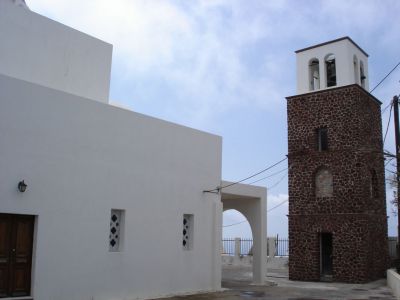
The Church of Panagia Malteza was originally built in the 19th century. Theodoros Borlis, a ship's captain, found an icon of the Virgin Mary floating in the sea near Malta. He brought the icon back to Santorini and built a church to honor the icon of Panagia Malteza.
The Church of Panagia Malteza features a beautifully carved screen that depicts scenes from the Old Testament. The church's bell tower has four bells. The Church of Panagia Malteza has a celebration festival every year on November 21st.
The church is built on the cliff's edge and provides a beautiful view. It is open to the public, and visitors are welcome to enjoy the beautiful and serene setting. The Church of Panagia Malteza is a popular location for weddings.
Paths from the church lead visitors to the imposing Skaros Rock, the Caldera walkway, and the Chapel of Panagia Theoskepasti.
The Church of Panagia Malteza features a beautifully carved screen that depicts scenes from the Old Testament. The church's bell tower has four bells. The Church of Panagia Malteza has a celebration festival every year on November 21st.
The church is built on the cliff's edge and provides a beautiful view. It is open to the public, and visitors are welcome to enjoy the beautiful and serene setting. The Church of Panagia Malteza is a popular location for weddings.
Paths from the church lead visitors to the imposing Skaros Rock, the Caldera walkway, and the Chapel of Panagia Theoskepasti.
12) Panagia Theoskepasti Chapel
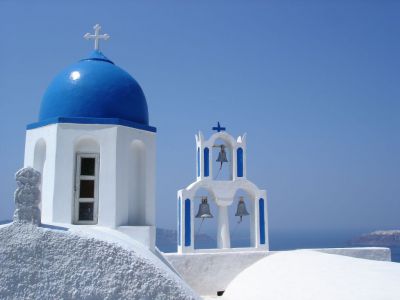
One of Santorini's symbols, the Chapel of Panagia Theoskepasti, is located near the port of Andres, on Skaros Rock, a rocky peninsula that projects into the sea. It was fashioned by multiple volcanoes that changed the shape of the island from circular to crescent. In addition, many other islands were also formed from these volcanoes. The rock was also the site of a castle until an earthquake destroyed the building in the 19th century.
The white building with a blue dome housing the church is open during the day until 4pm, free for anyone to visit. Moreover, the village of Imerovigli has some of the best views of Santorini because of its high vantage point. Visitors can reach the church via the nearby walking trail that begins at Imerovigli and runs through the cape that connects Skaros to the village. The trail ends at the Chapel of Theoskepasti. There is also a stunning underwater caldera that is worth the wait. Once you have visited the church, make sure to see the Hidden Room. The cave sits to the right of the trail and is one of the few elements that remain from the original castle structure.
Tip:
Weekend morning chanting begins at 7am and is broadcasted via loudspeakers to the entire district for hours.
The white building with a blue dome housing the church is open during the day until 4pm, free for anyone to visit. Moreover, the village of Imerovigli has some of the best views of Santorini because of its high vantage point. Visitors can reach the church via the nearby walking trail that begins at Imerovigli and runs through the cape that connects Skaros to the village. The trail ends at the Chapel of Theoskepasti. There is also a stunning underwater caldera that is worth the wait. Once you have visited the church, make sure to see the Hidden Room. The cave sits to the right of the trail and is one of the few elements that remain from the original castle structure.
Tip:
Weekend morning chanting begins at 7am and is broadcasted via loudspeakers to the entire district for hours.
