Custom Walk in Ghent, Belgium by karla_324e3 created on 2026-02-17
Guide Location: Belgium » Ghent
Guide Type: Custom Walk
# of Sights: 8
Tour Duration: 1 Hour(s)
Travel Distance: 1.9 Km or 1.2 Miles
Share Key: CLRR4
Guide Type: Custom Walk
# of Sights: 8
Tour Duration: 1 Hour(s)
Travel Distance: 1.9 Km or 1.2 Miles
Share Key: CLRR4
How It Works
Please retrieve this walk in the GPSmyCity app. Once done, the app will guide you from one tour stop to the next as if you had a personal tour guide. If you created the walk on this website or come to the page via a link, please follow the instructions below to retrieve the walk in the app.
Retrieve This Walk in App
Step 1. Download the app "GPSmyCity: Walks in 1K+ Cities" on Apple App Store or Google Play Store.



Step 2. In the GPSmyCity app, download(or launch) the guide "Ghent Map and Walking Tours".
Step 3. Tap the menu button located at upper right corner of the "Walks" screen and select "Retrieve custom walk". Enter the share key: CLRR4
1) Belfort (Belfry of Ghent) (must see)
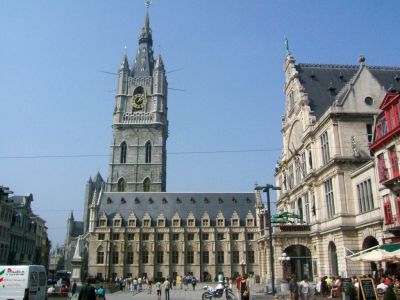
There are three medieval towers rising over the old city of Ghent: Saint Bavo Cathedral, Saint Nicholas' Church and the 298 foot Belfry of Ghent. The building of the Belfry tower began in 1313, following the designs of master mason Jan van Haelst. Wars, pestilence and politics slowed progress but the tower was completed in 1380.
At the peak of the tower sits the latest version of the gilded Dragon of Ghent. The original dragon, installed in 1382, was acquired by Count Baldwin IX of Flanders and brought to Bruges. It later became a war trophy of Ghent. Meant to protect charters and documents stored in the tower, the Dragon became a symbol of the city's power.
The upper reaches of the tower have been rebuilt occasionally to allow for a growing number of bells. The campanile was finished in 1771 with a spire designed by architect Louis 't Kindt. A neo-Gothic spire was installed in 1851. It was replaced in 1913 by the stone spire of today.
Historically the belfry bells were used to announce the time, sound warnings and announce victories. The great alarm bell called "Roland" was installed in 1325. After he had subdued an uprising in Ghent, Holy Roman Emperor Charles V ordered Roland removed.
Henry Wadsworth Longfellow wrote:
"...I am Roland! I am Roland!
There is victory in the land!"
Why You Should Visit:
Climbing this tower on your visit to Ghent is imperative! Not excessively high, but still allows a very pretty view of the city and of the Cathedral right next to it.
Tip:
Stick around for the chiming of the bells on the hour. You can watch how the bell mechanism works from the inside or stand outside on the corridor and just listen. The admission forms part of the CityCard Gent so if you plan to visit multiple attractions, you might save a few euros by buying a CityCard.
At the peak of the tower sits the latest version of the gilded Dragon of Ghent. The original dragon, installed in 1382, was acquired by Count Baldwin IX of Flanders and brought to Bruges. It later became a war trophy of Ghent. Meant to protect charters and documents stored in the tower, the Dragon became a symbol of the city's power.
The upper reaches of the tower have been rebuilt occasionally to allow for a growing number of bells. The campanile was finished in 1771 with a spire designed by architect Louis 't Kindt. A neo-Gothic spire was installed in 1851. It was replaced in 1913 by the stone spire of today.
Historically the belfry bells were used to announce the time, sound warnings and announce victories. The great alarm bell called "Roland" was installed in 1325. After he had subdued an uprising in Ghent, Holy Roman Emperor Charles V ordered Roland removed.
Henry Wadsworth Longfellow wrote:
"...I am Roland! I am Roland!
There is victory in the land!"
Why You Should Visit:
Climbing this tower on your visit to Ghent is imperative! Not excessively high, but still allows a very pretty view of the city and of the Cathedral right next to it.
Tip:
Stick around for the chiming of the bells on the hour. You can watch how the bell mechanism works from the inside or stand outside on the corridor and just listen. The admission forms part of the CityCard Gent so if you plan to visit multiple attractions, you might save a few euros by buying a CityCard.
2) Lakenhalle (Cloth Hall) (must see)
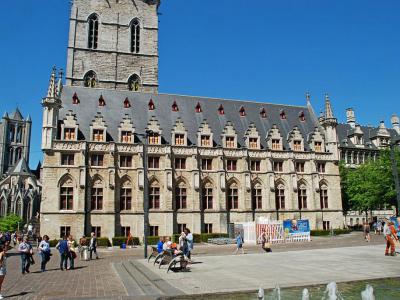
The Lakenhalle, or Cloth Hall, is adjunct to the Belfry. Construction started in 1425 but it was still incomplete twenty years later. Only seven of the eleven bays had been completed. In 1903 four more bays were added.
The Cloth Hall was built to harbor the business of the cloth trade of Ghent. Woolens and textiles had made Ghent a boom town of the middle ages. Fortune changes. The textile trades fell off in time and other tenants, including a militia Guild and a fencing school, moved into the Cloth Hall.
There is an annex to the Cloth Hall dating from 1741, called the "Mammelokker." The annex was the guards' quarters and the entrance to the city jail in the Cloth Hall from 1742 until 1902. The name Mammelokker means "breast sucker." It refers to the sculpture of the Roman legend of Pero and Cimon above the front door of the annex.
Cimon was sentenced to death by starvation. His daughter, Pero, who was a wet nurse, visited him in prison and breastfed him. She saved his life. His guards, awed by this show of filial devotion, released him.
Tip:
Visiting the Cloth Hall is free; the belfry, however, is not.
The Cloth Hall was built to harbor the business of the cloth trade of Ghent. Woolens and textiles had made Ghent a boom town of the middle ages. Fortune changes. The textile trades fell off in time and other tenants, including a militia Guild and a fencing school, moved into the Cloth Hall.
There is an annex to the Cloth Hall dating from 1741, called the "Mammelokker." The annex was the guards' quarters and the entrance to the city jail in the Cloth Hall from 1742 until 1902. The name Mammelokker means "breast sucker." It refers to the sculpture of the Roman legend of Pero and Cimon above the front door of the annex.
Cimon was sentenced to death by starvation. His daughter, Pero, who was a wet nurse, visited him in prison and breastfed him. She saved his life. His guards, awed by this show of filial devotion, released him.
Tip:
Visiting the Cloth Hall is free; the belfry, however, is not.
3) Stadhuis (Town Hall) (must see)
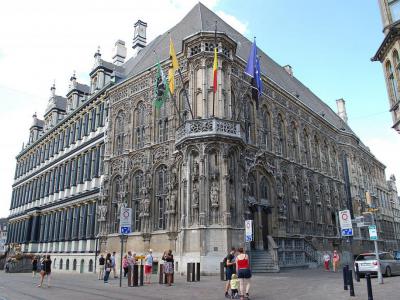
The Town Hall of Ghent is a quadrangular group of buildings of different styles. The alderman's house of Keure is in the Flamboyant Gothic style (1519-1539). It was designed by Rombout Keldermans and Dominicus de Waeghenmackere. Niches in the facade hold 19 statues of the Counts of Flanders made in the 19th and 20th centuries.
The Gedele Alderman's house is Renaissance, built between 1595n and 1618. The facades of both Alderman's houses hold Doric, Ionic and Corinthian three-quarter columns and pilasters. The effect is reminiscent of Italian palace. The complex is surrounded by the streets of Patermarkt, Hoogspoort, Stadhuistaaeg and Pooljiemarkt.
Inside the town hall are 51 rooms, including a wedding chapel and a labyrinth. The most important halls in the town hall are the Pacification Hall, the Arsenal hall, the Cabinet of the Mayor (1728), the Throne Room and the Reception lounge, formerly the chamber of the States of Flanders.
The interior rooms vary greatly in style but all are lavishly decorated. Weddings in the Halle are in demand but tourist access is limited.
Tip:
You can get a tour by booking with a guide at the information center. Well worth the money – lots of interesting history. If the weather is nice, have a drink outside one of the bars opposite and take your time to enjoy the facade.
The Gedele Alderman's house is Renaissance, built between 1595n and 1618. The facades of both Alderman's houses hold Doric, Ionic and Corinthian three-quarter columns and pilasters. The effect is reminiscent of Italian palace. The complex is surrounded by the streets of Patermarkt, Hoogspoort, Stadhuistaaeg and Pooljiemarkt.
Inside the town hall are 51 rooms, including a wedding chapel and a labyrinth. The most important halls in the town hall are the Pacification Hall, the Arsenal hall, the Cabinet of the Mayor (1728), the Throne Room and the Reception lounge, formerly the chamber of the States of Flanders.
The interior rooms vary greatly in style but all are lavishly decorated. Weddings in the Halle are in demand but tourist access is limited.
Tip:
You can get a tour by booking with a guide at the information center. Well worth the money – lots of interesting history. If the weather is nice, have a drink outside one of the bars opposite and take your time to enjoy the facade.
4) Gravensteen Castle (must see)
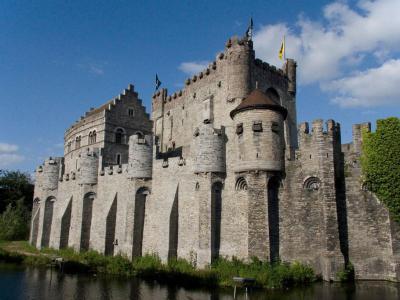
In 1180 Count Philip of Alsace wanted to impress the sassy burghers of Ghent with the idea that he was the big boss. But Gravensteen originated in the reign of Arnulf I in the 9th century. The site was fortified around 1000 AD, first in wood and then in stone. Philip built his castle in 1180 to replace the motte-and-bailey castle destroyed in 1176.
Philip had been on the Second Crusade and he was impressed by the crusader castles he saw. He wanted one like that. The castle has a central donjon, or keep, a residence and other smaller buildings. These are surrounded by a fortified enclosure with 24 small- sized barbicans. A large moat, fed by the river Leie, completes the picture.
The castle was the main residence of the Counts of Flanders until 1353. Louis of Male (1330-1384) was the last tenant in possession of Gravensteen. He moved to nearby Court of Walls as Gravensteen Castle was falling into disrepair.
After the last of the Counts departed, conditions at the castle took a nosedive. It was used as a court and prison-torture house until the 18th century. From 1353 to 1491 it was also a mint. During the industrial revolution it became a cotton mill. How the mighty had fallen!
In 1893 the city of Ghent had bought enough of the castle to begin major restorations. Under the direction of architect Joseph de Waele, a romanticized Gothic style was used to recall the castle's 12th century appearance. The Gravensteen starred in the Ghent World's Fair of 1913. The castle is open to the public.
Why You Should Visit:
To go back in time and enjoy the excellent views of Ghent's medieval skyline from the top (particularly at dusk).
Nowhere else in the world will you find such a massive castle right in the heart of the city!
Tip:
Save time and skip the queue by booking tickets online, but make sure you go early enough. Don't skip the (free) entertaining audio guide – you'll probably never hear another like it!
Philip had been on the Second Crusade and he was impressed by the crusader castles he saw. He wanted one like that. The castle has a central donjon, or keep, a residence and other smaller buildings. These are surrounded by a fortified enclosure with 24 small- sized barbicans. A large moat, fed by the river Leie, completes the picture.
The castle was the main residence of the Counts of Flanders until 1353. Louis of Male (1330-1384) was the last tenant in possession of Gravensteen. He moved to nearby Court of Walls as Gravensteen Castle was falling into disrepair.
After the last of the Counts departed, conditions at the castle took a nosedive. It was used as a court and prison-torture house until the 18th century. From 1353 to 1491 it was also a mint. During the industrial revolution it became a cotton mill. How the mighty had fallen!
In 1893 the city of Ghent had bought enough of the castle to begin major restorations. Under the direction of architect Joseph de Waele, a romanticized Gothic style was used to recall the castle's 12th century appearance. The Gravensteen starred in the Ghent World's Fair of 1913. The castle is open to the public.
Why You Should Visit:
To go back in time and enjoy the excellent views of Ghent's medieval skyline from the top (particularly at dusk).
Nowhere else in the world will you find such a massive castle right in the heart of the city!
Tip:
Save time and skip the queue by booking tickets online, but make sure you go early enough. Don't skip the (free) entertaining audio guide – you'll probably never hear another like it!
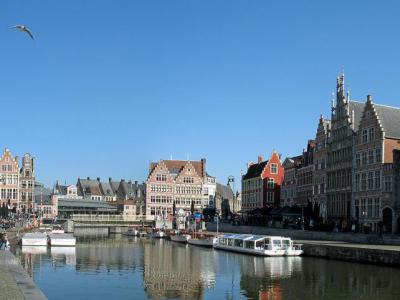
5) Gaslei (Grass Quai) & Korenlei (Wheat Quai) (must see)
Ghent was a center of the grain and cereal trade as early as the 5th century AD. Laid out along the shores of the river Leie, in the center of Ghent, were the two main quais of Ghent, Grass Quai and Wheat Quai. Grass Quai, on the right bank, was reserved for herbs and vegetables. On the opposite bank Wheat Quai received shipments of wheat and cereals.
Ships have been docking at the quais since the 11th century. Grass Quai and Wheat Quai are lined with medieval buildings restored and rebuilt. Behind many of the restored facades there are shops and offices dedicated to modern purposes but they look as they did in the golden age of Ghent.
The stepped gables of the old guild houses have watched over the city since the 13th century. The Wheat Measure House, where wheat was first weighed in 1527 is today an accessory store.
The banks of the river are lined with terraces and cafes and wonderful places to hang out. On the renovated facade of the Mariot Hotel at Wheat Quai, two gilded swans swim in opposite directions: left for women and right for drinks. One wonders what entertainments were happening in the 16th century.
Boat rides are a popular way to take in the historic sights along the river as they appeared so many years ago.
Tip:
Make sure to climb the steps of Sint-Michielsbrug (Saint Michael's Bridge), where Grass Quai and Wheat Quai can be viewed well with the canal. Another very nice viewpoint and photo spot is directly on Wheat Quai, looking in the direction of Grass Quai. From there you can see the building guild houses as well as some of the famous landmark buildings like the Belfry in the background. Take your time to look around, perhaps with binoculars.
Ships have been docking at the quais since the 11th century. Grass Quai and Wheat Quai are lined with medieval buildings restored and rebuilt. Behind many of the restored facades there are shops and offices dedicated to modern purposes but they look as they did in the golden age of Ghent.
The stepped gables of the old guild houses have watched over the city since the 13th century. The Wheat Measure House, where wheat was first weighed in 1527 is today an accessory store.
The banks of the river are lined with terraces and cafes and wonderful places to hang out. On the renovated facade of the Mariot Hotel at Wheat Quai, two gilded swans swim in opposite directions: left for women and right for drinks. One wonders what entertainments were happening in the 16th century.
Boat rides are a popular way to take in the historic sights along the river as they appeared so many years ago.
Tip:
Make sure to climb the steps of Sint-Michielsbrug (Saint Michael's Bridge), where Grass Quai and Wheat Quai can be viewed well with the canal. Another very nice viewpoint and photo spot is directly on Wheat Quai, looking in the direction of Grass Quai. From there you can see the building guild houses as well as some of the famous landmark buildings like the Belfry in the background. Take your time to look around, perhaps with binoculars.
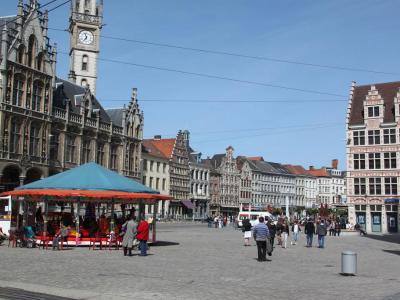
6) Korenmarkt (Wheat Market) (must see)
The Korenmarkt, or Wheat Market is a large square in the center of Ghent's historic district. It is called Wheat Market for the prosperous wheat trade beginning in the 10th and 11th centuries. Grain would be brought up the river Leie to Graslei (Grass Quai) and KorenLei (Wheat Quai). It then could be sold in the Wheat Market.
The Wheat Market is connected to two of Ghent's most active commercial streets, Veldstraat and Kortemunt on a north-south line. Saint Michael's Bridge reaches over the river Leie to Saint Nicholas Church on the east side. On the west side is access to the waterfront and the Grass Quai.
The picturesque buildings around the square house bars, restaurants and terraces. Alongside Saint Nicholas church there are the pubs of Klein Turkijie (Little Turky). The square was once the scene of bankruptcy auctions. The term "Little Turky" is actually a corruption of the expression "ter keie gaan", which means "hit rock bottom."
The Wheat Market is connected to two of Ghent's most active commercial streets, Veldstraat and Kortemunt on a north-south line. Saint Michael's Bridge reaches over the river Leie to Saint Nicholas Church on the east side. On the west side is access to the waterfront and the Grass Quai.
The picturesque buildings around the square house bars, restaurants and terraces. Alongside Saint Nicholas church there are the pubs of Klein Turkijie (Little Turky). The square was once the scene of bankruptcy auctions. The term "Little Turky" is actually a corruption of the expression "ter keie gaan", which means "hit rock bottom."
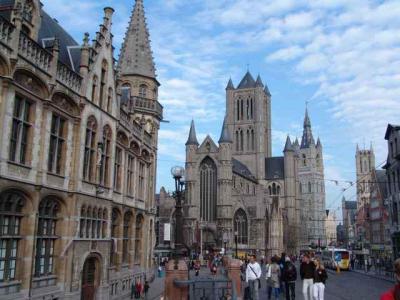
7) Sint-Niklaaskerk (St. Nicholas Church) (must see)
Saint Nicholas Church is one of the celebrated "Three Towers of Ghent." Building was begun in the 13th century to replace an earlier Romanesque structure. The style of construction is Scheldt Gothic. This style called for the use of blue-gray stone taken from the area of Tournai. There is a single tower above the crossing and corner turrets.
The church has had a stormy existence. During the 16th century militant iconoclasts destroyed its religious images and artifacts. Come the French revolution, the church served as a stable for horses. By the 1700s numerous shops and small houses had been built clinging to the church's outer walls.
Extensive restoration carried out in the 19th century has rescued the church from a dilapidated ending. The Scheldt Gothic style tower is above the nave and transepts instead of the main entrance. As a result, light from the tower is permitted to illuminate the transept.
The organ of the church is one of the most impressive in the country. It was built by the famous French organ maker, Aristide Canaille-Coll. The instrument is a three-manual organ with 16 pipes in front. The inauguration concert was given by Louis James Lefebure-Wely in 1856.
The church is open every day. Admission is free.
The church has had a stormy existence. During the 16th century militant iconoclasts destroyed its religious images and artifacts. Come the French revolution, the church served as a stable for horses. By the 1700s numerous shops and small houses had been built clinging to the church's outer walls.
Extensive restoration carried out in the 19th century has rescued the church from a dilapidated ending. The Scheldt Gothic style tower is above the nave and transepts instead of the main entrance. As a result, light from the tower is permitted to illuminate the transept.
The organ of the church is one of the most impressive in the country. It was built by the famous French organ maker, Aristide Canaille-Coll. The instrument is a three-manual organ with 16 pipes in front. The inauguration concert was given by Louis James Lefebure-Wely in 1856.
The church is open every day. Admission is free.
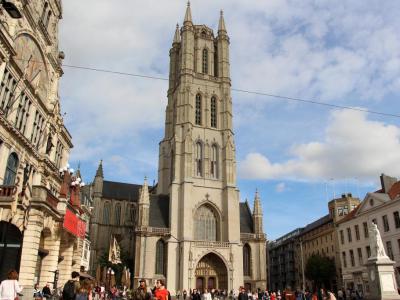
8) Sint-Baafskathedraal (St. Bavo's Cathedral) (must see)
In 1566 the Calvanist iconoclasts were on a rampage in the Netherlands. Raiding churches, they found a target rich environment. Stained glass windows, statues, artwork, everything had to go. Three days before they got to Saint Bavo's, artwork was hidden in the crypt and Saint Bavo's was mostly spared.
Saint Bavo's Cathedral or Saint-Baafskathedraal, is a 292 foot tall Catholic cathedral in Ghent. It is built on the site of the wooden Chapel of Saint John the Baptist, founded in 942 by Transmanus, Bishop of Tournai and Noyon. Construction of a new Romanesque church began there in 1150.
In the 14th through the 16th centuries ambitious Gothic renovations were added. On top of the lower Romanesque church a high Gothic choir and an enormous vault with tall windows was built. Around the choir is an ambulatory and 14 chapels. The 292 foot tower was erected in 1534. The church became a cathedral in 1569. A new nave was added by 1590.
Among the treasures that were saved from the iconoclasts of 1566 is the Famous Ghent Altarpiece, a painted polyptych by the van Eyck brothers Jan and Hubert in 1432.
Other artists represented in the cathedral are Peter Paul Rubens and Lucas de Heere. Frans Pourbus the Elder created 14 panels of The History of Saint Andrew (1572). There are three paintings by Caspar de Crayer, including The Beheading of John the Baptist. Eleven grisailles of the Old and New Testaments adorn the choir above the stalls.
The high choir is an awesome part of the interior. It has stalls for members of the Chapter of Saint-Bavon. The Baroque High Altar, installed from 1702 to 1782, is made with black, white and red flamed marble. In the nave is a rococo pulpit from 1745.
In the crypt are reliquaries and collections of liturgical ornaments and vessels. Virtual tours of the crypt, including the altarpiece, are available. There is a basic tour and an advanced tour of at least ninety minutes. Do not miss the painting of the Mystic Lamb.
Saint Bavo's Cathedral or Saint-Baafskathedraal, is a 292 foot tall Catholic cathedral in Ghent. It is built on the site of the wooden Chapel of Saint John the Baptist, founded in 942 by Transmanus, Bishop of Tournai and Noyon. Construction of a new Romanesque church began there in 1150.
In the 14th through the 16th centuries ambitious Gothic renovations were added. On top of the lower Romanesque church a high Gothic choir and an enormous vault with tall windows was built. Around the choir is an ambulatory and 14 chapels. The 292 foot tower was erected in 1534. The church became a cathedral in 1569. A new nave was added by 1590.
Among the treasures that were saved from the iconoclasts of 1566 is the Famous Ghent Altarpiece, a painted polyptych by the van Eyck brothers Jan and Hubert in 1432.
Other artists represented in the cathedral are Peter Paul Rubens and Lucas de Heere. Frans Pourbus the Elder created 14 panels of The History of Saint Andrew (1572). There are three paintings by Caspar de Crayer, including The Beheading of John the Baptist. Eleven grisailles of the Old and New Testaments adorn the choir above the stalls.
The high choir is an awesome part of the interior. It has stalls for members of the Chapter of Saint-Bavon. The Baroque High Altar, installed from 1702 to 1782, is made with black, white and red flamed marble. In the nave is a rococo pulpit from 1745.
In the crypt are reliquaries and collections of liturgical ornaments and vessels. Virtual tours of the crypt, including the altarpiece, are available. There is a basic tour and an advanced tour of at least ninety minutes. Do not miss the painting of the Mystic Lamb.
