Custom Walk in Philadelphia, Pennsylvania by sgastrich_b97eb7 created on 2026-03-09
Guide Location: USA » Philadelphia
Guide Type: Custom Walk
# of Sights: 9
Tour Duration: 2 Hour(s)
Travel Distance: 3.5 Km or 2.2 Miles
Share Key: 6WT3K
Guide Type: Custom Walk
# of Sights: 9
Tour Duration: 2 Hour(s)
Travel Distance: 3.5 Km or 2.2 Miles
Share Key: 6WT3K
How It Works
Please retrieve this walk in the GPSmyCity app. Once done, the app will guide you from one tour stop to the next as if you had a personal tour guide. If you created the walk on this website or come to the page via a link, please follow the instructions below to retrieve the walk in the app.
Retrieve This Walk in App
Step 1. Download the app "GPSmyCity: Walks in 1K+ Cities" on Apple App Store or Google Play Store.



Step 2. In the GPSmyCity app, download(or launch) the guide "Philadelphia Map and Walking Tours".
Step 3. Tap the menu button located at upper right corner of the "Walks" screen and select "Retrieve custom walk". Enter the share key: 6WT3K
1) Independence Hall (must see)
By the late 1720s, Philadelphia was in need of a state house. The ground for its construction – on the south side of Chestnut Street, between Fifth and Sixth Streets, to a design by architect Edmund Woolley – was broken in 1732.
Upon its completion in 1753, the Colonial Government of Pennsylvania took occupancy of the State House immediately. The building served as the Capitol of the Province and Commonwealth of Pennsylvania until 1799.
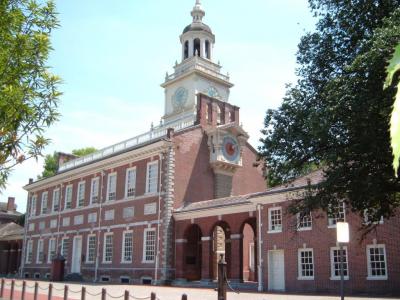
The former Pennsylvania State House, now known as Independence Hall, is a Georgian-style hall with a red brick facade. There is a central building with a bell tower and steeple. The center is attached by arcaded passageways to wings on either side. The steeple spire is 169 feet high. Old City Hall, Congress Hall, and Independence Hall together with Philosophical Hall, share Independence Square.
The Hall underwent several renovations in the 19th and 20th centuries ultimately restoring its 18th-century appearance. On the ground floor are the Assembly Room and the Supreme Court Room, separated by a vestibule. Behind the entrance is the Tower Stair Hall.
On June 14, 1775, the delegates of the Continental Congress chose George Washington to serve as the commander-in-chief of the Continental Army in the Assembly Room of the Independence Hall. Later, on July 26, the Congress named Benjamin Franklin as the first Postmaster General, a position that eventually evolved into the United States Post Office Department.
From 1775 to 1783, the Independence Hall was the main meeting house of the Second Continental Congress. The Declaration of Independence was approved within its walls on July 4, 1776. The United States Constitution was approved here in 1787.
Ever since then, Independence Hall has often served as a venue for speeches, rallies, and protests. Most events have been held on behalf of democratic and civil rights movements.
Upon its completion in 1753, the Colonial Government of Pennsylvania took occupancy of the State House immediately. The building served as the Capitol of the Province and Commonwealth of Pennsylvania until 1799.
The former Pennsylvania State House, now known as Independence Hall, is a Georgian-style hall with a red brick facade. There is a central building with a bell tower and steeple. The center is attached by arcaded passageways to wings on either side. The steeple spire is 169 feet high. Old City Hall, Congress Hall, and Independence Hall together with Philosophical Hall, share Independence Square.
The Hall underwent several renovations in the 19th and 20th centuries ultimately restoring its 18th-century appearance. On the ground floor are the Assembly Room and the Supreme Court Room, separated by a vestibule. Behind the entrance is the Tower Stair Hall.
On June 14, 1775, the delegates of the Continental Congress chose George Washington to serve as the commander-in-chief of the Continental Army in the Assembly Room of the Independence Hall. Later, on July 26, the Congress named Benjamin Franklin as the first Postmaster General, a position that eventually evolved into the United States Post Office Department.
From 1775 to 1783, the Independence Hall was the main meeting house of the Second Continental Congress. The Declaration of Independence was approved within its walls on July 4, 1776. The United States Constitution was approved here in 1787.
Ever since then, Independence Hall has often served as a venue for speeches, rallies, and protests. Most events have been held on behalf of democratic and civil rights movements.
2) Congress Hall
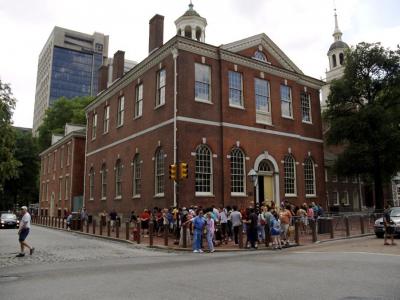
Congress Hall, a significant landmark in Philadelphia, is situated at the intersection of Chestnut and 6th Streets. Notably, it served as the seat of the United States Congress from December 6, 1790, to May 14, 1800. During this decade, Philadelphia was the temporary capital of the United States.
The building's architecture and use reflect the formative years of the U.S. government. The House of Representatives convened on the first floor, while the Senate met upstairs. This period in Congress Hall was marked by pivotal moments in American history, including the inauguration of Presidents George Washington (for his second term) and John Adams.
The first floor, home to the House chamber, features a simple design with mahogany desks and leather chairs. By 1796, it accommodated 106 representatives from 16 states, including the original 13, plus Vermont in 1791, Kentucky in 1792, and Tennessee in 1796. This room has been meticulously restored to its 1796 condition.
In contrast, the Senate chamber on the second floor is more elaborate. It was adorned with heavy red drapes and, by 1796, equipped with 32 secretary desks, 28 of which are original and akin to those in the current Senate chamber at the United States Capitol. The room also displays portraits of Louis XVI and Marie Antoinette, gifts from France post-Revolution. Noteworthy features include a ceiling fresco of an American bald eagle, symbolizing peace, and a plaster medallion depicting a sunburst with 13 stars for the original colonies.
The building's architecture and use reflect the formative years of the U.S. government. The House of Representatives convened on the first floor, while the Senate met upstairs. This period in Congress Hall was marked by pivotal moments in American history, including the inauguration of Presidents George Washington (for his second term) and John Adams.
The first floor, home to the House chamber, features a simple design with mahogany desks and leather chairs. By 1796, it accommodated 106 representatives from 16 states, including the original 13, plus Vermont in 1791, Kentucky in 1792, and Tennessee in 1796. This room has been meticulously restored to its 1796 condition.
In contrast, the Senate chamber on the second floor is more elaborate. It was adorned with heavy red drapes and, by 1796, equipped with 32 secretary desks, 28 of which are original and akin to those in the current Senate chamber at the United States Capitol. The room also displays portraits of Louis XVI and Marie Antoinette, gifts from France post-Revolution. Noteworthy features include a ceiling fresco of an American bald eagle, symbolizing peace, and a plaster medallion depicting a sunburst with 13 stars for the original colonies.
3) Liberty Bell (must see)
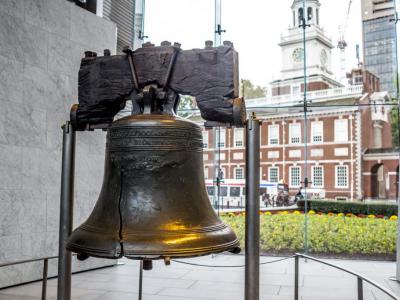
The Liberty Bell, an iconic symbol of American freedom and independence, has a rich and storied history closely tied to Philadelphia, Pennsylvania. Cast in 1752 by the Whitechapel Bell Foundry in London, England, the bell was originally commissioned to mark the 50th anniversary of Pennsylvania's original constitution and to symbolize the ideals of liberty and justice.
Initially hung in the Pennsylvania State House (now known as Independence Hall), the bell gained fame not only for its impressive size and sound but also for its role in important historical events. One popular but apocryphal story links the Liberty Bell to the reading of the Declaration of Independence on July 4, 1776, claiming that it rang out to announce the birth of the new nation. While there is no historical evidence to support this specific event, the bell did gain significance as a symbol of American independence in the ensuing decades.
The bell's inscription, "Proclaim LIBERTY Throughout all the Land unto all the Inhabitants Thereof," from the Bible, became its defining feature and a powerful statement in support of abolitionist movements in the 19th century. Its association with the abolitionist cause led to the bell being dubbed the "Liberty Bell" around the 1830s.
By the mid-19th century, as the bell's structural integrity deteriorated, it was retired from active service. In 1852, it was moved to a pavilion near Independence Hall where it became an object of public veneration. During World War II, the bell's iconic status was further solidified as it was used as a symbol of liberty and freedom, inspiring war bond drives and patriotic sentiment.
Today, the Liberty Bell is housed in the Liberty Bell Center, part of Independence National Historical Park in Philadelphia. It continues to attract millions of visitors each year who come to see and reflect upon its enduring message of liberty, justice, and the ongoing struggle for equality.
Initially hung in the Pennsylvania State House (now known as Independence Hall), the bell gained fame not only for its impressive size and sound but also for its role in important historical events. One popular but apocryphal story links the Liberty Bell to the reading of the Declaration of Independence on July 4, 1776, claiming that it rang out to announce the birth of the new nation. While there is no historical evidence to support this specific event, the bell did gain significance as a symbol of American independence in the ensuing decades.
The bell's inscription, "Proclaim LIBERTY Throughout all the Land unto all the Inhabitants Thereof," from the Bible, became its defining feature and a powerful statement in support of abolitionist movements in the 19th century. Its association with the abolitionist cause led to the bell being dubbed the "Liberty Bell" around the 1830s.
By the mid-19th century, as the bell's structural integrity deteriorated, it was retired from active service. In 1852, it was moved to a pavilion near Independence Hall where it became an object of public veneration. During World War II, the bell's iconic status was further solidified as it was used as a symbol of liberty and freedom, inspiring war bond drives and patriotic sentiment.
Today, the Liberty Bell is housed in the Liberty Bell Center, part of Independence National Historical Park in Philadelphia. It continues to attract millions of visitors each year who come to see and reflect upon its enduring message of liberty, justice, and the ongoing struggle for equality.
4) Independence Visitor Center
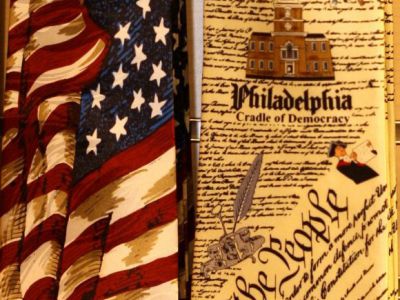
What to buy here: ‘We the People’ Silk Tie.
Here’s an elegant silk tie that will get people talking! Beautifully tailored and understated, it comes in a variety of power colors and designs. It is a sharp looking accessory that conveys to everyone your belief and pride in the American way of government. The rest of the text is smaller and complements the powerful look of this fashion accessory. $32.99
At the same location you’ll find a finely crafted Pilsner glass imprinted with one of Ben Franklin’s most popular sayings, “Beer is living proof that God loves us and wants us to be happy." Yep, that quote comes to us courtesy of Ben Franklin. So when you’re in Philly raise a glass in salute to his indelible impact on a very young U.S. government. $9.99. Then of course you’ll need some coasters for those glasses, perhaps ones bearing the image of Ben himself...
Here’s an elegant silk tie that will get people talking! Beautifully tailored and understated, it comes in a variety of power colors and designs. It is a sharp looking accessory that conveys to everyone your belief and pride in the American way of government. The rest of the text is smaller and complements the powerful look of this fashion accessory. $32.99
At the same location you’ll find a finely crafted Pilsner glass imprinted with one of Ben Franklin’s most popular sayings, “Beer is living proof that God loves us and wants us to be happy." Yep, that quote comes to us courtesy of Ben Franklin. So when you’re in Philly raise a glass in salute to his indelible impact on a very young U.S. government. $9.99. Then of course you’ll need some coasters for those glasses, perhaps ones bearing the image of Ben himself...
Image Courtesy of Andrée Jannette.
5) Independence National Historical Park (must see)
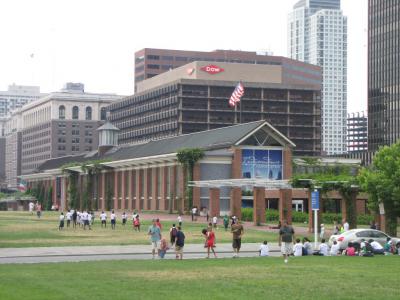
Independence National Historical Park in Philadelphia has been called "America's most historic square mile." Administered by the National Park Service, the 55 landscaped acres hold several often-visited historic sites within the Old City and Society Hill neighborhoods.
The heart of the Park is Independence Hall, the former Old State House of Philadelphia. This is where the Declaration of Independence and the Constitution of the United States were adopted. The first Continental Congress met in 1774 in Carpenters' Hall next door to Independence Hall, the home of the Second Continental Congress.
The Liberty Bell hangs in the Liberty Bell Center across from Independence Hall. The First Bank of the United States is in the Park. The Second Bank of the United States was closed down by President Andrew Jackson. Nearby is the City Tavern, a refuge of delegates and John Adams' favorite hangout.
The Park houses Franklin Court Museum dedicated to Benjamin Franklin. Another park resident is the United States Postal Service Museum. The three blocks immediately north of Independence Hall is Independence Mall. Besides the Liberty Bell Center, the Mall holds the National Constitution Center and George Washington's residence in his second term.
The first proposal for Independence National Historical Park was floated in 1915. Architects Albert Kelsey and David K. Boyd were driven to create a more sylvan locale for Independence Hall. The action was not taken until June 1948, when Congress authorized the creation of the Park. The Park is listed on the National Register of Historic Places.
The heart of the Park is Independence Hall, the former Old State House of Philadelphia. This is where the Declaration of Independence and the Constitution of the United States were adopted. The first Continental Congress met in 1774 in Carpenters' Hall next door to Independence Hall, the home of the Second Continental Congress.
The Liberty Bell hangs in the Liberty Bell Center across from Independence Hall. The First Bank of the United States is in the Park. The Second Bank of the United States was closed down by President Andrew Jackson. Nearby is the City Tavern, a refuge of delegates and John Adams' favorite hangout.
The Park houses Franklin Court Museum dedicated to Benjamin Franklin. Another park resident is the United States Postal Service Museum. The three blocks immediately north of Independence Hall is Independence Mall. Besides the Liberty Bell Center, the Mall holds the National Constitution Center and George Washington's residence in his second term.
The first proposal for Independence National Historical Park was floated in 1915. Architects Albert Kelsey and David K. Boyd were driven to create a more sylvan locale for Independence Hall. The action was not taken until June 1948, when Congress authorized the creation of the Park. The Park is listed on the National Register of Historic Places.
6) Declaration House (Graff House)
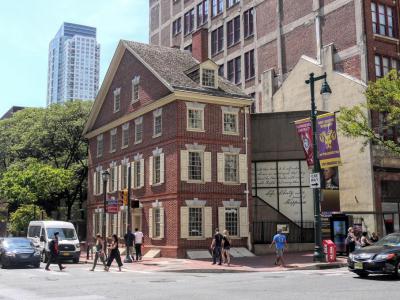
The Declaration House, also known as the Graff House, stands as a significant historical landmark in Philadelphia. This modest three-story structure was constructed in the 1770s by bricklayer Jacob Graff, who intended the second floor to be rented out for additional income. The house gained historical importance when it became the temporary abode of Thomas Jefferson, a slim, ginger-haired lodger, during a pivotal moment in American history. Jefferson, seeking a tranquil environment away from the bustling city noise, found refuge in this house and accomplished a remarkable feat. It was within these walls, in late spring 1776, that he drafted the Declaration of Independence in just a few weeks.
The house's architecture and design reflect the era of its construction. During its reconstruction 200 years later, many elements typical of the 1770s were meticulously incorporated to preserve its historical authenticity. This includes the Flemish Bond brick checkerboard pattern visible on its walls, windows adorned with paneled shutters, and an array of period-appropriate knickknacks. Unlike the larger, more symmetrical homes in Society Hill, the Graff House is notably small and asymmetrical, with a distinctly off-center front door. Preceding this entrance is a quaint garden, adding to the house's historical charm.
Today, the Declaration House serves not only as a reminder of Jefferson's monumental task but also as an educational site. Visitors are greeted with a short film about Jefferson's life and his drafting of the Declaration of Independence. A replica of his draft of the Declaration is also on display. The house, therefore, stands as a testament to the extraordinary circumstances and humble settings that played a backdrop to one of the most significant documents in the United States' history.
The house's architecture and design reflect the era of its construction. During its reconstruction 200 years later, many elements typical of the 1770s were meticulously incorporated to preserve its historical authenticity. This includes the Flemish Bond brick checkerboard pattern visible on its walls, windows adorned with paneled shutters, and an array of period-appropriate knickknacks. Unlike the larger, more symmetrical homes in Society Hill, the Graff House is notably small and asymmetrical, with a distinctly off-center front door. Preceding this entrance is a quaint garden, adding to the house's historical charm.
Today, the Declaration House serves not only as a reminder of Jefferson's monumental task but also as an educational site. Visitors are greeted with a short film about Jefferson's life and his drafting of the Declaration of Independence. A replica of his draft of the Declaration is also on display. The house, therefore, stands as a testament to the extraordinary circumstances and humble settings that played a backdrop to one of the most significant documents in the United States' history.

7) Washington Square
Washington Square in Philadelphia offers a rich blend of history, culture, and natural beauty intertwined with American history. Initially designated in 1682 as Southeast Square, this open-space park nestles in the heart of Center City Philadelphia's Southeast quadrant. Its origins are as one of the five original squares planned out on the city grid by William Penn's surveyor, Thomas Holme, marking it as a cornerstone in Philadelphia's urban design.
The square is uniquely positioned at the crossroads of the Washington Square West and Society Hill neighborhoods, serving as a vibrant focal point for both communities. Over the centuries, Washington Square has been a witness to and a participant in significant historical events. Notably, it was the site of the first human flight in the Americas in 1793, a groundbreaking achievement when Jean Pierre Blanchard ascended in his hot-air balloon from the nearby Walnut Street Jail, capturing the imagination of a young nation.
One of the square's most solemn features is the Tomb of the Unknown Soldier, a memorial that honors the unnamed heroes of the American Revolutionary War. This tribute in Washington Square adds historical depth, honoring sacrifices for independence. Beneath the park's greenery, countless buried bodies bear witness to its rich, hidden history, occasionally unearthed during construction and maintenance projects.
Adding to the square's unique character was a sycamore tree known as a Moon tree, planted in 1975. This tree was grown from seeds that had been carried to the moon by astronaut Stuart Roosa on the Apollo 14 mission, symbolizing the human spirit's boundless curiosity and our quest for knowledge that stretches beyond our terrestrial confines. Although the Moon tree died around 2008, its legacy continues to inspire those who visit.
The square is uniquely positioned at the crossroads of the Washington Square West and Society Hill neighborhoods, serving as a vibrant focal point for both communities. Over the centuries, Washington Square has been a witness to and a participant in significant historical events. Notably, it was the site of the first human flight in the Americas in 1793, a groundbreaking achievement when Jean Pierre Blanchard ascended in his hot-air balloon from the nearby Walnut Street Jail, capturing the imagination of a young nation.
One of the square's most solemn features is the Tomb of the Unknown Soldier, a memorial that honors the unnamed heroes of the American Revolutionary War. This tribute in Washington Square adds historical depth, honoring sacrifices for independence. Beneath the park's greenery, countless buried bodies bear witness to its rich, hidden history, occasionally unearthed during construction and maintenance projects.
Adding to the square's unique character was a sycamore tree known as a Moon tree, planted in 1975. This tree was grown from seeds that had been carried to the moon by astronaut Stuart Roosa on the Apollo 14 mission, symbolizing the human spirit's boundless curiosity and our quest for knowledge that stretches beyond our terrestrial confines. Although the Moon tree died around 2008, its legacy continues to inspire those who visit.
8) Vietnam Memorial
The Philadelphia Vietnam Veterans Memorial, nestled at Penn's Landing in Philadelphia, stands as a tribute to the city's servicemen who made the ultimate sacrifice during the Vietnam War. Dedicated in 1987, this memorial honors 648 individuals who were either killed in action or listed as missing in action.
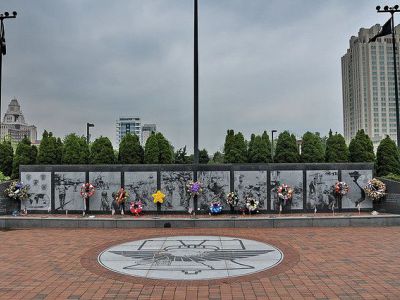
Designed by the local architect Perry M. Morgan, the memorial was selected through a national competition that drew 102 entries, reflecting a wide interest in commemorating the sacrifices made during the Vietnam War. The memorial's design resembles an amphitheater plaza, offering a peaceful setting. The south wall showcases soldiers' names in granite, honoring their bravery and sacrifice.
Ten panels chronicle key moments from the war, spanning its inception to the 1975 rescue of Vietnamese refugees. They provide a comprehensive narrative for educating visitors about the war's impact and history at the memorial.
The Philadelphia Vietnam Veterans Memorial serves as a place of remembrance and ongoing education, thanks to the dedicated efforts of the Philadelphia Vietnam Veterans Memorial Fund. They preserve and improve the memorial while also providing educational programs about the Vietnam War for future generations.
A seven-year restoration and redesign project, completed in 2015, made the memorial more accessible to visitors with disabilities. This commitment to inclusivity was further demonstrated in 2016, when the names of two additional soldiers were added to the wall, ensuring that the memorial accurately reflects the sacrifices made by Philadelphia's servicemen.
Designed by the local architect Perry M. Morgan, the memorial was selected through a national competition that drew 102 entries, reflecting a wide interest in commemorating the sacrifices made during the Vietnam War. The memorial's design resembles an amphitheater plaza, offering a peaceful setting. The south wall showcases soldiers' names in granite, honoring their bravery and sacrifice.
Ten panels chronicle key moments from the war, spanning its inception to the 1975 rescue of Vietnamese refugees. They provide a comprehensive narrative for educating visitors about the war's impact and history at the memorial.
The Philadelphia Vietnam Veterans Memorial serves as a place of remembrance and ongoing education, thanks to the dedicated efforts of the Philadelphia Vietnam Veterans Memorial Fund. They preserve and improve the memorial while also providing educational programs about the Vietnam War for future generations.
A seven-year restoration and redesign project, completed in 2015, made the memorial more accessible to visitors with disabilities. This commitment to inclusivity was further demonstrated in 2016, when the names of two additional soldiers were added to the wall, ensuring that the memorial accurately reflects the sacrifices made by Philadelphia's servicemen.
9) Fireman's Hall
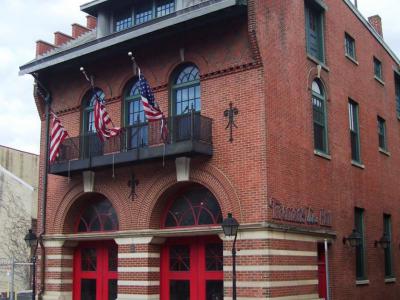
Housed in an old firehouse that was operational between 1902-52, this unique museum was designed for the Bicentennial to showcase Philadelphia's rich firefighting history and the first organized volunteer fire company in Colonial America – the Union Fire Company – established by Benjamin Franklin in 1736. Another reminder that the Founding Father had a hand in everything!
The building still contains the original brass sliding pole used for quick access to fire trucks. Several other pieces of old equipment are on display, including an 1896 hook-and-ladder, a 1903 high-pressure Cannon Wagon, and a 1907 steam-powered pumper. Of special note are two well preserved hand-pumpers – one from 1815, and the other from 1730. Also on display are axes, saws, nozzles, old fire plaques indicating insured buildings, and leather fire hats from the early 19th century. A large stained-glass window memorializes fallen firefighters.
The building still contains the original brass sliding pole used for quick access to fire trucks. Several other pieces of old equipment are on display, including an 1896 hook-and-ladder, a 1903 high-pressure Cannon Wagon, and a 1907 steam-powered pumper. Of special note are two well preserved hand-pumpers – one from 1815, and the other from 1730. Also on display are axes, saws, nozzles, old fire plaques indicating insured buildings, and leather fire hats from the early 19th century. A large stained-glass window memorializes fallen firefighters.
