Custom Walk in Santa Cruz de Tenerife, Spain by hanswollny_7e888e created on 2026-03-10
Guide Location: Spain » Santa Cruz de Tenerife
Guide Type: Custom Walk
# of Sights: 15
Tour Duration: 3 Hour(s)
Travel Distance: 5.2 Km or 3.2 Miles
Share Key: CDH4Q
Guide Type: Custom Walk
# of Sights: 15
Tour Duration: 3 Hour(s)
Travel Distance: 5.2 Km or 3.2 Miles
Share Key: CDH4Q
How It Works
Please retrieve this walk in the GPSmyCity app. Once done, the app will guide you from one tour stop to the next as if you had a personal tour guide. If you created the walk on this website or come to the page via a link, please follow the instructions below to retrieve the walk in the app.
Retrieve This Walk in App
Step 1. Download the app "GPSmyCity: Walks in 1K+ Cities" on Apple App Store or Google Play Store.



Step 2. In the GPSmyCity app, download(or launch) the guide "Santa Cruz de Tenerife Map and Walking Tours".
Step 3. Tap the menu button located at upper right corner of the "Walks" screen and select "Retrieve custom walk". Enter the share key: CDH4Q
1) Palacio Insular de Tenerife (Insular Palace of Tenerife)
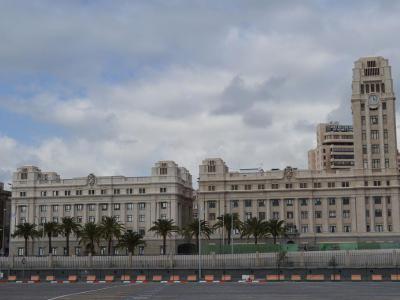
The Insular Palace of Tenerife is an impressive example of 20th-century monumental architecture. Designed by José Enrique Marrero Regalado following a design competition in 1934, construction began in 1935 and concluded by 1940. Its grand façade, characterized by a porticoed gallery of semicircular arches, Tuscan pilasters, and topped by a six-storey clock tower, makes it one of the most recognisable landmarks in the city skyline.
Beyond its function as the seat of Tenerife’s island government, the Insular Palace holds remarkable artistic features within its walls. The most notable is the Noble Hall, a grand ceremonial hall often referred to as the “Sistine Chapel of the Canary Islands.” In 1960, renowned Canarian artist José Aguiar decorated this space with a series of murals that vividly illustrate the island’s history-featuring scenes from Guanche culture, local agriculture, maritime traditions, and important religious moments such as the arrival of the Virgin of Candelaria.
These impressive works helped earn the hall its famous nickname. In recognition of its cultural and artistic value, both the building and its murals were officially declared an Asset of Cultural Interest.
Beyond its function as the seat of Tenerife’s island government, the Insular Palace holds remarkable artistic features within its walls. The most notable is the Noble Hall, a grand ceremonial hall often referred to as the “Sistine Chapel of the Canary Islands.” In 1960, renowned Canarian artist José Aguiar decorated this space with a series of murals that vividly illustrate the island’s history-featuring scenes from Guanche culture, local agriculture, maritime traditions, and important religious moments such as the arrival of the Virgin of Candelaria.
These impressive works helped earn the hall its famous nickname. In recognition of its cultural and artistic value, both the building and its murals were officially declared an Asset of Cultural Interest.
2) Plaza de España (Spain Square) (must see)
On July 25, 1797, British Rear Admiral Horatio Nelson lost his right arm to a musket ball fired from the Tiger Cannon of the Castle of San Cristobal in the Battle of Santa Cruz de Tenerife. The Admiral had attempted an amphibious landing to take the town. He lost the battle and his arm.
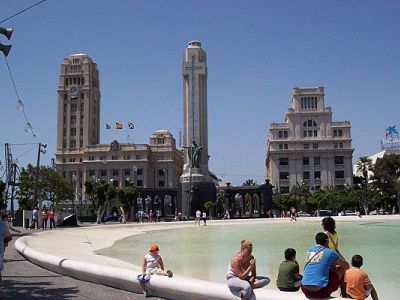
The Spain Square was laid down over the Castle of San Cristobal in 1929. Remains of the castle walls are on display in a tunnel under the square. The notorious Tiger Cannon is also there, looking fine after all these years. The square is located in the center of town. It is one of the main squares of the island of Tenerife.
The square is the work of architects Jacques Herzog and Pierre de Meuron of Herzog & Meuron of Switzerland. The Plaza has a lake and a fountain. Around the square is the Insular Palace of Tenerife, the Palace of the Charter and the Candelaria Square. The Monument to the Fallen of the Spanish Civil War is in the center of the square.
A sign, reading "Santa Cruz" (short for the slogan "Sant Cruz, the heart of Tenerife") is at one end of the square. The last letter of the word "Santa" is in the form of two hearts, one green, one blue. A sculpture "I AM Fine (Lo Llevo bien)" by Basque artist Julio Nieto is next to the lake. It is a man in the shape of a tree, a symbol of optimism.
The Spain Square was laid down over the Castle of San Cristobal in 1929. Remains of the castle walls are on display in a tunnel under the square. The notorious Tiger Cannon is also there, looking fine after all these years. The square is located in the center of town. It is one of the main squares of the island of Tenerife.
The square is the work of architects Jacques Herzog and Pierre de Meuron of Herzog & Meuron of Switzerland. The Plaza has a lake and a fountain. Around the square is the Insular Palace of Tenerife, the Palace of the Charter and the Candelaria Square. The Monument to the Fallen of the Spanish Civil War is in the center of the square.
A sign, reading "Santa Cruz" (short for the slogan "Sant Cruz, the heart of Tenerife") is at one end of the square. The last letter of the word "Santa" is in the form of two hearts, one green, one blue. A sculpture "I AM Fine (Lo Llevo bien)" by Basque artist Julio Nieto is next to the lake. It is a man in the shape of a tree, a symbol of optimism.
3) Castillo de San Cristóbal (Castle of San Cristóbal)
The Castle of San Cristóbal served as the city’s main line of defense against invaders for centuries. Built in 1575 on the orders of King Philip II, this coastal fortress helped shape the early history of Tenerife and played a crucial role during key events-most famously repelling Admiral Horatio Nelson’s attack in 1797.
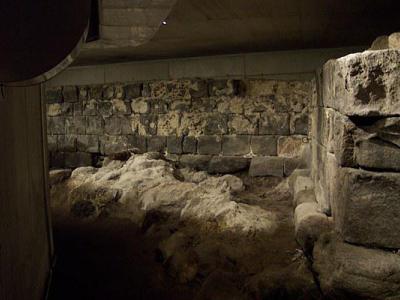
Today, the original structure is largely gone, but its legacy lives on beneath the Spain Square. Visitors can explore the Castle of San Cristóbal Interpretation Centre, where sections of the old walls remain preserved underground. The exhibition space uses models, artifacts, and interactive displays to illuminate the daily life of the fortress, recounting stories of sieges, cannons, and the strategic importance of Santa Cruz’s harbor.
A highlight of the visit is the chance to see the iconic “Tiger Cannon”, the historic castel's bronze cannon, which, according to legend, helped wound Nelson himself, by losing his right arm.
Today, the original structure is largely gone, but its legacy lives on beneath the Spain Square. Visitors can explore the Castle of San Cristóbal Interpretation Centre, where sections of the old walls remain preserved underground. The exhibition space uses models, artifacts, and interactive displays to illuminate the daily life of the fortress, recounting stories of sieges, cannons, and the strategic importance of Santa Cruz’s harbor.
A highlight of the visit is the chance to see the iconic “Tiger Cannon”, the historic castel's bronze cannon, which, according to legend, helped wound Nelson himself, by losing his right arm.
4) Plaza de la Candelaria (Candelaria Square)
Forty days after Christmas is the celebration of the Candelaria. This is the day when Mary, mother of Jesus, presented her infant son in the temple for the first time. In the Canary Islands Candelaria is also observed on August 15th, the day of the Assumption. Before the Spanish conquest, August 15th was the harvest feast of the indigenous people.
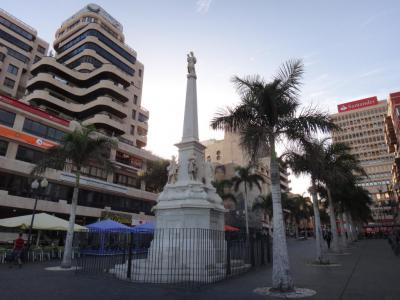
The Candelaria Square is located next to the Spain Square. Featured in the square is the monument, Triumph of Candelaria. It is in the form of an obelisk of white marble sculpted by the artist, Pasquale Bocciardo, in 1768.
Originally the obelisk was 36 feet high, mounted on a square base. Currently it is 13 feet tall. Four marble statues of indigenous Guanche people are at the base venerating the image of Mary atop the obelisk. In May the "Feast of May" is held in the square memorializing the founding of the city.
The Candelaria Square is located next to the Spain Square. Featured in the square is the monument, Triumph of Candelaria. It is in the form of an obelisk of white marble sculpted by the artist, Pasquale Bocciardo, in 1768.
Originally the obelisk was 36 feet high, mounted on a square base. Currently it is 13 feet tall. Four marble statues of indigenous Guanche people are at the base venerating the image of Mary atop the obelisk. In May the "Feast of May" is held in the square memorializing the founding of the city.
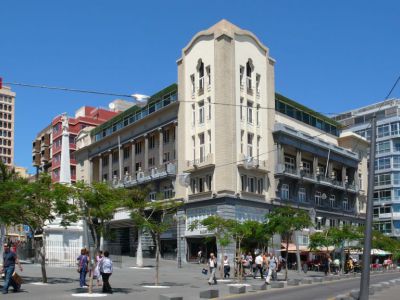
5) Casino of Tenerife Building
The Casino of Tenerife stands as a symbol of the city’s social and architectural heritage. Designed by Miguel Martín Fernández de la Torre and completed in 1935, the building originally served as the headquarters for the Real Casino of Tenerife, a private society dedicated to cultural and recreational life.
The building’s neoclassical design is evident in its tall pilasters, decorative cornices, and symmetrical façades. Its most iconic feature, a main tower rising from the corner, complements the rationalist principles that shaped its 1930s construction.
Inside, the casino’s grand entrance hall leads to marble staircases and elegant reception rooms, where visitors are greeted by murals and artworks from celebrated Canary Island artists Néstor Martín Fernández de la Torre and José Aguiar. The two upper levels, lined with glazed walls and open terraces, offer L-shaped outdoor areas and panoramic views of the city.
Still operating as a private club, the Casino of Tenerife continues to host an array of events, from concerts and art exhibitions to quiet moments in its library and café.
The building’s neoclassical design is evident in its tall pilasters, decorative cornices, and symmetrical façades. Its most iconic feature, a main tower rising from the corner, complements the rationalist principles that shaped its 1930s construction.
Inside, the casino’s grand entrance hall leads to marble staircases and elegant reception rooms, where visitors are greeted by murals and artworks from celebrated Canary Island artists Néstor Martín Fernández de la Torre and José Aguiar. The two upper levels, lined with glazed walls and open terraces, offer L-shaped outdoor areas and panoramic views of the city.
Still operating as a private club, the Casino of Tenerife continues to host an array of events, from concerts and art exhibitions to quiet moments in its library and café.
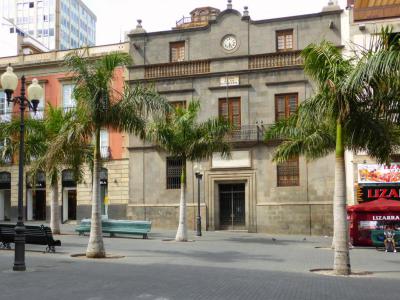
6) Palacio de Carta (Charter Palace)
The Charter Palace was commissioned in 1721 by Captain Matías Rodríguez Carta as his grand family residence and completed in 1752. Its stone façade showcases a harmonious blend of Canarian Baroque and Neoclassical styles, with elegant balconies and a clock adorning the upper level.
Inside, the palace unfolds around two traditional Canarian courtyards. The main patio is a masterpiece of colonial domestic architecture, featuring intricately carved wooden galleries and even original floorboards beneath some of the current paved surfaces.
Over the centuries, the palace has played many roles. It housed the Captaincy General of the Canary Islands, served as the headquarters of the Civil Government, and even functioned as a bank in the mid-20th century. Today, after an extensive restoration completed in early 2023, it has found new life as both a tourist information office and the home of the Santa Cruz History Museum.
Inside, the palace unfolds around two traditional Canarian courtyards. The main patio is a masterpiece of colonial domestic architecture, featuring intricately carved wooden galleries and even original floorboards beneath some of the current paved surfaces.
Over the centuries, the palace has played many roles. It housed the Captaincy General of the Canary Islands, served as the headquarters of the Civil Government, and even functioned as a bank in the mid-20th century. Today, after an extensive restoration completed in early 2023, it has found new life as both a tourist information office and the home of the Santa Cruz History Museum.
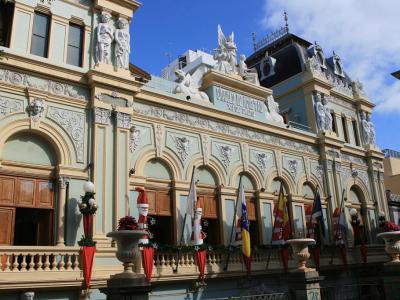
7) Circulo de Amistad XII de Enero (Circle of Friendship XII of January)
The Circle of Friendship XII of January is a early 20th-century social club, designed by esteemed architect Mariano Estanga y Arias-Girón and later expanded. The building exemplifies the elegant Second Empire style: its symmetrical façade with rustication, mansard-roofed corner towers, ornate balconies, and sculptural embellishments. It has been recognized as an Asset of Cultural Interest reflecting its cultural and architectural importance since December 15, 1985.
Founded in 1855 and relocated to its magnificent current quarters in 1904, the Circle began as a private society for Tenerife’s bourgeois elite. Inside, you’ll find a grand marble staircase, a 500-seat theatre, a historic ballroom, a library of over 15,000 volumes, and dedicated rooms for billiards, chess, exhibitions, concerts, and cultural events .
Today, it remains a place for artistic performances, folklore concerts, temporary exhibitions, and plays a central role during Carnival season - notably hosting zarzuela ensembles and gala events central to Tenerife’s festivities.
For tourists, the Circle of Friendship XII of January offers a unique glimpse into the island’s sociocultural heritage. Even if you’re not a member, many events-especially cultural evenings, concerts, and Carnival presentations-are open to the public.
Founded in 1855 and relocated to its magnificent current quarters in 1904, the Circle began as a private society for Tenerife’s bourgeois elite. Inside, you’ll find a grand marble staircase, a 500-seat theatre, a historic ballroom, a library of over 15,000 volumes, and dedicated rooms for billiards, chess, exhibitions, concerts, and cultural events .
Today, it remains a place for artistic performances, folklore concerts, temporary exhibitions, and plays a central role during Carnival season - notably hosting zarzuela ensembles and gala events central to Tenerife’s festivities.
For tourists, the Circle of Friendship XII of January offers a unique glimpse into the island’s sociocultural heritage. Even if you’re not a member, many events-especially cultural evenings, concerts, and Carnival presentations-are open to the public.
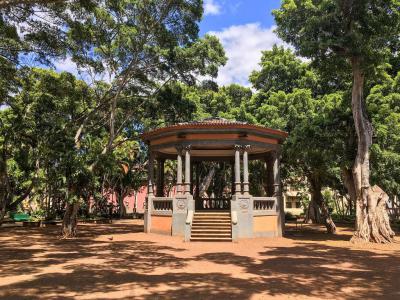
8) Plaza del Príncipe (The Prince’s Square)
The Prince’s Square is a charming 19th-century urban oasis, laid out in 1857 on the former garden of the old Franciscan Convent of San Pedro de Alcántara. Its creation is attributed to architect Manuel de Oraá y Arcocha, commemorating the then-Prince Alfonso.
As visitors step into the plaza, they encounter two graceful allegorical statues-Spring and Summer-imported from Genoa and placed there in 1868. At the center of the square is an octagonal bandstand, constructed in 1929 on the site of an earlier Victorian-style fountain.
Around the park, you’ll also find the expressive bronze-and-steel sculpture “Courage” by Hanneke Beaumont from 1995, commemorating resilience and artistic spirit. In 2013, a bronze statue was added to honor Enrique González Bethencourt, founder of the famed Murga NiFú-NiFá carnival group. The square functions also as a venue for cultural events, including daytime carnival dancing and occasional performances.
As visitors step into the plaza, they encounter two graceful allegorical statues-Spring and Summer-imported from Genoa and placed there in 1868. At the center of the square is an octagonal bandstand, constructed in 1929 on the site of an earlier Victorian-style fountain.
Around the park, you’ll also find the expressive bronze-and-steel sculpture “Courage” by Hanneke Beaumont from 1995, commemorating resilience and artistic spirit. In 2013, a bronze statue was added to honor Enrique González Bethencourt, founder of the famed Murga NiFú-NiFá carnival group. The square functions also as a venue for cultural events, including daytime carnival dancing and occasional performances.
9) Calle del Castillo (Castle Street)
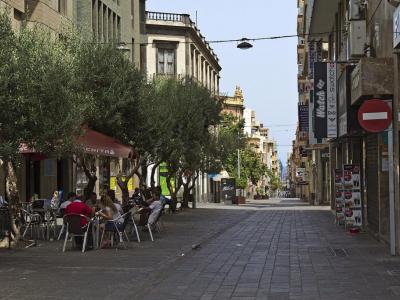
Castle Street is named for the Castillo Cristobal, built in 1575 and demolished in 1929 to make way for the Spain Square. Castle Street is among the oldest streets in the city of Santa Cruz. It extends from Weyler Square to Plaza Candelaria Square and ends in Spain Square.
Castle Street is a pedestrian street in the heart of the city. It has always been a shopping street. It features international franchise stores and local retailers. Buildings on the street are a fish-mash of styles: Canadian, Victorian, neoclassical, Moorish revival, etc.
Castle Street is a street where one can find literally everything, from clothes to Canary Islands food specialties. Combine shopping with sightseeing. End the shopping expedition at the Spain Square. Go under the square and check out the remains of the original castillo.
Castle Street is a pedestrian street in the heart of the city. It has always been a shopping street. It features international franchise stores and local retailers. Buildings on the street are a fish-mash of styles: Canadian, Victorian, neoclassical, Moorish revival, etc.
Castle Street is a street where one can find literally everything, from clothes to Canary Islands food specialties. Combine shopping with sightseeing. End the shopping expedition at the Spain Square. Go under the square and check out the remains of the original castillo.
10) Teatro Guimera (Guimera Theatre)
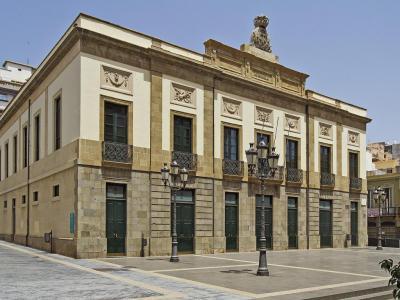
The Guimerá Theatre, the oldest in the Canary Islands, first opened in January 1851 and was built on the site of a former Dominican convent that had been dismantled during the Mendizábal confiscations. Designed by the Canarian architect Manuel de Oraá, its neoclassical-romantic façade is topped with the crest of Queen Isabel II.
Inside, you’ll find a sumptuous auditorium famously nicknamed “The Chocolate Box” thanks to its gilded moldings, plush velvets, frescoed ceilings, and sweeping balconied seating-drawing comparisons to The Royal Theatre. Over the years, successive renovations-in 1911, the late 20th century, and again in 2010-have modernized its facilities while preserving its historic charm. The theatre spans several performance spaces, including the main hall (roughly 800–900 seats) and the flexible “Guimerá Space” annex.
Named in 1923 for beloved native playwright Ángel Guimerá, whose works like Terra baixa and María Rosa helped transform Catalan theatre, the venue stands as a testament to Tenerife’s literary heritage. Today, it hosts theatre, cinema, concerts, dance, comedies, zarzuelas, and longstanding fixtures of the local cultural scene-including events linked to the International Canary Music Festival and the city’s Carnival.
A stroll around the plaza reveals public art and tributes: a bronze statue of Ángel Guimerá and the “Per Adriano” sculpture by Igor Mitoraj, representing the duality of tragedy and comedy.
Inside, you’ll find a sumptuous auditorium famously nicknamed “The Chocolate Box” thanks to its gilded moldings, plush velvets, frescoed ceilings, and sweeping balconied seating-drawing comparisons to The Royal Theatre. Over the years, successive renovations-in 1911, the late 20th century, and again in 2010-have modernized its facilities while preserving its historic charm. The theatre spans several performance spaces, including the main hall (roughly 800–900 seats) and the flexible “Guimerá Space” annex.
Named in 1923 for beloved native playwright Ángel Guimerá, whose works like Terra baixa and María Rosa helped transform Catalan theatre, the venue stands as a testament to Tenerife’s literary heritage. Today, it hosts theatre, cinema, concerts, dance, comedies, zarzuelas, and longstanding fixtures of the local cultural scene-including events linked to the International Canary Music Festival and the city’s Carnival.
A stroll around the plaza reveals public art and tributes: a bronze statue of Ángel Guimerá and the “Per Adriano” sculpture by Igor Mitoraj, representing the duality of tragedy and comedy.
11) Puente Serrador (General Serrador Bridge)
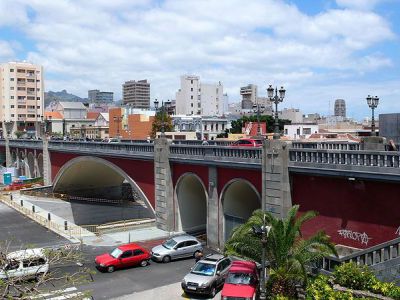
General Serrador Bridge is a mid-20th century arch bridge spanning the Santos Ravine. Designed by architect José Blasco Robles and constructed by Entrecanales y Távora between 1942 and its inauguration in 1943, the bridge was built to connect the expanding city center with newer neighborhoods across the ravine. It honors Captain General Ricardo Serrador Santés, who commissioned the work shortly before his death.
Architecturally, the bridge stands as a refined example of mid-century civic engineering. It spans 13 meters in width and features a sweeping central arch 30 meters long. The structure is characterized by light granite columns, minimalist concrete railings, and stylish period lamp posts. At either end of the bridge, bronze lion statues, replicas commemorating General Serrador’s past military achievements, mark its entrances.
Wander underneath its arch to discover vibrant graffiti murals, and climb the staircases for refreshing views over the ravine’s dry riverbed. Golden-hour light makes the bridge especially photogenic.
Architecturally, the bridge stands as a refined example of mid-century civic engineering. It spans 13 meters in width and features a sweeping central arch 30 meters long. The structure is characterized by light granite columns, minimalist concrete railings, and stylish period lamp posts. At either end of the bridge, bronze lion statues, replicas commemorating General Serrador’s past military achievements, mark its entrances.
Wander underneath its arch to discover vibrant graffiti murals, and climb the staircases for refreshing views over the ravine’s dry riverbed. Golden-hour light makes the bridge especially photogenic.
12) Mercado Nuestra Señora de Africa (Market of Our Lady of Africa) (must see)
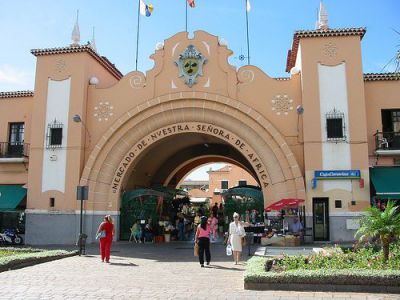
By the ornate entrance arch of the Market of Our Lady of Africa are two sculptures. First, La Lechera ("Milkmaid"), is a shoeless woman hurrying along, a jug in one hand while supporting with the other hand a basket of dairy products on her head. It is in honor of the generations of hard-working milkmaids of Tenerife.
The second sculpture, Homenaje Al Chicharrero ("People of Santa Cruz"), is of two fishermen launching a boat in the surf. The main catch in the old days was horse mackerel, locally known as "chicharos." At one time Santa Cruz was a fishing village. It produced poverty and fish, and was generally looked down on by folks in the city.
The Market of our Lady of Africa is dedicated to food and the people who produce it. Founded in 1944, it is housed in an exotic building of arches and patios with Latin American and Moorish touches. A minaret-like clock tower announces the location of the market. For drivers, there is underground parking with stairs to the market.
Stalls and shops are housed on two busy floors offering fresh produce, flowers, fruit, fish, bread, cheeses, wines and yes, cold cuts. There are also lots of deli offerings, including salsa, cactus marmalade, honey, and spices. For hungry shoppers who can't wait, there are restaurants and tasting stalls.
The second sculpture, Homenaje Al Chicharrero ("People of Santa Cruz"), is of two fishermen launching a boat in the surf. The main catch in the old days was horse mackerel, locally known as "chicharos." At one time Santa Cruz was a fishing village. It produced poverty and fish, and was generally looked down on by folks in the city.
The Market of our Lady of Africa is dedicated to food and the people who produce it. Founded in 1944, it is housed in an exotic building of arches and patios with Latin American and Moorish touches. A minaret-like clock tower announces the location of the market. For drivers, there is underground parking with stairs to the market.
Stalls and shops are housed on two busy floors offering fresh produce, flowers, fruit, fish, bread, cheeses, wines and yes, cold cuts. There are also lots of deli offerings, including salsa, cactus marmalade, honey, and spices. For hungry shoppers who can't wait, there are restaurants and tasting stalls.
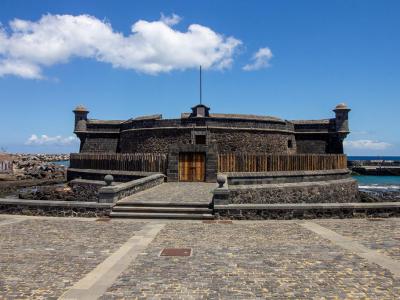
13) Castillo de San Juan Bautista (Castle of John Baptist)
The Castle of John Baptist, also known as the Black Castle, is a 17th-century coastal fortress. Built between 1641 and 1644 from locally sourced black volcanic stone, this round bastion was designed to safeguard the port from pirates and foreign navies. In 1765, its defensive strength was enhanced with the addition of a cylindrical tower overlooking the sea.
Today, the fortress stands as one of the best-preserved military monuments on the island. Most notably, every July 25, the castle comes to life with a theatrical reenactment of Admiral Horatio Nelson’s failed 1797 invasion-offering a captivating glimpse into Tenerife’s storied past. Even though it is currently closed for interior visits, its historical significance and unique architecture make it a noteworthy landmark in the city.
Today, the fortress stands as one of the best-preserved military monuments on the island. Most notably, every July 25, the castle comes to life with a theatrical reenactment of Admiral Horatio Nelson’s failed 1797 invasion-offering a captivating glimpse into Tenerife’s storied past. Even though it is currently closed for interior visits, its historical significance and unique architecture make it a noteworthy landmark in the city.
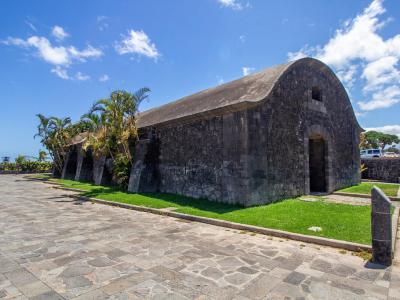
14) Casa de la Pólvora (Gunpowder House)
The Gunpowder House is a hidden gem of 18th-century military architecture. Constructed between 1756 and 1758 under the direction of engineer Francisco La Pierre, this robust structure was originally built to store artillery powder for the city’s coastal defences. Its rectangular basalt stone construction, rounded end walls, and barrel-vaulted roof provided a fire-resistant chamber capable of holding up to 150 000 kg of gunpowder while withstanding potential bombardment.
In 1779, additional earthworks were added to mask the building from naval view and absorb enemy cannon fire, ensuring the safety of its volatile contents. For roughly 150 years, the Gunpowder House served as the island’s primary powder magazine. In 1926, by royal decree, control transferred from the military to the city council, marking the end of its direct military use.
Today, the Gunpowder House remains one of the few surviving fortification buildings. While the interior is not currently open to visitors, the exterior and its scenic riverside gardens offer a glimpse into Tenerife’s defensive past.
In 1779, additional earthworks were added to mask the building from naval view and absorb enemy cannon fire, ensuring the safety of its volatile contents. For roughly 150 years, the Gunpowder House served as the island’s primary powder magazine. In 1926, by royal decree, control transferred from the military to the city council, marking the end of its direct military use.
Today, the Gunpowder House remains one of the few surviving fortification buildings. While the interior is not currently open to visitors, the exterior and its scenic riverside gardens offer a glimpse into Tenerife’s defensive past.
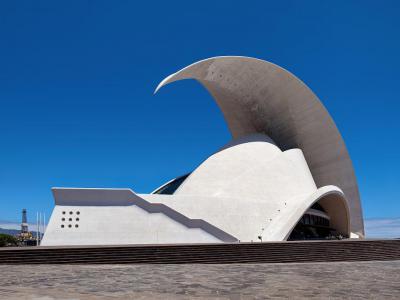
15) The Tenerife Auditorium (must see)
The Tenerife Auditorium “Adán Martín” rises dramatically as a stunning sculptural landmark. Designed by famed Spanish architect Santiago Calatrava and inaugurated in 2003, its sweeping concrete arch-rising 58 m from a two-point base-has become an representation of modern architecture in the Canary Islands.
Inside, the auditorium serves as a cultural center. Its principal concert hall seats around 1,616 attendees, while the more intimate chamber hall accommodates about 422. It hosts a rich calendar of cultural offerings-including performances by the Tenerife Symphony Orchestra, opera, ballet, jazz, world music, and events like the Tenerife Opera Festival and International Music Festival. Beyond music, the venue frequently opens its doors to film festivals, conferences, and even served as a backdrop for productions like Doctor Who and the film Rambo: Last Blood.
The Tenerife Auditorium features cafés and terraces where visitors can enjoy expansive views of the harbor. For the best experience, take time to admire the landmark's remarkable silhouette from different angles-especially during golden hour or when the building is beautifully lit at night for special events.
Inside, the auditorium serves as a cultural center. Its principal concert hall seats around 1,616 attendees, while the more intimate chamber hall accommodates about 422. It hosts a rich calendar of cultural offerings-including performances by the Tenerife Symphony Orchestra, opera, ballet, jazz, world music, and events like the Tenerife Opera Festival and International Music Festival. Beyond music, the venue frequently opens its doors to film festivals, conferences, and even served as a backdrop for productions like Doctor Who and the film Rambo: Last Blood.
The Tenerife Auditorium features cafés and terraces where visitors can enjoy expansive views of the harbor. For the best experience, take time to admire the landmark's remarkable silhouette from different angles-especially during golden hour or when the building is beautifully lit at night for special events.
