Custom Walk in Toronto, Canada by bobwrobinson56_9d6da created on 2026-03-20
Guide Location: Canada » Toronto
Guide Type: Custom Walk
# of Sights: 10
Tour Duration: 4 Hour(s)
Travel Distance: 10.1 Km or 6.3 Miles
Share Key: TJUCY
Guide Type: Custom Walk
# of Sights: 10
Tour Duration: 4 Hour(s)
Travel Distance: 10.1 Km or 6.3 Miles
Share Key: TJUCY
How It Works
Please retrieve this walk in the GPSmyCity app. Once done, the app will guide you from one tour stop to the next as if you had a personal tour guide. If you created the walk on this website or come to the page via a link, please follow the instructions below to retrieve the walk in the app.
Retrieve This Walk in App
Step 1. Download the app "GPSmyCity: Walks in 1K+ Cities" on Apple App Store or Google Play Store.



Step 2. In the GPSmyCity app, download(or launch) the guide "Toronto Map and Walking Tours".
Step 3. Tap the menu button located at upper right corner of the "Walks" screen and select "Retrieve custom walk". Enter the share key: TJUCY
1) Union Station
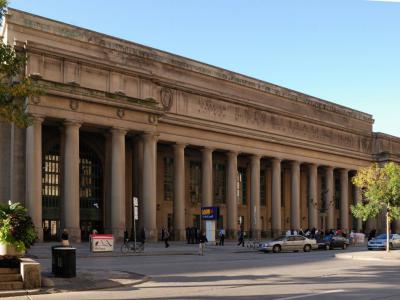
Toronto's Union Station stands as a prominent railway station and intermodal transportation hub, recognized as a National Historic Site of Canada since 1975. Moreover, it holds the distinction of being a Heritage Railway Station since 1989.
Renowned as Canada's largest and most magnificent railway station, Union Station in Toronto was masterfully crafted by the Montreal architecture firm of Ross and Macdonald. Designed in the elegant Beaux-Arts style, this architectural gem emerged as a collaborative effort between the Grand Trunk Railway, the Canadian Pacific Railway, and notable architects Hugh Jones from CPR and John M. Lyle from Toronto. Recognizing its exceptional design, the Historic Sites and Monuments Board of Canada acclaimed it in 1975 for its "national architectural significance as one of the finest examples of Beaux-Arts railway station design in Canada."
The striking exterior of Union Station showcases a Front Street façade meticulously laid out in an ashlar pattern. Smooth beige Indiana and Queenston limestone were meticulously employed in its construction. Along the colonnaded loggia facing Front Street, visitors are greeted by 22 Roman Tuscan columns, equally spaced and crafted from Bedford limestone. Enhancing the grandeur, the recessed main entrance is adorned by two sets of four columns, with intricately carved relief wreaths adorning the entablature above them.
Renowned as Canada's largest and most magnificent railway station, Union Station in Toronto was masterfully crafted by the Montreal architecture firm of Ross and Macdonald. Designed in the elegant Beaux-Arts style, this architectural gem emerged as a collaborative effort between the Grand Trunk Railway, the Canadian Pacific Railway, and notable architects Hugh Jones from CPR and John M. Lyle from Toronto. Recognizing its exceptional design, the Historic Sites and Monuments Board of Canada acclaimed it in 1975 for its "national architectural significance as one of the finest examples of Beaux-Arts railway station design in Canada."
The striking exterior of Union Station showcases a Front Street façade meticulously laid out in an ashlar pattern. Smooth beige Indiana and Queenston limestone were meticulously employed in its construction. Along the colonnaded loggia facing Front Street, visitors are greeted by 22 Roman Tuscan columns, equally spaced and crafted from Bedford limestone. Enhancing the grandeur, the recessed main entrance is adorned by two sets of four columns, with intricately carved relief wreaths adorning the entablature above them.
2) Osgoode Hall
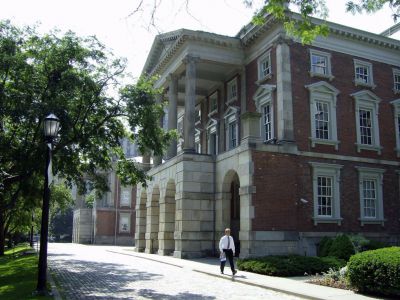
Toronto's Osgoode Hall is a remarkable heritage building sprawling across six acres. It has captivated attention for 170 years as a hub of legal activity and was aptly named after William Osgoode, the first Chief Justice of the province. Construction on this historic structure commenced in 1829, but it took a span of 20 years and the expertise of multiple architects, including John Ewart and W.W. Baldwin, to complete.
The exterior facade proudly showcases the exquisite Italian Renaissance style, while the interior boasts an array of stunning features, such as stained glass heraldic windows, intricate ceilings, and graceful arched pillars. Elements of the Palladian architectural style can also be admired within the Hall.
Following a period of use as troop barracks from 1838 to 1843, Osgoode Hall underwent a series of restoration projects between 1844 and 1891. Until the relocation of York University's faculty in 1969, the Hall served as the prestigious home of the Osgoode Hall Law School, a renowned institution for legal education.
In 1928, to honor Ontario lawyers and law students who had lost their lives during the First World War, a memorial sculpted by Frances Norma Loring was added to the Hall's Library. In recognition of its historical significance, Osgoode Hall was officially designated a National Historic Site of Canada in 1979.
Presently, Osgoode Hall accommodates the Law Society of Upper Canada, the Superior Court of Justice, and the Ontario Court of Appeal, solidifying its enduring role as a vital center for the legal community.
The exterior facade proudly showcases the exquisite Italian Renaissance style, while the interior boasts an array of stunning features, such as stained glass heraldic windows, intricate ceilings, and graceful arched pillars. Elements of the Palladian architectural style can also be admired within the Hall.
Following a period of use as troop barracks from 1838 to 1843, Osgoode Hall underwent a series of restoration projects between 1844 and 1891. Until the relocation of York University's faculty in 1969, the Hall served as the prestigious home of the Osgoode Hall Law School, a renowned institution for legal education.
In 1928, to honor Ontario lawyers and law students who had lost their lives during the First World War, a memorial sculpted by Frances Norma Loring was added to the Hall's Library. In recognition of its historical significance, Osgoode Hall was officially designated a National Historic Site of Canada in 1979.
Presently, Osgoode Hall accommodates the Law Society of Upper Canada, the Superior Court of Justice, and the Ontario Court of Appeal, solidifying its enduring role as a vital center for the legal community.
3) Nathan Phillips Square
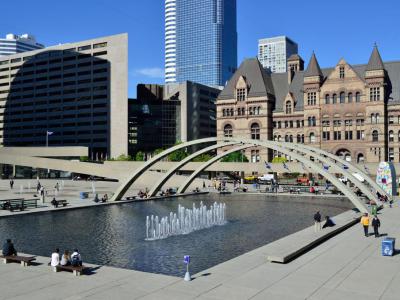
Nathan Phillips Square stands as a bustling urban plaza, positioned as the welcoming space before Toronto City Hall, also known as New City Hall. Situated at the intersection of Queen Street West and Bay Street, this vibrant square derives its name from Nathan Phillips, who served as the mayor of Toronto between 1955 and 1962. The visionary architect Viljo Revell, in collaboration with landscape architect Richard Strong, crafted the design of this square, which was officially inaugurated in 1965.
In present times, Nathan Phillips Square remains a vibrant hub, hosting a diverse range of public events. It serves as a venue for captivating art exhibitions, thrilling concerts, inspiring rallies, and a bustling weekly farmers' market, among other ceremonies. Notable annual occasions include the lively New Year's Eve Party and the enchanting Cavalcade of Lights Festival, where the official Christmas tree is splendidly illuminated.
The square also welcomes the renowned Nuit Blanche art festival, which transforms the square into an artistic haven, extending its displays into the underground parking garage. Furthermore, during the winter months, the reflective pool undergoes a marvelous metamorphosis, transforming into an inviting ice rink for ice-skating enthusiasts.
Year after year, Nathan Phillips Square magnetizes an estimated 1.5 million visitors, allured by its charm and grandeur. Covering an expansive area of 4.85 hectares (12.0 acres), this city square proudly claims the title of Canada's largest, offering an expansive and captivating experience to all who venture within its borders.
In present times, Nathan Phillips Square remains a vibrant hub, hosting a diverse range of public events. It serves as a venue for captivating art exhibitions, thrilling concerts, inspiring rallies, and a bustling weekly farmers' market, among other ceremonies. Notable annual occasions include the lively New Year's Eve Party and the enchanting Cavalcade of Lights Festival, where the official Christmas tree is splendidly illuminated.
The square also welcomes the renowned Nuit Blanche art festival, which transforms the square into an artistic haven, extending its displays into the underground parking garage. Furthermore, during the winter months, the reflective pool undergoes a marvelous metamorphosis, transforming into an inviting ice rink for ice-skating enthusiasts.
Year after year, Nathan Phillips Square magnetizes an estimated 1.5 million visitors, allured by its charm and grandeur. Covering an expansive area of 4.85 hectares (12.0 acres), this city square proudly claims the title of Canada's largest, offering an expansive and captivating experience to all who venture within its borders.
4) Toronto New City Hall
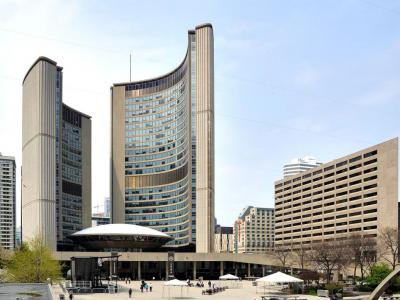
Ontario's capital boasts yet another architectural marvel known as the New City Hall, captivating the lenses of countless photographers. This iconic emblem of Toronto stands as a remarkable testament to the city's individuality and elegance.
The visionary behind the New City Hall was Finnish architect Viljo Revell, chosen for the task through an international competition that attracted an astounding 500 designs from 42 countries. Initially, the competition faced severe criticism and controversy, with some insisting that a Canadian should have been entrusted with the project. Nevertheless, the outcome bestowed upon Toronto one of its most splendid edifices, beloved by all and regarded as a symbol of the region.
The construction of the New City Hall commenced in 1961 and spanned four years. The building has a rectangular base with curved towers of different heights. The east tower is 27 stories (99.5 meters) tall, while the west tower is 20 stories (79.4 meters) tall. The towers cradle a saucer-like council chamber. Concrete covers the curved surfaces with a rib pattern for strength and to prevent fabric collapse due to exterior expansion or tearing caused by different air pressures. The north, west, and east sides have abstract and sculptural designs, while the south side facing the square has extensive glazing.
From the air, the building resembles an unblinking eye, earning it the nickname "The Eye of Government." Its futuristic design stirred controversy, but it was praised as an exceptional city hall by Arthur in his book, Toronto, No Mean City.
The visionary behind the New City Hall was Finnish architect Viljo Revell, chosen for the task through an international competition that attracted an astounding 500 designs from 42 countries. Initially, the competition faced severe criticism and controversy, with some insisting that a Canadian should have been entrusted with the project. Nevertheless, the outcome bestowed upon Toronto one of its most splendid edifices, beloved by all and regarded as a symbol of the region.
The construction of the New City Hall commenced in 1961 and spanned four years. The building has a rectangular base with curved towers of different heights. The east tower is 27 stories (99.5 meters) tall, while the west tower is 20 stories (79.4 meters) tall. The towers cradle a saucer-like council chamber. Concrete covers the curved surfaces with a rib pattern for strength and to prevent fabric collapse due to exterior expansion or tearing caused by different air pressures. The north, west, and east sides have abstract and sculptural designs, while the south side facing the square has extensive glazing.
From the air, the building resembles an unblinking eye, earning it the nickname "The Eye of Government." Its futuristic design stirred controversy, but it was praised as an exceptional city hall by Arthur in his book, Toronto, No Mean City.
5) Old City Hall
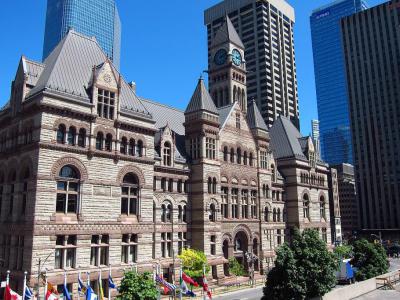
Located at the intersection of Queen and Bay Streets in Downtown Toronto stands an impressive building with Romanesque-style architecture. This remarkable structure, known today as the Old City Hall, served as the Toronto City Council's home from 1899 to 1966, becoming the third city hall constructed for the flourishing city. Upon its completion, it ranked among the largest buildings in Toronto and stood as the largest civic edifice in North America.
Renowned architect Edward James Lennox led the creation of this masterpiece. Over a decade of construction, the majestic City Hall emerged as an iconic landmark. Its remarkable clock tower, standing at 103.6 meters (340 feet), became the city's crown jewel. The clock mechanism was crafted in Croydon, England. Inside the clock room, three bells were placed: two smaller ones that chimed every quarter hour, and a bourdon bell weighing 5,443 kilograms, which tolled every hour.
Matching the splendid exterior, the interior of the building exuded charm, adorned with intricate details. Noteworthy features include a grand staircase adorned with stained glass windows depicting Canadian history, various murals, statues, and other decorative elements.
Despite its grandeur, the Old City Hall proved inadequate for Toronto's expanding municipal government within a few decades of its construction. In the 1960s, plans were made to demolish the building and make way for a retail complex known as the Eaton Centre. However, thanks to public outcry, the Old City Hall was saved and repurposed as a courthouse. In 1984, it received the prestigious designation as a National Historic Site, preserving its historical significance for future generations.
Tip:
Make sure to visit the small "lake" close by, as many of the pictures from Toronto you might know are taken from this place while facing the "TORONTO" sign.
Renowned architect Edward James Lennox led the creation of this masterpiece. Over a decade of construction, the majestic City Hall emerged as an iconic landmark. Its remarkable clock tower, standing at 103.6 meters (340 feet), became the city's crown jewel. The clock mechanism was crafted in Croydon, England. Inside the clock room, three bells were placed: two smaller ones that chimed every quarter hour, and a bourdon bell weighing 5,443 kilograms, which tolled every hour.
Matching the splendid exterior, the interior of the building exuded charm, adorned with intricate details. Noteworthy features include a grand staircase adorned with stained glass windows depicting Canadian history, various murals, statues, and other decorative elements.
Despite its grandeur, the Old City Hall proved inadequate for Toronto's expanding municipal government within a few decades of its construction. In the 1960s, plans were made to demolish the building and make way for a retail complex known as the Eaton Centre. However, thanks to public outcry, the Old City Hall was saved and repurposed as a courthouse. In 1984, it received the prestigious designation as a National Historic Site, preserving its historical significance for future generations.
Tip:
Make sure to visit the small "lake" close by, as many of the pictures from Toronto you might know are taken from this place while facing the "TORONTO" sign.
6) St. James Anglican Cathedral
One of the most enthralling churches of Toronto is the Saint James Cathedral. Not only does the facade of this church make it captivating, but it is also the story that accompanies it.
Home to the oldest congregation in Toronto, established in 1797, Saint James's serves as the spiritual center of Saint Lawrence neighborhood and is the episcopal seat of the Anglican Church of Canada's Diocese of Toronto. All of this makes it one of the most treasured heritage sites in the city.
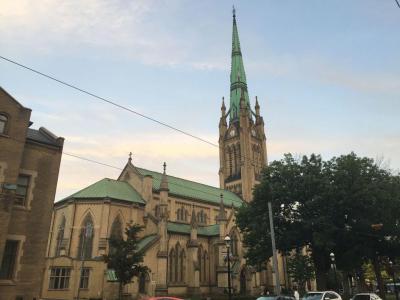
Built in the mid-19th century, the cathedral boasts a magnificent Gothic Revival style of architecture. Designed by Frederick William Cumberland, the Saint James Cathedral greets spectators from far and wide coming to admire its sheer beauty. The structure flaunts a wonderful harmony of proportions and grandeur. With its white brick and sandstone exterior, the building conspicuously stands out in contrast to its surrounding landscape. Along with its exteriors, the cathedral's insides are also equally breathtaking. The architectural elements include high raised ceiling, ribbed vaults and pointed arched lights that brighten the interiors with natural illumination, making it a truly magnificent sight to behold during daylight.
Home to the oldest congregation in Toronto, established in 1797, Saint James's serves as the spiritual center of Saint Lawrence neighborhood and is the episcopal seat of the Anglican Church of Canada's Diocese of Toronto. All of this makes it one of the most treasured heritage sites in the city.
Built in the mid-19th century, the cathedral boasts a magnificent Gothic Revival style of architecture. Designed by Frederick William Cumberland, the Saint James Cathedral greets spectators from far and wide coming to admire its sheer beauty. The structure flaunts a wonderful harmony of proportions and grandeur. With its white brick and sandstone exterior, the building conspicuously stands out in contrast to its surrounding landscape. Along with its exteriors, the cathedral's insides are also equally breathtaking. The architectural elements include high raised ceiling, ribbed vaults and pointed arched lights that brighten the interiors with natural illumination, making it a truly magnificent sight to behold during daylight.
7) St. Lawrence Market (must see)
Established in 1803, Saint Lawrence Market is the nerve centre of Toronto's commercial activity. Located in the former industrial area (between Jarvis, Front, King, and Church streets), this is the city's largest and perhaps most famous market. The bulk of its crowd are locals doing regular grocery shopping or simply popping in for a cup of coffee or chit-chat with neighbors. Tourists are also seen here rather often, lured by the bustling atmosphere and tasty foods.
Undoubtedly, food is the main draw at Saint Lawrence. Here, you can find everything: from beef to kangaroo meat, plus hundreds of kinds of cheeses, gourmet dog treats, local wines, French baked goods, Greek olive oil, and even New Zealand honey. There is also plenty of prepared food, such as the famous peameal bacon sandwich, that you can eat right on site.
The South Market section houses daily sales of fresh produce, dairy, and meats. Freshly-baked goods are also available here all day, much as some non-food items. There is a number of artisan shops selling jewelry and other crafts. Also, the Market Gallery, on the second floor, has an area for cultural events.
The North Market section traditionally houses a Saturday farmer’s market (featuring producers from southern Ontario) and a Sunday antiques sale. Both ventures start at 5 o'clock in the morning and run until 5 o'clock in the evening.
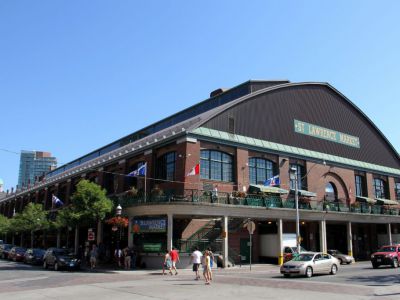
From an architectural standpoint, Saint Lawrence is just as attractive. Its massive main brick building, with a cast-iron ceiling inspired by London’s Saint Pancras train station, was constructed in 1902. Part of the Old City Hall, which dates from 1845, was incorporated into the building, and you can still see part of the original jail on the lower level of the market.
Undoubtedly, food is the main draw at Saint Lawrence. Here, you can find everything: from beef to kangaroo meat, plus hundreds of kinds of cheeses, gourmet dog treats, local wines, French baked goods, Greek olive oil, and even New Zealand honey. There is also plenty of prepared food, such as the famous peameal bacon sandwich, that you can eat right on site.
The South Market section houses daily sales of fresh produce, dairy, and meats. Freshly-baked goods are also available here all day, much as some non-food items. There is a number of artisan shops selling jewelry and other crafts. Also, the Market Gallery, on the second floor, has an area for cultural events.
The North Market section traditionally houses a Saturday farmer’s market (featuring producers from southern Ontario) and a Sunday antiques sale. Both ventures start at 5 o'clock in the morning and run until 5 o'clock in the evening.
From an architectural standpoint, Saint Lawrence is just as attractive. Its massive main brick building, with a cast-iron ceiling inspired by London’s Saint Pancras train station, was constructed in 1902. Part of the Old City Hall, which dates from 1845, was incorporated into the building, and you can still see part of the original jail on the lower level of the market.
8) Gooderham Building
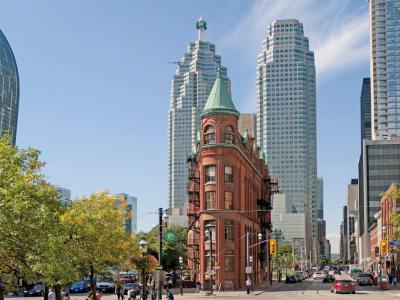
Among the many places worth visiting in the Saint Lawrence neighborhood, especially for an architecture buff, is the Gooderham Building. Hardly five stories tall, wedged in a triangular intersection between Front and Wellington streets, this structure is one of the most photographed sights in the city. The house was built in 1892, ten years before its famous kin, the Fuller Building in New York City, and as such, represents an early example of the flatiron form of architecture.
The previous building on this site was shorter but of the same shape and was called the Coffin Block. The current vermilion red-brick edifice, with tinges of Romanesque styling, was constructed for distiller George Gooderham and served as the office of the Gooderham & Worts distillery until 1952. The Gooderham family sold the property in 1957, following which it changed hands several times. In 1975, the building was designated a historic site under the Ontario Heritage Act.
Besides its shape, the Gooderham Building is well-known for the mural on its back wall. The Flatiron Mural – created by renowned Canadian artist Derek Michael Besant – uses a trompe-l'œil effect to make the wall appear to have more windows than it does, as well as to give it a more mobile effect with the help of a picture of the Perkins Building, which is located directly across the street, depicted as if loosely 'tacked' down to the wall, with some of its edges 'fluttering' away.
Right behind the Gooderham Building is a tree-lined spot called Berczy Park. This park, housing a sizeable three-tier fountain fitted with 27 cast-iron dogs spouting water, a cast-iron cat, and crowned with a bone, was completed in 2017. The drinking trough for dogs has made this fountain a popular destination, particularly for dog lovers.
The previous building on this site was shorter but of the same shape and was called the Coffin Block. The current vermilion red-brick edifice, with tinges of Romanesque styling, was constructed for distiller George Gooderham and served as the office of the Gooderham & Worts distillery until 1952. The Gooderham family sold the property in 1957, following which it changed hands several times. In 1975, the building was designated a historic site under the Ontario Heritage Act.
Besides its shape, the Gooderham Building is well-known for the mural on its back wall. The Flatiron Mural – created by renowned Canadian artist Derek Michael Besant – uses a trompe-l'œil effect to make the wall appear to have more windows than it does, as well as to give it a more mobile effect with the help of a picture of the Perkins Building, which is located directly across the street, depicted as if loosely 'tacked' down to the wall, with some of its edges 'fluttering' away.
Right behind the Gooderham Building is a tree-lined spot called Berczy Park. This park, housing a sizeable three-tier fountain fitted with 27 cast-iron dogs spouting water, a cast-iron cat, and crowned with a bone, was completed in 2017. The drinking trough for dogs has made this fountain a popular destination, particularly for dog lovers.

9) Toronto Island Park (must see)
The Toronto Islands Park, also known as the Island or Toronto Island, can be found in Lake Ontario, just a 13-minute ferry ride away from downtown Toronto. The Jack Layton Ferry Terminal, situated at the foot of Bay Street and Queen's Quay, serves as the departure point for boats heading to the Island. Comprising a collection of 15 interconnected islands, one can easily traverse the Island from end to end on foot. Stretching approximately 5 kilometers from Ward's Island to Hanlan's Point, the Island offers a range of attractions suitable for individuals of all ages.
Visitors to the Island, whether young or old, will discover a plethora of activities and sights to enjoy. Sandy swimming beaches, including the renowned Clothing Optional Beach on Hanlan's Point, beckon beachgoers. Sports enthusiasts can make use of the various sports facilities available, while those seeking outdoor adventures can rent bikes, canoes, and kayaks. Additionally, the Island boasts a boating marina, expansive grassy fields perfect for picnics, a theater, nature paths, and even emergency medical services and a fire station. Not to be missed is the charming 150-year-old community of 600 year-round residents living in quaint cottage-like homes.
However, it's important to note that the park operates seasonally, with its vibrant atmosphere from May to late September. During the winter months, the Island becomes eerily quiet, and most facilities close down.
The view of the city from the Islands is truly stunning, and the islands themselves are equally picturesque, making it a paradise for photographers. If you've never had the chance to visit the islands, be sure to add it to your to-do list!
Visitors to the Island, whether young or old, will discover a plethora of activities and sights to enjoy. Sandy swimming beaches, including the renowned Clothing Optional Beach on Hanlan's Point, beckon beachgoers. Sports enthusiasts can make use of the various sports facilities available, while those seeking outdoor adventures can rent bikes, canoes, and kayaks. Additionally, the Island boasts a boating marina, expansive grassy fields perfect for picnics, a theater, nature paths, and even emergency medical services and a fire station. Not to be missed is the charming 150-year-old community of 600 year-round residents living in quaint cottage-like homes.
However, it's important to note that the park operates seasonally, with its vibrant atmosphere from May to late September. During the winter months, the Island becomes eerily quiet, and most facilities close down.
The view of the city from the Islands is truly stunning, and the islands themselves are equally picturesque, making it a paradise for photographers. If you've never had the chance to visit the islands, be sure to add it to your to-do list!
10) CN Tower (must see)
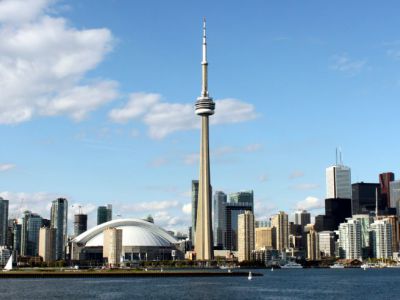
CN Tower is a concrete communications and observation tower situated in Toronto. Standing at an impressive height of 553.3 meters (1,815.3 feet), it was completed in 1976. The tower is prominently located in downtown Toronto, occupying the former Railway Lands. Its name, "CN," originates from Canadian National, the railway company responsible for its construction. When Canadian National decided to divest non-core freight railway assets before privatization in 1995, the tower was transferred to the Canada Lands Company, a federal Crown corporation responsible for the government's real estate portfolio.
For 32 years, from 1975 to 2007, the CN Tower held the distinction of being the world's tallest free-standing structure. It was surpassed by the Burj Khalifa and later the Canton Tower in 2009, relinquishing its title as the world's tallest tower. Nonetheless, it remains the tallest free-standing structure on land in the Western Hemisphere and currently ranks as the tenth-tallest free-standing structure globally. In 1995, the CN Tower was honored as one of the modern Seven Wonders of the World by the American Society of Civil Engineers. Additionally, it is a member of the World Federation of Great Towers.
The CN Tower has become an iconic symbol of Toronto's skyline, drawing over two million international visitors each year. Within its remarkable structure, visitors can explore various observation decks, dine at a revolving restaurant situated approximately 350 meters (1,150 feet) above the ground, and enjoy an entertainment complex.
Why You Should Visit:
Simply put one of the best views in North America. The city is so incredibly planned and laid out and you can truly see this from the top of the CN Tower.
Tip:
You can pay for a time slot to avoid a long wait and some extra to go to the upper levels where it's a bit quieter.
The food at the tower can be quite pricey, so plan accordingly.
For 32 years, from 1975 to 2007, the CN Tower held the distinction of being the world's tallest free-standing structure. It was surpassed by the Burj Khalifa and later the Canton Tower in 2009, relinquishing its title as the world's tallest tower. Nonetheless, it remains the tallest free-standing structure on land in the Western Hemisphere and currently ranks as the tenth-tallest free-standing structure globally. In 1995, the CN Tower was honored as one of the modern Seven Wonders of the World by the American Society of Civil Engineers. Additionally, it is a member of the World Federation of Great Towers.
The CN Tower has become an iconic symbol of Toronto's skyline, drawing over two million international visitors each year. Within its remarkable structure, visitors can explore various observation decks, dine at a revolving restaurant situated approximately 350 meters (1,150 feet) above the ground, and enjoy an entertainment complex.
Why You Should Visit:
Simply put one of the best views in North America. The city is so incredibly planned and laid out and you can truly see this from the top of the CN Tower.
Tip:
You can pay for a time slot to avoid a long wait and some extra to go to the upper levels where it's a bit quieter.
The food at the tower can be quite pricey, so plan accordingly.
