Custom Walk in Montpellier, France by segherssonia_85ae25 created on 2026-03-25
Guide Location: France » Montpellier
Guide Type: Custom Walk
# of Sights: 16
Tour Duration: 3 Hour(s)
Travel Distance: 5.9 Km or 3.7 Miles
Share Key: V4PW5
Guide Type: Custom Walk
# of Sights: 16
Tour Duration: 3 Hour(s)
Travel Distance: 5.9 Km or 3.7 Miles
Share Key: V4PW5
How It Works
Please retrieve this walk in the GPSmyCity app. Once done, the app will guide you from one tour stop to the next as if you had a personal tour guide. If you created the walk on this website or come to the page via a link, please follow the instructions below to retrieve the walk in the app.
Retrieve This Walk in App
Step 1. Download the app "GPSmyCity: Walks in 1K+ Cities" on Apple App Store or Google Play Store.



Step 2. In the GPSmyCity app, download(or launch) the guide "Montpellier Map and Walking Tours".
Step 3. Tap the menu button located at upper right corner of the "Walks" screen and select "Retrieve custom walk". Enter the share key: V4PW5
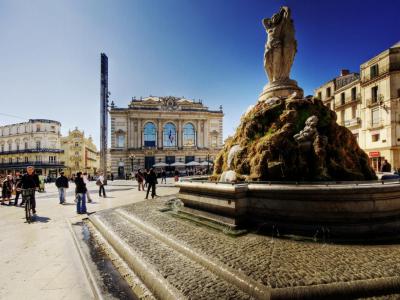
1) Place de la Comédie (Comedy Square) (must see)
Comedy Square is called a square. But it is not a square. It is an oval. For this reason, locals often refer to it as "the Egg". It is shaped like an egg and it is one of the largest "squares" in Europe. It is located in the heart of the medieval city.
The square extends across the space once occupied by the ancient fortifications of Montpellier, almost touching the Joffre High School (formerly the citadel of Montpellier) and the Charles de Gaulle Esplanade in the east. It is about 756 feet long by 164 feet wide.
The earliest mention of the square is 1755. It was named for the Municipal Theatre, Opera Comedy. The theater burned down twice, the first time in 1785 and then again in 1881. Each time it was rebuilt.
In 1790 The fountain and sculpture of the three Graces, Euphrosyne, Aglaea and Thalia, by the well known French sculptor Étienne Dantoine, was installed in the square. The Graces were the daughters of Zeus. Thalia was Youth, Euphrosyne was Humor and Aglaea was Elegance; three qualities prized in France.
The square extends across the space once occupied by the ancient fortifications of Montpellier, almost touching the Joffre High School (formerly the citadel of Montpellier) and the Charles de Gaulle Esplanade in the east. It is about 756 feet long by 164 feet wide.
The earliest mention of the square is 1755. It was named for the Municipal Theatre, Opera Comedy. The theater burned down twice, the first time in 1785 and then again in 1881. Each time it was rebuilt.
In 1790 The fountain and sculpture of the three Graces, Euphrosyne, Aglaea and Thalia, by the well known French sculptor Étienne Dantoine, was installed in the square. The Graces were the daughters of Zeus. Thalia was Youth, Euphrosyne was Humor and Aglaea was Elegance; three qualities prized in France.
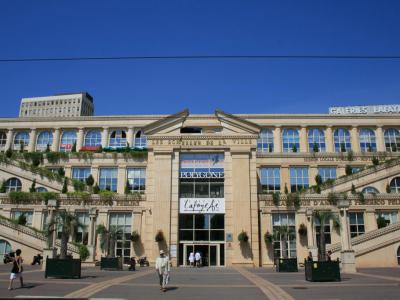
2) Polygone Shopping Center
Located in the Antigone district of Montpellier, the Polygone Shopping Center is the largest retail complex in the city and a key shopping destination for the entire Languedoc-Roussillon region. Originally built in 1977, Polygone initially spanned two levels, with a third floor added in subsequent years to accommodate growing demand. Today, this modernized shopping hub is home to 110 stores and 10 restaurants, offering a diverse array of shopping and leisure options.
From high-end brands like Galeries Lafayette and Zara to household names such as Fnac, Gap, and C&A, Polygone hosts a comprehensive selection of retailers that cater to a variety of tastes and budgets. The center also features a range of exclusive stores not found elsewhere in the region, including Aroma Zone, Rosyne Club, Liu Jo, and Snipes, making it a unique destination for fashion enthusiasts and connoisseurs of home décor.
Polygone's recent renovations have enhanced its appeal, making it a vibrant and comfortable place to spend time. Visitors can take advantage of rest areas, phone charging stations, scooter lockers, and even a dedicated children’s play area, Poly'Kids. With a focus on both shopping and leisure, Polygone also includes a variety of activities such as an urban spa and entertainment options like video games and a gym.
For those looking to maximize their shopping experience, Polygone's loyalty program offers additional benefits, including up to 60 promotional offers, gifts, and exclusive access to events. The center is not just a shopping destination but a place to socialize and explore, whether you’re indulging in the latest fashion trends, hunting for home décor items, or simply relaxing at one of its many cafes and restaurants.
From high-end brands like Galeries Lafayette and Zara to household names such as Fnac, Gap, and C&A, Polygone hosts a comprehensive selection of retailers that cater to a variety of tastes and budgets. The center also features a range of exclusive stores not found elsewhere in the region, including Aroma Zone, Rosyne Club, Liu Jo, and Snipes, making it a unique destination for fashion enthusiasts and connoisseurs of home décor.
Polygone's recent renovations have enhanced its appeal, making it a vibrant and comfortable place to spend time. Visitors can take advantage of rest areas, phone charging stations, scooter lockers, and even a dedicated children’s play area, Poly'Kids. With a focus on both shopping and leisure, Polygone also includes a variety of activities such as an urban spa and entertainment options like video games and a gym.
For those looking to maximize their shopping experience, Polygone's loyalty program offers additional benefits, including up to 60 promotional offers, gifts, and exclusive access to events. The center is not just a shopping destination but a place to socialize and explore, whether you’re indulging in the latest fashion trends, hunting for home décor items, or simply relaxing at one of its many cafes and restaurants.

3) Halles Jacques-Coeur (Jacques-Coeur Market)
Halles Jacques-Coeur (Jacques-Coeur Market) is a must-visit destination in Montpellier's Antigone district, featuring a unique architecture that blends both modern and classical elements. The market is situated between the two iconic neighborhoods of Polygone and Antigone, making it easily accessible to both locals and tourists alike.
The building's design is characterized by a roof resembling two spread wings that provide shade, supported by a sturdy steel frame. Meanwhile, the walls are transparent, offering a clear view of the shops from the outside while also providing ample protection from the sun. Inside, the market boasts a unique ambiance created by the interplay between light and shadow, making for a memorable shopping experience.
Jacques-Coeur Market features more than 20 shops, each offering a diverse range of products and services. Visitors can indulge in various gastronomic delights, from fresh produce and seafood to artisanal cheeses and wines. The market is open seven days a week, although individual shop hours may vary, so it's best to check their schedules before planning your visit.
At the center of the market, presided over by a statue of Jacques Coeur, the famous merchant after whom the market is named, visitors can discover the closed halls and open stands, where vendors display their wares in an inviting and friendly atmosphere. From fresh fruits and vegetables to handcrafted items and souvenirs, Jacques-Coeur Market has something for everyone.
Jacques-Coeur Market is a fine destination that combines stunning architecture, gourmet dining, and unique shopping experiences. So if you're ever in Montpellier, make sure to include it on your list of must-visit places.
The building's design is characterized by a roof resembling two spread wings that provide shade, supported by a sturdy steel frame. Meanwhile, the walls are transparent, offering a clear view of the shops from the outside while also providing ample protection from the sun. Inside, the market boasts a unique ambiance created by the interplay between light and shadow, making for a memorable shopping experience.
Jacques-Coeur Market features more than 20 shops, each offering a diverse range of products and services. Visitors can indulge in various gastronomic delights, from fresh produce and seafood to artisanal cheeses and wines. The market is open seven days a week, although individual shop hours may vary, so it's best to check their schedules before planning your visit.
At the center of the market, presided over by a statue of Jacques Coeur, the famous merchant after whom the market is named, visitors can discover the closed halls and open stands, where vendors display their wares in an inviting and friendly atmosphere. From fresh fruits and vegetables to handcrafted items and souvenirs, Jacques-Coeur Market has something for everyone.
Jacques-Coeur Market is a fine destination that combines stunning architecture, gourmet dining, and unique shopping experiences. So if you're ever in Montpellier, make sure to include it on your list of must-visit places.
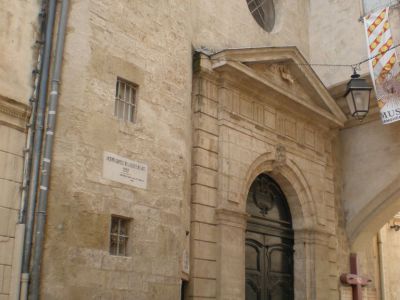
4) Chapel of the White Penitents
The Chapel of the White Penitents, also known as the Sainte-Foy Chapel, is a hidden gem of religious architecture in the heart of Montpellier. With origins dating back to the 12th century, the chapel was originally built along the Camin Roumieu, a key route for pilgrims heading to Saint James’ Way. It was once part of the Church of Saint Foy, dedicated to the 3rd-century virgin and martyr, Saint Foy. However, the original structure was destroyed in 1568 during the Wars of Religion, and the land was temporarily used as an open-air cemetery.
Reconstruction of the chapel began in 1624 after the Brotherhood of White Penitents acquired the site. Today, the chapel’s sleek facade, adorned with three classical stripes and a refined portal, serves as a modest introduction to the rich Baroque interior hidden behind its walls. Often referred to as the “Sistine of Languedoc” due to its magnificent painted ceiling and gold-colored wooden decorations, the chapel features intricate artwork that rivals the grandeur of more well-known European religious landmarks.
Although rarely open to the public, the Chapel of the White Penitents occasionally reveals its stunning interior, where visitors can admire the beautiful stained glass windows and remarkable acoustics. Currently undergoing a significant restoration project, this historic site continues to be a testament to the resilience and dedication of the White Penitents, who have safeguarded its legacy through centuries of turmoil and transformation.
Reconstruction of the chapel began in 1624 after the Brotherhood of White Penitents acquired the site. Today, the chapel’s sleek facade, adorned with three classical stripes and a refined portal, serves as a modest introduction to the rich Baroque interior hidden behind its walls. Often referred to as the “Sistine of Languedoc” due to its magnificent painted ceiling and gold-colored wooden decorations, the chapel features intricate artwork that rivals the grandeur of more well-known European religious landmarks.
Although rarely open to the public, the Chapel of the White Penitents occasionally reveals its stunning interior, where visitors can admire the beautiful stained glass windows and remarkable acoustics. Currently undergoing a significant restoration project, this historic site continues to be a testament to the resilience and dedication of the White Penitents, who have safeguarded its legacy through centuries of turmoil and transformation.
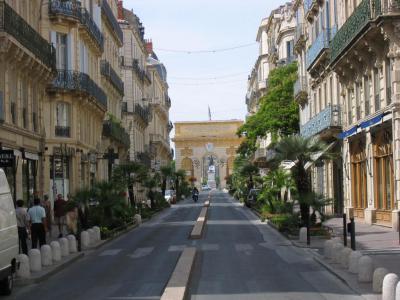
5) Rue Foch (Foch Street)
Foch Street was originally Peyrou Street, a commune road of Montpellier established in 1205 with the construction of the second fortification of the town. Known as a "cloture commune", it allowed access to the gate of the Rampart called the Gate of Peyrou.
Foch Street is a commercial artery in the town center. The street begins in the west by the Francois Franque Street, adjoining the promenade Peyrou. It passes over the Vialleton Bridge and under the Arch of Triumph. Cut by the the Square of the Martyrs of the Resistance, it ends in the east at the Needlework Street.
Following the urban renewal trends during the reign of Napoleon III in Paris, Montpellier also made Haussmannian adjustments and enlargements to some of its streets. So the Peyrou Street became the Imperial Street in 1864. During the Third Republic the name was changed again to National Street.
Ferdinand Foch was a French general and military theorist who served during World War I. Known for his aggressive military style, Foch became the Allied Commander-in-Chief in late March 1918 in the face of the all-out German spring offensive. He successfully coordinated the French, British and American troops into a coherent whole, stopped the German offensive and launched a war-winning counterattack.
One month after the death of Marshal Foch in 1929, the street was renamed to Foch Street.
Foch Street is a commercial artery in the town center. The street begins in the west by the Francois Franque Street, adjoining the promenade Peyrou. It passes over the Vialleton Bridge and under the Arch of Triumph. Cut by the the Square of the Martyrs of the Resistance, it ends in the east at the Needlework Street.
Following the urban renewal trends during the reign of Napoleon III in Paris, Montpellier also made Haussmannian adjustments and enlargements to some of its streets. So the Peyrou Street became the Imperial Street in 1864. During the Third Republic the name was changed again to National Street.
Ferdinand Foch was a French general and military theorist who served during World War I. Known for his aggressive military style, Foch became the Allied Commander-in-Chief in late March 1918 in the face of the all-out German spring offensive. He successfully coordinated the French, British and American troops into a coherent whole, stopped the German offensive and launched a war-winning counterattack.
One month after the death of Marshal Foch in 1929, the street was renamed to Foch Street.
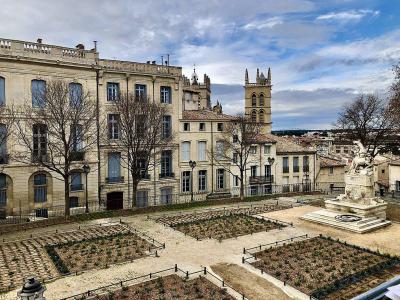
6) Place de la Canourgue (Canourgue Square)
Canourque Square is the oldest, most pleasant square in Montpellier. It was developed over the ruins of a church. It is located in the old city. It is bordered in the north by Saint Pierre Street, in the east by City Hall Street and in the south and west by Sainte-Croix Street.
In 1129, Guilhem VI, Lord of Montpellier, chose to build his palace and an oratory on the future site of the Canourgue Street. Guilhem placed a piece of the true cross in his oratory. The oratory was destroyed during the religious wars in 1562.
The Confraternity of White Penitents rebuilt the sanctuary. This chapel was also destroyed in another war of religion. The Penitents decided to place Guilhem's True Cross on a stone column instead and that was destroyed in 1791.
The Fountain of Unicorns, created in 1776, was transferred to the square in 1863. The sculptures on the fountain are struggling sea horses and unicorns and a human figure. The memorial is in honor of the Marquis de Castries for his victory in the Battle of Clostercamp in 1760.
Today the square is lined with buildings from the 17th century. The replacement for the stone column of the True Cross, destroyed in 1791, can be seen in the square.
In 1129, Guilhem VI, Lord of Montpellier, chose to build his palace and an oratory on the future site of the Canourgue Street. Guilhem placed a piece of the true cross in his oratory. The oratory was destroyed during the religious wars in 1562.
The Confraternity of White Penitents rebuilt the sanctuary. This chapel was also destroyed in another war of religion. The Penitents decided to place Guilhem's True Cross on a stone column instead and that was destroyed in 1791.
The Fountain of Unicorns, created in 1776, was transferred to the square in 1863. The sculptures on the fountain are struggling sea horses and unicorns and a human figure. The memorial is in honor of the Marquis de Castries for his victory in the Battle of Clostercamp in 1760.
Today the square is lined with buildings from the 17th century. The replacement for the stone column of the True Cross, destroyed in 1791, can be seen in the square.
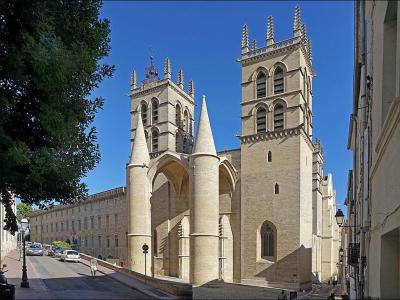
7) Montpellier Cathedral (must see)
Saint Peter's Cathedral is the enlargement of the former Benedictine convent chapel dedicated to Saints Benedict and Germain, founded by Pope Urban V in 1364. The chapel became a cathedral in 1536. The building is in the center of the old town. It is a Gothic style version of a medieval "fortress" cathedral.
Four imposing towers are set at the corners of the nave. Before the entrance is a great porch supported by two massive cylindrical pillars topped with inverted cone-shaped spires. The pillars are connected to the facade by a vaulted roof. The main entrance itself is flanked by two pilasters with conical tops.
The church is a single vessel with one nave. There are five bays harboring 14 side chapels. The chapels are dedicated to: Our Lady, Saints Germain, Victor, Cecilia, Martin, Catherine, Peter, Magdalene, Lazarus and Michael. We must also not overlook Saint Ursula and the eleven thousand virgins, the Holy Cross and Saint Blaise.
The high altar is veiled with a vermeil altarpiece. There are two sacristies, major and minor, containing books, relics, reliquaries and sacred vessels. There are relics of Saint Germain and Saint Blaise and Saint Benedict's silver arm.
In 1906 the cathedral was classified as a historical monument. In 2002, by decree of the Congregation of Bishops, it became a metropolitan cathedral.
Four imposing towers are set at the corners of the nave. Before the entrance is a great porch supported by two massive cylindrical pillars topped with inverted cone-shaped spires. The pillars are connected to the facade by a vaulted roof. The main entrance itself is flanked by two pilasters with conical tops.
The church is a single vessel with one nave. There are five bays harboring 14 side chapels. The chapels are dedicated to: Our Lady, Saints Germain, Victor, Cecilia, Martin, Catherine, Peter, Magdalene, Lazarus and Michael. We must also not overlook Saint Ursula and the eleven thousand virgins, the Holy Cross and Saint Blaise.
The high altar is veiled with a vermeil altarpiece. There are two sacristies, major and minor, containing books, relics, reliquaries and sacred vessels. There are relics of Saint Germain and Saint Blaise and Saint Benedict's silver arm.
In 1906 the cathedral was classified as a historical monument. In 2002, by decree of the Congregation of Bishops, it became a metropolitan cathedral.
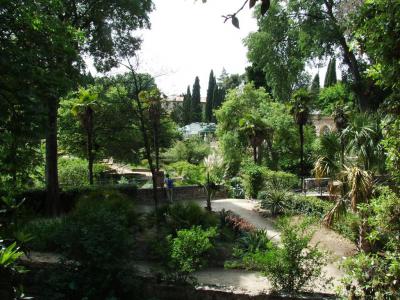
8) Plant Garden (must see)
The Plant Garden (Jardin des Plantes) in Montpellier, spanning 4.5 hectares, is a historic botanical garden and arboretum located on Boulevard Henri IV in Montpellier. As the oldest botanical garden in France, it was established in 1593 by royal decree from King Henri IV, under the direction of Pierre Richer de Belleval, a professor of botany and anatomy. The garden is inspired by the Orto Botanico di Padova in Italy, the world’s first university botanical garden, and later became the model for the Jardin des Plantes de Paris, created in 1626.
Initially designed to support the teaching of botany and the study of plants used in traditional medicine, the garden was almost destroyed during the siege of Montpellier in 1622 but was restored a few years later. Throughout the 19th century, it was further expanded and embellished. The orangery, designed by Claude-Mathieu Delagardette, was completed in 1804, while the arboretum, landscaped in 1810, features a diverse collection of old and rare trees. The English Garden, established in 1859, added a picturesque pond and greenhouse, and the Martins Greenhouse, a monumental structure, opened in 1860.
Today, the garden hosts around 2,680 plant species, including 500 native to the Mediterranean region. Of these, about 2,000 species thrive outdoors, while 1,000 grow under glass. The garden’s collection includes notable species such as a 400-year-old Phillyrea latifolia, a green olive tree in the family Oleaceae, and a mature Ginkgo biloba, planted in 1795 and later grafted to produce seeds for the first time in France.
Despite its historical significance, parts of the garden, including the orangery, are currently under renovation, and some sections show signs of neglect. However, the garden’s serene pathways, architectural ruins, and ancient trees offer visitors an enchanting experience, even in its less maintained state. Several "beautiful trees" are marked with information boards that describe their characteristics, adding an educational dimension to the visit. This historical and botanical gem continues to serve as a resource for botanical research and education, despite its current need for restoration and renewed support.
Initially designed to support the teaching of botany and the study of plants used in traditional medicine, the garden was almost destroyed during the siege of Montpellier in 1622 but was restored a few years later. Throughout the 19th century, it was further expanded and embellished. The orangery, designed by Claude-Mathieu Delagardette, was completed in 1804, while the arboretum, landscaped in 1810, features a diverse collection of old and rare trees. The English Garden, established in 1859, added a picturesque pond and greenhouse, and the Martins Greenhouse, a monumental structure, opened in 1860.
Today, the garden hosts around 2,680 plant species, including 500 native to the Mediterranean region. Of these, about 2,000 species thrive outdoors, while 1,000 grow under glass. The garden’s collection includes notable species such as a 400-year-old Phillyrea latifolia, a green olive tree in the family Oleaceae, and a mature Ginkgo biloba, planted in 1795 and later grafted to produce seeds for the first time in France.
Despite its historical significance, parts of the garden, including the orangery, are currently under renovation, and some sections show signs of neglect. However, the garden’s serene pathways, architectural ruins, and ancient trees offer visitors an enchanting experience, even in its less maintained state. Several "beautiful trees" are marked with information boards that describe their characteristics, adding an educational dimension to the visit. This historical and botanical gem continues to serve as a resource for botanical research and education, despite its current need for restoration and renewed support.
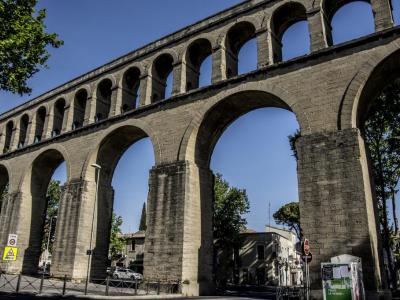
9) Montpellier Aqueduct
The Montpellier Aqueduct, also known as the Saint-Clément or Arceaux Aqueduct, is a monumental structure that stands as a testament to 18th-century engineering ingenuity. Constructed between 1753 and 1765, the aqueduct was designed to transport water from the Saint-Clément spring, located 14 kilometers (8.7 miles) away, to the water tower in Peyrou Park, a key landmark at the western end of Montpellier’s city center.
The aqueduct’s most striking feature is its double layer of arches in the middle section, inspired by traditional Roman aqueducts. With 53 arches stretching over 800 meters (2,600 feet), the structure showcases a harmonious blend of practicality and aesthetics, making it an iconic piece of Montpellier’s urban landscape.
Built using local Castries stone, the aqueduct’s channels were lined with lead to prevent freezing during winter months, ensuring a consistent water supply year-round. The completion of this ambitious project silenced skeptics who had doubted its feasibility, and it became one of the largest private hydraulic projects ever undertaken in France.
Today, visitors can walk beneath the arches and marvel at the aqueduct’s intricate design. A popular time to visit is on Sundays, when the area around the Les Arceaux tram stop transforms into a bustling flea market, providing a lively backdrop to the historic structure. Nearby attractions such as the Montpellier Plant Garden, the Atger Museum, and the Fabre Museum make this part of the city a vibrant hub for history and culture enthusiasts.
The Montpellier Aqueduct not only served a crucial role in providing water to the city but also stands as a symbol of the vision and perseverance of the people who built it, bringing a piece of history into the heart of modern-day Montpellier.
The aqueduct’s most striking feature is its double layer of arches in the middle section, inspired by traditional Roman aqueducts. With 53 arches stretching over 800 meters (2,600 feet), the structure showcases a harmonious blend of practicality and aesthetics, making it an iconic piece of Montpellier’s urban landscape.
Built using local Castries stone, the aqueduct’s channels were lined with lead to prevent freezing during winter months, ensuring a consistent water supply year-round. The completion of this ambitious project silenced skeptics who had doubted its feasibility, and it became one of the largest private hydraulic projects ever undertaken in France.
Today, visitors can walk beneath the arches and marvel at the aqueduct’s intricate design. A popular time to visit is on Sundays, when the area around the Les Arceaux tram stop transforms into a bustling flea market, providing a lively backdrop to the historic structure. Nearby attractions such as the Montpellier Plant Garden, the Atger Museum, and the Fabre Museum make this part of the city a vibrant hub for history and culture enthusiasts.
The Montpellier Aqueduct not only served a crucial role in providing water to the city but also stands as a symbol of the vision and perseverance of the people who built it, bringing a piece of history into the heart of modern-day Montpellier.
10) Promenade du Peyrou (Peyrou Promenade) (must see)
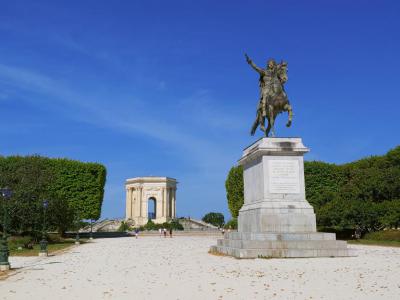
At the edge of the old town the city, is the Peyrou Promenade. The Triumph Arch honoring Louis XIV is here. There is also a statue of Louis on horseback erected in 1718. And close by is the neoclassical water tower and the 18th century aqueduct, reaching 14 kilometers to the Saint Clement spring.
The park dates from 1774, when Louis ascended the throne of France. It was designed and laid out by architect Jean Giral. Visitors to the park are rewarded with a panoramic view of the city and its surroundings. The Aqueduct of Saint Clement and its reservoir date from 1753. The cistern, called the Water Castle, was added in 1766.
There are the statues of children and a Lion by sculptor Injalbert of 1883. In 1927 a walk-in annualized sun dial was installed by Pierre Humbert. The promenade is 953 feet long and 529 feet in width. It has four entrances, three on the east side and one above the stairs on the west side. The main entrance is on the Francois Frank Street.
The park dates from 1774, when Louis ascended the throne of France. It was designed and laid out by architect Jean Giral. Visitors to the park are rewarded with a panoramic view of the city and its surroundings. The Aqueduct of Saint Clement and its reservoir date from 1753. The cistern, called the Water Castle, was added in 1766.
There are the statues of children and a Lion by sculptor Injalbert of 1883. In 1927 a walk-in annualized sun dial was installed by Pierre Humbert. The promenade is 953 feet long and 529 feet in width. It has four entrances, three on the east side and one above the stairs on the west side. The main entrance is on the Francois Frank Street.
11) Porte du Peyrou (Gate of Peyrou)
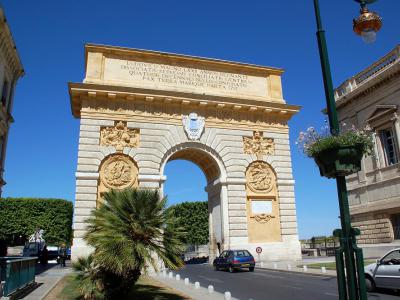
The Gate of Peyrou, also called Triumphal Arch, can be found at the east end of the Peyou Park gardens in the center of Montpellier. It is almost fifty feet high and 59 feet wide. It was built in 1693 and designed by Francois Dorbay. Dorbay was perhaps inspired by the Parisian arch, the Gate of Dionysius, or even the Gate of Saint-Martin.
The Gate of Peyrou was dedicated to King Louis XIV, the "Sun King" of France. The Gate marks the entrance to the Royal Palace of Peyrou. It is within walking distance of the Saint-Clement Aqueduct offering a great view of the eastern part of the city.
The different stations of progress in King Louis XIV's reign are set into the facade of the arch. The shield and badge of the city of Montpellier are fixed at the top of the arch. There is a climb of 88 steps to the top of the Triumphal Arch. Every Sunday there is a flea market in the nearby Peyrou Square. One can shop here and think of the King.
The Gate of Peyrou was dedicated to King Louis XIV, the "Sun King" of France. The Gate marks the entrance to the Royal Palace of Peyrou. It is within walking distance of the Saint-Clement Aqueduct offering a great view of the eastern part of the city.
The different stations of progress in King Louis XIV's reign are set into the facade of the arch. The shield and badge of the city of Montpellier are fixed at the top of the arch. There is a climb of 88 steps to the top of the Triumphal Arch. Every Sunday there is a flea market in the nearby Peyrou Square. One can shop here and think of the King.
12) Church of Saint Anne & Carre Saint Anne Gallery
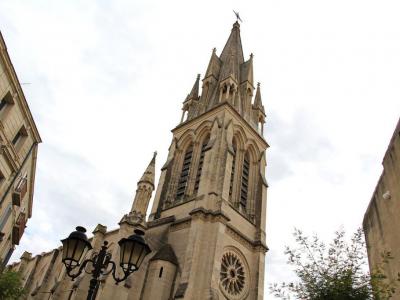
The Church of Saint Anne, one of Montpellier's most striking landmarks, captivates with its towering 68-meter steeple, making it the tallest edifice in the city. Built between 1866 and 1869 by architect Jules Cassan, who also designed the Saint Roch Church, this neo-Gothic marvel stands on the site of a former 12th-century church. Its ornate façade and impressive height make it a visible point of reference across the city's skyline.
Although inaugurated relatively recently in 1869, the church was deconsecrated in the 1980s and has since taken on a new life as a contemporary art space known as the Carré Sainte Anne Gallery. Transformed in 2011 into a premier venue for modern artistic expression, the gallery now hosts an array of exhibitions featuring contemporary art from both local and international artists. Over the years, the space has exhibited works by renowned artists such as Desgrandchamps, Garouste, and Di Rosa, among others.
Located in the oldest square of Montpellier, Place Sainte Anne, the gallery is surrounded by charming medieval buildings and offers a Bohemian atmosphere perfect for strolling and discovering art. The square itself is a hub of life, with numerous terraces, cafés, and restaurants, making it a popular spot for locals and visitors alike. In the summer, the open-air music festival "Nuits de Sainte Anne" brings additional vibrancy to this already lively area.
The juxtaposition of the church's stunning neo-Gothic exterior and its cutting-edge contemporary exhibitions inside creates a dynamic contrast, reflecting the blend of antiquity and modernity that characterizes Montpellier today. With its diverse and avant-garde artistic programming, Carré Sainte Anne has established itself as a vital cultural venue in the region.
Although inaugurated relatively recently in 1869, the church was deconsecrated in the 1980s and has since taken on a new life as a contemporary art space known as the Carré Sainte Anne Gallery. Transformed in 2011 into a premier venue for modern artistic expression, the gallery now hosts an array of exhibitions featuring contemporary art from both local and international artists. Over the years, the space has exhibited works by renowned artists such as Desgrandchamps, Garouste, and Di Rosa, among others.
Located in the oldest square of Montpellier, Place Sainte Anne, the gallery is surrounded by charming medieval buildings and offers a Bohemian atmosphere perfect for strolling and discovering art. The square itself is a hub of life, with numerous terraces, cafés, and restaurants, making it a popular spot for locals and visitors alike. In the summer, the open-air music festival "Nuits de Sainte Anne" brings additional vibrancy to this already lively area.
The juxtaposition of the church's stunning neo-Gothic exterior and its cutting-edge contemporary exhibitions inside creates a dynamic contrast, reflecting the blend of antiquity and modernity that characterizes Montpellier today. With its diverse and avant-garde artistic programming, Carré Sainte Anne has established itself as a vital cultural venue in the region.
13) Saint Roch Church
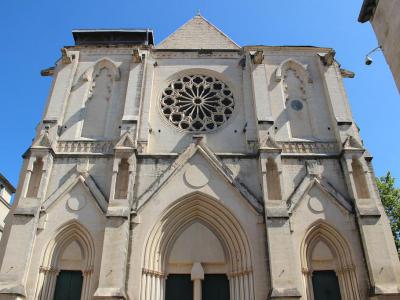
The Saint Roch Church, also known as the Saint Roch Sanctuary, is a prominent neo-Gothic style church situated in the heart of Montpellier. It was built in the 19th century and dedicated to Saint Roch, the city’s most venerated saint, who is recognized as the patron of plague victims and pilgrims. According to legend, Saint Roch was born in Montpellier, making the church a key landmark in his hometown.
The design of the church was inspired by a variety of architectural styles and structures, including the Abbey of Valmagne in Hérault, the Church of Notre-Dame-en-Vaux in Châlons-en-Champagne, and the Church of Notre-Dame de Belleville. The building features a rib-vaulted nave and two side aisles, with its proportions and height reminiscent of the Abbey of Valmagne. However, the construction of the church remained incomplete. Though the nave, aisles, and choir were built, the intended spires, statues, and bas-reliefs that were to adorn the façade were never realized, leaving the exterior relatively unembellished.
The current Saint Roch Church stands on the site of the former Saint-Paul Church, which was destroyed in 1622 during the siege of Montpellier. The project to build the new church began in 1860, led by architect J. Cassan and funded by local contributions. Despite its unfinished state, the church remains a significant religious site and is classified as a diocesan shrine by the Diocese of Montpellier.
The church is notable for its large marble statue of Saint Roch, as well as for two beautifully crafted stained glass windows representing Saint Paul and Saint Roch, which were installed during its renovation. Every year, the church hosts a pilgrimage on August 16th to commemorate the death of Saint Roch, during the Fête de la Saint Roch. This festival includes religious ceremonies, parades, animal blessings, and music, reflecting the enduring legacy of the saint in his native city.
The design of the church was inspired by a variety of architectural styles and structures, including the Abbey of Valmagne in Hérault, the Church of Notre-Dame-en-Vaux in Châlons-en-Champagne, and the Church of Notre-Dame de Belleville. The building features a rib-vaulted nave and two side aisles, with its proportions and height reminiscent of the Abbey of Valmagne. However, the construction of the church remained incomplete. Though the nave, aisles, and choir were built, the intended spires, statues, and bas-reliefs that were to adorn the façade were never realized, leaving the exterior relatively unembellished.
The current Saint Roch Church stands on the site of the former Saint-Paul Church, which was destroyed in 1622 during the siege of Montpellier. The project to build the new church began in 1860, led by architect J. Cassan and funded by local contributions. Despite its unfinished state, the church remains a significant religious site and is classified as a diocesan shrine by the Diocese of Montpellier.
The church is notable for its large marble statue of Saint Roch, as well as for two beautifully crafted stained glass windows representing Saint Paul and Saint Roch, which were installed during its renovation. Every year, the church hosts a pilgrimage on August 16th to commemorate the death of Saint Roch, during the Fête de la Saint Roch. This festival includes religious ceremonies, parades, animal blessings, and music, reflecting the enduring legacy of the saint in his native city.
14) Mural at Saint Roch Square
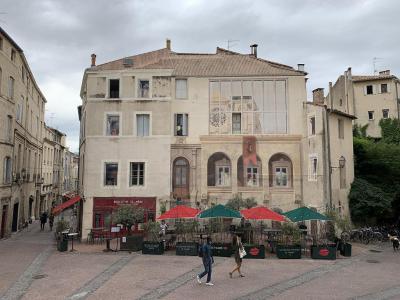
At first glance, the mural at Saint Roch Square may not seem like a mural at all. The Trompe-l'oeil technique used deceives the eye to create the appearance of realism in what is actually a fresco. This mural shows a reflection of the Saint Roch Church along with the facade of a cafe.
With so many cafes and terraces in the neighborhood, the mural artfully copies everyday life near Saint Roch Church. The optical illusion of the mural makes it appear three dimensional. This mural was created by Agnes and Olivier Costa. Their team, Mad'Art Concept, used a 300-square-meter wall with only one window to break up the blank space as their canvas.
Along with the cafe and the reflection of the church, the Costas referenced the history of Montpellier by including the shells of Saint-Jacques de Compostelle, an image of a dog with bread in its mouth and a medicine jar.
With so many cafes and terraces in the neighborhood, the mural artfully copies everyday life near Saint Roch Church. The optical illusion of the mural makes it appear three dimensional. This mural was created by Agnes and Olivier Costa. Their team, Mad'Art Concept, used a 300-square-meter wall with only one window to break up the blank space as their canvas.
Along with the cafe and the reflection of the church, the Costas referenced the history of Montpellier by including the shells of Saint-Jacques de Compostelle, an image of a dog with bread in its mouth and a medicine jar.
15) Tower of Babotte
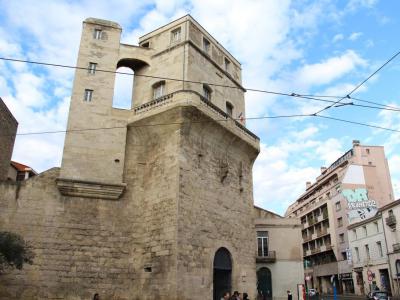
The Tower of Babotte, a striking remnant of Montpellier's 12th-century fortifications, stands as a testament to the city’s rich history and scientific heritage. Originally constructed as part of the Medieval walls surrounding the L’Ecusson district, the tower was repurposed in 1745 when the States of Languedoc established an observatory on its foundation. The building quickly became a hub for scientific exploration, under the auspices of the Academy of Sciences and later the Royal Society of Sciences.
One of the more intriguing stories associated with the tower is that of Sébastien Lenormand, the supposed inventor of the parachute. Legend has it that on December 26, 1783, he tested his invention by leaping from the top of the Tower of Babotte-a bold act that captured the public’s imagination and remains part of the site’s lore.
In 1832, the tower shifted from its astronomical role and was taken over by the telegraph department. Today, the Tower of Babotte is home to the Federation of Popular Amateur Astronomy, continuing its legacy as a place for stargazing and scientific inquiry.
Standing at 26 meters tall, the tower offers a unique vantage point over Montpellier’s historical center, with views of landmarks such as the Triumphal Arch, Saint Peter’s Cathedral, and the modern Arbre Blanc building. As one of the two surviving towers from the original city walls, it is an essential piece of Montpellier’s architectural and cultural landscape, open to visitors who wish to explore its storied past and gaze at the stars through guided tours like “The Tower of Babotte: Higher Towards the Stars.”
One of the more intriguing stories associated with the tower is that of Sébastien Lenormand, the supposed inventor of the parachute. Legend has it that on December 26, 1783, he tested his invention by leaping from the top of the Tower of Babotte-a bold act that captured the public’s imagination and remains part of the site’s lore.
In 1832, the tower shifted from its astronomical role and was taken over by the telegraph department. Today, the Tower of Babotte is home to the Federation of Popular Amateur Astronomy, continuing its legacy as a place for stargazing and scientific inquiry.
Standing at 26 meters tall, the tower offers a unique vantage point over Montpellier’s historical center, with views of landmarks such as the Triumphal Arch, Saint Peter’s Cathedral, and the modern Arbre Blanc building. As one of the two surviving towers from the original city walls, it is an essential piece of Montpellier’s architectural and cultural landscape, open to visitors who wish to explore its storied past and gaze at the stars through guided tours like “The Tower of Babotte: Higher Towards the Stars.”
16) National Opera
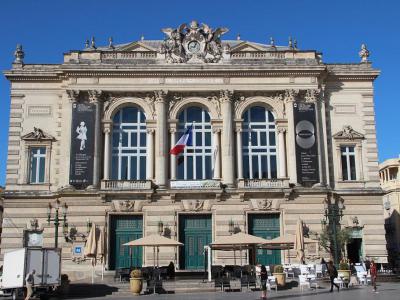
The National Opera of Montpellier is a distinguished cultural institution situated in the heart of Comedy Square (Place de la Comédie) in Montpellier. Originally established in 1755, it received the esteemed status of "National Opera" in 2002 by the French Ministry of Culture, underscoring its importance in the national cultural landscape. The opera company performs in two main venues: the Opéra Comédie and the Opéra Berlioz.
The Opéra Comédie, designed by Joseph Marie Cassien Bernard, opened its doors on October 1, 1888. Built in the Italian style, this elegant venue boasts a 1,200-seat main auditorium and the 350-seat Salle Molière concert hall. The interior of the opera house, noted for its Second Empire-style decor, features intricate gilding, lavish sculptures, and grand paintings. Among its highlights is the original Statue of the Three Graces, sculpted by Etienne Dantoine in 1777. A grand double marble staircase leads up to the Grand Foyer, creating a sense of grandeur and elegance typical of its era. The building was classified as a historic monument in September 2020, cementing its status as one of Montpellier's most important architectural landmarks.
The Opéra Berlioz, housed within the Le Corum arts complex, was inaugurated in 1990 with a performance of Les Huguenots, the same opera that marked the opening of the Opéra Comédie 102 years earlier. With a seating capacity of 2,000, the venue is designed for large-scale productions, particularly those in the symphonic and lyrical genres. Its unique design features pink granite walls and a movable wooden ceiling, enhancing both aesthetics and acoustics. The Opéra Berlioz quickly became a prominent venue for contemporary and classical performances, including the works of Richard Wagner.
The dual venues of Opéra Comédie and Opéra Berlioz serve as key cultural hubs for the city, hosting a variety of performances including opera, ballet, and theatre. As such, the National Opera of Montpellier continues to play a pivotal role in the city’s cultural life, attracting both local audiences and international visitors.
The Opéra Comédie, designed by Joseph Marie Cassien Bernard, opened its doors on October 1, 1888. Built in the Italian style, this elegant venue boasts a 1,200-seat main auditorium and the 350-seat Salle Molière concert hall. The interior of the opera house, noted for its Second Empire-style decor, features intricate gilding, lavish sculptures, and grand paintings. Among its highlights is the original Statue of the Three Graces, sculpted by Etienne Dantoine in 1777. A grand double marble staircase leads up to the Grand Foyer, creating a sense of grandeur and elegance typical of its era. The building was classified as a historic monument in September 2020, cementing its status as one of Montpellier's most important architectural landmarks.
The Opéra Berlioz, housed within the Le Corum arts complex, was inaugurated in 1990 with a performance of Les Huguenots, the same opera that marked the opening of the Opéra Comédie 102 years earlier. With a seating capacity of 2,000, the venue is designed for large-scale productions, particularly those in the symphonic and lyrical genres. Its unique design features pink granite walls and a movable wooden ceiling, enhancing both aesthetics and acoustics. The Opéra Berlioz quickly became a prominent venue for contemporary and classical performances, including the works of Richard Wagner.
The dual venues of Opéra Comédie and Opéra Berlioz serve as key cultural hubs for the city, hosting a variety of performances including opera, ballet, and theatre. As such, the National Opera of Montpellier continues to play a pivotal role in the city’s cultural life, attracting both local audiences and international visitors.
