Custom Walk in Lille, France by emilytearle_6a9fdb created on 2026-03-25
Guide Location: France » Lille
Guide Type: Custom Walk
# of Sights: 9
Tour Duration: 1 Hour(s)
Travel Distance: 1.5 Km or 0.9 Miles
Share Key: XKKXQ
Guide Type: Custom Walk
# of Sights: 9
Tour Duration: 1 Hour(s)
Travel Distance: 1.5 Km or 0.9 Miles
Share Key: XKKXQ
How It Works
Please retrieve this walk in the GPSmyCity app. Once done, the app will guide you from one tour stop to the next as if you had a personal tour guide. If you created the walk on this website or come to the page via a link, please follow the instructions below to retrieve the walk in the app.
Retrieve This Walk in App
Step 1. Download the app "GPSmyCity: Walks in 1K+ Cities" on Apple App Store or Google Play Store.



Step 2. In the GPSmyCity app, download(or launch) the guide "Lille Map and Walking Tours".
Step 3. Tap the menu button located at upper right corner of the "Walks" screen and select "Retrieve custom walk". Enter the share key: XKKXQ
1) Église Sainte-Catherine (St. Catherine Church)
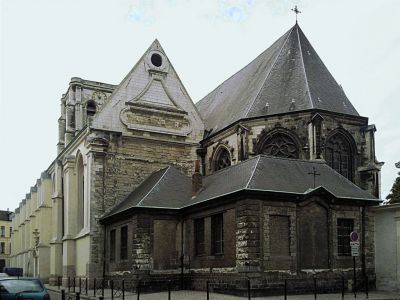
In the center of the Old Lille district is Saint Catherine Church, dedicated to Saint Catherine of Alexandria. It was built in the thirteenth century. It is constructed as a "Hallekerk", a church laid out like a hall in the old Flemish tradition. It is the oldest parish church in the city.
Although it appears in a lush Gothic style, it is all on one level with three naves and one transept. The bell tower is squat and stolid. It is a dominating figure and it holds the oldest bell in the city. The tower served as an optical telegraph station in the 18th century. On the north wall were reclusoirs, cells for pious meditation.
Inside the church there is much to admire. There is carved wooden furniture from the 1800s and paintings of Saint Mathieu, Saint John the Evangelist, and Saints Mark and Luke by artist Victor Mottez. Most admirable is the stained glass window showing the Triumph of Saint Catherine and the paneled cradles of the ceiling.
The church was classified as an Historical Monument in August 1991.
Although it appears in a lush Gothic style, it is all on one level with three naves and one transept. The bell tower is squat and stolid. It is a dominating figure and it holds the oldest bell in the city. The tower served as an optical telegraph station in the 18th century. On the north wall were reclusoirs, cells for pious meditation.
Inside the church there is much to admire. There is carved wooden furniture from the 1800s and paintings of Saint Mathieu, Saint John the Evangelist, and Saints Mark and Luke by artist Victor Mottez. Most admirable is the stained glass window showing the Triumph of Saint Catherine and the paneled cradles of the ceiling.
The church was classified as an Historical Monument in August 1991.
2) Place aux Oignons (Onions Square)
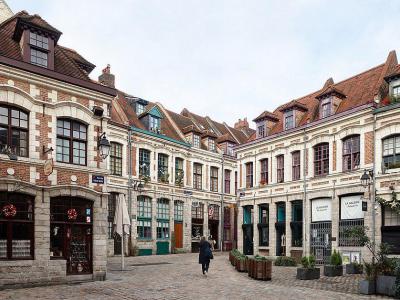
Looking for onions? You won't necessarily find a sack of onions in Onions Square. The site of the square once held the fortress of the counts of Flanders. In the fortress was a keep, a strong place, called dominium. That is all gone now, but the locals corrupted the word, dominium, into "Ognions."
The square is lined with houses dating from the 17th and 18th centuries. The houses on the square originally were homes for artisan weavers. The weavers used the attics and cellars as workshops if conditions of humidity were acceptable. In the eighteenth century the houses became living quarters for factory workers and their families.
The neighborhood was not known for its sanitation or habitability. In 1945, George d'Orgeville, a novelist, described the square as a "district of misfortune...lined with hovels which are falling apart..." Living conditions were deplorable by today's standards. Six or seven families were often sharing one water tap and a toilet.
Buildings were dilapidated. In 1976 reinforcing work was begun prior to restoration. Between 1985 and 1990 all buildings on the square were partially or completely rebuilt. Since the year 2000, the square has become a draw for tourists. The square is now a pedestrian area surrounded by restaurants and cafes.
The square is lined with houses dating from the 17th and 18th centuries. The houses on the square originally were homes for artisan weavers. The weavers used the attics and cellars as workshops if conditions of humidity were acceptable. In the eighteenth century the houses became living quarters for factory workers and their families.
The neighborhood was not known for its sanitation or habitability. In 1945, George d'Orgeville, a novelist, described the square as a "district of misfortune...lined with hovels which are falling apart..." Living conditions were deplorable by today's standards. Six or seven families were often sharing one water tap and a toilet.
Buildings were dilapidated. In 1976 reinforcing work was begun prior to restoration. Between 1985 and 1990 all buildings on the square were partially or completely rebuilt. Since the year 2000, the square has become a draw for tourists. The square is now a pedestrian area surrounded by restaurants and cafes.
3) Hospice Comtesse Museum
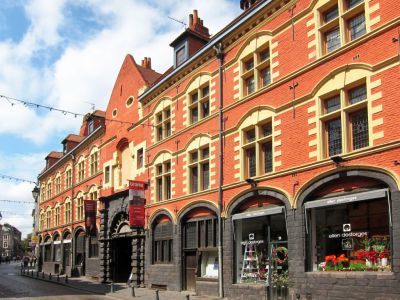
In the middle of the old town of Lille, on the cobbled street, Money Street (rue de la Monnaie), there is a museum like no other. Behind imposing wooden doors is the Hospice Comtesse Museum. Pass through the doors and discover a museum consisting of different buildings and courtyards laid out like a medieval convent.
The museum was once a hospital founded in 1237 by Jeanne, Comtesse of Flanders. The Comtesse established the hospital within her own palace walls. The mission of the hospital was to care for the sick and the poor and to be a haven for pilgrims on their way to Rome and Compostela. It fulfilled its mission until 1939.
The museum is made up of buildings dating from the 15th, 17th and 18th centuries. There is a former hospital ward with a paneled vault ceiling. The chapel is adorned with the coats-of-arms of titled donors. Other buildings belonged to a community of Augustine nuns. All were arranged around a couple of courtyards and a garden of medicinal herbs.
Since 1962 the building has operated as museum. The collections include paintings, wood sculptures, tapestries and porcelain drawn from the area. The overall ambience is of a Flemish convent of the 1600s.
The museum was once a hospital founded in 1237 by Jeanne, Comtesse of Flanders. The Comtesse established the hospital within her own palace walls. The mission of the hospital was to care for the sick and the poor and to be a haven for pilgrims on their way to Rome and Compostela. It fulfilled its mission until 1939.
The museum is made up of buildings dating from the 15th, 17th and 18th centuries. There is a former hospital ward with a paneled vault ceiling. The chapel is adorned with the coats-of-arms of titled donors. Other buildings belonged to a community of Augustine nuns. All were arranged around a couple of courtyards and a garden of medicinal herbs.
Since 1962 the building has operated as museum. The collections include paintings, wood sculptures, tapestries and porcelain drawn from the area. The overall ambience is of a Flemish convent of the 1600s.
4) Lille Cathedral (must see)
The miraculous statue of the Virgin Mary of the Trellis made its home in the Collegiate Church of Saint Peter from the 13th century until 1792. The gilded iron trellis wrapped around the statue was lost in the upheavals of the French Revolution. The statue was recovered and placed in the church of Saint Catherine, its iron trellis replaced with a wooden one.
In 1853 Charles-Kolb Bernard and his cousin formed a commission to build a fabulous new church in honor of Our Lady of the Treille. Land in the center of Lille was set aside for the construction. The 13th century Gothic styles shown by the cathedrals in Reims, Amiens and Chartres were pressed on the architects and builders.
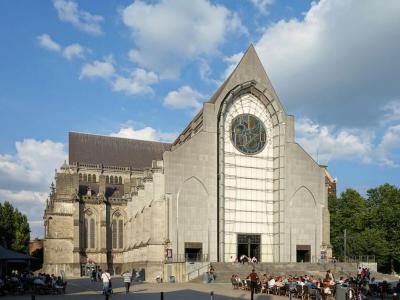
At first the task was intimidating. It called for a building 433 feet long and spires reaching to 377 feet. The proportions were too large, the budget too small. The cathedral's main facade was not completed until the 1990s. The center is made of an ogive 96 feet high faced with 110 sheets of thick white marble.
A rose window dedicated to the Resurrection is by Ladislas Kijno. The main iron doorway was created by Georges Jeanclos. It is an enormous neo-Gothic building with a bold modern facade designed by architects Pierre-Louis Carlier and Peter Rice. In addition to services, the cathedral hosts concerts and it has a Sacred Art Center in its crypt.
The Cathedral is open all year. Guided tours are available.
In 1853 Charles-Kolb Bernard and his cousin formed a commission to build a fabulous new church in honor of Our Lady of the Treille. Land in the center of Lille was set aside for the construction. The 13th century Gothic styles shown by the cathedrals in Reims, Amiens and Chartres were pressed on the architects and builders.
At first the task was intimidating. It called for a building 433 feet long and spires reaching to 377 feet. The proportions were too large, the budget too small. The cathedral's main facade was not completed until the 1990s. The center is made of an ogive 96 feet high faced with 110 sheets of thick white marble.
A rose window dedicated to the Resurrection is by Ladislas Kijno. The main iron doorway was created by Georges Jeanclos. It is an enormous neo-Gothic building with a bold modern facade designed by architects Pierre-Louis Carlier and Peter Rice. In addition to services, the cathedral hosts concerts and it has a Sacred Art Center in its crypt.
The Cathedral is open all year. Guided tours are available.
5) Chambre de Commerce (Chamber of Commerce)
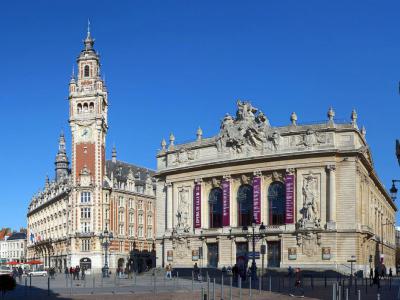
The Chamber of Commerce (Chambre de Commerce) in Lille housed within the Nouvelle Bourse building, stands as a prominent architectural and historical landmark. Constructed over 11 years from 1910 to 1921, it is situated directly across from the Old Stock Exchange (Vieille Bourse) on the Theater Square (Place du Théâtre). Designed by architect Louis Marie Cordonnier, the New Stock Exchange (Nouvelle Bourse) was intended to serve as the headquarters for the Chamber of Commerce and Industry of Greater Lille, an institution that was founded in 1715.
Architecturally, the building exemplifies Neo-Flemish style, drawing inspiration from the grand Dutch town halls of the past. This style is apparent in its rich decorative elements, including plant motifs and scrolls reminiscent of 17th-century Lille. One of the most striking features of the building is its 76-meter-high belfry, adorned with a four-dial clock and an automated carillon that includes 26 bells weighing a total of 2000 kg, cast in 1984 by Luigi Bergamo of the Cornille-Havard foundry.
The interior of the building is equally impressive, with a 25x25-meter hall of honor that boasts colonnaded galleries and a 17-meter high dome, lavishly decorated with exquisite frescoes. The building also houses several important rooms used for various functions, including a 300-seat auditorium known as the Descamps room, Reception rooms, the Sessions room, and the Committee room or the Kuhlmann office, which are also richly decorated with frescoes and woodwork.
In recognition of its architectural and historical significance, the Chamber of Commerce and Industry building was listed as a historic monument in 2015. This designation underscores its importance not only as a center of commerce and industry but also as a key part of Lille’s cultural and historical heritage.
Architecturally, the building exemplifies Neo-Flemish style, drawing inspiration from the grand Dutch town halls of the past. This style is apparent in its rich decorative elements, including plant motifs and scrolls reminiscent of 17th-century Lille. One of the most striking features of the building is its 76-meter-high belfry, adorned with a four-dial clock and an automated carillon that includes 26 bells weighing a total of 2000 kg, cast in 1984 by Luigi Bergamo of the Cornille-Havard foundry.
The interior of the building is equally impressive, with a 25x25-meter hall of honor that boasts colonnaded galleries and a 17-meter high dome, lavishly decorated with exquisite frescoes. The building also houses several important rooms used for various functions, including a 300-seat auditorium known as the Descamps room, Reception rooms, the Sessions room, and the Committee room or the Kuhlmann office, which are also richly decorated with frescoes and woodwork.
In recognition of its architectural and historical significance, the Chamber of Commerce and Industry building was listed as a historic monument in 2015. This designation underscores its importance not only as a center of commerce and industry but also as a key part of Lille’s cultural and historical heritage.
6) Opéra de Lille (Lille Opera)
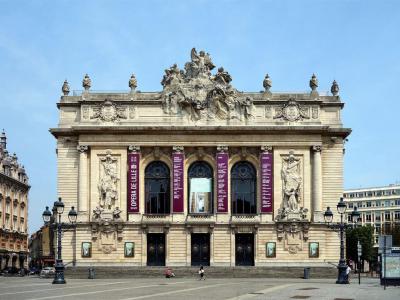
The Lille Opera (Opéra de Lille) is an example of Neoclassical architecture, seamlessly integrated with the adjacent Chamber of Commerce and Old Stock Exchange. The current structure was erected from 1907 to 1913 after its predecessor, dating back to 1785, was destroyed by fire in 1903.
The design of the new opera house was the vision of architect Louis Marie Cordonnier, selected through a competitive process. His Belle Époque style is evident in the building's grand façade, which features an elaborate pediment relief crafted by Hippolyte Lefèbvre. This is complemented by two bas-relief panels on either side, created by Alphonse-Amédée Cordonnier and Hector Lemaire. The interior of the opera house is equally striking, showcasing the artistic contributions of the prominent sculptor Edgar-Henri Boutry.
However, the building's completion was marred by the events of World War I. In July 1914, German forces occupying Lille requisitioned the still unfinished opera house, stripping it of its furniture and equipment to outfit the local Sebastopol Theatre. It wasn't until after the war that the opera house was fully restored, reopening in 1923 as the Grand Theatre. This reopening was celebrated with a French premiere (première française), marking a new chapter in its history.
The theatre again faced challenges in 1998 when it was forced to close mid-season due to deteriorating physical conditions. This closure led to an extensive renovation project aimed not only at restoring the building but also at enhancing its functional capacities. The renovation was completed in 2004, coinciding with Lille's designation as the European Capital of Culture, thus affirming the Opéra de Lille's status as a cultural and architectural landmark in the region.
The design of the new opera house was the vision of architect Louis Marie Cordonnier, selected through a competitive process. His Belle Époque style is evident in the building's grand façade, which features an elaborate pediment relief crafted by Hippolyte Lefèbvre. This is complemented by two bas-relief panels on either side, created by Alphonse-Amédée Cordonnier and Hector Lemaire. The interior of the opera house is equally striking, showcasing the artistic contributions of the prominent sculptor Edgar-Henri Boutry.
However, the building's completion was marred by the events of World War I. In July 1914, German forces occupying Lille requisitioned the still unfinished opera house, stripping it of its furniture and equipment to outfit the local Sebastopol Theatre. It wasn't until after the war that the opera house was fully restored, reopening in 1923 as the Grand Theatre. This reopening was celebrated with a French premiere (première française), marking a new chapter in its history.
The theatre again faced challenges in 1998 when it was forced to close mid-season due to deteriorating physical conditions. This closure led to an extensive renovation project aimed not only at restoring the building but also at enhancing its functional capacities. The renovation was completed in 2004, coinciding with Lille's designation as the European Capital of Culture, thus affirming the Opéra de Lille's status as a cultural and architectural landmark in the region.
7) Vieille Bourse (Old Stock Exchange) (must see)
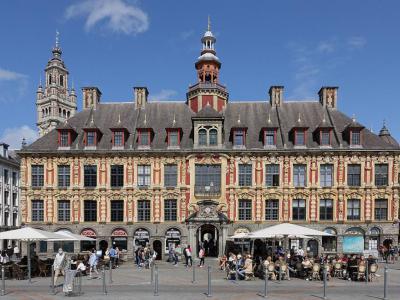
Julien Destree was a master cabinet maker and architect in the city of Lille in 1651. The city had obtained from King Philip IV of Spain a license to build an exchange (bourse) for the merchants of the city. Julien Destree was the man to make it happen. He was determined to create a great monument to commerce to rival the one in Antwerp.
The King had authorized "an exchange...surrounded and encloses 24 houses." Twenty-four plots of land around the market square were sold to traders. Construction of the galleries, paving the courtyard and the four entrances were undertaken by the city. Construction took place under the direction of Julien Destree from 1652-1653.
The building shows a Renaissance Flemish influence prevalent in the 17th century. Piers and columns richly adorned with garlands and horns of plenty are a paen to the commerce of Lille. At the top of the bell tower stands a golden image of the god, Mercury. Lille was in fierce competition with her sister cities, Antwerp, Ghent, and Bruges.
In 1861 the stock exchange opened for business. It was a very modest exchange, not trading much more than 3% of its capital. In 1921 the new stock exchange building, the Chamber of Commerce, was opened. The Old Stock Exchange was indeed the "old" stock exchange.
The Old Stock Exchange is situated by the Main Square and the Theatre Square. It is an important landmark of the center of the city. It consists of a quadrangle of 24 look-alike houses surrounding a large courtyard. The courtyard today is a gathering venue for book stalls, florists, chess players, tourists and visitors.
The Old Stock Exchange can be reached by the Rihour metro station.
Why You Should Visit:
The old building sells a lot of things. Old books, coins, etc. The courtyard hosts games and bookstalls. The building itself is like a voyage back in time.
The King had authorized "an exchange...surrounded and encloses 24 houses." Twenty-four plots of land around the market square were sold to traders. Construction of the galleries, paving the courtyard and the four entrances were undertaken by the city. Construction took place under the direction of Julien Destree from 1652-1653.
The building shows a Renaissance Flemish influence prevalent in the 17th century. Piers and columns richly adorned with garlands and horns of plenty are a paen to the commerce of Lille. At the top of the bell tower stands a golden image of the god, Mercury. Lille was in fierce competition with her sister cities, Antwerp, Ghent, and Bruges.
In 1861 the stock exchange opened for business. It was a very modest exchange, not trading much more than 3% of its capital. In 1921 the new stock exchange building, the Chamber of Commerce, was opened. The Old Stock Exchange was indeed the "old" stock exchange.
The Old Stock Exchange is situated by the Main Square and the Theatre Square. It is an important landmark of the center of the city. It consists of a quadrangle of 24 look-alike houses surrounding a large courtyard. The courtyard today is a gathering venue for book stalls, florists, chess players, tourists and visitors.
The Old Stock Exchange can be reached by the Rihour metro station.
Why You Should Visit:
The old building sells a lot of things. Old books, coins, etc. The courtyard hosts games and bookstalls. The building itself is like a voyage back in time.
8) Grande Place (Main Square) (must see)
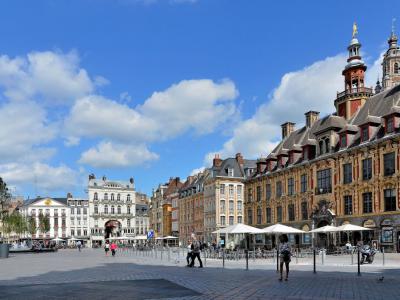
The Main Square of Lille was officially called "General de Gaulle Square" at the end of World War II. Among the good people of Lille however, it is often referred to as "The Main Square" As with New York, the Avenue of the Americas is "Sixth Avenue." Whatever it might be called, it is still the Main Square of the city.
In 1066 the area of the Main Square was referred to as the "forum." The forum was declared a market square. The ground was drained, leveled and paved and voila! A market square. In the 17th century, the Commodity Exchange divided the Square into the Main Square and the Little Square.
The Place du General-de-Gaulle assumes the role of Main Square. Oops, it is also referred to as "Place de la Decesse." Let us declare for Grand Place or Main Square. Today it is a venue for events and business exchanges. It is the traditional location for Lille book clearance sales, a major event.
The square is surrounded by a number of buildings. They include the Theatre of the North and the Old Stock Exchange (no longer the commercial exchange). In the center of the Main Square is the awesome "Column of the Goddess", memorializing the siege of Lille in 1792.
The square is paved in a checks of blue and pink granite. It is partially pedestrianized. It can be reached by metro first line Rihour station. There is also an underground car park with 342 spaces.
In 1066 the area of the Main Square was referred to as the "forum." The forum was declared a market square. The ground was drained, leveled and paved and voila! A market square. In the 17th century, the Commodity Exchange divided the Square into the Main Square and the Little Square.
The Place du General-de-Gaulle assumes the role of Main Square. Oops, it is also referred to as "Place de la Decesse." Let us declare for Grand Place or Main Square. Today it is a venue for events and business exchanges. It is the traditional location for Lille book clearance sales, a major event.
The square is surrounded by a number of buildings. They include the Theatre of the North and the Old Stock Exchange (no longer the commercial exchange). In the center of the Main Square is the awesome "Column of the Goddess", memorializing the siege of Lille in 1792.
The square is paved in a checks of blue and pink granite. It is partially pedestrianized. It can be reached by metro first line Rihour station. There is also an underground car park with 342 spaces.
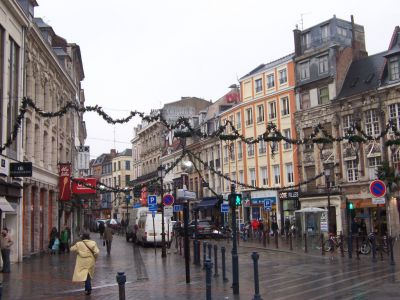
9) Vieux-Lille (Old Lille)
Old Lille (Vieux-Lille) is a historical district in the northern part of Lille, renowned for its extensive collection of pre-19th-century architecture. This area is characterized by its charming cobbled streets and remnants of ancient canals that once crisscrossed the city. Old Lille is home to approximately 20,000 residents and stands out as a quintessential representation of the city's architectural heritage.
Originally, until the First World War, the term "Vieux-Lille" designated the parts of the city predating its 1858 expansion. This was primarily the area west of Liberty Boulevard (Boulevard de la Liberté) and south of Louis XIV Boulevard. During the war, significant portions around Rue de Béthune, the railway station, and Rue du Molinel were destroyed. Notably, the Rihour Palace suffered considerable damage. The post-war reconstruction embraced the styles of the 1930s, with Art Deco and neo-regionalist influences evident around Rue du Molinel and Rue Faidherbe respectively.
The destruction of the Saint-Sauveur district in the 1960s and 1970s left Old Lille as one of the few areas retaining Lille's pre-industrial architecture. Initially neglected by wealthier residents until the 1980s, particularly around Place aux Oignons, this neglect preserved its charm and architectural integrity. Despite its history as a neighborhood for immigrants and economically disadvantaged families, it avoided major disruptions like the proposed expressway construction. Mayor Pierre Mauroy's restoration efforts transformed Old Lille into a bustling commercial hub with bars, restaurants, and luxury boutiques. This led to a surge in property values and rapid gentrification, altering the district's demographic and economic makeup significantly.
Lille has roots in the 11th century around Notre-Dame de la Treille cathedral and an ancient motte castle. However, Old Lille isn't the oldest part. The former Faubourg de Weppes and Château de Courtrai areas show medieval and early modern expansions. Annexed by France in the 17th century, Old Lille grew under Vauban's guidance, with a linear street plan. Streets like Rue de la Clef and Rue de la Grande-Chaussée showcase Flemish Renaissance buildings from the 17th and 18th centuries, preserving Lille's historical look.
Originally, until the First World War, the term "Vieux-Lille" designated the parts of the city predating its 1858 expansion. This was primarily the area west of Liberty Boulevard (Boulevard de la Liberté) and south of Louis XIV Boulevard. During the war, significant portions around Rue de Béthune, the railway station, and Rue du Molinel were destroyed. Notably, the Rihour Palace suffered considerable damage. The post-war reconstruction embraced the styles of the 1930s, with Art Deco and neo-regionalist influences evident around Rue du Molinel and Rue Faidherbe respectively.
The destruction of the Saint-Sauveur district in the 1960s and 1970s left Old Lille as one of the few areas retaining Lille's pre-industrial architecture. Initially neglected by wealthier residents until the 1980s, particularly around Place aux Oignons, this neglect preserved its charm and architectural integrity. Despite its history as a neighborhood for immigrants and economically disadvantaged families, it avoided major disruptions like the proposed expressway construction. Mayor Pierre Mauroy's restoration efforts transformed Old Lille into a bustling commercial hub with bars, restaurants, and luxury boutiques. This led to a surge in property values and rapid gentrification, altering the district's demographic and economic makeup significantly.
Lille has roots in the 11th century around Notre-Dame de la Treille cathedral and an ancient motte castle. However, Old Lille isn't the oldest part. The former Faubourg de Weppes and Château de Courtrai areas show medieval and early modern expansions. Annexed by France in the 17th century, Old Lille grew under Vauban's guidance, with a linear street plan. Streets like Rue de la Clef and Rue de la Grande-Chaussée showcase Flemish Renaissance buildings from the 17th and 18th centuries, preserving Lille's historical look.
