Custom Walk in Marrakech, Morocco by dasleena_ae737f created on 2026-03-26
Guide Location: Morocco » Marrakech
Guide Type: Custom Walk
# of Sights: 10
Tour Duration: 3 Hour(s)
Travel Distance: 5.3 Km or 3.3 Miles
Share Key: F6BTS
Guide Type: Custom Walk
# of Sights: 10
Tour Duration: 3 Hour(s)
Travel Distance: 5.3 Km or 3.3 Miles
Share Key: F6BTS
How It Works
Please retrieve this walk in the GPSmyCity app. Once done, the app will guide you from one tour stop to the next as if you had a personal tour guide. If you created the walk on this website or come to the page via a link, please follow the instructions below to retrieve the walk in the app.
Retrieve This Walk in App
Step 1. Download the app "GPSmyCity: Walks in 1K+ Cities" on Apple App Store or Google Play Store.



Step 2. In the GPSmyCity app, download(or launch) the guide "Marrakech Map and Walking Tours".
Step 3. Tap the menu button located at upper right corner of the "Walks" screen and select "Retrieve custom walk". Enter the share key: F6BTS
1) Le Jardin Secret (The Secret Garden) (must see)
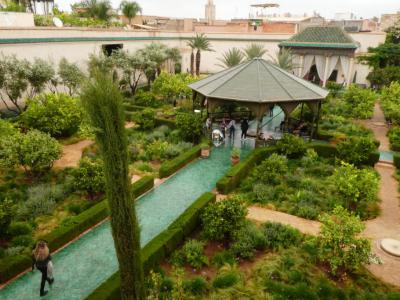
The Secret Garden, tucked within the heart of Marrakech’s medina, is a serene historic complex that traces its origins back several centuries. The site was once part of a grand Saadian-era palace from the 16th century, built for powerful local dignitaries when Marrakech flourished as an imperial capital. After the fall of the Saadian dynasty, the estate changed hands multiple times and was repeatedly rebuilt, most notably during the 19th century when it became a refined aristocratic residence. Over time, the property fell into neglect, hidden behind high walls and largely forgotten until a major restoration project in the early 21st century brought it back to life and opened it to the public.
Today, The Secret Garden offers a peaceful contrast to the lively crowds of the surrounding souks. Its charm lies in its two distinct garden spaces, each reflecting traditional Islamic landscape design. As you step through the glass doors of the main entrance, you are first met by the shade of the smaller garden. This is the Exotic Garden, which features rare species from around the world-succulents, palms, and tropical plants-working together to create an intimate, almost hidden-oasis atmosphere. The larger Islamic Garden can be reached by walking along a narrow path to the right of a red pavilion, which is easily visible while exploring the Exotic Garden. The Islamic Garden follows a geometric layout inspired by Quranic descriptions of paradise, divided by pathways and fed by a historic hydraulic system that once supplied water to the palace. Shaded by olive trees, cypresses, and fruit trees, it showcases native Moroccan plants arranged with elegant symmetry.
Architectural elements also enrich the space. Restored pavilions located at both ends of the main garden display intricate zellige tilework, carved cedar, and elegant wooden balconies typical of 19th-century Moroccan mansions. Last but not least, a view from the tall tower on the western edge of the main garden brings everything into a single frame. As you enter the Islamic Garden, the tower appears to the right of the space’s far end. Second only to the Koutoubia Minaret in height, it offers one of the medina’s best panoramic viewpoints, with sweeping views of red rooftops, nearby minarets, and the distant silhouette of the Atlas Mountains.
Today, The Secret Garden offers a peaceful contrast to the lively crowds of the surrounding souks. Its charm lies in its two distinct garden spaces, each reflecting traditional Islamic landscape design. As you step through the glass doors of the main entrance, you are first met by the shade of the smaller garden. This is the Exotic Garden, which features rare species from around the world-succulents, palms, and tropical plants-working together to create an intimate, almost hidden-oasis atmosphere. The larger Islamic Garden can be reached by walking along a narrow path to the right of a red pavilion, which is easily visible while exploring the Exotic Garden. The Islamic Garden follows a geometric layout inspired by Quranic descriptions of paradise, divided by pathways and fed by a historic hydraulic system that once supplied water to the palace. Shaded by olive trees, cypresses, and fruit trees, it showcases native Moroccan plants arranged with elegant symmetry.
Architectural elements also enrich the space. Restored pavilions located at both ends of the main garden display intricate zellige tilework, carved cedar, and elegant wooden balconies typical of 19th-century Moroccan mansions. Last but not least, a view from the tall tower on the western edge of the main garden brings everything into a single frame. As you enter the Islamic Garden, the tower appears to the right of the space’s far end. Second only to the Koutoubia Minaret in height, it offers one of the medina’s best panoramic viewpoints, with sweeping views of red rooftops, nearby minarets, and the distant silhouette of the Atlas Mountains.
2) Koutoubia Mosque and Minaret (must see)
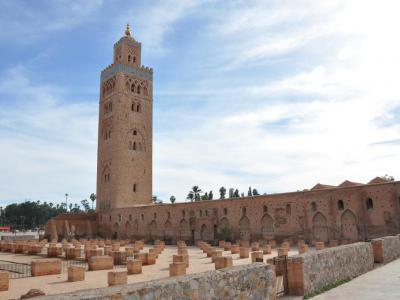
The Koutoubia Mosque and its soaring minaret are the most recognizable landmarks of Marrakech, standing at the edge of the bustling Jemaa el-Fnaa square and marking the spiritual heart of the city. Construction began in 1150, shortly after the Almohad dynasty seized Marrakech from the Almoravids. The mosque was built on the site of an earlier structure and later expanded, with its final form taking shape by the late 12th century. Its name, “Koutoubia,” comes from the Arabic term meaning “booksellers,” because it once stood beside a thriving market of manuscript vendors and scholars.
The minaret, rising approximately 77 meters including its spire, is a masterpiece of Almohad architecture and a model for later towers, including the Giralda in Seville and the Hassan Tower in Rabat. Built of red sandstone, it features harmonious proportions, decorative arches, and intricate geometric stonework, topped with a golden finial of four copper spheres. Its design reflects both the religious ambition and political authority of the Almohad empire, which sought to redefine Islamic architecture across North Africa and Al-Andalus.
The mosque itself is still in active use and not accessible to non-Muslims, but its exterior and surroundings offer much to appreciate. The gardens surrounding the mosque, known as the Koutoubia Gardens or Lalla Hasna Park, provide shaded paths, fountains, and views of the minaret framed by palms and roses. At sunset, when the tower glows softly against the sky and the call to prayer echoes across the city, the site becomes one of the most atmospheric places in Marrakech.
A Marrakech walking tour cannot be complete without its symbol. Wherever your legs take you, the Koutoubia Mosque is watching over you and is making sure that you will come back to take in the liveliness of its surroundings.
The minaret, rising approximately 77 meters including its spire, is a masterpiece of Almohad architecture and a model for later towers, including the Giralda in Seville and the Hassan Tower in Rabat. Built of red sandstone, it features harmonious proportions, decorative arches, and intricate geometric stonework, topped with a golden finial of four copper spheres. Its design reflects both the religious ambition and political authority of the Almohad empire, which sought to redefine Islamic architecture across North Africa and Al-Andalus.
The mosque itself is still in active use and not accessible to non-Muslims, but its exterior and surroundings offer much to appreciate. The gardens surrounding the mosque, known as the Koutoubia Gardens or Lalla Hasna Park, provide shaded paths, fountains, and views of the minaret framed by palms and roses. At sunset, when the tower glows softly against the sky and the call to prayer echoes across the city, the site becomes one of the most atmospheric places in Marrakech.
A Marrakech walking tour cannot be complete without its symbol. Wherever your legs take you, the Koutoubia Mosque is watching over you and is making sure that you will come back to take in the liveliness of its surroundings.
3) Marrakech Ramparts
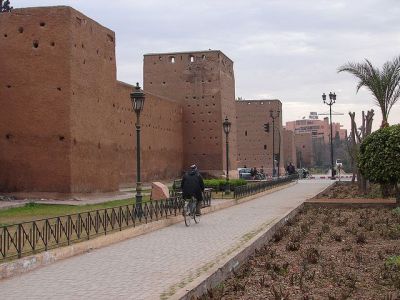
The ramparts of Marrakech form one of the city’s most enduring symbols, encircling the historic old town with kilometers of warm, reddish-pink walls that have stood for centuries. They were first constructed in the early 12th century under the Almoravid dynasty, shortly after Marrakech was founded as the capital of a growing North African empire. Later expanded and reinforced by the Almohads, the ramparts served both defensive and symbolic functions-protecting the city from outside threats while projecting its power and prestige.
Built from a mixture of clay, lime, and red earth, the walls stretch for roughly 19 kilometers and originally included more than 200 defensive towers, along with several monumental gates that controlled movement in and out of the city. These gates-such as Bab Agnaou-became architectural landmarks in their own right, often adorned with decorative patterns and inscriptions.
For visitors, the ramparts offer multiple points of interest. Walking or driving along their length provides a changing view of the city, from bustling markets and palm-lined avenues to quieter stretches where the walls meet open fields or gardens. Sunset is a particularly atmospheric time, when the walls glow in deep shades of ochre and rose. Some sections of the ramparts are accessible on foot, allowing visitors to get a closer look at the construction methods and weathered textures that tell the story of nearly 900 years of history.
Built from a mixture of clay, lime, and red earth, the walls stretch for roughly 19 kilometers and originally included more than 200 defensive towers, along with several monumental gates that controlled movement in and out of the city. These gates-such as Bab Agnaou-became architectural landmarks in their own right, often adorned with decorative patterns and inscriptions.
For visitors, the ramparts offer multiple points of interest. Walking or driving along their length provides a changing view of the city, from bustling markets and palm-lined avenues to quieter stretches where the walls meet open fields or gardens. Sunset is a particularly atmospheric time, when the walls glow in deep shades of ochre and rose. Some sections of the ramparts are accessible on foot, allowing visitors to get a closer look at the construction methods and weathered textures that tell the story of nearly 900 years of history.
4) Kasbah Mosque
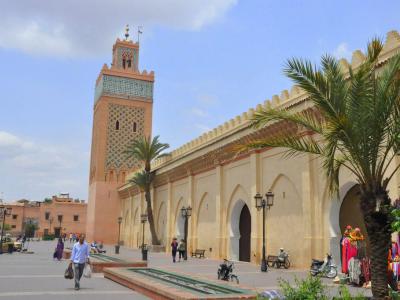
The Kasbah Mosque was built in the late 12th century, around 1185–1190, during the reign of Sultan Yaqub al-Mansur, the same ruler responsible for the iconic Koutoubia Mosque. Located within the royal kasbah - the fortified citadel that once served as the seat of power - the mosque was intended as the official place of worship for the sultan, his court, and the military elite. Its position near the Saadian Tombs underscores the sacred and ceremonial role of this district.
Although the mosque suffered damage from a massive explosion in the 16th century and later required reconstruction under the Saadians, it retains much of its original Almohad character. The minaret, built in a distinct style with decorative brickwork and subtle geometric motifs, stands as a quieter counterpart to the more famous Koutoubia. The prayer hall is supported by rows of arches and simple but elegant plasterwork, reflecting the Almohad preference for austere beauty rather than excessive ornamentation.
For visitors, the Kasbah Mosque is meaningful not only for its architecture but also for its context. It remains an active place of worship, offering a living connection to centuries of Moroccan religious life. While non-Muslims cannot enter the prayer hall, the exterior and surrounding neighborhood - including the nearby Saadian Tombs and the old kasbah walls - create a rich historical atmosphere.
Although the mosque suffered damage from a massive explosion in the 16th century and later required reconstruction under the Saadians, it retains much of its original Almohad character. The minaret, built in a distinct style with decorative brickwork and subtle geometric motifs, stands as a quieter counterpart to the more famous Koutoubia. The prayer hall is supported by rows of arches and simple but elegant plasterwork, reflecting the Almohad preference for austere beauty rather than excessive ornamentation.
For visitors, the Kasbah Mosque is meaningful not only for its architecture but also for its context. It remains an active place of worship, offering a living connection to centuries of Moroccan religious life. While non-Muslims cannot enter the prayer hall, the exterior and surrounding neighborhood - including the nearby Saadian Tombs and the old kasbah walls - create a rich historical atmosphere.
5) Bab Agnaou
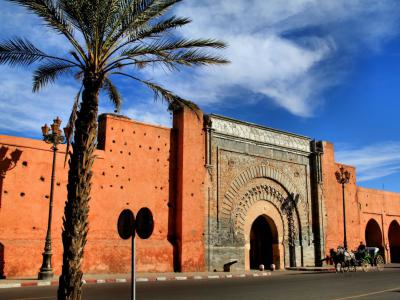
Bab Agnaou is one of the most historically important gates of Marrakech, serving as a ceremonial entrance to the royal kasbah, the fortified district built by the Almohad dynasty in the 12th century. Constructed during the reign of Sultan Yaqub al-Mansur around 1185–1190, the gate was designed not for defense but as a monumental statement of power and prestige. Its name is often translated as “Gate of the Black People,” possibly referring to the sub-Saharan soldiers who once guarded this part of the city, or to the dark-colored stone originally used in its construction.
Architecturally, Bab Agnaou is an exceptional example of Almohad design, showcasing a refined balance between strength and ornament. The gate features a large horseshoe arch framed by intricate carved decoration, including inscriptions, floral motifs, and interlacing patterns typical of the period. The two damaged sections at the top corners suggest that slender towers once rose here, which may explain the name Agnaou - meaning “sheep without horns” in ancient Berber.
Today, Bab Agnaou remains one of the most photographed landmarks in Marrakech, both for its dramatic form and for its position at the edge of the historic kasbah quarter, close to the Saadian Tombs and the Kasbah Mosque. Standing before the gate, it’s easy to imagine processions, guards, and dignitaries passing beneath its arch during the height of Marrakech’s imperial era.
For travelers interested in history, architecture, or the layers of power that shaped the city, Bab Agnaou offers a vivid point of connection - a silent witness to eight centuries of royal life, ritual, and urban evolution.
Architecturally, Bab Agnaou is an exceptional example of Almohad design, showcasing a refined balance between strength and ornament. The gate features a large horseshoe arch framed by intricate carved decoration, including inscriptions, floral motifs, and interlacing patterns typical of the period. The two damaged sections at the top corners suggest that slender towers once rose here, which may explain the name Agnaou - meaning “sheep without horns” in ancient Berber.
Today, Bab Agnaou remains one of the most photographed landmarks in Marrakech, both for its dramatic form and for its position at the edge of the historic kasbah quarter, close to the Saadian Tombs and the Kasbah Mosque. Standing before the gate, it’s easy to imagine processions, guards, and dignitaries passing beneath its arch during the height of Marrakech’s imperial era.
For travelers interested in history, architecture, or the layers of power that shaped the city, Bab Agnaou offers a vivid point of connection - a silent witness to eight centuries of royal life, ritual, and urban evolution.
6) Jemaa el-Fnaa Square (must see)
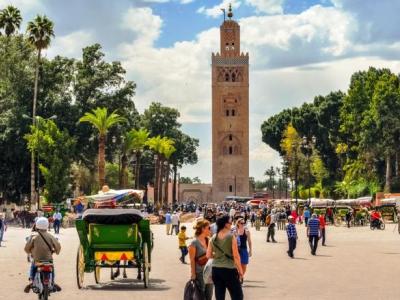
Jemaa el-Fnaa is the beating heart of Marrakech and one of the most iconic public squares in the world. It has served as a central gathering place for more than a thousand years. The name is often translated as “Assembly of the Dead” or “Place of the Vanished,” likely referring to its early use as a site for public executions during the rule of the Almoravids and Almohads in the 11th and 12th centuries. Over time, however, Jemaa el-Fnaa transformed from a grim ceremonial ground into a vibrant crossroads of trade, storytelling, and culture.
By the medieval period, the square had become a lively open market where caravans arriving from the Sahara, the Atlas Mountains, and coastal cities converged. Merchants sold spices, leather, textiles, and medicinal herbs, while musicians, poets, and snake charmers entertained crowds - traditions that have endured to this day. This unique blend led UNESCO to declare Jemaa el-Fnaa a Masterpiece of the Oral and Intangible Heritage of Humanity in 2001, recognizing its role in preserving Moroccan cultural traditions.
Visitors can watch snake charmers coax cobras to the rhythm of desert flutes, listen to traditional storytellers recount ancient folktales in Moroccan Arabic, or sip mint tea while observing the shifting rhythms of daily life. Barbary macaques may be placed on your shoulder for a souvenir photograph, and bargaining is part of the experience. The square also serves as a gateway into the surrounding maze of souks, where carpets, lanterns, spices, and silver jewelry await discovery.
By the medieval period, the square had become a lively open market where caravans arriving from the Sahara, the Atlas Mountains, and coastal cities converged. Merchants sold spices, leather, textiles, and medicinal herbs, while musicians, poets, and snake charmers entertained crowds - traditions that have endured to this day. This unique blend led UNESCO to declare Jemaa el-Fnaa a Masterpiece of the Oral and Intangible Heritage of Humanity in 2001, recognizing its role in preserving Moroccan cultural traditions.
Visitors can watch snake charmers coax cobras to the rhythm of desert flutes, listen to traditional storytellers recount ancient folktales in Moroccan Arabic, or sip mint tea while observing the shifting rhythms of daily life. Barbary macaques may be placed on your shoulder for a souvenir photograph, and bargaining is part of the experience. The square also serves as a gateway into the surrounding maze of souks, where carpets, lanterns, spices, and silver jewelry await discovery.
7) Souk Semmarine (Semmarine Market)
Semmarine Market is one of the most famous and atmospheric markets in Marrakech’s medina, forming the main artery that leads from Jemaa el-Fnaa into the deeper network of traditional souks. Its history dates back to the Almoravid and Almohad periods, when Marrakech developed as a major trading hub linking North Africa, the Sahara, and Andalusia. By the medieval era, this route had already become a bustling commercial passage where caravans unloaded goods and merchants sold everything from textiles to metalwork.
Today, Semmarine Market competes for the title of the largest market in Morocco, having hosted traders for over a thousand years. The market is partially roofed with wooden slats that cast patterned light across the stalls below, giving the street its distinctive interplay of shadow and sun. It is best known for its overflowing displays of brightly dyed fabrics, handwoven carpets, leather bags, traditional slippers, and intricately carved wooden boxes. Tailors, kaftan sellers, and textile merchants dominate the upper stretch, while the lower section transitions into jewelry, ceramics, and metalwork.
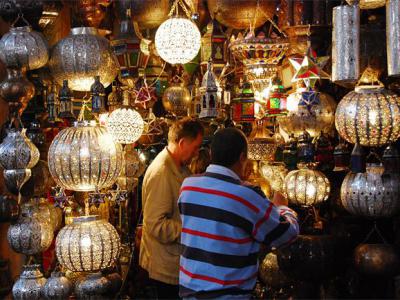
One of the most captivating traditions here is the craft of lamp-making. The intricately designed lamps lining the stalls create a magical glow in the evening hours, reflecting an art form passed down through generations in Morocco.
The souk is also one of the best places to observe the traditional organization of Marrakech’s medina, where trades cluster by specialty and workshops sit directly behind storefronts. As you walk, the aromas of saffron, cedarwood, and tanned leather drift through the air, blending with the sound of hammers shaping metal and merchants calling out their prices. Souk Semmarine is not only a lively shopping street but also a gateway: continue walking and it leads into deeper, more specialized markets dedicated to spices, blacksmithing, carpets, and beyond.
Today, Semmarine Market competes for the title of the largest market in Morocco, having hosted traders for over a thousand years. The market is partially roofed with wooden slats that cast patterned light across the stalls below, giving the street its distinctive interplay of shadow and sun. It is best known for its overflowing displays of brightly dyed fabrics, handwoven carpets, leather bags, traditional slippers, and intricately carved wooden boxes. Tailors, kaftan sellers, and textile merchants dominate the upper stretch, while the lower section transitions into jewelry, ceramics, and metalwork.
One of the most captivating traditions here is the craft of lamp-making. The intricately designed lamps lining the stalls create a magical glow in the evening hours, reflecting an art form passed down through generations in Morocco.
The souk is also one of the best places to observe the traditional organization of Marrakech’s medina, where trades cluster by specialty and workshops sit directly behind storefronts. As you walk, the aromas of saffron, cedarwood, and tanned leather drift through the air, blending with the sound of hammers shaping metal and merchants calling out their prices. Souk Semmarine is not only a lively shopping street but also a gateway: continue walking and it leads into deeper, more specialized markets dedicated to spices, blacksmithing, carpets, and beyond.
8) Marrakech Medina (Old City) (must see)
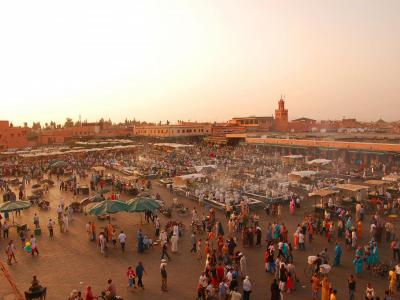
The oldest sector of Marrakech is the Medina, encircled by protective walls. Entry into this district is via one of numerous gateways, and it boasts a wealth of age-old wonders to be explored, promising an enchanting experience.
Marrakech's Medina is a UNESCO site, a vibrant historic market with a fortified city. It's a bustling African hub for commerce and tourism, backed by King Mohammed VI's goal to attract 20 million visitors by 2020.
Within the Medina, you'll encounter at least eight principal historical gates: Bab Doukkala, Bab el-Khemis, Bab ad-Debbagh, Bab Aylan, Bab Aghmat, Bab er-Robb, Bab el-Makhzen, and Bab el-'Arissa. These gateways trace back to the 12th century during the Almoravid era, although many have been subject to modifications since then.
In the time before the rise of the Almoravid Dynasty, the capital of present-day Morocco was situated in Aghmat, now an archaeological site located 30 km from Marrakech. Following the Almoravides' conquest of the city in 1062 and their establishment of rule, their leader Abou Bakir ibn Umar sought to create a new capital.
Two rival cities vied to be the new capital, with ibn Umar choosing a plain near the River Tensift to prevent further rivalry. By 1070, the new capital emerged, adorned with palm trees, orange groves, and houses along alleys. Fearing rival tribes like the Almohades, the sultan built a defensive wall around the city.
The Almohades ultimately captured the Medina in 1147, resulting in the destruction and subsequent reconstruction of numerous splendid edifices to align with the new dynasty's vision. The Medina retained its status as Morocco's capital until the fall of the Almohad Dynasty in 1269. It once again held the capital designation between the 16th and 17th centuries, as well as in 1792.
The city's expansion occurred organically beyond the confines of the Medina. Here, remnants of ancient palaces, the Koutoubia Mosque, the Ben Youssef Madrasa, and the renowned Saadian Tombs still stand, testifying to the grandeur of the Moroccan Empire.
Marrakech's Medina is a UNESCO site, a vibrant historic market with a fortified city. It's a bustling African hub for commerce and tourism, backed by King Mohammed VI's goal to attract 20 million visitors by 2020.
Within the Medina, you'll encounter at least eight principal historical gates: Bab Doukkala, Bab el-Khemis, Bab ad-Debbagh, Bab Aylan, Bab Aghmat, Bab er-Robb, Bab el-Makhzen, and Bab el-'Arissa. These gateways trace back to the 12th century during the Almoravid era, although many have been subject to modifications since then.
In the time before the rise of the Almoravid Dynasty, the capital of present-day Morocco was situated in Aghmat, now an archaeological site located 30 km from Marrakech. Following the Almoravides' conquest of the city in 1062 and their establishment of rule, their leader Abou Bakir ibn Umar sought to create a new capital.
Two rival cities vied to be the new capital, with ibn Umar choosing a plain near the River Tensift to prevent further rivalry. By 1070, the new capital emerged, adorned with palm trees, orange groves, and houses along alleys. Fearing rival tribes like the Almohades, the sultan built a defensive wall around the city.
The Almohades ultimately captured the Medina in 1147, resulting in the destruction and subsequent reconstruction of numerous splendid edifices to align with the new dynasty's vision. The Medina retained its status as Morocco's capital until the fall of the Almohad Dynasty in 1269. It once again held the capital designation between the 16th and 17th centuries, as well as in 1792.
The city's expansion occurred organically beyond the confines of the Medina. Here, remnants of ancient palaces, the Koutoubia Mosque, the Ben Youssef Madrasa, and the renowned Saadian Tombs still stand, testifying to the grandeur of the Moroccan Empire.
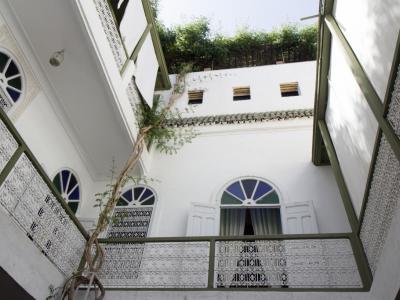
9) Maison de la Photographie (House of Photography) (must see)
The House of Photography is one of the medina’s most engaging cultural institutions, offering a vivid window into Morocco’s past through the lens of early photography. Opened in 2009, the museum occupies a beautifully restored 1920s inn whose traditional architecture-carved wooden balconies, tiled floors, and an airy central courtyard-creates an intimate and atmospheric setting for its collection.
The museum was founded with the purpose of preserving and showcasing Morocco’s photographic heritage. Their collection now includes over ten thousand of original photographs, postcards, glass plates, and documents dating from the 1870s to the 1950s. These rare images capture a world that has largely vanished: Berber communities in the Atlas Mountains, early portraits of Marrakech’s residents, bustling markets, desert caravans, and scenes of rural life long before modernisation reshaped the country. Many of the photographs were taken by explorers, military officers, and travelling artists who documented Morocco during pivotal historical moments.
The museum is particularly compelling because it presents Morocco from the perspective of daily life rather than grand monuments or official portraits. The black-and-white images reveal details of clothing, tools, architecture, and traditions that provide an extraordinary sense of authenticity. Remarkably, one of the exhibits is the first color movie documentary filmed in 1957 on the Berber tribes of the High Atlas. Temporary exhibitions rotate regularly, about every six months, ensuring that repeat visitors can always discover something new.
One of the highlights is the rooftop terrace, which offers stunning panoramic views over the medina, with the Atlas Mountains rising in the distance. It is an ideal spot to pause after exploring the galleries, enjoy a quiet drink, and take in the scenery that early photographers once sought to capture.
The museum was founded with the purpose of preserving and showcasing Morocco’s photographic heritage. Their collection now includes over ten thousand of original photographs, postcards, glass plates, and documents dating from the 1870s to the 1950s. These rare images capture a world that has largely vanished: Berber communities in the Atlas Mountains, early portraits of Marrakech’s residents, bustling markets, desert caravans, and scenes of rural life long before modernisation reshaped the country. Many of the photographs were taken by explorers, military officers, and travelling artists who documented Morocco during pivotal historical moments.
The museum is particularly compelling because it presents Morocco from the perspective of daily life rather than grand monuments or official portraits. The black-and-white images reveal details of clothing, tools, architecture, and traditions that provide an extraordinary sense of authenticity. Remarkably, one of the exhibits is the first color movie documentary filmed in 1957 on the Berber tribes of the High Atlas. Temporary exhibitions rotate regularly, about every six months, ensuring that repeat visitors can always discover something new.
One of the highlights is the rooftop terrace, which offers stunning panoramic views over the medina, with the Atlas Mountains rising in the distance. It is an ideal spot to pause after exploring the galleries, enjoy a quiet drink, and take in the scenery that early photographers once sought to capture.

10) Marrakech Souks (Marrakech Market) (must see)
The Marrakech Market - commonly referred to simply as the souks of the medina - is one of the oldest and most characteristic trading networks in North Africa. Its history stretches back to the 11th and 12th centuries, when the Almoravids and later the Almohads established Marrakech as a major imperial capital. As caravans arrived from the Sahara, the Atlas Mountains, and cities across North Africa and Andalusia, the medina developed into a dense commercial maze where every profession had its own dedicated street or quarter. Over time, these clustered craft guilds formed the interconnected market system that survives today.
For centuries, the souks functioned as Marrakech’s economic engine. Goods such as leather, wool, spices, metals, pottery, and textiles were crafted and traded in the very same alleys where artisans still work today. Many workshops are family-run and passed down through generations, preserving traditional techniques such as hand-dyeing wool for carpets, hammering brass lanterns, and carving cedarwood.
Entering the Marrakech Market brings you into a vibrant, sensory world. Narrow lanes unfold into covered passages where sunlight filters through reed roofs, illuminating stacks of rugs, rows of bright traditional slippers, woven baskets, and intricate metalwork. The smell of saffron, mint, and sandalwood fills the air as spice merchants display pyramids of colourful powders. Leather tanneries supply stalls selling bags and belts, while textile souks offer handwoven blankets and traditional garments. Artisans often work just steps from their storefronts, allowing visitors to watch pottery being shaped, wood being carved, or silver jewellery being polished.
Beyond shopping, the souks offer a rich cultural experience. Merchants engage in friendly bargaining, herbalists explain traditional remedies, and local women select ingredients for home cooking. Squares and intersections become informal meeting places where cafés spill onto the street, serving some of the best mint tea in the city. Walk with confidence, and you’ll quickly feel at home in the lively rhythm of the medina’s markets.
For centuries, the souks functioned as Marrakech’s economic engine. Goods such as leather, wool, spices, metals, pottery, and textiles were crafted and traded in the very same alleys where artisans still work today. Many workshops are family-run and passed down through generations, preserving traditional techniques such as hand-dyeing wool for carpets, hammering brass lanterns, and carving cedarwood.
Entering the Marrakech Market brings you into a vibrant, sensory world. Narrow lanes unfold into covered passages where sunlight filters through reed roofs, illuminating stacks of rugs, rows of bright traditional slippers, woven baskets, and intricate metalwork. The smell of saffron, mint, and sandalwood fills the air as spice merchants display pyramids of colourful powders. Leather tanneries supply stalls selling bags and belts, while textile souks offer handwoven blankets and traditional garments. Artisans often work just steps from their storefronts, allowing visitors to watch pottery being shaped, wood being carved, or silver jewellery being polished.
Beyond shopping, the souks offer a rich cultural experience. Merchants engage in friendly bargaining, herbalists explain traditional remedies, and local women select ingredients for home cooking. Squares and intersections become informal meeting places where cafés spill onto the street, serving some of the best mint tea in the city. Walk with confidence, and you’ll quickly feel at home in the lively rhythm of the medina’s markets.
