Custom Walk in Frankfurt, Germany by asliyildirim875_6f6d22 created on 2026-03-28
Guide Location: Germany » Frankfurt
Guide Type: Custom Walk
# of Sights: 8
Tour Duration: 2 Hour(s)
Travel Distance: 5.2 Km or 3.2 Miles
Share Key: GFEEL
Guide Type: Custom Walk
# of Sights: 8
Tour Duration: 2 Hour(s)
Travel Distance: 5.2 Km or 3.2 Miles
Share Key: GFEEL
How It Works
Please retrieve this walk in the GPSmyCity app. Once done, the app will guide you from one tour stop to the next as if you had a personal tour guide. If you created the walk on this website or come to the page via a link, please follow the instructions below to retrieve the walk in the app.
Retrieve This Walk in App
Step 1. Download the app "GPSmyCity: Walks in 1K+ Cities" on Apple App Store or Google Play Store.



Step 2. In the GPSmyCity app, download(or launch) the guide "Frankfurt Map and Walking Tours".
Step 3. Tap the menu button located at upper right corner of the "Walks" screen and select "Retrieve custom walk". Enter the share key: GFEEL
1) Zeil Shopping Lane
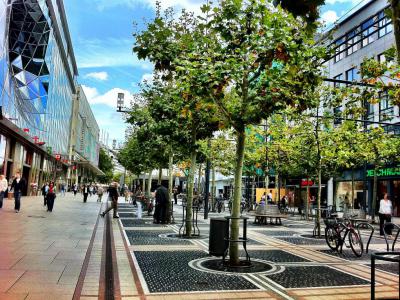
Zeil is Frankfurt’s main shopping street and one of the busiest retail areas in Germany. The wide boulevard runs between the major city squares Hauptwache and Konstablerwache, forming the central commercial corridor of the city. Most of the street is pedestrianized, creating a lively space filled with shops, department stores, cafés, and restaurants. Because of its central location and variety of stores, Zeil attracts both locals and visitors throughout the day.
Historically, Zeil has been one of Frankfurt’s most important commercial streets for centuries. Before the Second World War it was lined with elegant historic buildings and was often called one of the finest shopping avenues in Europe. Much of the street was destroyed during the air raids of 1944 and later rebuilt with modern architecture. Today the area reflects postwar reconstruction combined with contemporary retail buildings.
One of the most striking landmarks along the street is MyZeil, a modern shopping mall opened in 2009. Its glass façade features a dramatic swirling design often described as a “glass vortex,” making it one of the most recognizable modern buildings in Frankfurt. Inside, several floors of shops, restaurants, and entertainment spaces attract large numbers of visitors.
At both ends of Zeil are two important city squares that serve as transportation hubs. Hauptwache Square marks the western entrance to the street, while Konstablerwache Square forms its eastern end and frequently hosts weekly markets and food stalls.
Historically, Zeil has been one of Frankfurt’s most important commercial streets for centuries. Before the Second World War it was lined with elegant historic buildings and was often called one of the finest shopping avenues in Europe. Much of the street was destroyed during the air raids of 1944 and later rebuilt with modern architecture. Today the area reflects postwar reconstruction combined with contemporary retail buildings.
One of the most striking landmarks along the street is MyZeil, a modern shopping mall opened in 2009. Its glass façade features a dramatic swirling design often described as a “glass vortex,” making it one of the most recognizable modern buildings in Frankfurt. Inside, several floors of shops, restaurants, and entertainment spaces attract large numbers of visitors.
At both ends of Zeil are two important city squares that serve as transportation hubs. Hauptwache Square marks the western entrance to the street, while Konstablerwache Square forms its eastern end and frequently hosts weekly markets and food stalls.
2) Old Opera House (Alte Oper) (must see)
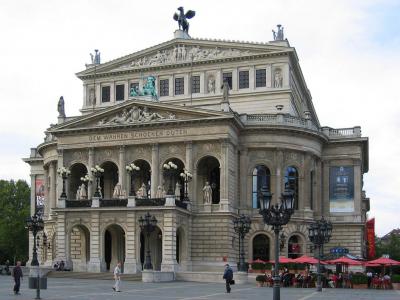
Perched above a picturesque square adorned with a graceful fountain lies the Opera House, sporting a Renaissance-style façade. This historic edifice, known by the moniker "Alte Oper," or "the Old Opera House," stands in place of a predecessor that graced the location from 1880 to 1944.
The inaugural Frankfurt Opera House, conceived by the Berlin-based architect Richard Lucae, made its debut in 1880, with Kaiser Wilhelm I presiding over the grand opening. The architectural design exuded the opulence expected of a venue patronized by royalty, showcasing Renaissance aesthetics. Tragically, during World War II, the structure suffered complete devastation. Following extensive deliberations among Frankfurt's residents, a new building arose, echoing the design of its predecessor. While the lobby and façade maintained their Renaissance architectural charm, the remainder of the structure underwent a transformation into a versatile modern complex, housing banquet halls, concert venues, and a convention center. This Opera House now fulfills the dual role of a cultural hub and a gathering place for Frankfurt's denizens.
At the Alte Oper, visitors can relish classical and popular music concerts. The edifice takes on an enchanting allure in the evening, its exterior adorned with splendid statues of Goethe and Mozart, who preside over the square below.
Why You Should Visit:
Great location to spend time in Frankfurt – beautifully restored theatre in a beautifully designed square.
Tip:
Both the café and the restaurant are generally busy in the evening, so try and reserve a spot in advance.
During a nice warm day, try and grab a seat outside, enjoy a cup of coffee/glass of wine and people watch.
The inaugural Frankfurt Opera House, conceived by the Berlin-based architect Richard Lucae, made its debut in 1880, with Kaiser Wilhelm I presiding over the grand opening. The architectural design exuded the opulence expected of a venue patronized by royalty, showcasing Renaissance aesthetics. Tragically, during World War II, the structure suffered complete devastation. Following extensive deliberations among Frankfurt's residents, a new building arose, echoing the design of its predecessor. While the lobby and façade maintained their Renaissance architectural charm, the remainder of the structure underwent a transformation into a versatile modern complex, housing banquet halls, concert venues, and a convention center. This Opera House now fulfills the dual role of a cultural hub and a gathering place for Frankfurt's denizens.
At the Alte Oper, visitors can relish classical and popular music concerts. The edifice takes on an enchanting allure in the evening, its exterior adorned with splendid statues of Goethe and Mozart, who preside over the square below.
Why You Should Visit:
Great location to spend time in Frankfurt – beautifully restored theatre in a beautifully designed square.
Tip:
Both the café and the restaurant are generally busy in the evening, so try and reserve a spot in advance.
During a nice warm day, try and grab a seat outside, enjoy a cup of coffee/glass of wine and people watch.
3) Main Tower (must see)
Main Tower is one of the most recognizable skyscrapers in Frankfurt and a key feature of the city’s financial district. Completed in 1999, the tower rises about 200 meters above the city and contains 56 floors. It takes its name from the River Main, which flows through Frankfurt. The building is part of the skyline cluster often nicknamed “Mainhattan,” a reference to the city’s concentration of modern high-rise buildings. Its reflective glass façade and cylindrical tower design make it one of the most distinctive structures among Frankfurt’s banks and office towers.
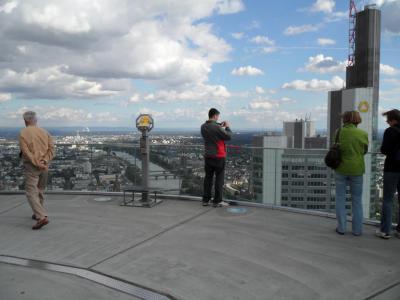
One of the main attractions of Main Tower is that it is one of the few skyscrapers in Frankfurt open to the public. High-speed elevators take visitors to an observation platform located about 187 meters above the ground. From this height, the view stretches across the entire city. The historic Old Town can be seen along the River Main, while the dense group of modern financial towers rises nearby. On clear days the panorama extends far beyond the city limits, reaching the Taunus hills to the northwest and the surrounding Rhine-Main region.
Inside the tower there is also a restaurant and lounge with large panoramic windows, making it a popular place for dinners with skyline views, especially in the evening when the city lights illuminate the financial district. The building also displays several works of contemporary art in its public areas. Among the pieces on display are works by internationally known artists such as Stephan Balkenhol, whose 5.6-meter-tall “Man” mosaic is a landmark in the foyer, and Bill Viola, whose video installation “The World of Appearances” is a key feature of the entrance area.
One of the main attractions of Main Tower is that it is one of the few skyscrapers in Frankfurt open to the public. High-speed elevators take visitors to an observation platform located about 187 meters above the ground. From this height, the view stretches across the entire city. The historic Old Town can be seen along the River Main, while the dense group of modern financial towers rises nearby. On clear days the panorama extends far beyond the city limits, reaching the Taunus hills to the northwest and the surrounding Rhine-Main region.
Inside the tower there is also a restaurant and lounge with large panoramic windows, making it a popular place for dinners with skyline views, especially in the evening when the city lights illuminate the financial district. The building also displays several works of contemporary art in its public areas. Among the pieces on display are works by internationally known artists such as Stephan Balkenhol, whose 5.6-meter-tall “Man” mosaic is a landmark in the foyer, and Bill Viola, whose video installation “The World of Appearances” is a key feature of the entrance area.
4) Eiserner Steg (Iron Footbridge) (must see)
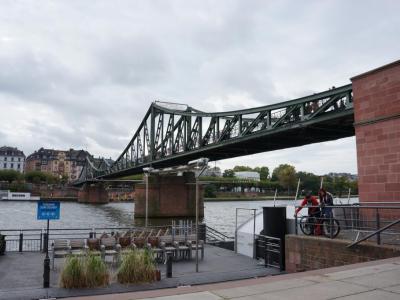
The Iron Footbridge is one of Frankfurt’s best-known pedestrian bridges and an important crossing over the River Main. It connects the historic Old Town with the Sachsenhausen district on the southern bank. The first version of the bridge was built in 1868 after local citizens financed a pedestrian crossing between the two sides of the city. The structure was destroyed during the Second World War but rebuilt in 1946 and later renovated, preserving the recognizable iron design that gives the bridge its name.
The bridge has become one of the most photographed viewpoints in Frankfurt because of its clear view of the city skyline. From its central span, the historic buildings of the Old Town appear in the foreground while the towers of the financial district rise behind them. This contrast between medieval streets and modern skyscrapers has become one of the defining images of Frankfurt.
A distinctive feature of the bridge is the large number of padlocks attached to its railings. These “love locks” have been placed by couples as a symbol of their relationship, with the key traditionally thrown into the river below. Another interesting detail is the inscription running along the side of the bridge, written in ancient Greek. The line comes from Greek poet Homer’s Odyssey and translates roughly as “Sailing across the wine-dark sea to people of another language,” a poetic reference to journeys and encounters with new cultures.
Beyond its scenic qualities, the Iron Footbridge also serves an important practical role. It is one of the busiest pedestrian crossings in the city and provides a direct route between the historic center and Sachsenhausen, a district known for its traditional taverns serving Frankfurt’s well-known apple wine.
The bridge has become one of the most photographed viewpoints in Frankfurt because of its clear view of the city skyline. From its central span, the historic buildings of the Old Town appear in the foreground while the towers of the financial district rise behind them. This contrast between medieval streets and modern skyscrapers has become one of the defining images of Frankfurt.
A distinctive feature of the bridge is the large number of padlocks attached to its railings. These “love locks” have been placed by couples as a symbol of their relationship, with the key traditionally thrown into the river below. Another interesting detail is the inscription running along the side of the bridge, written in ancient Greek. The line comes from Greek poet Homer’s Odyssey and translates roughly as “Sailing across the wine-dark sea to people of another language,” a poetic reference to journeys and encounters with new cultures.
Beyond its scenic qualities, the Iron Footbridge also serves an important practical role. It is one of the busiest pedestrian crossings in the city and provides a direct route between the historic center and Sachsenhausen, a district known for its traditional taverns serving Frankfurt’s well-known apple wine.
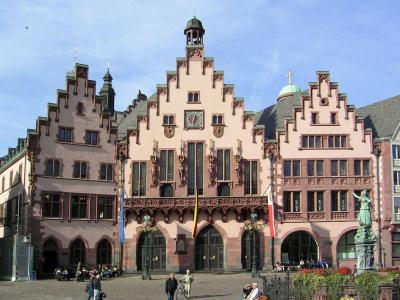
5) Römer (City Hall) (must see)
The Römer, Frankfurt’s historic city hall, stands at the heart of Römerberg Square and has been the political center of the city for more than six centuries. The complex takes its name from the central medieval house called House of the Romans (or Haus Römer in german), which the city council purchased in 1405 along with a neighboring building. Over time, additional houses were incorporated, eventually forming a complex of several interconnected buildings that still serve as Frankfurt’s municipal government today. Because of its long history and prominent location, the Römer has become one of the most recognizable landmarks in the city and a focal point of Frankfurt’s historic Old Town.
Facing Römerberg Square is the building’s famous façade with three distinctive stepped gables, a design that has become one of Frankfurt’s most recognizable architectural images. The statues placed on the façade represent four Holy Roman Emperors connected to Frankfurt’s imperial history. They depict Frederick Barbarossa, the first king elected in Frankfurt; Louis the Bavarian, who granted important trade and fair privileges that allowed the city to expand; Charles IV, who established Frankfurt as the official location for imperial elections; and Maximilian II, the first emperor to be crowned in Frankfurt Cathedral. These emperors recall Frankfurt’s importance as the place where German kings were elected and later crowned.
Inside the building is one of the City Hall's most significant historic spaces: the Imperial Hall (or Kaisersaal in german). After coronations at the nearby Frankfurt Cathedral, newly crowned Holy Roman Emperors traditionally held their ceremonial banquets here. The hall is lined with portraits of all Holy Roman Emperors, creating a visual record of imperial history that stretches from Charlemagne to Francis II.
The balcony on the front of the Römer has taken on a new role in modern times. Today it is the place where Frankfurt’s sports teams celebrate major victories, appearing on the balcony to greet thousands of fans gathered in Römerberg Square below.
Facing Römerberg Square is the building’s famous façade with three distinctive stepped gables, a design that has become one of Frankfurt’s most recognizable architectural images. The statues placed on the façade represent four Holy Roman Emperors connected to Frankfurt’s imperial history. They depict Frederick Barbarossa, the first king elected in Frankfurt; Louis the Bavarian, who granted important trade and fair privileges that allowed the city to expand; Charles IV, who established Frankfurt as the official location for imperial elections; and Maximilian II, the first emperor to be crowned in Frankfurt Cathedral. These emperors recall Frankfurt’s importance as the place where German kings were elected and later crowned.
Inside the building is one of the City Hall's most significant historic spaces: the Imperial Hall (or Kaisersaal in german). After coronations at the nearby Frankfurt Cathedral, newly crowned Holy Roman Emperors traditionally held their ceremonial banquets here. The hall is lined with portraits of all Holy Roman Emperors, creating a visual record of imperial history that stretches from Charlemagne to Francis II.
The balcony on the front of the Römer has taken on a new role in modern times. Today it is the place where Frankfurt’s sports teams celebrate major victories, appearing on the balcony to greet thousands of fans gathered in Römerberg Square below.
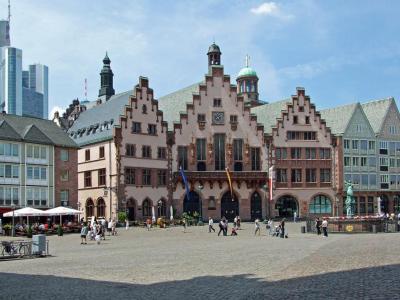
6) Römerberg (Square) (must see)
Römerberg Square is the historic heart of Frankfurt’s Old Town and one of the most recognizable places in the city. For centuries this square served as Frankfurt’s main marketplace and the stage for major public events, including imperial ceremonies, medieval trade fairs, and civic celebrations. Today it remains one of the most visited parts of the city, surrounded by historic buildings that reflect Frankfurt’s long past. At the western side of the square stands the Römer, Frankfurt’s historic city hall, whose distinctive stepped gables have become one of the city’s most iconic architectural images.
As you stand in the square, look toward the row of colorful half-timbered houses on the eastern side. This line of buildings, known as the Eastern Row, was reconstructed in the 1980s to recreate the historic appearance of Römerberg before the destruction of the Second World War. Each house features steep roofs, wooden beams, and decorative façades typical of traditional German architecture. Today these buildings house cafés, restaurants, and small shops, making this side of the square one of the most photographed spots in Frankfurt.
Walk toward the center of the square and you’ll find the Justice Fountain, a Renaissance fountain dating from the 16th century. At the top stands a statue of Lady Justice holding a sword and scales. During the coronation celebrations of Holy Roman Emperors, the fountain famously flowed with wine instead of water so that the crowds gathered here could join the festivities. Nearby, on the southern side, stands Old Saint Nicholas Church, a Gothic church that has watched over the square since the 13th century and once served merchants and travelers who came to the city’s markets.
Today Römerberg remains one of the liveliest places in Frankfurt. The square regularly hosts festivals, public gatherings, and seasonal markets, including the famous Frankfurt Christmas Market, which attracts visitors from around the world each winter. Surrounded by reconstructed historic buildings and anchored by the city hall, the square offers one of the clearest glimpses into Frankfurt’s medieval past while remaining an active gathering place for the city today.
As you stand in the square, look toward the row of colorful half-timbered houses on the eastern side. This line of buildings, known as the Eastern Row, was reconstructed in the 1980s to recreate the historic appearance of Römerberg before the destruction of the Second World War. Each house features steep roofs, wooden beams, and decorative façades typical of traditional German architecture. Today these buildings house cafés, restaurants, and small shops, making this side of the square one of the most photographed spots in Frankfurt.
Walk toward the center of the square and you’ll find the Justice Fountain, a Renaissance fountain dating from the 16th century. At the top stands a statue of Lady Justice holding a sword and scales. During the coronation celebrations of Holy Roman Emperors, the fountain famously flowed with wine instead of water so that the crowds gathered here could join the festivities. Nearby, on the southern side, stands Old Saint Nicholas Church, a Gothic church that has watched over the square since the 13th century and once served merchants and travelers who came to the city’s markets.
Today Römerberg remains one of the liveliest places in Frankfurt. The square regularly hosts festivals, public gatherings, and seasonal markets, including the famous Frankfurt Christmas Market, which attracts visitors from around the world each winter. Surrounded by reconstructed historic buildings and anchored by the city hall, the square offers one of the clearest glimpses into Frankfurt’s medieval past while remaining an active gathering place for the city today.
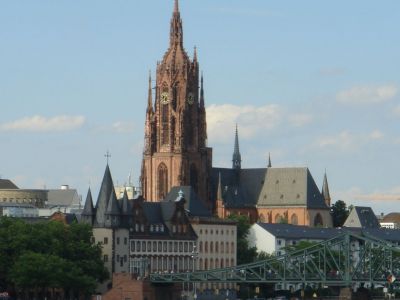
7) Frankfurt Cathedral (Cathedral of St. Bartholomew) (must see)
Frankfurt Cathedral, officially the Cathedral of Saint Bartholomew, is one of the most important historic landmarks in Frankfurt. Built mainly between the 14th and 15th centuries from deep red Main sandstone, the church rises prominently above the surrounding Old Town. Its Gothic tower reaches about 95 meters and remains one of the city’s most recognizable landmarks.
Although it was never a bishop’s seat, the cathedral played a major political role in the Holy Roman Empire. Between 1562 and 1792, ten Holy Roman Emperors were crowned here, giving the church its long-standing nickname, the “Imperial Cathedral.”
Enter through the vestibule, the modern entrance added in 1879 or 1880. From here you can access the cloister, which today houses the Frankfurt Cathedral Museum, as well as the tower hall. Inside the church, the central nave is flanked by two aisles separated by six great Gothic pillars, three on each side, and along the wall of the left aisle you’ll notice several tombs dating from the 16th to the 18th centuries.
Continue toward the High Choir just ahead, built between 1315 and 1349 and one of the best-preserved parts of the cathedral. It survived both the major fire of 1867 and much of the destruction caused by Allied bombing in 1944. At its center stands the high altar, on the left of it you’ll see the Apostles’ Farewell Altar from 1523, while on the right stands the Altar of Our Lady, made in southern Germany in the 15th century. Wooden choir stalls line the walls and are decorated with carved scenes of the Resurrection, reflecting the central Christian theme of redemption and eternal life.
Here you’ll also find one of the cathedral’s most important monuments: the tomb of King Günther von Schwarzburg, the only German king buried in Frankfurt. The tomb shows the king in full armor with a sword and shield, with two lions at his feet. The cathedral also preserves a relic of Saint Bartholomew—part of the apostle’s skull kept here since the 13th century, which helped establish the church as an important religious center in medieval Frankfurt.
Make sure to climb the cathedral tower during your visit. After 328 steps you reach a viewing platform about 66 meters above the ground. From here, you’ll enjoy a beautiful panoramic view over the narrow streets of the reconstructed Old Town, the River Main, and Frankfurt’s modern skyline.
Although it was never a bishop’s seat, the cathedral played a major political role in the Holy Roman Empire. Between 1562 and 1792, ten Holy Roman Emperors were crowned here, giving the church its long-standing nickname, the “Imperial Cathedral.”
Enter through the vestibule, the modern entrance added in 1879 or 1880. From here you can access the cloister, which today houses the Frankfurt Cathedral Museum, as well as the tower hall. Inside the church, the central nave is flanked by two aisles separated by six great Gothic pillars, three on each side, and along the wall of the left aisle you’ll notice several tombs dating from the 16th to the 18th centuries.
Continue toward the High Choir just ahead, built between 1315 and 1349 and one of the best-preserved parts of the cathedral. It survived both the major fire of 1867 and much of the destruction caused by Allied bombing in 1944. At its center stands the high altar, on the left of it you’ll see the Apostles’ Farewell Altar from 1523, while on the right stands the Altar of Our Lady, made in southern Germany in the 15th century. Wooden choir stalls line the walls and are decorated with carved scenes of the Resurrection, reflecting the central Christian theme of redemption and eternal life.
Here you’ll also find one of the cathedral’s most important monuments: the tomb of King Günther von Schwarzburg, the only German king buried in Frankfurt. The tomb shows the king in full armor with a sword and shield, with two lions at his feet. The cathedral also preserves a relic of Saint Bartholomew—part of the apostle’s skull kept here since the 13th century, which helped establish the church as an important religious center in medieval Frankfurt.
Make sure to climb the cathedral tower during your visit. After 328 steps you reach a viewing platform about 66 meters above the ground. From here, you’ll enjoy a beautiful panoramic view over the narrow streets of the reconstructed Old Town, the River Main, and Frankfurt’s modern skyline.
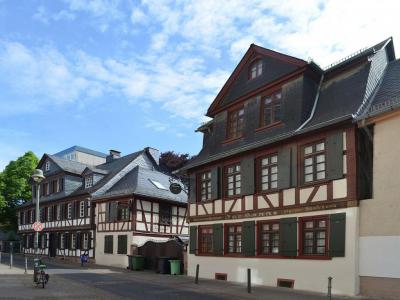
8) Berger Straße (must see)
Berger Straße stands as Frankfurt's lengthiest shopping avenue, spanning a distance of 2.9 kilometers. This road serves as a vital link connecting Frankfurt's city center to the Seckbach district, traversing through the Nordend and Bornheim districts.
The name "Berger Straße" traces its origins to the town of Bergen, which became part of the Frankfurt district of Bergen-Enkheim in 1977. This appellation has remained unchanged since 1862. Notably, it traverses the location formerly occupied by the Bornheimer Heide until the late 19th century, where Germany's inaugural hot air balloon flight took place in 1785.
The lower part of Berger Straße, extending from Friedberger Anlagen to Höhenstraße, plays host to the annual Bergerstraße festival during the summer. Furthermore, the Bornheim weekly market convenes on Wednesdays and Saturdays near the clock tower, situated close to the Bornheim Mitte subway station. The upper Berger Straße is a venue for both the Bornheim wine festival and the annual Bernemer Kerb (Bornheimer Kirmes).
Beginning at the Friedberger Anlagen, Berger Straße runs northeastward, offering a diverse streetscape. Toward the city center, the lower Berger Straße is characterized by a mix of fashionable bars, boutique shops, and specialty stores. A notable attraction in this section is Bethmann Park, which houses the Garden of Heavenly Peace, named by Tom Koenigs and one of the few Chinese gardens in Germany. Between Merianplatz and Höhenstraße, Berger Straße retains its distinctive charm, with a variety of shops and eateries managed by individual entrepreneurs.
Why You Should Visit:
To wander down when you're in need of interesting, vintage, independent shopping, plus bars, "best wurst in town", or basically anything out of the ordinary.
It's also a fabulous place to sit and people watch, which you can do for hours and get a real feel of this vibrant part of Frankfurt.
Tip:
Try "Rucola" down the street for good Italian food at one edge, and the special cinema at the other edge.
The name "Berger Straße" traces its origins to the town of Bergen, which became part of the Frankfurt district of Bergen-Enkheim in 1977. This appellation has remained unchanged since 1862. Notably, it traverses the location formerly occupied by the Bornheimer Heide until the late 19th century, where Germany's inaugural hot air balloon flight took place in 1785.
The lower part of Berger Straße, extending from Friedberger Anlagen to Höhenstraße, plays host to the annual Bergerstraße festival during the summer. Furthermore, the Bornheim weekly market convenes on Wednesdays and Saturdays near the clock tower, situated close to the Bornheim Mitte subway station. The upper Berger Straße is a venue for both the Bornheim wine festival and the annual Bernemer Kerb (Bornheimer Kirmes).
Beginning at the Friedberger Anlagen, Berger Straße runs northeastward, offering a diverse streetscape. Toward the city center, the lower Berger Straße is characterized by a mix of fashionable bars, boutique shops, and specialty stores. A notable attraction in this section is Bethmann Park, which houses the Garden of Heavenly Peace, named by Tom Koenigs and one of the few Chinese gardens in Germany. Between Merianplatz and Höhenstraße, Berger Straße retains its distinctive charm, with a variety of shops and eateries managed by individual entrepreneurs.
Why You Should Visit:
To wander down when you're in need of interesting, vintage, independent shopping, plus bars, "best wurst in town", or basically anything out of the ordinary.
It's also a fabulous place to sit and people watch, which you can do for hours and get a real feel of this vibrant part of Frankfurt.
Tip:
Try "Rucola" down the street for good Italian food at one edge, and the special cinema at the other edge.
