Custom Walk in Philadelphia, Pennsylvania by 777merbear_956d4c created on 2026-03-29
Guide Location: USA » Philadelphia
Guide Type: Custom Walk
# of Sights: 6
Tour Duration: 2 Hour(s)
Travel Distance: 4.6 Km or 2.9 Miles
Share Key: VLXQF
Guide Type: Custom Walk
# of Sights: 6
Tour Duration: 2 Hour(s)
Travel Distance: 4.6 Km or 2.9 Miles
Share Key: VLXQF
How It Works
Please retrieve this walk in the GPSmyCity app. Once done, the app will guide you from one tour stop to the next as if you had a personal tour guide. If you created the walk on this website or come to the page via a link, please follow the instructions below to retrieve the walk in the app.
Retrieve This Walk in App
Step 1. Download the app "GPSmyCity: Walks in 1K+ Cities" on Apple App Store or Google Play Store.



Step 2. In the GPSmyCity app, download(or launch) the guide "Philadelphia Map and Walking Tours".
Step 3. Tap the menu button located at upper right corner of the "Walks" screen and select "Retrieve custom walk". Enter the share key: VLXQF
1) Liberty Bell (must see)
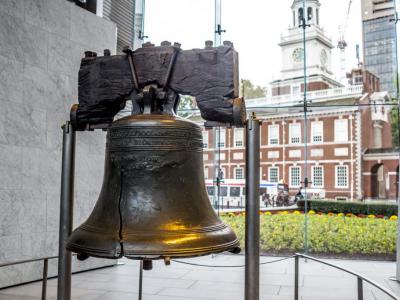
The Liberty Bell, an iconic symbol of American freedom and independence, has a rich and storied history closely tied to Philadelphia, Pennsylvania. Cast in 1752 by the Whitechapel Bell Foundry in London, England, the bell was originally commissioned to mark the 50th anniversary of Pennsylvania's original constitution and to symbolize the ideals of liberty and justice.
Initially hung in the Pennsylvania State House (now known as Independence Hall), the bell gained fame not only for its impressive size and sound but also for its role in important historical events. One popular but apocryphal story links the Liberty Bell to the reading of the Declaration of Independence on July 4, 1776, claiming that it rang out to announce the birth of the new nation. While there is no historical evidence to support this specific event, the bell did gain significance as a symbol of American independence in the ensuing decades.
The bell's inscription, "Proclaim LIBERTY Throughout all the Land unto all the Inhabitants Thereof," from the Bible, became its defining feature and a powerful statement in support of abolitionist movements in the 19th century. Its association with the abolitionist cause led to the bell being dubbed the "Liberty Bell" around the 1830s.
By the mid-19th century, as the bell's structural integrity deteriorated, it was retired from active service. In 1852, it was moved to a pavilion near Independence Hall where it became an object of public veneration. During World War II, the bell's iconic status was further solidified as it was used as a symbol of liberty and freedom, inspiring war bond drives and patriotic sentiment.
Today, the Liberty Bell is housed in the Liberty Bell Center, part of Independence National Historical Park in Philadelphia. It continues to attract millions of visitors each year who come to see and reflect upon its enduring message of liberty, justice, and the ongoing struggle for equality.
Initially hung in the Pennsylvania State House (now known as Independence Hall), the bell gained fame not only for its impressive size and sound but also for its role in important historical events. One popular but apocryphal story links the Liberty Bell to the reading of the Declaration of Independence on July 4, 1776, claiming that it rang out to announce the birth of the new nation. While there is no historical evidence to support this specific event, the bell did gain significance as a symbol of American independence in the ensuing decades.
The bell's inscription, "Proclaim LIBERTY Throughout all the Land unto all the Inhabitants Thereof," from the Bible, became its defining feature and a powerful statement in support of abolitionist movements in the 19th century. Its association with the abolitionist cause led to the bell being dubbed the "Liberty Bell" around the 1830s.
By the mid-19th century, as the bell's structural integrity deteriorated, it was retired from active service. In 1852, it was moved to a pavilion near Independence Hall where it became an object of public veneration. During World War II, the bell's iconic status was further solidified as it was used as a symbol of liberty and freedom, inspiring war bond drives and patriotic sentiment.
Today, the Liberty Bell is housed in the Liberty Bell Center, part of Independence National Historical Park in Philadelphia. It continues to attract millions of visitors each year who come to see and reflect upon its enduring message of liberty, justice, and the ongoing struggle for equality.
2) Independence Hall (must see)
By the late 1720s, Philadelphia realized it was running a colony with big decisions to make, but was lacking a proper stage to make them—so, naturally, it decided to build one.
Construction began in 1732 on Chestnut Street, guided by architect Edmund Woolley, and by 1753, the Colonial Government of Pennsylvania moved in without hesitation. For nearly half a century, this was where the business of the province—and later the commonwealth—was handled, until the capital duties packed up and moved on in 1799.
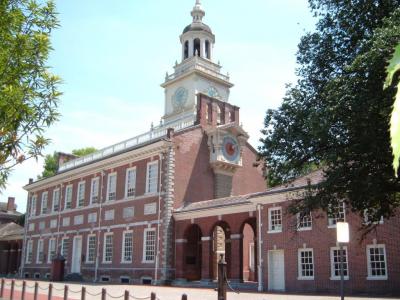
The building itself, now known as Independence Hall, keeps things elegantly symmetrical. Red brick, Georgian style, a central block crowned with a bell tower and a steeple rising 169 feet. Arcaded passageways link the main structure to its side wings, while nearby, Old City Hall, Congress Hall, and Philosophical Hall gather around Independence Square like a well-organized ensemble cast.
Inside, the layout is straightforward but loaded with history. The Assembly Room and Supreme Court Room sit on the ground floor, divided by a vestibule, with the Tower Stair Hall waiting just beyond the entrance. The interiors you see today are the result of careful restorations in the 19th and 20th centuries, all aimed at returning the building to its 18th-century look—because when your past includes founding a nation, you tend to preserve the décor...
And then, of course, came the moments. In June 1775, George Washington was appointed commander-in-chief of the Continental Army right here. A month later, Benjamin Franklin was named the first Postmaster General—arguably launching one of the longest-running institutions in American life. Between 1775 and 1783, this was the meeting place of the Second Continental Congress, where, on July 4, 1776, the Declaration of Independence was approved. Eleven years later, in 1787, the Constitution followed.
Since then, Independence Hall has remained more than just a historic building. It continues to serve as a backdrop for speeches, rallies, and protests—less a frozen monument, more an ongoing conversation about democracy, still very much in progress.
Construction began in 1732 on Chestnut Street, guided by architect Edmund Woolley, and by 1753, the Colonial Government of Pennsylvania moved in without hesitation. For nearly half a century, this was where the business of the province—and later the commonwealth—was handled, until the capital duties packed up and moved on in 1799.
The building itself, now known as Independence Hall, keeps things elegantly symmetrical. Red brick, Georgian style, a central block crowned with a bell tower and a steeple rising 169 feet. Arcaded passageways link the main structure to its side wings, while nearby, Old City Hall, Congress Hall, and Philosophical Hall gather around Independence Square like a well-organized ensemble cast.
Inside, the layout is straightforward but loaded with history. The Assembly Room and Supreme Court Room sit on the ground floor, divided by a vestibule, with the Tower Stair Hall waiting just beyond the entrance. The interiors you see today are the result of careful restorations in the 19th and 20th centuries, all aimed at returning the building to its 18th-century look—because when your past includes founding a nation, you tend to preserve the décor...
And then, of course, came the moments. In June 1775, George Washington was appointed commander-in-chief of the Continental Army right here. A month later, Benjamin Franklin was named the first Postmaster General—arguably launching one of the longest-running institutions in American life. Between 1775 and 1783, this was the meeting place of the Second Continental Congress, where, on July 4, 1776, the Declaration of Independence was approved. Eleven years later, in 1787, the Constitution followed.
Since then, Independence Hall has remained more than just a historic building. It continues to serve as a backdrop for speeches, rallies, and protests—less a frozen monument, more an ongoing conversation about democracy, still very much in progress.
3) Christ Church (must see)
Christ Church in Philadelphia dates back to 1695, when the Church of England set up shop in what was still very much a growing colonial town. Within a year, they had a wooden building up—but clearly, that didn’t hold the crowd for long. By the 1720s, they replaced it with something far more ambitious, creating what was considered one of the most elegant churches in the Thirteen Colonies.
The new parish became known as the “Nation’s Church,” and for good reason. Fifteen signers of the Declaration of Independence were part of this congregation. Names like George Washington, Benjamin Franklin, Robert Morris, and Betsy Ross all passed through these doors. If you’re wondering where they sat, you’re in luck—this place keeps receipts. Brass plaques mark their pews: Washington in #56, Franklin in #70, Betsy Ross in #12. No guessing required.
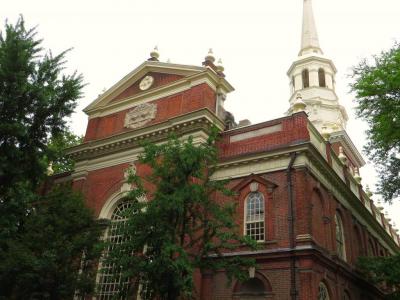
Architecturally, the church is themed around Georgian style, with a clear nod to Christopher Wren’s London designs—all that symmetry, tall arched windows, and a clean, orderly interior with fluted columns and rows of wooden pews. And instead of dramatic stained glass, you get clear windows—meaning plenty of natural light and a direct connection to the outside world. Revolutionary thinking, in more ways than one...
Construction stretched from 1727 to 1744, with the steeple added in 1754. At that point, it was the tallest building in what would become the United States, holding that title for over fifty years. Not bad for a church... Along the way, it saw changes, including a rebuild in 1777 and interior updates in 1883, but its overall character has held steady.
Step outside into the churchyard, and you’ll find the graves of Robert Morris and James Wilson, both signers of the Declaration of Independence. Today, Christ Church is still an active Episcopal parish and a National Historic Landmark, welcoming more than 250,000 visitors each year—so you won’t be the only one curious about who sat where...
And before you leave, take a moment to look at the artifacts. There’s a 14th-century baptismal font used for William Penn, the founder of Pennsylvania. Add in a rare book collection and communion pieces from the 1790s, and you start to realize: this place doesn’t just tell history—it quietly keeps it on display.
The new parish became known as the “Nation’s Church,” and for good reason. Fifteen signers of the Declaration of Independence were part of this congregation. Names like George Washington, Benjamin Franklin, Robert Morris, and Betsy Ross all passed through these doors. If you’re wondering where they sat, you’re in luck—this place keeps receipts. Brass plaques mark their pews: Washington in #56, Franklin in #70, Betsy Ross in #12. No guessing required.
Architecturally, the church is themed around Georgian style, with a clear nod to Christopher Wren’s London designs—all that symmetry, tall arched windows, and a clean, orderly interior with fluted columns and rows of wooden pews. And instead of dramatic stained glass, you get clear windows—meaning plenty of natural light and a direct connection to the outside world. Revolutionary thinking, in more ways than one...
Construction stretched from 1727 to 1744, with the steeple added in 1754. At that point, it was the tallest building in what would become the United States, holding that title for over fifty years. Not bad for a church... Along the way, it saw changes, including a rebuild in 1777 and interior updates in 1883, but its overall character has held steady.
Step outside into the churchyard, and you’ll find the graves of Robert Morris and James Wilson, both signers of the Declaration of Independence. Today, Christ Church is still an active Episcopal parish and a National Historic Landmark, welcoming more than 250,000 visitors each year—so you won’t be the only one curious about who sat where...
And before you leave, take a moment to look at the artifacts. There’s a 14th-century baptismal font used for William Penn, the founder of Pennsylvania. Add in a rare book collection and communion pieces from the 1790s, and you start to realize: this place doesn’t just tell history—it quietly keeps it on display.
4) Elfreth's Alley (must see)
In the 18th century, Philadelphia became a bustling city, overcrowded with artisans, tradesmen, shipwrights, metalsmiths, glassblowers, and furniture makers. As a result, the landowners Arthur Wells and John Gilbert started a cart path from Front Street to Second Street in 1703. The path became Elfreth's Alley, named after Jeremiah Elfreth, an 18th-century blacksmith and a man of property in young Philadelphia.
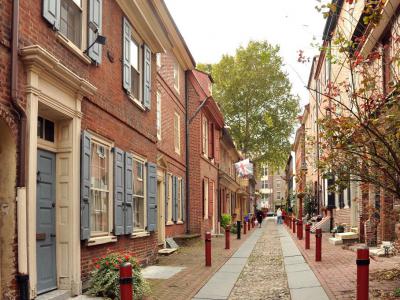
By the 1770s Georgian and Federal-style houses lined the cobblestone Alley. Many of the structures were uniquely Philadelphian Trinity houses. These were three-story houses, exceptionally narrow, with one room on each floor. The floors were referred to as "Father, Son, and Holy Ghost." And that is how Trinity houses got their name.
In the 19th and 20th centuries, the industry started to close in on the Alley. A stove factory took its place in a row of residential houses. Immigrants, hoping for jobs, came in waves. In 1934 the Elfreth's Alley Association (EAA) was founded by Alley resident Dolly Ottey. Ottey fought to combat the deterioration of the Alley by encroaching industry in the early 20th century.
Elfreth's Alley Museum is located in houses 124 and 126. The museum preserves the home of 18th-century dressmakers. Tour guides discuss other homes and inhabitants of the Alley. On "Fete Day" in early June, which celebrates Alley's diverse ethnic heritage, the residents open their homes. There are historical reenactments with drum and fife bands. The Alley also host events for the 4th of July, Oktoberfestivities, and Halloween.
By the 1770s Georgian and Federal-style houses lined the cobblestone Alley. Many of the structures were uniquely Philadelphian Trinity houses. These were three-story houses, exceptionally narrow, with one room on each floor. The floors were referred to as "Father, Son, and Holy Ghost." And that is how Trinity houses got their name.
In the 19th and 20th centuries, the industry started to close in on the Alley. A stove factory took its place in a row of residential houses. Immigrants, hoping for jobs, came in waves. In 1934 the Elfreth's Alley Association (EAA) was founded by Alley resident Dolly Ottey. Ottey fought to combat the deterioration of the Alley by encroaching industry in the early 20th century.
Elfreth's Alley Museum is located in houses 124 and 126. The museum preserves the home of 18th-century dressmakers. Tour guides discuss other homes and inhabitants of the Alley. On "Fete Day" in early June, which celebrates Alley's diverse ethnic heritage, the residents open their homes. There are historical reenactments with drum and fife bands. The Alley also host events for the 4th of July, Oktoberfestivities, and Halloween.
5) Betsy Ross House (must see)
The story goes that Mrs. Eizabeth Claypoole, also known as Betsy Ross, had a visit from George Washington in 1776. She persuaded him, some say, that a five-pointed star was better than a six-pointed star. Betsy was an upholsterer, and she had been making flags for the Pennsylvania Navy. Flags were her specialty.
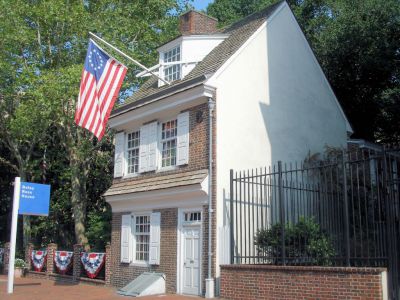
True or not, this captivating tale was told by her grandsons, William and George Canby, in the 1870s. People loved it, and it became a popular national legend. Number 239 Arch Street in Philadelphia is where Betsy is said to have lived with her third husband, John Claypoole. The house is a restoration done by architect Richardson Okie in 1940.
The "Betsy Ross" house that stands today may have been the house used by Betsy for her business. The residence of Betsy and her husband was adjacent to the present house. The houses next door were demolished and turned into a courtyard.
Richardson Okie used materials from the demolished houses in his restoration. A brick structure was built behind the house. Windows and a dormer were replaced. The whole property was gifted to the city of Philadelphia in 1941. In 1974 the courtyard was provided with a fountain.
As part of the American Bicentennial of 1976, city authorities moved the remains of Betsy and her husband, John Claypoole. They were reinterred in the courtyard of the Betsy Ross House. Betsy is thought to have resided in the house from 1776 until 1779.
John Ross, Betsy's first husband, a member of the militia, died in a gunpowder explosion. Her second husband, Joseph Ashburn, a mariner captured by the British, died in prison in Plymouth, England. John Claypoole was a fellow prisoner. He knew Ashburn. Betsy married Claypoole in 1783.
The Betsy Ross House is traditionally the site of Philadelphia's celebration of Flag Day. This legendary woman lived and worked here for a few short years when the Great Experiment began. Whatever else she may have done, she made flags.
True or not, this captivating tale was told by her grandsons, William and George Canby, in the 1870s. People loved it, and it became a popular national legend. Number 239 Arch Street in Philadelphia is where Betsy is said to have lived with her third husband, John Claypoole. The house is a restoration done by architect Richardson Okie in 1940.
The "Betsy Ross" house that stands today may have been the house used by Betsy for her business. The residence of Betsy and her husband was adjacent to the present house. The houses next door were demolished and turned into a courtyard.
Richardson Okie used materials from the demolished houses in his restoration. A brick structure was built behind the house. Windows and a dormer were replaced. The whole property was gifted to the city of Philadelphia in 1941. In 1974 the courtyard was provided with a fountain.
As part of the American Bicentennial of 1976, city authorities moved the remains of Betsy and her husband, John Claypoole. They were reinterred in the courtyard of the Betsy Ross House. Betsy is thought to have resided in the house from 1776 until 1779.
John Ross, Betsy's first husband, a member of the militia, died in a gunpowder explosion. Her second husband, Joseph Ashburn, a mariner captured by the British, died in prison in Plymouth, England. John Claypoole was a fellow prisoner. He knew Ashburn. Betsy married Claypoole in 1783.
The Betsy Ross House is traditionally the site of Philadelphia's celebration of Flag Day. This legendary woman lived and worked here for a few short years when the Great Experiment began. Whatever else she may have done, she made flags.
6) Rodin Museum (must see)
The Rodin Museum, situated in Philadelphia, is an art museum that boasts one of the largest collections of the renowned sculptor Auguste Rodin's creations outside of Paris.
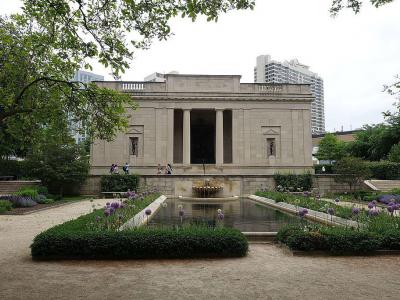
The museum was established as a gift to the city of Philadelphia by Jules Mastbaum (1872–1926), a prominent figure in the movie theater industry. In 1923, Mastbaum embarked on a mission to collect Rodin's works with the goal of creating a museum to enhance the cultural life of the city's residents. In just three years, he managed to assemble an impressive collection of Rodin's pieces, including bronze sculptures, plaster studies, drawings, prints, letters, and books. In 1926, Mastbaum enlisted the services of French architects Paul Cret and Jacques Gréber to design the museum building and its surrounding gardens. Unfortunately, Mastbaum did not live to see his vision come to fruition, but his widow, Etta Wedell Mastbaum, upheld his commitment to the city, and the museum officially opened its doors on November 29, 1929. Notably, the museum features murals created by the painter Franklin C. Watkins.
Prominently displayed in the museum's entry courtyard is one of Rodin's most famous works, "The Thinker" (1880–1882). Previously, visitors would enter through a replica of "The Gates of Hell," situated at the main entrance, which is no longer in use. This colossal bronze doorway, standing at a height of 5.5 meters, was initially conceived for the Museum of Decorative Arts, originally intended for Paris but never realized. Rodin meticulously sculpted over 100 figures for these doors from 1880 until his passing in 1917. The casting on display at the Rodin Museum is one of only three originals. Several of Rodin's iconic pieces, including "The Thinker," were initially conceived as studies for these doors and later evolved into independent works of art.
Throughout the museum's various rooms, visitors can explore a diverse array of Rodin's creations, including notable pieces such as "The Kiss" (1886), "Eternal Springtime" (1884), "The Age of Bronze" (1875–76), and "The Burghers of Calais," a monument commissioned by the City of Calais in 1884.
The museum was established as a gift to the city of Philadelphia by Jules Mastbaum (1872–1926), a prominent figure in the movie theater industry. In 1923, Mastbaum embarked on a mission to collect Rodin's works with the goal of creating a museum to enhance the cultural life of the city's residents. In just three years, he managed to assemble an impressive collection of Rodin's pieces, including bronze sculptures, plaster studies, drawings, prints, letters, and books. In 1926, Mastbaum enlisted the services of French architects Paul Cret and Jacques Gréber to design the museum building and its surrounding gardens. Unfortunately, Mastbaum did not live to see his vision come to fruition, but his widow, Etta Wedell Mastbaum, upheld his commitment to the city, and the museum officially opened its doors on November 29, 1929. Notably, the museum features murals created by the painter Franklin C. Watkins.
Prominently displayed in the museum's entry courtyard is one of Rodin's most famous works, "The Thinker" (1880–1882). Previously, visitors would enter through a replica of "The Gates of Hell," situated at the main entrance, which is no longer in use. This colossal bronze doorway, standing at a height of 5.5 meters, was initially conceived for the Museum of Decorative Arts, originally intended for Paris but never realized. Rodin meticulously sculpted over 100 figures for these doors from 1880 until his passing in 1917. The casting on display at the Rodin Museum is one of only three originals. Several of Rodin's iconic pieces, including "The Thinker," were initially conceived as studies for these doors and later evolved into independent works of art.
Throughout the museum's various rooms, visitors can explore a diverse array of Rodin's creations, including notable pieces such as "The Kiss" (1886), "Eternal Springtime" (1884), "The Age of Bronze" (1875–76), and "The Burghers of Calais," a monument commissioned by the City of Calais in 1884.
