Custom Walk in Stockholm, Sweden by johnfuller301_f2c37 created on 2026-04-24
Guide Location: Sweden » Stockholm
Guide Type: Custom Walk
# of Sights: 14
Tour Duration: 2 Hour(s)
Travel Distance: 1.8 Km or 1.1 Miles
Share Key: MJFBV
Guide Type: Custom Walk
# of Sights: 14
Tour Duration: 2 Hour(s)
Travel Distance: 1.8 Km or 1.1 Miles
Share Key: MJFBV
How It Works
Please retrieve this walk in the GPSmyCity app. Once done, the app will guide you from one tour stop to the next as if you had a personal tour guide. If you created the walk on this website or come to the page via a link, please follow the instructions below to retrieve the walk in the app.
Retrieve This Walk in App
Step 1. Download the app "GPSmyCity: Walks in 1K+ Cities" on Apple App Store or Google Play Store.



Step 2. In the GPSmyCity app, download(or launch) the guide "Stockholm Map and Walking Tours".
Step 3. Tap the menu button located at upper right corner of the "Walks" screen and select "Retrieve custom walk". Enter the share key: MJFBV
1) Royal Palace (must see)
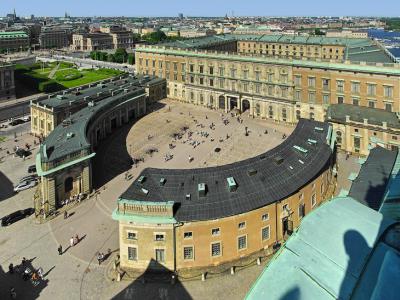
The Royal Palace in Stockholm, also known as Stockholm Palace, is the official residence of the Swedish monarch, although King Carl XVI Gustaf and Queen Silvia primarily reside at Drottningholm Palace. Situated in the Old Town of Stockholm (Gamla Stan), adjacent to the Parliament building, the Royal Palace is a significant ceremonial venue for the King in his role as head of state.
This historic site has served as a royal residence since the mid-13th century, originally home to the Three Crowns (Tre Kronor) Castle. Following a devastating fire in 1697, the current palace was constructed, with its completion delayed until 1754 due to the Great Northern War. The palace is one of the largest in the world, boasting over 1,400 rooms, including state and guest apartments, the Hall of State, the Royal Chapel, and several museums.
Visitors are welcomed by the Swedish Royal Guard, a tradition rooted in medieval Sweden, adding to the palace's majestic atmosphere. The palace’s interior is notable for its exquisite copper roof and houses significant cultural artifacts, including the Bernadotte Library, the Royal Armoury, and the Three Crowns Museum.
One of the most distinguished features is Gustav III's Museum of Antiquities, one of Europe’s oldest museums, which displays over 200 sculptures acquired by King Gustav III during his travels in Italy. The palace also offers a unique shopping experience at the Royal Gift Shop, where visitors can purchase exclusive items linked to the Royal Collections. The shop is open daily with free entry, making it a popular destination for both history enthusiasts and those seeking distinctive souvenirs.
Tip:
While the rooms are well-marked in English, it's always good to go on a guided tour for a more personalized experience.
The Treasury room, with all the regalia, would justify taking the tour as you get to learn more about what you're looking at.
This historic site has served as a royal residence since the mid-13th century, originally home to the Three Crowns (Tre Kronor) Castle. Following a devastating fire in 1697, the current palace was constructed, with its completion delayed until 1754 due to the Great Northern War. The palace is one of the largest in the world, boasting over 1,400 rooms, including state and guest apartments, the Hall of State, the Royal Chapel, and several museums.
Visitors are welcomed by the Swedish Royal Guard, a tradition rooted in medieval Sweden, adding to the palace's majestic atmosphere. The palace’s interior is notable for its exquisite copper roof and houses significant cultural artifacts, including the Bernadotte Library, the Royal Armoury, and the Three Crowns Museum.
One of the most distinguished features is Gustav III's Museum of Antiquities, one of Europe’s oldest museums, which displays over 200 sculptures acquired by King Gustav III during his travels in Italy. The palace also offers a unique shopping experience at the Royal Gift Shop, where visitors can purchase exclusive items linked to the Royal Collections. The shop is open daily with free entry, making it a popular destination for both history enthusiasts and those seeking distinctive souvenirs.
Tip:
While the rooms are well-marked in English, it's always good to go on a guided tour for a more personalized experience.
The Treasury room, with all the regalia, would justify taking the tour as you get to learn more about what you're looking at.
2) Stockholm Cathedral (must see)
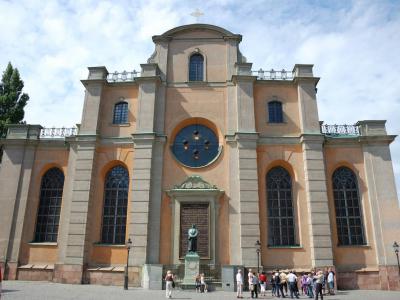
Stockholm Cathedral, also known as the Church of Saint Nicholas (Sankt Nikolai Kyrka), is the oldest and one of the most historically significant temples in Stockholm. Centrally located at the highest point of Old Town (Gamla Stan), it is flanked by the Stock Exchange Building and Stockholm Palace, forming an integral part of the city's Baroque architectural landscape.
The cathedral was consecrated in 1306, with its origins dating back to the 13th century. It features a late medieval hall interior, while the exterior showcases Baroque modifications added in the 18th century. As a crucial site during the Reformation, Stockholm Cathedral hosted the first Mass in the Swedish language. Since 1942, it has served as the seat of the Bishop of Stockholm, highlighting its ongoing religious importance.
The cathedral has a deep historical connection with the Swedish royal family, having served as the city's sole parish church for many centuries. It has been the venue for royal coronations and other significant ceremonies, including the wedding of Crown Princess Victoria in 2010. The cathedral continues to play a vital role in national events and memorials, such as the funeral of renowned Swedish author Astrid Lindgren.
Inside, the cathedral houses several significant artworks, including a medieval sculpture of Saint George and the Dragon and the Vädersolstavlan painting, one of the earliest depictions of Stockholm. The surrounding area of the cathedral is rich with historical courtyards and statues, including representations of Reason, Divine Love, Caution, and Hope. Additionally, a statue of Olaus Petri, a key figure in the Swedish Reformation, stands near the church's east facade, where the pavement also marks the former extent of a church choir demolished during the reign of King Gustav Vasa in the 16th century.
Why You Should Visit:
Architecturally interesting, culturally enriching, and very peaceful.
Tip:
Check for free organ recitals (usually at noon) and other events.
Make sure to pick up a brochure as it is very helpful in explaining several main focuses within the cathedral.
The cathedral was consecrated in 1306, with its origins dating back to the 13th century. It features a late medieval hall interior, while the exterior showcases Baroque modifications added in the 18th century. As a crucial site during the Reformation, Stockholm Cathedral hosted the first Mass in the Swedish language. Since 1942, it has served as the seat of the Bishop of Stockholm, highlighting its ongoing religious importance.
The cathedral has a deep historical connection with the Swedish royal family, having served as the city's sole parish church for many centuries. It has been the venue for royal coronations and other significant ceremonies, including the wedding of Crown Princess Victoria in 2010. The cathedral continues to play a vital role in national events and memorials, such as the funeral of renowned Swedish author Astrid Lindgren.
Inside, the cathedral houses several significant artworks, including a medieval sculpture of Saint George and the Dragon and the Vädersolstavlan painting, one of the earliest depictions of Stockholm. The surrounding area of the cathedral is rich with historical courtyards and statues, including representations of Reason, Divine Love, Caution, and Hope. Additionally, a statue of Olaus Petri, a key figure in the Swedish Reformation, stands near the church's east facade, where the pavement also marks the former extent of a church choir demolished during the reign of King Gustav Vasa in the 16th century.
Why You Should Visit:
Architecturally interesting, culturally enriching, and very peaceful.
Tip:
Check for free organ recitals (usually at noon) and other events.
Make sure to pick up a brochure as it is very helpful in explaining several main focuses within the cathedral.
3) Stortorget (Great Square) (must see)
Contrary to its name, Stockholm's "Great Square" (Stortorget) was never a stylish showpiece unlike the ones in many other European cities during the Middle Ages. It was created gradually, with the surrounding buildings added haphazardly throughout the years.
Nowadays, this is the city's oldest square and an artistic and shopping hub, particularly renowned for its annual Christmas market with fun shows, traditional handicrafts, and culinary delights.
It is also the location of the Stock Exchange Building (Börshuset) – home to the Swedish Academy, the Nobel Museum, and the Nobel Library – built in 1773 through 1776. The nearby well dried up in 1856 due to land elevation. It was then relocated to another square (Brunkebergstorg) but eventually moved back to its original location in the 1950s, and has been connected to the city water conduit ever since.
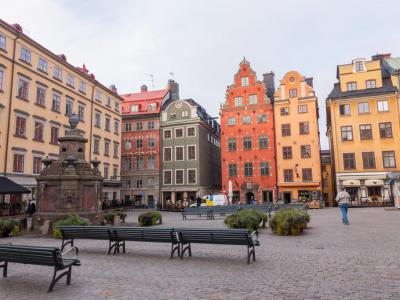
Great Square sits at the highest point in Stockholm and presents a carefully restored rendition of the historical buildings. Among them is house No. 3 constructed in the 1640s, commonly known as Grill House (Grillska Huset), named after its owner, Antoni Grill. The nearby building No. 5 was also Grill's property. The buildings at numbers 18 and 20 were merged into one in the 17th century and named for Johan Eberhard Schantz, the secretary of King Charles X Gustavus. House No. 22, on the left side of the square, once occupied by one of the closest friends of King Charles XI, was built in 1758 and is easily identified by its green color.
The square had a violent history, ill-famed as the location of the Stockholm Bloodbath, which took place in 1520 and resulted in the beheadings of over 80 noblemen. Their bodies were left there to bleed out, leaving pools of blood running throughout the town. Eww...(((
Indeed, the antique cobblestones of Great Square make you feel like stepping back into the times of Old Sweden, with the pastel buildings mimicking the colors commonplace in those days.
Tip:
Make sure to stand in the middle and look all around you.
Nowadays, this is the city's oldest square and an artistic and shopping hub, particularly renowned for its annual Christmas market with fun shows, traditional handicrafts, and culinary delights.
It is also the location of the Stock Exchange Building (Börshuset) – home to the Swedish Academy, the Nobel Museum, and the Nobel Library – built in 1773 through 1776. The nearby well dried up in 1856 due to land elevation. It was then relocated to another square (Brunkebergstorg) but eventually moved back to its original location in the 1950s, and has been connected to the city water conduit ever since.
Great Square sits at the highest point in Stockholm and presents a carefully restored rendition of the historical buildings. Among them is house No. 3 constructed in the 1640s, commonly known as Grill House (Grillska Huset), named after its owner, Antoni Grill. The nearby building No. 5 was also Grill's property. The buildings at numbers 18 and 20 were merged into one in the 17th century and named for Johan Eberhard Schantz, the secretary of King Charles X Gustavus. House No. 22, on the left side of the square, once occupied by one of the closest friends of King Charles XI, was built in 1758 and is easily identified by its green color.
The square had a violent history, ill-famed as the location of the Stockholm Bloodbath, which took place in 1520 and resulted in the beheadings of over 80 noblemen. Their bodies were left there to bleed out, leaving pools of blood running throughout the town. Eww...(((
Indeed, the antique cobblestones of Great Square make you feel like stepping back into the times of Old Sweden, with the pastel buildings mimicking the colors commonplace in those days.
Tip:
Make sure to stand in the middle and look all around you.
4) Gamla Stan (Old Town) (must see)
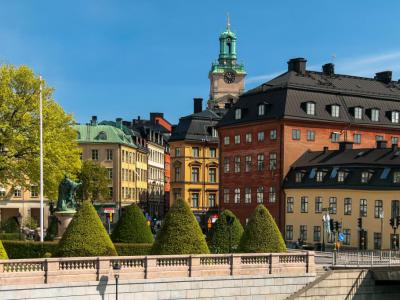
The Old Town (Gamla Stan) is the historic heart of Stockholm. Officially known until 1980 as "the Town between the Bridges," this area is situated primarily on the island of Stadsholmen. Although the name Gamla Stan is colloquially used to refer to the entire Old Town, it also officially includes the surrounding islets of Riddarholmen, Helgeandsholmen, and Strömsborg. The area is home to approximately 3,000 residents.
Dating back to the 13th century, Old Town is a well-preserved medieval district, characterized by its narrow alleyways, cobblestone streets, and historical architecture. The influence of North German architectural styles is particularly evident in many of the buildings. The area has been shaped by some of Sweden’s most notable architects, such as Nicodemus Tessin and Carl Hårleman, who played key roles in the construction of significant landmarks like the Stockholm Palace.
Old Town is rich in historical buildings, including the Stockholm Stock Exchange Building, Bonde Palace (the seat of the Swedish Supreme Court), and the House of Nobility, which once hosted the Swedish parliament. In the heart of Old Town lies Stortorget, a picturesque large square surrounded by old merchants' houses and notable buildings such as the Stockholm Stock Exchange Building. Stortorget is also infamous as the site of the Stockholm Bloodbath of 1520, where Danish King Christian II ordered the execution of Swedish noblemen, leading to a revolt that eventually dissolved the Kalmar Union and saw the rise of King Gustav I.
Key landmarks in Old Town include the Stockholm Cathedral, the Nobel Museum, and the Riddarholm Church, which is the royal burial church. Another significant site is the Royal Palace, which was constructed in the 18th century after the previous palace, Tre Kronor, was destroyed by fire. The House of Nobility (Riddarhuset), located in the north-western part of Old Town, is another historic structure of note.
Old Town is also home to one of the world's oldest continuously operating restaurants, Den Gyldene Freden, located on Österlånggatan. Established in 1722, it has maintained its original environment and is now owned by the Swedish Nobel Academy, which holds weekly luncheons there. The Stockholm Cathedral houses the famous statue of Saint George and the Dragon, sculpted by Bernt Notke, while the Riddarholm Church (Riddarholmskyrkan) serves as the royal burial church.
Tip:
Some streets can be a bit too touristy to handle, so try and stay away from the beaten tracks and explore a bit, or come in the morning for a stroll.
If you look beyond the tourist shops, there are quite a few nice little fascinating stores.
Dating back to the 13th century, Old Town is a well-preserved medieval district, characterized by its narrow alleyways, cobblestone streets, and historical architecture. The influence of North German architectural styles is particularly evident in many of the buildings. The area has been shaped by some of Sweden’s most notable architects, such as Nicodemus Tessin and Carl Hårleman, who played key roles in the construction of significant landmarks like the Stockholm Palace.
Old Town is rich in historical buildings, including the Stockholm Stock Exchange Building, Bonde Palace (the seat of the Swedish Supreme Court), and the House of Nobility, which once hosted the Swedish parliament. In the heart of Old Town lies Stortorget, a picturesque large square surrounded by old merchants' houses and notable buildings such as the Stockholm Stock Exchange Building. Stortorget is also infamous as the site of the Stockholm Bloodbath of 1520, where Danish King Christian II ordered the execution of Swedish noblemen, leading to a revolt that eventually dissolved the Kalmar Union and saw the rise of King Gustav I.
Key landmarks in Old Town include the Stockholm Cathedral, the Nobel Museum, and the Riddarholm Church, which is the royal burial church. Another significant site is the Royal Palace, which was constructed in the 18th century after the previous palace, Tre Kronor, was destroyed by fire. The House of Nobility (Riddarhuset), located in the north-western part of Old Town, is another historic structure of note.
Old Town is also home to one of the world's oldest continuously operating restaurants, Den Gyldene Freden, located on Österlånggatan. Established in 1722, it has maintained its original environment and is now owned by the Swedish Nobel Academy, which holds weekly luncheons there. The Stockholm Cathedral houses the famous statue of Saint George and the Dragon, sculpted by Bernt Notke, while the Riddarholm Church (Riddarholmskyrkan) serves as the royal burial church.
Tip:
Some streets can be a bit too touristy to handle, so try and stay away from the beaten tracks and explore a bit, or come in the morning for a stroll.
If you look beyond the tourist shops, there are quite a few nice little fascinating stores.
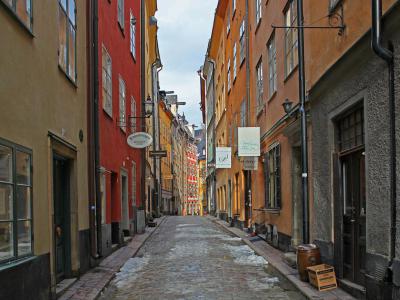
5) Kindstugatan
Kindstugatan, a historic street in Stockholm, offers a fascinating journey back in time, with its origins tracing back to the medieval era. Originally known as Tverru Gatu, or "Cross Street," it once connected the eastern city gate near the current location of Köpmantorget to a western gate, beyond which the street continues as Tyska Brinken. This ancient thoroughfare is lined with buildings that carry deep historical significance, reflecting a rich tapestry of Stockholm's past.
One of the most notable buildings on Kindstugatan is Törnska huset at Number 4, a 17th-century gray structure. It features two distinct portals: the left, from the 17th century with 19th-century updates, and the right, originally an entrance, now a window. A cartouche reads, "God helps those who let Him." This honors Olof Hansson Törne, a self-made mayor later ennobled as Törnflycht. His thirteen children continued his legacy in prominent government roles.
At Number 8, the wall anchors reveal the origins of a building from 1657, once home to Johan von Hoorn, a distinguished physician who served Swedish Queen Ulrika Eleonora the Elder. Von Hoorn is renowned for introducing obstetrics to Sweden and for his 1697 publication, The Well-Trained Swedish Midwife, a pioneering work that significantly contributed to reducing maternal mortality in Sweden.
Further down the street, the rose-colored building at Number 14 marks the former site of the tavern Fimmelstången, where the celebrated Swedish poet Lasse Lucidor met a tragic end in a fight in 1674. Lucidor, known for his hymns, spiritual songs, and realistic portrayals of life’s hardships, is best remembered for his poignant poem "I would be a fool to grieve".
The architectural styles along Kindstugatan are a visual feast, featuring a mix of Rococo, Baroque, and Renaissance designs. The well-preserved cobblestones and lush green landscaping further enhance the street's charm, making it a remarkable blend of history, architecture, and culture in the heart of Stockholm's Old Town.
One of the most notable buildings on Kindstugatan is Törnska huset at Number 4, a 17th-century gray structure. It features two distinct portals: the left, from the 17th century with 19th-century updates, and the right, originally an entrance, now a window. A cartouche reads, "God helps those who let Him." This honors Olof Hansson Törne, a self-made mayor later ennobled as Törnflycht. His thirteen children continued his legacy in prominent government roles.
At Number 8, the wall anchors reveal the origins of a building from 1657, once home to Johan von Hoorn, a distinguished physician who served Swedish Queen Ulrika Eleonora the Elder. Von Hoorn is renowned for introducing obstetrics to Sweden and for his 1697 publication, The Well-Trained Swedish Midwife, a pioneering work that significantly contributed to reducing maternal mortality in Sweden.
Further down the street, the rose-colored building at Number 14 marks the former site of the tavern Fimmelstången, where the celebrated Swedish poet Lasse Lucidor met a tragic end in a fight in 1674. Lucidor, known for his hymns, spiritual songs, and realistic portrayals of life’s hardships, is best remembered for his poignant poem "I would be a fool to grieve".
The architectural styles along Kindstugatan are a visual feast, featuring a mix of Rococo, Baroque, and Renaissance designs. The well-preserved cobblestones and lush green landscaping further enhance the street's charm, making it a remarkable blend of history, architecture, and culture in the heart of Stockholm's Old Town.
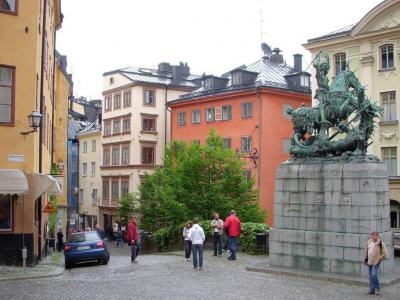
6) Köpmanbrinken (Merchant's Slope)
Merchant's Slope (Köpmanbrinken) is a historic street located in Stockholm's Old Town (Gamla Stan). This street is unique as it consists of two distinct slopes that were unified under the current name in 1885, following the creation of Merchant's Square (Köpmantorget) which separates them.
The northern slope of Merchant's Slope has a rich history, once known as Fishing Shore Slope (Fiskestrandsbrinken), due to its proximity to the city's primary fish market during the Middle Ages, from 1413 to 1520. This market, located to the east of the slope, played a crucial role in the city's daily life, highlighting the area's importance as a bustling center of commerce.
As you walk along Merchant's Slope, one of the most striking features is the statue of Saint George and the Dragon. This bronze replica, cast in 1912, is a copy of the original medieval sculpture housed in Stockholm Cathedral. The statue depicts a young Saint George, dressed in full battle armor, valiantly fighting a dragon. While the replica stays true to the spirit of the original from 1489, it introduces several alterations, such as modifications to the knight's helmet and the dragon's position. The statue is mounted on a plinth adorned with reliefs depicting the martyrdom of Saint George, adding to its historical and artistic significance.
Number 17 Köpmanbrinken stands out for its early 20th-century design, completed in 1902. The building accommodates a mix of ground-floor shops, office spaces, and residences. It also houses the restaurant "Pontus in the Green House," which adds a modern touch with its distinctive color scheme. Flanking this building are two alleys with historical significance: Nygränd (New Alley) and Brunnsgränd (Well's Alley). Although Brunnsgränd suggests the presence of a well, none exists, adding a bit of historical curiosity to the area.
The northern slope of Merchant's Slope has a rich history, once known as Fishing Shore Slope (Fiskestrandsbrinken), due to its proximity to the city's primary fish market during the Middle Ages, from 1413 to 1520. This market, located to the east of the slope, played a crucial role in the city's daily life, highlighting the area's importance as a bustling center of commerce.
As you walk along Merchant's Slope, one of the most striking features is the statue of Saint George and the Dragon. This bronze replica, cast in 1912, is a copy of the original medieval sculpture housed in Stockholm Cathedral. The statue depicts a young Saint George, dressed in full battle armor, valiantly fighting a dragon. While the replica stays true to the spirit of the original from 1489, it introduces several alterations, such as modifications to the knight's helmet and the dragon's position. The statue is mounted on a plinth adorned with reliefs depicting the martyrdom of Saint George, adding to its historical and artistic significance.
Number 17 Köpmanbrinken stands out for its early 20th-century design, completed in 1902. The building accommodates a mix of ground-floor shops, office spaces, and residences. It also houses the restaurant "Pontus in the Green House," which adds a modern touch with its distinctive color scheme. Flanking this building are two alleys with historical significance: Nygränd (New Alley) and Brunnsgränd (Well's Alley). Although Brunnsgränd suggests the presence of a well, none exists, adding a bit of historical curiosity to the area.
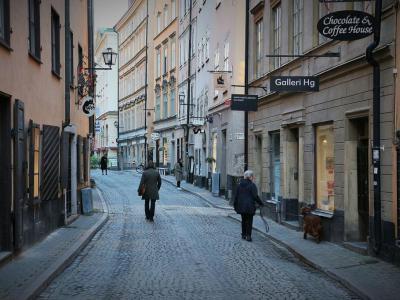
7) Österlånggatan (Eastern Long Street)
Eastern Long Street (Österlånggatan) is a historic thoroughfare located in the Old Town (Gamla Stan) of Stockholm. Its origins trace back to the 13th century when it served as a pathway along the eastern shoreline just outside the city's original walls. Over the centuries, significant changes transformed this street from a coastal road into a central artery of urban life, as land reclamation projects pushed the shoreline further eastward. This evolution turned Eastern Long Street into a bustling area lined with workshops, stores, and residences.
During the 17th century, the street became famous for its numerous taverns, which were particularly popular among the business crowd of the time. Of these taverns, only "The Golden Peace" (Den Gyldene Freden) at Number 51 remains today. Established in 1722, it holds a place in the Guinness Book of Records as one of the oldest restaurants with its interior largely unchanged since its founding. Despite its now peaceful and charming ambiance, Den Gyldene Freden's history is steeped in the rough and tumultuous life of the area, which was once notorious for its filth, stench, and frequent brawls.
As the centuries progressed, the street's connection to the shipping trade dwindled, and by the early 20th century, nearly all maritime-related activities had vanished. Today, Eastern Long Street is much quieter than in its bustling past, yet it still retains a significant amount of its historical charm.
Notable landmarks along the street include the Royal Coin Cabinet, which houses a collection of coins dating back to the 16th century, the Stockholm Concert Hall, and the Stockholm School of Economics. Additionally, Skipper Karl Alley (Skeppar Karls Gränd), named after a 16th-century skipper, serves as a reminder of the street's maritime heritage. Despite the passage of time and the changes that have occurred, Eastern Long Street remains a fascinating blend of history and modernity, offering a unique glimpse into Stockholm's rich past.
During the 17th century, the street became famous for its numerous taverns, which were particularly popular among the business crowd of the time. Of these taverns, only "The Golden Peace" (Den Gyldene Freden) at Number 51 remains today. Established in 1722, it holds a place in the Guinness Book of Records as one of the oldest restaurants with its interior largely unchanged since its founding. Despite its now peaceful and charming ambiance, Den Gyldene Freden's history is steeped in the rough and tumultuous life of the area, which was once notorious for its filth, stench, and frequent brawls.
As the centuries progressed, the street's connection to the shipping trade dwindled, and by the early 20th century, nearly all maritime-related activities had vanished. Today, Eastern Long Street is much quieter than in its bustling past, yet it still retains a significant amount of its historical charm.
Notable landmarks along the street include the Royal Coin Cabinet, which houses a collection of coins dating back to the 16th century, the Stockholm Concert Hall, and the Stockholm School of Economics. Additionally, Skipper Karl Alley (Skeppar Karls Gränd), named after a 16th-century skipper, serves as a reminder of the street's maritime heritage. Despite the passage of time and the changes that have occurred, Eastern Long Street remains a fascinating blend of history and modernity, offering a unique glimpse into Stockholm's rich past.
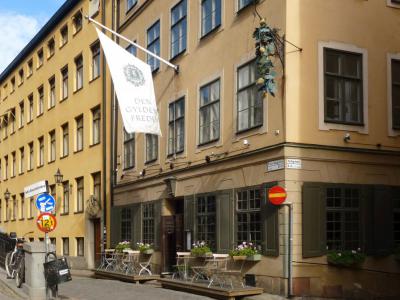
8) Den Gyldene Freden (The Golden Peace) Restaurant
The Golden Peace (Den Gyldene Freden), often affectionately referred to as "The Peace" by locals, is a renowned restaurant in Stockholm. Its name commemorates the Treaty of Nystad, which ended the Great Northern War between Russia and Sweden in 1721. This treaty resulted in Russia acquiring significant Swedish territories in the Baltics, but Sweden retained the larger territory of Finland, thus the "Golden" part of the name symbolizing this significant retention.
Established in 1722, Den Gyldene Freden holds the distinction of being the second oldest restaurant in the world to have preserved its original interior, making it a rare and authentic example of an 18th-century tavern. This historical significance has earned it a place in the Guinness Book of Records.
Over the centuries, Den Gyldene Freden has been a central hub for Sweden's cultural and literary figures, serving as a gathering spot for many renowned authors, painters, and songwriters. The restaurant initially gained fame through the songs of Carl Michael Bellman, an 18th-century national poet, and later through the works of 20th-century singer-songwriter Cornelis Vreeswijk.
Since 1901, the restaurant has been closely associated with the Nobel Prize in Literature. Each October, the Swedish Academy convenes at Golden Peace to announce the Nobel laureate in literature, further cementing the restaurant's place in Sweden's cultural and literary history.
Established in 1722, Den Gyldene Freden holds the distinction of being the second oldest restaurant in the world to have preserved its original interior, making it a rare and authentic example of an 18th-century tavern. This historical significance has earned it a place in the Guinness Book of Records.
Over the centuries, Den Gyldene Freden has been a central hub for Sweden's cultural and literary figures, serving as a gathering spot for many renowned authors, painters, and songwriters. The restaurant initially gained fame through the songs of Carl Michael Bellman, an 18th-century national poet, and later through the works of 20th-century singer-songwriter Cornelis Vreeswijk.
Since 1901, the restaurant has been closely associated with the Nobel Prize in Literature. Each October, the Swedish Academy convenes at Golden Peace to announce the Nobel laureate in literature, further cementing the restaurant's place in Sweden's cultural and literary history.
9) Marten Trotzigs Grand (Marten Trotzig's Alley)
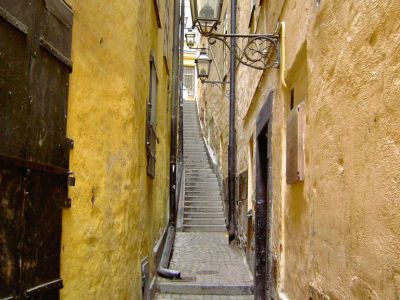
Marten Trotzig's Alley is a unique and historical street located in the heart of Stockholm's Old Town, Gamla Stan. This area is renowned for its charming, centuries-old buildings and labyrinthine streets that have stood the test of time. Mårten Trotzigs Alley is particularly notable for being the narrowest street in Stockholm, a characteristic that has made it a popular attraction for both locals and tourists.
The alleyway is so narrow that at its tightest point, it measures only 35 inches (about 90 centimeters) wide, barely allowing enough space for a person to pass through without brushing against the walls. This cramped passage is not just a walkway; it also includes a steep staircase that connects two of the main roads in Gamla Stan. The street is adorned with a few modest lamps hanging from the walls, adding to its quaint and historical atmosphere.
The name of the alley pays homage to Mårten Trotzig, a wealthy German merchant who settled in Stockholm during the 16th century. Trotzig amassed his fortune by trading in iron and copper, becoming one of the city's wealthiest citizens. He eventually purchased the land surrounding the alleyway and set up a shop there. Although the alley did not originally have a name, it quickly became associated with Trotzig, and thus it has carried his name ever since.
Mårten Trotzigs Alley remains a fascinating piece of Stockholm's history, offering a glimpse into the city's past and the daily life of its earlier inhabitants. Despite its narrowness, or perhaps because of it, the alley continues to captivate visitors who come to experience this small but significant piece of Gamla Stan.
The alleyway is so narrow that at its tightest point, it measures only 35 inches (about 90 centimeters) wide, barely allowing enough space for a person to pass through without brushing against the walls. This cramped passage is not just a walkway; it also includes a steep staircase that connects two of the main roads in Gamla Stan. The street is adorned with a few modest lamps hanging from the walls, adding to its quaint and historical atmosphere.
The name of the alley pays homage to Mårten Trotzig, a wealthy German merchant who settled in Stockholm during the 16th century. Trotzig amassed his fortune by trading in iron and copper, becoming one of the city's wealthiest citizens. He eventually purchased the land surrounding the alleyway and set up a shop there. Although the alley did not originally have a name, it quickly became associated with Trotzig, and thus it has carried his name ever since.
Mårten Trotzigs Alley remains a fascinating piece of Stockholm's history, offering a glimpse into the city's past and the daily life of its earlier inhabitants. Despite its narrowness, or perhaps because of it, the alley continues to captivate visitors who come to experience this small but significant piece of Gamla Stan.
10) Järntorget (The Iron Square)
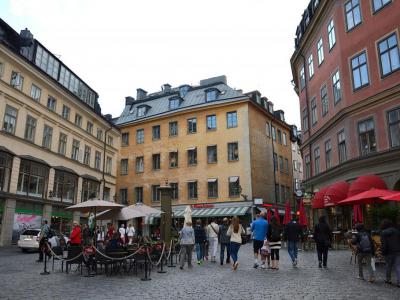
Järntorget, meaning "The Iron Square," is a historic public square located in the old town of Stockholm. This small but significant square serves as a crossroads where the main thoroughfares, Västerlånggatan and Österlånggatan, converge, with several alleys stretching out to connect it to other key areas such as Skeppsbron, Slussplan, and Kornhamnstorg.
Järntorget, dating back to around 1300, is Stockholm's second oldest square, just younger than Stortorget. Originally named Korntorget ("Grain Square"), it was renamed in 1489 as the iron trade overtook grain in importance. For centuries, the square was a hub of commerce, with merchants trading goods and official scales used to manage and tax iron, generating significant revenue for the city and monarchy.
Järntorget has undergone many changes throughout its history. In the Middle Ages, it was much larger, covering areas now occupied by additional buildings. By the 16th century, sheds were built along its eastern side, and in the 17th century, it became a hub for taverns like The Blue Eagle, The Lion, and The Griffin. Significant transformation occurred in the early 17th century when the city's scales moved to Södermalm, prompting the construction of taller, more prestigious buildings. In 1680, Södra Bankohuset, the world's oldest national bank building, was built on the square, designed by Nicodemus Tessin the Elder in the Italian Renaissance style.
The buildings around Järntorget hold rich histories. For example, Number 78, part of a former medieval alley, has elements dating back to the 17th century. Number 80 features an Art Nouveau façade shaped by renovations in the 20th century, while Number 84, home to Södra Bankohuset, stands as a testament to the square's financial legacy. Additionally, the square is adorned with a cast iron well, donated by the National Bank in 1829, modeled after a British prototype, and a statue of Swedish poet Evert Taube, created by Karl-Göte Bejemark in 1985.
Järntorget, dating back to around 1300, is Stockholm's second oldest square, just younger than Stortorget. Originally named Korntorget ("Grain Square"), it was renamed in 1489 as the iron trade overtook grain in importance. For centuries, the square was a hub of commerce, with merchants trading goods and official scales used to manage and tax iron, generating significant revenue for the city and monarchy.
Järntorget has undergone many changes throughout its history. In the Middle Ages, it was much larger, covering areas now occupied by additional buildings. By the 16th century, sheds were built along its eastern side, and in the 17th century, it became a hub for taverns like The Blue Eagle, The Lion, and The Griffin. Significant transformation occurred in the early 17th century when the city's scales moved to Södermalm, prompting the construction of taller, more prestigious buildings. In 1680, Södra Bankohuset, the world's oldest national bank building, was built on the square, designed by Nicodemus Tessin the Elder in the Italian Renaissance style.
The buildings around Järntorget hold rich histories. For example, Number 78, part of a former medieval alley, has elements dating back to the 17th century. Number 80 features an Art Nouveau façade shaped by renovations in the 20th century, while Number 84, home to Södra Bankohuset, stands as a testament to the square's financial legacy. Additionally, the square is adorned with a cast iron well, donated by the National Bank in 1829, modeled after a British prototype, and a statue of Swedish poet Evert Taube, created by Karl-Göte Bejemark in 1985.

11) Järntorgsgatan (Järntorg Street)
Järntorg Street (Järntorgsgatan) is a historically significant street in Gamla Stan, the old town of Stockholm. This street extends from Järntorget, the Old Iron Market, down to Slussplan, forming a key thoroughfare. It intersects with Norra Dryckesgränd and Södra Dryckesgränd and runs parallel to other notable streets like Triewaldsgränd and Skeppsbron.
The street has a rich history dating back hundreds of years and is one of the oldest and most densely populated areas in Stockholm. Historically, Järntorg Street was referred to as "Stora Gatan" or "The Big Street" because it was the main route connecting the city center to Södermalm. This name reflects its importance as a major artery for commerce and transportation.
Interestingly, until the 14th century, the waterfront cut through the present-day square at Järntorget, meaning that Järntorg Street did not exist in its current form. Over time, through land elevation and landfilling, the area expanded, and the street as it is known today began to take shape. The name Järntorg Street was first recorded in 1685 as "Jerntorgs gatun," highlighting its connection to the iron trade that was central to the area's economy.
Järntorg Street is lined with middle-class dwellings that have stood for centuries, giving the street a timeless character. It is a testament to Stockholm's historical growth and remains a vital part of the city's cultural heritage.
The street has a rich history dating back hundreds of years and is one of the oldest and most densely populated areas in Stockholm. Historically, Järntorg Street was referred to as "Stora Gatan" or "The Big Street" because it was the main route connecting the city center to Södermalm. This name reflects its importance as a major artery for commerce and transportation.
Interestingly, until the 14th century, the waterfront cut through the present-day square at Järntorget, meaning that Järntorg Street did not exist in its current form. Over time, through land elevation and landfilling, the area expanded, and the street as it is known today began to take shape. The name Järntorg Street was first recorded in 1685 as "Jerntorgs gatun," highlighting its connection to the iron trade that was central to the area's economy.
Järntorg Street is lined with middle-class dwellings that have stood for centuries, giving the street a timeless character. It is a testament to Stockholm's historical growth and remains a vital part of the city's cultural heritage.
12) Lilla Nygatan (Small New Street)
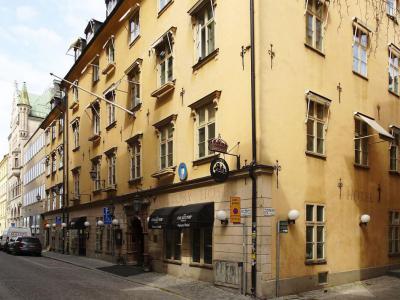
Lilla Nygatan, or "Small New Street," is a historic street located in Gamla Stan, the old town of Stockholm. This street dates back to the early 17th century, having been established as part of a new city plan following the devastating great fire of 1625. It is believed to have been laid out around 1630, and the name Lilla Nygatan became common in 1720.
In 1993, archaeological excavations at the junction of Lilla Nygatan and Tyska Brinken revealed significant historical remnants, including parts of an old city wall and what was initially thought to be a 14th-century defensive tower known as Bocktornet ("Buck (He-goat) Tower"). However, further studies suggest these structures more likely belong to a defensive system constructed in the 1560s. The old wall once ran diagonally across what is now Lilla Nygatan, creating an intriguing historical layer beneath the modern street.
One of the notable buildings on Lilla Nygatan is located at Number 6, which houses the Postmuseum. This museum is renowned for its extensive collection of historic postal and philatelic artifacts. The building itself has a rich history, having served as Stockholm's only post office from 1720 until the museum's establishment in 1906. The façade, designed by Fredrik Blom between 1820 and 1825, is distinguished by four green Ekeberg marble columns with Doric capitals, supporting a balcony adorned with sphinxes. The windows of the piano nobile are topped with pediments and corbels, while the upper levels of the building's exterior design become progressively simpler. The interior was modernized in 1986, and the entire building underwent significant restoration in 1999.
Lilla Nygatan thus encapsulates both the historical evolution of Stockholm's old town and the architectural heritage of the city, offering a glimpse into its past through the structures and stories preserved along this storied street.
In 1993, archaeological excavations at the junction of Lilla Nygatan and Tyska Brinken revealed significant historical remnants, including parts of an old city wall and what was initially thought to be a 14th-century defensive tower known as Bocktornet ("Buck (He-goat) Tower"). However, further studies suggest these structures more likely belong to a defensive system constructed in the 1560s. The old wall once ran diagonally across what is now Lilla Nygatan, creating an intriguing historical layer beneath the modern street.
One of the notable buildings on Lilla Nygatan is located at Number 6, which houses the Postmuseum. This museum is renowned for its extensive collection of historic postal and philatelic artifacts. The building itself has a rich history, having served as Stockholm's only post office from 1720 until the museum's establishment in 1906. The façade, designed by Fredrik Blom between 1820 and 1825, is distinguished by four green Ekeberg marble columns with Doric capitals, supporting a balcony adorned with sphinxes. The windows of the piano nobile are topped with pediments and corbels, while the upper levels of the building's exterior design become progressively simpler. The interior was modernized in 1986, and the entire building underwent significant restoration in 1999.
Lilla Nygatan thus encapsulates both the historical evolution of Stockholm's old town and the architectural heritage of the city, offering a glimpse into its past through the structures and stories preserved along this storied street.
13) Prästgatan (Priest’s Street)
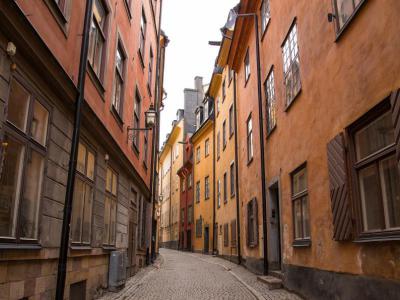
Prästgatan, known as "The Priest’s Street," is one of the most historically rich streets in Gamla Stan, the oldest section of Stockholm. This street's name harks back to the 16th century when it was home to several ecclesiastical figures, including three chaplains and a bell ringer. The parsonage built in 1708 still stands as a testament to the street's enduring religious significance.
One of the street’s most intriguing historical connections is its proximity to the Blackfriars monastery, which belonged to the Dominican Order, an order of the Roman Catholic Church founded by Saint Dominic in 1216. The monastery played a significant role in the spiritual life of Stockholm until it was ordered to be destroyed during the Protestant Reformation under the rule of King Gustav Vasa. The remnants of this monastery were partially uncovered during an archaeological excavation in 1991, revealing the front corner of the ancient structure.
Another fascinating aspect of Priest’s Street is the presence of a Viking-era runestone located at the corner where Kåkbrinken intersects the street. This runestone, dating back to around the year 1000, is one of the oldest artifacts in Stockholm and serves as a tangible link to the city’s Viking heritage. It is one of three runestones that can be found in Gamla Stan, offering visitors a unique historical treasure hunt as they explore the streets of this ancient district.
Priest’s Street is more than just a street; it is a journey through Stockholm's layered history, from its Viking roots to its medieval religious significance, making it a must-visit for anyone interested in the rich cultural tapestry of Sweden’s capital.
One of the street’s most intriguing historical connections is its proximity to the Blackfriars monastery, which belonged to the Dominican Order, an order of the Roman Catholic Church founded by Saint Dominic in 1216. The monastery played a significant role in the spiritual life of Stockholm until it was ordered to be destroyed during the Protestant Reformation under the rule of King Gustav Vasa. The remnants of this monastery were partially uncovered during an archaeological excavation in 1991, revealing the front corner of the ancient structure.
Another fascinating aspect of Priest’s Street is the presence of a Viking-era runestone located at the corner where Kåkbrinken intersects the street. This runestone, dating back to around the year 1000, is one of the oldest artifacts in Stockholm and serves as a tangible link to the city’s Viking heritage. It is one of three runestones that can be found in Gamla Stan, offering visitors a unique historical treasure hunt as they explore the streets of this ancient district.
Priest’s Street is more than just a street; it is a journey through Stockholm's layered history, from its Viking roots to its medieval religious significance, making it a must-visit for anyone interested in the rich cultural tapestry of Sweden’s capital.
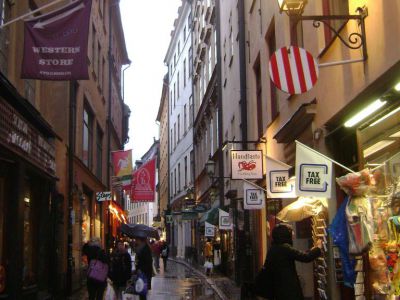
14) Västerlånggatan (Western Long Street)
Western Long Street (Västerlånggatan) is one of the most iconic and vibrant thoroughfares in Stockholm's Old Town (Gamla Stan). A bustling hub for tourists, the street's historical significance and picturesque charm make it a must-visit destination.
Historically, Western Long Street was part of a larger road known as "The Common Street" or "The Long Street," which connected both the western and eastern sides of the city, extending beyond the medieval city walls. Its current name was officially adopted in 1885, distinguishing it from its counterpart, Österlånggatan (Eastern Long Street).
In its earliest days, Western Long Street was a simple pathway tracing the shoreline, linking the northern and southern city gates. By the 15th century, it had evolved into a bustling, paved street, lined with homes and shops. The street played a vital role in the city's economic life, first hosting blacksmiths' and coppersmiths' workshops, which were pushed outside the city limits due to the risk of fire. Later, in the 17th century, goldsmiths established themselves here, bringing a touch of prestige to the area.
The 19th century saw significant transformations along Western Long Street. Medieval facades were modernized with plaster ornaments and imported cast iron colonettes, reflecting contemporary tastes. Large shop windows began to appear, showcasing lavish interiors and drawing the attention of passersby.
In the latter half of the 20th century, Western Long Street underwent further changes, as part of a broader revitalization effort. The arrival of hotels, upscale businesses, and restaurants replaced many of the older shops. These new establishments catered to the growing number of tourists, shifting the street's character but also ensuring its continued vibrancy.
Today, Western Long Street remains a lively blend of the old and new. It is a place where shoppers explore boutiques, pub-goers add to the street's boisterous atmosphere, and musicians provide a soundtrack to the daily life of both locals and visitors. Despite its evolution, the street has managed to retain its historic charm and continues to be a vital part of Stockholm's cultural fabric.
Historically, Western Long Street was part of a larger road known as "The Common Street" or "The Long Street," which connected both the western and eastern sides of the city, extending beyond the medieval city walls. Its current name was officially adopted in 1885, distinguishing it from its counterpart, Österlånggatan (Eastern Long Street).
In its earliest days, Western Long Street was a simple pathway tracing the shoreline, linking the northern and southern city gates. By the 15th century, it had evolved into a bustling, paved street, lined with homes and shops. The street played a vital role in the city's economic life, first hosting blacksmiths' and coppersmiths' workshops, which were pushed outside the city limits due to the risk of fire. Later, in the 17th century, goldsmiths established themselves here, bringing a touch of prestige to the area.
The 19th century saw significant transformations along Western Long Street. Medieval facades were modernized with plaster ornaments and imported cast iron colonettes, reflecting contemporary tastes. Large shop windows began to appear, showcasing lavish interiors and drawing the attention of passersby.
In the latter half of the 20th century, Western Long Street underwent further changes, as part of a broader revitalization effort. The arrival of hotels, upscale businesses, and restaurants replaced many of the older shops. These new establishments catered to the growing number of tourists, shifting the street's character but also ensuring its continued vibrancy.
Today, Western Long Street remains a lively blend of the old and new. It is a place where shoppers explore boutiques, pub-goers add to the street's boisterous atmosphere, and musicians provide a soundtrack to the daily life of both locals and visitors. Despite its evolution, the street has managed to retain its historic charm and continues to be a vital part of Stockholm's cultural fabric.
