Custom Walk in San Juan, Puerto Rico by kfsiv_b65c5d created on 2026-04-27
Guide Location: Puerto Rico » San Juan
Guide Type: Custom Walk
# of Sights: 7
Tour Duration: 2 Hour(s)
Travel Distance: 4.6 Km or 2.9 Miles
Share Key: CTVKY
Guide Type: Custom Walk
# of Sights: 7
Tour Duration: 2 Hour(s)
Travel Distance: 4.6 Km or 2.9 Miles
Share Key: CTVKY
How It Works
Please retrieve this walk in the GPSmyCity app. Once done, the app will guide you from one tour stop to the next as if you had a personal tour guide. If you created the walk on this website or come to the page via a link, please follow the instructions below to retrieve the walk in the app.
Retrieve This Walk in App
Step 1. Download the app "GPSmyCity: Walks in 1K+ Cities" on Apple App Store or Google Play Store.



Step 2. In the GPSmyCity app, download(or launch) the guide "San Juan Map and Walking Tours".
Step 3. Tap the menu button located at upper right corner of the "Walks" screen and select "Retrieve custom walk". Enter the share key: CTVKY
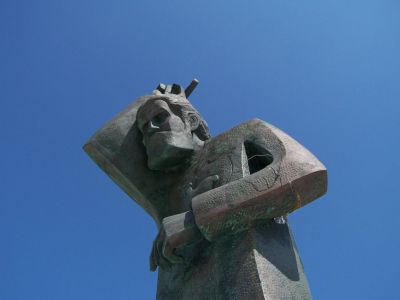
1) San Juan de Bautista Statue
The statue of San Juan de Bautista is located near the beautiful El Capitolio and historical Castillo de San Cristóbal. This statue is dedicated to John the Baptist, an itinerant preacher and prominent historical religious figure after whom the city was named.
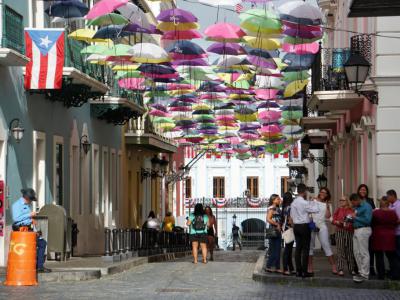
2) Calle de la Fortaleza (Fortaleza Street) (must see)
Proudly presiding over the bay of San Juan is the imposing La Fortaleza (Fortress), formally known as the Palace of Santa Catalina, the official residence of the Governor of Puerto Rico. The narrow road leading to the building, called Fortaleza Street, is the main artery of San Juan's historic quarter, cutting through most of it, and is also the oldest street in the area. It starts from Columbus Square and for the whole of its duration is lined with governmental buildings, hotels, perfumeries, craft shops, jewelry stores, and restaurants, gradually transforming into Avenue Juan Ponce de León in the east.
Just like many other colorful cobblestone streets in Old San Juan, each one more photogenic than the other, this thoroughfare is an important tourist attraction, in large part due to its historical and cultural significance. Visiting Fortaleza Street should be an integral part of every Old San Juan itinerary.
While the walled-in Old City has no shortage of vibrant photo spots, Fortaleza Street stands out above the rest due to the display of umbrellas – at the end of the street, near La Fortaleza itself – creating an overhead canopy that makes it particularly recognizable. These umbrellas tend to change colors during the year, from rainbow to all pink. Before the umbrellas, La Fortaleza Street was adorned with colorful kites.
Just like many other colorful cobblestone streets in Old San Juan, each one more photogenic than the other, this thoroughfare is an important tourist attraction, in large part due to its historical and cultural significance. Visiting Fortaleza Street should be an integral part of every Old San Juan itinerary.
While the walled-in Old City has no shortage of vibrant photo spots, Fortaleza Street stands out above the rest due to the display of umbrellas – at the end of the street, near La Fortaleza itself – creating an overhead canopy that makes it particularly recognizable. These umbrellas tend to change colors during the year, from rainbow to all pink. Before the umbrellas, La Fortaleza Street was adorned with colorful kites.
Sight description based on Wikipedia.
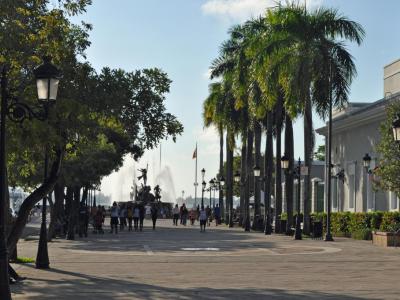
3) Paseo de la Princesa (Princess Promenade) (must see)
No trip to San Juan is complete without a stroll along the beautiful Princess Promenade, a carefully restored historic landmark, one of the most visited in the capital. Built in 1853, this esplanade skirts the curved city walls on the southern side of Old San Juan and is quite picture-perfect, with the San Juan Bay on the one side and the impressive fortification walls on the other.
The Promenade is equally suited for both walking and people-watching. It is also a great place to visit for families with children – easily accessible and traffic-free. The abundance of trees here provides plenty of shade, and there are lots of artisan stalls and street vendors selling local food. The area also often hosts festivals and fairs on weekends.
From here, you can make a slight detour to the narrow path, known as Paseo El Morro, leading to the historic El Morro Fort and the nearby San Juan Gate, which is the only city gate remaining from the colonial period.
Princess Promenade gets its name from an old 1837 building, located here, known as La Princesa. Originally, this building served as a municipal prison, although presently it houses the headquarters of the Puerto Rico Tourism Company and an art gallery.
The Promenade is equally suited for both walking and people-watching. It is also a great place to visit for families with children – easily accessible and traffic-free. The abundance of trees here provides plenty of shade, and there are lots of artisan stalls and street vendors selling local food. The area also often hosts festivals and fairs on weekends.
From here, you can make a slight detour to the narrow path, known as Paseo El Morro, leading to the historic El Morro Fort and the nearby San Juan Gate, which is the only city gate remaining from the colonial period.
Princess Promenade gets its name from an old 1837 building, located here, known as La Princesa. Originally, this building served as a municipal prison, although presently it houses the headquarters of the Puerto Rico Tourism Company and an art gallery.
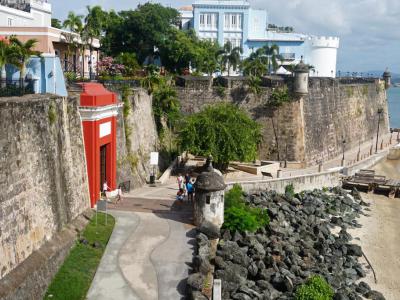
4) San Juan Gate and City Wall (must see)
Built in the late 1700s, the San Juan Gate is a giant (40 feet high) structure, the last remaining of the original five gates carved into the three-mile wall that once surrounded the city. Today, the wall wraps around Old San Juan, from the cruise ship piers on San Juan Harbor to the capitol on the Atlantic.
Originally, each gate had a designated function. The red gate of San Juan played a symbolic role, serving as the main entrance to the city, and was named in honor of Saint John the Baptist. The first thing you notice approaching it is the inscription of The Sanctus ("Holy") hymn from the Catholic liturgy.
The city wall is the most enduring symbol of Puerto Rico and was built by the Spanish between 1539 and 1782. Made of sandstone, rubble, and mortar blocks – 20 feet thick, the wall measures 45 feet wide and 40 feet high in some parts and was meant to protect San Juan from invaders, notably the English, the Dutch, and the Americans. Its iconic sentry boxes now symbolize the island's Spanish heritage and resilience in an ever-changing world.
Nearly impenetrable to foreign attack, the city wall proved defenseless, nonetheless, against modern automobile traffic, pollution, and misguided attempts to preserve it that have seriously endangered the wall, leaving it crumbling in some places.
Currently a National Historic Site, the city wall is maintained by the National Park Service which attempts to recreate the magic mixture of sand, water, and limestone that was once used to stucco the wall. Along with the adjoining fortresses of El Morro and San Cristóbal, the city wall attracts 1.2 million visitors each year.
Tip:
As you walk through the gate, just pause for a second and notice how thick the walls really are. Also, check out the street vendors outside, on the corner, offering refreshments including Puerto Ricans' favorite, piragua.
Originally, each gate had a designated function. The red gate of San Juan played a symbolic role, serving as the main entrance to the city, and was named in honor of Saint John the Baptist. The first thing you notice approaching it is the inscription of The Sanctus ("Holy") hymn from the Catholic liturgy.
The city wall is the most enduring symbol of Puerto Rico and was built by the Spanish between 1539 and 1782. Made of sandstone, rubble, and mortar blocks – 20 feet thick, the wall measures 45 feet wide and 40 feet high in some parts and was meant to protect San Juan from invaders, notably the English, the Dutch, and the Americans. Its iconic sentry boxes now symbolize the island's Spanish heritage and resilience in an ever-changing world.
Nearly impenetrable to foreign attack, the city wall proved defenseless, nonetheless, against modern automobile traffic, pollution, and misguided attempts to preserve it that have seriously endangered the wall, leaving it crumbling in some places.
Currently a National Historic Site, the city wall is maintained by the National Park Service which attempts to recreate the magic mixture of sand, water, and limestone that was once used to stucco the wall. Along with the adjoining fortresses of El Morro and San Cristóbal, the city wall attracts 1.2 million visitors each year.
Tip:
As you walk through the gate, just pause for a second and notice how thick the walls really are. Also, check out the street vendors outside, on the corner, offering refreshments including Puerto Ricans' favorite, piragua.
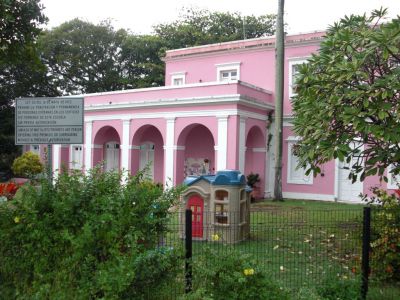
5) Casa Rosa (The Pink House)
Casa Rosa or Casa Rosada, also known as the Pink House, is a historic house located in Old San Juan. The house was built in 1812 as a barrack for the troops assigned to the San Agustin Bastion. It was converted to an officers quarters in 1881 by the Spanish Army. The building was later converted to a museum for Puerto Rican crafts. Today it operates as a day care center for the children of employees of the government of Puerto Rico.
Sight description based on Wikipedia.
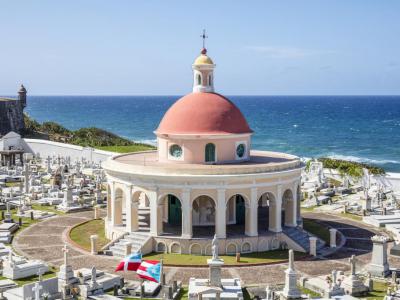
6) Santa María Magdalena de Pazzis Cemetery (must see)
Santa María Magdalena de Pazzis Cemetery is a colonial-era cemetery located in Old San Juan, Puerto Rico. It is the final resting place of many of Puerto Rico's most prominent natives and residents. Construction began in 1863 under the auspices of Ignacio Mascaro. The cemetery is located outside the walls of Fort San Felipe del Morro fortress, one of the island's most famous landmarks.
It was named in honor of Saint Maria Magdalena de Pazzi. The location of the cemetery is central to the Puerto Rican belief in the separation of death and life. The colonial Spanish government at the time the construction of the cemetery commenced, viewed death with fear because it was a mystery. Therefore, they decided to build the cemetery to overlook the Atlantic Ocean to symbolize the spirit's journey to cross over to the afterlife.
It was named in honor of Saint Maria Magdalena de Pazzi. The location of the cemetery is central to the Puerto Rican belief in the separation of death and life. The colonial Spanish government at the time the construction of the cemetery commenced, viewed death with fear because it was a mystery. Therefore, they decided to build the cemetery to overlook the Atlantic Ocean to symbolize the spirit's journey to cross over to the afterlife.
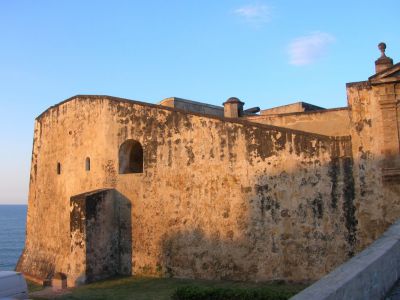
7) Castillo San Cristóbal (Fort San Cristobal) (must see)
Standing guard at the eastern gate, north of Columbus Square, is an imposing 18th-century fortress, called San Cristóbal. Contrary to her sister, El Morro, which was designed to protect from attacks by sea, the San Cristóbal Fort guarded the city against the enemy approaching by land, for which purpose it created a crossfire with El Morro over the bay. The citadel construction began in 1634 and was meant to strengthen the Spanish position in the face of imminent English and Dutch invasion.
The fort was named San Cristóbal in celebration of the Spanish victories which enabled ejecting of the English and Dutch interlopers from the island of the same name in the Lesser Antilles, which was then part of the insular territorial glacis of Puerto Rico.
When finished in 1783, the Fort San Cristóbal covered nearly 27 acres of land and practically wrapped around the whole of San Juan, with the entry to the city sealed by the San Cristóbal's double gates. After almost 100 years of relative peace, about a third of the fortification was demolished, in 1897, to help ease the flow of traffic in and out of the walled city.
The Fort San Cristóbal is now a listed National Historic Site. It is particularly worth visiting as the largest fortification ever built by the Spanish in the New World, where the first shots of the Spanish-American War were fired. If you're a keen photographer, San Cristobal is a goldmine of panoramic views of the coast, from Old San Juan to Condado and beyond.
Tip:
Guided tours by local rangers visit the extensive tunnel system connecting various sections of the fort. There is an exhibition of military clothing. Be sure to visit the overlook for the Devil's Sentry Box ("Garita del Diablo"), from which, according to legends, soldiers mysteriously disappeared. Tickets to San Cristobal or El Morro can be used to enter either of the forts.
The fort was named San Cristóbal in celebration of the Spanish victories which enabled ejecting of the English and Dutch interlopers from the island of the same name in the Lesser Antilles, which was then part of the insular territorial glacis of Puerto Rico.
When finished in 1783, the Fort San Cristóbal covered nearly 27 acres of land and practically wrapped around the whole of San Juan, with the entry to the city sealed by the San Cristóbal's double gates. After almost 100 years of relative peace, about a third of the fortification was demolished, in 1897, to help ease the flow of traffic in and out of the walled city.
The Fort San Cristóbal is now a listed National Historic Site. It is particularly worth visiting as the largest fortification ever built by the Spanish in the New World, where the first shots of the Spanish-American War were fired. If you're a keen photographer, San Cristobal is a goldmine of panoramic views of the coast, from Old San Juan to Condado and beyond.
Tip:
Guided tours by local rangers visit the extensive tunnel system connecting various sections of the fort. There is an exhibition of military clothing. Be sure to visit the overlook for the Devil's Sentry Box ("Garita del Diablo"), from which, according to legends, soldiers mysteriously disappeared. Tickets to San Cristobal or El Morro can be used to enter either of the forts.
Sight description based on Wikipedia.
