Custom Walk in Bologna, Italy by palbers1_666696 created on 2026-05-04
Guide Location: Italy » Bologna
Guide Type: Custom Walk
# of Sights: 10
Tour Duration: 4 Hour(s)
Travel Distance: 8.5 Km or 5.3 Miles
Share Key: 2X97W
Guide Type: Custom Walk
# of Sights: 10
Tour Duration: 4 Hour(s)
Travel Distance: 8.5 Km or 5.3 Miles
Share Key: 2X97W
How It Works
Please retrieve this walk in the GPSmyCity app. Once done, the app will guide you from one tour stop to the next as if you had a personal tour guide. If you created the walk on this website or come to the page via a link, please follow the instructions below to retrieve the walk in the app.
Retrieve This Walk in App
Step 1. Download the app "GPSmyCity: Walks in 1K+ Cities" on Apple App Store or Google Play Store.



Step 2. In the GPSmyCity app, download(or launch) the guide "Bologna Map and Walking Tours".
Step 3. Tap the menu button located at upper right corner of the "Walks" screen and select "Retrieve custom walk". Enter the share key: 2X97W
1) Piazza Maggiore (Main Square) (must see)
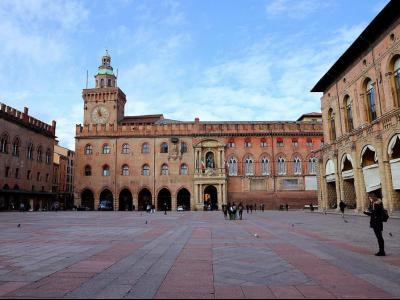
At the heart of Bologna lies the city’s main square and the historic center of its civic, religious, and social life for more than eight centuries. Created in its present form during the Middle Ages, the square developed from the late 13th century as Bologna grew into one of Europe’s most important university cities and a major political center of the Papal States. It expanded significantly in the 14th century, while many of the grand buildings surrounding it were added or remodeled during the 16th century.
On a sunny day, Main Square is one of the best places to experience Bologna’s atmosphere, with locals gathering at café tables beneath the arcades or relaxing on the broad steps around the square. Standing on the southern side is the impressive yet incomplete Basilica of Saint Petronius, one of the city’s most cherished landmarks. Around the square are several important historic buildings: the Municipal Palace, the former seat of Bologna’s government and now the city hall; the Notaries' Palace; the Podesta Palace, once the center of medieval administration; and the Palace of the Banks, which closes the eastern side of the square. At the center stands the Fountain of Neptune, featuring the famous bronze statue that has become one of Bologna’s best-known symbols.
A particularly interesting feature is the slightly raised platform in the middle of the square, known as the crescentone because its shape resembles the local flat bread crescente. Today, it becomes the setting for the "Under the Stars of Cinema'' festival in July and August, when more than 3,000 chairs transform Main Square into one of Italy’s largest outdoor cinemas.
Visitors should also explore the Vault of the Podesta, the passage beneath Podesta Palace, where a curious medieval acoustic effect allows two people standing at opposite corners to hear each other’s whispers clearly.
On a sunny day, Main Square is one of the best places to experience Bologna’s atmosphere, with locals gathering at café tables beneath the arcades or relaxing on the broad steps around the square. Standing on the southern side is the impressive yet incomplete Basilica of Saint Petronius, one of the city’s most cherished landmarks. Around the square are several important historic buildings: the Municipal Palace, the former seat of Bologna’s government and now the city hall; the Notaries' Palace; the Podesta Palace, once the center of medieval administration; and the Palace of the Banks, which closes the eastern side of the square. At the center stands the Fountain of Neptune, featuring the famous bronze statue that has become one of Bologna’s best-known symbols.
A particularly interesting feature is the slightly raised platform in the middle of the square, known as the crescentone because its shape resembles the local flat bread crescente. Today, it becomes the setting for the "Under the Stars of Cinema'' festival in July and August, when more than 3,000 chairs transform Main Square into one of Italy’s largest outdoor cinemas.
Visitors should also explore the Vault of the Podesta, the passage beneath Podesta Palace, where a curious medieval acoustic effect allows two people standing at opposite corners to hear each other’s whispers clearly.
2) Fontana del Nettuno (Fountain of Neptune) (must see)
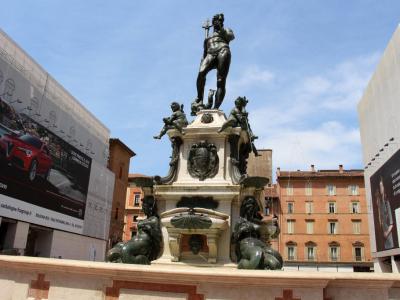
Standing between Neptune Square and Main Square, beside the medieval King Enzo Palace, the Fountain of Neptune is one of Bologna’s most recognizable Renaissance monuments. It was created between 1563 and 1566 after part of the existing city block was cleared to provide a suitably spacious setting. Architect Tommaso Laureti designed the fountain, while its elaborate bronze figures were made by Giambologna, the Flemish-born sculptor originally named Jean Boulogne, who developed much of his career in Florence. This ambitious commission helped establish his reputation as one of the leading sculptors of the late Renaissance.
Direct your gaze up to the top level of the monument to inspect the main figure. At the center rises the colossal figure of Neptune, affectionately known to Bolognese residents as "the Giant.'' The Roman god of the sea stands in a commanding pose above a basin faced with Verona marble, extending one hand as though calming the waters beneath him. The image was intended as a political allegory: just as Neptune ruled the seas, Pope Pius IV claimed authority over Bologna and the wider territories of the Church.
Next up, shift your focus downward to the base and perimeter of the stone pedestal. Walk around the fountain to examine its lively supporting figures. Four cherubs represent the winds, while four bronze female figures, often described as nereids or sirens, sit astride dolphins and spout water from their breasts. They traditionally symbolize four major rivers known to Europeans at the time-the Ganges, Nile, La Plata, and Danube-and therefore four parts of the known world.
A popular local legend concerns Neptune’s anatomy. Giambologna was reportedly prevented from making one feature of the statue as prominent as he wished, so he created an optical illusion instead. Stand on the specially marked paving stone near the entrance to Salaborsa Library and look toward Neptune from behind: from this carefully chosen angle, the extended thumb appears as a phallic projection from the figure’s lower body.
The fountain is best appreciated by circling it slowly, observing the contrast between Neptune’s solemn authority and the playful cherubs, dolphins, and water-spouting figures below.
Direct your gaze up to the top level of the monument to inspect the main figure. At the center rises the colossal figure of Neptune, affectionately known to Bolognese residents as "the Giant.'' The Roman god of the sea stands in a commanding pose above a basin faced with Verona marble, extending one hand as though calming the waters beneath him. The image was intended as a political allegory: just as Neptune ruled the seas, Pope Pius IV claimed authority over Bologna and the wider territories of the Church.
Next up, shift your focus downward to the base and perimeter of the stone pedestal. Walk around the fountain to examine its lively supporting figures. Four cherubs represent the winds, while four bronze female figures, often described as nereids or sirens, sit astride dolphins and spout water from their breasts. They traditionally symbolize four major rivers known to Europeans at the time-the Ganges, Nile, La Plata, and Danube-and therefore four parts of the known world.
A popular local legend concerns Neptune’s anatomy. Giambologna was reportedly prevented from making one feature of the statue as prominent as he wished, so he created an optical illusion instead. Stand on the specially marked paving stone near the entrance to Salaborsa Library and look toward Neptune from behind: from this carefully chosen angle, the extended thumb appears as a phallic projection from the figure’s lower body.
The fountain is best appreciated by circling it slowly, observing the contrast between Neptune’s solemn authority and the playful cherubs, dolphins, and water-spouting figures below.
3) Basilica di San Petronio (Basilica of Saint Petronius) (must see)
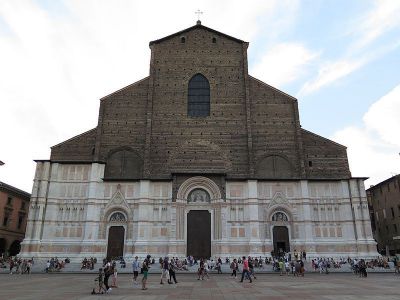
Dominating the southern side of Main Square, the Basilica of Saint Petronius is Bologna’s principal church and one of the largest Gothic basilicas in the world. Dedicated to Saint Petronius, the city’s fifth-century bishop and patron saint, the basilica was begun in 1390.
The original plans were extraordinarily ambitious. The basilica was intended to surpass even Saint Peter’s Basilica in Rome in size and become one of Christianity’s greatest churches. However, the project was halted after opposition from the papacy, particularly under Pope Pius IV, who redirected resources toward the creation of the nearby Archiginnasio. As a result, the façade was never completed. Its lower section is decorated with pink Verona marble panels, while the upper portion remains unfinished brick.
Before entering, stop right in the middle of the main facade to admire the central entrance. Masterfully sculpted between 1425 and 1438, it features highly expressive reliefs from the Bible, displaying detailed Old Testament scenes vertically flanking the doorway on the surrounding side pilasters, and New Testament stories detailed on the architrave directly above the entrance. These vivid carvings were heavily admired by Michelangelo, who later drew direct design inspiration from their raw musculature for his Sistine Chapel ceiling panels. Above the door frame, the top lunette depicts the Madonna and Child standing between Saint Petronius and Saint Ambrose.
Inside, the vast, airy Gothic interior contains 22 deep side chapels. As you enter the basilica, walk down the left aisle to the fourth bay on your left to locate the Bolognini Chapel, which houses Giovanni da Modena's dramatic 15th-century frescoes depicting heaven and hell.
Last but not least, peek down at the stone foor along the same aisle. You'll find the remarkable astronomical meridian line designed by the renowned astronomer Giovanni Domenico Cassini in 1655. Stretching exactly 66.8 meters, it stands as the longest indoor meridian line in the world, utilizing a pinhole camera effect where a shaft of sunlight passes through a small aperture 27 meters above the floor to track the solar noon with mathematical accuracy.
For panoramic views over Bologna’s rooftops and the Apennine hills, visit the recently renovated terrace, accessible from Galvani Square by elevator and a short flight of stairs.
The original plans were extraordinarily ambitious. The basilica was intended to surpass even Saint Peter’s Basilica in Rome in size and become one of Christianity’s greatest churches. However, the project was halted after opposition from the papacy, particularly under Pope Pius IV, who redirected resources toward the creation of the nearby Archiginnasio. As a result, the façade was never completed. Its lower section is decorated with pink Verona marble panels, while the upper portion remains unfinished brick.
Before entering, stop right in the middle of the main facade to admire the central entrance. Masterfully sculpted between 1425 and 1438, it features highly expressive reliefs from the Bible, displaying detailed Old Testament scenes vertically flanking the doorway on the surrounding side pilasters, and New Testament stories detailed on the architrave directly above the entrance. These vivid carvings were heavily admired by Michelangelo, who later drew direct design inspiration from their raw musculature for his Sistine Chapel ceiling panels. Above the door frame, the top lunette depicts the Madonna and Child standing between Saint Petronius and Saint Ambrose.
Inside, the vast, airy Gothic interior contains 22 deep side chapels. As you enter the basilica, walk down the left aisle to the fourth bay on your left to locate the Bolognini Chapel, which houses Giovanni da Modena's dramatic 15th-century frescoes depicting heaven and hell.
Last but not least, peek down at the stone foor along the same aisle. You'll find the remarkable astronomical meridian line designed by the renowned astronomer Giovanni Domenico Cassini in 1655. Stretching exactly 66.8 meters, it stands as the longest indoor meridian line in the world, utilizing a pinhole camera effect where a shaft of sunlight passes through a small aperture 27 meters above the floor to track the solar noon with mathematical accuracy.
For panoramic views over Bologna’s rooftops and the Apennine hills, visit the recently renovated terrace, accessible from Galvani Square by elevator and a short flight of stairs.
4) Palazzo del Podesta (Podesta Palace)
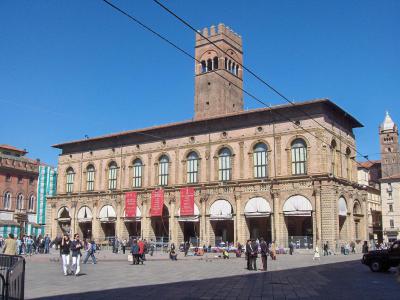
Facing the Main Square stands the elegant Podesta Palace, erected in the 13th century as the epicenter of political power. Alas, it quickly became evident that the place was too small for the business of governance, prompting the birth of the neighboring King Enzo Palace.
The Podesta Palace features a Renaissance porticoed facade, which replaced the original Gothic one, facing the Main Square and is distinguished by its brick tower, the Arengo Tower, originally erected to summon citizens in emergencies. Architecture enthusiasts should take note of the pillars of the portico, carved with a whopping 3,000 rosettes, each one as unique as a snowflake in a blizzard!
Beneath the vault, known as the Vault of the Podesta, terracotta statues of the town’s patron saints were once displayed. Today, visitors are drawn to the echo in the 'whispering gallery' - stand at one of the four corners of the arcade, whisper sweet nothings, and your voice will softly reverberate from the opposite corner. It's like having a secret conversation with yourself!
The Podesta Palace features a Renaissance porticoed facade, which replaced the original Gothic one, facing the Main Square and is distinguished by its brick tower, the Arengo Tower, originally erected to summon citizens in emergencies. Architecture enthusiasts should take note of the pillars of the portico, carved with a whopping 3,000 rosettes, each one as unique as a snowflake in a blizzard!
Beneath the vault, known as the Vault of the Podesta, terracotta statues of the town’s patron saints were once displayed. Today, visitors are drawn to the echo in the 'whispering gallery' - stand at one of the four corners of the arcade, whisper sweet nothings, and your voice will softly reverberate from the opposite corner. It's like having a secret conversation with yourself!
5) Mercato di Mezzo (Middle Market) (must see)
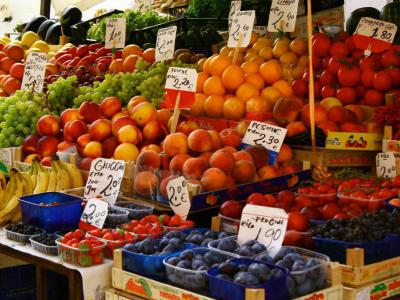
Located in the heart of Bologna’s historic Quadrilateral district, the Middle Market is one of the city’s oldest and most atmospheric food destinations. Tucked away just steps from Main Square, this area has preserved the lively commercial character it had during medieval times, when the streets were occupied by guilds of butchers, fishmongers, blacksmiths, goldsmiths, and furriers. Their legacy can still be seen in the names of surrounding streets, which recall the trades that once shaped this part of the city.
The market occupies a historic building on Clavature Street, one of Bologna’s narrow medieval streets lined with porticoes and traditional food shops. Originally created as a covered market in the 19th century, it replaced some of the open-air trading areas that had long operated in the neighborhood. After a period of decline, the building was restored and reopened in 2014 as a modern food hall, while maintaining its role as a gathering place where locals and visitors can enjoy Bologna’s culinary traditions.
Today, Middle Market offers an ideal introduction to the flavors of Emilia-Romagna. Visitors can wander between stalls and counters offering fresh pasta, handmade pastries, regional cheeses, cured meats such as pink Parma ham or the legendary Bologna Mortadella, traditional sauces, seafood, and local wines. The atmosphere encourages a little “gaze and graze” experience: sample a few cherries or peaches from a fruit stand, admire freshly prepared pasta, or stop for a small tapas-style bite while exploring the market. For a quick snack, look for freshly fried fish from Brunelli Fish Shop or watch pizza dough being prepared nearby.
The surrounding Quadrilateral district is just as rewarding to explore. Step outside the market and follow the narrow streets, where historic delicatessens, bakeries, wine bars, and specialty food shops continue centuries-old traditions. Hidden among these old buildings are also more modern additions, such as the basement Baladin microbrewery, offering craft beers and burgers in a distinctive vintage-style setting.
While Bologna is famous for its university and medieval architecture, its reputation as "the fat one'' comes from places like this, where the city’s culinary heritage remains part of everyday life.
The market occupies a historic building on Clavature Street, one of Bologna’s narrow medieval streets lined with porticoes and traditional food shops. Originally created as a covered market in the 19th century, it replaced some of the open-air trading areas that had long operated in the neighborhood. After a period of decline, the building was restored and reopened in 2014 as a modern food hall, while maintaining its role as a gathering place where locals and visitors can enjoy Bologna’s culinary traditions.
Today, Middle Market offers an ideal introduction to the flavors of Emilia-Romagna. Visitors can wander between stalls and counters offering fresh pasta, handmade pastries, regional cheeses, cured meats such as pink Parma ham or the legendary Bologna Mortadella, traditional sauces, seafood, and local wines. The atmosphere encourages a little “gaze and graze” experience: sample a few cherries or peaches from a fruit stand, admire freshly prepared pasta, or stop for a small tapas-style bite while exploring the market. For a quick snack, look for freshly fried fish from Brunelli Fish Shop or watch pizza dough being prepared nearby.
The surrounding Quadrilateral district is just as rewarding to explore. Step outside the market and follow the narrow streets, where historic delicatessens, bakeries, wine bars, and specialty food shops continue centuries-old traditions. Hidden among these old buildings are also more modern additions, such as the basement Baladin microbrewery, offering craft beers and burgers in a distinctive vintage-style setting.
While Bologna is famous for its university and medieval architecture, its reputation as "the fat one'' comes from places like this, where the city’s culinary heritage remains part of everyday life.
6) Due Torri (Two Towers: Asinelli and Garisenda) (must see)
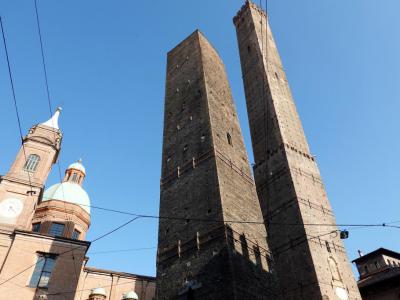
Dominating the scene at Ravegnana Gate Square, where the main gate of the Roman walls once stood, are the iconic Two Towers, emblematic of Bologna's medieval past when the city boasted around 120 such structures. Dating back to the 12th century, these likely served as both lookout points and symbols of prestige. Legend has it that the Asinelli and Garisenda families, engaged in a fierce competition to erect the tallest and most magnificent tower in the city.
Approach the base of the taller structure and enter through the ground-floor portal to begin your climb. Brave the ascent to the top of the Asinelli Tower, rising over 97 meters (or 318 feet) high. Though the climb is steep, navigating a narrow spiral staircase of nearly 500 steps, the reward is well worth the effort. From the summit, you can spot other surviving medieval towers and, weather permitting, catch a glimpse of the Alpine foothills beyond Verona.
Once back down in the square, stroll toward the northern side of the square to look at the shorter neighbor, the Garisenda Tower. Originally reaching 60 meters, it was truncated by 12 meters in the mid-14th century due to unstable foundations; however, from certain angles, the two towers appear to be of equal height. Like many of Bologna's towers, both the Two Towers have a noticeable tilt: Garisenda tilts 3.33 meters northeast, while Asinelli leans 2.23 meters westward.
Dante Alighieri, who spent time in Bologna as a student in the late 13th century, was so captivated by the leaning Garisenda that he later referenced it in Canto XXXI of The Inferno, comparing its dramatic tilt to the bent silhouette of the giant Antaeus looming over the depths of hell.
While still facing the square's northern side, turn south-east and go around the corner on Maggiore Street to observe the facade of 17th-century Saint Bartholomew's Church, featuring a Renaissance portico. Inside, seek out Francesco Albani's "Annunciation" in the fourth chapel of the south aisle, and Guido Reni's small "Madonna with Child" in the north transept.
Approach the base of the taller structure and enter through the ground-floor portal to begin your climb. Brave the ascent to the top of the Asinelli Tower, rising over 97 meters (or 318 feet) high. Though the climb is steep, navigating a narrow spiral staircase of nearly 500 steps, the reward is well worth the effort. From the summit, you can spot other surviving medieval towers and, weather permitting, catch a glimpse of the Alpine foothills beyond Verona.
Once back down in the square, stroll toward the northern side of the square to look at the shorter neighbor, the Garisenda Tower. Originally reaching 60 meters, it was truncated by 12 meters in the mid-14th century due to unstable foundations; however, from certain angles, the two towers appear to be of equal height. Like many of Bologna's towers, both the Two Towers have a noticeable tilt: Garisenda tilts 3.33 meters northeast, while Asinelli leans 2.23 meters westward.
Dante Alighieri, who spent time in Bologna as a student in the late 13th century, was so captivated by the leaning Garisenda that he later referenced it in Canto XXXI of The Inferno, comparing its dramatic tilt to the bent silhouette of the giant Antaeus looming over the depths of hell.
While still facing the square's northern side, turn south-east and go around the corner on Maggiore Street to observe the facade of 17th-century Saint Bartholomew's Church, featuring a Renaissance portico. Inside, seek out Francesco Albani's "Annunciation" in the fourth chapel of the south aisle, and Guido Reni's small "Madonna with Child" in the north transept.
7) Complesso di Santo Stefano (St. Stephen's Complex) (must see)
Navigating through this ecclesiastical maze, a pilgrimage through Bologna's holiest sites, demands patience and time. Universally known as Santo Stefano and nicknamed "the Seven Churches", this highly unique complex originally mirrored the sacred topography of Jerusalem's holy sites, though only four distinct churches endure today. Dating back to the 5th century, the sanctuary was established by Bishop Petronius atop a former pagan temple dedicated to Isis, eventually evolving into a grand Benedictine monastery by the 10th century.
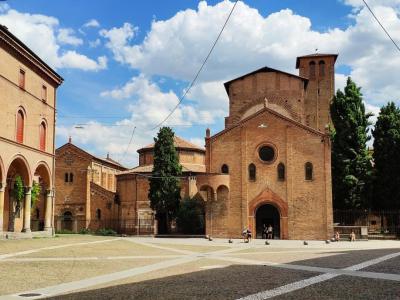
When viewed from the picturesque cobblestones of Saint Stephen Square, the building layout unfolds from left to right: the Church of the Crucifix stands on the left serving as the main entryway, the polygonal Basilica of Saint Sepolcro occupies the center, and the church of Saints Vitale and Agricola sits on the right.
Visitors enter through the Church of the Crucifix, a single-nave structure originally built by the Lombards but extensively modified over the centuries. Walk down the central aisle to ascend the raised presbytery, then drop down into the graceful 11th-century subterranean crypt. This vaulted chamber features columns of varying marble types and historically served as a resting site for early local martyrs. A doorway on the left of the main nave leads directly into the Basilica of Saint Sepolcro, an octagonal structure built around a replica of Jerusalem's Holy Sepulchre tomb that once housed the relics of Saint Petronius.
Bathed in mystical, dim light, the adjacent church of Saints Vitale and Agricola captivates with its raw Romanesque simplicity. It preserves the ancient stone sarcophagi of Bologna's first Christian martyrs, Vitale and Agricola, decorated with reliefs of deer and peacocks. Stepping out the back of the octagonal basilica brings visitors into Pilate's Courtyard, featuring a 13th-century marble basin erroneously linked by medieval folklore to Pontius Pilate. Beyond the courtyard lies the Martyrium, an enigmatic multi-aisled space that houses Europe's oldest known monumental nativity scene-a magnificent, life-sized painted wooden sculpture group from the 14th century.
The tranquil Saint Stephen Cloister features two magnificent tiers of loggias, leading directly into a specialized onsite museum showcasing precious reliquaries, medieval crucifixes, and early Sienese and Sienese-influenced paintings.
When viewed from the picturesque cobblestones of Saint Stephen Square, the building layout unfolds from left to right: the Church of the Crucifix stands on the left serving as the main entryway, the polygonal Basilica of Saint Sepolcro occupies the center, and the church of Saints Vitale and Agricola sits on the right.
Visitors enter through the Church of the Crucifix, a single-nave structure originally built by the Lombards but extensively modified over the centuries. Walk down the central aisle to ascend the raised presbytery, then drop down into the graceful 11th-century subterranean crypt. This vaulted chamber features columns of varying marble types and historically served as a resting site for early local martyrs. A doorway on the left of the main nave leads directly into the Basilica of Saint Sepolcro, an octagonal structure built around a replica of Jerusalem's Holy Sepulchre tomb that once housed the relics of Saint Petronius.
Bathed in mystical, dim light, the adjacent church of Saints Vitale and Agricola captivates with its raw Romanesque simplicity. It preserves the ancient stone sarcophagi of Bologna's first Christian martyrs, Vitale and Agricola, decorated with reliefs of deer and peacocks. Stepping out the back of the octagonal basilica brings visitors into Pilate's Courtyard, featuring a 13th-century marble basin erroneously linked by medieval folklore to Pontius Pilate. Beyond the courtyard lies the Martyrium, an enigmatic multi-aisled space that houses Europe's oldest known monumental nativity scene-a magnificent, life-sized painted wooden sculpture group from the 14th century.
The tranquil Saint Stephen Cloister features two magnificent tiers of loggias, leading directly into a specialized onsite museum showcasing precious reliquaries, medieval crucifixes, and early Sienese and Sienese-influenced paintings.
8) Piazza Santo Stefano (St. Stephen's Square)
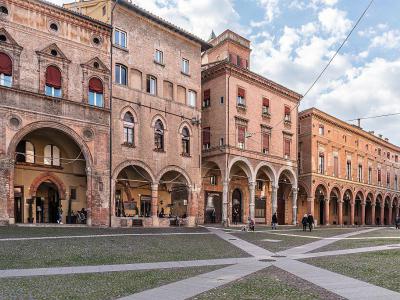
Via Santo Stefano exudes the same charm as the Main Street ("Strada Maggiore"), with late Gothic palaces once favored by Bolognese silk merchants. As you stroll, occasional upward glances reveal 12th-century tower-houses integrated into late-medieval residences, now embellished with Renaissance facades. The cobblestone Saint Stephen's Square (although more triangular than square), particularly vibrant during antiques markets or gourmet food fairs, provides an intimate setting for Saint Stephen's (Santo Stefano) complex, the city's most revered site. Exploring this ecclesiastical labyrinth, with its array of ancient and medieval churches, requires ample time. Originally a complex of seven churches, akin to Jerusalem's architecture, it is known as Le Sette Chiese ("the Seven Churches"), though only four remain.
Dating back to at least the 5th century, the complex may have been established by Bishop Petronius as his cathedral atop a former pagan temple site; by the 10th century, however, it evolved into a Benedictine sanctuary. Santo Stefano is still overseen by stern Benedictines, one of whom reveals: "Dante often came here to meditate in 1287, but we are inclusive - even local prostitutes come here for confession at Easter."
The interconnected churches and courtyards, including the Benedictine cloisters, create a harmonious ensemble. From the picturesque square, the larger church on the right is the Church of the Crucifix ("Chiesa del Crocifisso"), the central one is the Basilica of the Holy Sepulchre ("San Sepolcro"), modeled after Jerusalem's Holy Sepulchre, and on the left stands Santi Vitale e Agricola, Bologna's oldest church.
Dating back to at least the 5th century, the complex may have been established by Bishop Petronius as his cathedral atop a former pagan temple site; by the 10th century, however, it evolved into a Benedictine sanctuary. Santo Stefano is still overseen by stern Benedictines, one of whom reveals: "Dante often came here to meditate in 1287, but we are inclusive - even local prostitutes come here for confession at Easter."
The interconnected churches and courtyards, including the Benedictine cloisters, create a harmonious ensemble. From the picturesque square, the larger church on the right is the Church of the Crucifix ("Chiesa del Crocifisso"), the central one is the Basilica of the Holy Sepulchre ("San Sepolcro"), modeled after Jerusalem's Holy Sepulchre, and on the left stands Santi Vitale e Agricola, Bologna's oldest church.
9) Portico di San Luca (Portico of San Luca) (must see)
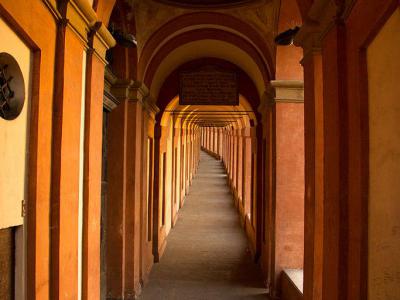
A defining characteristic of Bologna is its extensive network of "portici", or porticoes, stretching for nearly 40 kilometers (25 miles). Originally constructed from wood outside the homes of shopkeepers to provide additional space for trade, these elegant arcades date back centuries. In 1568, primarily due to concerns over fire hazards, regulations mandated that porticoes be constructed from brick or stone, though a handful of the original wooden structures still remain.
Among these structures, the Portico San Luca stands out as the world's longest, stretching for almost 3.5 kilometers (2 miles) up to the hilltop Sanctuary of San Luca. Its existence is owed to the dedication of Don Ludovico Genaroli, who spent two decades championing its construction. The portico serves to shield pilgrims making their vows to the Madonna of Saint Luke from inclement weather and harsh sunlight, while also facilitating the annual procession that transports the revered image from the Sanctuary to Saint Peter's Cathedral in the city center for a week of festivities before returning it to its hillside abode overlooking Bologna.
Funded by devout believers, artisan guilds, and prominent Bolognese families, this monumental undertaking was realized under the guidance of the Bolognese architect Carlo Francesco Dotti (1670-1759). Dotti was not only responsible for completing the portico project but also for designing the new basilica constructed to accompany it, as well as the Meloncello Arch ("Arco del Meloncello"), marking the starting point of the ascent to the Colle della Guardia.
Among these structures, the Portico San Luca stands out as the world's longest, stretching for almost 3.5 kilometers (2 miles) up to the hilltop Sanctuary of San Luca. Its existence is owed to the dedication of Don Ludovico Genaroli, who spent two decades championing its construction. The portico serves to shield pilgrims making their vows to the Madonna of Saint Luke from inclement weather and harsh sunlight, while also facilitating the annual procession that transports the revered image from the Sanctuary to Saint Peter's Cathedral in the city center for a week of festivities before returning it to its hillside abode overlooking Bologna.
Funded by devout believers, artisan guilds, and prominent Bolognese families, this monumental undertaking was realized under the guidance of the Bolognese architect Carlo Francesco Dotti (1670-1759). Dotti was not only responsible for completing the portico project but also for designing the new basilica constructed to accompany it, as well as the Meloncello Arch ("Arco del Meloncello"), marking the starting point of the ascent to the Colle della Guardia.
10) Via Rizzoli (Rizzoli Street)
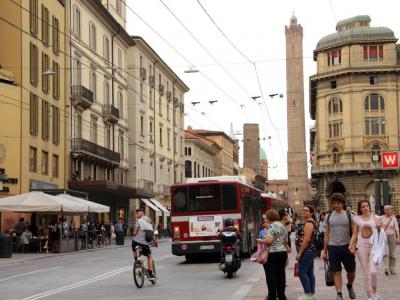
Rizzoli Street is one of the city’s principal streets and follows a route that has served as a main thoroughfare for more than 2,000 years. Originally part of the Roman Aemilia Way and the city's decumanus maximus, the main east-west axis of Roman Bononia, it has connected the heart of the city with its eastern districts since antiquity. The modern street emerged in the early 20th century through the redevelopment of part of the old Middle Market area and was named after the renowned orthopedic surgeon Francesco Rizzoli, who founded Bologna’s famous orthopedic institute.
Today, Rizzoli Street forms part of the city's pedestrian center and is lined with cafés, shops, banks, and elegant buildings beneath Bologna’s celebrated porticoes. On hot summer days, the arcades provide welcome shade, while their beautifully patterned mosaic pavements add a touch of elegance to the walk. Throughout the day, especially during busy hours, the street often comes alive with musicians, performers, and other street artists.
As you stroll eastward, one of Bologna’s most iconic views gradually unfolds before you: the medieval Asinelli Tower and the leaning Garisenda Tower rising at the end of the street.
Along the way, Rizzoli Street also provides easy access to the Quadrilateral market district, historic palaces, and the university quarter. If you'd like to pause for a treat, this is also a good place to stop for authentic Italian gelato, with OGGI Gelato Bologna being a popular choice for both traditional and vegan flavors.
Today, Rizzoli Street forms part of the city's pedestrian center and is lined with cafés, shops, banks, and elegant buildings beneath Bologna’s celebrated porticoes. On hot summer days, the arcades provide welcome shade, while their beautifully patterned mosaic pavements add a touch of elegance to the walk. Throughout the day, especially during busy hours, the street often comes alive with musicians, performers, and other street artists.
As you stroll eastward, one of Bologna’s most iconic views gradually unfolds before you: the medieval Asinelli Tower and the leaning Garisenda Tower rising at the end of the street.
Along the way, Rizzoli Street also provides easy access to the Quadrilateral market district, historic palaces, and the university quarter. If you'd like to pause for a treat, this is also a good place to stop for authentic Italian gelato, with OGGI Gelato Bologna being a popular choice for both traditional and vegan flavors.
