Custom Walk in Rome, Italy by m_cloppenburg_99234 created on 2026-05-10
Guide Location: Italy » Rome
Guide Type: Custom Walk
# of Sights: 11
Tour Duration: 4 Hour(s)
Travel Distance: 10.1 Km or 6.3 Miles
Share Key: 3HVPJ
Guide Type: Custom Walk
# of Sights: 11
Tour Duration: 4 Hour(s)
Travel Distance: 10.1 Km or 6.3 Miles
Share Key: 3HVPJ
How It Works
Please retrieve this walk in the GPSmyCity app. Once done, the app will guide you from one tour stop to the next as if you had a personal tour guide. If you created the walk on this website or come to the page via a link, please follow the instructions below to retrieve the walk in the app.
Retrieve This Walk in App
Step 1. Download the app "GPSmyCity: Walks in 1K+ Cities" on Apple App Store or Google Play Store.



Step 2. In the GPSmyCity app, download(or launch) the guide "Rome Map and Walking Tours".
Step 3. Tap the menu button located at upper right corner of the "Walks" screen and select "Retrieve custom walk". Enter the share key: 3HVPJ
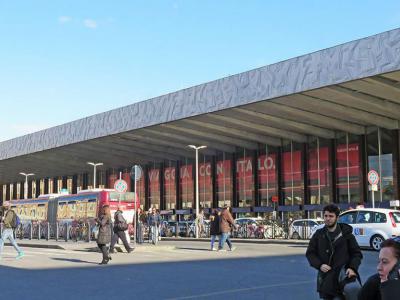
1) Roma Termini (Rome's main railway station)
Roma Termini, also known as Stazione Termini, stands as the central hub of Rome's railway system. Located in the district bearing the same name, which is derived from the ancient Baths of Diocletian ("thermae" in Latin), the station boasts a prime position just across the street from this historic site.
With an impressive 29 platforms and an extensive network of daily services reaching destinations throughout Italy and beyond, Roma Termini is one of the largest railway stations in Europe. It provides travelers with numerous amenities and seamless connections, including ItaliaRail's exclusive VIP oasis, the ItaliaPass Lounge situated at the beginning of Track 25.
As you enter the station from Piazza dei Cinquecento, you'll find a bustling entrance hall adorned with restaurants, a spacious ticket office, travel agencies, currency exchange booths, as well as a vibrant cluster of shops that shops remain open until 10pm, even on Sundays, making it a convenient "shop before you hop" destination. From popular chains like Mango, Moleskine, and Sephora to bookstores offering a wide selection of English-language bestsellers, you'll find a diverse range of options. Additionally, there is a grocery store and a well-stocked food court, providing a variety of culinary delights to satisfy your cravings.
With an impressive 29 platforms and an extensive network of daily services reaching destinations throughout Italy and beyond, Roma Termini is one of the largest railway stations in Europe. It provides travelers with numerous amenities and seamless connections, including ItaliaRail's exclusive VIP oasis, the ItaliaPass Lounge situated at the beginning of Track 25.
As you enter the station from Piazza dei Cinquecento, you'll find a bustling entrance hall adorned with restaurants, a spacious ticket office, travel agencies, currency exchange booths, as well as a vibrant cluster of shops that shops remain open until 10pm, even on Sundays, making it a convenient "shop before you hop" destination. From popular chains like Mango, Moleskine, and Sephora to bookstores offering a wide selection of English-language bestsellers, you'll find a diverse range of options. Additionally, there is a grocery store and a well-stocked food court, providing a variety of culinary delights to satisfy your cravings.
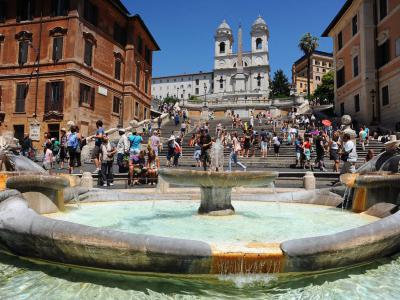
2) Scalinata di Trinita dei Monti (Spanish Steps) (must see)
The Spanish Steps, a monumental stairway of 135 steps, holds the distinction of being the longest and widest in Europe. The steps link Spanish Square, at the base, with the Trinity of the Mountains Square at the top.
The stairway was completed under Pope Clement XI in 1717, deriving its name from the nearby Spanish Embassy to the Holy See. Financed in part by a French diplomat, it features Baroque elements, inspired by garden stairs, and incorporates symbolic decorations such as the Bourbon heraldic lily flowers and papal eagles.
As a cultural and seasonal hub hosting public events such as Christmas cribs, spring azalea displays, and a flower market, the Spanish Steps have captivated artists and people of letters since the 18th century. Among them was the renowned English poet, John Keats, who lived and died practically next door. His house, at the base of the steps (located to the right, if you face the stairs), is now a museum.
Other nearby landmarks include the Ferrari di Valbona Palace, redesigned in 1936, and Babington's tea room, a resilient establishment that has withstood two world wars and numerous adversities, ultimately becoming a beloved tourist attraction.
The steps' cinematic appeal also made them a backdrop for numerous films, including the Hollywood blockbuster “Roman Holiday” made in 1953, starring Audrey Hepburn and Gregory Peck. In the scene where Joe Bradley, played by Peck, meets Princess Ann, played by Hepburn, she sits on the steps, enjoying the view and eating ice cream. Fresh after the haircut, the princess takes compliments for her new look and makes up a story that she has run away from school. She accepts his proposal to spend the day together before she returns, and thus the Roman Holiday story begins!
Other filmmakers also made a mark on the steps, such as “The Talented Mr. Ripley” movie with Matt Damon, shot in 1999, and “Mission: Impossible – Dead Reckoning Part One,” featuring Tom Cruise, which premiered at the steps on June 19, 2023.
Consequently, the Spanish Steps became a magnet for aspiring models, affluent Romans, international travelers, and people from all walks of life. The tradition of gathering here is deeply ingrained in the locals and visitors alike. Today, the steps are protected by strict regulations against loitering, eating, or damaging, with heavy fines introduced to maintain decorum.
Tip:
The staircase offers picturesque views of Rome from its pinnacle, particularly at sunset-a truly unbeatable sight!
The afternoon and late hours are the best for visiting, so to avoid the heat of the day.
Alongside tourist activities such as carriage rides, you'll find nearby an array of shops and bars worth exploring.
The stairway was completed under Pope Clement XI in 1717, deriving its name from the nearby Spanish Embassy to the Holy See. Financed in part by a French diplomat, it features Baroque elements, inspired by garden stairs, and incorporates symbolic decorations such as the Bourbon heraldic lily flowers and papal eagles.
As a cultural and seasonal hub hosting public events such as Christmas cribs, spring azalea displays, and a flower market, the Spanish Steps have captivated artists and people of letters since the 18th century. Among them was the renowned English poet, John Keats, who lived and died practically next door. His house, at the base of the steps (located to the right, if you face the stairs), is now a museum.
Other nearby landmarks include the Ferrari di Valbona Palace, redesigned in 1936, and Babington's tea room, a resilient establishment that has withstood two world wars and numerous adversities, ultimately becoming a beloved tourist attraction.
The steps' cinematic appeal also made them a backdrop for numerous films, including the Hollywood blockbuster “Roman Holiday” made in 1953, starring Audrey Hepburn and Gregory Peck. In the scene where Joe Bradley, played by Peck, meets Princess Ann, played by Hepburn, she sits on the steps, enjoying the view and eating ice cream. Fresh after the haircut, the princess takes compliments for her new look and makes up a story that she has run away from school. She accepts his proposal to spend the day together before she returns, and thus the Roman Holiday story begins!
Other filmmakers also made a mark on the steps, such as “The Talented Mr. Ripley” movie with Matt Damon, shot in 1999, and “Mission: Impossible – Dead Reckoning Part One,” featuring Tom Cruise, which premiered at the steps on June 19, 2023.
Consequently, the Spanish Steps became a magnet for aspiring models, affluent Romans, international travelers, and people from all walks of life. The tradition of gathering here is deeply ingrained in the locals and visitors alike. Today, the steps are protected by strict regulations against loitering, eating, or damaging, with heavy fines introduced to maintain decorum.
Tip:
The staircase offers picturesque views of Rome from its pinnacle, particularly at sunset-a truly unbeatable sight!
The afternoon and late hours are the best for visiting, so to avoid the heat of the day.
Alongside tourist activities such as carriage rides, you'll find nearby an array of shops and bars worth exploring.
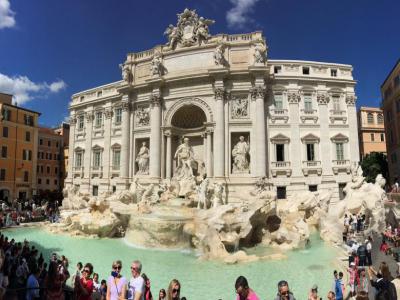
3) Piazza di Trevi & Fontana di Trevi (Trevi Square & Trevi Fountain) (must see)
The Trevi Fountain is one of Rome’s most iconic landmarks, drawing visitors to the eponymous Trevi Square all day long. Surprisingly, the fountain was not initially built in the heart of the city; instead, the city grew around it. Its name derives from the Latin word "trivium," which means “three streets,” as it sits at the junction of three streets: De Crocicchi, Poli, and Delle Muratte.
The fountain’s history dates back to 1629 when Pope Urban VIII commissioned Gian Lorenzo Bernini to redesign it, though his plans were never realized. Later, Pope Clement XII organized a competition in 1730, leading to Nicola Salvi's selection for the project, who incorporated the fountain into the rear of the Poli Palace. Salvi passed away before its completion. Giuseppe Pannini and other artists finalized the work in 1762.
Measuring over 26 meters in height and 49 meters in width, it is the largest Baroque fountain in Rome.
The Trevi Fountain features a Corinthian façade and bas-reliefs depicting the origins of the Acqua Vergine aqueduct, constructed in 19 BC. According to legend, a virgin guided Roman engineers to the aqueduct’s source, an event depicted in the fountain’s bas-reliefs. The aqueduct, which survived the Gothic invasions and was restored during the Middle Ages, still supplies water to the fountain today.
At the heart of the fountain is Oceanus, depicted riding a shell-shaped chariot drawn by two horses and guided by Tritons. The horses symbolize the sea’s contrasting moods-calm and turbulent. Flanking Oceanus are the statues of Abundance and Salubrity, representing prosperity and health. The symmetrical Rococo design combines dynamic artistry with Baroque grandeur, reflecting 18th-century European trends.
The Trevi Fountain is also known for the tradition of tossing coins, which promises a return to Rome. Popularized by the 1954 Hollywood film "Three Coins in the Fountain," visitors toss coins over their left shoulder with their right hand, generating daily about €3,000. This money, collected by municipal authorities, is donated to charity.
Celebrated in films like Roman Holiday and La Dolce Vita, the Trevi Fountain’s global fame is further evidenced by replicas worldwide. Access to the fountain is now limited to 400 visitors at a time, ensuring a more enjoyable visit to this timeless masterpiece. Surrounding the fountain are charming shops, restaurants, and gelaterias, making it a delightful spot to soak in Rome’s vibrant atmosphere.
Tip:
The fountain holds particular allure at night, especially after 10 pm when it is beautifully illuminated and the crowds dissipate, allowing you to enjoy the site almost exclusively.
The fountain’s history dates back to 1629 when Pope Urban VIII commissioned Gian Lorenzo Bernini to redesign it, though his plans were never realized. Later, Pope Clement XII organized a competition in 1730, leading to Nicola Salvi's selection for the project, who incorporated the fountain into the rear of the Poli Palace. Salvi passed away before its completion. Giuseppe Pannini and other artists finalized the work in 1762.
Measuring over 26 meters in height and 49 meters in width, it is the largest Baroque fountain in Rome.
The Trevi Fountain features a Corinthian façade and bas-reliefs depicting the origins of the Acqua Vergine aqueduct, constructed in 19 BC. According to legend, a virgin guided Roman engineers to the aqueduct’s source, an event depicted in the fountain’s bas-reliefs. The aqueduct, which survived the Gothic invasions and was restored during the Middle Ages, still supplies water to the fountain today.
At the heart of the fountain is Oceanus, depicted riding a shell-shaped chariot drawn by two horses and guided by Tritons. The horses symbolize the sea’s contrasting moods-calm and turbulent. Flanking Oceanus are the statues of Abundance and Salubrity, representing prosperity and health. The symmetrical Rococo design combines dynamic artistry with Baroque grandeur, reflecting 18th-century European trends.
The Trevi Fountain is also known for the tradition of tossing coins, which promises a return to Rome. Popularized by the 1954 Hollywood film "Three Coins in the Fountain," visitors toss coins over their left shoulder with their right hand, generating daily about €3,000. This money, collected by municipal authorities, is donated to charity.
Celebrated in films like Roman Holiday and La Dolce Vita, the Trevi Fountain’s global fame is further evidenced by replicas worldwide. Access to the fountain is now limited to 400 visitors at a time, ensuring a more enjoyable visit to this timeless masterpiece. Surrounding the fountain are charming shops, restaurants, and gelaterias, making it a delightful spot to soak in Rome’s vibrant atmosphere.
Tip:
The fountain holds particular allure at night, especially after 10 pm when it is beautifully illuminated and the crowds dissipate, allowing you to enjoy the site almost exclusively.
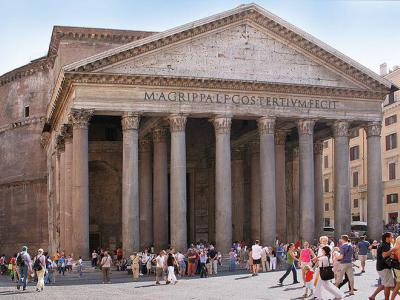
4) Pantheon (must see)
The Pantheon is one of Rome’s most iconic landmarks, renowned for its architectural brilliance. Originally a Roman temple, its name comes from the Ancient Greek "pan theos," which means dedication to all gods. Built on the site of a temple commissioned by consul Marcus Agrippa during Augustus’ reign, the current structure was completed under Emperor Hadrian around 126 AD. It was transformed into a Catholic Church of Saint Mary and the Martyrs in 609 AD, ensuring its preservation through centuries.
The Pantheon’s unique design combines a classical portico supported by Corinthian granite columns with a domed cylindrical structure (called a rotunda). The unsupported concrete dome, still the largest of its kind in the world, features a central oculus that provides natural light, ventilation, and symbolic celestial connections. The rotunda's harmonious dimensions-43 meters in both height and diameter-epitomize Roman engineering excellence, while its original massive bronze doors, each weighing over 20 tons, and intricate drainage system (allowing to effectively divert rainwater) highlight the ingenuity of its creators.
Throughout its history, the Pantheon has been a vibrant part of Roman life. It served as a burial site during the Renaissance, housing notable figures like painter Raphael and Italian kings Victor Emmanuel II and Umberto I. Its materials, such as bronze, have been repurposed for other projects like Bernini’s baldachin above the high altar of Saint Peter's Basilica. However, its core structure remains remarkably intact. Today, the church still host religious ceremonies, including masses, weddings, and Pentecost celebrations.
The Pantheon’s influence extends far beyond Rome. Its dome inspired architectural marvels like the Florence Cathedral and Rotunda of the U.S. Capital in Washington D.C., while its combination of classical and modern elements shaped countless government and academic buildings worldwide.
With over six million annual visitors, the Pantheon remains a symbol of Roman ingenuity and artistic achievement. Tourists can enjoy free entry to this historic site or soak in its splendor from Rotonda Square, savoring gelato while marveling at its timeless beauty.
Tip:
Incredible at night (from the outside), it is especially so if you enjoy musicians with talent and engagement... but beware of pickpockets.
The Pantheon’s unique design combines a classical portico supported by Corinthian granite columns with a domed cylindrical structure (called a rotunda). The unsupported concrete dome, still the largest of its kind in the world, features a central oculus that provides natural light, ventilation, and symbolic celestial connections. The rotunda's harmonious dimensions-43 meters in both height and diameter-epitomize Roman engineering excellence, while its original massive bronze doors, each weighing over 20 tons, and intricate drainage system (allowing to effectively divert rainwater) highlight the ingenuity of its creators.
Throughout its history, the Pantheon has been a vibrant part of Roman life. It served as a burial site during the Renaissance, housing notable figures like painter Raphael and Italian kings Victor Emmanuel II and Umberto I. Its materials, such as bronze, have been repurposed for other projects like Bernini’s baldachin above the high altar of Saint Peter's Basilica. However, its core structure remains remarkably intact. Today, the church still host religious ceremonies, including masses, weddings, and Pentecost celebrations.
The Pantheon’s influence extends far beyond Rome. Its dome inspired architectural marvels like the Florence Cathedral and Rotunda of the U.S. Capital in Washington D.C., while its combination of classical and modern elements shaped countless government and academic buildings worldwide.
With over six million annual visitors, the Pantheon remains a symbol of Roman ingenuity and artistic achievement. Tourists can enjoy free entry to this historic site or soak in its splendor from Rotonda Square, savoring gelato while marveling at its timeless beauty.
Tip:
Incredible at night (from the outside), it is especially so if you enjoy musicians with talent and engagement... but beware of pickpockets.
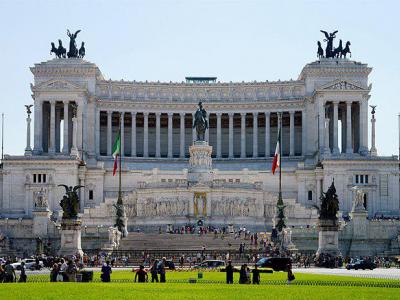
5) Vittoriano (Victor Emmanuel II National Monument) (must see)
The Victor Emmanuel II National Monument, also known as the Altar of the Fatherland, honors Italy’s first king and symbolizes the nation’s unification. Constructed from 1885 to 1935, its design was inspired by the Roman Forum. The neoclassical monument blends Hellenistic influences with modern urban design, featuring grand staircases, Corinthian columns, fountains, and statues, including a striking equestrian statue of Victor Emmanuel II.
Its dimensions are imposing, with a width of 135 meters and a height of 81 meters, including statues of the goddess Victoria atop quadrigas. Also adding to its grandeur are the two colossal Italian tricolors at the sides.
The monument's key features include the Tomb of the Unknown Soldier, inaugurated in 1921. Its eternal flames perpetually guarded by soldiers reflect classical traditions of remembrance. Sculptures like The Thought and The Action are complemented by allegorical decorations and mosaics highlighting Italian virtues, sciences, and intellectual achievements. The site also honors Italy's pre-unification legacy through sculptures of 14 historic capitals and other artistic elements.
Ascending the central staircase rewards visitors with a view of the monument itself but also a panoramic vista over the city. This elevated spot offers an ideal opportunity for capturing memorable photos. For added convenience, a lift was installed in 2007, enabling visitors to reach the rooftop and enjoy a bird's-eye panorama of Rome (please note that there is a small fee for the ride).
Flanking Venice Square, the Fountains of the Two Seas symbolize Italy's geographical unity, representing the Adriatic and Tyrrhenian Seas. Beneath the monument lies a crypt built with materials from World War I battlefields, creating a sacred space for reflection.
At the base of the complex, visitors can explore the Central Museum of Italian Unification, which chronicles the country’s history from the late 18th century to World War I, and the Shrine of the Flags, showcasing military flags and artifacts. The admission is free.
The monument is a centerpiece for national celebrations like Republic Day and Liberation Day. Although initially met with controversy and subjected to derogatory nicknames like the "wedding cake," it has become one of the city's most popular attractions after the Vatican and the Roman Ruins. Despite some locals considering it tacky, there is an undeniable allure in witnessing triumphal architecture that aspires to rival the grandeur of ancient structures.
Tip:
Visit the monument at night when it is beautifully illuminated.
Its dimensions are imposing, with a width of 135 meters and a height of 81 meters, including statues of the goddess Victoria atop quadrigas. Also adding to its grandeur are the two colossal Italian tricolors at the sides.
The monument's key features include the Tomb of the Unknown Soldier, inaugurated in 1921. Its eternal flames perpetually guarded by soldiers reflect classical traditions of remembrance. Sculptures like The Thought and The Action are complemented by allegorical decorations and mosaics highlighting Italian virtues, sciences, and intellectual achievements. The site also honors Italy's pre-unification legacy through sculptures of 14 historic capitals and other artistic elements.
Ascending the central staircase rewards visitors with a view of the monument itself but also a panoramic vista over the city. This elevated spot offers an ideal opportunity for capturing memorable photos. For added convenience, a lift was installed in 2007, enabling visitors to reach the rooftop and enjoy a bird's-eye panorama of Rome (please note that there is a small fee for the ride).
Flanking Venice Square, the Fountains of the Two Seas symbolize Italy's geographical unity, representing the Adriatic and Tyrrhenian Seas. Beneath the monument lies a crypt built with materials from World War I battlefields, creating a sacred space for reflection.
At the base of the complex, visitors can explore the Central Museum of Italian Unification, which chronicles the country’s history from the late 18th century to World War I, and the Shrine of the Flags, showcasing military flags and artifacts. The admission is free.
The monument is a centerpiece for national celebrations like Republic Day and Liberation Day. Although initially met with controversy and subjected to derogatory nicknames like the "wedding cake," it has become one of the city's most popular attractions after the Vatican and the Roman Ruins. Despite some locals considering it tacky, there is an undeniable allure in witnessing triumphal architecture that aspires to rival the grandeur of ancient structures.
Tip:
Visit the monument at night when it is beautifully illuminated.
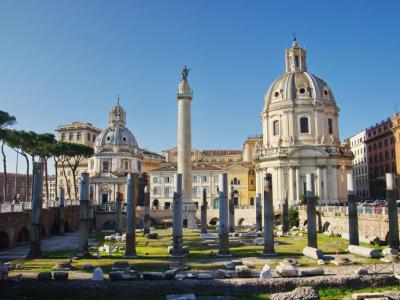
6) Foro di Traiano (Trajan's Forum)
Emperor Trajan, who reigned from 98 to 117 AD, is best known for his military conquests. Prime among them were the Dacian Wars, resulting in the annexation of Dacia (which is modern-day Romania) and expanding the Roman Empire to its greatest territorial extent. Trajan's successful campaigns brought immense wealth to Rome, notably in the form of Dacian gold, which funded various public works.
Beyond military achievements, Trajan was admired for his relatively fair and just governance, implementing social programs such as the Alimenta, a welfare program for orphaned children and poor families. His reign is often seen as a high point in Roman history, marked by prosperity, effective leadership, and the expansion of the empire.
Trajan is also celebrated for his significant contributions to Roman architecture, including the construction of Trajan's Forum in 113 AD. Set to commemorate Trajan's military victories, particularly the conquest of Dacia, the forum was part of a larger complex that featured a vast, portico-lined square measuring 300 by 185 meters, enclosed by tall tuff walls clad in marble. The main entrance at the south end had a triumphal arch celebrating the Dacian Wars. The arch was adorned with friezes and statues depicting Dacian prisoners.
The forum's open space was paved in Carrara marble and connected to the Forum of Augustus. Key structures therein included Trajan's Market, the Basilica Ulpia, one Latin library and one Greek library, and Trajan’s Column.
Today, the forum is one of the most impressive and well-preserved ancient Roman sites. Although mostly in ruins, visitors can still see the iconic Trajan’s Column standing 30 meters tall, covered in a continuous frieze depicting scenes from the Dacian Wars. Also, don't miss the ruins of Trajan's Market. This structure – a series of multi-level buildings that once housed administrative offices and retail spaces – is often referred to as the world’s oldest shopping mall.
Beyond military achievements, Trajan was admired for his relatively fair and just governance, implementing social programs such as the Alimenta, a welfare program for orphaned children and poor families. His reign is often seen as a high point in Roman history, marked by prosperity, effective leadership, and the expansion of the empire.
Trajan is also celebrated for his significant contributions to Roman architecture, including the construction of Trajan's Forum in 113 AD. Set to commemorate Trajan's military victories, particularly the conquest of Dacia, the forum was part of a larger complex that featured a vast, portico-lined square measuring 300 by 185 meters, enclosed by tall tuff walls clad in marble. The main entrance at the south end had a triumphal arch celebrating the Dacian Wars. The arch was adorned with friezes and statues depicting Dacian prisoners.
The forum's open space was paved in Carrara marble and connected to the Forum of Augustus. Key structures therein included Trajan's Market, the Basilica Ulpia, one Latin library and one Greek library, and Trajan’s Column.
Today, the forum is one of the most impressive and well-preserved ancient Roman sites. Although mostly in ruins, visitors can still see the iconic Trajan’s Column standing 30 meters tall, covered in a continuous frieze depicting scenes from the Dacian Wars. Also, don't miss the ruins of Trajan's Market. This structure – a series of multi-level buildings that once housed administrative offices and retail spaces – is often referred to as the world’s oldest shopping mall.
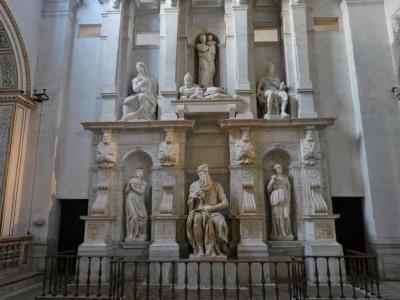
7) Basilica di San Pietro in Vincoli (Basilica of St. Peter in Chains)
This basilica gained significant recognition thanks to Michelangelo's "Moses", a masterpiece sculpted in the early 16th century for Pope Julius II's unfinished tomb. Originally intended to be a grand structure featuring numerous statues and towering nearly 40 feet tall in Saint Peter's Basilica, only three statues were completed-Moses and the flanking figures of Leah and Rachel-before Julius passed away. The subsequent pope, a member of the rival Medici family, had different plans for Michelangelo, leading to the abandonment of the unfinished tomb. Despite this, the intense power of the remarkable Moses sculpture remains unparalleled in its setting. Legend has it that Michelangelo's profile, as well as that of the pope, can be discerned in the intricate details, such as the lock of Moses's beard beneath his lip.
In the church itself, Saint Peter takes a secondary role to the commanding presence of Moses. Under the main altar, an urn made of bronze and crystal houses the reputed chains that once bound Saint Peter during his imprisonment in Jerusalem and Rome. Other notable treasures include a 7th-century mosaic depicting Saint Sebastian, situated in front of the second altar to the left of the main altar, and the tomb of the Pollaiuolo brothers, two Florentine artists from the 15th century, located near the entrance.
Why You Should Visit:
Understated exterior, incredible interior; a Michelangelo must-see.
In the church itself, Saint Peter takes a secondary role to the commanding presence of Moses. Under the main altar, an urn made of bronze and crystal houses the reputed chains that once bound Saint Peter during his imprisonment in Jerusalem and Rome. Other notable treasures include a 7th-century mosaic depicting Saint Sebastian, situated in front of the second altar to the left of the main altar, and the tomb of the Pollaiuolo brothers, two Florentine artists from the 15th century, located near the entrance.
Why You Should Visit:
Understated exterior, incredible interior; a Michelangelo must-see.
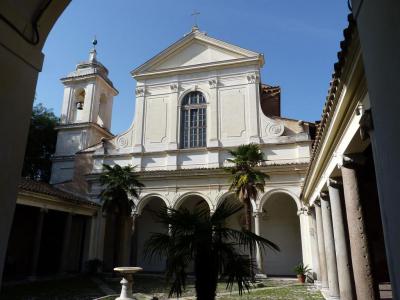
8) Basilica di San Clemente al Laterano (Basilica of Saint Clement) (must see)
San Clemente is a most impressive archaeological site in Rome, renowned for its unique triple-decker structure. At its pinnacle sits the present-day basilica, erected in the 12th century. Below it lies a 4th-century church, built upon the remnants of a 2nd-century pagan temple dedicated to the god Mithras and ancient Roman apartments dating back to the 1st century. In 1857, Friar Joseph Mullooly initiated excavations beneath the basilica, unveiling these fascinating layers of history. Today, visitors can descend through time and explore all three levels, immersing themselves in the rich heritage preserved within.
The upper church, located at street level, exudes charm and splendor. Its apse features a radiant 12th-century mosaic depicting Jesus on the cross, transforming into a vibrant tree. Delicate green acanthus leaves dance across the mosaic, adorned with intricate scenes of daily life. The 4th-century marble choir screens showcase early Christian symbols, including doves, vines, and fish. Within the left nave, the Castiglioni chapel reveals frescoes created around 1400 by the Florentine artist Masolino da Panicale, renowned for his contributions to realism and perspective in Renaissance painting. Notable frescoes within the chapel depict the Crucifixion, scenes from the lives of Saints Catherine, Ambrose, and Christopher, and the Annunciation above the entrance.
Descending the stairs to the right of the sacristy and bookshop, visitors are transported to the 4th-century church, which remained in use until 1084 when it suffered irreparable damage during a siege led by Norman prince Robert Guiscard. Despite the passage of time, vibrant 11th-century frescoes depicting stories from the life of Saint Clement have endured. Of particular interest is the final fresco on the left, once part of the central nave. It showcases a captivating quote, including the unexpected phrase "Go on, you sons of harlots, pull!"-a rare and intriguing inclusion in a religious painting and an early example of written vernacular Italian.
Descending further down a set of stairs unveils the Mithraeum, a sacred shrine dedicated to the god Mithras. The cult of Mithras originated in Persia and gained popularity in Rome during the 2nd and 3rd centuries AD. These underground chambers served as a place of worship, mirroring the belief that Mithras was born in a cave. Stone couches, visible within the Mithraeum, served as seats for initiates who would gather to share meals. It is worth noting that many pagan shrines in Rome were dismantled by Christians, who often repurposed the sites by constructing churches atop them.
Why You Should Visit:
A very interesting glimpse into the ancient past – below street level!
Tip:
Bring a small flashlight for a closer inspection of the frescoes and wall paintings.
The upper church, located at street level, exudes charm and splendor. Its apse features a radiant 12th-century mosaic depicting Jesus on the cross, transforming into a vibrant tree. Delicate green acanthus leaves dance across the mosaic, adorned with intricate scenes of daily life. The 4th-century marble choir screens showcase early Christian symbols, including doves, vines, and fish. Within the left nave, the Castiglioni chapel reveals frescoes created around 1400 by the Florentine artist Masolino da Panicale, renowned for his contributions to realism and perspective in Renaissance painting. Notable frescoes within the chapel depict the Crucifixion, scenes from the lives of Saints Catherine, Ambrose, and Christopher, and the Annunciation above the entrance.
Descending the stairs to the right of the sacristy and bookshop, visitors are transported to the 4th-century church, which remained in use until 1084 when it suffered irreparable damage during a siege led by Norman prince Robert Guiscard. Despite the passage of time, vibrant 11th-century frescoes depicting stories from the life of Saint Clement have endured. Of particular interest is the final fresco on the left, once part of the central nave. It showcases a captivating quote, including the unexpected phrase "Go on, you sons of harlots, pull!"-a rare and intriguing inclusion in a religious painting and an early example of written vernacular Italian.
Descending further down a set of stairs unveils the Mithraeum, a sacred shrine dedicated to the god Mithras. The cult of Mithras originated in Persia and gained popularity in Rome during the 2nd and 3rd centuries AD. These underground chambers served as a place of worship, mirroring the belief that Mithras was born in a cave. Stone couches, visible within the Mithraeum, served as seats for initiates who would gather to share meals. It is worth noting that many pagan shrines in Rome were dismantled by Christians, who often repurposed the sites by constructing churches atop them.
Why You Should Visit:
A very interesting glimpse into the ancient past – below street level!
Tip:
Bring a small flashlight for a closer inspection of the frescoes and wall paintings.
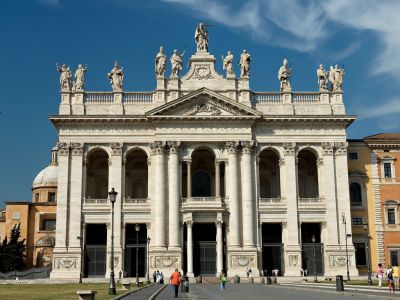
9) Arcibasilica di San Giovanni in Laterano (Archbasilica of Saint John in the Lateran)
Saint John's, not Saint Peter's, holds the distinction of being highest-ranking basilica in the world. Founded in 324, it is the oldest public church in the city of Rome, and the oldest basilica of the Western world.
Emperor Constantine commissioned the construction of this grand structure, predating the establishment of Saint Peter's, making it the primary ecclesiastical seat of the Pope. Throughout its history, the edifice has faced challenges such as vandalism, earthquakes, and fires, leading to extensive restorations in the 16th and 17th centuries. Notably, the interior was artfully designed by the renowned Baroque genius Borromini. Standing tall on the impressive facade are colossal statues representing the Twelve Apostles, Christ, John the Baptist, and the Virgin Mary.
While much of the structure has undergone restoration, fragments from earlier periods remain. Adorning the left portico is an ancient statue of Constantine, while the central portal has ancient bronze doors transferred from the Curia in the Roman Forum. Inside, the altar boasts a magnificent Gothic tabernacle, dating back to 1367, which is believed to house the revered heads of Saint Peter and Saint Paul. A captivating sight awaits in the last chapel of the left aisle, where a cloister adorned with 12th-century cosmatesque mosaics can be admired.
Just around the corner, Emperor Constantine's octagonal baptistery stands as one of Rome's oldest Christian structures. Despite multiple restorations, a 17th-century redecoration, and even a car bombing in 1993 associated with the Mafia, this baptistery has preserved its ancient form.
Tip: Don't miss the opportunity to visit the cloister behind the archbasilica. Although there is a small fee, it grants you access to a collection of authentic antiquities dating back to pre-Roman times, as well as a selection of intriguing Catholic relics.
Emperor Constantine commissioned the construction of this grand structure, predating the establishment of Saint Peter's, making it the primary ecclesiastical seat of the Pope. Throughout its history, the edifice has faced challenges such as vandalism, earthquakes, and fires, leading to extensive restorations in the 16th and 17th centuries. Notably, the interior was artfully designed by the renowned Baroque genius Borromini. Standing tall on the impressive facade are colossal statues representing the Twelve Apostles, Christ, John the Baptist, and the Virgin Mary.
While much of the structure has undergone restoration, fragments from earlier periods remain. Adorning the left portico is an ancient statue of Constantine, while the central portal has ancient bronze doors transferred from the Curia in the Roman Forum. Inside, the altar boasts a magnificent Gothic tabernacle, dating back to 1367, which is believed to house the revered heads of Saint Peter and Saint Paul. A captivating sight awaits in the last chapel of the left aisle, where a cloister adorned with 12th-century cosmatesque mosaics can be admired.
Just around the corner, Emperor Constantine's octagonal baptistery stands as one of Rome's oldest Christian structures. Despite multiple restorations, a 17th-century redecoration, and even a car bombing in 1993 associated with the Mafia, this baptistery has preserved its ancient form.
Tip: Don't miss the opportunity to visit the cloister behind the archbasilica. Although there is a small fee, it grants you access to a collection of authentic antiquities dating back to pre-Roman times, as well as a selection of intriguing Catholic relics.
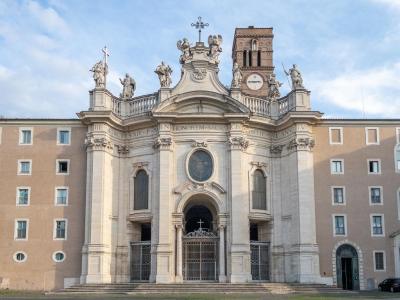
10) Basílica de la Santa Cruz de Jerusalen (Basilica of the Holy Cross in Jerusalem)
This basilica is one of the most important holy sites in Rome, both for its historical significance and its connection to the relics of Christ. Located on the eastern slopes of the Esquiline Hill, it dates back to the 4th century and was originally built by Emperor Constantine’s mother, Saint Helena, who is credited with finding the True Cross in Jerusalem.
The architecture blends elements of early Christian and Baroque styles. Its interior is richly decorated, with numerous frescoes, mosaics, and sculptures. The most famous of these is the Chapel of the Relics, housing the revered relics of the Passion of Christ. Among them are pieces of the True Cross, a fragment of the titulus (the inscription placed above Christ on the cross), nails, and a portion of the ladder used during the Crucifixion. These relics have made the church an important pilgrimage site for centuries.
The church has undergone several modifications and restorations over the centuries, including a significant Baroque renovation in the 17th century. The façade, however, still retains much of its original character. All in all, a significant site for both tourists and pilgrims, attracting those who come to see the relics and to admire beautiful art.
The architecture blends elements of early Christian and Baroque styles. Its interior is richly decorated, with numerous frescoes, mosaics, and sculptures. The most famous of these is the Chapel of the Relics, housing the revered relics of the Passion of Christ. Among them are pieces of the True Cross, a fragment of the titulus (the inscription placed above Christ on the cross), nails, and a portion of the ladder used during the Crucifixion. These relics have made the church an important pilgrimage site for centuries.
The church has undergone several modifications and restorations over the centuries, including a significant Baroque renovation in the 17th century. The façade, however, still retains much of its original character. All in all, a significant site for both tourists and pilgrims, attracting those who come to see the relics and to admire beautiful art.
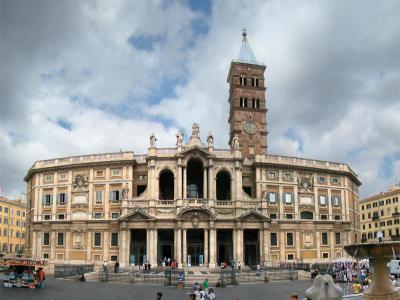
11) Basilica di Santa Maria Maggiore (Basilica of Saint Mary Major) (must see)
As the largest among the 26 churches in Rome dedicated to the Virgin Mary, the Basilica of Saint Mary Major holds a significant place in history. Originally constructed by Pope Liberius in the 4th century, the grandiose church has undergone renovations and enhancements by successive popes while still retaining its early medieval structure. The colonnaded nave, an integral part of the original 5th-century building, offers a glimpse into its ancient origins. The medieval era contributed the captivating Cosmatesque marble floor and the delightful Romanesque bell tower adorned with intricate blue ceramic roundels. During the Renaissance, a new coffered ceiling was introduced, while the Baroque period left its imprint with twin domes and grand facades at the front and rear. All in all, it’s a most successful blend of different architectural styles.
However, the true splendor of Saint Mary Major lies in its mosaics, which are among the oldest in Rome. The biblical scenes adorning the aisles date back to the 5th century, captivating visitors with their artistic depiction. The mosaics on the triumphal arch are particularly breathtaking, showcasing the skill and craftsmanship of the time. Among other medieval highlights is a magnificent 13th-century mosaic featuring an enthroned Christ in the loggia, adding to the artistic treasures within.
In 2001, Pope John Paul II inaugurated the Basilica Museum, dedicated to the church's history and the spread of Catholicism throughout the world. Here you will see ecclesiastical paintings, ritual vestments, scores from the choir and various manuscripts.
Tips: When visiting, be sure to take advantage of the small tours available to explore the church's hidden treasures. Additionally, don't miss the opportunity to visit the balcony loggia, which offers a unique perspective and allows you to admire more of the church's architecture. As evening sets in, find a serene spot by the fountain and marvel at the illuminated beauty of the building.
However, the true splendor of Saint Mary Major lies in its mosaics, which are among the oldest in Rome. The biblical scenes adorning the aisles date back to the 5th century, captivating visitors with their artistic depiction. The mosaics on the triumphal arch are particularly breathtaking, showcasing the skill and craftsmanship of the time. Among other medieval highlights is a magnificent 13th-century mosaic featuring an enthroned Christ in the loggia, adding to the artistic treasures within.
In 2001, Pope John Paul II inaugurated the Basilica Museum, dedicated to the church's history and the spread of Catholicism throughout the world. Here you will see ecclesiastical paintings, ritual vestments, scores from the choir and various manuscripts.
Tips: When visiting, be sure to take advantage of the small tours available to explore the church's hidden treasures. Additionally, don't miss the opportunity to visit the balcony loggia, which offers a unique perspective and allows you to admire more of the church's architecture. As evening sets in, find a serene spot by the fountain and marvel at the illuminated beauty of the building.
