Custom Walk in Granada, Spain by tulikamohan_358c6e created on 2026-05-30
Guide Location: Spain » Granada
Guide Type: Custom Walk
# of Sights: 9
Tour Duration: 2 Hour(s)
Travel Distance: 2.3 Km or 1.4 Miles
Share Key: MA6S5
Guide Type: Custom Walk
# of Sights: 9
Tour Duration: 2 Hour(s)
Travel Distance: 2.3 Km or 1.4 Miles
Share Key: MA6S5
How It Works
Please retrieve this walk in the GPSmyCity app. Once done, the app will guide you from one tour stop to the next as if you had a personal tour guide. If you created the walk on this website or come to the page via a link, please follow the instructions below to retrieve the walk in the app.
Retrieve This Walk in App
Step 1. Download the app "GPSmyCity: Walks in 1K+ Cities" on Apple App Store or Google Play Store.



Step 2. In the GPSmyCity app, download(or launch) the guide "Granada Map and Walking Tours".
Step 3. Tap the menu button located at upper right corner of the "Walks" screen and select "Retrieve custom walk". Enter the share key: MA6S5
1) Granada Cathedral (must see)
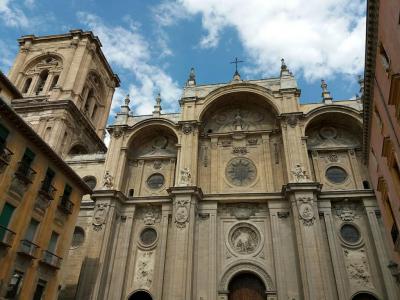
Granada Cathedral is a Roman Catholic church. It is the seat of the Archdiocese of Granada and it was built on top of the bones of the Mosque of the City. The construction took place in 1518 after the Christian Reconquest of Andalusia.
The Cathedral was started in The Spanish Renaissance style rather than the Gothic. In 1523 the first architect, Enrique Egas was replaced by Diego de Siloe. The work continued for forty years. Diego planned for a triforium of five naves rather than three. His principal chapel (capilla mayor) was circular, not a semicircular apse.
For 181 years alterations and revisions proceeded under different architects until 1667. Alonso Cano and Gaspar de la Pena introduced Baroque elements to the facade. In 1699 after 181 years, this document of stone might be considered almost complete. But two high towers were planned and never built. The ground underneath was considered unstable.
The Cathedral was meant to be the royal mausoleum but Philip II moved the royal burial site to the palace of El Escorial near Madrid.
The Cathedral was started in The Spanish Renaissance style rather than the Gothic. In 1523 the first architect, Enrique Egas was replaced by Diego de Siloe. The work continued for forty years. Diego planned for a triforium of five naves rather than three. His principal chapel (capilla mayor) was circular, not a semicircular apse.
For 181 years alterations and revisions proceeded under different architects until 1667. Alonso Cano and Gaspar de la Pena introduced Baroque elements to the facade. In 1699 after 181 years, this document of stone might be considered almost complete. But two high towers were planned and never built. The ground underneath was considered unstable.
The Cathedral was meant to be the royal mausoleum but Philip II moved the royal burial site to the palace of El Escorial near Madrid.
2) Capilla Real de Granada (Royal Chapel) (must see)
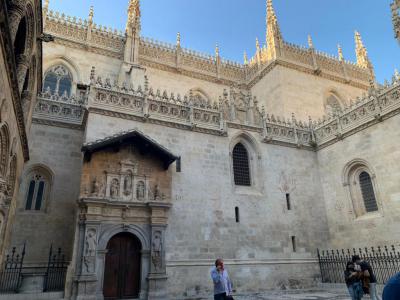
When Queen Isabella moved into Granada, she was a woman who had found her new home. She was determined to fix it up, to make it her own. Among the first things on her list was to make an addition to that new cathedral that was sitting on the old mosque. The add-on would be her very own chapel, not a little one either. It would be her Main Chapel.
The Main Chapel was constructed at last by 1517. It was built in the new Isabelline style. It is a transition from Gothic to early Renaissance architecture. Isabella planned to stay. By royal decree the chapel was declared to be the future burial site for herself and King Ferdinand. The King did not object.
The chapel is dedicated to Saint John the Baptist and Saint John the Evangelist. The interior is reminiscent of the Monastery of San Juan de los Reyes in Toledo. It has four side chapels in the form of a cross and a Gothic vault. In the center of the transept are the tombs of Isabella and Ferdinand. The tombs are sculpted and raised.
Spoiler alert. The tombs are empty. The royal remains are actually in the crypt below. Since the church is still used for services, the crypt is not always open to visitors. The Catholic kings and queens are joined in this chapel. Their memorials mark the emergence of the coming power and glory of Spain and the brilliant renaissance of Europe.
The Main Chapel was constructed at last by 1517. It was built in the new Isabelline style. It is a transition from Gothic to early Renaissance architecture. Isabella planned to stay. By royal decree the chapel was declared to be the future burial site for herself and King Ferdinand. The King did not object.
The chapel is dedicated to Saint John the Baptist and Saint John the Evangelist. The interior is reminiscent of the Monastery of San Juan de los Reyes in Toledo. It has four side chapels in the form of a cross and a Gothic vault. In the center of the transept are the tombs of Isabella and Ferdinand. The tombs are sculpted and raised.
Spoiler alert. The tombs are empty. The royal remains are actually in the crypt below. Since the church is still used for services, the crypt is not always open to visitors. The Catholic kings and queens are joined in this chapel. Their memorials mark the emergence of the coming power and glory of Spain and the brilliant renaissance of Europe.
3) La Madrasa (The Prayer Room) (must see)
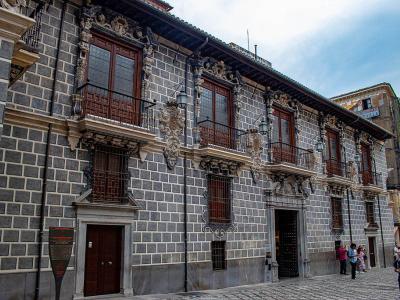
On the Oficios Street, between the Granada Cathedral and the Alcaiceria, where gold, and silk were traded long ago, sits the Madrasa of Granada. Founded in 1349 by Yusuf I, Nasrid Emir of Granada, the Madrasa was a school of Islamic law and grammar. The syllabus also included Rhetoric and Medicine.
The Madrasa survived when the city was ceded to Ferdinand and Isabella. Then in 1500, after a Muslim rebellion, Gonzalo Jimenez de Cisneros, Inquisitor-General, attacked the Madrasa. The building was sacked, the irreplaceable library books were burned in the Plaza Bib-Rambla. No one was ready for the Spanish Inquisition.
Subsequently, the building was variously standing empty, used as a city hall, or taken over to serve as a textile warehouse, its noble purpose long forgotten. In 1860 The Mihrab inscription dedicating the mosque to the month of Muharram was found. After several restorations, the Madrasa was opened to the public in 2011.
The sole part of the original Madrasa surviving today is the Prayer Room. It has a high ceiling. Halfway up the walls the shape of the room changes to an octagonal form. The upper walls are covered with stucco decorations and calligraphy. There are 16 windows and a wooden cupola overhead.
Within the entrance an inscription reads, "If in your spirit you provide a place for the desire to study...you will find within it the beautiful tree of honor..." The Inquisition tried to erase this place, and it failed.
The Madrasa survived when the city was ceded to Ferdinand and Isabella. Then in 1500, after a Muslim rebellion, Gonzalo Jimenez de Cisneros, Inquisitor-General, attacked the Madrasa. The building was sacked, the irreplaceable library books were burned in the Plaza Bib-Rambla. No one was ready for the Spanish Inquisition.
Subsequently, the building was variously standing empty, used as a city hall, or taken over to serve as a textile warehouse, its noble purpose long forgotten. In 1860 The Mihrab inscription dedicating the mosque to the month of Muharram was found. After several restorations, the Madrasa was opened to the public in 2011.
The sole part of the original Madrasa surviving today is the Prayer Room. It has a high ceiling. Halfway up the walls the shape of the room changes to an octagonal form. The upper walls are covered with stucco decorations and calligraphy. There are 16 windows and a wooden cupola overhead.
Within the entrance an inscription reads, "If in your spirit you provide a place for the desire to study...you will find within it the beautiful tree of honor..." The Inquisition tried to erase this place, and it failed.
4) Puerta de las Granadas (Gate of the Pomegranates)
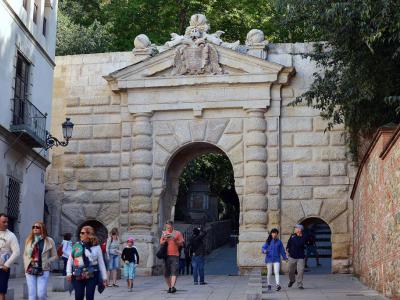
Also known as the gate of the pomegranates, the puerta de las Granadas is the gate to the path through the Alhambra Forest to the Alhambra itself. The path originates in the New Plaza and leads to the Nasrid Palace, the Alhambra.
The gate is made in a Roman style, with triumphal arches with a classic facade. It is the main entrance to the walled Alhambra enclosure. It was constructed during the reign of Charles V. The gate is made of stone with carved Florentine designs. The gate was built to memorialize the wedding of Charles I after his marriage to Isabel of Portugal.
The gate was made to replace the original Islamic gate, Bib al-Buxar, a defensive tower. Arabic architecture is to the right of the gate. On the left is a baroque style door to the Palace of the Marquise of Cartagena. The gate is named for the three pomegranates above the main arch, a promise of peace and abundance promised to Andalusia by Charles I.
The gate is made in a Roman style, with triumphal arches with a classic facade. It is the main entrance to the walled Alhambra enclosure. It was constructed during the reign of Charles V. The gate is made of stone with carved Florentine designs. The gate was built to memorialize the wedding of Charles I after his marriage to Isabel of Portugal.
The gate was made to replace the original Islamic gate, Bib al-Buxar, a defensive tower. Arabic architecture is to the right of the gate. On the left is a baroque style door to the Palace of the Marquise of Cartagena. The gate is named for the three pomegranates above the main arch, a promise of peace and abundance promised to Andalusia by Charles I.
5) Plaza Nueva (The New Square) (must see)
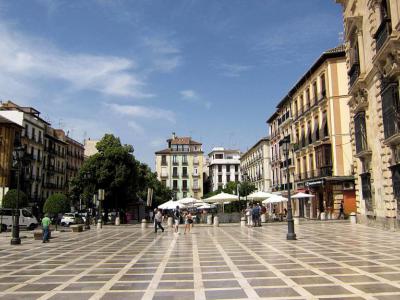
Despite its name, the Plaza Nueva (New Square) is one of the oldest squares in Granada. In former times the plaza was the scene of bull fights, tournaments and an occasional execution, definitely a spectator event. Before it was a square, however, it was a bridge. Called the Bridge of of Loggers, it spanned the River Darro.
The square is centrally located and is an ideal starting point for explorations on foot. Walk from the Puerto Granadas to the Alhambra forest to the Alhambra, a 15 or 20 minute journey. Exit by way of the cobbled street on the left of the Church of Santa Ana to the River Darro. Perhaps go up Elvira Street to the Mirador San Nicolas and the Albaicin.
The main attraction of the square itself is the High Court of Andalusia. The court building was formerly the Chancilleria Real (Royal Chancellery). Construction of the Chancellery began in 1530. In the rear of the building a prison, handy to the court. The square is also home to the Arborea Flamenco. Cafes, flamenco, ole!
The square is centrally located and is an ideal starting point for explorations on foot. Walk from the Puerto Granadas to the Alhambra forest to the Alhambra, a 15 or 20 minute journey. Exit by way of the cobbled street on the left of the Church of Santa Ana to the River Darro. Perhaps go up Elvira Street to the Mirador San Nicolas and the Albaicin.
The main attraction of the square itself is the High Court of Andalusia. The court building was formerly the Chancilleria Real (Royal Chancellery). Construction of the Chancellery began in 1530. In the rear of the building a prison, handy to the court. The square is also home to the Arborea Flamenco. Cafes, flamenco, ole!
6) Corral del Carbón
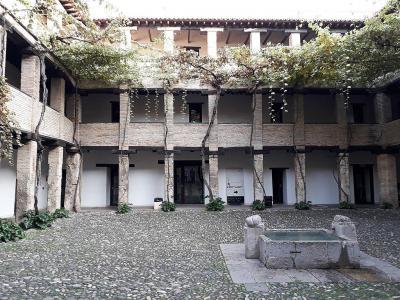
The Corral del Carbón is located behind the City Hall in the centre of Granada. It is perhaps the oldest complete building in the city that has survived from the Moorish era. Its name translates as ‘coal house’ – and it seems that is exactly what it was used for when Granada was ruled by Emirs. Yusuf I ordered its construction as a warehouse and trading post for coal and other goods. Following the Christian conquest of Granada, it was converted into a theatre, where plays on the lives of Spanish folk heroes like Don Quixote were performed.
The building is constructed around a courtyard, decorated with black and white tiles, and with a water trough at its centre. The courtyard is surrounded by galleries and craft rooms. A pavilion links the main entrance to the central area. The Corral del Carbón is believed to have been used as a tavern for coal merchants, complete with sleeping quarters. Known as ‘caravansaras’ or ‘fundaks’, these hostelries were common in Moorish Spain. The building is now a tourist attraction, open from 9am to 7pm on weekdays, and 10am to 2pm on weekends. Admission is free. The Corral del Carbón also houses a small museum and art shop within its walls.
The building is constructed around a courtyard, decorated with black and white tiles, and with a water trough at its centre. The courtyard is surrounded by galleries and craft rooms. A pavilion links the main entrance to the central area. The Corral del Carbón is believed to have been used as a tavern for coal merchants, complete with sleeping quarters. Known as ‘caravansaras’ or ‘fundaks’, these hostelries were common in Moorish Spain. The building is now a tourist attraction, open from 9am to 7pm on weekdays, and 10am to 2pm on weekends. Admission is free. The Corral del Carbón also houses a small museum and art shop within its walls.
7) Alcaicería (The Arab Market)
In the sixth century the Byzantine Emperor Justinian granted the Arabs the exclusive right to make and sell silk within the Empire. To show appreciation the Arabs gave their bazaars the Arabic name for Caesar, al-Kaysar-ia, "the place of Ceasar." Sounds like "Alcaiceria." And so from that time all Arab bazaars took this name.
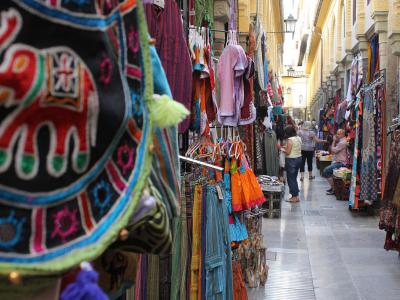
The Alcaiceria of Granada was opened in the 15th century. It lasted well into the 19th century when it was destroyed by fire. The fire was caused by a shop for matches. The shop went up first, then all else followed. The replacement Alcaiceria is a weak imitation of the original. It is smaller, made with cheaper materials. It looks worn.
The first Alcaiceria held over 200 shops and stalls within a maze of streets and alleys. The streets were closed with iron gates to keep horsemen out. The gates were locked at night. Business was given over almost exclusively to the precious silks. Today the Aciceria is devoted to souvenir stalls, knick-knacks, and memorabilia.
The Alcaiceria of Granada was opened in the 15th century. It lasted well into the 19th century when it was destroyed by fire. The fire was caused by a shop for matches. The shop went up first, then all else followed. The replacement Alcaiceria is a weak imitation of the original. It is smaller, made with cheaper materials. It looks worn.
The first Alcaiceria held over 200 shops and stalls within a maze of streets and alleys. The streets were closed with iron gates to keep horsemen out. The gates were locked at night. Business was given over almost exclusively to the precious silks. Today the Aciceria is devoted to souvenir stalls, knick-knacks, and memorabilia.
8) Plaza Bib-Rambla
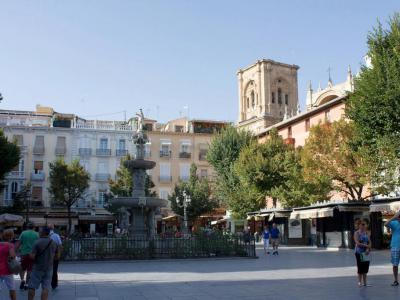
In the Plaza Bib-Rambla, when you stand before the Fountain of Giants, here's what you should do. Sit down. Sit at one of the cafes. Look at the giants, enjoy the flower market, have churros with your hot chocolate and allow your mind to go back in time.
You are in the square of Medina Garnata of the Nasrid era. The square is a Muslim bazaar, a souq. The Arabs call this place Bib-Rambla (Sand Gate) for the sandy banks of the Darro river nearby. There are three other rivers, the Genil, the Monachil, and the Beiro.
Here's a factoid. Where you are sitting was a Jewish ghetto. But that's another story. Sip your chocolate, move on. Going forward (as they say), see Bazaars, jousting knights, bull fights, burning heretics, executions, Corpus Christi processions.
In December the square is given over to Christmas markets and stalls selling hot chestnuts. In May carnival giants with swollen heads dominate in the Tarasca procession, in observance of Corpus Christi. The figure of a warrior mounted on a dragon (La Tarasca) is wafted around the square to remind people that good will triumph over evil.
Bib-Rambla today is a haven to buy flowers, enjoy the shade of the lemon trees and study the faces on the Gigantones Fountain. Still hungry? Have some tapas.
You are in the square of Medina Garnata of the Nasrid era. The square is a Muslim bazaar, a souq. The Arabs call this place Bib-Rambla (Sand Gate) for the sandy banks of the Darro river nearby. There are three other rivers, the Genil, the Monachil, and the Beiro.
Here's a factoid. Where you are sitting was a Jewish ghetto. But that's another story. Sip your chocolate, move on. Going forward (as they say), see Bazaars, jousting knights, bull fights, burning heretics, executions, Corpus Christi processions.
In December the square is given over to Christmas markets and stalls selling hot chestnuts. In May carnival giants with swollen heads dominate in the Tarasca procession, in observance of Corpus Christi. The figure of a warrior mounted on a dragon (La Tarasca) is wafted around the square to remind people that good will triumph over evil.
Bib-Rambla today is a haven to buy flowers, enjoy the shade of the lemon trees and study the faces on the Gigantones Fountain. Still hungry? Have some tapas.
9) San Juan de Dios Church (must see)
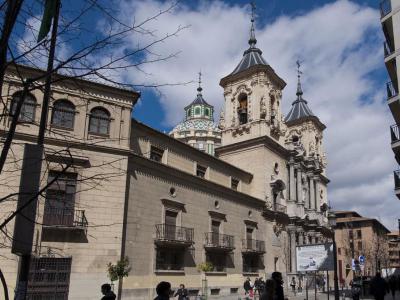
The San Juan de Dios Church is located on the street of the same name. Both are named after Juan Duarte, a local monk who arrived in Granada in 1536. In a time of hardship for the city and surrounding region, Duarte dedicated his life to caring for the sick and needy. He died in Casa de los Pisa in 1550, and was later canonized. The city’s main hospital also bears his name. Inside this stunning baroque church, you can see the silver urn, held within a raised shrine, which contains his ashes.
The church was erected in the 17th century, as a sanctuary and crypt for Juan Duarte. It was designed by Jose de Bada y Navajas, the high master of cathedrals in Granada and Malaga. Designed in a Latin cruciform plan, it is notable for its collection of paintings and sculpture, added soon after the church was completed. The main altar was designed by Francisco Guerrero, and is made from gilded wood. A four room chapel dedicated to the Virgin Mary can be found above the sacristy, close to the shrine to San Juan de Dios.
The church of San Juan de Dios is located in the very centre of Granada. It is open from 10am until 1pm, and from 4pm to 7pm, in summer. The church closes at 6pm during the winter months.
The church was erected in the 17th century, as a sanctuary and crypt for Juan Duarte. It was designed by Jose de Bada y Navajas, the high master of cathedrals in Granada and Malaga. Designed in a Latin cruciform plan, it is notable for its collection of paintings and sculpture, added soon after the church was completed. The main altar was designed by Francisco Guerrero, and is made from gilded wood. A four room chapel dedicated to the Virgin Mary can be found above the sacristy, close to the shrine to San Juan de Dios.
The church of San Juan de Dios is located in the very centre of Granada. It is open from 10am until 1pm, and from 4pm to 7pm, in summer. The church closes at 6pm during the winter months.
