Custom Walk in Salt Lake City, Utah by msfortin_5d339a created on 2026-06-12
Guide Location: USA » Salt Lake City
Guide Type: Custom Walk
# of Sights: 14
Tour Duration: 3 Hour(s)
Travel Distance: 5.2 Km or 3.2 Miles
Share Key: EUVJT
Guide Type: Custom Walk
# of Sights: 14
Tour Duration: 3 Hour(s)
Travel Distance: 5.2 Km or 3.2 Miles
Share Key: EUVJT
How It Works
Please retrieve this walk in the GPSmyCity app. Once done, the app will guide you from one tour stop to the next as if you had a personal tour guide. If you created the walk on this website or come to the page via a link, please follow the instructions below to retrieve the walk in the app.
Retrieve This Walk in App
Step 1. Download the app "GPSmyCity: Walks in 1K+ Cities" on Apple App Store or Google Play Store.



Step 2. In the GPSmyCity app, download(or launch) the guide "Salt Lake City Map and Walking Tours".
Step 3. Tap the menu button located at upper right corner of the "Walks" screen and select "Retrieve custom walk". Enter the share key: EUVJT
1) State Capitol (must see)
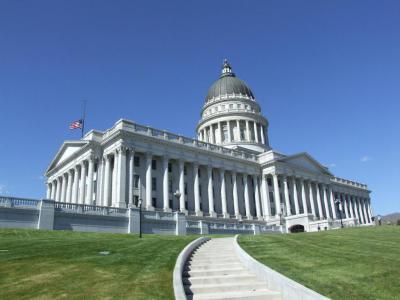
Utah's spectacular State Capitol building is a bit of an uphill hike from the heart of downtown Salt Lake City, but well worth the effort. Take in the breathtaking mountain views from the front steps, then head inside to see the state's history unspool through the glorious artwork adorning the walls and ceiling of the cavernous atrium. Traditional architecture built with a variety of stone and other materials, as well as a very open interior, makes this building quite an experience to visit.
Utah history is dramatized in large murals and canvasses, while the dome ceiling is painted with seagulls – the official state bird since 1955. Exhibits from all 29 counties are displayed on the ground floor, but the 2nd floor – and especially the Gold Room where visiting celebrities are hosted – should not be missed. Decorated with native bird's eye marble, the room boasts exquisite chandeliers, chairs and a table adorned with gold leaf from Utah mines.
Once the (free) tour is over, you can ponder your thoughts in the quaint outdoor courtyard area or the really neat park on the east side – just walk along one of the trails to get down the hill. Immediately across the street, the visitor center has lots of free brochures, maps, and travel guides for all of Utah, as well lots of awesome and affordable gifts and collectibles.
Utah history is dramatized in large murals and canvasses, while the dome ceiling is painted with seagulls – the official state bird since 1955. Exhibits from all 29 counties are displayed on the ground floor, but the 2nd floor – and especially the Gold Room where visiting celebrities are hosted – should not be missed. Decorated with native bird's eye marble, the room boasts exquisite chandeliers, chairs and a table adorned with gold leaf from Utah mines.
Once the (free) tour is over, you can ponder your thoughts in the quaint outdoor courtyard area or the really neat park on the east side – just walk along one of the trails to get down the hill. Immediately across the street, the visitor center has lots of free brochures, maps, and travel guides for all of Utah, as well lots of awesome and affordable gifts and collectibles.
2) McCune Mansion
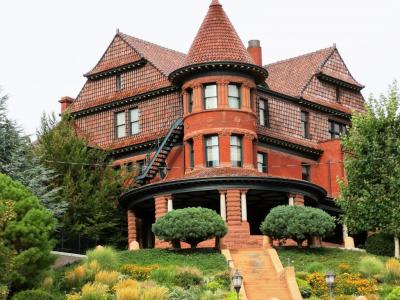
Situated on a prominent corner location on Capitol Hill, the McCune Mansion majestically overlooks Temple Square and downtown Salt Lake City. According to the sign on site, it was built in 1901 by railroad and mining tycoon Alfred McCune, who spared little expense on design and decoration, having even financed a two-year tour of America and Europe for architect S.C. Dallas to study different designs and techniques. The chosen design was a Gothic revival plan with East Asian influence, replicating a house that the McCunes saw while driving in New York City.
Now listed on the National Register of Historic Places, the extravagant mansion features imported materials from many parts of the world. McCune had mahogany shipped from San Domingo, oak from England, and a rare white-grained mahogany from South Africa. The red roof tiles came from the Netherlands, and an enormous broad mirror wall was transported from Germany in a specially-made railroad car. The walls were adorned with moiré silks, tapestries, and Russian leather, and only the exterior was built of locally-sourced red sandstone – though some details like the lavish fireplaces used more exotic stone like Nubian marble. At its completion, the mansion had cost McCune one million dollars.
Lovingly restored to its original grandeur, the privately-owned building is open to private tours, business events, weddings and other special occasions. Historical tours are provided by Preservation Utah – call ahead to schedule your tour time.
Now listed on the National Register of Historic Places, the extravagant mansion features imported materials from many parts of the world. McCune had mahogany shipped from San Domingo, oak from England, and a rare white-grained mahogany from South Africa. The red roof tiles came from the Netherlands, and an enormous broad mirror wall was transported from Germany in a specially-made railroad car. The walls were adorned with moiré silks, tapestries, and Russian leather, and only the exterior was built of locally-sourced red sandstone – though some details like the lavish fireplaces used more exotic stone like Nubian marble. At its completion, the mansion had cost McCune one million dollars.
Lovingly restored to its original grandeur, the privately-owned building is open to private tours, business events, weddings and other special occasions. Historical tours are provided by Preservation Utah – call ahead to schedule your tour time.
3) Salt Lake Temple (must see)
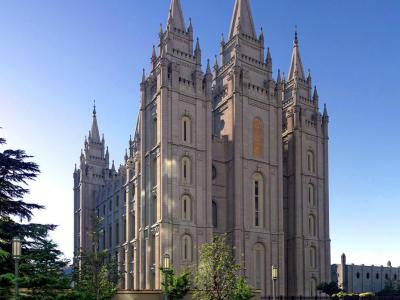
The centerpiece of Temple Square, this beautiful neo-gothic edifice took 40 years to build at the direction of then Church President, Brigham Young, and has withstood the test of time since being dedicated in 1893. The granite-like quartz monzonite was quarried in Little Cottonwood Canyon, 22 miles south of the site, and was then laboriously hauled by oxen, stone by stone, until the railroad became operational in 1869. Oriented towards Jerusalem and incorporating a host of symbolic designs and decorations, many of which are visible on the exterior, it remains the largest LDS temple by floor area (253,015 square feet / 23,505.9 square meters). Its massive presence is a marvel, considering there was no electricity, no computers, nor any other artificial means used during construction. The stone masonry is so precise, there is not even mortar between the stones! And then to think the pioneers built this huge edifice in the middle of a desert guided by faith is just awesome.
As with all LDS temples, only qualifying members of the LDS faith can enter the building (used primarily for marriages, baptisms for the dead, religious ritual instruction, and meetings of the First Presidency and of the Quorum of the Twelve Apostles), but visitors can walk around the exterior and enter other historic structures nearby. During the winter months the beauties of the world-famous flower beds are replaced by nativity displays and millions of Christmas lights strung through all the trees on Temple Square, making it a hugely popular destination for visitors and locals alike.
***PIONEERS TRAIL***
As noted by the scholars, "Brigham Young was almost sole author of one of the most important chapters in the history of the American West." When the first group of pioneers, led by Young, entered Immigration Canyon overlooking the Salt Lake Valley on July 24, 1847, Young (who had been ill and was bedded in a covered wagon) rose long enough to gaze out over the valley and famously declared "This is the right place. Drive on." Those with him clearly understood that he was talking about his vision of where the Latter-Day Saints were to settle. It should be noted that Church leaders and members alike felt that settling in Utah (near the Rockies) would fulfill Isaiah 2:2 - "And it shall come to pass in the last days, that the mountain of the LORD'S house [temple] shall be established in the top of the mountains, and shall be exalted above the hills; and all nations shall flow unto it."
Perhaps among Young's greatest visible accomplishments was his initiation of the construction of the world famous Salt Lake Temple and Tabernacle on Temple Square, and the incredible construction of a system of miles and miles of irrigation canals that fulfilled the prophecy in Isaiah 35:1 "The wilderness and the solitary place shall be glad for them; and the desert shall rejoice, and blossom as the rose."
Tip:
One of the best (and free!) views of the edifice (and of Temple Square) is from the atrium and inside of The Roof restaurant, located on the top floor of the Joseph Smith Memorial Building, a short walk and elevator ride directly to the east.
As with all LDS temples, only qualifying members of the LDS faith can enter the building (used primarily for marriages, baptisms for the dead, religious ritual instruction, and meetings of the First Presidency and of the Quorum of the Twelve Apostles), but visitors can walk around the exterior and enter other historic structures nearby. During the winter months the beauties of the world-famous flower beds are replaced by nativity displays and millions of Christmas lights strung through all the trees on Temple Square, making it a hugely popular destination for visitors and locals alike.
***PIONEERS TRAIL***
As noted by the scholars, "Brigham Young was almost sole author of one of the most important chapters in the history of the American West." When the first group of pioneers, led by Young, entered Immigration Canyon overlooking the Salt Lake Valley on July 24, 1847, Young (who had been ill and was bedded in a covered wagon) rose long enough to gaze out over the valley and famously declared "This is the right place. Drive on." Those with him clearly understood that he was talking about his vision of where the Latter-Day Saints were to settle. It should be noted that Church leaders and members alike felt that settling in Utah (near the Rockies) would fulfill Isaiah 2:2 - "And it shall come to pass in the last days, that the mountain of the LORD'S house [temple] shall be established in the top of the mountains, and shall be exalted above the hills; and all nations shall flow unto it."
Perhaps among Young's greatest visible accomplishments was his initiation of the construction of the world famous Salt Lake Temple and Tabernacle on Temple Square, and the incredible construction of a system of miles and miles of irrigation canals that fulfilled the prophecy in Isaiah 35:1 "The wilderness and the solitary place shall be glad for them; and the desert shall rejoice, and blossom as the rose."
Tip:
One of the best (and free!) views of the edifice (and of Temple Square) is from the atrium and inside of The Roof restaurant, located on the top floor of the Joseph Smith Memorial Building, a short walk and elevator ride directly to the east.
4) Deuel Log Cabin
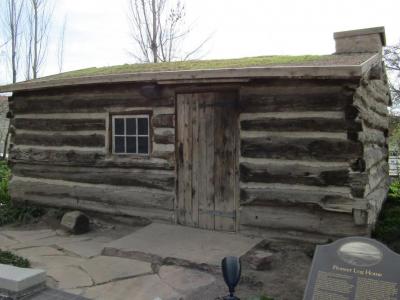
The Deuel Log Cabin in Salt Lake City is a remarkable remnant of early Mormon pioneer history, nestled discreetly between the Museum of Church History and the Family History Library, just across from Temple Square. Built in 1847, this cabin stands as one of only two surviving original log homes constructed by the Mormon settlers upon their arrival in the Salt Lake Valley. The Deuel cabin preserves its authentic roof, walls, and supporting beams-materials that have endured for over 170 years.
Originally home to Osmyn and Mary Deuel along with Osmyn’s brother Amos, the cabin measures a compact 15 by 20 feet, offering a rare glimpse into the modest pioneer lifestyle through a plexiglass viewing door. Restored to reflect its 1847 condition, it is furnished with period artifacts, illustrating the practical yet sparse living arrangements typical of the time.
The structure has journeyed across several locations before reaching its current setting in 1985. Initially part of the Old Fort at Pioneer Park, it later moved to Temple Square as a preserved historic artifact. Since its restoration, the cabin has been surrounded by landscaping that features native Utah plants, curated to evoke the environment the Deuels would have known.
This cabin is not only a preserved piece of architecture but a tangible connection to the lives of the Deuel family and other early pioneers, capturing a significant moment in the settlement of the Salt Lake Valley. Its enduring presence offers visitors a quiet, reflective space amid Temple Square's bustling surroundings, inviting them to step briefly into Utah’s pioneer past.
Originally home to Osmyn and Mary Deuel along with Osmyn’s brother Amos, the cabin measures a compact 15 by 20 feet, offering a rare glimpse into the modest pioneer lifestyle through a plexiglass viewing door. Restored to reflect its 1847 condition, it is furnished with period artifacts, illustrating the practical yet sparse living arrangements typical of the time.
The structure has journeyed across several locations before reaching its current setting in 1985. Initially part of the Old Fort at Pioneer Park, it later moved to Temple Square as a preserved historic artifact. Since its restoration, the cabin has been surrounded by landscaping that features native Utah plants, curated to evoke the environment the Deuels would have known.
This cabin is not only a preserved piece of architecture but a tangible connection to the lives of the Deuel family and other early pioneers, capturing a significant moment in the settlement of the Salt Lake Valley. Its enduring presence offers visitors a quiet, reflective space amid Temple Square's bustling surroundings, inviting them to step briefly into Utah’s pioneer past.
5) Family Search Library
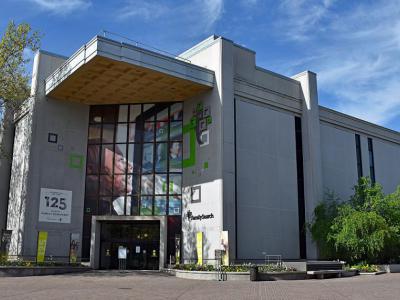
The FamilySearch Library (FSL), formerly known as the Family History Library, stands in the heart of Salt Lake City as the world’s largest genealogical research facility. Operated by FamilySearch, the genealogical branch of the Church of Jesus Christ of Latter-day Saints (LDS Church), the FSL traces its origins to the establishment of the Genealogical Society of Utah (GSU) in 1894. Since opening its current location just west of Temple Square on October 23, 1985, the library has welcomed the public free of charge, drawing thousands each year who are passionate about uncovering their family histories.
The FSL houses a remarkable collection that includes over 2.4 million rolls of microfilmed records, 727,000 microfiche, 356,000 books and serials, 125,000 periodicals, and 3,725 electronic resources. This vast archive represents genealogical information from over 100 countries, making it an invaluable resource for both seasoned researchers and beginners alike. Professional genealogists and knowledgeable volunteers assist in around 30 languages, offering expertise in reading, translating, and tracing genealogically relevant documents. For those needing extra guidance, the library also provides free one-on-one consultations, as well as both on-site and online classes covering various genealogical research methods.
One unique aspect of the FamilySearch Library is its mission, which aligns with the LDS Church’s belief in eternal family connections. Families who were not able to complete saving ordinances in life can have them completed posthumously by proxy, making family history work a central, spiritually significant task for the church.
Over the years, the library has adapted its resources to meet the demands of the digital age. The GSU’s historical microfilming project, which began in 1938, has now evolved into a fully digitized archive, available through the FamilySearch website. This accessibility allows users to explore genealogical records from anywhere in the world, bridging past generations with present-day searchers.
The FSL houses a remarkable collection that includes over 2.4 million rolls of microfilmed records, 727,000 microfiche, 356,000 books and serials, 125,000 periodicals, and 3,725 electronic resources. This vast archive represents genealogical information from over 100 countries, making it an invaluable resource for both seasoned researchers and beginners alike. Professional genealogists and knowledgeable volunteers assist in around 30 languages, offering expertise in reading, translating, and tracing genealogically relevant documents. For those needing extra guidance, the library also provides free one-on-one consultations, as well as both on-site and online classes covering various genealogical research methods.
One unique aspect of the FamilySearch Library is its mission, which aligns with the LDS Church’s belief in eternal family connections. Families who were not able to complete saving ordinances in life can have them completed posthumously by proxy, making family history work a central, spiritually significant task for the church.
Over the years, the library has adapted its resources to meet the demands of the digital age. The GSU’s historical microfilming project, which began in 1938, has now evolved into a fully digitized archive, available through the FamilySearch website. This accessibility allows users to explore genealogical records from anywhere in the world, bridging past generations with present-day searchers.
6) Salt Lake Tabernacle (must see)
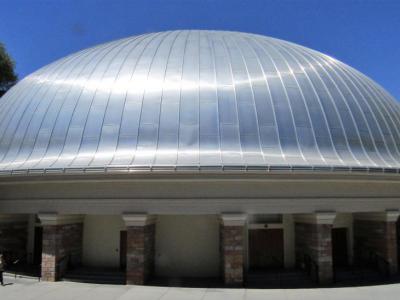
A great marvel of sound and acoustics, this domed building is the home of the famed Tabernacle Choir, and was the previous home of the Utah Symphony Orchestra until the construction of Abravanel Hall. Inside, the beautiful pipe organ – one of the largest in the world – is something to see, but catching a Sunday morning choir performance (or a rehearsal at the least – Thursdays at 7:30pm) counts as one of those experiences of a life time. Both the tour and the choir concerts/rehearsals are free to the public, by the way!
At a time before electronics and audio amplifiers, the Tabernacle was constructed with remarkable acoustic qualities so the entire congregation could hear sermons given here. The roof was built in a three-dimensional ellipse – a concept that came from none other than church president Brigham Young, who reportedly said that the design was inspired by "the best sounding board in the world ... the roof of my mouth." It is common for LDS missionary tour guides to demonstrate the acoustics by dropping a pin on the pulpit or tearing a newspaper there, which can be heard throughout the building.
Built without nails, the structure itself was an architectural wonder in its day, prompting a writer for Scientific American to comment on "the mechanical difficulties of attending the construction of so ponderous a roof." Apparently, the supporting beams were made by a shipbuilder, who used his knowledge to hold together the dome by means of horsehair and leather alone. In 1882, while on a lecture tour of America, Oscar Wilde noted that the building had the appearance of a soup-kettle; he added that it was the most purely dreadful building he ever saw. Some visitors around the beginning of the 20th century criticized it as "a prodigious tortoise that has lost its way" or "the Church of the Holy Turtle," but Frank Lloyd Wright dubbed the Tabernacle "one of the architectural masterpieces of the country and perhaps the world."
At a time before electronics and audio amplifiers, the Tabernacle was constructed with remarkable acoustic qualities so the entire congregation could hear sermons given here. The roof was built in a three-dimensional ellipse – a concept that came from none other than church president Brigham Young, who reportedly said that the design was inspired by "the best sounding board in the world ... the roof of my mouth." It is common for LDS missionary tour guides to demonstrate the acoustics by dropping a pin on the pulpit or tearing a newspaper there, which can be heard throughout the building.
Built without nails, the structure itself was an architectural wonder in its day, prompting a writer for Scientific American to comment on "the mechanical difficulties of attending the construction of so ponderous a roof." Apparently, the supporting beams were made by a shipbuilder, who used his knowledge to hold together the dome by means of horsehair and leather alone. In 1882, while on a lecture tour of America, Oscar Wilde noted that the building had the appearance of a soup-kettle; he added that it was the most purely dreadful building he ever saw. Some visitors around the beginning of the 20th century criticized it as "a prodigious tortoise that has lost its way" or "the Church of the Holy Turtle," but Frank Lloyd Wright dubbed the Tabernacle "one of the architectural masterpieces of the country and perhaps the world."
7) Brigham Young Monument / Meridian Marker
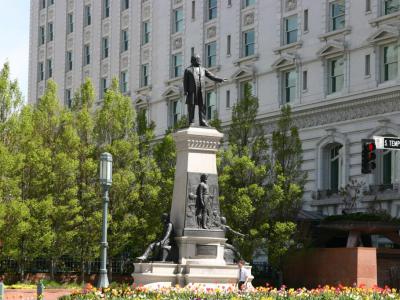
First displayed at the Chicago World's Fair in 1893, this 25-foot bronze monument was erected in honor of pioneer-colonizer, Utah governor, and LDS Church president Brigham Young who led the Mormon pioneers into the Utah Territory in 1847 – here seen pointing with an outstretched left arm. Its base has the figure of an Indian facing east and that of a bearded fur trapper facing west, both of which preceded the Mormon settlers. On the south side is a bronze bas-relief of a pioneer man, woman, and child, while another bronze plaque has a list of the pioneers who arrived in the Salt Lake Valley on July 24, 1847, and their equipment.
Redesigned and restored in 2000, the beautifully kept Memorial Gardens also hold the grave of Brigham Young (back left corner with the fencing around it) and of some of his family members, including four of his wives. Just west of the statue, right next to the wall around Temple Square, the Meridian Marker is the spot from where all the measurements in Utah originate. Nothing but a small concrete obelisk, with a medallion on the top, but would make quite a nice spot for geogachers to log a trophy.
Redesigned and restored in 2000, the beautifully kept Memorial Gardens also hold the grave of Brigham Young (back left corner with the fencing around it) and of some of his family members, including four of his wives. Just west of the statue, right next to the wall around Temple Square, the Meridian Marker is the spot from where all the measurements in Utah originate. Nothing but a small concrete obelisk, with a medallion on the top, but would make quite a nice spot for geogachers to log a trophy.
8) Temple Square (must see)
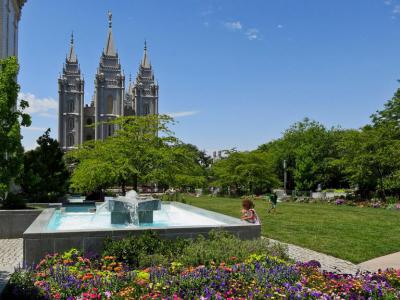
In 1847, when Mormon pioneers arrived in the Salt Lake Valley, president Brigham Young selected a plot of the desert ground and proclaimed, "Here we will build a temple to our God." When the city was surveyed, the block enclosing that location became known as Temple Square and a 15-foot surrounding wall was built shortly after the block was so designated. Now attracting 3 million to 5 million visitors a year, Temple Square is the most popular tourist attraction in Utah, bringing in more visitors than the Grand Canyon or Yellowstone National Park.
Though the 10-acre (4.0 hectares) complex is mostly known as the headquarters of the LDS Church, other buildings currently contained within are the Salt Lake Tabernacle, the Salt Lake Assembly Hall, the Seagull Monument, and two visitors' centers, the one on the north being the larger of the two. Most of the buildings are open and you are free to walk in and look around, enjoy the well-tended grounds, sneak in a picture by the reflecting pool, or have dinner/coffee in the coffee shop or restaurant on site. Let's not forget the many statues and flower beds for everyone to enjoy!
The grounds, as well as the Gardens at Temple Square, often host concerts and other events. During the Christmas holiday season, approximately 100,000 Christmas lights sparkle from trees and shrubs around Temple Square each evening until 10 pm. The lighting of Temple Square is a popular event, usually attended by more than 10,000 people.
Though the 10-acre (4.0 hectares) complex is mostly known as the headquarters of the LDS Church, other buildings currently contained within are the Salt Lake Tabernacle, the Salt Lake Assembly Hall, the Seagull Monument, and two visitors' centers, the one on the north being the larger of the two. Most of the buildings are open and you are free to walk in and look around, enjoy the well-tended grounds, sneak in a picture by the reflecting pool, or have dinner/coffee in the coffee shop or restaurant on site. Let's not forget the many statues and flower beds for everyone to enjoy!
The grounds, as well as the Gardens at Temple Square, often host concerts and other events. During the Christmas holiday season, approximately 100,000 Christmas lights sparkle from trees and shrubs around Temple Square each evening until 10 pm. The lighting of Temple Square is a popular event, usually attended by more than 10,000 people.
9) Lion House
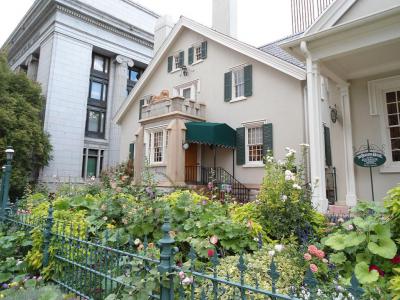
Taking its name from the recumbent lion set on top of the front portico, this house was constructed 1855-56 as a residence for some of Mormon leader Brigham Young's wives and children. Like all other buildings on Temple Square, it has been pristinely preserved, looking like it was built last year. There is now a pleasant cafeteria-style restaurant inside serving local fare to the faithful and the visitors alike. When you see people gathering together to enter, you know you're in for a good lunch – and you likely won't be disappointed. The homemade bread rolls served with honey butter are Utah famous!
Back in the day, the basement contained a dining room which could accommodate 70 people, while on the main floor were sitting rooms and bedrooms for wives with children. The 2nd floor contained 20 bedrooms for children and childless wives – one under each of the steeply-pitched gables. A polygamist, Young ultimately fathered 57 children by more than two dozen wives, and also had many adopted, foster, and stepchildren. By the 1930s, however, the practice of polygamy had been abandoned by the LDS Church and banned by the state of Utah, making it punishable by imprisonment and a hefty fine.
Back in the day, the basement contained a dining room which could accommodate 70 people, while on the main floor were sitting rooms and bedrooms for wives with children. The 2nd floor contained 20 bedrooms for children and childless wives – one under each of the steeply-pitched gables. A polygamist, Young ultimately fathered 57 children by more than two dozen wives, and also had many adopted, foster, and stepchildren. By the 1930s, however, the practice of polygamy had been abandoned by the LDS Church and banned by the state of Utah, making it punishable by imprisonment and a hefty fine.
10) Beehive House
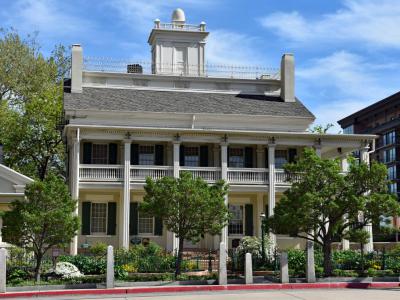
Getting its name from the clearly visible beehive sculpture on top, this was one of two official residences of Brigham Young, who led the famous Mormon migration from Nauvoo, IL, to the Salt Lake Valley in 1847 and became the 2nd president (after founder Joseph Smith) of The Church of Jesus Christ of Latter-Day Saints. Like most buildings on Temple Square, the house is meticulously maintained and can be visited on a free 30-minute tour that takes you around the lower and 2nd floor. Featuring superb woodwork and craftsmanship throughout, the tour provides an excellent opportunity to dig into local history – so if you love old houses and learning about how people lived in times past, this is for you!
Constructed of adobe and sandstone, the home was designed by Young's brother-in-law and architect of the Salt Lake Temple, Truman O. Angell, who also designed the neighboring Lion House – once a home many of his wives and children. Although perhaps an over-achiever in "raising up seed", Young was nonetheless devoted to his first wife above all, as anyone who visits both the Beehive House and the Lion House can attest.
Constructed of adobe and sandstone, the home was designed by Young's brother-in-law and architect of the Salt Lake Temple, Truman O. Angell, who also designed the neighboring Lion House – once a home many of his wives and children. Although perhaps an over-achiever in "raising up seed", Young was nonetheless devoted to his first wife above all, as anyone who visits both the Beehive House and the Lion House can attest.
11) Eagle Gate
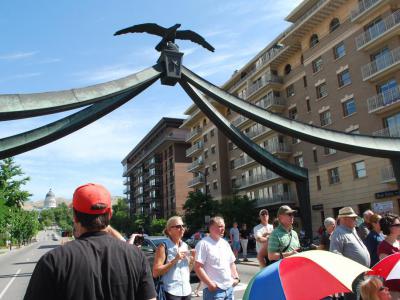
The Eagle Gate in Salt Lake City is a historical monument that spans State Street at the intersection with South Temple, right in the heart of the city’s downtown area. This prominent arch was originally constructed in 1859 as an entrance to Brigham Young’s estate and served as the gateway to City Creek Canyon. With its iconic eagle and beehive sculpture, the monument has come to symbolize Salt Lake City's pioneer heritage and the industrious spirit of Utah.
The gate’s current iteration, designed in the 1960s, is a striking example of Mid-century modern architecture. Supported by four pillars with a steel frame covered in metal panels, the arch leads up to a keystone embellished with five-point stars. Atop this keystone rests a bronze eagle, a replica of the original wooden sculpture that once adorned the gate. This eagle, with a wingspan of 20 feet, is perched on a beehive-a symbolic nod to Utah’s nickname, “The Beehive State.” This enduring symbol of thrift and perseverance has been a part of Utah’s identity since the Mormon pioneer era when the beehive became an emblem of the early settlers’ industrious nature.
On the eastern side of the monument, a granite stone containing a time capsule lies between two pillars, accompanied by a plaque detailing the Eagle Gate’s history. Originally, the gate featured large wooden doors, which were closed nightly to secure Brigham Young’s extensive estate, including the Beehive House, Lion House, private offices, gardens, and various facilities. In 1891, the wooden gates were removed, and the entrance was expanded into a public street, with the eagle receiving a copper-plated finish on stone pillars. By 1960, after the original wood had deteriorated, the gate was rebuilt with an enlarged bronze eagle, solidifying its place as a tribute to the pioneers who established the state.
Today, the Eagle Gate remains one of Salt Lake City’s best-known landmarks, inspiring the names of several local businesses and buildings. As a monument to both historical roots and modern design, it continues to bridge the city’s pioneer legacy with its evolving urban identity.
The gate’s current iteration, designed in the 1960s, is a striking example of Mid-century modern architecture. Supported by four pillars with a steel frame covered in metal panels, the arch leads up to a keystone embellished with five-point stars. Atop this keystone rests a bronze eagle, a replica of the original wooden sculpture that once adorned the gate. This eagle, with a wingspan of 20 feet, is perched on a beehive-a symbolic nod to Utah’s nickname, “The Beehive State.” This enduring symbol of thrift and perseverance has been a part of Utah’s identity since the Mormon pioneer era when the beehive became an emblem of the early settlers’ industrious nature.
On the eastern side of the monument, a granite stone containing a time capsule lies between two pillars, accompanied by a plaque detailing the Eagle Gate’s history. Originally, the gate featured large wooden doors, which were closed nightly to secure Brigham Young’s extensive estate, including the Beehive House, Lion House, private offices, gardens, and various facilities. In 1891, the wooden gates were removed, and the entrance was expanded into a public street, with the eagle receiving a copper-plated finish on stone pillars. By 1960, after the original wood had deteriorated, the gate was rebuilt with an enlarged bronze eagle, solidifying its place as a tribute to the pioneers who established the state.
Today, the Eagle Gate remains one of Salt Lake City’s best-known landmarks, inspiring the names of several local businesses and buildings. As a monument to both historical roots and modern design, it continues to bridge the city’s pioneer legacy with its evolving urban identity.
12) Cathedral of the Madeleine (must see)
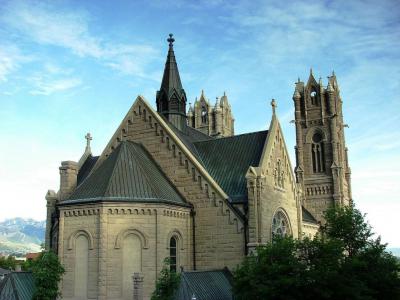
The Cathedral of the Madeleine, located in the heart of Salt Lake City, is a testament to Catholic presence in a city known as the headquarters of the Mormon faith. This impressive structure, completed in 1909 with land gifted by the Mormons and significant construction support from Mormon volunteers, serves as the mother church of the Diocese of Salt Lake City. The only cathedral in the United States dedicated to Saint Mary Magdalene, its Neo-Romanesque sandstone exterior and cross-shaped layout honor its historical roots, while its Spanish Gothic-inspired interior, adorned with colorful ceiling murals, icons, and stained glass, adds a vibrant and sacred aesthetic.
The cathedral's contemporary Stations of the Cross include images influenced by the American Southwest alongside traditional iconography, showcasing a blend of religious and cultural significance. Inside, visitors will find a separate Blessed Sacrament Chapel, a baptismal font, and the resting place of Bishop Lawrence Scanlan, the diocese’s founding bishop who dedicated the cathedral. A relic of Saint Mary Magdalene, once housed here, was recently stolen in July 2024, marking a rare and unfortunate event for this cathedral, which was one of only two in the world with a first-class relic of the saint.
Renowned for its musical heritage, the Cathedral of the Madeleine hosts the only co-educational Catholic Choir School in the U.S., with choristers performing regularly and embarking on tours both nationally and internationally. Established in 1996, the Madeleine Choir School has become an integral part of the cathedral’s spiritual and cultural life, drawing audiences from far and wide. Visitors can explore this remarkable place, though those wishing to walk freely through the cathedral should avoid visiting during services. With its rich history, unique architectural details, and active role in the arts, the Cathedral of the Madeleine is both a spiritual landmark and a cultural treasure in Salt Lake City.
The cathedral's contemporary Stations of the Cross include images influenced by the American Southwest alongside traditional iconography, showcasing a blend of religious and cultural significance. Inside, visitors will find a separate Blessed Sacrament Chapel, a baptismal font, and the resting place of Bishop Lawrence Scanlan, the diocese’s founding bishop who dedicated the cathedral. A relic of Saint Mary Magdalene, once housed here, was recently stolen in July 2024, marking a rare and unfortunate event for this cathedral, which was one of only two in the world with a first-class relic of the saint.
Renowned for its musical heritage, the Cathedral of the Madeleine hosts the only co-educational Catholic Choir School in the U.S., with choristers performing regularly and embarking on tours both nationally and internationally. Established in 1996, the Madeleine Choir School has become an integral part of the cathedral’s spiritual and cultural life, drawing audiences from far and wide. Visitors can explore this remarkable place, though those wishing to walk freely through the cathedral should avoid visiting during services. With its rich history, unique architectural details, and active role in the arts, the Cathedral of the Madeleine is both a spiritual landmark and a cultural treasure in Salt Lake City.
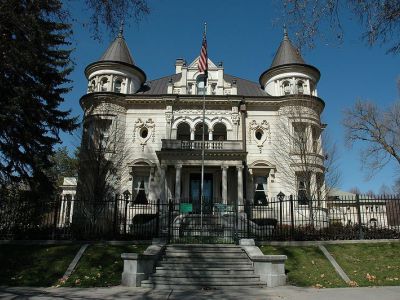
13) Utah Governor's Mansion
Completed in 1902 for U.S. Senator and mining magnate Thomas Kearns, this elegant house was designed by notable Utah architect Carl M. Neuhausen, who also designed the nearby Cathedral of the Madeleine. For its construction were used the finest materials by the finest craftsmen available, resulting in a quality and style similar to that of Eastern mansions like those of the Vanderbilts and Carnegies. The mansion also served not only as a home and a place for the Senator to conduct official business, but also as a venue for entertainment where guests would dance and enjoy the music of live orchestras. During this period many political and religious dignitaries were guests in the Kearns mansion, including President Theodore Roosevelt, who was a personal friend of Senator Kearns.
With the Senator passing away in 1918, his wife donated the mansion to the State of Utah, with the condition that it serve as the Governor's Residence. In December 1993, a fire, caused by faulty wiring on the Christmas tree in the main hall, destroyed much of the structure. Governor Mike Leavitt was not at home at the time, but the First Lady and her staff were quick to notify the Fire Department, and their response prevented more significant damage. A long and painstaking restoration was begun, to return the building to its original state and salvage as much of the historical interior as possible.
The $7.8 million restoration brought the home back to its original 1902 style, while providing many current safety standards, such as a fire sprinkler system, new wiring and plumbing, new heating and cooling, a security system, and seismic upgrades.
With the Senator passing away in 1918, his wife donated the mansion to the State of Utah, with the condition that it serve as the Governor's Residence. In December 1993, a fire, caused by faulty wiring on the Christmas tree in the main hall, destroyed much of the structure. Governor Mike Leavitt was not at home at the time, but the First Lady and her staff were quick to notify the Fire Department, and their response prevented more significant damage. A long and painstaking restoration was begun, to return the building to its original state and salvage as much of the historical interior as possible.
The $7.8 million restoration brought the home back to its original 1902 style, while providing many current safety standards, such as a fire sprinkler system, new wiring and plumbing, new heating and cooling, a security system, and seismic upgrades.
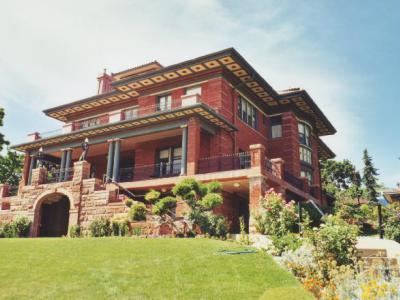
14) Woodruff-Riter Mansion
Sitting up on the hillside above the corner of 200 North and State Street, this large two-and-a-half story mansion shows influence of the Second Renaissance Revival, a style popular at the turn of the century for public buildings and homes of the wealthy. The delightful bed and breakfast on site, Inn on the Hill, is open daily, allowing fantastic views of Salt Lake City.
Original owner, Edward D. Woodruff, was a Union Pacific medical doctor who, on moving to SLC, entered into commerce, having immediately become successful in a number of speculative enterprises. In 1906, at the height of his fortunes, he built this mansion and as befitted an entrepreneur of his eminence, he chose the city's prestigious firm of Headlund and Wood to execute the design in a befittingly baronial style. Made to resemble traditional English manor houses, the interior was handsomely decorated with stained glass, mahogany paneling, generous leather coverings, and mural-adorned walls.
The house eventually passed into the hands of Woodruff's daughter and her husband Franklin Riter, a lawyer who was called into active service during WWII. In his role as Head of the European Branch Office of the Judge Advocate General Army and as chief of the Army Board of Review in Europe, Riter was deeply involved in the Private Slovik case when tens of thousands of U.S. soldiers were deserting in Europe and Eisenhower approved Slovik's firing squad to set an example.
Original owner, Edward D. Woodruff, was a Union Pacific medical doctor who, on moving to SLC, entered into commerce, having immediately become successful in a number of speculative enterprises. In 1906, at the height of his fortunes, he built this mansion and as befitted an entrepreneur of his eminence, he chose the city's prestigious firm of Headlund and Wood to execute the design in a befittingly baronial style. Made to resemble traditional English manor houses, the interior was handsomely decorated with stained glass, mahogany paneling, generous leather coverings, and mural-adorned walls.
The house eventually passed into the hands of Woodruff's daughter and her husband Franklin Riter, a lawyer who was called into active service during WWII. In his role as Head of the European Branch Office of the Judge Advocate General Army and as chief of the Army Board of Review in Europe, Riter was deeply involved in the Private Slovik case when tens of thousands of U.S. soldiers were deserting in Europe and Eisenhower approved Slovik's firing squad to set an example.
