Custom Walk in Philadelphia, Pennsylvania by gail_trenholm_25b8b2 created on 2026-06-19
Guide Location: USA » Philadelphia
Guide Type: Custom Walk
# of Sights: 8
Tour Duration: 2 Hour(s)
Travel Distance: 4.1 Km or 2.5 Miles
Share Key: 2P3ZN
Guide Type: Custom Walk
# of Sights: 8
Tour Duration: 2 Hour(s)
Travel Distance: 4.1 Km or 2.5 Miles
Share Key: 2P3ZN
How It Works
Please retrieve this walk in the GPSmyCity app. Once done, the app will guide you from one tour stop to the next as if you had a personal tour guide. If you created the walk on this website or come to the page via a link, please follow the instructions below to retrieve the walk in the app.
Retrieve This Walk in App
Step 1. Download the app "GPSmyCity: Walks in 1K+ Cities" on Apple App Store or Google Play Store.



Step 2. In the GPSmyCity app, download(or launch) the guide "Philadelphia Map and Walking Tours".
Step 3. Tap the menu button located at upper right corner of the "Walks" screen and select "Retrieve custom walk". Enter the share key: 2P3ZN
1) Benjamin Franklin Museum and Court
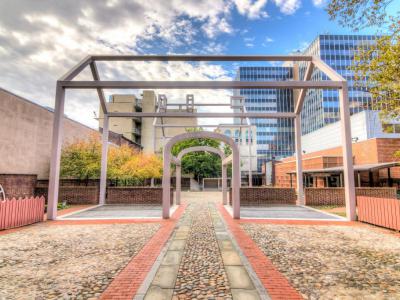
The Benjamin Franklin Museum sits in a courtyard that’s doing its best impression of the past—right where Franklin’s house and print shop once stood before history decided to clear the stage. The buildings themselves are long gone, but look down, and you’ll spot their story still lingering: archaeological remains tucked beneath glass panels, quietly reminding you that this was once a very busy corner of early America.
To help fill in the blanks, the site leans into a bit of creative storytelling. “Ghost” houses rise in clean white outlines exactly where the originals stood—less haunted mansion, more architectural sketch come to life—so you can picture the space as it once was. Just nearby, a working 18th-century print shop keeps things lively, clanking and pressing like the 1700s haven't gone anywhere.
Wandering through Franklin Court won’t cost you a thing, and neither will a peek at the ghost houses or the print shop. The museum itself asks for a modest fee, and in return, it packs in a surprisingly rich look at Franklin’s life. It’s not enormous, but it doesn’t need to be—between interactive exhibits for kids and plenty of clever details for adults, it manages to cover a lot of ground without wearing out your attention span.
Inside, you’ll get the full Franklin experience: inventor, diplomat, writer, and occasional mischief-maker. Alongside the big-picture story are smaller, more human moments—quirks, trivia, and anecdotes that make him feel less like a textbook figure and more like someone you might have bumped into… probably mid-experiment. Add in a few entertaining video segments—equal parts informative and amusing—and you’ve got a visit that manages to be both educational and genuinely fun.
To help fill in the blanks, the site leans into a bit of creative storytelling. “Ghost” houses rise in clean white outlines exactly where the originals stood—less haunted mansion, more architectural sketch come to life—so you can picture the space as it once was. Just nearby, a working 18th-century print shop keeps things lively, clanking and pressing like the 1700s haven't gone anywhere.
Wandering through Franklin Court won’t cost you a thing, and neither will a peek at the ghost houses or the print shop. The museum itself asks for a modest fee, and in return, it packs in a surprisingly rich look at Franklin’s life. It’s not enormous, but it doesn’t need to be—between interactive exhibits for kids and plenty of clever details for adults, it manages to cover a lot of ground without wearing out your attention span.
Inside, you’ll get the full Franklin experience: inventor, diplomat, writer, and occasional mischief-maker. Alongside the big-picture story are smaller, more human moments—quirks, trivia, and anecdotes that make him feel less like a textbook figure and more like someone you might have bumped into… probably mid-experiment. Add in a few entertaining video segments—equal parts informative and amusing—and you’ve got a visit that manages to be both educational and genuinely fun.
2) Franklin Court Printing Office
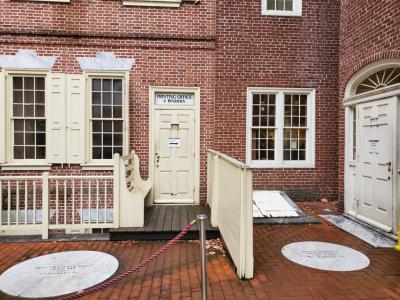
If you’ve ever wondered how ideas in the past went viral before Wi-Fi came to life, step into the Franklin Court Printing Office, tucked inside Franklin Court, just off Market Street between 3rd and 4th. This is where ink, paper, and a bit of attitude did the heavy lifting. Benjamin Franklin wasn’t just printing words—he was shaping public opinion, slipping in political cartoons, maps, and sharp commentary to make sure people didn’t just read but also paid attention.
One of his biggest hits was Poor Richard’s Almanac, launched in 1732 under the alias Richard Saunders—because, apparently, one Benjamin Franklin was not enough... Packed with witty, slightly bossy advice on thrift, hard work, and common sense, it became a household staple for decades. Think of it as the 18th-century version of life hacks, minus the hashtags.
At the reconstructed printing office, you can watch the process unfold the old-fashioned way—letter by letter, page by page. There’s a typesetting area, a bindery, and working presses that look like they require equal parts skill and patience. Park rangers demonstrate how it all came together, vividly illustrating that, back in the day, printing was not “click and send” but more like “sweat and precision.”
The story doesn’t stop with Franklin. The site also includes the newspaper office of his grandson, Benjamin Franklin Bache, who carried on the family tradition of stirring debate—this time in the politically charged 1790s. Next door, his house adds another layer to the narrative, showing how the business of shaping opinions stayed very much in the family.
The Printing Office is free to visit, and it works on on a first-come, first-served basis—so no subscription required, just curiosity.
One of his biggest hits was Poor Richard’s Almanac, launched in 1732 under the alias Richard Saunders—because, apparently, one Benjamin Franklin was not enough... Packed with witty, slightly bossy advice on thrift, hard work, and common sense, it became a household staple for decades. Think of it as the 18th-century version of life hacks, minus the hashtags.
At the reconstructed printing office, you can watch the process unfold the old-fashioned way—letter by letter, page by page. There’s a typesetting area, a bindery, and working presses that look like they require equal parts skill and patience. Park rangers demonstrate how it all came together, vividly illustrating that, back in the day, printing was not “click and send” but more like “sweat and precision.”
The story doesn’t stop with Franklin. The site also includes the newspaper office of his grandson, Benjamin Franklin Bache, who carried on the family tradition of stirring debate—this time in the politically charged 1790s. Next door, his house adds another layer to the narrative, showing how the business of shaping opinions stayed very much in the family.
The Printing Office is free to visit, and it works on on a first-come, first-served basis—so no subscription required, just curiosity.
3) Independence Hall (must see)
By the late 1720s, Philadelphia realized it was running a colony with big decisions to make, but was lacking a proper stage to make them—so, naturally, it decided to build one.
Construction began in 1732 on Chestnut Street, guided by architect Edmund Woolley, and by 1753, the Colonial Government of Pennsylvania moved in without hesitation. For nearly half a century, this was where the business of the province—and later the commonwealth—was handled, until the capital duties packed up and moved on in 1799.
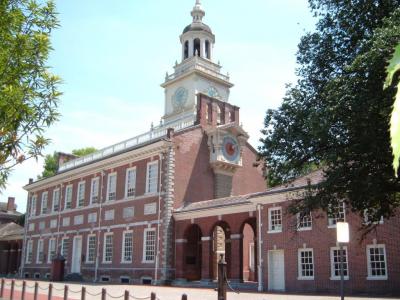
The building itself, now known as Independence Hall, keeps things elegantly symmetrical. Red brick, Georgian style, a central block crowned with a bell tower and a steeple rising 169 feet. Arcaded passageways link the main structure to its side wings, while nearby, Old City Hall, Congress Hall, and Philosophical Hall gather around Independence Square like a well-organized ensemble cast.
Inside, the layout is straightforward but loaded with history. The Assembly Room and Supreme Court Room sit on the ground floor, divided by a vestibule, with the Tower Stair Hall waiting just beyond the entrance. The interiors you see today are the result of careful restorations in the 19th and 20th centuries, all aimed at returning the building to its 18th-century look—because when your past includes founding a nation, you tend to preserve the décor...
And then, of course, came the moments. In June 1775, George Washington was appointed commander-in-chief of the Continental Army right here. A month later, Benjamin Franklin was named the first Postmaster General—arguably launching one of the longest-running institutions in American life. Between 1775 and 1783, this was the meeting place of the Second Continental Congress, where, on July 4, 1776, the Declaration of Independence was approved. Eleven years later, in 1787, the Constitution followed.
Since then, Independence Hall has remained more than just a historic building. It continues to serve as a backdrop for speeches, rallies, and protests—less a frozen monument, more an ongoing conversation about democracy, still very much in progress.
Construction began in 1732 on Chestnut Street, guided by architect Edmund Woolley, and by 1753, the Colonial Government of Pennsylvania moved in without hesitation. For nearly half a century, this was where the business of the province—and later the commonwealth—was handled, until the capital duties packed up and moved on in 1799.
The building itself, now known as Independence Hall, keeps things elegantly symmetrical. Red brick, Georgian style, a central block crowned with a bell tower and a steeple rising 169 feet. Arcaded passageways link the main structure to its side wings, while nearby, Old City Hall, Congress Hall, and Philosophical Hall gather around Independence Square like a well-organized ensemble cast.
Inside, the layout is straightforward but loaded with history. The Assembly Room and Supreme Court Room sit on the ground floor, divided by a vestibule, with the Tower Stair Hall waiting just beyond the entrance. The interiors you see today are the result of careful restorations in the 19th and 20th centuries, all aimed at returning the building to its 18th-century look—because when your past includes founding a nation, you tend to preserve the décor...
And then, of course, came the moments. In June 1775, George Washington was appointed commander-in-chief of the Continental Army right here. A month later, Benjamin Franklin was named the first Postmaster General—arguably launching one of the longest-running institutions in American life. Between 1775 and 1783, this was the meeting place of the Second Continental Congress, where, on July 4, 1776, the Declaration of Independence was approved. Eleven years later, in 1787, the Constitution followed.
Since then, Independence Hall has remained more than just a historic building. It continues to serve as a backdrop for speeches, rallies, and protests—less a frozen monument, more an ongoing conversation about democracy, still very much in progress.
4) Liberty Bell (must see)
The Liberty Bell, an iconic symbol of American freedom and independence, has a rich and storied history closely tied to Philadelphia, Pennsylvania. Cast in 1752 by the Whitechapel Bell Foundry in London, England, the bell was originally commissioned to mark the 50th anniversary of Pennsylvania's original constitution and to symbolize the ideals of liberty and justice.
Initially hung in the Pennsylvania State House (now known as Independence Hall), the bell gained fame not only for its impressive size and sound but also for its role in important historical events. One popular but apocryphal story links the Liberty Bell to the reading of the Declaration of Independence on July 4, 1776, claiming that it rang out to announce the birth of the new nation. While there is no historical evidence to support this specific event, the bell did gain significance as a symbol of American independence in the ensuing decades.
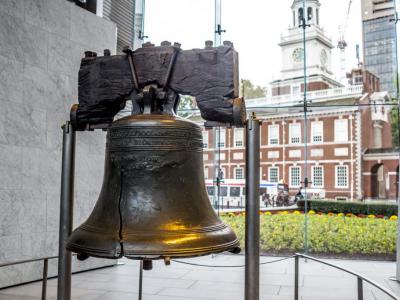
The bell's inscription, "Proclaim LIBERTY Throughout all the Land unto all the Inhabitants Thereof," from the Bible, became its defining feature and a powerful statement in support of abolitionist movements in the 19th century. Its association with the abolitionist cause led to the bell being dubbed the "Liberty Bell" around the 1830s.
By the mid-19th century, as the bell's structural integrity deteriorated, it was retired from active service. In 1852, it was moved to a pavilion near Independence Hall where it became an object of public veneration. During World War II, the bell's iconic status was further solidified as it was used as a symbol of liberty and freedom, inspiring war bond drives and patriotic sentiment.
Today, the Liberty Bell is housed in the Liberty Bell Center, part of Independence National Historical Park in Philadelphia. It continues to attract millions of visitors each year who come to see and reflect upon its enduring message of liberty, justice, and the ongoing struggle for equality.
Initially hung in the Pennsylvania State House (now known as Independence Hall), the bell gained fame not only for its impressive size and sound but also for its role in important historical events. One popular but apocryphal story links the Liberty Bell to the reading of the Declaration of Independence on July 4, 1776, claiming that it rang out to announce the birth of the new nation. While there is no historical evidence to support this specific event, the bell did gain significance as a symbol of American independence in the ensuing decades.
The bell's inscription, "Proclaim LIBERTY Throughout all the Land unto all the Inhabitants Thereof," from the Bible, became its defining feature and a powerful statement in support of abolitionist movements in the 19th century. Its association with the abolitionist cause led to the bell being dubbed the "Liberty Bell" around the 1830s.
By the mid-19th century, as the bell's structural integrity deteriorated, it was retired from active service. In 1852, it was moved to a pavilion near Independence Hall where it became an object of public veneration. During World War II, the bell's iconic status was further solidified as it was used as a symbol of liberty and freedom, inspiring war bond drives and patriotic sentiment.
Today, the Liberty Bell is housed in the Liberty Bell Center, part of Independence National Historical Park in Philadelphia. It continues to attract millions of visitors each year who come to see and reflect upon its enduring message of liberty, justice, and the ongoing struggle for equality.
5) Reading Terminal Market (must see)
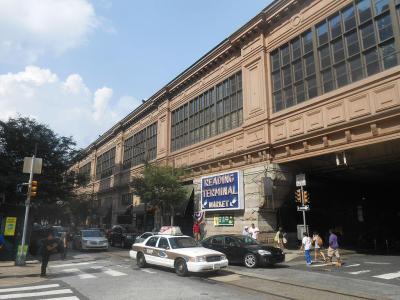
Open-air markets were popular in early Philadelphia. By the mid-19th century, markets along the Delaware River ran on for a mile or more, and High Street was renamed "Market Street." In 1859, the city dismantled everything under public pressure, which perceived open-air markets as dirty and unhygienic. Two indoor markets, Franklin Market and Farmers' Market opened at 12th and Market Streets. These two would be the foundation of the Reading Terminal Market.
With the coming of the railroads, architect Francis H. Kimball designed the Reading Railroad headhouse terminal in 1891. The train shed platform was built over the newly opened consolidated market. In 1893 an up-to-date refrigerated storage space was available for use in the market basement. Vendors could store perishable goods year-round.
After a period of prosperity, the Market experienced a long period of hardship. The Great Depression and the rise of competing supermarkets took their toll. Reading Railroad went bankrupt. In 1990 the City Council set up the non-profit Reading Terminal Market Corporation. The Market revived, and it is currently open seven days a week.
The Reading Terminal Market features arts, crafts, gifts, bakeries, confectionaries, eateries, flowers, ice creams, meats, seafood, Pennsylvania Dutch products, produce, and specialties. There are also diners, restaurants, and fast-food venues.
With the coming of the railroads, architect Francis H. Kimball designed the Reading Railroad headhouse terminal in 1891. The train shed platform was built over the newly opened consolidated market. In 1893 an up-to-date refrigerated storage space was available for use in the market basement. Vendors could store perishable goods year-round.
After a period of prosperity, the Market experienced a long period of hardship. The Great Depression and the rise of competing supermarkets took their toll. Reading Railroad went bankrupt. In 1990 the City Council set up the non-profit Reading Terminal Market Corporation. The Market revived, and it is currently open seven days a week.
The Reading Terminal Market features arts, crafts, gifts, bakeries, confectionaries, eateries, flowers, ice creams, meats, seafood, Pennsylvania Dutch products, produce, and specialties. There are also diners, restaurants, and fast-food venues.
6) Christ Church Burial Ground
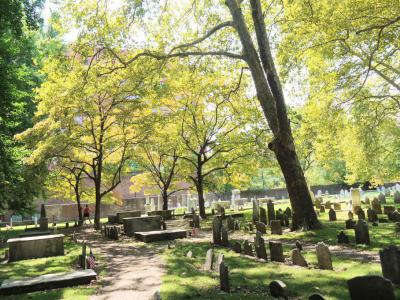
Christ Church Burial Ground in Philadelphia is one of those places where history both happened and decided to stay put. Still an active cemetery, it sits three blocks west of Christ Church itself, despite the name suggesting otherwise. The land was acquired back in 1719, when the original churchyard ran out of room, and this spot—then considered the edge of town—became the logical expansion. Today, it feels anything but remote.
Christ Church, founded in 1695, was the spiritual home of several key figures of the American Revolution, including George Washington. And just nearby, this burial ground gathers an equally impressive cast. Benjamin Franklin rests here with his wife Deborah, joined by four other signers of the Declaration of Independence: Benjamin Rush, Francis Hopkinson, Joseph Hewes, and George Ross. Two more—James Wilson and Robert Morris—are buried at the church itself, keeping things neatly divided.
The Burial Ground is open to visitors for a small fee, but even when the gates are closed, Franklin remains accessible—quite literally. At the corner of 5th and Arch Streets, a section of iron railing was added in 1858, so passersby could peer in. It didn’t take long for a tradition to form: tossing pennies onto Franklin’s grave, a small tribute to the man who famously advised that a penny saved is a penny earned...
Move a little farther from the crowd gathered around Franklin, and the atmosphere shifts. The space becomes quieter, with rows of lesser-known graves—carefully kept, often overlooked, and occasionally just as intriguing as the famous names that draw people in.
Christ Church, founded in 1695, was the spiritual home of several key figures of the American Revolution, including George Washington. And just nearby, this burial ground gathers an equally impressive cast. Benjamin Franklin rests here with his wife Deborah, joined by four other signers of the Declaration of Independence: Benjamin Rush, Francis Hopkinson, Joseph Hewes, and George Ross. Two more—James Wilson and Robert Morris—are buried at the church itself, keeping things neatly divided.
The Burial Ground is open to visitors for a small fee, but even when the gates are closed, Franklin remains accessible—quite literally. At the corner of 5th and Arch Streets, a section of iron railing was added in 1858, so passersby could peer in. It didn’t take long for a tradition to form: tossing pennies onto Franklin’s grave, a small tribute to the man who famously advised that a penny saved is a penny earned...
Move a little farther from the crowd gathered around Franklin, and the atmosphere shifts. The space becomes quieter, with rows of lesser-known graves—carefully kept, often overlooked, and occasionally just as intriguing as the famous names that draw people in.
7) Betsy Ross House (must see)
The story goes that Mrs. Eizabeth Claypoole, also known as Betsy Ross, had a visit from George Washington in 1776. She persuaded him, some say, that a five-pointed star was better than a six-pointed star. Betsy was an upholsterer, and she had been making flags for the Pennsylvania Navy. Flags were her specialty.
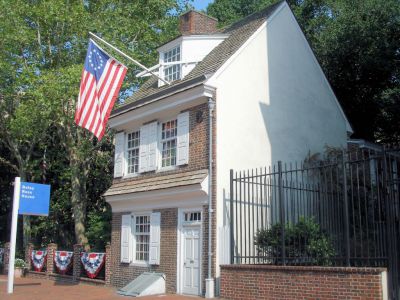
True or not, this captivating tale was told by her grandsons, William and George Canby, in the 1870s. People loved it, and it became a popular national legend. Number 239 Arch Street in Philadelphia is where Betsy is said to have lived with her third husband, John Claypoole. The house is a restoration done by architect Richardson Okie in 1940.
The "Betsy Ross" house that stands today may have been the house used by Betsy for her business. The residence of Betsy and her husband was adjacent to the present house. The houses next door were demolished and turned into a courtyard.
Richardson Okie used materials from the demolished houses in his restoration. A brick structure was built behind the house. Windows and a dormer were replaced. The whole property was gifted to the city of Philadelphia in 1941. In 1974 the courtyard was provided with a fountain.
As part of the American Bicentennial of 1976, city authorities moved the remains of Betsy and her husband, John Claypoole. They were reinterred in the courtyard of the Betsy Ross House. Betsy is thought to have resided in the house from 1776 until 1779.
John Ross, Betsy's first husband, a member of the militia, died in a gunpowder explosion. Her second husband, Joseph Ashburn, a mariner captured by the British, died in prison in Plymouth, England. John Claypoole was a fellow prisoner. He knew Ashburn. Betsy married Claypoole in 1783.
The Betsy Ross House is traditionally the site of Philadelphia's celebration of Flag Day. This legendary woman lived and worked here for a few short years when the Great Experiment began. Whatever else she may have done, she made flags.
True or not, this captivating tale was told by her grandsons, William and George Canby, in the 1870s. People loved it, and it became a popular national legend. Number 239 Arch Street in Philadelphia is where Betsy is said to have lived with her third husband, John Claypoole. The house is a restoration done by architect Richardson Okie in 1940.
The "Betsy Ross" house that stands today may have been the house used by Betsy for her business. The residence of Betsy and her husband was adjacent to the present house. The houses next door were demolished and turned into a courtyard.
Richardson Okie used materials from the demolished houses in his restoration. A brick structure was built behind the house. Windows and a dormer were replaced. The whole property was gifted to the city of Philadelphia in 1941. In 1974 the courtyard was provided with a fountain.
As part of the American Bicentennial of 1976, city authorities moved the remains of Betsy and her husband, John Claypoole. They were reinterred in the courtyard of the Betsy Ross House. Betsy is thought to have resided in the house from 1776 until 1779.
John Ross, Betsy's first husband, a member of the militia, died in a gunpowder explosion. Her second husband, Joseph Ashburn, a mariner captured by the British, died in prison in Plymouth, England. John Claypoole was a fellow prisoner. He knew Ashburn. Betsy married Claypoole in 1783.
The Betsy Ross House is traditionally the site of Philadelphia's celebration of Flag Day. This legendary woman lived and worked here for a few short years when the Great Experiment began. Whatever else she may have done, she made flags.
8) Elfreth's Alley (must see)
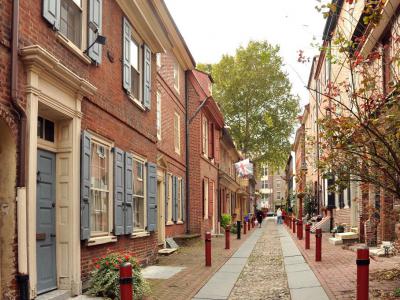
In the 18th century, Philadelphia became a bustling city, overcrowded with artisans, tradesmen, shipwrights, metalsmiths, glassblowers, and furniture makers. As a result, the landowners Arthur Wells and John Gilbert started a cart path from Front Street to Second Street in 1703. The path became Elfreth's Alley, named after Jeremiah Elfreth, an 18th-century blacksmith and a man of property in young Philadelphia.
By the 1770s Georgian and Federal-style houses lined the cobblestone Alley. Many of the structures were uniquely Philadelphian Trinity houses. These were three-story houses, exceptionally narrow, with one room on each floor. The floors were referred to as "Father, Son, and Holy Ghost." And that is how Trinity houses got their name.
In the 19th and 20th centuries, the industry started to close in on the Alley. A stove factory took its place in a row of residential houses. Immigrants, hoping for jobs, came in waves. In 1934 the Elfreth's Alley Association (EAA) was founded by Alley resident Dolly Ottey. Ottey fought to combat the deterioration of the Alley by encroaching industry in the early 20th century.
Elfreth's Alley Museum is located in houses 124 and 126. The museum preserves the home of 18th-century dressmakers. Tour guides discuss other homes and inhabitants of the Alley. On "Fete Day" in early June, which celebrates Alley's diverse ethnic heritage, the residents open their homes. There are historical reenactments with drum and fife bands. The Alley also host events for the 4th of July, Oktoberfestivities, and Halloween.
By the 1770s Georgian and Federal-style houses lined the cobblestone Alley. Many of the structures were uniquely Philadelphian Trinity houses. These were three-story houses, exceptionally narrow, with one room on each floor. The floors were referred to as "Father, Son, and Holy Ghost." And that is how Trinity houses got their name.
In the 19th and 20th centuries, the industry started to close in on the Alley. A stove factory took its place in a row of residential houses. Immigrants, hoping for jobs, came in waves. In 1934 the Elfreth's Alley Association (EAA) was founded by Alley resident Dolly Ottey. Ottey fought to combat the deterioration of the Alley by encroaching industry in the early 20th century.
Elfreth's Alley Museum is located in houses 124 and 126. The museum preserves the home of 18th-century dressmakers. Tour guides discuss other homes and inhabitants of the Alley. On "Fete Day" in early June, which celebrates Alley's diverse ethnic heritage, the residents open their homes. There are historical reenactments with drum and fife bands. The Alley also host events for the 4th of July, Oktoberfestivities, and Halloween.
