Custom Walk in Split, Croatia by slrg175_935c79 created on 2026-07-23
Guide Location: Croatia » Split
Guide Type: Custom Walk
# of Sights: 6
Tour Duration: 1 Hour(s)
Travel Distance: 0.1 Km or 0.1 Miles
Share Key: BMZSR
Guide Type: Custom Walk
# of Sights: 6
Tour Duration: 1 Hour(s)
Travel Distance: 0.1 Km or 0.1 Miles
Share Key: BMZSR
How It Works
Please retrieve this walk in the GPSmyCity app. Once done, the app will guide you from one tour stop to the next as if you had a personal tour guide. If you created the walk on this website or come to the page via a link, please follow the instructions below to retrieve the walk in the app.
Retrieve This Walk in App
Step 1. Download the app "GPSmyCity: Walks in 1K+ Cities" on Apple App Store or Google Play Store.



Step 2. In the GPSmyCity app, download(or launch) the guide "Split Map and Walking Tours".
Step 3. Tap the menu button located at upper right corner of the "Walks" screen and select "Retrieve custom walk". Enter the share key: BMZSR
1) Cathedral of St. Domnius (must see)
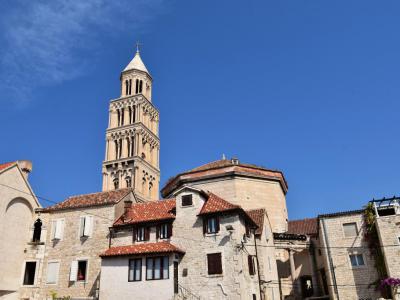
In 305 AD, Emperor Diocletian, known for his brutal persecution of Christians, retired to sunny Dalmatia to cultivate cabbages and built himself a magnificent mausoleum at the heart of his new palace. A few centuries later, that same mausoleum was transformed into a cathedral dedicated to one of the very martyrs he had executed. What a dramatic irony of history...
The structure we see today was expertly crafted from white marble, limestone, and brick around the late third century. By the seventh century, refugees from destroyed Salona, who settled in the palace walls, consecrated it as a Christian church dedicated to the Virgin Mary. A choir was later added, and by the 12th century, the elegant bell tower honoring Bishop Domnius rose above the ancient stone.
Saint Domnius himself was the Bishop of Salona, born in Antioch and beheaded in 304 alongside other Christians, ironically dying just a year before Diocletian abdicated. Today, this cathedral is still in use within its original structure, making it the oldest Catholic cathedral in the world still used in its primary form.
As you approach the cathedral, you’ll walk along the same main north-south and east-west streets that guided pilgrims through the palace centuries ago. At their crossing lies the Peristyle, a grand courtyard that serves as the main entrance to the cathedral.
Cross the threshold, and you’re stepping into over 1,700 years of layered history: from an emperor’s resting place to a medieval choir loft, through the Romanesque tower, and into a treasury. The latter is filled with numerous masterpieces such as the 13th-century Madonna and Child panel, intricately crafted reliquaries, ceremonial chalices, and manuscripts spanning from the 6th to the 19th centuries.
It is fair to say that nowhere else do imperial power, medieval devotion, and contemporary faith converge so elegantly, especially when viewed through the lens of fate’s own historical twist...
The structure we see today was expertly crafted from white marble, limestone, and brick around the late third century. By the seventh century, refugees from destroyed Salona, who settled in the palace walls, consecrated it as a Christian church dedicated to the Virgin Mary. A choir was later added, and by the 12th century, the elegant bell tower honoring Bishop Domnius rose above the ancient stone.
Saint Domnius himself was the Bishop of Salona, born in Antioch and beheaded in 304 alongside other Christians, ironically dying just a year before Diocletian abdicated. Today, this cathedral is still in use within its original structure, making it the oldest Catholic cathedral in the world still used in its primary form.
As you approach the cathedral, you’ll walk along the same main north-south and east-west streets that guided pilgrims through the palace centuries ago. At their crossing lies the Peristyle, a grand courtyard that serves as the main entrance to the cathedral.
Cross the threshold, and you’re stepping into over 1,700 years of layered history: from an emperor’s resting place to a medieval choir loft, through the Romanesque tower, and into a treasury. The latter is filled with numerous masterpieces such as the 13th-century Madonna and Child panel, intricately crafted reliquaries, ceremonial chalices, and manuscripts spanning from the 6th to the 19th centuries.
It is fair to say that nowhere else do imperial power, medieval devotion, and contemporary faith converge so elegantly, especially when viewed through the lens of fate’s own historical twist...
2) Vestibule
Now and then, something magical happens in the Vestibule of Diocletian's Palace. A klapa group quietly gathers, forms a small circle, clears a throat or two—and suddenly, traditional Dalmatian a cappella fills the air. No instruments, no microphones. Just voices rising, blending, and bouncing off ancient stone. If emperors have ghosts, you can almost picture Diocletian pausing mid-haunt to listen.
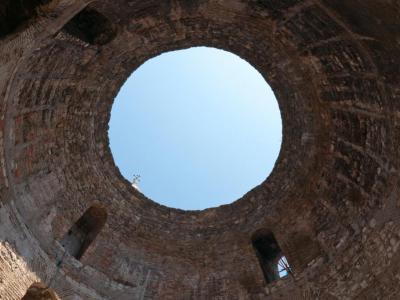
Glance upward. The Vestibule is a rotunda with its dome missing, replaced by a perfect round window of blue sky. It feels a bit like an ancient temple open to the heavens. Long ago, smoke from pagan rituals would have drifted upward. Today, it is harmonies that spiral into the open air—no fire and sacrifice, just tenor and baritone...
Architecturally, this space served as a grand reception hall. It linked the Peristyle to the emperor’s private apartments and was designed to impress ambassadors before they even laid eyes on the ruler himself. Imagine the scene: polished marble, guarded entrances, visiting dignitaries rehearsing their speeches. The room was built to command attention.
So, why do klapa singers choose this very spot? Quite simple—for its acoustics. The curved stone walls act like a giant resonating chamber. Every note expands, deepens, and returns richer than before. The space doesn’t just carry sound—it embraces it. And for a few minutes, under that open circle of sky, Roman architecture becomes the world’s most dramatic concert hall...
Glance upward. The Vestibule is a rotunda with its dome missing, replaced by a perfect round window of blue sky. It feels a bit like an ancient temple open to the heavens. Long ago, smoke from pagan rituals would have drifted upward. Today, it is harmonies that spiral into the open air—no fire and sacrifice, just tenor and baritone...
Architecturally, this space served as a grand reception hall. It linked the Peristyle to the emperor’s private apartments and was designed to impress ambassadors before they even laid eyes on the ruler himself. Imagine the scene: polished marble, guarded entrances, visiting dignitaries rehearsing their speeches. The room was built to command attention.
So, why do klapa singers choose this very spot? Quite simple—for its acoustics. The curved stone walls act like a giant resonating chamber. Every note expands, deepens, and returns richer than before. The space doesn’t just carry sound—it embraces it. And for a few minutes, under that open circle of sky, Roman architecture becomes the world’s most dramatic concert hall...
3) Podrum (Cellars of Diocletian's Palace)
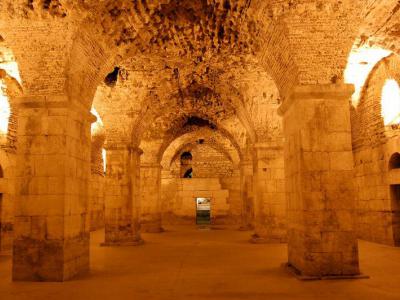
Hidden just beneath Diocletian’s lavish imperial apartments lies a labyrinth few emperors could boast about: the mighty Podrum, or cellars. Built in the 4th century to mirror and support the grand halls above, these vaulted chambers span about one-eighth of the entire palace, and to this day, you can still see the remnants of a large wine and olive press used in Roman times. And yes, there was even a small nymphaeum: a shrine to the nymphs said to guard the precious fresh water flowing through the palace.
As centuries rolled on and Split grew, the palace transformed from an emperor’s retirement retreat into a refuge. When Salona fell in the 7th century, refugees found shelter within its sturdy walls. Over time, residents above broke through vaults to build basements or storerooms—early medieval real-estate hacks, you might call them.
In modern times, Podrum’s fame soared thanks to its role in “Game of Thrones.” Fans will instantly recognize the cellars as the location where Daenerys Targaryen kept her dragons chained in Meereen. These scenes were filmed in the central halls, turning ancient stone into television legend.
Today, you enter this underground world either through the Bronze Gate on the Riva or a staircase from the Peristyle. The western part has been carefully preserved and opened to the public in 1959, used for exhibitions, artisan fairs, and occasional concerts under soaring arches. The eastern section (which collapsed in medieval times) is now mostly restored and accessible since the 1990s.
Walking through these cool, echoing halls, you’re literally walking in the footsteps—and stone foundations—of emperors, traders, refugees, and storytellers. Here, the past thrives beneath your feet, merging Roman ambition with modern fascination, one vaulted chamber after another.
As centuries rolled on and Split grew, the palace transformed from an emperor’s retirement retreat into a refuge. When Salona fell in the 7th century, refugees found shelter within its sturdy walls. Over time, residents above broke through vaults to build basements or storerooms—early medieval real-estate hacks, you might call them.
In modern times, Podrum’s fame soared thanks to its role in “Game of Thrones.” Fans will instantly recognize the cellars as the location where Daenerys Targaryen kept her dragons chained in Meereen. These scenes were filmed in the central halls, turning ancient stone into television legend.
Today, you enter this underground world either through the Bronze Gate on the Riva or a staircase from the Peristyle. The western part has been carefully preserved and opened to the public in 1959, used for exhibitions, artisan fairs, and occasional concerts under soaring arches. The eastern section (which collapsed in medieval times) is now mostly restored and accessible since the 1990s.
Walking through these cool, echoing halls, you’re literally walking in the footsteps—and stone foundations—of emperors, traders, refugees, and storytellers. Here, the past thrives beneath your feet, merging Roman ambition with modern fascination, one vaulted chamber after another.
4) Diocletian's Palace (must see)
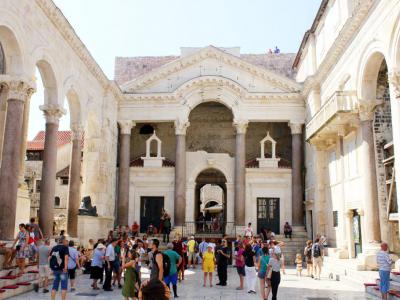
Call it a palace if you like, but Diocletian’s masterpiece is really part imperial retirement villa, part military fortress, and part living city. Built at the end of the third century AD for the Roman emperor who gave up power in favor of peace (and yes, cabbages), it’s a place where stone walls once sheltered soldiers, emperors, monks—and today, generations of Split’s residents.
Perched on a peninsula near Salona—then Dalmatia’s Roman capital and Diocletian’s birthplace—the palace originally served as a seaside sanctuary for the emperor’s final years. When he died in 312, the complex remained under Roman control and occasionally offered refuge to members of the imperial family who needed to lay low.
In the 7th century, when Slavic and Avar invaders destroyed Salona, survivors escaped behind these formidable walls, founding a new settlement right inside the palace. And here’s the surprise—they never left. Today, Split’s Old Town literally lives within those ancient foundations: temples transformed into churches, courtyards became vibrant squares, and homes sprang up between columns.
Later transformations added layers of history. The emperor’s mausoleum was converted into what is now recognized as the world’s oldest Catholic cathedral still in use in its original structure—the Cathedral of Domnius. In the 18th century, Scottish architect Robert Adam studied the palace ruins and helped inspire the elegance of Neoclassical architecture across Europe.
The palace’s layout originally formed an irregular rectangle, once fortified by 16 defensive towers. Its southern façade opened directly to the sea, with ships docking at what is still known as the Sea Gate. Three other gates connected the city walls to external routes: the Golden Gate to the north, leading toward Salona; the Silver Gate to the east, facing Stobreč; and the Iron Gate on the west, reserved for military access.
Indeed, there are few places like this, where centuries layer so vividly in stone—Roman ambition, medieval resilience, and Venetian finesse all mingle beneath your footsteps...
Perched on a peninsula near Salona—then Dalmatia’s Roman capital and Diocletian’s birthplace—the palace originally served as a seaside sanctuary for the emperor’s final years. When he died in 312, the complex remained under Roman control and occasionally offered refuge to members of the imperial family who needed to lay low.
In the 7th century, when Slavic and Avar invaders destroyed Salona, survivors escaped behind these formidable walls, founding a new settlement right inside the palace. And here’s the surprise—they never left. Today, Split’s Old Town literally lives within those ancient foundations: temples transformed into churches, courtyards became vibrant squares, and homes sprang up between columns.
Later transformations added layers of history. The emperor’s mausoleum was converted into what is now recognized as the world’s oldest Catholic cathedral still in use in its original structure—the Cathedral of Domnius. In the 18th century, Scottish architect Robert Adam studied the palace ruins and helped inspire the elegance of Neoclassical architecture across Europe.
The palace’s layout originally formed an irregular rectangle, once fortified by 16 defensive towers. Its southern façade opened directly to the sea, with ships docking at what is still known as the Sea Gate. Three other gates connected the city walls to external routes: the Golden Gate to the north, leading toward Salona; the Silver Gate to the east, facing Stobreč; and the Iron Gate on the west, reserved for military access.
Indeed, there are few places like this, where centuries layer so vividly in stone—Roman ambition, medieval resilience, and Venetian finesse all mingle beneath your footsteps...
5) Temple of Jupiter
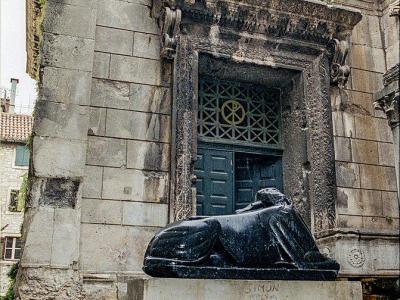
Just a few steps from the Peristyle, in the western stretch of Diocletian's Palace, stands a compact but powerful survivor: the Temple of Jupiter. Built around the year 300 AD, it began as a shrine to Jupiter—Roman Zeus and, conveniently, Emperor Diocletian’s so-called “divine father.” Because when you rule the empire, it helps to keep the king of the gods in the family...
Out front, you’ll meet one of the twelve sphinxes Diocletian imported from Egypt. Yes, imported. Apparently, retirement plans included a touch of Nile-side décor. Above the entrance, reliefs line up like a mythological guest list: Victoria, Triton, Helios, Hercules, Apollo... Heroes, sea gods, sun gods—everyone showed up. Or almost everyone. Parts of the palace were still unfinished when the emperor returned rather suddenly after his abdication. Even divine sons, it seems, don’t always stick to the construction schedule...
Then history pivoted. In the sixth century, the pagan temple became a baptistery dedicated to Saint John the Baptist. The pagan gods stepped aside; the Christian saints stepped in. Inside, you’ll find the sarcophagi of early archbishops Ivan of Ravenna and Lovre, linking the space to Split’s Christian story. And Saint John himself appears in striking form—a large bronze statue, adding a bold 20th-century presence to a 4th-century shell.
Raise your gaze, and you’ll notice yet another layer: an 11th-century Romanesque bell tower rising above the vault. Pagan temple, Christian baptistery, medieval addition—this small structure carries centuries with surprising confidence.
And one final twist: in 1907, the surrounding houses that had grown tightly against its walls were cleared away, finally giving the temple room to breathe again. So, standing here, be aware—you’re not merely looking at ancient stone, you’re watching a building that has reinvented itself for more than 1,700 years, without ever losing its sense of drama...
Out front, you’ll meet one of the twelve sphinxes Diocletian imported from Egypt. Yes, imported. Apparently, retirement plans included a touch of Nile-side décor. Above the entrance, reliefs line up like a mythological guest list: Victoria, Triton, Helios, Hercules, Apollo... Heroes, sea gods, sun gods—everyone showed up. Or almost everyone. Parts of the palace were still unfinished when the emperor returned rather suddenly after his abdication. Even divine sons, it seems, don’t always stick to the construction schedule...
Then history pivoted. In the sixth century, the pagan temple became a baptistery dedicated to Saint John the Baptist. The pagan gods stepped aside; the Christian saints stepped in. Inside, you’ll find the sarcophagi of early archbishops Ivan of Ravenna and Lovre, linking the space to Split’s Christian story. And Saint John himself appears in striking form—a large bronze statue, adding a bold 20th-century presence to a 4th-century shell.
Raise your gaze, and you’ll notice yet another layer: an 11th-century Romanesque bell tower rising above the vault. Pagan temple, Christian baptistery, medieval addition—this small structure carries centuries with surprising confidence.
And one final twist: in 1907, the surrounding houses that had grown tightly against its walls were cleared away, finally giving the temple room to breathe again. So, standing here, be aware—you’re not merely looking at ancient stone, you’re watching a building that has reinvented itself for more than 1,700 years, without ever losing its sense of drama...
6) Iron Gate and Church of Our Lady of the Bell Tower
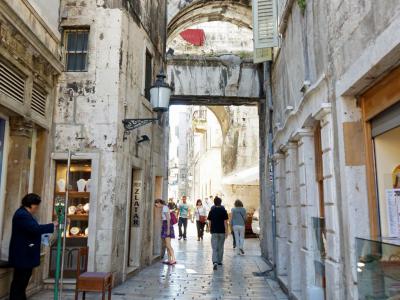
On the western side of Diocletian’s Palace stands the West Gate—better known as the Iron Gate—one of the four original entrances into the emperor’s fortified retirement dream. Today, it opens straight into the lively fabric of Split, where the palace walls blend seamlessly with People’s Square. Around you rise the old City Hall, the clock tower, and a lineup of aristocratic residences—the Nakić, Karepić, Cambi, and Cipriani palaces—proof that prime real estate has always been in demand...
But don’t let the cafés and chatter distract you. The Iron Gate still carries traces of its defensive past. Look closely, and you’ll notice the ancient rampart and what was once a double-door security chamber—an early version of “authorized personnel only.” Above the passage sits the Church of Our Lady of the Bell Tower, a narrow, almost hidden sacred space tucked into the thickness of the walls. Like the chapels above the other gates, it makes impressive use of very limited square footage. In the 11th century, a bell tower was added, giving the structure a new vertical accent and a fresh medieval identity layered onto its Roman bones.
And here’s a detail many pass by without noticing: on the northern wall of the rampart, behind what was once a sealed medieval niche, a sculpture was discovered—hands holding a crown. Carefully restored and returned to its original position, it now quietly watches over the gate once more.
So, as you step through the Iron Gate, remember—while entering this square, you’re crossing a threshold guarded by emperors, nobles, and a pair of stone hands still holding on to their crown...
But don’t let the cafés and chatter distract you. The Iron Gate still carries traces of its defensive past. Look closely, and you’ll notice the ancient rampart and what was once a double-door security chamber—an early version of “authorized personnel only.” Above the passage sits the Church of Our Lady of the Bell Tower, a narrow, almost hidden sacred space tucked into the thickness of the walls. Like the chapels above the other gates, it makes impressive use of very limited square footage. In the 11th century, a bell tower was added, giving the structure a new vertical accent and a fresh medieval identity layered onto its Roman bones.
And here’s a detail many pass by without noticing: on the northern wall of the rampart, behind what was once a sealed medieval niche, a sculpture was discovered—hands holding a crown. Carefully restored and returned to its original position, it now quietly watches over the gate once more.
So, as you step through the Iron Gate, remember—while entering this square, you’re crossing a threshold guarded by emperors, nobles, and a pair of stone hands still holding on to their crown...
