Custom Walk in Edinburgh, Scotland by rmacdonald_26b6a4 created on 2026-07-27
Guide Location: Scotland » Edinburgh
Guide Type: Custom Walk
# of Sights: 6
Tour Duration: 1 Hour(s)
Travel Distance: 2.2 Km or 1.4 Miles
Share Key: EPU2C
Guide Type: Custom Walk
# of Sights: 6
Tour Duration: 1 Hour(s)
Travel Distance: 2.2 Km or 1.4 Miles
Share Key: EPU2C
How It Works
Please retrieve this walk in the GPSmyCity app. Once done, the app will guide you from one tour stop to the next as if you had a personal tour guide. If you created the walk on this website or come to the page via a link, please follow the instructions below to retrieve the walk in the app.
Retrieve This Walk in App
Step 1. Download the app "GPSmyCity: Walks in 1K+ Cities" on Apple App Store or Google Play Store.



Step 2. In the GPSmyCity app, download(or launch) the guide "Edinburgh Map and Walking Tours".
Step 3. Tap the menu button located at upper right corner of the "Walks" screen and select "Retrieve custom walk". Enter the share key: EPU2C
1) Calton Hill (must see)
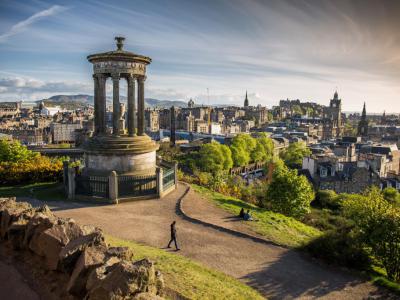
Calton Hill, located in the heart of Edinburgh, extends beyond the eastern terminus of Princes Street and is part of the city's UNESCO World Heritage Site. It is a popular subject for photography and art, both offering scenic vistas of the city and being featured in various depictions of it.
The Scottish Government has its headquarters on Calton Hill, specifically at Saint Andrew's House, situated on the steep southern slope of the hill. Nearby, at the base of the hill, you'll find significant landmarks like the Scottish Parliament Building and Holyrood Palace. Additionally, Calton Hill boasts several iconic monuments and structures, including the National Monument, the Nelson Monument, the Dugald Stewart Monument, the old Royal High School, the Robert Burns Monument, the Political Martyrs' Monument, and the City Observatory.
Calton Hill hosts various events throughout the year, with the most significant being the Beltane Fire Festival occurring annually on April 30th, drawing a crowd of over 12,000 attendees. Additionally, the Dussehra Hindu Festival is celebrated on Calton Hill at the beginning of October, and the Samhuinn Fire Festival takes place there at the end of October. Notably, Calton Hill has served as a filming location for movies like "Sunshine on Leith," where Davy and Yvonne perform "Misty Blue," "Death Defying Acts" featuring Houdini, and "Greyfriars Bobby," offering scenic views of the city.
The Scottish Government has its headquarters on Calton Hill, specifically at Saint Andrew's House, situated on the steep southern slope of the hill. Nearby, at the base of the hill, you'll find significant landmarks like the Scottish Parliament Building and Holyrood Palace. Additionally, Calton Hill boasts several iconic monuments and structures, including the National Monument, the Nelson Monument, the Dugald Stewart Monument, the old Royal High School, the Robert Burns Monument, the Political Martyrs' Monument, and the City Observatory.
Calton Hill hosts various events throughout the year, with the most significant being the Beltane Fire Festival occurring annually on April 30th, drawing a crowd of over 12,000 attendees. Additionally, the Dussehra Hindu Festival is celebrated on Calton Hill at the beginning of October, and the Samhuinn Fire Festival takes place there at the end of October. Notably, Calton Hill has served as a filming location for movies like "Sunshine on Leith," where Davy and Yvonne perform "Misty Blue," "Death Defying Acts" featuring Houdini, and "Greyfriars Bobby," offering scenic views of the city.
2) Scott Monument (must see)
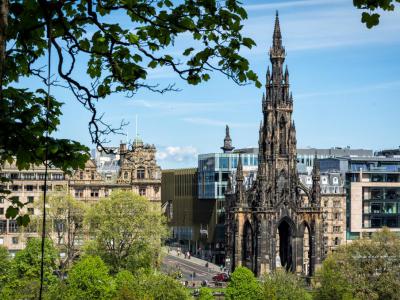
Sir Walter Scott-Scotland’s literary darling, national treasure, and master of the pen-was so loved by the country that they figured one statue for him wasn't enough. Instead, they built him a giant Gothic spire right in Princes Street Gardens-the Scott Monument. Because, indeed, what better way to honour a writer than with a stone rocket aimed at the heavens?
When Scott passed away in 1832, the city held a grand design competition for his monument. Out of the great many prestigious architects who entered, the winning design came from... a draughtsman with zero architectural credentials. George Meikle Kemp, feeling cheeky, submitted his entry under the pseudonym “John Morvo,” borrowing the name of a 15th-century stonemason to boost his street cred. And it worked.
Now, if you’re up for a challenge, you can tackle the 61-metre-tall monument that has several viewing platforms accessed by narrow winding stairways. The highest of them is only 287 steps away. Yes, 287. But rest assured-if your legs don’t give out en route to the top, you’ll be rewarded with sweeping city views and an actual certificate for surviving the climb. Bragging rights included.
The whole structure is made of Binny Sandstone, a material with a peculiar talent: it is so oily that it attracts dirt almost immediately. Just one year after its completion, the monument looked like it had been standing there for centuries. American writer Bill Bryson once lovingly described it as a “Gothic rocket-ship”-which, honestly, is spot-on.
Inside the base, you’ll find a marble statue of Sir Walter himself, complete with quill, paper, and his loyal dog Maida. Scattered across the monument are 64 statues of characters from his novels, plus a healthy dose of grotesques-those wonderfully creepy Gothic faces that the architect deliberately added to his design to make the monument look more “ancient” and moodier than it is.
For the ease of it, you can admire the monument casually from the safety of the grass. Otherwise, go full adventurer and climb for a 360-degree panoramic view-just don’t expect a lift-and note a fee attached to that.
Tip:
The staircase gets narrow and twisty, and yes, you’ll likely meet people coming down as you're going up. Not particularly recommended for the fainthearted... or the claustrophobic.
When Scott passed away in 1832, the city held a grand design competition for his monument. Out of the great many prestigious architects who entered, the winning design came from... a draughtsman with zero architectural credentials. George Meikle Kemp, feeling cheeky, submitted his entry under the pseudonym “John Morvo,” borrowing the name of a 15th-century stonemason to boost his street cred. And it worked.
Now, if you’re up for a challenge, you can tackle the 61-metre-tall monument that has several viewing platforms accessed by narrow winding stairways. The highest of them is only 287 steps away. Yes, 287. But rest assured-if your legs don’t give out en route to the top, you’ll be rewarded with sweeping city views and an actual certificate for surviving the climb. Bragging rights included.
The whole structure is made of Binny Sandstone, a material with a peculiar talent: it is so oily that it attracts dirt almost immediately. Just one year after its completion, the monument looked like it had been standing there for centuries. American writer Bill Bryson once lovingly described it as a “Gothic rocket-ship”-which, honestly, is spot-on.
Inside the base, you’ll find a marble statue of Sir Walter himself, complete with quill, paper, and his loyal dog Maida. Scattered across the monument are 64 statues of characters from his novels, plus a healthy dose of grotesques-those wonderfully creepy Gothic faces that the architect deliberately added to his design to make the monument look more “ancient” and moodier than it is.
For the ease of it, you can admire the monument casually from the safety of the grass. Otherwise, go full adventurer and climb for a 360-degree panoramic view-just don’t expect a lift-and note a fee attached to that.
Tip:
The staircase gets narrow and twisty, and yes, you’ll likely meet people coming down as you're going up. Not particularly recommended for the fainthearted... or the claustrophobic.
3) Heart of Midlothian
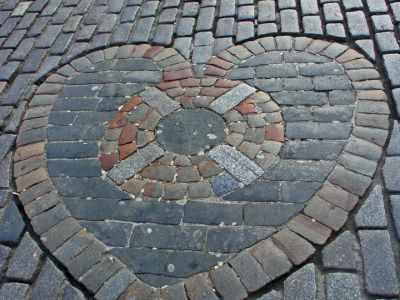
Walking the Royal Mile, you might stumble upon one of Edinburgh’s strange traditions-strange, if not say bizarre, and frankly, a little unhygienic... Just outside the west door of St. Giles’ Cathedral, locals casually spit on a heart-shaped mosaic set into the cobblestones. Don’t worry, they’re not insulting romance-it’s the Heart of Midlothian, and the spit is meant to bring good luck. Just be careful to keep out of range, as you draw closer...
This mosaic marks the site of the Old Tolbooth, a building that once served as the city’s customs house, a meeting hall (briefly used by the Estates of Scotland), and, most infamously, a prison. Yes, back in 1640, it housed the Court of Session, the principal jail of the burgh. And this was no cozy jail at all: the Tolbooth gained a fearsome reputation for torture, trials, and public executions carried out right at its front door. Not exactly the kind of spot you’d put on a postcard...
Legend has it that Edinburgh’s less-than-law-abiding citizens started the spitting custom themselves. Passing through the Tolbooth doors on their way to trial or worse, the petty thieves and not-so-petty criminals spat for luck-though in truth, it probably didn’t help much.
The Tolbooth was demolished in 1817, but the Heart remains, just as yet another stop for tourists dodging loogies. It now serves as a reminder that beneath the charm of the Royal Mile lie centuries of grit, misery, and gallows humor. So, if you see the heart, step wide-and maybe think twice before following tradition.
This mosaic marks the site of the Old Tolbooth, a building that once served as the city’s customs house, a meeting hall (briefly used by the Estates of Scotland), and, most infamously, a prison. Yes, back in 1640, it housed the Court of Session, the principal jail of the burgh. And this was no cozy jail at all: the Tolbooth gained a fearsome reputation for torture, trials, and public executions carried out right at its front door. Not exactly the kind of spot you’d put on a postcard...
Legend has it that Edinburgh’s less-than-law-abiding citizens started the spitting custom themselves. Passing through the Tolbooth doors on their way to trial or worse, the petty thieves and not-so-petty criminals spat for luck-though in truth, it probably didn’t help much.
The Tolbooth was demolished in 1817, but the Heart remains, just as yet another stop for tourists dodging loogies. It now serves as a reminder that beneath the charm of the Royal Mile lie centuries of grit, misery, and gallows humor. So, if you see the heart, step wide-and maybe think twice before following tradition.
4) Victoria Street
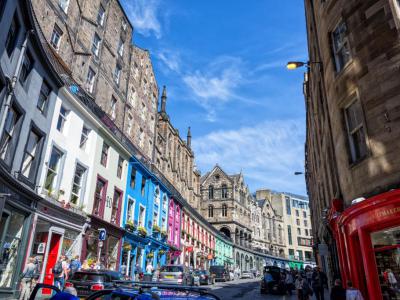
Perhaps the most photographed location in all of Edinburgh, Victoria Street-with its gentle curve, candy-coloured shopfronts, and fairytale charm-is the Old Town icon that throughout the decades has graced everything from tourist postcards to glossy TV ads. Indeed, if streets had agents, this one would have been booked solid.
Built between 1829 and 1834, Victoria Street wasn’t always the whimsical rainbow we know today, though. Credit-or creative blame for it, rather-goes to Thomas Hamilton, a mastermind behind Edinburgh’s numerous architectural wonders, better known for his love affair with all things neoclassical. On this occasion, however, he deviated from his habitual neoclassical stamp, being told to create something mimicking the Old Flemish style. For this purpose, many of the area's old buildings were torn down. The result of such a dramatic medieval makeover was the appearance of arches, lining the new terrace, which now house some of the city’s most charming little shops.
And then came the magic. In recent years, Victoria Street-along with its downhill cousin, the West Bow-has gained notoriety as possible real-world prototypes for none other than Diagon Alley, featured in the Harry Potter books (you know, wizards, magic wands, and all that...).
Given that Edinburgh was home turf for JK Rowling while she penned her famous boy-wizard saga, it’s not a stretch to imagine Victoria Street as an inspiration for the ever-so fabulous wizard market after all. Packed with the cobbled stones, higgledy-piggledy medley of vibrant buildings, quirky boutiques, and a general air of eccentricity, it practically shouts Diagon Alley. So, whether you're here for the architecture, the shopping, or the spellcasting vibes, just know-this street has layers, arches, and more than a dash of enchantment...
Built between 1829 and 1834, Victoria Street wasn’t always the whimsical rainbow we know today, though. Credit-or creative blame for it, rather-goes to Thomas Hamilton, a mastermind behind Edinburgh’s numerous architectural wonders, better known for his love affair with all things neoclassical. On this occasion, however, he deviated from his habitual neoclassical stamp, being told to create something mimicking the Old Flemish style. For this purpose, many of the area's old buildings were torn down. The result of such a dramatic medieval makeover was the appearance of arches, lining the new terrace, which now house some of the city’s most charming little shops.
And then came the magic. In recent years, Victoria Street-along with its downhill cousin, the West Bow-has gained notoriety as possible real-world prototypes for none other than Diagon Alley, featured in the Harry Potter books (you know, wizards, magic wands, and all that...).
Given that Edinburgh was home turf for JK Rowling while she penned her famous boy-wizard saga, it’s not a stretch to imagine Victoria Street as an inspiration for the ever-so fabulous wizard market after all. Packed with the cobbled stones, higgledy-piggledy medley of vibrant buildings, quirky boutiques, and a general air of eccentricity, it practically shouts Diagon Alley. So, whether you're here for the architecture, the shopping, or the spellcasting vibes, just know-this street has layers, arches, and more than a dash of enchantment...
5) Grassmarket
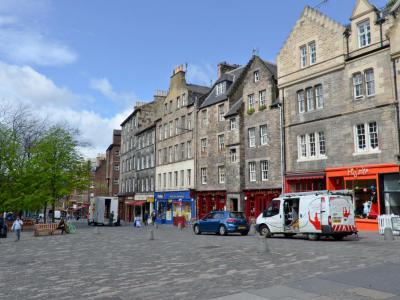
If you're looking to shop, snack, or relax over a pint while in Edinburgh, the Grassmarket is undoubtedly your one-stop cobbled playground. Once the city’s bustling horse-and-cattle bazaar which drew crowds between 1477 and 1911, it also doubled as a top place for executions-because, apparently, back in the day, nothing did for the public entertainment more than hooves and hangings...
Keep an eye out for “The Shadow of the Gibbet”-the dark paving stones laid out in the form of a gallows near the Covenanter’s Monument. It’s a charmingly grim touch, in case you needed a reminder that this scenic square once served as the city’s unofficial “dead-end.” And over to one side of it stands the Bow Well that has been around since 1681.
According to legend, once upon a time, there was a woman named Maggie Dickson, a fishwife who made headlines by dying and... remarkably coming back again. Hanged right here for the alleged murder of her child, she stunned everyone when she unexpectedly woke up en route to the cemetery. Apparently, in those days, the “until dead” provision didn’t quite yet settle in the sentence proceedings (legal loophole of the day...). So, once hanged, her debt was considered paid and Maggie was set free. Today, you can toast her improbable resurrection at Maggie Dickson’s pub, conveniently located on the very spot where she was hanged but miraculously survived the ordeal.
Fast forward a few centuries and the Grassmarket swapped gallows for gastropubs. A formerly scruffy patch of the city, it became a magnet for students in the 1980s-likely lured by cheap beer and late-night kebabs. Nowadays gentrified, it’s all terraces, boutique shops, vintage finds, and indie charm.
Quirky, safe and interesting, this area is a great destination for those who need a regular change of scenery, complete with a variety of retail and dining opportunities to suit every wallet and taste, and enough character to fill a tartan suitcase.
Hot tip:
Check out Carnivàle Vintage for a wonderful selection of fun vintage clothing, Tasty Buns for pastry and coffee, Hula Juice Bar for guilt-free fuel, and Mary’s Milk Bar for glorious indulgence. And when you're done, wind your way up Victoria Street and onto the Royal Mile (further up)-because one eccentric shopping spree always deserves another...
Keep an eye out for “The Shadow of the Gibbet”-the dark paving stones laid out in the form of a gallows near the Covenanter’s Monument. It’s a charmingly grim touch, in case you needed a reminder that this scenic square once served as the city’s unofficial “dead-end.” And over to one side of it stands the Bow Well that has been around since 1681.
According to legend, once upon a time, there was a woman named Maggie Dickson, a fishwife who made headlines by dying and... remarkably coming back again. Hanged right here for the alleged murder of her child, she stunned everyone when she unexpectedly woke up en route to the cemetery. Apparently, in those days, the “until dead” provision didn’t quite yet settle in the sentence proceedings (legal loophole of the day...). So, once hanged, her debt was considered paid and Maggie was set free. Today, you can toast her improbable resurrection at Maggie Dickson’s pub, conveniently located on the very spot where she was hanged but miraculously survived the ordeal.
Fast forward a few centuries and the Grassmarket swapped gallows for gastropubs. A formerly scruffy patch of the city, it became a magnet for students in the 1980s-likely lured by cheap beer and late-night kebabs. Nowadays gentrified, it’s all terraces, boutique shops, vintage finds, and indie charm.
Quirky, safe and interesting, this area is a great destination for those who need a regular change of scenery, complete with a variety of retail and dining opportunities to suit every wallet and taste, and enough character to fill a tartan suitcase.
Hot tip:
Check out Carnivàle Vintage for a wonderful selection of fun vintage clothing, Tasty Buns for pastry and coffee, Hula Juice Bar for guilt-free fuel, and Mary’s Milk Bar for glorious indulgence. And when you're done, wind your way up Victoria Street and onto the Royal Mile (further up)-because one eccentric shopping spree always deserves another...
6) Greyfriars Bobby's Statue (must see)
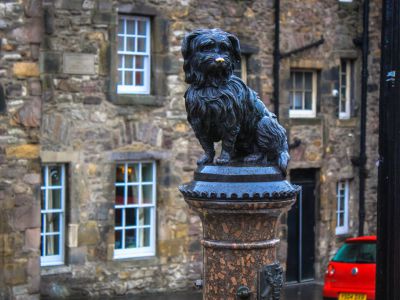
Ah yes-nothing tugs at the heartstrings quite like a tale of undying love and loyalty… especially if it involves a scruffy little dog. Meet Greyfriars Bobby, the Skye Terrier and Edinburgh’s most beloved four-legged legend, immortalized in bronze at the south end of George IV Bridge (just a tail’s wag from the entrance to Greyfriars Kirkyard).
Now, Bobby’s origin story is a bit fuzzy (pun fully intended here). Some say he belonged to a kindly policeman named John Grey; others claim that he was just a clever stray adopted by a “bobby” during his beat (hence the name). Either way, Bobby and John were inseparable for two years… until 1858, when John died of tuberculosis, and Bobby found himself alone in the world.
Whether Grey lived by himself or his widow kicked Bobby out when her husband died remains unclear, but this is where the tear ducts really kick in. Without a home, Bobby made one for himself-on his master’s grave. Indeed, rather than chase squirrels or sniff lampposts like a normal dog, he trotted over to Greyfriars Kirkyard and stayed there-for fourteen years!-until his own death. Through rain, sleet, snow, and the occasional curious visitor, Bobby stood guard with a loyalty that would put most humans to shame.
Usually, dogs weren’t exactly welcomed in church cemeteries, but Bobby had charm. The caretaker took pity on him and fed him, locals left snacks, and even William Chambers, the Lord Provost of Edinburgh, chipped in to pay Bobby’s yearly dog license, without which he would definitely have been destroyed as a stray.
When Bobby passed on in 1872, church rules said “no dogs in holy dirt,” so he was laid to rest just outside the gates. A local philanthropist lady had a statue erected in his honour, complete with two drinking fountains: one for people, and one for thirsty pups.
Over the years, Bobby’s story has had many versions and inspired numerous books, films, and tall tales-you name it. His breed would change depending on who told the tale, but Bobby’s spirit always remained the same-loyal to his master beyond the grave, and always legendary.
Tip:
Wander into Greyfriars Kirkyard right behind the statue for a dose of Edinburgh’s weirder history. Attention, Potterheads!-Rumour has it that Lord Voldemort’s gravestone is in there somewhere, too. Loyalty and dark magic, all in one stop...
Now, Bobby’s origin story is a bit fuzzy (pun fully intended here). Some say he belonged to a kindly policeman named John Grey; others claim that he was just a clever stray adopted by a “bobby” during his beat (hence the name). Either way, Bobby and John were inseparable for two years… until 1858, when John died of tuberculosis, and Bobby found himself alone in the world.
Whether Grey lived by himself or his widow kicked Bobby out when her husband died remains unclear, but this is where the tear ducts really kick in. Without a home, Bobby made one for himself-on his master’s grave. Indeed, rather than chase squirrels or sniff lampposts like a normal dog, he trotted over to Greyfriars Kirkyard and stayed there-for fourteen years!-until his own death. Through rain, sleet, snow, and the occasional curious visitor, Bobby stood guard with a loyalty that would put most humans to shame.
Usually, dogs weren’t exactly welcomed in church cemeteries, but Bobby had charm. The caretaker took pity on him and fed him, locals left snacks, and even William Chambers, the Lord Provost of Edinburgh, chipped in to pay Bobby’s yearly dog license, without which he would definitely have been destroyed as a stray.
When Bobby passed on in 1872, church rules said “no dogs in holy dirt,” so he was laid to rest just outside the gates. A local philanthropist lady had a statue erected in his honour, complete with two drinking fountains: one for people, and one for thirsty pups.
Over the years, Bobby’s story has had many versions and inspired numerous books, films, and tall tales-you name it. His breed would change depending on who told the tale, but Bobby’s spirit always remained the same-loyal to his master beyond the grave, and always legendary.
Tip:
Wander into Greyfriars Kirkyard right behind the statue for a dose of Edinburgh’s weirder history. Attention, Potterheads!-Rumour has it that Lord Voldemort’s gravestone is in there somewhere, too. Loyalty and dark magic, all in one stop...
