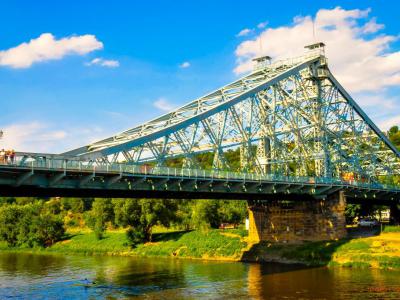


Blaues Wunder Bridge, Dresden
The Blaues Wunder Bridge, officially known as Loschwitz Bridge, is an iconic cantilever truss bridge spanning the River Elbe in Dresden. Completed in 1893, it was an engineering marvel of its time, boasting the title of the longest unsupported iron bridge. This architectural feat connects the Loschwitz and Blasewitz districts-two of Dresden's most affluent areas during the late 19th century.
Originally named the König Albert Brücke in honor of King Albert of Saxony, the bridge's current moniker, "Blaues Wunder," translates to "Blue Wonder." This nickname derives from an urban legend stating that the bridge, initially painted green, mysteriously turned blue due to sunlight effects.
Designed by engineers Claus Koepcke and H.M. Krüger, the bridge stretches 280 meters and weighs 3500 tons. Remarkably, it withstood the destruction of both World Wars, remaining a standing testament to historic engineering. Its railings still hold old padlocks, a nostalgic nod to its storied past.
Historically, crossing the bridge incurred a toll, a practice that ceased in 1923 amid the severe hyperinflation that gripped Germany. Today, the bridge is not only a crucial transport link but also a tourist attraction offering breathtaking views of the Elbe Valley. A drive across the Blaues Wunder presents a picturesque vista, encapsulating the enduring beauty and historical significance of this remarkable structure.
Want to visit this sight? Check out these Self-Guided Walking Tours in Dresden. Alternatively, you can download the mobile app "GPSmyCity: Walks in 1K+ Cities" from Apple App Store or Google Play Store. The app turns your mobile device to a personal tour guide and it works offline, so no data plan is needed when traveling abroad.
Download The GPSmyCity App



Blaues Wunder Bridge on Map
Sight Name: Blaues Wunder Bridge
Sight Location: Dresden, Germany (See walking tours in Dresden)
Sight Type: Attraction/Landmark
Sight Location: Dresden, Germany (See walking tours in Dresden)
Sight Type: Attraction/Landmark
Nearby Sights

Walking Tours in Dresden, Germany
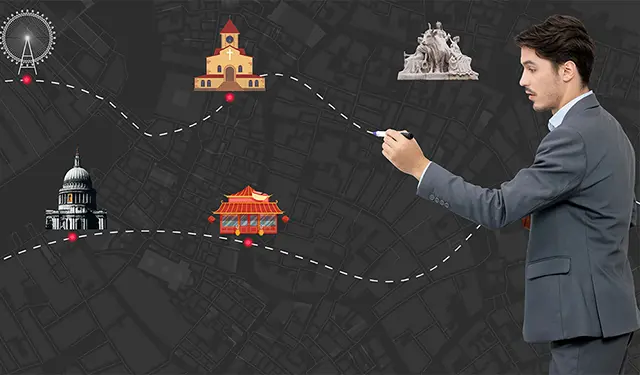
Create Your Own Walk in Dresden
Creating your own self-guided walk in Dresden is easy and fun. Choose the city attractions that you want to see and a walk route map will be created just for you. You can even set your hotel as the start point of the walk.
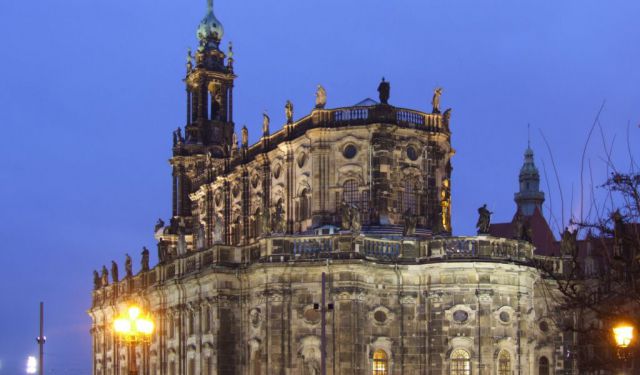
Dresden's Architectural Jewels
If there is one thing Dresden is particularly famous for, it is the magnificent architecture. Although known primarily for its Baroque buildings, the city has several other architectural styles present too, such as Renaissance, Historicism, Modernism and Post-modernism.
Much of downtown Dresden was destroyed in February 1945 by Allied bombing, which in turn prompted the rebuilding of the... view more
Tour Duration: 1 Hour
Travel Distance: 1.9 Km or 1.2 Miles
Much of downtown Dresden was destroyed in February 1945 by Allied bombing, which in turn prompted the rebuilding of the... view more
Tour Duration: 1 Hour
Travel Distance: 1.9 Km or 1.2 Miles
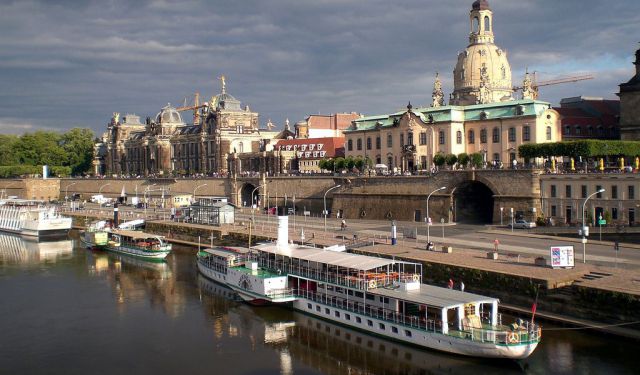
A Walk Through Dresden's Historic Old Town
Dresden’s reputation as a city of art and architecture has earned it the nickname “Florence on the Elbe.”
Dresden, the capital of Saxony, lies on the banks of the River Elbe in eastern Germany. The area may have been settled by Neolithic communities as early as 7500 BC, but Dresden’s documented history begins much later. The city developed within the Margraviate of Meissen, a territory... view more
Tour Duration: 2 Hours
Travel Distance: 2.5 Km or 1.6 Miles
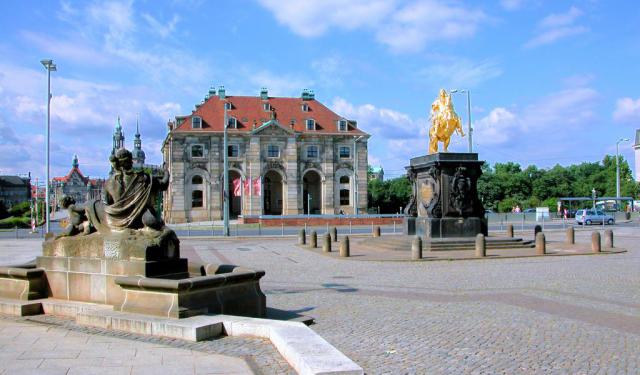
Exploring Dresden New Town on Foot
Dresden’s New Town occupies the northern bank of the Elbe, directly opposite the historic Old Town. Despite its name, it is far from new. The area was settled in the Middle Ages and was historically known as Old Dresden. It was incorporated into Dresden in 1549 under Elector Moritz but remained a relatively modest settlement for centuries compared with the more prestigious city on the opposite... view more
Tour Duration: 1 Hour
Travel Distance: 2.2 Km or 1.4 Miles
Tour Duration: 1 Hour
Travel Distance: 2.2 Km or 1.4 Miles