

Bobby Sands Mural, Belfast
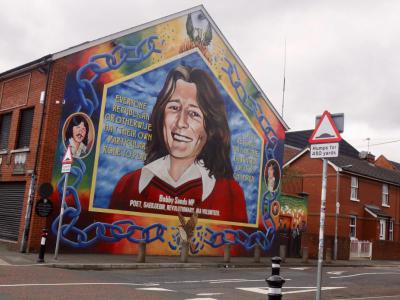
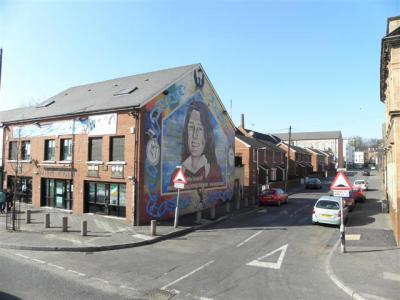
The Bobby Sands Mural is one of Belfast’s most recognisable political murals and a powerful reminder of the Troubles. Located on the gable wall of the Sinn Féin offices at the corner of Falls Road and Sevastopol Street, it depicts Bobby Sands, a member of the Provisional Irish Republican Army (IRA) who became one of the best-known figures of the 1981 hunger strikes. The portrait is based on a photograph taken of Sands while he was imprisoned. Given its sheer size, the mural is virtually impossible to miss. Depending on the direction from which you approach, you may first spot the white sign marking Sevastopol Street on the building opposite the Sinn Féin offices.
In 1977, Sands was sentenced to 14 years in the Maze Prison, also known as Long Kesh, for firearms possession. There, republican prisoners protested against the withdrawal of Special Category Status, refusing to wear prison uniforms or carry out prison work and demanding greater freedom of association, visits and other privileges. On 1 March 1981, Sands began a hunger strike demanding recognition of the prisoners’ political status.
During the protest, Sands was elected as a Member of the UK Parliament, attracting international attention. However, he died on 5 May 1981, aged 27, after 66 days without food.
Murals have occupied this wall since the early 1980s, with the present portrait of Sands forming one of Belfast’s best-known examples of political street art. His smiling face is surrounded by republican imagery, including broken chains, a lark at the bottom and a phoenix at the top, evoking themes of freedom, resistance and rebirth. Step closer to the mural to appreciate the smaller portraits of fellow IRA members Kieran Doherty, Seán McCaughey and Joe McDonnell on the far left and right sides of the wall.
In 1977, Sands was sentenced to 14 years in the Maze Prison, also known as Long Kesh, for firearms possession. There, republican prisoners protested against the withdrawal of Special Category Status, refusing to wear prison uniforms or carry out prison work and demanding greater freedom of association, visits and other privileges. On 1 March 1981, Sands began a hunger strike demanding recognition of the prisoners’ political status.
During the protest, Sands was elected as a Member of the UK Parliament, attracting international attention. However, he died on 5 May 1981, aged 27, after 66 days without food.
Murals have occupied this wall since the early 1980s, with the present portrait of Sands forming one of Belfast’s best-known examples of political street art. His smiling face is surrounded by republican imagery, including broken chains, a lark at the bottom and a phoenix at the top, evoking themes of freedom, resistance and rebirth. Step closer to the mural to appreciate the smaller portraits of fellow IRA members Kieran Doherty, Seán McCaughey and Joe McDonnell on the far left and right sides of the wall.
Want to visit this sight? Check out these Self-Guided Walking Tours in Belfast. Alternatively, you can download the mobile app "GPSmyCity: Walks in 1K+ Cities" from Apple App Store or Google Play Store. The app turns your mobile device to a personal tour guide and it works offline, so no data plan is needed when traveling abroad.
Download The GPSmyCity App



Bobby Sands Mural on Map
Sight Name: Bobby Sands Mural
Sight Location: Belfast, Ireland (See walking tours in Belfast)
Sight Type: Attraction/Landmark
Guide(s) Containing This Sight:
Sight Location: Belfast, Ireland (See walking tours in Belfast)
Sight Type: Attraction/Landmark
Guide(s) Containing This Sight:
Nearby Sights
Walking Tours in Belfast, Ireland

Create Your Own Walk in Belfast
Creating your own self-guided walk in Belfast is easy and fun. Choose the city attractions that you want to see and a walk route map will be created just for you. You can even set your hotel as the start point of the walk.
Belfast Victorian Architecture Jewels
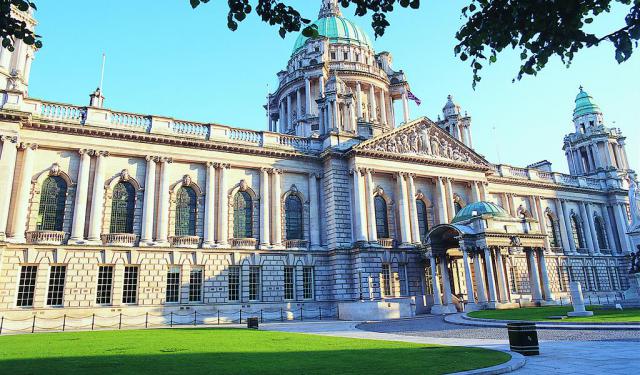
Described as “modestly scaled, undemonstrative, somewhat solid in aspect, and usually restrained (sometimes even austere) in its use of external decoration”, the urban landscape of Belfast has been influenced by the demands of shipbuilding and linen industry, much as transitioning between culture, arts, commerce, and education. Still, the architectural spectrum of the city is quite broad and... view more
Tour Duration: 2 Hours
Travel Distance: 2.9 Km or 1.8 Miles
Tour Duration: 2 Hours
Travel Distance: 2.9 Km or 1.8 Miles
Belfast Introduction Walking Tour
Clive Staples Lewis, the author behind the hugely successful Chronicles of Narnia series, was born in Belfast in 1898. The city and the surrounding landscapes of Northern Ireland proved crucial in shaping his imagination and the fantastical worlds he would later create.
Sitting on the River Lagan near where it meets the Irish Sea, Belfast's name comes from the Irish Béal Feirste, meaning... view more
Tour Duration: 2 Hours
Travel Distance: 3.8 Km or 2.4 Miles
Sitting on the River Lagan near where it meets the Irish Sea, Belfast's name comes from the Irish Béal Feirste, meaning... view more
Tour Duration: 2 Hours
Travel Distance: 3.8 Km or 2.4 Miles
The Troubles and Peace Process Landmarks
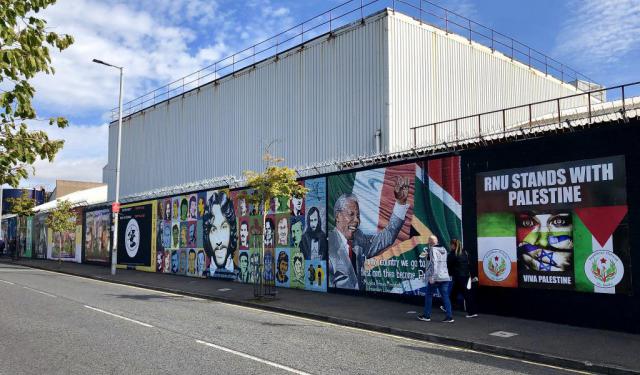
For almost three decades, Belfast was at the centre of the Troubles, a conflict that profoundly shaped Northern Ireland and left lasting marks on the city. Although its roots stretch much further back, the Troubles are generally dated from the late 1960s to the Good Friday Agreement of 1998.
At the heart of the conflict were competing visions of Northern Ireland’s future. Unionists and... view more
Tour Duration: 1 Hour
Travel Distance: 2.1 Km or 1.3 Miles
At the heart of the conflict were competing visions of Northern Ireland’s future. Unionists and... view more
Tour Duration: 1 Hour
Travel Distance: 2.1 Km or 1.3 Miles