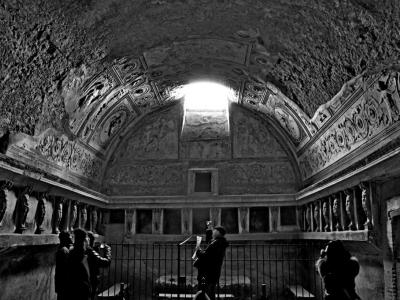


Forum Baths, Pompei
The Forum Baths are one of four bathhouses discovered in the ruined city of Pompeii. Along with the Central, Stabian, and Suburban Baths, they have provided fascinating insight into the importance of public baths in Roman life. With little in the way of bathing facilities found inside private dwellings, it appears that bathing in these buildings would have been a daily ritual for many citizens. The Forum Baths were not the largest or most decorated in the city, but they survived the earthquake of 62 AD relatively unscathed and, as a result, were the only public baths fully back in use when the city was destroyed.
The Forum Baths are located opposite the Temple of Fortuna Augusta in the centre of Pompeii. Divided into men’s and women’s sections, this compact bathhouse contained all of the features found in larger public baths, including a frigidarium, where customers could take a cold bath.
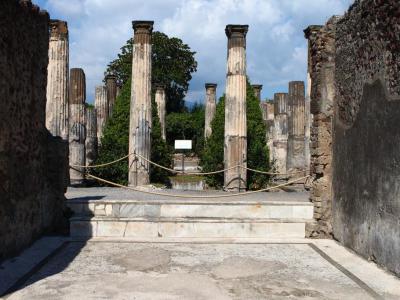
To witness how visitors prepared for this routine, step directly through the main street entrance corridor into the open-air palaestra courtyard. Here, a compact exercise yard opens up, framed by a classic stone colonnade where ancient bathers would lift weights, wrestle, or play ball games before entering the heated chambers.
The adjoining warm room, or tepidarium, is notable for its high barrel-vaulted roof, complete with beautiful, intact stucco decorations. Reaching the room requires passing through the vaulted threshold of the ancient changing room leading off the courtyard. Inside, the massive plaster ceiling remains completely covered in elaborate, intact stucco reliefs of mythological figures, visually held up by a row of muscular, terracotta male statues called atlantes projecting from the walls.
The caldarium, which contained the hot baths, was heated by warm air circulated within cavities in the walls. This room is accessed by stepping through the low, narrow thermal doorway located at the far side of the warm room. As you cross this threshold into the steaming zone, look directly up at the main barrel-vaulted ceiling to see a pattern of parallel fluted grooves running down the plaster - an ingenious design feature that forced condensation to roll cleanly down the walls rather than dripping onto the heads of bathers.
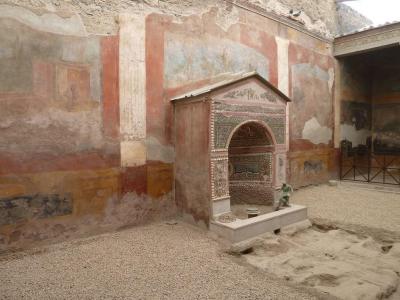
Move deeper into the hall and turn your attention toward the semicircular, domed alcove at the far western end. This recessed area features a large, elevated marble basin known as a labrum, which provided refreshing cold water for bathers to splash on themselves and cool off after bathing.
The Forum Baths are located opposite the Temple of Fortuna Augusta in the centre of Pompeii. Divided into men’s and women’s sections, this compact bathhouse contained all of the features found in larger public baths, including a frigidarium, where customers could take a cold bath.
To witness how visitors prepared for this routine, step directly through the main street entrance corridor into the open-air palaestra courtyard. Here, a compact exercise yard opens up, framed by a classic stone colonnade where ancient bathers would lift weights, wrestle, or play ball games before entering the heated chambers.
The adjoining warm room, or tepidarium, is notable for its high barrel-vaulted roof, complete with beautiful, intact stucco decorations. Reaching the room requires passing through the vaulted threshold of the ancient changing room leading off the courtyard. Inside, the massive plaster ceiling remains completely covered in elaborate, intact stucco reliefs of mythological figures, visually held up by a row of muscular, terracotta male statues called atlantes projecting from the walls.
The caldarium, which contained the hot baths, was heated by warm air circulated within cavities in the walls. This room is accessed by stepping through the low, narrow thermal doorway located at the far side of the warm room. As you cross this threshold into the steaming zone, look directly up at the main barrel-vaulted ceiling to see a pattern of parallel fluted grooves running down the plaster - an ingenious design feature that forced condensation to roll cleanly down the walls rather than dripping onto the heads of bathers.
Move deeper into the hall and turn your attention toward the semicircular, domed alcove at the far western end. This recessed area features a large, elevated marble basin known as a labrum, which provided refreshing cold water for bathers to splash on themselves and cool off after bathing.
Want to visit this sight? Check out these Self-Guided Walking Tours in Pompei. Alternatively, you can download the mobile app "GPSmyCity: Walks in 1K+ Cities" from Apple App Store or Google Play Store. The app turns your mobile device to a personal tour guide and it works offline, so no data plan is needed when traveling abroad.
Download The GPSmyCity App



Forum Baths on Map
Sight Name: Forum Baths
Sight Location: Pompei, Italy (See walking tours in Pompei)
Sight Type: Attraction/Landmark
Guide(s) Containing This Sight:
Sight Location: Pompei, Italy (See walking tours in Pompei)
Sight Type: Attraction/Landmark
Guide(s) Containing This Sight:
Nearby Sights
Walking Tours in Pompei, Italy

Create Your Own Walk in Pompei
Creating your own self-guided walk in Pompei is easy and fun. Choose the city attractions that you want to see and a walk route map will be created just for you. You can even set your hotel as the start point of the walk.
Pompeii Introduction Walk I
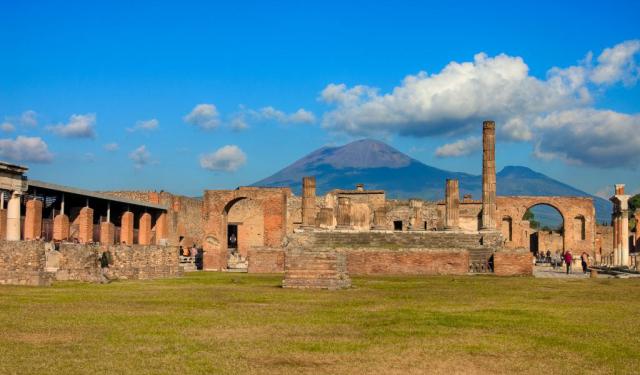
Modern-day Pompei is best known for its ancient predecessor, the Roman city of Pompeii, that fell victim to the massive eruption of Mount Vesuvius in 79 AD. The ruins of Pompeii, first uncovered in the late 18th century, were declared a World Heritage Site by UNESCO in 1997. Presently, this is one of the most popular tourist attractions in Italy, drawing annually up to 2.5 million visitors.
The... view more
Tour Duration: 2 Hour(s)
Travel Distance: 2.0 Km or 1.2 Miles
The... view more
Tour Duration: 2 Hour(s)
Travel Distance: 2.0 Km or 1.2 Miles
Pompeii Introduction Walk II
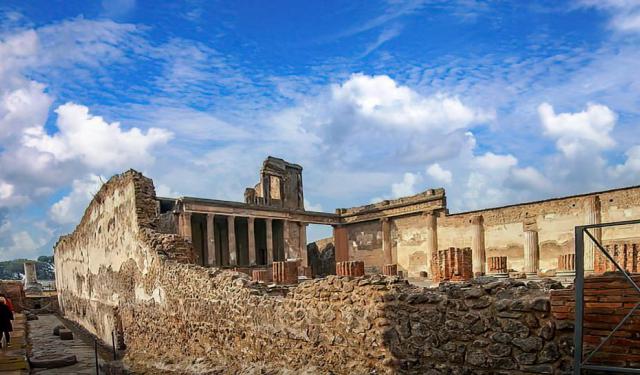
Frozen at the moment it was buried under the thick blanket of ash and pumice, the city of Pompeii (now excavated) remains a unique window into the past, offering a snapshot of everyday life back in the 1st century AD Roman Empire. Aside from causing quick and unexpected death to the city, the huge eruption of Vesuvius in 79 AD did have one positive outcome – it preserved everything (properties,... view more
Tour Duration: 3 Hour(s)
Travel Distance: 2.3 Km or 1.4 Miles
Tour Duration: 3 Hour(s)
Travel Distance: 2.3 Km or 1.4 Miles