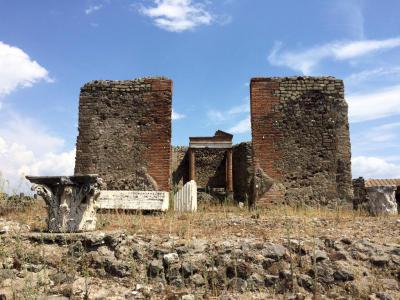


Temple of Fortuna Augusta, Pompei
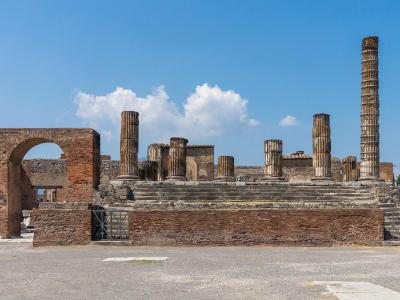
The Temple of Fortuna Augusta stands on the corner of Forum Street and the Street of Fortune. It was built by Marcus Tullius, a wealthy local benefactor and relative of the major philosopher, writer, and statesman Cicero. Tullius established a dedicated board of ministers to maintain the imperial cult, which intertwined the worship of the goddess Fortuna with the veneration of the Roman Emperor, Augustus Caesar. As the decades progressed, the temple continued to honor successive rulers, serving as a powerful monument to imperial loyalty.
The temple, like many Roman places of worship, kept religious statues in its inner sanctuary. Over time, the ministers and local elites would commission and place statues of various members of the imperial family into the sanctuary's smaller niches. This practice allowed the citizens of Pompeii to seamlessly combine civic patriotism with religious devotion. A sacred cult statue of the goddess Fortuna Augusta herself remained anchored in the large central niche throughout the temple’s history, flanked by these imperial portraits.
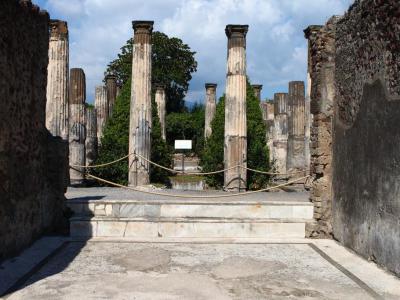
This small temple was heavily damaged in the earthquake of 62 AD, and was still undergoing repairs when the city was buried. It originally had a very similar layout to the Temple of Jupiter, located nearby at the edge of the Forum. A raised podium at the centre of the temple, accessible via a grand stone staircase, contained an outdoor altar and the inner sanctuary. Within it, five distinct niches housed the central statue of Fortuna along with those of the imperial family.
The temple, like many Roman places of worship, kept religious statues in its inner sanctuary. Over time, the ministers and local elites would commission and place statues of various members of the imperial family into the sanctuary's smaller niches. This practice allowed the citizens of Pompeii to seamlessly combine civic patriotism with religious devotion. A sacred cult statue of the goddess Fortuna Augusta herself remained anchored in the large central niche throughout the temple’s history, flanked by these imperial portraits.
This small temple was heavily damaged in the earthquake of 62 AD, and was still undergoing repairs when the city was buried. It originally had a very similar layout to the Temple of Jupiter, located nearby at the edge of the Forum. A raised podium at the centre of the temple, accessible via a grand stone staircase, contained an outdoor altar and the inner sanctuary. Within it, five distinct niches housed the central statue of Fortuna along with those of the imperial family.
Want to visit this sight? Check out these Self-Guided Walking Tours in Pompei. Alternatively, you can download the mobile app "GPSmyCity: Walks in 1K+ Cities" from Apple App Store or Google Play Store. The app turns your mobile device to a personal tour guide and it works offline, so no data plan is needed when traveling abroad.
Download The GPSmyCity App



Temple of Fortuna Augusta on Map
Sight Name: Temple of Fortuna Augusta
Sight Location: Pompei, Italy (See walking tours in Pompei)
Sight Type: Attraction/Landmark
Guide(s) Containing This Sight:
Sight Location: Pompei, Italy (See walking tours in Pompei)
Sight Type: Attraction/Landmark
Guide(s) Containing This Sight:
Nearby Sights
Walking Tours in Pompei, Italy

Create Your Own Walk in Pompei
Creating your own self-guided walk in Pompei is easy and fun. Choose the city attractions that you want to see and a walk route map will be created just for you. You can even set your hotel as the start point of the walk.
Pompeii Introduction Walk I
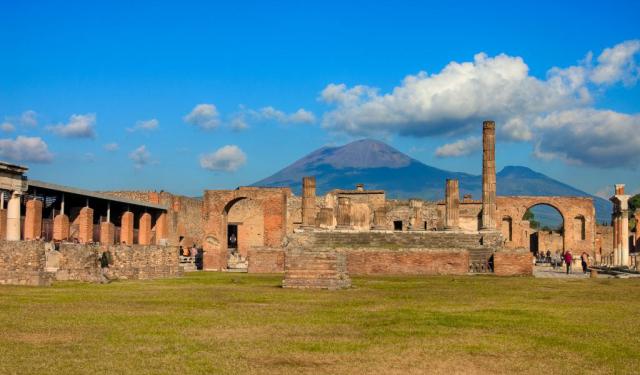
Modern-day Pompei is best known for its ancient predecessor, the Roman city of Pompeii, that fell victim to the massive eruption of Mount Vesuvius in 79 AD. The ruins of Pompeii, first uncovered in the late 18th century, were declared a World Heritage Site by UNESCO in 1997. Presently, this is one of the most popular tourist attractions in Italy, drawing annually up to 2.5 million visitors.
The... view more
Tour Duration: 2 Hour(s)
Travel Distance: 2.0 Km or 1.2 Miles
The... view more
Tour Duration: 2 Hour(s)
Travel Distance: 2.0 Km or 1.2 Miles
Pompeii Introduction Walk II
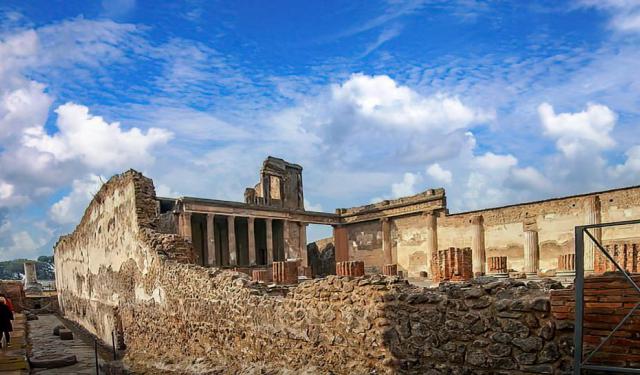
Frozen at the moment it was buried under the thick blanket of ash and pumice, the city of Pompeii (now excavated) remains a unique window into the past, offering a snapshot of everyday life back in the 1st century AD Roman Empire. Aside from causing quick and unexpected death to the city, the huge eruption of Vesuvius in 79 AD did have one positive outcome – it preserved everything (properties,... view more
Tour Duration: 3 Hour(s)
Travel Distance: 2.3 Km or 1.4 Miles
Tour Duration: 3 Hour(s)
Travel Distance: 2.3 Km or 1.4 Miles