

House of Octavius Quartio, Pompei
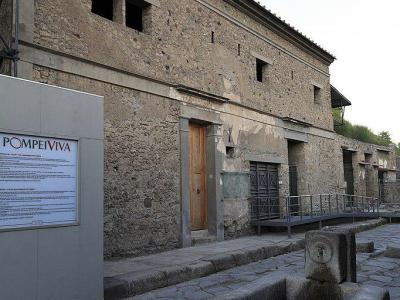
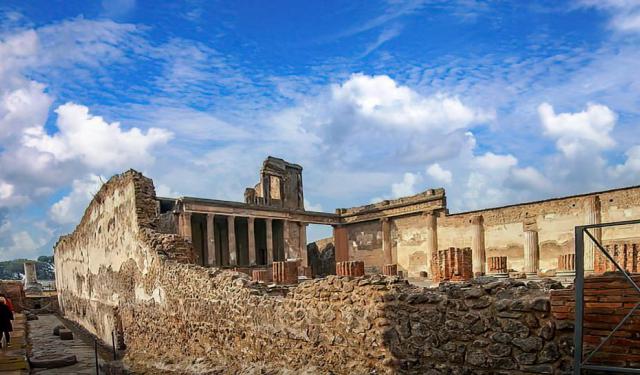
The House of Octavius Quartio, previously known as the House of Loreius Tiburtinus, is one of Pompeii’s most distinctive residences. It stands on the Street of Abundance, in an area that became one of the city’s prosperous centers in its final years. The older name comes from election slogans painted on the façade, although Loreius and Tiburtinus may have referred to two different politicians. The property is linked instead to Octavius Quartio, its last known owner.
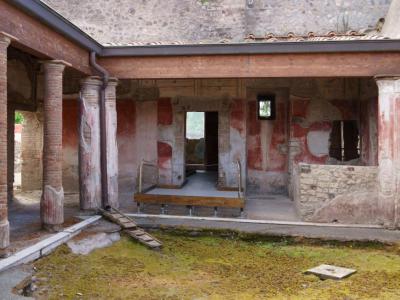
Occupying an entire city block, the house combined domestic luxury with commercial activity, with shops and food outlets arranged around its perimeter. Inside, it included familiar features of a grand Roman home, such as an atrium with an impluvium for collecting rainwater.
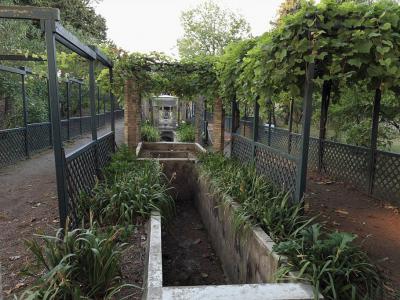
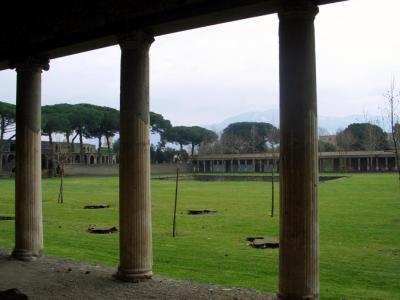
Its greatest attraction is the garden. Behind the summer triclinium, visitors can see the remains of two long decorative water channels, once surrounded by fruit trees, fountains, sculpture, and painted decoration. Two frescoes near the upper fountain show Narcissus, the beautiful youth from Greek mythology who fell in love with his own reflection, and Pyramus and Thisbe, the tragic Babylonian lovers whose story later influenced Shakespeare’s Romeo and Juliet. The frescoes are signed “Lucius pinxit,” meaning “painted by Lucius.”
Occupying an entire city block, the house combined domestic luxury with commercial activity, with shops and food outlets arranged around its perimeter. Inside, it included familiar features of a grand Roman home, such as an atrium with an impluvium for collecting rainwater.
Its greatest attraction is the garden. Behind the summer triclinium, visitors can see the remains of two long decorative water channels, once surrounded by fruit trees, fountains, sculpture, and painted decoration. Two frescoes near the upper fountain show Narcissus, the beautiful youth from Greek mythology who fell in love with his own reflection, and Pyramus and Thisbe, the tragic Babylonian lovers whose story later influenced Shakespeare’s Romeo and Juliet. The frescoes are signed “Lucius pinxit,” meaning “painted by Lucius.”
Want to visit this sight? Check out these Self-Guided Walking Tours in Pompei. Alternatively, you can download the mobile app "GPSmyCity: Walks in 1K+ Cities" from Apple App Store or Google Play Store. The app turns your mobile device to a personal tour guide and it works offline, so no data plan is needed when traveling abroad.
Download The GPSmyCity App



House of Octavius Quartio on Map
Sight Name: House of Octavius Quartio
Sight Location: Pompei, Italy (See walking tours in Pompei)
Sight Type: Attraction/Landmark
Guide(s) Containing This Sight:
Sight Location: Pompei, Italy (See walking tours in Pompei)
Sight Type: Attraction/Landmark
Guide(s) Containing This Sight:
Nearby Sights

Walking Tours in Pompei, Italy

Create Your Own Walk in Pompei
Creating your own self-guided walk in Pompei is easy and fun. Choose the city attractions that you want to see and a walk route map will be created just for you. You can even set your hotel as the start point of the walk.
Pompeii Introduction Walk II
Frozen at the moment it was buried under the thick blanket of ash and pumice, the city of Pompeii (now excavated) remains a unique window into the past, offering a snapshot of everyday life back in the 1st century AD Roman Empire. Aside from causing quick and unexpected death to the city, the huge eruption of Vesuvius in 79 AD did have one positive outcome - it preserved everything (properties,... view more
Tour Duration: 3 Hours
Travel Distance: 2.3 Km or 1.4 Miles
Tour Duration: 3 Hours
Travel Distance: 2.3 Km or 1.4 Miles

Pompeii Introduction Walk I
Modern-day Pompei is best known for its ancient predecessor, the Roman city of Pompeii, that fell victim to the massive eruption of Mount Vesuvius in 79 AD. The ruins of Pompeii, first uncovered in the late 18th century, were declared a World Heritage Site by UNESCO in 1997. Presently, this is one of the most popular tourist attractions in Italy, drawing annually up to 2.5 million visitors.
The... view more
Tour Duration: 2 Hours
Travel Distance: 2 Km or 1.2 Miles
The... view more
Tour Duration: 2 Hours
Travel Distance: 2 Km or 1.2 Miles
City Walks Overview
