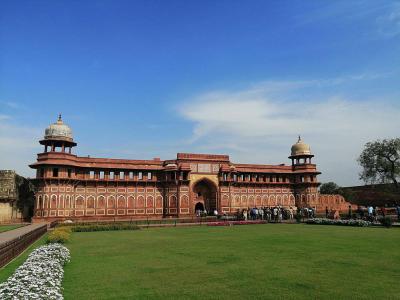


Jahangir Mahal, Agra
Jahangir Mahal is one of the finest surviving examples of Mughal domestic architecture from the reign of Emperor Akbar, built in the late 16th century as part of the royal palace complex. Despite its name, the structure was not built by Jahangir himself but was intended as a residence for his wives and royal women, particularly those of Rajput origin. The palace reflects Akbar’s appreciation for both functionality and cultural synthesis, combining Islamic design principles with elements of Hindu architectural traditions.
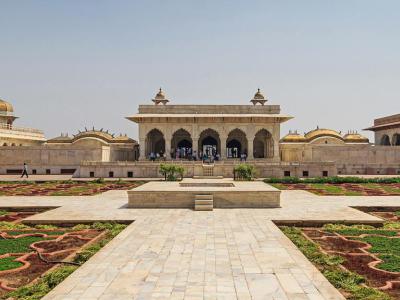
Constructed primarily from red sandstone, Jahangir Mahal features a symmetrical layout centered around an open courtyard. The building’s façades are adorned with intricate carvings, geometric latticework, and projecting balconies, typical of Mughal craftsmanship. The decorative motifs-such as lotus medallions, ornate brackets, and pierced stone screens (called jalis)-illustrate the blending of Persian and Indian influences that characterized Akbar’s architectural style. The structure’s multiple levels, interconnected staircases, and shaded corridors were designed to provide comfort and privacy for the royal household in India’s warm climate.
Inside the palace, visitors can explore large audience halls, smaller private chambers, and open terraces that overlook the fort complex. The rooms once contained rich textiles, painted ceilings, and elaborate furnishings that reflected the refinement of the Mughal court. Even in its present state, the proportions and layout offer a sense of the elegance and order that defined the empire’s domestic spaces. The palace’s central courtyard, with its stone platform and surrounding arcades, would have been a focal point for social and ceremonial gatherings.
Architecturally and historically, Jahangir Mahal represents a transitional moment in Mughal design-balancing Akbar’s robust, fortress-like style with the more decorative and refined aesthetics that would flourish under Jahangir and Shah Jahan.
Constructed primarily from red sandstone, Jahangir Mahal features a symmetrical layout centered around an open courtyard. The building’s façades are adorned with intricate carvings, geometric latticework, and projecting balconies, typical of Mughal craftsmanship. The decorative motifs-such as lotus medallions, ornate brackets, and pierced stone screens (called jalis)-illustrate the blending of Persian and Indian influences that characterized Akbar’s architectural style. The structure’s multiple levels, interconnected staircases, and shaded corridors were designed to provide comfort and privacy for the royal household in India’s warm climate.
Inside the palace, visitors can explore large audience halls, smaller private chambers, and open terraces that overlook the fort complex. The rooms once contained rich textiles, painted ceilings, and elaborate furnishings that reflected the refinement of the Mughal court. Even in its present state, the proportions and layout offer a sense of the elegance and order that defined the empire’s domestic spaces. The palace’s central courtyard, with its stone platform and surrounding arcades, would have been a focal point for social and ceremonial gatherings.
Architecturally and historically, Jahangir Mahal represents a transitional moment in Mughal design-balancing Akbar’s robust, fortress-like style with the more decorative and refined aesthetics that would flourish under Jahangir and Shah Jahan.
Want to visit this sight? Check out these Self-Guided Walking Tours in Agra. Alternatively, you can download the mobile app "GPSmyCity: Walks in 1K+ Cities" from Apple App Store or Google Play Store. The app turns your mobile device to a personal tour guide and it works offline, so no data plan is needed when traveling abroad.
Download The GPSmyCity App



Jahangir Mahal on Map
Sight Name: Jahangir Mahal
Sight Location: Agra, India (See walking tours in Agra)
Sight Type: Attraction/Landmark
Sight Location: Agra, India (See walking tours in Agra)
Sight Type: Attraction/Landmark
Nearby Sights
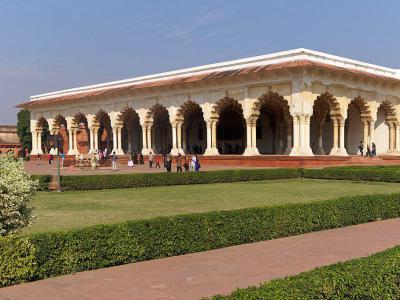

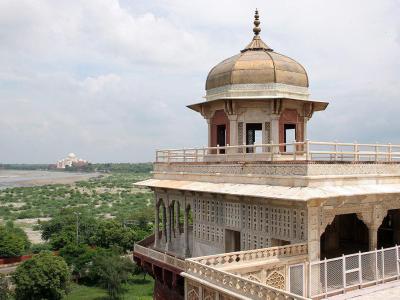
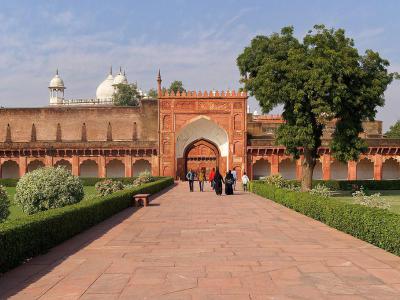
Walking Tours in Agra, India

Create Your Own Walk in Agra
Creating your own self-guided walk in Agra is easy and fun. Choose the city attractions that you want to see and a walk route map will be created just for you. You can even set your hotel as the start point of the walk.
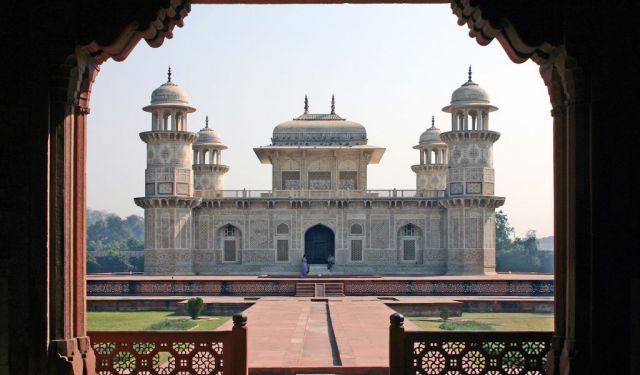
Agra's Top Attractions Walking Tour
Agra, the former capital of India under the powerful Mughal emperors, today is perhaps India's most popular tourist destination, in large part due to the magnificent Taj Mahal located here. Still, other than the iconic mausoleum, Agra is renowned for its colossal historic heritage manifested in numerous sites. To find out what else the city has to offer, take this orientation walk!
Tour Duration: 3 Hour(s)
Travel Distance: 6.2 Km or 3.9 Miles
Tour Duration: 3 Hour(s)
Travel Distance: 6.2 Km or 3.9 Miles
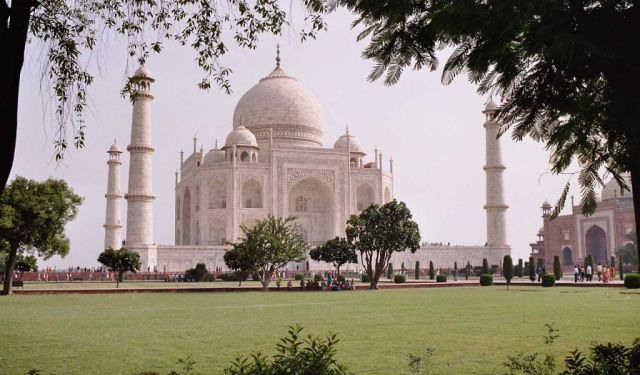
Taj Mahal Walking Tour
Agra is most known for containing one of the seven wonders of the modern world - the Taj Mahal. This finest example of Mughal architecture attracts thousands of tourists and visitors, who admire its magnificence and beauty. Take the following tour to see the marvelous attractions in the Taj area!
Tour Duration: 1 Hour(s)
Travel Distance: 0.7 Km or 0.4 Miles
Tour Duration: 1 Hour(s)
Travel Distance: 0.7 Km or 0.4 Miles