

Taj Mahal Walking Tour, Agra

Taj Mahal Walking Tour (Self Guided), Agra

Agra is most known for containing one of the seven wonders of the modern world - the Taj Mahal. This finest example of Mughal architecture attracts thousands of tourists and visitors, who admire its magnificence and beauty. Take the following tour to see the marvelous attractions in the Taj area!
How it works: Download the app "GPSmyCity: Walks in 1K+ Cities" from Apple App Store or Google Play Store to your mobile phone or tablet. The app turns your mobile device into a personal tour guide and its built-in GPS navigation functions guide you from one tour stop to next. The app works offline, so no data plan is needed when traveling abroad.

Download The GPSmyCity App

Taj Mahal Walking Tour Map

Guide Name: Taj Mahal Walking Tour
Guide Location: India » Agra (See other walking tours in Agra)
Guide Type: Self-guided Walking Tour (Sightseeing)
# of Attractions: 5
Tour Duration: 1 Hour(s)
Travel Distance: 0.7 Km or 0.4 Miles
Author: leticia
Sight(s) Featured in This Guide:
  • The Great Gate
  • Museum Taj Mahal
  • Taj Mahal Mosque
  • Taj Mahal
  • Jawab
1
The Great Gate

1) The Great Gate

The Great Gate, also known as the Darwaza-i Rauza, serves as the main entrance to the Taj Mahal complex. Built from red sandstone, the gate marks the beginning of the pathway leading visitors toward the mausoleum and its surrounding gardens. Its construction follows the principles of Mughal architecture, emphasizing symmetry and proportion, and it sets the tone for the design of the entire complex.

The gate features a large central arch flanked by smaller arches on either side. Its façade is decorated with calligraphy from the Quran, along with geometric and floral patterns carved into the stone. The inscriptions on the archways were carefully designed to appear uniform in size from the ground, demonstrating the attention to detail and planning in Mughal construction. The structure rises over several levels, with small domes and corner towers adding to its balanced appearance.

Visitors enter through the central arch, which opens onto the long waterway and pathway that lead to the main mausoleum. The view from the gate provides a clear perspective of the Taj Mahal and its reflecting pools, framing the monument in a way that emphasizes its symmetry. The gate itself is spacious, allowing groups of visitors to pass through while offering time to observe the carvings and architectural features up close.

The Great Gate also serves as a point of transition from the outside world into the serene environment of the Taj Mahal complex. Walking through it, visitors move from the busy exterior into the carefully planned gardens and open spaces, giving a sense of scale and context to the overall site.
2
Museum Taj Mahal

2) Museum Taj Mahal

The Museum Taj Mahal is located within the monument complex and occupies the Jal Mahal, a red sandstone building that dates back to the 1600s. The museum itself was first established in 1906 under the direction of Lord Curzon and later re-established in 1982. It houses a collection that focuses on the history, design, and construction of the Taj Mahal, giving visitors a closer look at the craftsmanship and planning behind the monument. The exhibits also highlight aspects of Mughal art and culture connected to the period of Emperor Shah Jahan.

Inside, visitors can see original drawings, plans, and early paintings showing how the monument was designed and built. Displayed alongside these are tools, coins, pottery, calligraphy samples, and decorative stone inlays that demonstrate the materials and artistic techniques used by Mughal craftsmen. Some artifacts relate to the workers and architects who contributed to the project, providing an understanding of how such an elaborate structure came together. Informational plaques throughout the museum help explain the historical background of each item in a clear and direct way.

The museum is compact and straightforward to explore, usually taking less than an hour to visit. The rooms are arranged in a simple layout, allowing for an easy flow between exhibits. The calm setting offers visitors a chance to slow down and take in the details of Mughal design and engineering. Because it is located inside the same complex as the Taj Mahal, it fits naturally into the overall experience of visiting the site.

A stop at the Museum Taj Mahal allows travelers to see more than just the marble structure itself. It helps connect the physical monument to the people, tools, and ideas that shaped its creation, showing how both art and careful planning contributed to one of the most admired works of Mughal architecture.
3
Taj Mahal Mosque

3) Taj Mahal Mosque (must see)

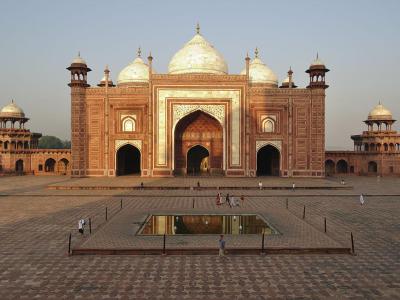
The Taj Mahal Mosque is part of the larger Taj Mahal complex and is located to the west of the main mausoleum. Built from red sandstone, it serves as a place of worship for visitors and follows traditional Islamic architectural principles.

The mosque was constructed at the same time as the Taj Mahal and is aligned with the main building to maintain symmetry across the site. It also faces the direction of Mecca, as required for Islamic prayer.

The mosque features a large central prayer hall with a series of smaller domes along the sides. The main entrance is marked by a high arched gateway, and the walls are decorated with geometric designs and calligraphy from the Quran. The red sandstone contrasts with the white marble of the Taj Mahal, creating a visual balance when viewed from the central gardens. The structure is raised on a platform, which allows visitors to see the entire façade clearly and adds to the sense of proportion and order across the complex.

Visitors can explore the mosque’s interior, where the space is divided into multiple sections for prayer. The floors are simple and open, allowing for group gatherings during services. The arches and domes help create good acoustics, amplifying the sound of recitations and chants. While the mosque remains an active place of worship, tourists are welcome to walk around respectfully, observing the architectural details and learning about its role within the Taj Mahal complex.

The mosque, along with its counterpart on the opposite side of the Taj Mahal, helps maintain the symmetrical layout of the site. Its design shows how Mughal architects combined functional religious spaces with aesthetic planning.
4
Taj Mahal

4) Taj Mahal (must see)

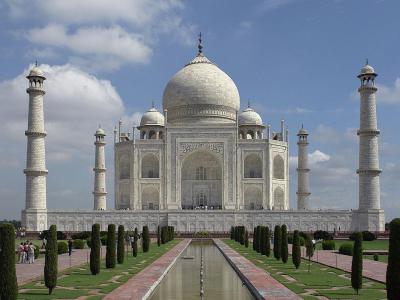
The Taj Mahal is a large marble mausoleum built during the 17th century by Emperor Shah Jahan in memory of his wife, Mumtaz Mahal. It was designed to serve as her final resting place and as a symbol of love and remembrance.

The structure is part of a larger complex that includes gardens, a mosque, and guest houses, arranged in a symmetrical layout. Visitors approach the main entrance through a wide pathway that leads to the central monument, providing clear views of its detailed architecture and reflecting pools along the way.

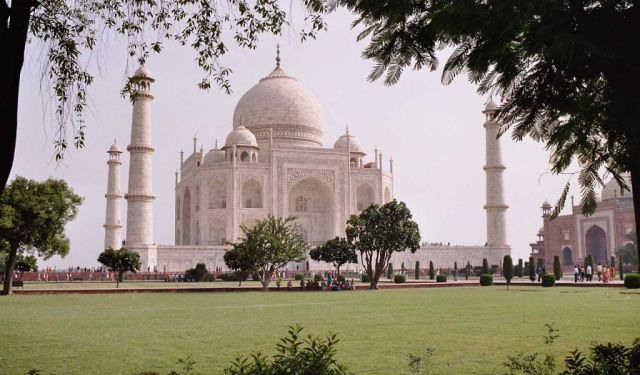
The main building is constructed entirely of white marble and features a large central dome flanked by four smaller domes. Minarets rise from each corner, creating a balanced and symmetrical appearance. The walls and entrances are decorated with intricate inlay work, carved patterns, and calligraphy drawn from Quranic verses. The central chamber houses the cenotaphs of Shah Jahan and Mumtaz Mahal, while the actual graves are located in a lower chamber.

The gardens surrounding the monument follow a traditional charbagh layout, divided into four sections by water channels and pathways. The long reflecting pool in the center provides a mirrored view of the building, allowing visitors to see its full symmetry. The combination of water, green spaces, and the marble monument creates a calm and open setting, encouraging visitors to walk slowly and observe the details of both the structure and its surroundings.

Visitors can spend several hours exploring the complex, moving from the entrance through the gardens to the main building and back. The site is active throughout the day, with people from around the world coming to see the architecture, learn about its history, and experience the careful planning and craftsmanship that went into its creation. The Taj Mahal remains one of the clearest examples of Mughal design and the blending of art, architecture, and cultural traditions.
5
Jawab

5) Jawab

Jawab is a red sandstone structure located within the Taj Mahal complex, positioned symmetrically opposite the mosque on the eastern side of the main mausoleum. Built during the reign of Emperor Shah Jahan in the mid-17th century, it was designed to maintain architectural balance across the complex’s riverside platform.

The word “jawab” translates to “answer” in Persian, referring to the building’s role as a visual counterpart, or “answer,” to the mosque on the western side. While the mosque was used for prayer, the Jawab served no religious purpose, ensuring symmetry without disrupting the sanctity of the complex’s design.

Constructed from the same red sandstone as the mosque, with contrasting white marble inlay, the Jawab mirrors its twin structure almost exactly in size, form, and detailing. It features three elegant domes, arched entrances, and slender minarets along its façade.

However, unlike the mosque, it does not contain a mihrab (a niche indicating the direction of Mecca), confirming its secular function. The building’s orientation toward the east further distinguishes it from a functioning place of worship, as Islamic prayers are performed facing west.

Inside, visitors can see the same refined Mughal decorative techniques found throughout the Taj Mahal complex—carved panels, geometric motifs, and delicate inlay work that harmonize with the mausoleum’s overall aesthetic. The Jawab’s symmetrical positioning also enhances the visual balance of the entire site, reinforcing the Mughal appreciation for proportion and spatial order.

Walking Tours in Agra, India

Create Your Own Walk in Agra

Create Your Own Walk in Agra

Creating your own self-guided walk in Agra is easy and fun. Choose the city attractions that you want to see and a walk route map will be created just for you. You can even set your hotel as the start point of the walk.
Agra Introduction Walking Tour

Agra Introduction Walking Tour

Agra, the former capital of India under the powerful Mughal emperors, today is perhaps India's most popular tourist destination, in large part due to the magnificent Taj Mahal located here. Still, other than the iconic mausoleum, Agra is renowned for its colossal historic heritage manifested in numerous sites. To find out what else the city has to offer, take this orientation walk!

Tour Duration: 3 Hour(s)
Travel Distance: 6.2 Km or 3.9 Miles